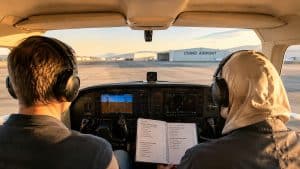
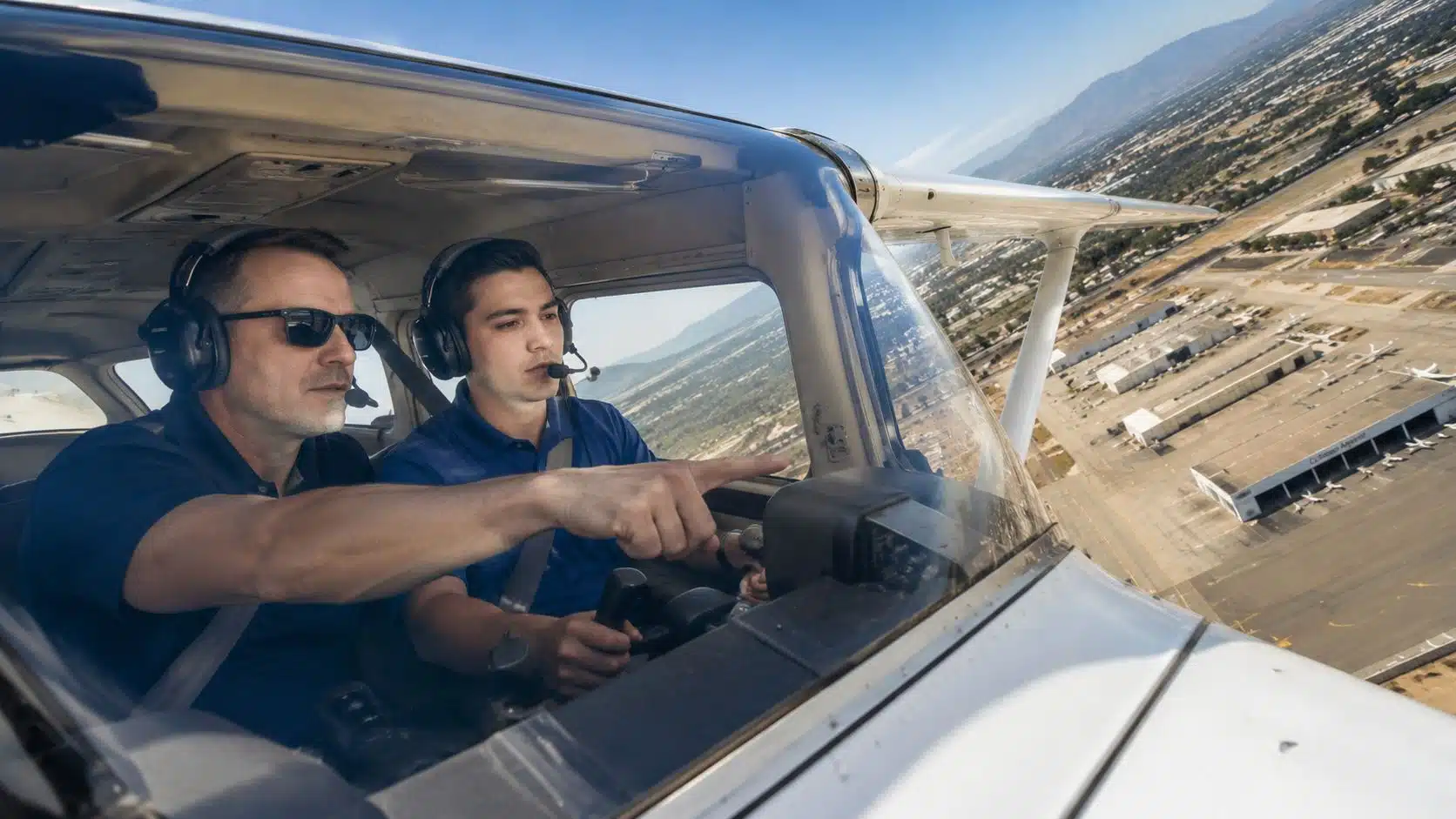
You can be flying a student who looks fine on downwind, calls the entry clean, and still gives you the same steep turn problem every time. The bank starts to build, the eyes drop inside, the nose wanders, and by the time the student tries to “fix” it, the altitude is already gone. That's the part most steep turns lesson plan writeups miss, the maneuver isn't failing because the numbers are hard to memorize, it's failing because the student hasn't learned what to look at first.
A good turn lesson at a busy towered airport has to respect that reality. At Chino, the airplane isn't the only thing competing for attention. Traffic, radio work, runway options, and the urge to chase the altimeter all push the student toward a bad scan. The instructor who solves that early gets more consistent turns, better energy management, and fewer ugly recoveries.
Table of Contents
- Why Steep Turns Trip Up Even Strong Students
- Learning Objectives and ACS Performance Standards
- Materials, Equipment, and the Pre-Flight Brief
- The In-Flight Lesson Flow from Entry to Debrief
- Teaching Outside References When Instinct Says Look Inside
- Common Errors, Safety Hazards, and the Abort Trigger
- Adapting the Lesson Across the DuBois Fleet
Why Steep Turns Trip Up Even Strong Students
Steep turns look like a simple maneuver that should reward tidy flying. In practice, they expose whether a student can keep the airplane on a visual reference while pressure, workload, and bank angle rise together. The common failure isn't a lack of memorization. It's a broken scan.
The real problem is where the eyes go
The strongest student in the pattern can still fall apart the moment the turn starts because the brain wants to hunt for a number. If the student stares at the attitude indicator, the rest of the sight picture disappears, and altitude loss usually follows. One instructional source on steep turns centers the maneuver on “eyes outside” and specifically notes that students lose altitude when they stare at the attitude indicator instead of trusting the horizon. The FAA's own maneuver guidance also emphasizes a visible reference point on the horizon and rollout timing based on visual cues, not needle chasing, which matches what works in the airplane.
That's why the maneuver feels different at a busy Class D airport like Chino. The student isn't just holding bank and pitch. They're also processing traffic, pattern geometry, and the sound of the radio while trying to keep the turn smooth.
Practical rule: If the student is asking the altimeter for permission to hold attitude, the scan is already late.
A checklist-only lesson plan creates inconsistent reps because the airplane doesn't care that the brief was neat. It cares where the student looks, when they look back outside, and whether they can keep the turn stable long enough to build a reliable sight picture. That's the instructional gap worth solving first.
Learning Objectives and ACS Performance Standards
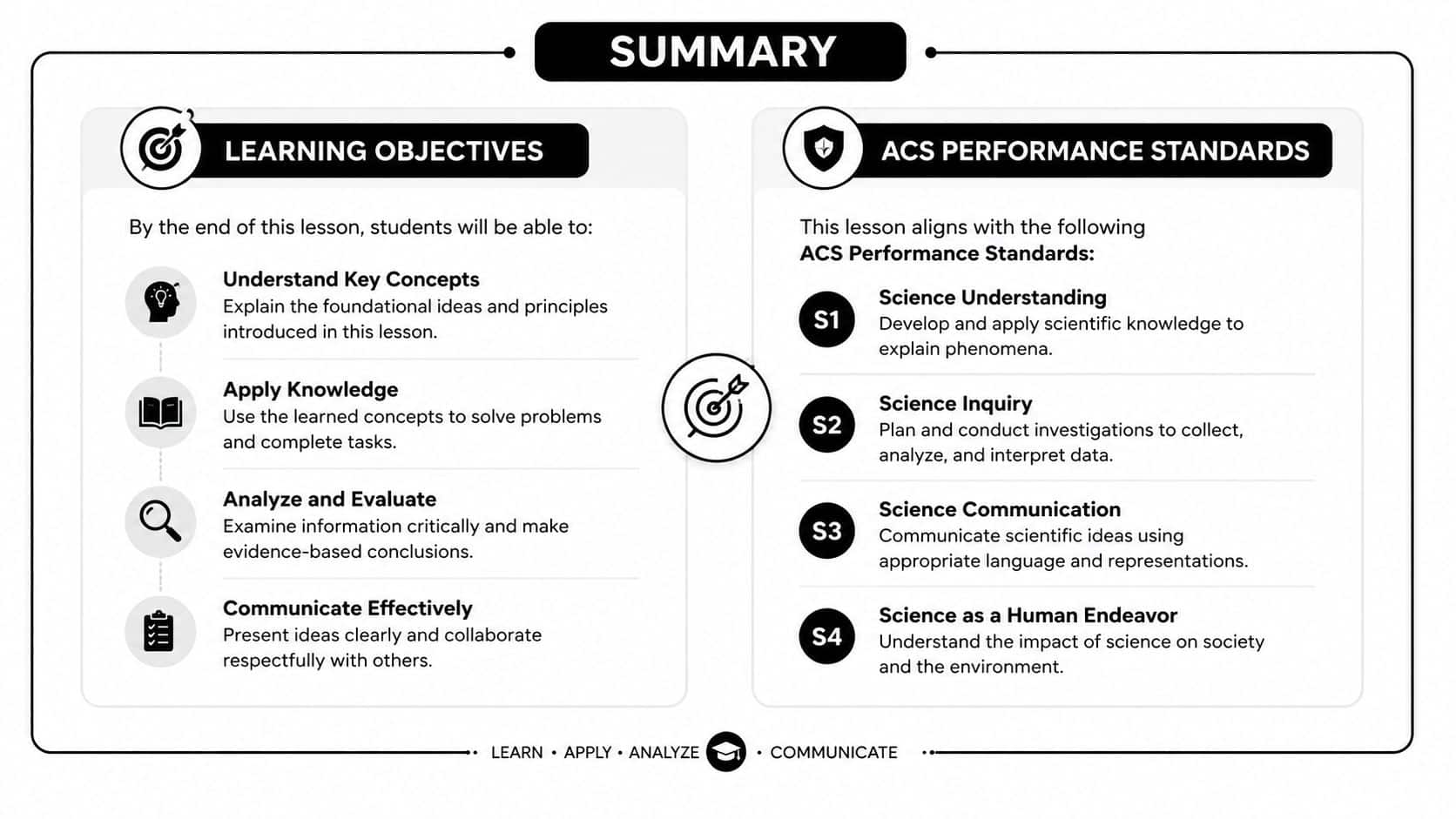
A useful brief board for a steep turns lesson plan should state exactly what the student is trying to do, not just what the student is trying to hit. The FAA baseline for private pilot steep turns is 45 degrees of bank, with a plus or minus 10-degree bank tolerance and 100 feet of altitude tolerance, while commercial and CFI applicants are generally held to 50 degrees of bank with a 50-foot altitude tolerance. FAA guidance also frames the maneuver as a coordinated turn that uses visual cues and a rollout lead based on about half the bank angle, which is why the student has to manage sight picture, not just control input. For a concise reference to the broader flight-training context, the angle-of-attack material at DuBois Aviation's angle of attack overview is a useful companion concept because the turn's load and energy picture only makes sense when the student understands what the wing is doing.
Write the objectives in verbs the student can own
A good board card gives the student something to evaluate after each rep. Write the words that describe performance, not theory.
- Clear the area and maintain situational awareness.
- Establish the correct entry speed before rolling.
- Lead the rollout with a visual reference point.
- Hold coordinated bank without chasing the panel.
- Correct bank trend early instead of rescuing altitude late.
- Recover to level flight without ballooning or diving.
The ACS also expects the applicant to show risk management, which means the instructor should look for division of attention, clearing the area, and energy management awareness throughout the maneuver. If those are weak, the turn isn't really “done” even if the bank angle looks acceptable.
The brief should make the student self-score
Use a short rubric before engine start so the student knows what a good rep feels like.
Student self-check: Did I keep the horizon primary, use the instruments as confirmation, and roll out where I planned?
That one question tells you more than a pile of disconnected numbers. It also gives you a clean debrief anchor after the flight, which is where the learning starts sticking.
Materials, Equipment, and the Pre-Flight Brief
A solid lesson starts on the ground with the right gear in front of the student. The point isn't to make the setup elaborate. It's to make the sequence repeatable so the student can carry the same mental model into the airplane every time.
Pack the lesson like a flight, not a classroom exercise
Bring the airplane, the syllabus page, and a working reference for the turn. A printed maneuver diagram helps the student visualize bank build, horizon placement, and rollout lead without flipping through pages in the cockpit. A kneeboard with a simple entry-timing cheat sheet keeps the student from inventing a new technique every lesson. A headset with a fresh battery sounds minor until a dead battery turns a calm lesson into a distraction drill.
If the student is brand new to steep turns, the simulator can be useful for the first exposure to entry timing and rollout rhythm. That works best before power changes and turbulence make the sensory load busier. Once the student knows the shape of the maneuver, real airplane reps do the rest.
The choice of aircraft matters too. A forgiving trainer is usually better for the first turn, while a more responsive airplane is useful later when you want the student to feel how quickly bank and energy move together. The lesson goes better when the airframe matches the student's stage of learning.
Run the ground brief in a simple order
Start with energy management, then move to where the student should look, then the reference point, then the common errors. That order keeps the student from obsessing over bank angle before understanding the sight picture. I've watched students get lost because they were briefed on inputs before they were briefed on perception.
Use the final minute for a verbal rehearsal of the entry call. The student should say, out loud, what they'll do when they clear, where they'll look, and how they'll know it's time to roll out.
Ground-brief standard: If the student can't describe the visual reference before startup, the first rep is too early.
That's the difference between a lesson plan and a maneuver demo. One builds repeatability, the other just burns avgas.
The In-Flight Lesson Flow from Entry to Debrief
The airplane should feel settled before the student starts the turn. I want a clearing turn, a stable entry speed, and a specific outside reference already chosen. At Chino, that often means picking a piece of horizon that won't disappear behind training traffic or airport clutter, then making the student say it back before rolling in.
Start with the call, not the bank
A clean sequence sounds like this in the cockpit, “Clearing left, clear right, set up, reference picked, rolling.” That call matters because it slows the student down enough to fly the setup instead of rushing into the turn. Once the bank starts, the instructor watches the student's eyes before watching the yoke.
As the turn builds, the right correction is usually small and early. If the student is over-banking, I'll often prompt first with the voice, then with a light touch if the correction never comes. If the student is under-banking and overthinking, the right move is usually to refocus them on the sight picture instead of feeding a dozen instrument updates.
The rollout should be taught as a look-through-the-turn task. The student should already be thinking about the target before the airplane reaches the lead point. That keeps the nose from drifting and keeps the student from yanking the turn flat at the last second.
Finish immediately after landing
The debrief should happen while the turn is still fresh. Ask three questions only. Did the student keep the horizon primary, did they start the rollout on time, and did they correct the right trend first. That keeps the feedback tied to behavior instead of memory.
If the student can tell you where the sight picture fell apart, you've got something to fix on the next flight. If they can't, they probably spent too much of the maneuver inside the panel.
Teaching Outside References When Instinct Says Look Inside
The hardest part of steep turn training is getting a student to trust what the airplane is showing outside. A lot of students know they should look outside, but the second the bank gets steep and the panel starts to feel busy, they snap their eyes inside and lose the visual anchor that would've kept the turn stable.
Build one horizon reference and protect it
Pick a specific point on the Chino horizon and use it every time. The student should know exactly where that point is before the turn begins, because a vague idea of “look outside” is too loose under workload. That reference becomes the anchor for bank, nose attitude, and rollout timing.
The useful verbal cue is simple. Ask, “What do you see?” during the turn. If the student answers with only a number from the panel, the scan is wrong. If they can describe the relationship between the nose, wing, and horizon, they're flying the maneuver.
A deliberate scan pattern works better than constant instrument staring. Use outside reference first, then a quick check of airspeed and altitude, then back outside. That keeps the panel in the loop without letting it dominate the turn.
For a related visual training concept, the ground-reference material at DuBois Aviation's ground reference overview reinforces the same habit. The eye has to learn where to go before the hand can correct smoothly.
Use short drills before the airplane gets busy
A closed-eye brief can help the student rehearse the sight picture before takeoff. Have them close their eyes, then describe what they expect to see when the bank reaches the target. That sounds simple, but it exposes whether they're building a visual model or just repeating a bank number.
If a student says they don't trust the horizon yet, don't argue with the feeling. Point out that the horizon is the primary reference in the maneuver, then prove it with a calm, repeatable rep. Confidence comes from the airplane matching the sight picture, not from a lecture.
Instructor cue: Trust the outside picture first, then use the instruments to confirm the trend.
That's the perceptual skill, and it's the part most lesson plans underweight.
Common Errors, Safety Hazards, and the Abort Trigger
The biggest steep turn problems usually show up in the same sequence. Students start by fixing the altimeter instead of flying the picture, then they overbank, roll out late, enter uncoordinated, or stop clearing for traffic once the cockpit gets busy. Each error is manageable when it shows up early. Wait too long, and the correction gets sloppy.
Rank the errors by what they do to the airplane
- Altitude loss from panel fixation: The student stops reading the outside picture and starts chasing the number on the panel. Fix it by moving the eyes back outside, then using the altimeter only to confirm the trend.
- Overbanking past the target: The airplane keeps rolling because the student has not matched the outside cue to the control input. Fix it by teaching a clear stop point and correcting the roll trend before it gets away.
- Late rollout: The student waits too long to lead the turn and ends up flattening the maneuver with a correction. Fix it by using the horizon reference and saying the rollout lead out loud before the turn starts.
- Uncoordinated entry: Rudder lag and sloppy aileron use make the airplane feel unstable right away. Fix it with coordinated setup and awareness of adverse yaw effects, plus a pause if the student tries to force the roll.
- Inadequate clearing: Traffic awareness falls apart because the student is already task-saturated. Fix it by treating the clearing turn as part of the maneuver, not a preamble.
The abort trigger needs to be briefed before the first rep. If traffic becomes a conflict, if the student freezes, if the turn passes 60 degrees of bank without recognition, or if situational awareness disappears, stop the maneuver and return the airplane to coordinated level flight. This is a judgment call, not a salvage attempt.
Towered-airport practice needs a tighter plan
A Class D field changes the rhythm. At Chino, the instructor has to decide where the maneuver fits in the pattern, how the radio call is sequenced, and whether the rep belongs in the traffic pattern or out over the practice area. When traffic is heavy, the practice area is usually the better choice because it lowers the chance of becoming a surprise on frequency.
Noise-sensitive corridor awareness matters too, especially when the airplane is near the Chino Hills side of the pattern. The student should understand that a badly timed turn affects more than the ACS. It affects everyone sharing the airspace.
If the rep is going to lead into a touch-and-go, say that before takeoff. The student needs to know whether the steep turn ends in a continuation, a reset, or a full pattern rejoin. Uncertainty adds distraction at exactly the wrong moment.
Adapting the Lesson Across the DuBois Fleet
Different airplanes teach the same lesson in different ways. A Cessna 150, a Cherokee, a Mooney M20B, and a Piper Apache all reveal the student's habits, but they don't reveal them with the same timing or control feel. That matters because a steep turn lesson should match the student's experience level to the airplane's response, not just the schedule.
Pick the airframe that matches the lesson goal
| Aircraft | Control Feel | Power Response | Teaching Emphasis |
|---|---|---|---|
| Cessna 150 | Light, honest, and easy to overcontrol | Modest response, so students feel the need to manage energy early | Best for first exposure, especially to sight picture and bank trend |
| Piper Cherokee | Stable and forgiving, with a familiar training feel | Predictable response that gives the student time to correct | Good for repeat reps and building rollout timing |
| Mooney M20B | Crisp and more demanding on precision | More responsive, so small mistakes show up fast | Best for polishing technique and discipline |
| Piper Apache | Multi-engine workload adds planning and coordination pressure | Power changes are more noticeable in the lesson flow | Useful when the student is ready to manage more cockpit tasks without losing the turn |
The helicopter fleet changes the lesson conceptually, even though the maneuver itself isn't the same. A Robinson or Enstrom teaches the student to think about bank, energy, and outside reference in a different control environment, which can sharpen judgment when they return to airplane work. The key is not to copy the airplane technique into the helicopter. It's to let the student recognize how fast attention can drift when control demands increase.
Grade the rep, then write the next one
The simplest grading rubric is a three-part check. Did the student clear properly, did they hold the sight picture, and did they roll out on time. If any one of those broke down, the next lesson should target that weakness first.
A good logbook note for a dual lesson is straightforward, for example, “Steep turns, improved outside reference, better bank control, continue rollout timing work.” For solo where appropriate and authorized, the note should be even simpler, “Steep turns, coordinated entry, maintained visual reference, practice required on rollout lead.” The goal is to make the next flight easier to plan.
A strong follow-up sequence usually looks like a polishing lesson in a different airframe, then integration into the commercial syllabus, then an upset prevention session that ties steep turns to broader energy management judgment. That way the student stops treating the maneuver as a checkride event and starts treating it as a control exercise that shows up in real flying.
Working standard: If the lesson plan doesn't change when a common error shows up, the plan isn't really alive.
That's how the best steep turn teaching gets better over time. It reacts to the student in front of you, not the syllabus behind you.
DuBois Aviation teaches steep turns the way they break down in the cockpit, with attention to sight picture, scan, and the classroom-to-airplane bridge that most students need. If you want that kind of targeted instruction at Chino Airport, visit DuBois Aviation and book time with an instructor who will turn the maneuver into something repeatable, not just something you pass once.