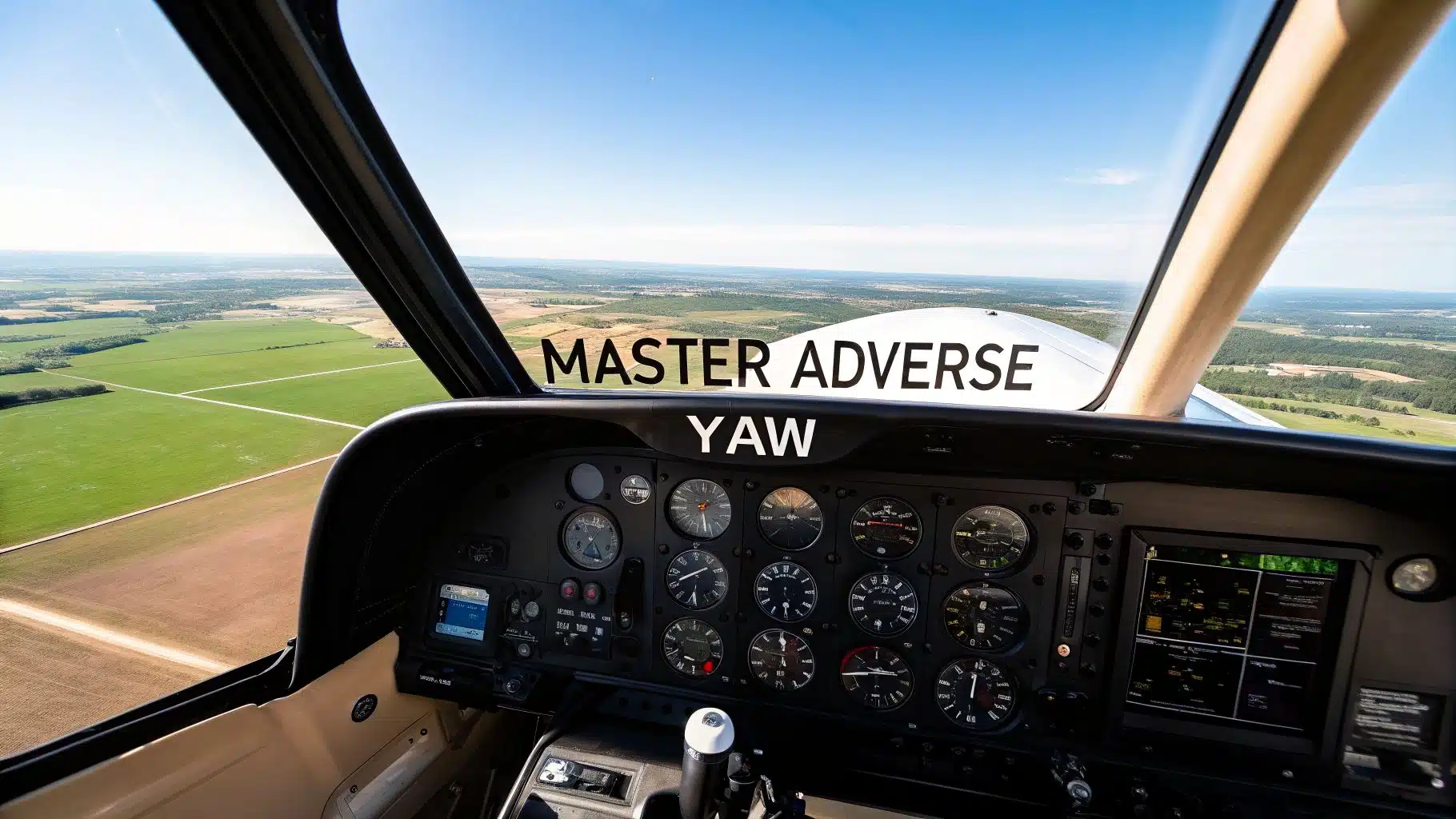
Adverse yaw is one of the first "aha!" moments for a student pilot. It's the aircraft's tendency to swing its nose, or yaw, in the opposite direction of a turn. This happens because the wing that lifts to start the roll also creates more drag, pulling the nose away from where you want to go.
Learning to master it is a rite of passage, separating a passenger who can move the controls from a pilot who truly understands the machine.
What Is Adverse Yaw in Simple Terms
Flying an airplane is a constant conversation about balance. When you bank the wings to initiate a turn, a simple input on the yoke or stick creates a fascinating chain reaction. This effect, known as adverse yaw, is something every pilot learns to anticipate and correct from their very first flight.
Think about turning a long canoe. If you want to turn left, you might just dig your paddle into the water on the right side. But what happens for a split second? The drag from that paddle first pulls the nose of the canoe to the right before the boat finally starts arcing left. An airplane's wings and ailerons act in a very similar way.
The Drag Imbalance at the Heart of the Problem
The whole issue boils down to a fundamental trade-off between lift and drag. To roll your airplane into a turn, you deflect the ailerons.
- To lift the left wing for a left turn, the aileron on that wing goes down, increasing its curvature and generating more lift.
- Simultaneously, the aileron on the right wing goes up, reducing its lift and causing it to drop.
But here’s the catch: creating more lift always comes with a penalty called induced drag. The rising, outside wing is now working much harder, and as a result, it creates significantly more drag than the descending, inside wing. This drag imbalance acts like a tiny brake on that outer wingtip, pulling the aircraft's nose away from your intended direction.
That's why your initial aileron input to turn left makes the nose momentarily swing to the right. This uncommanded, "adverse" movement is the yaw we're talking about. It makes the turn feel sloppy, uncoordinated, and inefficient.
Before we dive deeper, here's a quick cheat sheet that breaks down the sequence of events.
Adverse Yaw At a Glance
This table simplifies the aerodynamic chain reaction that occurs the moment you initiate a bank with ailerons alone.
| Pilot Action | Aerodynamic Effect | Result (Adverse Yaw) |
|---|---|---|
| Rolls into a left turn (moves yoke/stick left). | The left aileron goes up, decreasing lift on the left wing. | The left wing drops. |
| The right aileron goes down, increasing lift on the right wing. | The right wing rises. | |
| The rising right wing creates much more induced drag. | This drag pulls the nose to the right, opposite the turn. |
Understanding this cause-and-effect relationship is the first step toward correcting for it instinctively.
Why It Matters to Every Pilot
So, why do we make such a big deal about it? Flying in an uncoordinated manner, with the tail lagging behind, is simply inefficient. The aircraft is slipping or skidding through the air, burning more fuel and creating unnecessary drag.
More importantly, it can become a safety issue, especially at low airspeeds. An uncoordinated turn near the ground, like on final approach, is a classic setup for a potential stall or spin.
This is why instructors here at DuBois Aviation hammer home "stick and rudder" skills from day one. Learning to anticipate adverse yaw with a coordinated press of the rudder pedal isn't just about looking good—it's foundational airmanship. It's what makes you a pilot who is truly one with the aircraft.
The Aerodynamics Behind the Yaw
To really get a handle on adverse yaw, we have to look past what’s happening in the cockpit and understand the why behind it. It all comes down to basic physics and those ailerons on the trailing edge of your wings.
When you roll into a turn, you’re doing more than just tilting the airplane. As you move the yoke, you deflect the ailerons to change the shape of each wing. The aileron on the outside wing—the one you want to lift—goes down. This increases the wing’s curvature, or camber, forcing air to move faster over its top surface. That extra speed creates more lift, and up the wing goes.
Meanwhile, the aileron on the inside, descending wing moves up. This flattens the wing's profile, reducing its lift. This difference in lift is what makes the airplane roll, but it also creates an unwanted, lopsided side effect.
The Unavoidable Penalty of Lift
The real culprit here is induced drag. Think of it as an aerodynamic tax you have to pay for creating lift. The more lift a wing produces, the more induced drag it creates.
So, when you roll into a turn, that rising outer wing is working much harder and generating a lot more lift. As a result, it’s also creating significantly more drag than the descending inner wing. This imbalance acts like a brake on the outer wing, pulling the aircraft's nose away from the direction you want to turn. That, right there, is adverse yaw in a nutshell.
This isn't some new discovery; it's a challenge pilots have been dealing with since day one. During their early glider tests, the Wright brothers noticed that rolling into a turn caused the nose to swing in the opposite direction by as much as 20-30 degrees if they didn't use the rudder to correct it. It’s a foundational concept you can read about in their detailed flight logs, showing just how fundamental "stick and rudder" skills have always been.
This flowchart breaks down that basic cause-and-effect relationship.

As you can see, a simple bank starts a chain reaction. The rising wing creates more lift, which in turn creates more drag, pulling the nose the wrong way.
Designing a Better Roll
For over a century, aircraft designers have come up with clever ways to minimize adverse yaw. While you can't get rid of that drag imbalance completely, you can reduce it to make the pilot's job easier. Here are two of the most common solutions you'll find on everything from a Cessna 172 to a Boeing 787.
Differential Ailerons: This design is a direct fix for the drag imbalance. The linkage is set up so the aileron moving up deflects a greater distance than the aileron moving down. This creates more drag on the descending wing, helping to counteract the high induced drag on the rising wing and keeping the forces more balanced.
Frise-Type Ailerons: This is another smart, simple solution. The aileron is built with an offset hinge. When you command a roll, the leading edge of the upward-moving aileron protrudes down into the airflow. This creates a healthy dose of parasite drag on the descending wing, which helps pull the nose back into the turn where it belongs.
These design features make a big difference, but they don't eliminate adverse yaw. That's why mastering "stick and rudder" skills is more than just a training exercise—it's essential to becoming a truly proficient and safe pilot. No matter how sophisticated the airplane, the pilot is always the final ingredient for achieving perfectly coordinated flight.
How to Detect Adverse Yaw in the Cockpit
Knowing the theory behind adverse yaw is one thing, but actually feeling and seeing it from the pilot's seat is where the real learning happens. Spotting this unwanted yaw is the first step to correcting it, and your aircraft gives you plenty of clues through the instruments, the view out the window, and even the feeling in your seat.
At DuBois Aviation, we want to help you move beyond just manipulating the controls and become a pilot who is truly connected to the airplane. The goal is to recognize uncoordinated flight the moment it happens and fix it almost instinctively.
Using Your Instruments: The Ball Is Your Best Friend
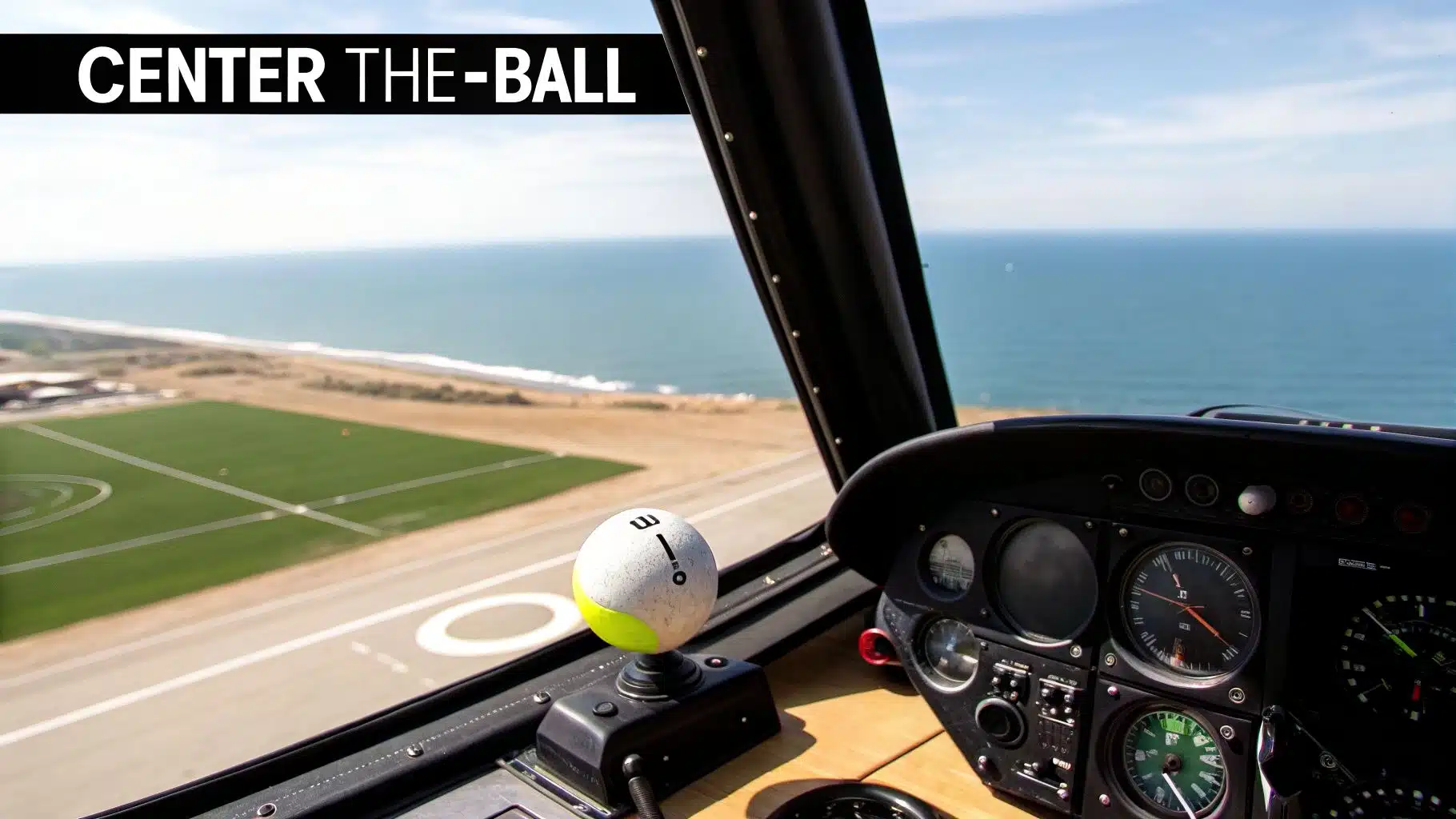
The most straightforward tool for spotting uncoordinated flight is the inclinometer. That's the little glass tube with a black ball floating in fluid, usually found at the bottom of the turn coordinator. In a coordinated turn, all the forces are balanced, and that ball stays right in the middle of its "cage."
But when adverse yaw enters the picture, it throws that balance off. This is where the old pilot's saying, "step on the ball," comes from. The ball's position is a dead giveaway, telling you exactly which way the tail is sliding and which rudder pedal you need to press.
Here’s how to read it:
- The Slip: You roll into a left turn but don't use enough left rudder. Adverse yaw tugs the nose to the right, and the ball will slide to the left—to the inside of the turn. The plane is literally slipping down toward the low wing. To fix it, you "step on the ball" by applying left rudder pressure until it centers up.
- The Skid: You apply too much rudder for your bank angle. In a left turn with too much left rudder, the ball will slide to the right—to the outside of the turn. This is a skid, which is more dangerous because the tail is swinging wide, a bit like a car losing its back end on a slippery corner. To correct it, you simply ease off the rudder pressure.
Think of the ball as a simple, honest friend who will always tell you if your turn is clean or sloppy.
Developing Your "Seat of the Pants" Feel
Long before modern instruments, pilots flew by the seat of their pants—and you still can. This physical feedback is one of the most intuitive ways to sense what the airplane is doing. In a perfectly coordinated turn, the force you feel pushes you straight down into your seat, just like sitting in a chair.
If you roll into a turn and feel a slight sideways push, that’s your body telling you the turn is uncoordinated.
In a slipping turn, you'll feel yourself being pushed toward the low wing (the inside of the turn). In a skidding turn, you'll feel pushed toward the high wing (the outside of the turn). Your body is acting like a human inclinometer.
With a little practice, you'll start to notice this sideways pressure even before you glance down at the ball. This is the beginning of true pilot instinct—feeling what the airplane needs and correcting it proactively. It's a fundamental skill that pays dividends, especially when your focus needs to be outside the cockpit.
Visual Cues: Looking Outside
Your best instruments are always your own two eyes looking out the windscreen. You can easily see adverse yaw just by watching how the nose of the aircraft behaves relative to the horizon.
Next time you initiate a bank, watch the nose carefully. If you roll left, the nose should start tracking smoothly to the left along the horizon. If you see the nose swing slightly to the right for a moment before it finally starts turning left, you've just witnessed adverse yaw in action. It's that initial, lazy wag of the tail in the wrong direction.
A fantastic—if old-school—way to visualize this is with a yaw string. It might not be standard equipment, but taping a piece of yarn to the center of the windscreen is a classic training trick.
- Coordinated Flight: The string flows straight back.
- Slip: The string is blown to the inside of the turn (the direction of the ball).
- Skid: The string is blown to the outside of the turn.
The yaw string gives you immediate, undeniable feedback on the airflow over the nose, making it an incredible tool for mastering the rudder and achieving perfectly coordinated flight.
Mastering Coordinated Rudder Control
Knowing what adverse yaw is is one thing; taming it is the art of flying. Correcting for it isn't just about stomping on a rudder pedal. It’s about developing a feel for the aircraft, applying just the right pressure at just the right time. This is the heart of "stick and rudder" flying, and it’s what separates a passenger from a pilot.
The fundamental idea is beautifully simple: apply rudder in the same direction as your turn. Rolling into a left bank? Add a little left rudder. Rolling right? A little right rudder. Your goal is to keep that little ball in the inclinometer perfectly centered, as if it’s glued to the middle of its glass tube.
Think of it as guiding the tail to follow the nose precisely through the turn. Without that rudder input, the tail wants to swing wide, fighting the turn. With coordinated control, the entire aircraft banks and yaws as one smooth, efficient unit.
The Three-Part Dance of a Coordinated Turn
A perfect turn isn't a single, abrupt action. It's a fluid, three-part maneuver, and your feet need to be just as active as your hands.
Rolling In: This is where adverse yaw is born. As you move the ailerons to initiate the bank, you must simultaneously apply rudder in the same direction. How much? It depends. A slow, steep turn will need a lot more rudder than a fast, shallow one. This initial input is proactive, not reactive.
Staying in the Turn: Once you've hit your desired bank angle, you'll usually relax the aileron pressure to hold it. Since you're no longer deflecting the ailerons, the drag they created is gone. That means you’ll also need to ease up on the rudder pressure to stay coordinated. In many planes, you might only need a touch of rudder, or none at all, to keep the ball centered.
Rolling Out: Time to level the wings. You’ll apply opposite aileron, which—you guessed it—creates adverse yaw in the other direction. To counteract this, you need to apply rudder in the direction you are rolling. So, as you roll out of a left turn, you’ll be pushing the right rudder pedal to keep the nose from swinging left.
Mastering this delicate dance transforms your flying. Jerky, skidding maneuvers become graceful, precise arcs across the sky. It feels better, it's more efficient, and most importantly, it's safer.
Why Speed and Bank Angle Change Everything
The amount of rudder you need is never the same. It’s a dynamic variable that depends heavily on your airspeed and bank angle. Nailing this relationship is what makes a great pilot, especially when the margins are thin.
Adverse yaw is most aggressive at low airspeeds and high angles of attack. This is because induced drag—the primary culprit—is at its peak. In fact, at slow speeds, adverse yaw can create a yawing force up to 4 times stronger than at cruise.
Here's a practical example: In a typical trainer at 60-70 knots on approach, you might need 25% more aileron to start a 30-degree bank than you would at 120 knots. This greater aileron deflection amplifies the adverse yaw by a staggering 200-300%.
Key Takeaway: The slower you fly, the bigger the yaw. This makes rudder coordination an absolutely essential skill for slow flight, steep turns, and approaches. It's not optional; it's fundamental.
When you're flying slow on final approach, your wings are working hard, generating a ton of lift and, consequently, a ton of induced drag. Any aileron input at this stage creates a powerful yawing moment that demands a firm rudder response. Ignoring it doesn't just look sloppy—it can lead to an uncoordinated stall, a dangerous situation every pilot trains to avoid. For pilots pursuing advanced certificates, this level of precision is non-negotiable. It's a foundational element in everything you do, which is why we emphasize it for those learning how to get an instrument rating.
Practical Training Exercises for Pilots
Knowing the theory is one thing, but taming adverse yaw happens in the cockpit. At DuBois Aviation, we move beyond the textbook and into the air with specific maneuvers that build the crucial connection between your hands on the yoke and your feet on the rudder pedals.
The real goal here is to make coordinated flight second nature. We want you to develop a feel for the airplane so you can anticipate and correct for yaw before it even starts, not just react after the fact.
Feeling the Yaw in Slow Flight
If you want to feel adverse yaw in a big way, slow flight is the place to do it. When you're flying at a high angle of attack, induced drag is through the roof, which makes adverse yaw much more pronounced. This is the perfect environment to learn what uncoordinated flight feels like and why precise rudder control is so important.
Next time you're practicing slow flight in a Cessna or Piper, try making some gentle turns with a 15-20 degree bank.
- Notice the lag. As you roll into the turn, you'll feel the outside wing wanting to drag or pull backward. That’s a powerful demonstration of adverse yaw.
- Step on the rudder with the aileron. You need to apply rudder at the same time you move the ailerons to keep the nose tracking cleanly through the turn. If you're late, you'll get a sloppy, slipping turn.
- Keep the ball centered. Your inclinometer will be extra sensitive at these speeds. Your mission is to keep that little ball dead center as you enter, fly, and roll out of the turn.
This drill is fantastic because it sharpens your senses for what uncoordinated flight feels like when it matters most, like on final approach.
Putting It All Together with S-Turns
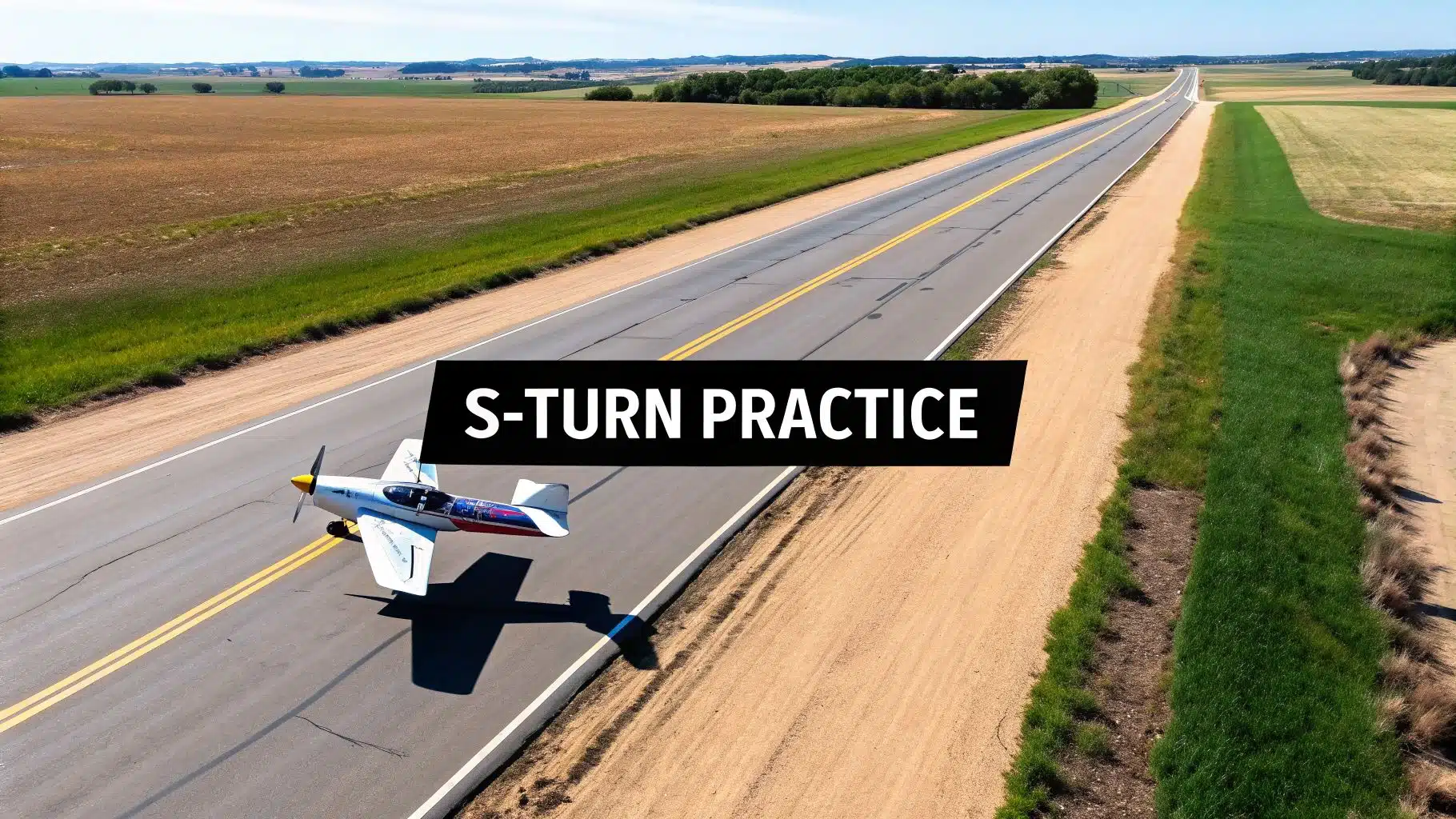
The classic S-turn across a road is one of the best exercises for practicing coordination. You’re not just making turns; you’re managing wind, maintaining a constant radius, and constantly reversing your bank—all while keeping your eyes outside.
As you cross the road and roll from one turn into the next, you have to fluidly switch your rudder input to counteract the adverse yaw in the new direction. This is where you really build your timing and feel for how much pressure is needed. You'll learn to apply smooth, measured inputs instead of just stomping on the pedals.
One of the most common student errors during S-turns is instrument fixation. You can’t learn coordination by staring at the little ball. The goal is to feel the aircraft and use the road as your primary reference, glancing at the inclinometer only to confirm what your body is already telling you.
Common Student Mistakes and How to Fix Them
Developing good rudder habits means catching and correcting common mistakes before they become ingrained. Here are a few things we see all the time during adverse yaw training.
| Common Mistake | What It Feels Like | The Fix |
|---|---|---|
| Over-Ruddering | The tail feels like it's skidding wide, and you'll feel pushed toward the outside of the turn. It's an uncomfortable, unbalanced feeling. | Ease off the rudder pressure. You're looking for balance, not force. Think "squeeze," not "stomp." Make small adjustments until the ball is centered. |
| Poor Timing (Rudder Lag) | The nose swings to the outside of the turn before it starts tracking properly. You're playing catch-up with the yaw instead of preventing it. | Think of your ailerons and rudder as a team that has to move at the exact same time. Practice initiating the rudder pressure at the very instant you start to roll. |
| "Dead Feet" | Forgetting to use the rudder pedals at all, especially in shallow turns at cruise speed where adverse yaw is less obvious. | Make it a conscious habit to use your feet for every single turn. This builds the muscle memory you need for it to become automatic in all situations. |
Mastering these skills is a huge part of your flight training, and it's something every pilot needs to stay sharp on. It’s a key topic we review during proficiency checks, which is why it's so important to keep practicing long after you get your license. You can review the requirements for a biennial flight review with DuBois Aviation to see how we help pilots maintain this critical skill.
How to Buy an Airplane the Safe Way
After you’ve put in the work and mastered fundamental skills like coordinated flight, the thought of owning your own airplane starts to feel less like a dream and more like the next logical step. But let’s be honest—buying an aircraft is a big deal, and a single misstep can be incredibly expensive. This guide is here to walk you through the process safely, helping you turn that dream into a reality without the buyer's remorse.
Making the jump from renting a club aircraft to having your own set of keys is a major transition. To get the most out of your training and sharpen your decision-making, it's worth exploring different metacognitive learning strategies. Being a smarter, more self-aware learner doesn't just make you a better pilot; it makes you a much sharper buyer.
Your Best Defense: The Pre-Purchase Inspection
If you only remember one thing from this entire guide, make it this: never buy an airplane without a thorough pre-purchase inspection. We're not talking about a quick walkaround. This is a deep, invasive examination of the airframe, engine, systems, and every page of the logbooks.
This inspection absolutely must be done by an independent, trusted Airframe and Powerplant (A&P) mechanic. Ideally, you’ll find someone who has deep experience with the specific make and model you're looking at. Never, ever use the seller's mechanic. You need a neutral expert who is working for you and has your best interests at heart.
Think of the pre-purchase inspection as your single best defense against buying a "lemon." The cost of a proper inspection is just a tiny fraction of what you could spend fixing hidden corrosion, chasing down internal engine problems, or repairing undocumented damage a seller might not even know exists.
Scrutinize the Logbooks
An airplane's logbooks are its official biography. They tell you everything that's ever happened to it, from routine oil changes to major structural repairs. Learning to read between the lines in these documents is one of the most important skills a prospective owner can develop.
Here's what you're looking for as you play detective:
- Damage History: Be on the lookout for any entries that detail repairs from things like gear-up landings, prop strikes, or hail damage. A damage history isn't automatically a deal-breaker if the work was done correctly by a reputable shop, but it demands a much closer look.
- Consistent Maintenance: Are the annuals, oil changes, and other scheduled tasks done on time, every time? Big gaps in the maintenance records are a massive red flag and suggest a history of neglect.
- Airworthiness Directive (AD) Compliance: ADs are mandatory fixes and inspections issued by the FAA to address known safety problems. You have to verify that every single applicable AD has been complied with and documented. A missing AD can ground your new-to-you aircraft until you pay to get it done.
Finalizing Your Purchase
Okay, the inspection is complete and the logbooks check out. You're on the home stretch! But don't rush through the final paperwork. A few key administrative steps are all that stand between you and a smooth, protected transfer of ownership.
Conduct a Title Search: Just like with a house, you need to make sure the seller actually has the legal right to sell the aircraft and that there are no hidden liens against it. An aviation title company can search the FAA registry to ensure the title is clean.
Secure Insurance: You must have an insurance policy active before you officially take possession. Start shopping for quotes early in the buying process, because rates and pilot requirements can vary dramatically between underwriters.
Draft a Purchase Agreement: A simple, clear purchase agreement protects both you and the seller. It should spell out the price, the conditions of the sale, and exactly who is responsible for what. Putting it in writing leaves no room for confusion later.
Buying your own airplane is a huge milestone. By following these steps, you can ensure the experience is filled with joy, not unexpected headaches and bills. For those ready to see what’s out there, you can learn more about the process and view available aircraft in our guide to aircraft sales and acquisitions.
Common Questions We Hear About Adverse Yaw
Even with a solid grasp of the basics, some questions about adverse yaw tend to pop up during hangar talk or in the cockpit. Let's clear up a few of the most common ones.
Does This Happen in Every Plane?
Yep, pretty much. Adverse yaw is a fundamental part of how wings work, so it affects virtually all fixed-wing aircraft, from the trainer you're flying to the biggest airliners. The real difference is how the plane deals with it.
In big commercial jets or high-performance aircraft, you’ll find sophisticated systems like yaw dampers and fly-by-wire controls. These are essentially autopilots for your rudder, making constant, tiny corrections so the pilot doesn't have to. In a classic trainer like a Piper or Cessna, however, you are the yaw damper. That's why building sharp rudder skills is non-negotiable.
Which Is Worse, a Slip or a Skid?
This one trips a lot of people up. It's best to think of adverse yaw as the cause, not the effect. It's the initial, unwanted yaw that happens the moment you bank. The slip or skid is the result of how you manage—or mismanage—your rudder in response.
- You bank the wings: Adverse yaw immediately tries to swing the nose away from your turn.
- Not enough rudder: The nose stays outside the turn arc, and the plane slips toward the inside of the turn. You'll see the ball slide to the inside.
- Too much rudder: You overcorrect, pushing the nose too far into the turn, and the plane skids toward the outside. The ball slides to the outside.
So, adverse yaw is the aerodynamic nudge that starts the problem. A slip or a skid is just the symptom of not applying the right amount of rudder to fix it. A perfectly coordinated turn is the cure.
Why Is It Such a Big Deal in Slow Flight?
Mastering rudder coordination during slow flight isn't just good technique—it's a critical safety habit. When you're flying slow, the wing needs a high angle of attack (AOA) to generate enough lift. This high AOA dramatically increases induced drag.
When you try to bank at slow speeds, the drag on that rising outer wing becomes massively disproportionate. This makes the adverse yaw far more aggressive and pronounced than at cruise speed.
If you don't correct this with precise and timely rudder, you'll find yourself in a significant slip or skid almost instantly. An uncoordinated turn when you're already slow and close to a stall is the classic setup for an inadvertent spin—a situation that's especially dangerous at low altitudes. That's why we hammer on proper rudder use during every takeoff, landing, and slow-speed maneuver.
At DuBois Aviation, we believe that a true pilot is one who has mastered the fundamentals by feel, not just by the book. Whether you're taking your first flight or honing your skills for an advanced rating, our instructors are dedicated to helping you build that foundation. To see how we can help, check out our flight training programs today.


