
You're lined up at a busy towered airport, taxi clearance already in hand, and the airplane starts talking back before you're even airborne. Maybe it's a rough mag check, a gusty crosswind, a passenger asking a distracting question, or an instructor who sees one thing and you see another. In that moment, pilot in command authority stops being a phrase on a certificate and becomes the person who has to make the call.
That call carries real legal weight in U.S. flying, but it also carries cockpit culture weight. A good pilot doesn't just know the rule, they know when to use it, how to explain it, and how to document it afterward. If you've ever wondered who gets to say “go,” “no-go,” “we're diverting,” or “we're going around,” you're asking the right question.
For a plainspoken discussion of ownership and accountability beyond aviation, the idea of accountability examples in the workplace helps frame the mindset well. In flying, accountability isn't abstract, it's immediate, visible, and tied to the safety of everyone on board.
Table of Contents
- What Pilot in Command Authority Really Means
- The Legal Foundation Under 14 CFR 91.3
- When PIC Responsibility Starts and Stops
- PIC Roles Across Student Private Commercial and Airline Operations
- Real Scenarios Where PIC Authority Is Tested
- Logging Insurance and the Emergency Deviation Report
- How Students and Renters Should Assert PIC Authority
- Carrying PIC Authority Into Every Flight
What Pilot in Command Authority Really Means
A low roughness at pattern altitude is the kind of moment every student imagines and every instructor watches for. The airplane is still flyable, the runway is still ahead of you, and the question is simple, who decides the next move? Pilot in command authority is the answer, and it isn't about bravado, it's about responsibility that lands on one person.
That's why the legal anchor matters. Under 14 CFR 91.3, the pilot in command is directly responsible for the aircraft and has the final authority over its operation, with emergency deviation authority built into the rule itself. The FAA's framework for that kind of command traces back to the Federal Aviation Act of August 23, 1958, and the idea is still the same in the cockpit today, one pilot owns the safety decision.
In day-to-day flying, this shows up in ordinary choices before it shows up in emergencies. Should you continue the pattern, break off, divert, or terminate the flight? At a busy airport like KCNO, those choices happen fast, with radio work, traffic flow, and passenger pressure all stacked together.
Practical rule: if you wouldn't be comfortable explaining the decision calmly on the ground, you probably shouldn't be making it casually in the air.
The rest of this guide follows the moments pilots wrestle with. That includes who the PIC is in different kinds of flying, when the responsibility starts and ends, how authority changes in students, renters, and airline crews, and what paperwork protects you after you've made the hard call. If you've ever felt torn between being polite and being decisive, this is the part of flying where the decisive answer usually keeps everyone safer.
The Legal Foundation Under 14 CFR 91.3
The legal language is short, but the meaning is heavy. 14 CFR 91.3 says the PIC is directly responsible for, and is the final authority as to, the operation of the aircraft, and in an in-flight emergency requiring immediate action, the PIC may deviate from any rule of Part 91 to the extent required to meet that emergency. That's not a suggestion, and it's not a courtesy title, it's the legal structure that backs cockpit decision-making in the United States.
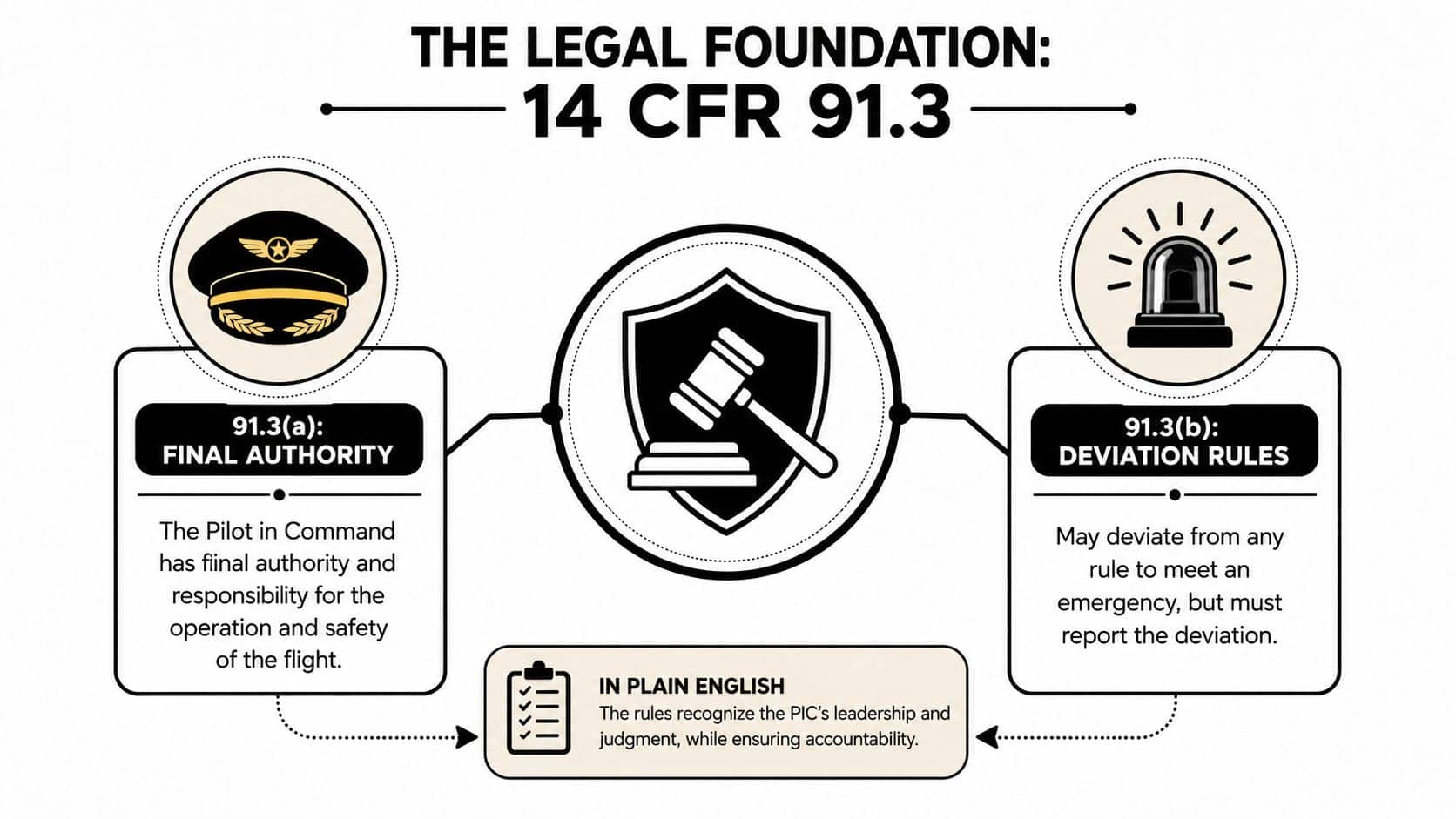
Final authority in plain English
Think of the PIC like a ship's captain or an incident commander at a structure fire. Other trained people can advise, disagree, or provide information, but one person still has to make the final call when the clock is running and conditions are changing. That's what “final authority” means in the cockpit, the PIC doesn't just fly, the PIC decides.
“Directly responsible” covers more than stick-and-rudder control. It includes whether the flight should start, continue, divert, or stop, and it includes the obligation to act when safety demands it. The same legal idea shows up in international aviation language, where the PIC has final authority over the aircraft while in command, and that's why the concept feels so familiar across different aviation systems.
What “to the extent required” really means
The emergency rule is narrower than many pilots think. It doesn't grant a free pass to do anything that seems helpful, it allows only the deviation needed to meet the emergency. If weather, a medical event, runway conflict, or an ATC problem creates a true emergency, the PIC can act outside the normal rule set to keep the flight safe, and FAA text also contemplates a written report if requested afterward.
That last part matters because authority in aviation isn't immunity. The rule gives the PIC room to act first when immediate action is necessary, but it does not erase the need to justify the choice later. A thoughtful pilot uses the rule to protect the flight, not to improvise around safety.
For pilots who are building consistency in training and currency, practical preparation matters too, and pilot currency requirements are part of that foundation. When the legal rule, the training habit, and the flight decision line up, authority feels less like pressure and more like routine judgment.
When PIC Responsibility Starts and Stops
Most pilots picture PIC authority as something that begins at rotation and ends at shutdown. The actual window is wider. For airplanes, European guidance says responsibility begins when the aircraft is first ready to move for taxi before takeoff and continues until it comes to rest and the engines are shut down, while helicopter responsibility runs from engine start until the helicopter is stopped with the engines off and rotor blades stopped.
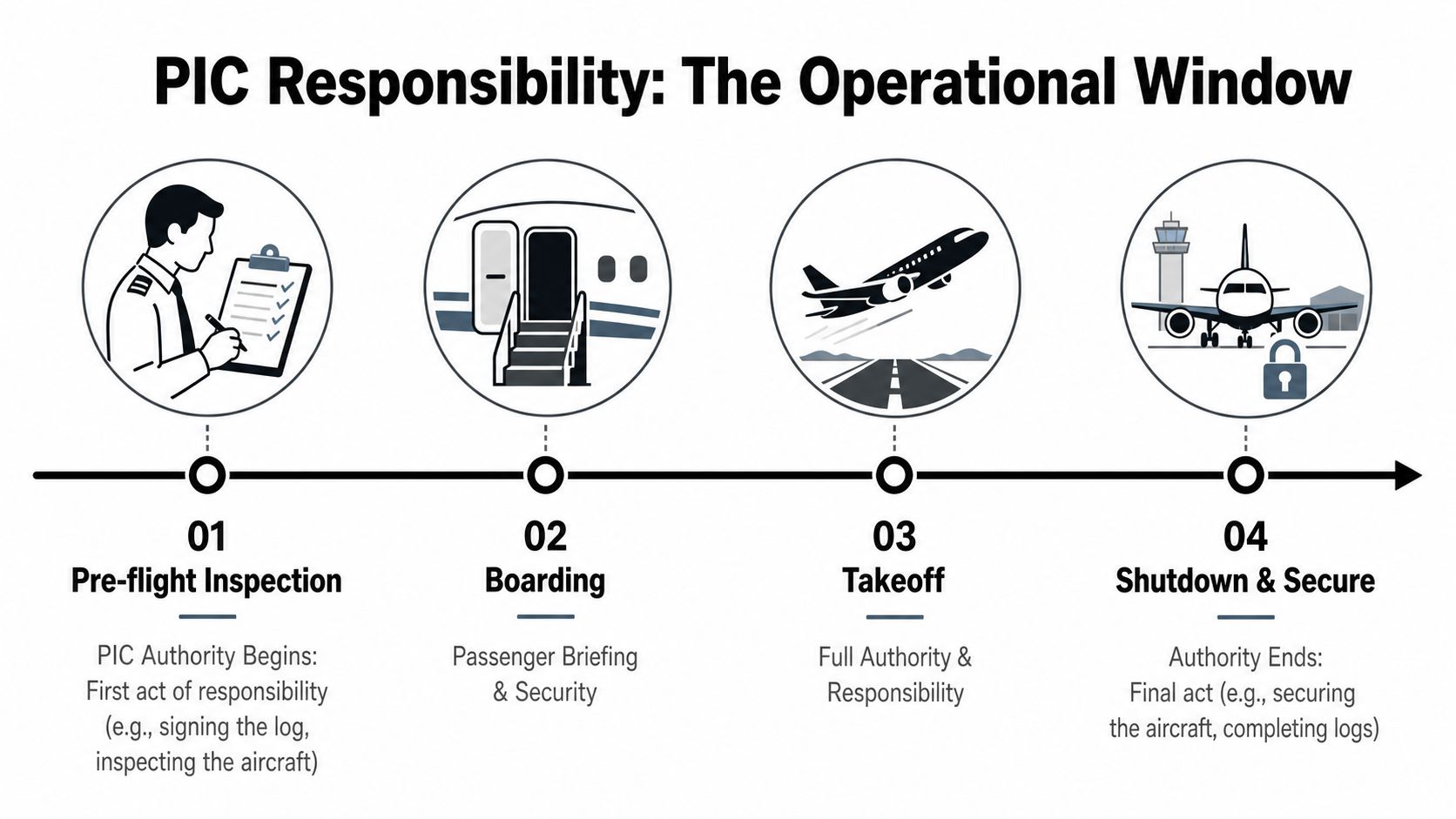
The airplane timeline
For an airplane, the responsibility begins before the wheels roll. That matters because taxi instructions, passenger handling, gate decisions, and even refusing to continue if something looks wrong are all part of the PIC's operating window. At a school or rental operation, that means the PIC isn't waiting for takeoff clearance to start thinking like the PIC.
The end point matters just as much. Once the airplane is parked, at rest, and the engines are shut down, the operational burden eases, but the duty to account for what happened in the flight does not disappear. That's why logbook accuracy and post-flight review belong to the same mindset as the takeoff brief.
Why helicopters are different
Helicopter authority uses a different boundary because the aircraft's operating cycle is different. The PIC role starts at engine start and ends only when the helicopter is fully stopped with the engines off and rotor blades stopped. In practical terms, that makes the PIC responsible across a longer ground-handling and shutdown sequence than many fixed-wing students expect.
That continuous window explains why the PIC can control more than just the controls. It covers the people, baggage, and cargo on board, and it shapes liability, operational control, and the way an incident gets reviewed later. If something goes wrong during boarding, taxi, or shutdown, that still sits inside the command frame.
A clean logbook entry starts with a pilot who knows when responsibility began, not just when the wheels left the pavement.
PIC Roles Across Student Private Commercial and Airline Operations
The title changes less than the situation does. A student in dual instruction, a solo private pilot, a renter, a commercial pilot, and an airline captain all sit under the same broad idea of PIC authority, but the legal and operational weight shifts with the operation. The fastest way to see that shift is side by side.
| Operation | Who Is PIC | Authority Scope | Logging |
|---|---|---|---|
| Student with instructor | Usually the instructor | Instructor exercises command responsibility during dual instruction | Student may log training time, not always acting PIC |
| Solo student | Student | Student has command authority for the solo flight | Student logs PIC for the solo segment if properly authorized |
| Private renter | The renting pilot | Full operational responsibility during the flight | Log as acting PIC when responsible for the flight |
| Commercial pilot | The certificated pilot designated for the operation | Authority expands to the carriage of passengers or cargo and operational judgment | Log according to actual PIC authority and role |
| Airline captain | Captain as PIC in a crew environment | Final authority within SOPs and CRM structure | PIC time reflects command role, not just seat position |
The student and the solo transition
The hardest mental jump for many students is the first solo. Before that day, the instructor may be the legal PIC even when the student is physically flying the airplane. Once the student goes solo, the responsibility changes fast, and there's no instructor left to absorb the hesitation.
That's why “sole manipulator of the controls” and “pilot in command” aren't the same thing. A pilot can move the controls without being the legal PIC, and a legal PIC can delegate tasks without giving away responsibility. Students usually feel that distinction the first time they have to act without coaching.
Airline crews and CRM
Airline flying adds structure, not ambiguity. The captain is still the PIC, but CRM and SOPs shape how that authority is exercised, which is why the best captains don't sound like dictators. They sound organized, clear, and willing to take input before making the final call.
The strongest cockpit authority is usually the calmest one. It doesn't need volume to be effective, only clarity.
The bigger lesson is that authority grows with experience, but so does exposure. Once passengers or cargo are involved, the PIC's decisions affect more people, more systems, and more consequences, which is exactly why the role becomes more procedural, not less.
Real Scenarios Where PIC Authority Is Tested
A weather diversion is often the first moment a pilot feels PIC authority in the world. The destination starts looking doubtful, the ceiling lowers, and the urge to “press on a little farther” can get loud in the cockpit. 14 CFR 91.3 does not force a diversion, but it clearly supports the pilot who decides that turning back or landing somewhere else is the safer call.
The weather call
The better decision is the one that keeps the flight inside the pilot's skill and the airplane's operating limits. If the pilot diverts early, the choice is easy to explain later, because the pilot acted before the weather boxed the flight in. If the pilot continues and the conditions keep getting worse, the pilot may still have authority, but the judgment becomes harder to defend.
That same test can show up in the traffic pattern. A student and instructor both see the conflict, but the instructor's response comes too late, and the go-around should already be underway. The student who has been briefed for command responsibility should not wait for a back-and-forth in a busy pattern. The student should call for the go-around and fly the missed approach if the situation calls for it.
Passenger pressure and maintenance pressure
Passengers can push a renter pilot just as hard as weather does. They have plans waiting, they want the trip to happen, and they may not understand the gap between “legal” and “smart.” PIC authority includes the right to refuse the flight or stop it when conditions no longer support a safe decision, and that refusal is part of the job, not a sign of weak judgment.
For a commercial crew, maintenance creates the same kind of test in a different form. A discrepancy found before departure can justify a delay or cancellation, and the captain's job is to protect the airplane, the crew, and the passengers from a rushed compromise. If the item is not cleared, the flight does not need to happen just because the schedule says it should.
Good records make that decision easier to defend. If the airplane's history is clear, the pilot can show exactly what was known before launch and what was not. For that reason, aircraft maintenance records belong in the decision-making process, not just in the paperwork drawer.
What made the decisions defensible
Each defensible outcome followed the same pattern.
- The pilot recognized the risk early. Waiting rarely improves a bad situation.
- The pilot used authority before urgency took over. That is how you stay ahead of the problem.
- The pilot could explain the choice in plain language. A safety decision should still make sense after the flight is over.
A pilot who has to choose whether a discrepancy should ground the airplane should start with the paperwork that shows the airplane's condition and recent history. That is also where the insurance side of the story comes in, because errors and omissions coverage can turn on whether the pilot's decision matched the facts available at the time.
Logging Insurance and the Emergency Deviation Report
PIC authority only helps you if the record matches what occurred. That begins with logbook accuracy, because future employers, insurers, and instructors read the same flight history through different lenses when the entries are clear, consistent, and honest. It also matters because acting PIC and sole manipulator time are not the same thing, and student logbooks often blur that line.
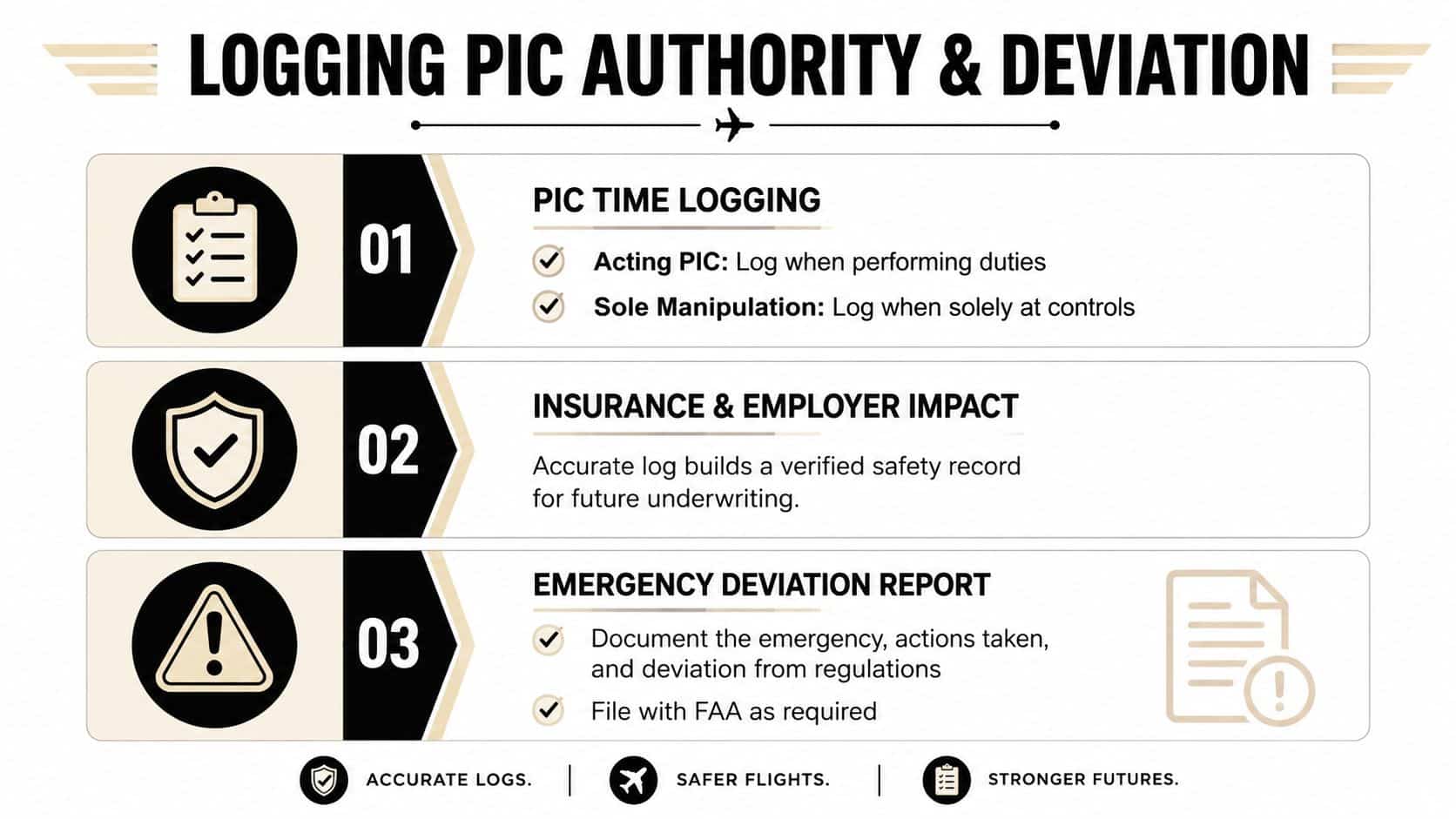
What the log should actually show
If you were the legal PIC, log that role. If you were only manipulating the controls while another pilot held command responsibility, log that time in the category that matches the authority you had. The goal is not to pad totals, it is to preserve a record that matches the flight you flew.
Insurance and employer review work the same way. A clean logbook shows that you understand the difference between command and control, and that helps underwriters and chief pilots trust the rest of the story you tell about your flying. If you fly renters or club airplanes, the airplane paperwork should be just as orderly, and aircraft maintenance records are part of that paper trail.
When a written report matters
The FAA text allows a PIC to deviate in an in-flight emergency requiring immediate action, and it also says the PIC must submit a written report if the Administrator requests one. In practice, that means a pilot should write down the emergency, the action taken, and the exact reason the deviation was necessary while the details are still fresh.
That kind of write-up helps even before anyone asks for it. A short note made soon after the flight can protect the pilot in an enforcement review because it shows the choice was made for safety, not convenience. For renters, it also helps the operator, insurer, and maintenance team understand what happened if the flight ended in an abnormal event.
If coverage questions come up during training or rental flying, it helps to understand how errors and omissions coverage is discussed in the insurance world, because documentation habits and risk exposure often follow the same logic. Good records do not replace judgment, but they do make good judgment easier to prove.
How Students and Renters Should Assert PIC Authority
Students usually think assertiveness means sounding confident. In flying, it means briefing the decision before the decision is forced on you. A proper preflight conversation should cover personal minimums, a committed go-around trigger, and a clear no-go line, so the flight doesn't depend on improvisation when the workload spikes.
The briefing that prevents the argument
Say the hard part out loud before engine start. If crosswinds exceed your comfort level, if the ceiling drops below your planned margin, or if the pattern gets too busy, the answer should already be in the brief. That way, “we're not continuing” sounds like a plan, not a surprise.
Use standard phraseology when the airplane needs it. “Unable,” “we're going around,” and “declaring an emergency” are clean, direct, and easy to understand on a radio full of other traffic. They also keep the message short, which matters when the cockpit is busy and the airport isn't waiting for a long discussion.
Renters need a different kind of discipline
If you're renting, read the aircraft club or school limitations before you show up. Know who needs to approve the flight, when the owner should be called, and what the local rules are for abnormal events or deviations. A renter who learns those details before the engine starts is a renter who can act decisively without guessing at the policy.
At a school or rental desk, one useful option is to train in an operation that supports structured instruction and recurrent currency work, such as the training and rental environment at DuBois Aviation. The point isn't the logo, it's the habit of practicing command decisions in a place where those decisions are expected, briefed, and reviewed.
Practical rule: a respectful tone doesn't cancel command authority. It just makes the command easier to hear.
If you disagree with an instructor in the air, don't try to win the argument. Fly the airplane, state the concern plainly, and document the training discussion afterward in a factual way. Assertive PIC authority is a trained habit, and the training starts before the wheels ever move.
Carrying PIC Authority Into Every Flight
Pilot in command authority works best when it's routine. The legal basis sits in 14 CFR 91.3, the responsibility window runs through the whole operating cycle, and the logbook and written record tell the story after the flight is over. Those three pieces travel together on every kind of flight, whether it's a first solo, a rental hop, a commercial sortie, or an airline leg.
The habit is simple enough to remember. Brief the decision before it happens. Commit to go-arounds and diversions early. Log accurately. Treat “unable” as a complete sentence. That's not hesitation, it's professionalism.
Every pilot eventually sits in the seat where the call is theirs. The ones who handle it well are usually the ones who practiced being decisive on calm days, not just on hard ones.
DuBois Aviation teaches and supports the same kind of decision-making you use when the airplane gets busy, whether you're training for your first solo, building currency, or staying current in a rental aircraft at KCNO. If you want to train in a place that treats command judgment as part of flying, visit DuBois Aviation and start the conversation with a team that flies and instructs in that reality every day.