

You haven't flown in a few months. A friend asks if you want to go up this weekend. Your certificate is still valid, your medical is in order, and the airplane is available. The key question isn't just whether you can go. It's whether you're legal for that specific flight, and whether you're ready for it.
That gap catches a lot of pilots. They remember earning the certificate. They don't always keep the moving windows straight. Passenger currency, instrument currency, and the flight review all run on different clocks. Add a new rental checkout, a tailwheel transition, or the jump from renting to buying your own aircraft, and the answer gets more mission-specific than most pilots expect.
A good pilot treats legal currency as the floor, not the finish line. That mindset matters whether you rent a Cherokee once a month, fly hard IFR, or you're starting to think seriously about buying an airplane or helicopter the safe way.
The Foundation Currency versus Proficiency
A pilot can be certificated and still not be ready to carry passengers safely. That's the central truth behind pilot currency requirements.
For U.S. pilots, passenger-carrying currency is a rolling 90-day requirement. A pilot must log three takeoffs and three landings in the same category, class, and type if required before carrying passengers again, and for night passenger operations those landings must be full-stop landings at night, as explained in AOPA's discussion of currency versus proficiency. That rule tells you when you're legal. It does not tell you whether your crosswind control, pattern spacing, and cockpit flow are where they need to be.

What the law asks and what real flying asks
Driving provides a useful analogy. A valid driver's license means the state says you may drive. It doesn't mean you're sharp enough to handle a mountain road in rain after a year away from the wheel.
Flying works the same way. A pilot can meet the legal minimum with very little recent flight time and still be rusty in ways that matter:
- Energy management gets sloppy on landing.
- Radio work falls behind in busy airspace.
- Avionics use slows down under pressure.
- Decision-making narrows when workload rises.
Practical rule: If you have to ask whether you're proficient, you probably need a warm-up flight before taking passengers.
That's why I tell pilots to stop using “current” and “ready” as if they mean the same thing. They don't. Current is a logbook answer. Ready is a performance answer.
Why this matters even more for renters and future owners
Rental flying can hide rust because the bar becomes simple compliance. Get the required landings, satisfy the checkout, and go. But a pilot who wants long-term safety should build a habit of flying with purpose. Work on short-field technique. Revisit unusual attitudes. Practice go-arounds that start early and cleanly.
Pilots building consistency usually progress faster than pilots chasing only minimums. If you're trying to stay active while keeping costs sensible, a structured plan for building flight hours efficiently helps more than random local flights.
Legal currency keeps you inside the regulations. Proficiency keeps you ahead of the airplane.
That distinction becomes even more important when you move from renting to ownership. An owner has more access to the aircraft, more flexibility, and more responsibility. If your habits are weak as a renter, ownership won't fix them. It usually exposes them.
Decoding Passenger and Instrument Currency Rules
The FAA framework is simple once you separate the moving parts. In the U.S., pilot currency is built around a small set of recurring legal thresholds: a flight review every 24 calendar months, three takeoffs and three landings within the preceding 90 days to carry passengers, and six instrument approaches plus holding and tracking tasks within the preceding six calendar months to act under IFR, as summarized in this overview of pilot currency rules. The important operational point is that a pilot may hold a certificate indefinitely and still lose the privilege to carry passengers or fly IFR if recent-experience requirements lapse.
FAA pilot currency requirements at a glance
| Flight Operation | Timeframe | Required Tasks | Aircraft Specifics |
|---|---|---|---|
| Flight review | 24 calendar months | Complete a flight review | Applies to keeping legal pilot privileges current |
| Carrying passengers in day operations | Preceding 90 days | 3 takeoffs and 3 landings | Must be in the same category, class, and type if required |
| Carrying passengers at night | Preceding 90 days | 3 takeoffs and 3 landings | Landings must be full-stop at night |
| Acting under IFR | Preceding 6 calendar months | 6 instrument approaches, holding procedures, intercepting and tracking tasks | Can be completed in a qualifying aircraft or approved training device representative of the aircraft category |
Passenger currency in practical terms
Passenger currency is the rule pilots use most often and misread most often.
The key question is not “Have I flown recently?” The key question is “Have I logged the right takeoffs and landings in the right aircraft grouping for the operation I'm about to conduct?” If you're taking someone up during the day, the recent takeoffs and landings must fit the category, class, and type if required. If you're flying at night with passengers, those landings must be full-stop landings at night.
That matters in real-world rental flying. A pilot may be comfortable in one airplane and still not be legal to carry passengers in another if the category, class, or type requirement changes. The legal answer follows the aircraft and operation, not your general confidence.
Instrument currency in practical terms
IFR currency is where pilots get surprised by the calendar. The instrument rules don't care that you felt sharp three months ago. They care what's in the logbook inside the applicable window.
To remain current for instrument operations, your logbook has to show the required recent approaches and associated tasks. If you're using a simulator or training device, the device has to be appropriate for the category of aircraft. If you need a detailed operational walkthrough, this guide on IFR currency requirements is a useful companion.
The safest way to track currency is to tie it to planned missions. Before every passenger flight or IFR trip, check legality first, then evaluate proficiency separately.
Pilots get into trouble when they treat these requirements as trivia instead of preflight planning. Put them in the same mental bucket as weather, fuel, and maintenance status. They are part of dispatch discipline.
The 24-Month Checkup Your Biennial Flight Review
The flight review is the long-cycle item that many pilots delay until the last minute. That's a mistake, because the 24-month flight review is the FAA's baseline mechanism for keeping a certificated pilot legally current, and industry guidance consistently frames the system as a recency standard rather than a proficiency test, as described in this explanation of currency versus proficiency and the flight review.
What it is and what it isn't
A flight review is a review. It is not a checkride. The point is to sit down with a CFI, revisit the rules and procedures that matter, and fly enough to confirm that you can operate safely.
Pilots who treat it like an exam usually prepare the wrong way. They try to memorize instead of refresh. A better approach is to show up ready to learn where your weak areas are right now.
Common areas that deserve attention include:
- Regulatory knowledge that drifts over time
- Normal and abnormal procedures that become rushed
- Basic aircraft control during steep turns, slow flight, and stalls
- Pattern judgment including go-around decisions
- Airspace and communication habits in the local environment
How to get more value from the review
Bring more than your logbook. Bring honesty. Tell the instructor what kind of flying you do and what kind of flying you want to do next.
If you mostly rent for local VFR flights, the review should reflect that. If you're planning mountain trips, night cross-countries, or a move into complex or high-performance aircraft, the review should be shaped around those goals instead of checking generic boxes.
A productive flight review should leave you better than it found you.
That's also why it helps to schedule before you're close to the deadline. A rushed review often turns into a bare-minimum signoff. A planned review can turn into a meaningful tune-up. If you want a straightforward summary of expectations, biennial flight review requirements are worth reviewing before you book time with an instructor.
Your Personal Currency and Proficiency Checklist
Most pilots don't need more theory. They need a repeatable cockpit-readiness check they can use with the logbook open and the flight mission in mind.
Start with legality. Then move to capability. Don't reverse that order.
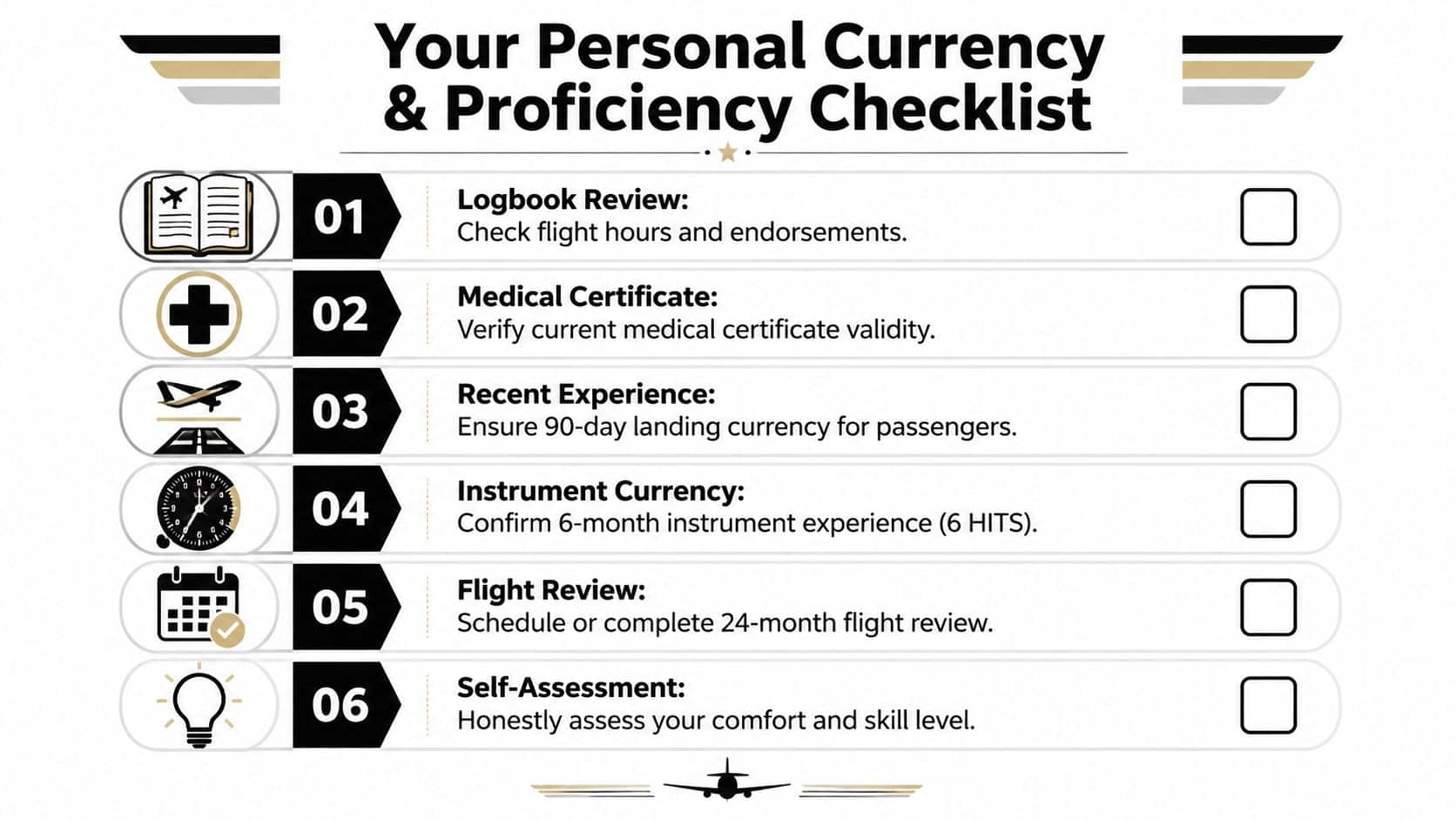
Logbook questions that answer the legal side
Use these questions before you schedule the airplane, not after.
- Flight review status: Is your flight review still within the required window, or are you close enough to the deadline that you should schedule now?
- Passenger-carrying status: In the last 90 days, have you logged the needed takeoffs and landings for the exact operation you plan to conduct?
- Night passenger status: If the flight will extend into night conditions, do you have the required recent full-stop night landings?
- Instrument status: If the weather or mission might require IFR, does your logbook clearly show the required recent instrument experience?
- Aircraft match: Are those entries in the same category, class, and type if required for the aircraft you're about to fly?
One of the most missed details in pilot currency requirements is that the answer can change with the airplane. FAA rules require recent takeoffs and landings in the same category, class, and type when a type rating is required. Night currency specifically requires three full-stop landings at night within the preceding 90 days, and tailwheel aircraft also require full-stop landings for passenger-carrying currency, as explained in this breakdown of different types of pilot currencies.
Questions that test proficiency instead of paperwork
A legal answer doesn't always produce a safe answer. Ask yourself harder questions.
- Crosswind competence: When did you last land in conditions that required active rudder work and disciplined aileron correction?
- Go-around discipline: If the approach got unstable, would you go around immediately or try to save it?
- Avionics fluency: Can you load and brief the procedure you need without heads-down confusion?
- Emergency memory: Would you know the first actions for an engine problem, vacuum issue, or electrical problem in this aircraft?
- Workload margin: Could you handle the flight if ATC got busy, the wind shifted, or the passenger started asking questions at the wrong time?
If your recent flying has all been easy flying, your proficiency may be narrower than you think.
A simple readiness scale
Use a plain three-level judgment before every flight:
Legal and sharp
Go fly the mission as planned.Legal but rusty
Fly solo first, take a CFI, or reduce the mission complexity.Not legal or not comfortable
Stop and fix the gap before the flight.
That simple self-assessment keeps pilots from making the classic mistake of using the passenger flight itself as the refresher flight.
Your Pathway Back to the Cockpit Regaining Currency
When a pilot realizes they've lapsed, the fix is usually straightforward. The problem is not complexity. The problem is that many pilots wait too long, then make the first return flight harder than it needs to be.
If passenger currency has lapsed
The fastest path back is usually simple pattern work in the correct aircraft category and class, with special attention to the exact operation you intend to conduct. If night passenger flying is the goal, make sure the night landing requirement is satisfied properly. If tailwheel is involved, fly with the stricter mindset that aircraft deserves.
A smart return sequence looks like this:
- First flight solo or dual: Don't make the first flight back a passenger event.
- Pick calm conditions: Reduce workload so you can focus on sight picture, rudder, and energy control.
- Stay in the pattern long enough: Don't stop at the legal minimum if the landings still feel uneven.
- Add a local area flight after: Practice departures, arrivals, radio changes, and checklist rhythm.
If instrument currency has lapsed
Instrument flying needs a more structured answer. Under 14 CFR 61.57, a pilot must log six instrument approaches, holding procedures, and intercepting and tracking tasks within the preceding six calendar months. If that six-month window is missed but the pilot is still within the next six months, currency can be regained with an authorized safety pilot or instructor. After that, an instrument proficiency check is required, as stated in the regulation text at Cornell Law School's presentation of 14 CFR 61.57.
That creates three practical return paths:
Recently lapsed but still inside the regain window
This is usually the simplest case. Go fly the missing approaches and associated tasks with the right support. A safety pilot may be enough for some pilots. Others should choose an instructor, especially if scan, avionics management, or procedure setup feels rusty.
Lapsed long enough that an IPC is required
At that point, stop trying to piece together legality on your own. Book the instrument proficiency check and treat it as a rebuild, not a hurdle. Most pilots who approach the IPC with humility come out stronger than they were before the lapse.
Current on paper but weak in actual IFR execution
That pilot needs recurrent training even if the logbook technically supports legality. This is common after long stretches of simulated work without much real-world weather decision-making, or after a move into unfamiliar avionics.
A good visual refresher can help before you book the flight:
Matching the solution to the kind of rust
Not every lapse needs the same cure.
- Procedural rust usually responds well to simulator work and chair-flying.
- Aircraft handling rust usually needs dual instruction in the airplane.
- Systems and avionics rust improves when you practice in the exact panel you plan to fly.
- Confidence rust fades fastest when the first few flights are narrow in scope and well briefed.
For pilots in Southern California, one factual option is DuBois Aviation, which offers aircraft rental, instructor-led recurrent training, and simulator access at Chino Airport. That kind of setup is useful when you want to rebuild skill in stages instead of trying to fix everything in one expensive flight.
Returning pilots do best when they lower complexity first. Short flight, good weather, clear objective, no audience.
That approach works. What doesn't work is scheduling a long cross-country, loading family members, and hoping the first hour back shakes the rust off.
From Proficient Pilot to Aircraft Owner
The pilot who manages currency well is often the same pilot who starts thinking about ownership. That connection makes sense. Renting teaches flexibility. Ownership rewards discipline.

The safe way to buy an airplane or helicopter starts with the same mindset used for pilot currency requirements. Define the mission clearly. Verify the details. Don't confuse access with readiness.
Start with mission, not with the listing
Many buying mistakes happen before the first call to the seller. A pilot falls in love with speed, payload, panel upgrades, or appearance before defining the actual use case.
A better buying filter asks:
- What trips will you actually fly? Local flying, training, family travel, IFR travel, backcountry, turbine transition, helicopter sightseeing, or utility work all point toward different machines.
- Who will fly it? Just you, multiple family members, business partners, students, or renters change the practical fit.
- Where will it live and who will maintain it? A great aircraft on paper can become a bad purchase if local support is weak.
- What level of complexity do you fly proficiently today? Buying beyond your present proficiency is possible, but only if you budget time and training for the transition.
The pre-purchase inspection is not optional
Never buy on cosmetics, seller confidence, or a quick walkaround. Use an independent mechanic who works for you, not for the seller. If the aircraft is complex, aging, modified, or operated in a demanding environment, the inspection needs to reflect that reality.
A strong pre-purchase process includes:
A full logbook review
Look for damage history, recurring discrepancies, missing entries, and signs that paperwork quality slipped over time.An independent maintenance opinion
The mechanic should have no incentive to close the sale.A mission-based evaluation flight
Not a joyride. You're evaluating systems, ergonomics, workload, and fit.Transition training planning
Before closing, know who will train you and how you'll step into the aircraft safely.
The wrong aircraft can keep a pilot less current, because it raises the cost, complexity, or intimidation factor of every flight.
Ownership raises the standard
An owned aircraft is easier to access than a rental. That's the upside. The hidden risk is that pilots assume access alone will keep them sharp. It won't.
Owners need a tighter personal standard than renters in several areas:
- Maintenance awareness: You need to understand the aircraft's condition, not just trust that someone else dispatched it.
- Avionics discipline: If you buy a more capable panel, your procedures have to catch up.
- Mission creep control: Owners often attempt longer, harder, or more weather-sensitive trips because the aircraft is available.
- Training continuity: A new aircraft should trigger more recurrent instruction, not less.
Helicopter buyers should take the same approach. The mission definition, maintenance review, and transition plan matter just as much. In some cases they matter more, because operating costs, handling qualities, and mission profiles can be less forgiving.
Buying safely means treating the purchase as part of your training life, not separate from it. The best acquisition decisions come from pilots who know exactly what they fly well, what they still need to learn, and what sort of aircraft supports consistent, realistic proficiency.
If you want a practical next step, talk with DuBois Aviation about recurrent training, aircraft rental, simulator sessions, or a transition plan before you carry passengers again or move toward aircraft ownership. A focused session with a CFI can clarify your legal status, expose weak spots, and help you build a safer path from staying current to flying with real confidence.