
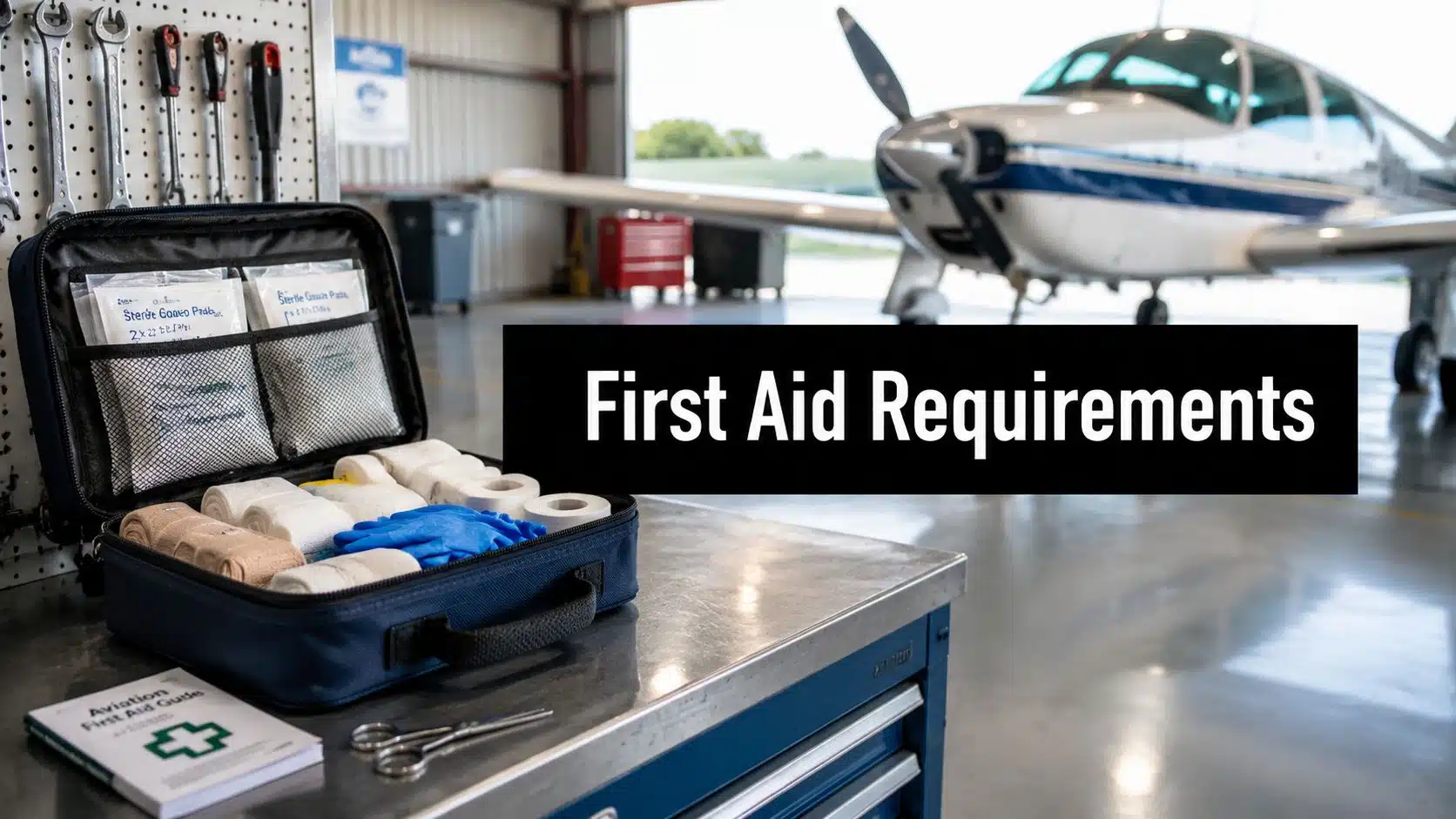
A lot of managers first think about first aid kit requirements after something small goes wrong. A line technician slices a hand on safety wire. A student catches a knuckle on a cowling latch. An instructor gets a mild burn from hot metal on the ramp. Then someone opens the wall kit and finds half the packets missing, the gloves brittle, and no one quite sure what belongs in the box anyway.
That's the problem. In a flight school or rental operation, a first aid kit isn't a decoration and it isn't just an inspection item. It's part of the same operational discipline behind fuel quality checks, preflight habits, dispatch control, and maintenance records. If you run aircraft, classrooms, a front desk, and a hangar floor, you need a system that works when people are busy, distracted, or under pressure.
Beyond the Checklist Why First Aid Kits Matter
A first aid kit matters because aviation work creates a steady stream of low-level injury exposure. Most days, it's nothing dramatic. It's a scraped forearm on a baggage door, a blister from tug work, a cut from sheet metal, or a student feeling faint after a hot lesson and a long debrief. Those incidents don't make headlines, but they shape whether your operation is prepared.
In a flight school environment, the risk picture is mixed. You have office tasks, classroom activity, line service exposure, aircraft cleaning, battery handling, moving propeller awareness, refueling, and sometimes maintenance-related hazards nearby. A single generic box from an office supply store rarely matches that reality.
What goes wrong in practice
The common failure isn't that a business has no kit. It's that the kit exists only on paper.
- Wrong location: The kit is in the office, but the cut happens at the far end of the hangar.
- Wrong contents: The box has small bandages but nothing useful for burns, immobilization, or blood exposure.
- No ownership: Everyone assumes someone else checks it.
- No training: Staff know the kit exists, but they don't know when to treat on site and when to call for emergency help.
Practical rule: If your first aid kit only satisfies a purchasing checklist, it will fail the first real incident.
That's why good first aid kit requirements should be treated as part of a broader safety system. You're not only buying supplies. You're deciding where response capability lives inside your operation, who maintains it, and how quickly a staff member can get the right item to the right place.
Compliance is only the floor
The confusion comes from overlapping expectations. Ground facilities are workplace environments. Aircraft add another layer of operational reality. Local expectations, insurance requirements, landlord standards, and internal safety policies can all affect what “adequate” really means in practice.
For managers who want staff to respond confidently, basic training matters as much as equipment. A short compliant emergency first aid course is often a practical way to build common language around bleeding, burns, shock, and escalation. The kit works better when the people opening it know what they're looking at.
A well-run operation doesn't ask, “Do we have a first aid kit?” It asks better questions. Is it accessible? Is it stocked for the work being done there? Can staff use it without guessing? Can you prove it was inspected?
Those are the questions that keep a small incident small.
FAA vs OSHA Navigating Two Sets of Rules
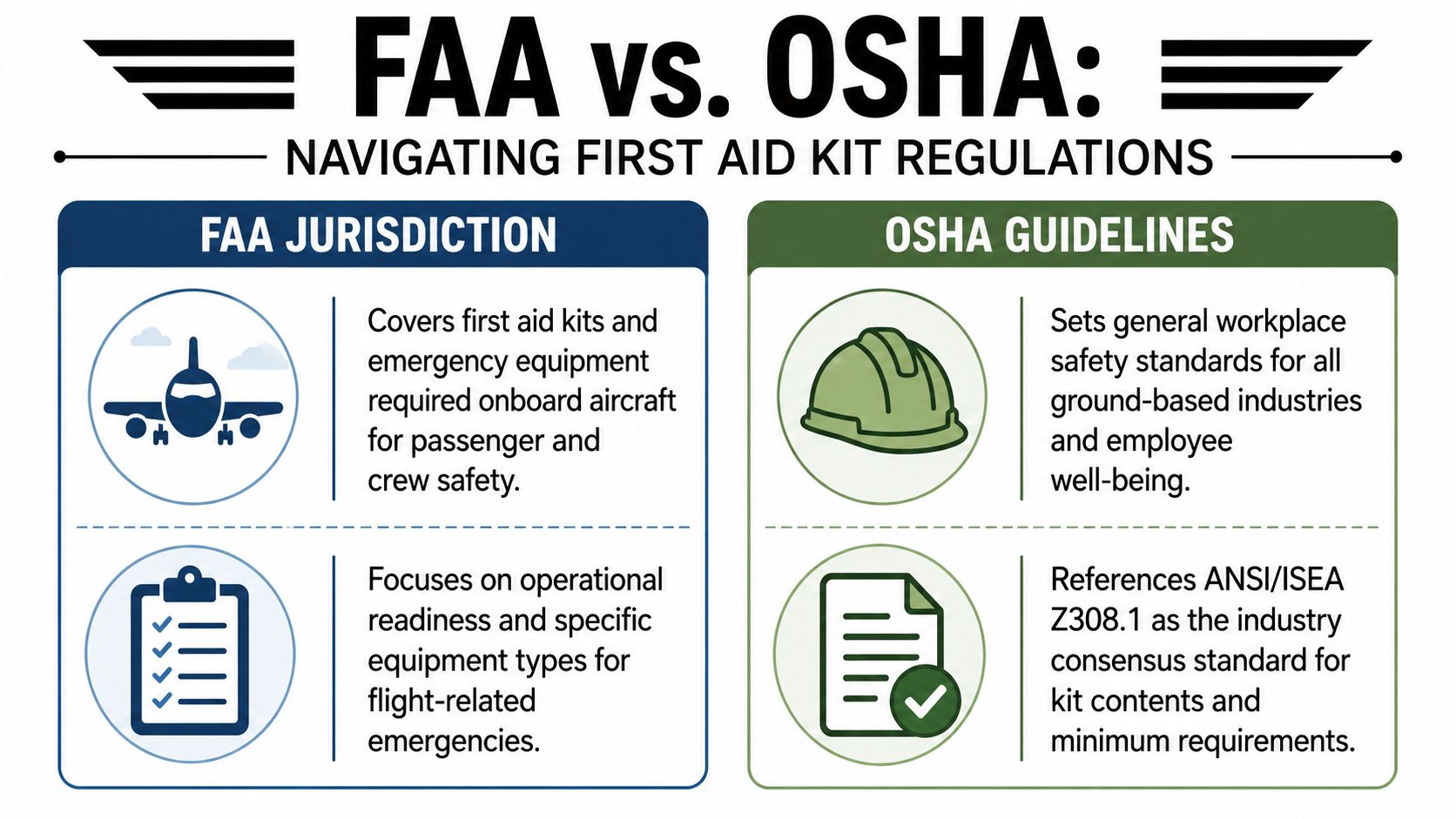
The cleanest way to think about first aid kit requirements in aviation is this. FAA concerns follow the aircraft and the operation in flight. OSHA concerns follow the workplace on the ground. If you blur those two, compliance gets messy fast.
That distinction matters in a flight school because one business often contains several environments. You may have aircraft used for instruction and rental, a dispatch counter, classrooms, a simulator room, a hangar, and ramp activity. The same company name sits on the lease, but the risk profile changes by location.
What OSHA controls on the ground
OSHA's focus is the employee work environment. That includes the places where instructors brief students, staff handle equipment, and technicians or line personnel work around aircraft. OSHA requires adequate first aid capability in the workplace, but federal text often sets only a baseline.
A useful example is OSHA's logging standard. Under OSHA Appendix A for logging operations, a first-aid kit for a small work site should be adequate for approximately 2 to 3 employees, and larger or multi-operation sites should add extra kits or larger quantities of supplies. The minimum list includes 2 large gauze pads, 2 triangular bandages, latex gloves, a splint, and directions for requesting emergency assistance. OSHA also says those contents are the minimally acceptable supplies under that standard.
That example isn't aviation-specific, but it shows the federal floor clearly. The baseline exists. It's not enough, by itself, to build a strong program for a busy aviation operation.
What the FAA changes operationally
The FAA's concern is different. It centers on what must be carried onboard for certain operations and how onboard emergency equipment supports passenger and crew safety. That is not the same question as what belongs in a wall-mounted kit near a whiteboard or on a hangar column.
For a school operating multiple training environments, the better approach is to separate the programs:
- Aircraft kits: compact, secured, and suited to onboard realities
- Facility kits: matched to workplace hazards and access time
- Shop or hangar kits: more capable, because injuries there are often more complex
If you're reviewing your broader operational structure, the way a formal school organizes procedures, records, and oversight can be instructive. That's one reason a well-documented Part 141 flight school framework often produces cleaner safety execution even outside pure training requirements.
Don't let the presence of an aircraft kit convince you the hangar is covered. It isn't.
A final point for managers: first aid readiness and incident reporting are related but not identical. One addresses response capability. The other addresses what must happen after an event. If you're updating your safety binder, this overview of 2026 OSHA reporting requirements is a useful companion reference for the reporting side of the equation.
The ANSI Standard Your Practical Compliance Benchmark
When managers ask what to buy, I usually steer them away from vague labels like “industrial” or “all-purpose.” Those terms don't tell you much. ANSI/ISEA Z308.1 is the more useful benchmark because it gives you a practical way to align kit contents with the actual environment.
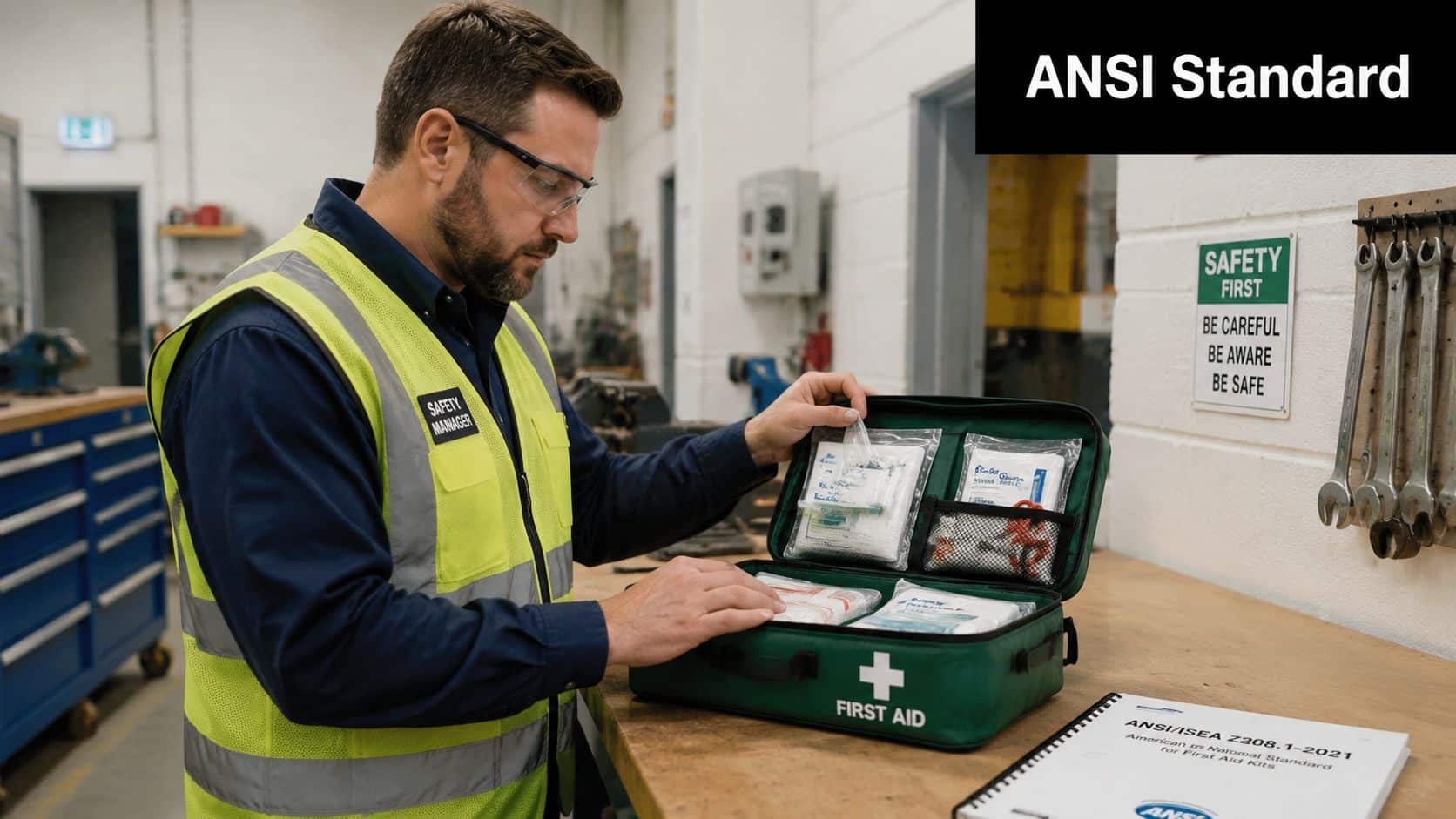
For a flight school, that matters because the operation isn't purely low-risk office work. Even if the front office is calm, the rest of the facility may involve fuel handling, hot surfaces, sharp edges, moving aircraft, rope burns, slips, and occasional delayed access to off-site medical care while activity is spread across a ramp and hangar area.
Class A and Class B are not interchangeable
ANSI/ISEA Z308.1-2021 defines workplace kits by performance class and fill level. Class A is intended for lower-risk environments. Class B is intended for higher-risk or more complex exposures. According to ANSI-based workplace guidance summarized here, Class B kits require larger minimum quantities, including 50 adhesive bandages, 50 antiseptic applications, 25 burn treatments, 4 pairs of medical exam gloves, 4 sterile pads, 2 triangular bandages, 2 cold packs, 1 tourniquet, 1 splint, and 1 breathing barrier.
That list tells you something important right away. Class B isn't just a larger box. It's built for environments where one moderate incident can consume supplies quickly, and where bleeding control, burn response, and temporary stabilization may matter before outside help arrives.
For aviation ground operations, that's a better fit in many hangar and line-service contexts than a barebones office kit.
Why aviation shops tend to outgrow basic kits
A Class A kit may be reasonable in an admin office with routine paper cuts and minor scrapes. It starts to look thin once people work around aircraft hardware and support equipment.
Consider the difference in typical exposure:
| Area | Common issues | Better fit |
|---|---|---|
| Front office | Minor cuts, headaches, small abrasions | Class A often works |
| Classroom | Minor illness, small cuts, light contact injuries | Class A or nearby shared support |
| Hangar floor | Lacerations, burns, impact injuries, blood exposure | Class B is usually the practical choice |
| Ramp support area | Abrasions, strains, heat stress, contact injuries | Class B or similarly capable support |
Aviation also depends on teamwork under stress. That's why the broader discipline behind crew resource management applies here too. Good kits support good coordination. People need clear locations, predictable contents, and shared expectations about who retrieves the kit, who calls for help, and who directs the response.
A short visual explainer can help when you're training staff on what standards-based kits include.
Buy for the worst credible ground incident in that area, not for the most convenient shelf size.
That's usually the turning point. Once you view ANSI as an operational benchmark instead of a purchasing label, first aid kit requirements become much easier to apply sensibly.
Stocking Your Kits For the Cockpit and the Hangar
One mistake shows up all the time. Operators try to make one kit do every job. That usually produces a box that is too bulky for the aircraft and too weak for the hangar. Separate the mission.
An aircraft kit should be compact, secure, and useful in a confined space. A hangar or classroom kit should support more sustained care until local emergency responders take over. Those are different design problems, so they deserve different solutions.
Size the ground kits to the operation
ANSI-based workplace guidance commonly scales kit size by headcount and hazard level. For low-risk workplaces, one small kit is recommended for fewer than 25 people, while in high-risk workplaces the breakpoint for needing a more substantial kit can be as low as 5 people, as outlined in this ANSI workplace guidance.
For a flight school, that means headcount alone can mislead you. A small office staff may still support a higher-risk hangar and ramp environment. Buy according to exposure, not just payroll numbers.
What belongs where
Use the aircraft kit for short-duration onboard needs and immediate minor care. Use the hangar kit for broader response capability.
| Item | Aircraft Kit (Recommended) | Hangar / Classroom Kit (ANSI Class B) |
|---|---|---|
| Adhesive bandages | Yes, for small cuts and blisters | Yes, in larger quantity |
| Antiseptic wipes | Yes | Yes |
| Medical gloves | Yes, compact supply | Yes, more than one pair available |
| Sterile pads or gauze | Yes, limited quantity | Yes, broader stock |
| Triangular bandage | Optional if space allows | Yes |
| Burn treatment | Small quantity is useful | Yes, important for shop and ramp exposure |
| Cold pack | Usually optional due to space | Yes |
| Splint | Usually not practical in every cockpit | Yes |
| Tourniquet | Usually reserved for ground response kits | Yes |
| Breathing barrier | Useful if compact and trained staff are present | Yes |
| Motion comfort and personal-use items | Sometimes appropriate under company policy | Usually separate from trauma supplies |
| Emergency instructions | Yes | Yes |
What works and what doesn't
A cockpit kit works when it is flat, sealed, labeled, and easy to secure behind a seat or in an approved storage location. It fails when someone packs a large plastic case that shifts around, crowds the cabin, or gets removed and never replaced.
A hangar kit works when it includes serious wound care and is mounted where people can reach it fast. It fails when it sits in a locked office or gets raided for everyday convenience items until the critical supplies disappear.
If you want a starting point for a larger packaged solution, a 320 piece first aid kit can be a decent reference point for comparing categories of contents. The key is not the marketing count. The key is whether the contents align with your hazards, accessibility needs, and restocking process.
The best aircraft kit is the one that stays onboard and stays organized. The best hangar kit is the one that can handle more than a paper cut.
For buyers and sellers of aircraft, the same practical mindset applies. Don't evaluate an airplane only by airframe, paint, and avionics. Evaluate the safety support around the transaction and future operation too. A careful pre-purchase process should include realistic planning for emergency gear, onboard storage, and the ground support environment where the aircraft will live. Buying an airplane the safe way means buying into a system, not just a machine.
Inspection and Maintenance A Living System
A first aid kit that was compliant on delivery can become useless imperceptibly. Seals break. People borrow supplies. Adhesive packets age out. Gloves get taken for fuel-sumping or cleaning tasks they were never meant for. If nobody owns the process, the kit degrades until an incident exposes it.
That's why maintenance matters as much as selection. OSHA requires that adequate first-aid supplies be readily available, and practical guidance often uses ANSI contents as the benchmark for what “adequate” means in real workplaces, as explained in this discussion of first-aid kit compliance in practice. The operational point is simple. A box on the wall doesn't help if the right contents aren't available when they're needed.
A simple inspection routine
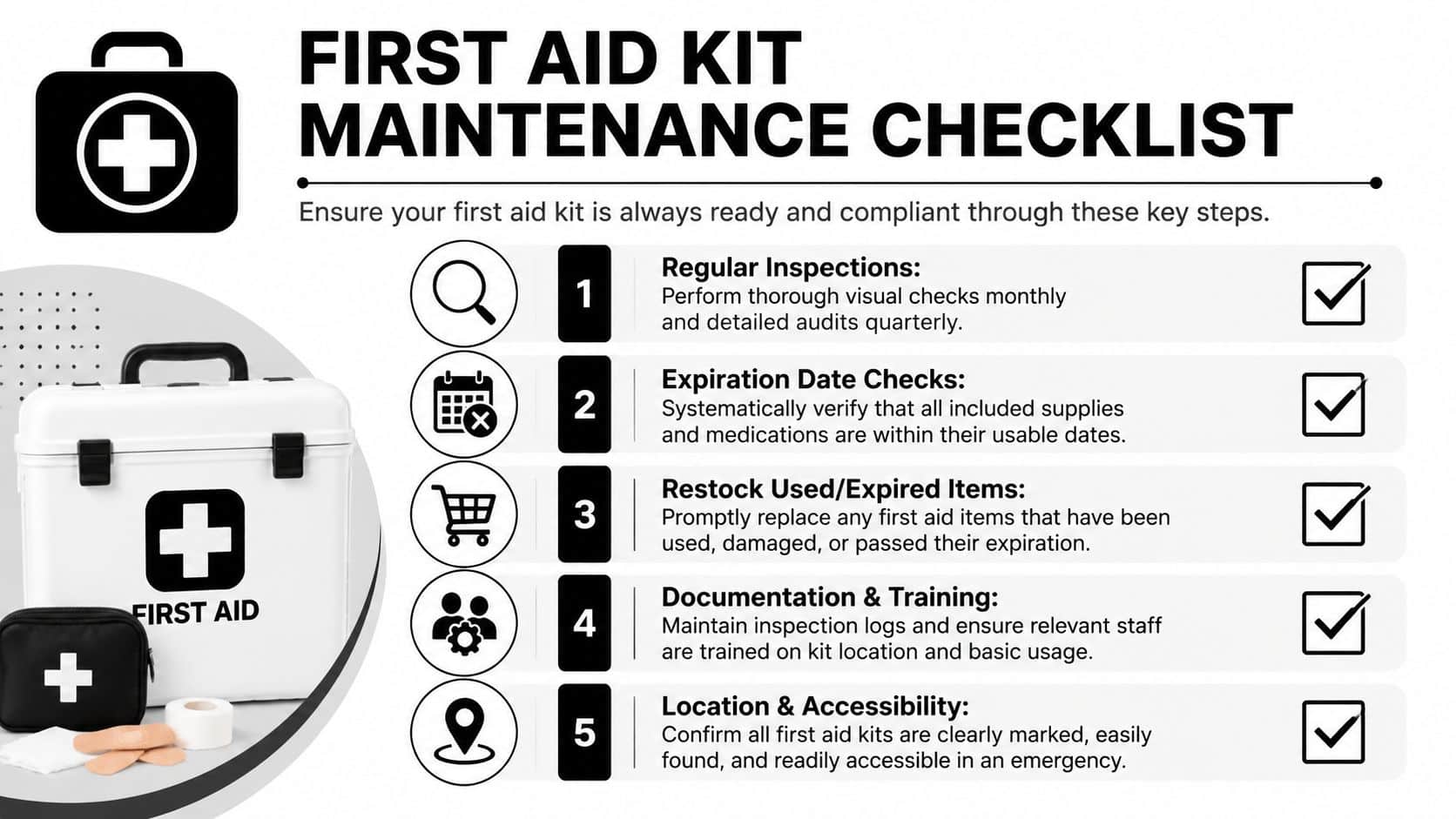
You don't need a complicated software system to manage this well. You need consistency.
- Assign one owner: One person should be accountable for each kit location, even if others help inspect.
- Check after use: If the kit was opened, inspect and restock it right away.
- Run scheduled reviews: Put recurring inspections on the calendar and treat them like any other safety task.
- Look for damage and age: Sterile items, ointments, wipes, and packaged goods deserve special attention.
- Keep a written log: A simple paper checklist in a sleeve inside the cabinet works fine.
A visible log matters. During a walkthrough, it shows that the program is alive, not theoretical.
What to verify during each check
The inspection itself should be short enough that staff will perform it.
- Confirm the kit is still in its assigned location and clearly marked.
- Open it and compare contents to the approved list for that kit type.
- Remove empty wrappers, damaged packaging, and expired items.
- Verify specialty items are still present in higher-risk locations.
- Initial and date the log.
A good parallel is the discipline behind pre-flight checks in a Cessna 172. Pilots don't assume yesterday's status guarantees today's readiness. They verify. First aid kits deserve the same mindset.
If a kit gets used, the maintenance clock starts immediately. Don't wait for the next monthly review.
Another practical move is to separate convenience supplies from emergency supplies. If employees routinely need adhesive bandages for small nicks, keep a small day-use box nearby. That prevents the primary emergency kit from being stripped for routine consumption.
The strongest programs also train staff to report use, not hide it. If someone takes the last pair of gloves and says nothing, the process failed before the next inspection even begins.
Your Action Plan for DuBois Aviation
For a busy training and rental operation, the answer isn't a single perfect kit. It's a managed network of kits matched to the spaces where people work. That means thinking in terms of aircraft, office and classroom, and hangar or ramp support.
Start with ownership. One manager should control the standard, approve kit types, and keep the inspection log system active. Without that, first aid kit requirements drift into informal habits, and informal habits fail under pressure.
A practical rollout sequence
Begin with an audit of what you already have.
Walk every area and ask a short set of questions:
- Aircraft coverage: Is there a compact onboard kit in each aircraft that is secure, legible, and complete?
- Office and classroom coverage: Are those spaces covered by kits suited to lower-risk use?
- Hangar coverage: Is there a more capable kit where sharper tools, heat, and blood exposure are more credible?
- Access time: Can staff reach a useful kit quickly from every normal work area?
Then standardize what each location gets. Don't let every cabinet evolve into its own random assortment. Standardization makes inspection faster and response calmer.
Train the people, not just the boxes
Once kit locations and contents are settled, brief the instructors, dispatch staff, and line personnel. Keep it simple. Show where each kit is, what it is meant for, who calls emergency services, and who documents the event.
That's also the right time to address special buying and ownership scenarios. People looking to buy or sell airplanes and helicopters often focus on title, logs, and pre-buy inspections. They should. But a safe purchase also looks at practical operating readiness. If the aircraft will be used for training, rental, or personal cross-country flying, onboard emergency equipment and the support setup at the home base deserve attention early, not after delivery.
A safe aircraft purchase process usually includes these questions:
- Storage reality: Where will the aircraft be based, and what first aid support exists there?
- Mission profile: Will it be a short-hop trainer, a cross-country machine, or a helicopter used in hotter, more physically demanding operations?
- Cabin limits: What compact medical items can be carried sensibly without creating clutter?
- Owner discipline: Who will inspect and replace onboard items after use or over time?
Safe airplane buying isn't only about mechanical condition. It's also about whether the future operation is set up to manage ordinary emergencies well.
The final step is documentation. Keep a written standard for what belongs in each kit type, where each kit lives, and who checks it. That turns a supply purchase into a repeatable safety program. In a regulated environment, that difference matters.
A well-run first aid system is quiet. It doesn't draw attention to itself on normal days. But when someone needs it, it shows whether the operation has real safety habits or just good intentions.
If you want flight training or aircraft rental from a team that takes operational discipline seriously, DuBois Aviation offers airplane and helicopter instruction, rental access, and a training environment built around professionalism, readiness, and practical safety at Chino Airport.


