

Before you even think about starting the engine, your first and most important decision as a pilot is made on the ramp. The pre-flight inspection of a Cessna 172 isn't just a routine; it's the moment you truly take command. This walk-around is where you connect with the machine, ensuring every component is ready for flight, whether your goal is to fly airliners or helicopters.
Why the Pre-Flight Is Your First Command Decision
Every single professional pilot, whether they're flying a jumbo jet or a rescue helicopter, started right here. They learned the discipline of the pre-flight. This isn't just about going through the motions on a checklist. It’s the very first command decision you make on any given day. Your authority as Pilot in Command (PIC) begins long before you call for taxi clearance—it begins with your hands on the airplane.
This process is how you develop a feel for the aircraft, a kind of mechanical empathy. You’re not just looking at it. You're feeling for a loose rivet, running a hand along a control surface, and listening for the satisfying thunk of a securely latched cowling.
Two practical options worth comparing
These are specific products pilots commonly compare for this type of flying. Confirm compatibility with your aircraft and instructor before ordering.
See the complete pilot gear guide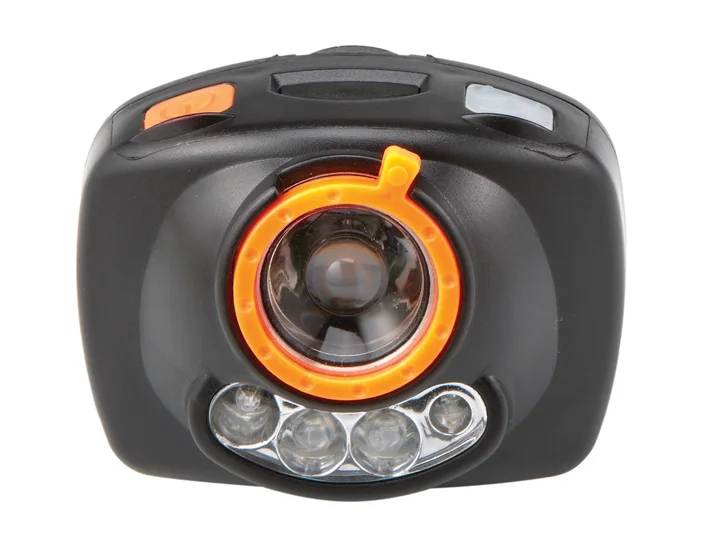
Building a Professional Aviator's Mindset
If your goal is a career as an airline pilot or a commercial helicopter pilot, the pre-flight is where you forge the habits that will define you as a professional. It’s a ritual that builds the meticulous, systematic mindset you'll need when managing complex systems in an airliner or a turbine-powered helicopter.
This simple routine hones the core skills of a great pilot:
- Situational Awareness: You’re training your eyes to spot the one small thing that’s out of place. That’s the same skill you'll use to scan your instruments or the sky for traffic.
- Systematic Problem-Solving: Following a logical flow—the same way, every time—builds the procedural discipline that is absolutely critical during normal and emergency situations.
- Confident Decision-Making: Finding a small issue on the ground and making the call to not fly is one of the toughest, and most important, judgments you'll ever make.
The professional habits you build during your Cessna 172 pre-flight are the exact same ones you'll lean on when facing a critical decision at 30,000 feet. This is the bedrock of your entire career, teaching you to trust your training, your instruments, and ultimately, your own thorough inspection.
Think about it. The captain of an international airline and a helicopter pilot flying mountain tours have one non-negotiable trait in common: they both started by learning how to meticulously inspect a simple training aircraft. The methodical discipline you develop during your pre flight checks cessna 172 training will serve you for every flight hour that follows. It's what makes a safe, competent, and professional pilot.
Your Pre-Flight Flow From Cockpit to Walk-Around
Every pilot knows the Pilot's Operating Handbook (POH) is the final word, but the real mark of an aspiring career aviator is turning those checklist pages into a smooth, repeatable, and almost instinctual flow. For me, that process always starts in the cockpit before I even think about stepping outside. This isn't just about flipping a few switches; it's about setting the stage for the entire flight and confirming the plane is legally and mechanically ready to go.
First things first, I tackle the paperwork. I make sure the required documents—the famous ARROW acronym: Airworthiness Certificate, Registration, and Operating Handbook—are all on board and current. Then, I grab the Hobbs and Tachometer times for my logbook. It’s a simple but crucial routine that establishes the baseline for the flight. Finally, a quick scan confirms all switches are off and, most importantly, the control lock is removed.
This infographic breaks down the very beginning of the pre-flight, covering those essential document and instrument checks you handle before leaving the seat.
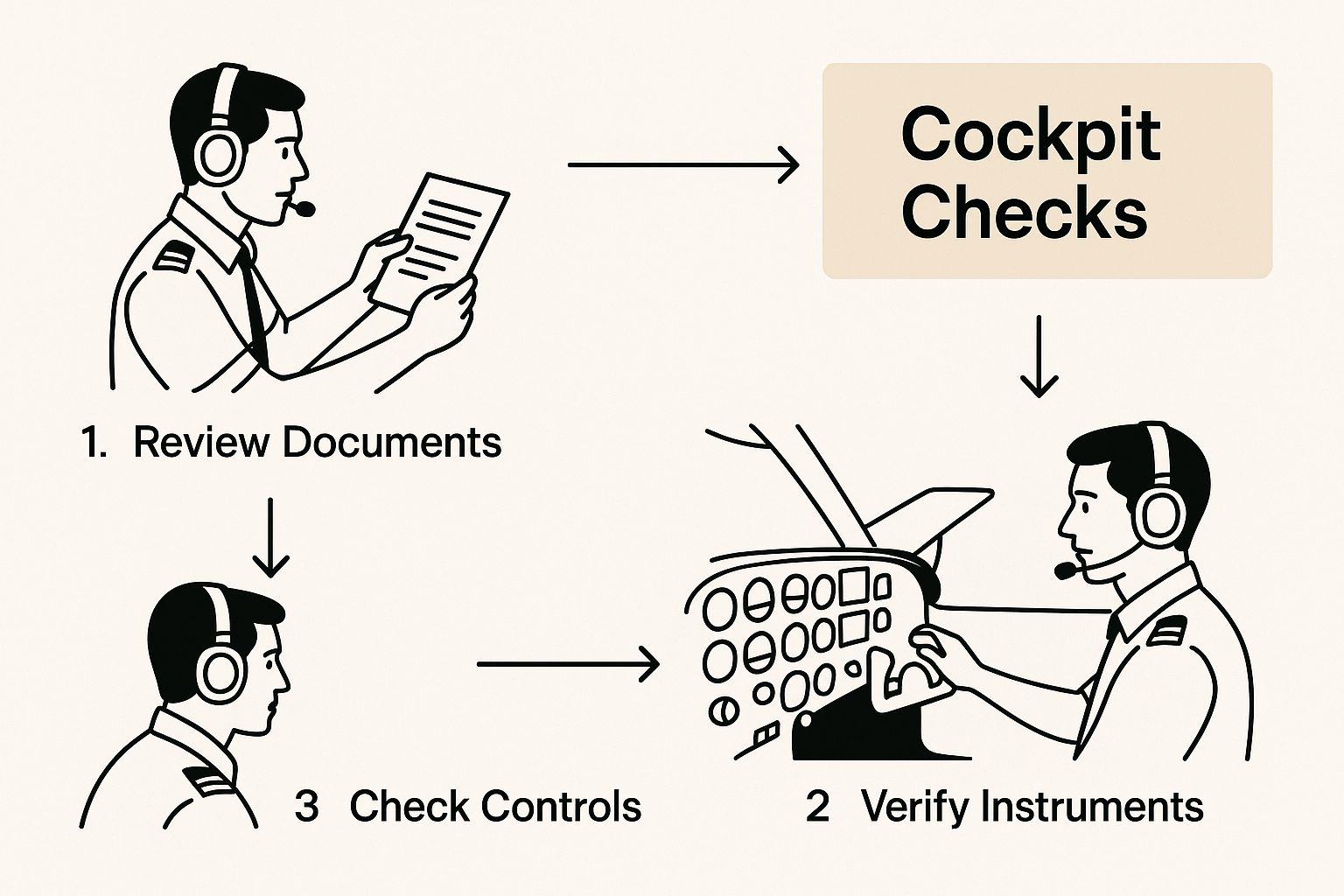
Starting inside the aircraft like this ensures all the critical admin and system checks are done before your focus shifts to the physical inspection outside.
Transitioning to the Exterior Walk-Around
With the cockpit squared away, it’s time to head outside. The best, most reliable way to do this is a systematic, counter-clockwise walk-around that starts and ends right at the pilot's door. This creates muscle memory. When you're rushed or distracted, that ingrained pattern is what prevents you from missing something important.
My first stop on the outside is always the left wing, and I start with the aileron. I don't just look at it; I gently take hold and move it through its complete range of travel.
You’re feeling for a few specific things here:
- Full movement: Does it travel all the way up and down to its stops without binding?
- Free movement: Is the motion smooth, or does it feel gritty or like it’s catching on something?
- Correct movement: As you move the aileron, a quick glance into the cockpit should show the yoke moving in the correct direction.
This is a physical conversation with the airplane. You’re feeling for the health of the control cables, pulleys, and connections. The exact same principle applies to the flaps—check that they're secure and look for any dings or damage. Understanding the why behind each of these checks is a core part of any good ground school program and what truly builds confidence for a student pilot.
Hands-On Inspection Details
Continuing down the wing, my focus shifts to the fuel and the landing gear. Checking the fuel is about more than just what the gauges say inside. You have to visually inspect the fuel level in each tank. It's the only way to be 100% certain how much usable fuel you actually have. I always unscrew the cap, make sure the seal isn't cracked or brittle, and then put it back on securely.
Next up is one of the most critical pre-flight tasks: sumping the fuel tanks. Using a GATS jar or a similar fuel sampler, I draw a sample from every sump point, including the main fuel strainer under the fuselage. This isn't just a quick glance. You have to be a bit of a detective.
Hold that fuel sample up to the light and really look at it. You’re searching for water (which will sink to the bottom as distinct bubbles), any sediment or gunk, and the correct color. For 100LL Avgas, it should be a clear light blue. Anything else is a no-go, and it’s time to call maintenance.
From there, I move to the main landing gear. I give the tire a good look for proper inflation, check the tread for wear, and scan for any cuts or obvious flat spots. I also get down and inspect the brake assembly for any tell-tale signs of a hydraulic fluid leak. A clean strut and brake caliper are what you want to see; any oily film is an immediate red flag.
A complete and thorough inspection process for a Cessna 172 involves 40 to 60 individual checkpoints and typically takes a careful pilot about 10-20 minutes. These daily checks are absolutely vital because they catch the small things—a slow fluid leak, a loose cotter pin—and prevent an estimated 70-80% of potential in-flight malfunctions that could have been spotted on the ground. This disciplined habit is what separates a passenger from a true Pilot in Command.
To help you build that muscle memory, here’s a quick-reference table summarizing the key inspection points you’ll cover during your walk-around.
Cessna 172 Walk-Around Key Inspection Points
| Aircraft Section | What to Check | Common Issues to Spot |
|---|---|---|
| Cockpit | ARROW Docs, Control Lock, Switches Off | Expired documents, master switch left on |
| Left Wing | Aileron & Flap Movement, Fuel Level & Sump | Binding controls, water in fuel, low tire pressure |
| Nose Section | Propeller, Engine Cowling, Oil Level, Nose Gear | Nicks on prop, oil leaks, loose cowling screws |
| Right Wing | Aileron & Flap, Fuel, Stall Warning Horn, Pitot Tube | Blocked pitot tube, insect nests, fuel cap loose |
| Empennage (Tail) | Elevator & Rudder Movement, Trim Tab, Antennas | Bird nests, loose control surfaces, damaged antennas |
| Fuselage | General Condition, Windows, Antennas | Dents, cracks in plexiglass, missing static wicks |
Internalizing this flow doesn't just make you a safer pilot; it makes you a more confident one, knowing you've personally verified your aircraft is ready for the sky.
Inspecting the Empennage and Powerplant
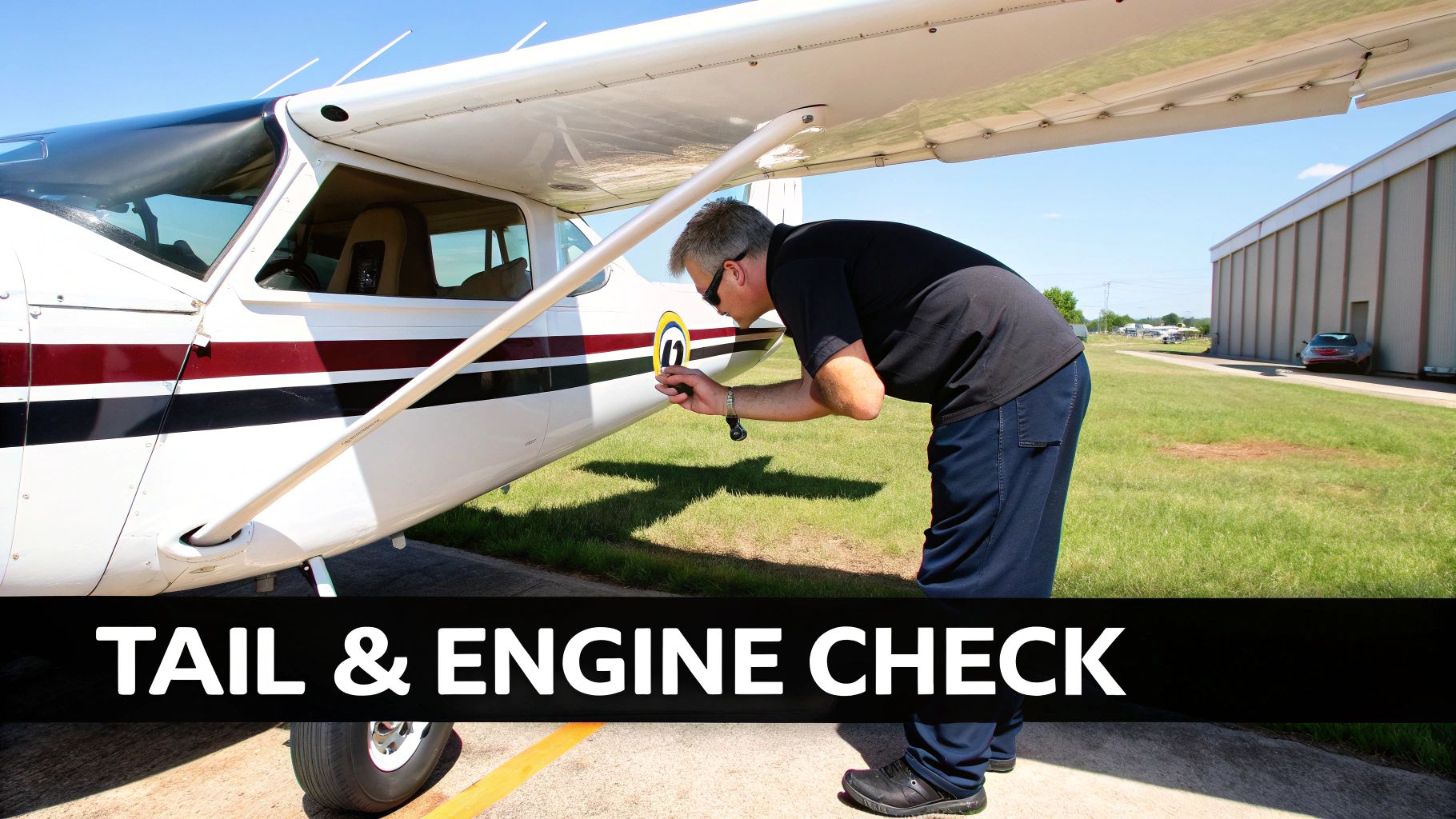
As you continue your walk-around, you'll arrive at the empennage—the tail section. This isn't just a quick glance. It’s a detailed, hands-on check of the surfaces that control the aircraft's pitch and yaw, and it's a critical part of your flow.
First, check the elevator and rudder for free and correct movement. Just as you did with the ailerons, physically take hold of each control surface and move it through its full range of travel. Does it move smoothly? Are there any odd noises, binding, or stiffness? It should feel solid and responsive.
While you're moving the controls, your eyes should be on the hinge points and all the attachment hardware. Look closely for loose bolts, missing cotter pins, or any excessive play in the connections. This level of detail is a non-negotiable habit for any student pilot aiming for a professional career.
Examining the Heart of the Aircraft
Now it’s time to move to the nose and inspect the powerplant. I can't overstate this: this is arguably the most critical part of your pre flight checks cessna 172. The engine is what keeps you in the air, and you need to be absolutely certain of its health before you even think about starting up.
Your inspection begins with the propeller and spinner. Gently and carefully run your hand along the leading edge of each blade. You're feeling for any nicks, dings, or cracks. Even a small nick can grow into a major crack from the intense vibrations and forces of flight.
The spinner needs to be secure, with no cracks spreading out from the screw holes. Grab it and give it a gentle wiggle; it should feel completely solid. A loose spinner can separate in flight, and that can lead to catastrophic damage.
Oil Level and Engine Cowling
Next, pop open the cowling door to check the engine's lifeblood: the oil. The dipstick on a Cessna 172 can be a bit finicky. The proper technique is to pull it out, wipe it clean, reinsert it fully, and then pull it out again for an accurate reading. Never depart with less than the minimum specified in the Pilot's Operating Handbook (POH), which is typically 5 to 6 quarts for most models.
Remember, the oil level is a key indicator of engine health. If it’s unusually low, you have to ask why. Is there a leak? Is the engine burning oil? This is an absolute no-go item until a mechanic gives it the all-clear.
With the cowling still open, grab a flashlight (paid link) and give the engine compartment a good look. You're searching for any signs of oil leaks—blue or black stains are the classic giveaway. Check that all the fasteners on the cowling are secure. A loose cowling can vibrate itself right off the aircraft in flight.
Finally, make sure the air intake is clear. It's a surprisingly common spot for birds' nests or other debris.
This meticulous mindset is universal in aviation, whether you're flying a Cessna or learning in a helicopter. The detailed inspection of a rotor head, its blades, and the transmission requires the same disciplined approach. As a student pilot, you'll find this skill is transferable across the diverse aircraft fleets available for training, sharpening the pre-flight instincts you'll need for your entire career.
The Engine Run-Up: Your Final Check Before Flight
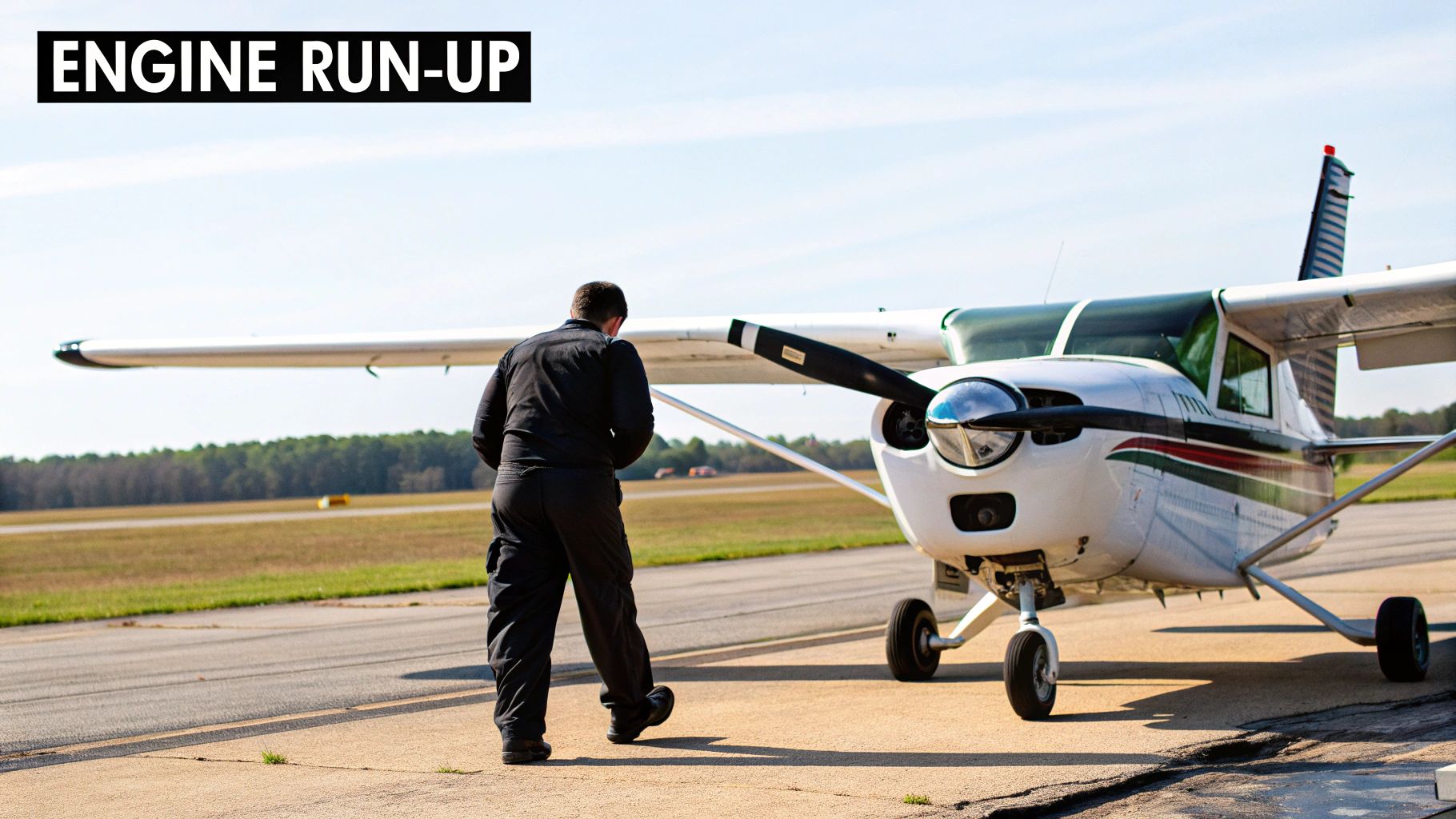
After you've done the meticulous walk-around, the engine run-up is your last big test on the ground. Think of it as a live diagnostic check. You’re not just warming up the engine; you're actively confirming that the powerplant is ready for the stress of flight. For any student pilot with professional aspirations, this is where you put your ground knowledge into practice in the cockpit.
During the run-up, you're essentially having a conversation with the airplane, interpreting its vital signs in real-time. Each step is a question, and the instrument readings are the answers. A smooth, methodical run-up is a critical safety gate that stands between you and taking the runway.
Setting the Stage for Key Checks
Before jumping into the guts of the run-up, you need to set a stable baseline for the engine. Your Pilot's Operating Handbook (POH) is the final word here, but for most Cessna 172s, you’ll bring the power up to a smooth 1700 to 1800 RPM.
Holding it at this RPM does a couple of important things. It gets the engine properly warmed up for the checks and allows the oil pressure and temperature to stabilize nicely within the green arc. Without this stable starting point, any readings you get during the following tests won't be reliable.
The Heart of the Matter: The Magneto Check
The magneto check is the core of the entire run-up. You're making absolutely sure that both of the engine's independent ignition systems are firing on all cylinders—literally. The procedure itself is straightforward: turn the ignition key from "BOTH" to "R" (right magneto), pause, then back to "BOTH." Then do the same for the "L" (left magneto).
What you’re watching for is a small, expected drop in RPM. When you switch to a single magneto, the engine is running on just one set of spark plugs, which makes combustion a little less efficient. That's a good thing—it means the switch is working.
Here's how to interpret what you see on the tachometer:
- A normal drop is usually somewhere between 50 and 125 RPM.
- An excessive drop, typically more than 150 RPM, is a red flag. This could point to anything from fouled spark plugs to a failing magneto.
- No RPM drop at all is also a big deal. It might mean you have a "hot" mag that isn't grounding correctly, which could create a dangerous situation where the propeller could kick over when you think the engine is off.
Aviation safety data consistently shows that ignoring these numbers is a bad idea. Deviations are direct warnings of ignition issues that have to be sorted out before you even think about flying. For a closer look at the numbers, you can find plenty of detailed Cessna 172 performance data online.
The magneto check is a foundational skill for a student pilot. The discipline you use to correctly interpret a 100 RPM drop in a Cessna is the exact same discipline a first officer uses to monitor engine parameters on a 737. It’s all about understanding the "why" behind what the instruments are telling you.
Verifying Other Critical Systems
Once you're satisfied with the magnetos, the run-up isn't quite over. There are a few more critical systems to check.
You’ll test the carburetor heat by pulling the control out. You're looking for a slight drop in RPM, which indicates that warmer, less-dense air is being introduced to the engine. This confirms the system is ready if you encounter potential icing conditions.
Next up is the suction gauge. A quick glance confirms that your vacuum system is producing enough power to reliably run your gyroscopic instruments, like the attitude indicator and heading indicator. Finally, do one last scan of all the engine instruments—oil pressure, oil temperature, ammeter—to make sure everything is still solidly in the green. Only then are you truly ready to fly.
Common Pre-Flight Mistakes Pilots Make
Every flight instructor has a long list of "you won't believe what I saw" stories, and a surprising number of them happen before the engine even starts. Knowing what these common slip-ups are before you ever touch the airplane is a huge advantage for a student pilot. It helps you build the kind of professional habits that separate a safe pilot from a statistic, whether your career goal is flying fixed-wing aircraft or helicopters.
One of the biggest culprits? The ticking Hobbs meter. That pressure to get airborne can make even the most diligent student start to rush through the pre-flight. When you rush, you miss things. It's as simple as that.
Right behind rushing is its dangerous cousin: complacency. After your tenth or twentieth pre-flight, the routine feels familiar. The temptation to just go through the motions from memory, without the physical checklist in hand, is incredibly strong. This is a trap that even seasoned airline captains have to consciously avoid.
The checklist is your single greatest defense against human error. Relying on memory isn't a sign of experience; it’s a sign of complacency. A true professional, from a helicopter tour pilot to an airline captain, uses the physical checklist every single time.
Real-World Errors and How to Avoid Them
These aren't just theoretical classroom warnings. Pilots have actually tried to take off with a tow bar still attached to the nose gear. They've left fuel caps unsecured, only to have fuel siphon out of the tank mid-flight. They’ve even mistaken a slug of water in a fuel sample for good, clean avgas.
Don't believe it? Data from NTSB investigations between 2010 and 2020 showed that improper preflight inspections were a direct cause in around 15% of all Cessna 172 incidents. That's a sobering statistic. It's precisely why any good flight training program hammers home the importance of a deliberate, methodical walk-around. You can see just how seriously we take it by looking at the Thrust Flight preflight checklist.
So, how do you avoid becoming one of those statistics? The method is straightforward, but it demands discipline.
- Always use the physical checklist. No exceptions.
- Touch what you check. Physically place your hand on the aileron, the fuel cap, the landing gear. This creates a tactile connection that reinforces the visual check.
- Create a sterile environment. Put your phone away. Ask your friends or family to wait until you're done. If you get interrupted, don't just pick up where you left off—go back and start that entire section of the checklist again.
Building these habits from day one isn't just about passing a checkride. It's about developing the mindset of a professional aviator, ready for the responsibility that comes with command.
Common Questions About the Cessna 172 Pre-Flight
Every student pilot aiming for a career has questions. When it comes to the pre-flight inspection, getting clear answers is what builds the confidence you need to act as a true Pilot in Command.
Let's walk through a few of the most common questions I hear on the ramp.
How Long Should a Pre-Flight Actually Take?
For a student pilot just learning the ropes, taking 20-25 minutes to do a proper, thorough pre-flight is completely normal. In fact, it’s a sign of great discipline.
An experienced pilot who has done it a thousand times might get it done in 10-15 minutes, but speed is never the goal. Thoroughness is what matters. Always give yourself enough time to feel 100% confident that the aircraft is ready to fly. Rushing is how critical items get missed.
What if I Find Something Wrong?
If you find an issue—maybe a tire looks a little low, you spot an unfamiliar drip of fluid, or a gauge isn't reading right—the decision is always simple: you don't fly.
Your job as a student pilot is to document exactly what you found and bring it to your instructor or the maintenance crew immediately.
Making the conservative "no-go" decision on the ground is one of the most professional things you can do as a pilot. It shows sound judgment, which is the foundation of a safe flying career, whether in airlines or helicopters.
This principle is universal in aviation. Whether it's a magneto check in a Cessna or a pre-flight on a complex helicopter, the rule is the same: when in doubt, ground the aircraft.
Do I Really Need to Use the Physical Checklist?
Absolutely, every single time. Memory is notoriously unreliable, and even the most experienced pilots can forget a step. Using a checklist isn't a sign of a beginner; it's the hallmark of a professional.
Every airline captain, corporate pilot, and helicopter tour pilot uses a checklist for every single flight. It builds discipline and creates a safety net to ensure nothing is ever overlooked. Treat it as an essential piece of flight equipment, because it is.
For more answers to questions that pop up during training, take a look at our detailed student pilot FAQ section.
At DuBois Aviation, we build professional aviators from the ground up, instilling the habits that ensure a long and safe career in the cockpit. Learn more at https://duboisaviation.com.
Article created using Outrank