
How to Fly Turns Around a Point
Learn how to enter downwind, adjust bank and crab for changing wind, and keep a constant radius around your reference point without chasing the ground track.
Watch the Complete Turns Around a Point Lesson
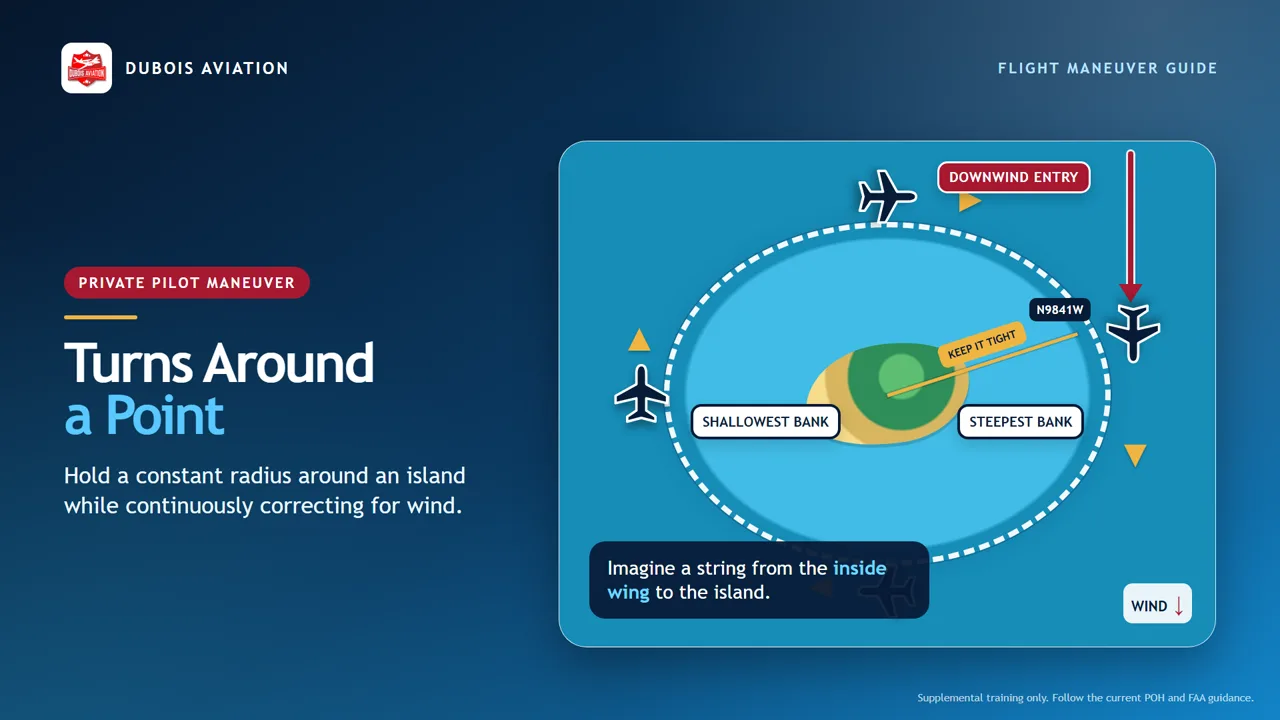
Follow November Niner Eight Four One Whiskey through the maneuver. The island represents the reference point, and the diagrams show why the bank must continually change as groundspeed changes.
Picture a String From the Wing to the Island
The easiest way to understand the maneuver is to imagine a string connecting your inside wing to the reference point. Your job is to keep that string tight and the same length all the way around the circle. Wind changes your groundspeed and pushes the airplane across the ground, so a fixed bank angle cannot hold a fixed radius.

Choose the Area First
Select a prominent point with open terrain and emergency landing options. Determine the wind before entry, clear for traffic, and avoid congested areas, towers, and unsuitable terrain.

Protect the Radius
Look through the inside wing toward the point and judge whether the imaginary string is getting longer or shorter. Correct the trend early with coordinated bank and crab.
Core idea: the steepest bank normally occurs on the downwind side where groundspeed is highest. The shallowest bank normally occurs on the upwind side where groundspeed is lowest.
Fly the Maneuver Step by Step
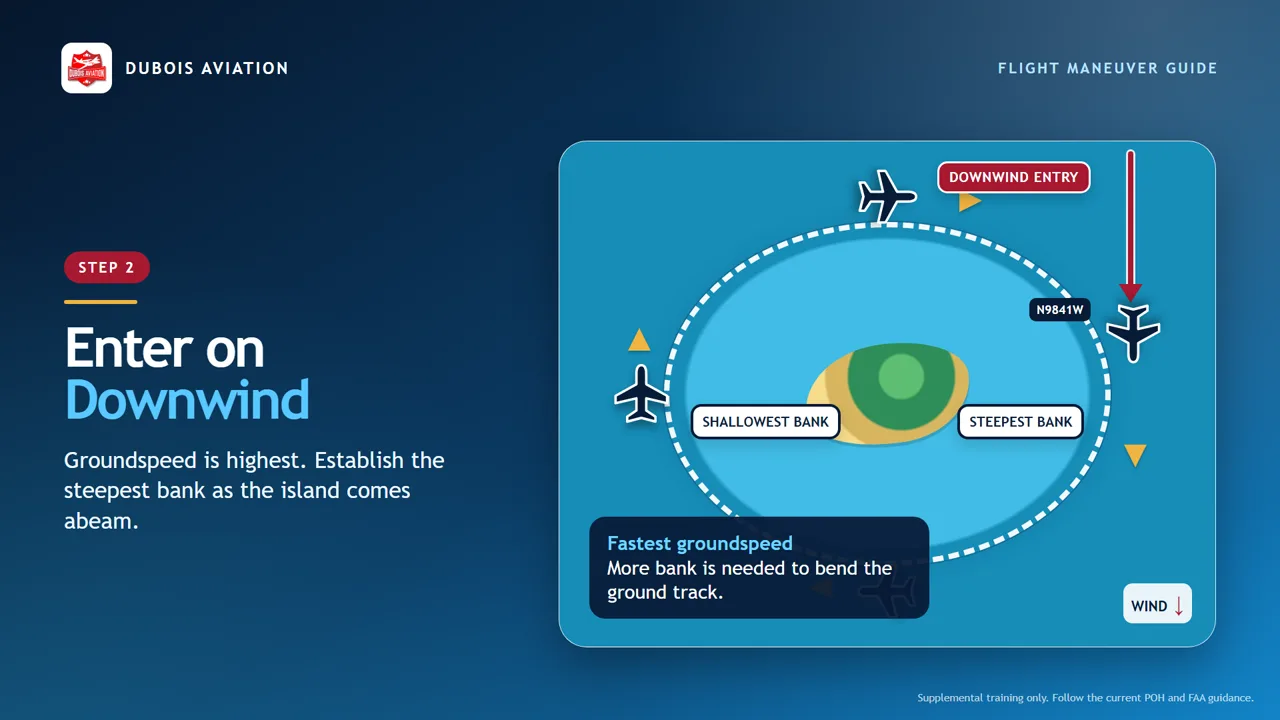
Start on Downwind
Approach the right side of the point on a downwind heading with the point abeam. Begin the turn smoothly. Because groundspeed is greatest here, establish the steepest bank of the maneuver without exceeding a safe training bank.

Shallow Toward Upwind
As the airplane turns toward the headwind, groundspeed decreases. Progressively reduce bank and adjust crab so the wind does not carry the airplane inside the desired circle.
Plan and Clear
Select a safe point, identify wind, note emergency landing areas, clear for traffic, and stabilize altitude and airspeed.
Enter Downwind
Place the point abeam and roll into the steepest bank as the high groundspeed tries to enlarge the radius.
Reduce Bank
Continuously shallow the bank as the airplane moves toward the upwind side and groundspeed falls.
Hold Upwind
Use the shallowest bank near the upwind position and apply enough crab to prevent drift across the circle.
Increase Bank
As the tailwind component returns, progressively steepen the bank to keep the faster airplane from moving outside the radius.
Complete and Scan
Return to the downwind side at the original radius while maintaining altitude, airspeed, coordination, and traffic awareness.
Current FAA Private Pilot Standards
The FAA Private Pilot Airplane ACS allows the evaluator to select a ground reference maneuver, including turns around a point. The applicant must demonstrate planning, wind correction, coordinated control, traffic avoidance, and division of attention.
| Item | Current standard or expectation |
|---|---|
| Planned altitude | 600 to 1,000 feet above ground level |
| Altitude | Maintain within ±100 feet |
| Airspeed | Maintain within ±10 knots |
| Ground track | Apply adequate wind correction to maintain a constant radius |
| Attention | Divide attention among airplane control, traffic avoidance, and ground track |
| Coordination | Maintain coordinated flight throughout the maneuver |
Training note: use this guide for preparation, not as a substitute for flight instruction. Follow your instructor, current FAA guidance, and the POH/AFM for the airplane you fly.
Common Errors and Better Corrections
Holding One Bank Angle
A constant bank produces a changing radius in wind. Continuously vary bank with groundspeed instead.
Entering Anywhere on the Circle
A random entry makes the wind picture harder to understand. Plan a downwind entry with the point abeam.
Fixating on the Point
Keep the point in your scan, but continue looking for traffic, terrain, altitude, airspeed, and coordination.
Chasing the Radius Late
Large corrections create another error. Recognize whether the string is lengthening or shortening and correct early.
Using Rudder to Skid Around
Use coordinated bank and crab. Do not force the nose around with uncoordinated rudder at low altitude.
Ignoring an Escape Plan
Choose terrain with emergency options and discontinue if traffic, turbulence, terrain, or airplane control becomes a concern.
Student Questions
Where should I enter turns around a point?
Enter on the downwind side with the point abeam at an appropriate distance. Your groundspeed is highest there, so the bank is normally steepest.
How do I know if the radius is changing?
Watch the apparent distance from the airplane to the point. Imagine the string from your wing: if it lengthens, you are drifting outside; if it shortens, you are drifting inside.
How steep should the bank be?
The exact bank varies with wind and groundspeed. Use the bank needed to preserve the radius without exceeding safe limits established by your instructor, POH/AFM, or operating rules.
Should I look inside or outside?
Use outside references as your primary information, with brief instrument checks for altitude, airspeed, bank, coordination, and engine indications.
Official Training Sources
This guide is aligned with current FAA training material. Always verify current standards before a practical test.
FAA Airplane Flying Handbook, Chapter 7FAA Private Pilot Airplane ACSMore ground reference training
Put the Sight Picture Into Practice
Train turns around a point with a DuBois Aviation instructor at Chino Airport and connect the ground lesson to the airplane.