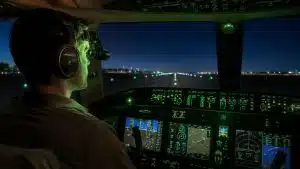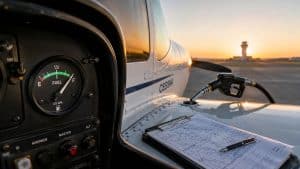
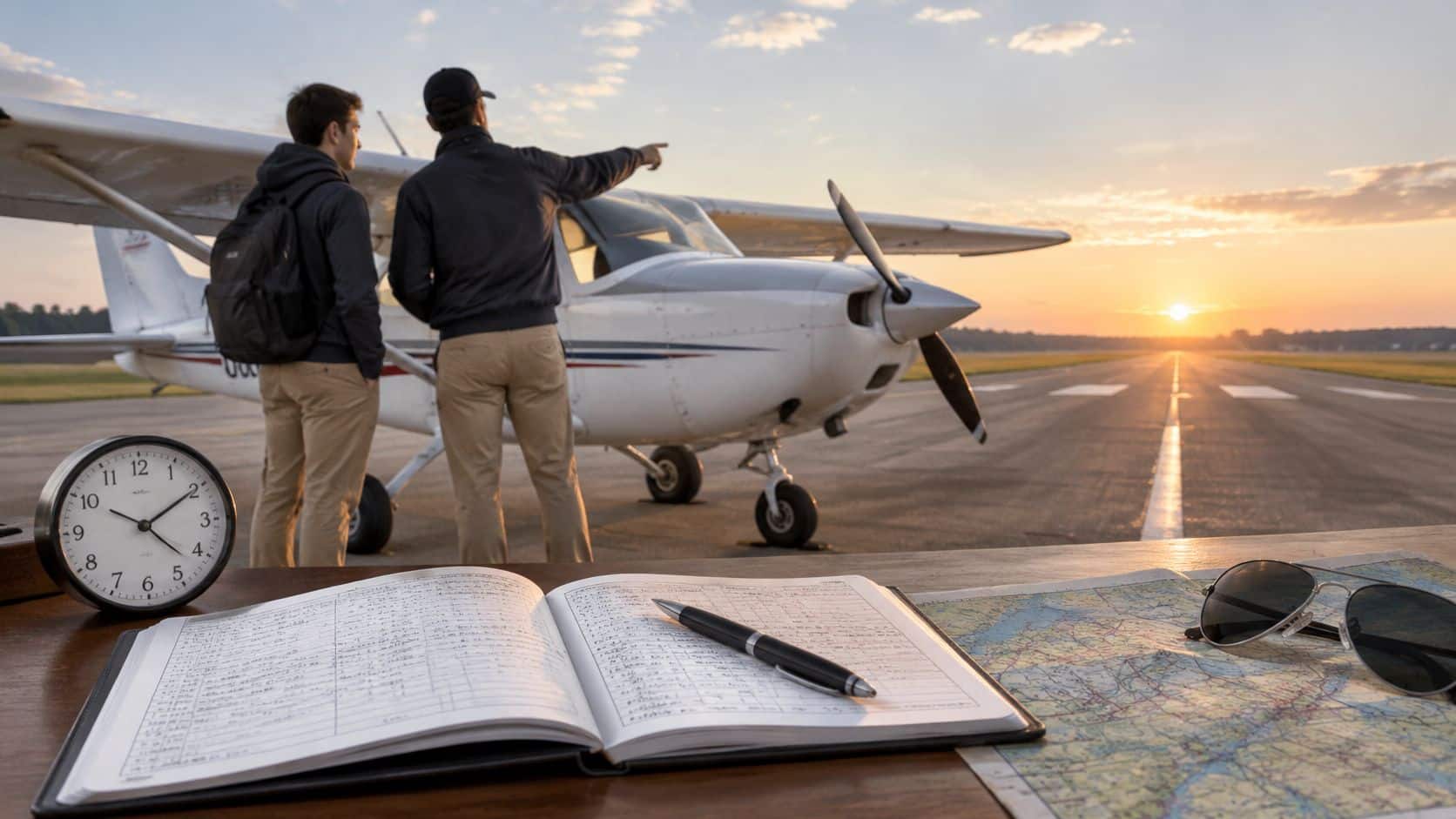
The FAA requires a minimum of 40 total flight hours for an airplane single-engine private pilot certificate, including at least 20 hours of dual instruction, 10 hours of solo flight, and 3 hours each of cross-country, night and instrument training. Those private pilot hour requirements are legal minimums, not a prediction of how long training will take.
That distinction surprises many new students. A logbook can reach the required total while one category is still short, a skill is still inconsistent, or recent test preparation has expired. Treating eligibility as readiness is the fastest way to build a plan that falls apart near the checkride.
Table of Contents
- FAA Private Pilot Hour Requirements at a Glance
- Why the 40-Hour Minimum Is Not the Finish Line
- Factors That Change Your Total Training Hours
- Sample Training Timelines by Weekly Lesson Pace
- How DuBois Aviation Builds Toward Test-Ready Hours
- Logbook and Endorsement Mistakes That Add Hours
- Plan Your Hours Before You Book Your First Lesson
- Frequently Asked Questions About Private Pilot Hours
Two practical options worth comparing
These are specific products pilots commonly compare for this type of flying. Confirm compatibility with your aircraft and instructor before ordering.
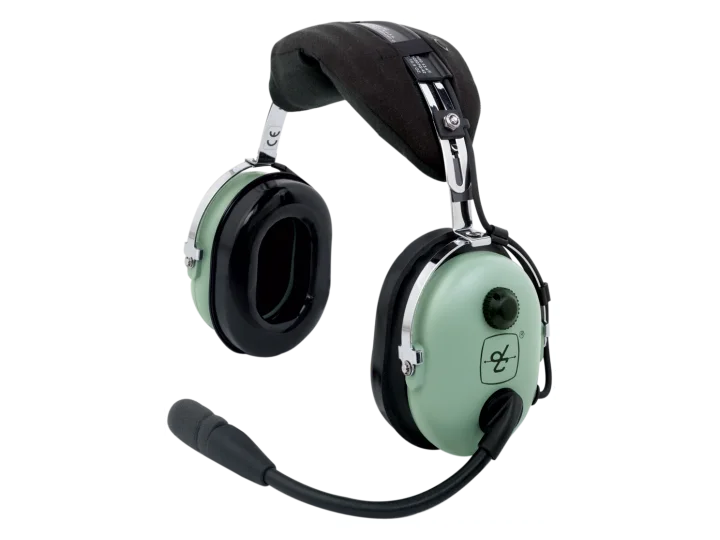 Student headsetDavid Clark H10-13.4 Aviation HeadsetCheck current availability on Amazon (paid link)
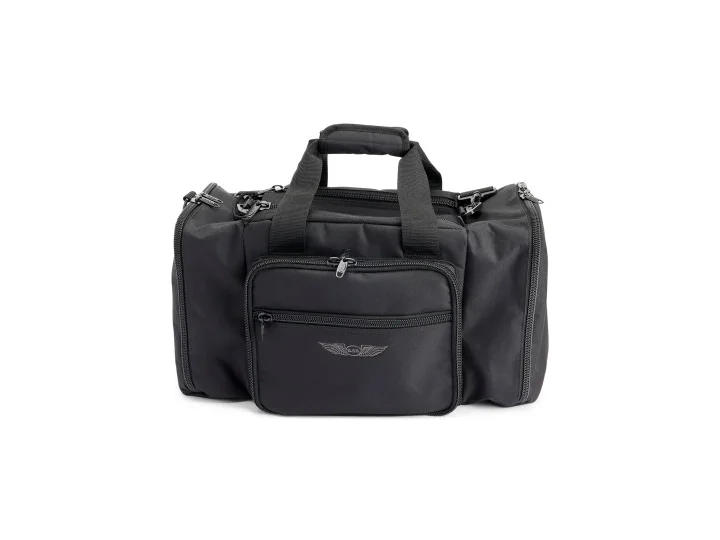 OrganizationASA Flight BagCheck current availability on Amazon (paid link)
FAA Private Pilot Hour Requirements at a Glance
Under 14 CFR 61.109, an applicant for an airplane single-engine private pilot certificate needs a minimum of 40 total flight hours, as set out in 14 CFR 61.109 on eCFR. That total is a framework, not a bucket of interchangeable time. Specific kinds of flying must sit inside it.
| Requirement | Minimum | Notes |
|---|---|---|
| Total flight time | 40 hours | Legal minimum for an airplane single-engine private pilot certificate under 14 CFR 61.109 |
| Dual flight training with an authorized instructor | At least 20 hours | Counts toward the 40-hour total |
| Supervised solo flight | At least 10 hours | Must cover the required areas of operation |
| Cross-country training | At least 3 hours | Solo cross-country flight also needs a separate instructor endorsement |
| Night training | At least 3 hours | Includes one cross-country over 100 nautical miles total distance, 10 takeoffs and 10 full-stop landings at an airport |
| Instrument training | At least 3 hours | Flight training conducted solely by reference to instruments |
| Practical test preparation | 3 hours | Completed within the 2 calendar months before the practical test |
| Approved pilot school route | 35 hours | Available to students at FAA-approved pilot schools, per the FAA |
The Categories Inside the Total
The dual and solo blocks do different work. Dual training puts an authorized instructor in the aircraft while a student learns control, procedures, navigation and decision-making. Supervised solo flight then tests whether the student can apply those lessons alone in the required areas of operation.
In 2025, the U.S. Federal Aviation Administration specified that the 40-hour airplane private-pilot minimum includes at least 3 hours of cross-country training, 3 hours of night training, and 3 hours of instrument training. The night block has sub-requirements of its own, so three casual night flights around the pattern don't complete it. A student must also schedule recent practical test preparation close enough to the test date for it to count.
Regulation Versus Recommendation
Students training at FAA-approved pilot schools follow a different regulatory route with a lower stated total. That's a difference in the legal floor, not a lower standard for safe flying or for passing the practical test.
Track every flight by regulatory category, not only by total time. A running total can't show whether the night, instrument or recent-preparation requirement is complete.
Regulations can change, so students should check the current text before planning around a number. A recommendation from a school or instructor can guide pace and budget, but it doesn't replace the rule itself.
Why the 40-Hour Minimum Is Not the Finish Line
Forty hours is the smallest legal doorway into the practical test. The FAA page on hourly requirements for becoming a pilot puts the airplane private-pilot floor at 40 total hours, and the category split in the table above shows what has to fit inside it. Clearing that floor makes an applicant eligible to apply; the examiner still evaluates whether the flying is steady, safe and repeatable.
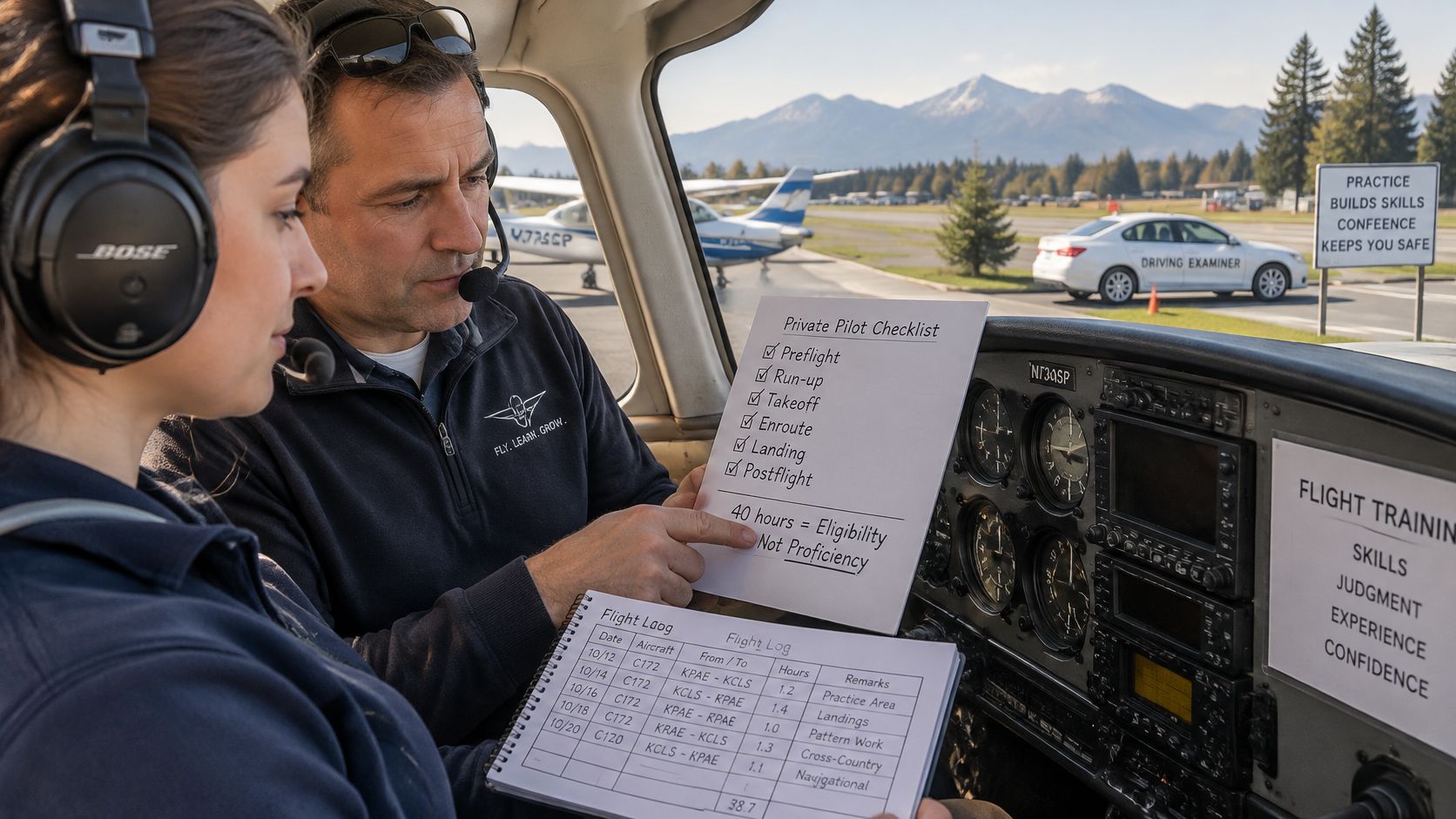
A driving test works the same way. The license examiner does not add up miles, so the result rests on calm control, good judgment and consistent recovery when something goes wrong. For the private pilot practical test, the same idea applies across required areas of operation, the knowledge test, recent preparation and instructor endorsements.
What Readiness Looks Like
A maneuver can pass once and still need work. A student may land well in a mild crosswind on Tuesday, then drift high, correct late or accept a poor touchdown on the third flight when the wind angle changes. That gap is the difference between having seen a task and owning it under the Airman Certification Standards.
Instructors usually watch for three signals:
- Consistent standards: Performance stays within the standards across several flights, including on an off day.
- Complete groundwork: The knowledge test is passed and the required areas of operation are finished.
- A clear next goal: Each lesson targets a named weakness instead of general practice.
Treat any total beyond the legal floor as a planning margin. Weather, pacing and unfinished categories can turn a fast calendar into a longer one, so budget a contingency block and ask the school for its typical completion pattern before setting a date.
Factors That Change Your Total Training Hours
Lesson frequency affects more students than any other single factor. A student who flies once every three weeks spends early lesson time relearning feel, flows and radio rhythm. That review time is necessary, but it doesn't move training forward.
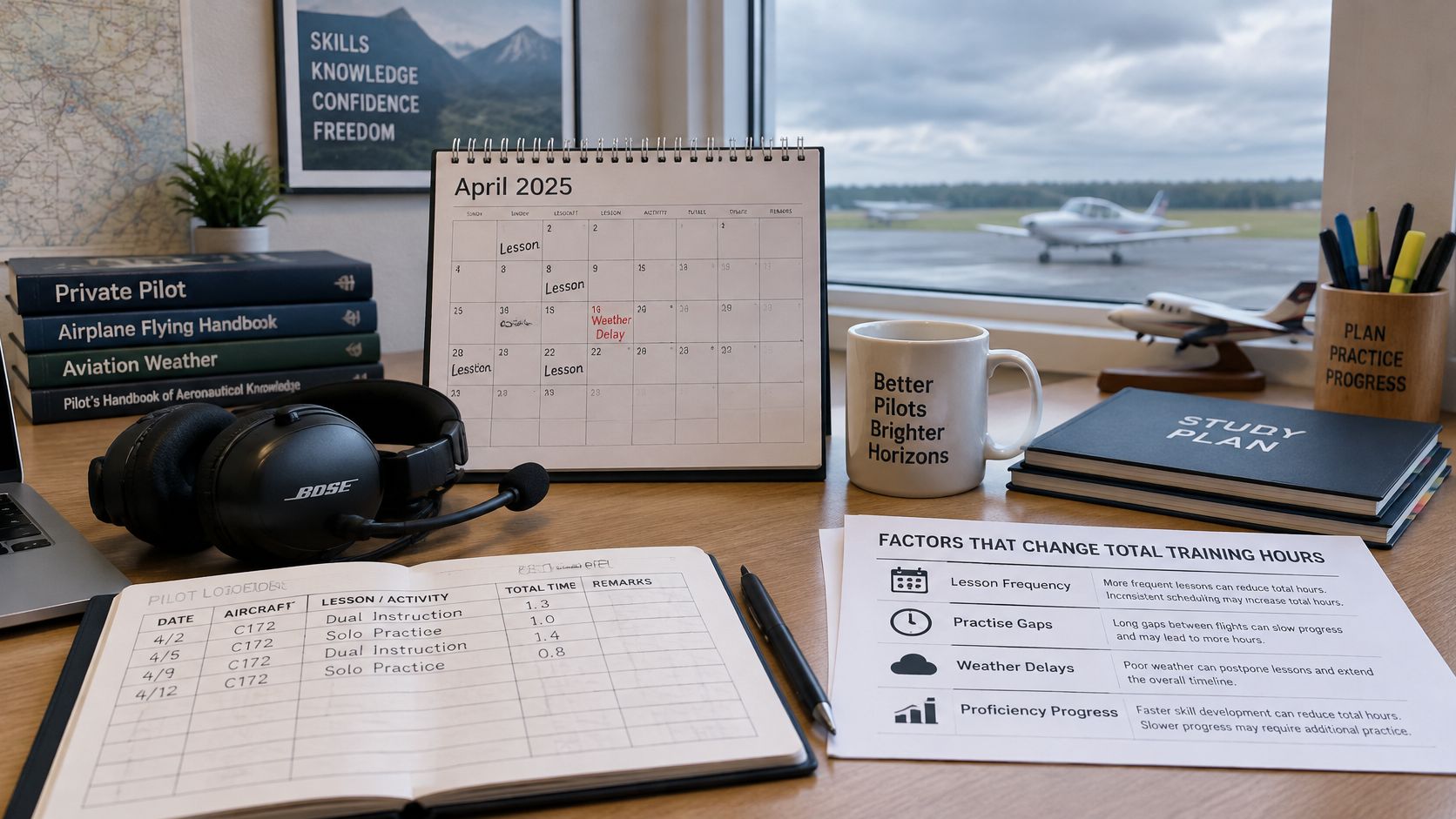
| Factor | Effect on total hours | Practical response |
|---|---|---|
| Lesson frequency | Long gaps erase skills and force review flights | Choose a weekly pace that can be sustained |
| Weather | Cancelled or scrubbed lessons stretch the calendar | Build buffer days into the schedule |
| Aircraft availability | Rescheduled slots break continuity between lessons | Ask for a backup slot or alternate aircraft when booking |
| Ground study | Students who arrive prepared repeat fewer lessons | Finish each lesson's ground topics before flying |
| Towered airport workload | Radio and airspace skills need extra practice time | Practice clearances and read-backs on every flight |
| Simulator practice | Rehearses procedures between flights | Use it for repetition, not as a substitute for aircraft time |
| Maneuver proficiency | Repeated lessons on landings, crosswinds or emergencies | Track weak items and review them before each flight |
How the Factors Play Out
Weather hits one lesson at a time. A marine layer or wind beyond a student's demonstrated limits can scrub a solo or cross-country flight, and the rescheduled lesson often opens with a short review before any new work. Aircraft maintenance or a missed slot breaks continuity the same way.
Ground study changes how much of a flight is new learning. Students who arrive knowing the procedure, airspace and checklist for the day spend airborne time flying rather than hearing first explanations. Radio work carries its own learning curve at a busy towered field such as Chino Airport, so clearances and read-backs deserve the same preparation as maneuvers.
Simulator sessions help between flights by rehearsing procedures, scans and emergency flows. They don't replace the feel of the aircraft, so progress still depends on demonstrated flying proficiency.
One structural factor sits outside student control: the approved-school route described in the first section can lower the legal minimum hours. Whichever floor applies, progress at DuBois Aviation depends on preparation, proficiency, weather, aircraft availability and examiner scheduling. Listing which factors apply to a student's own schedule is the practical first step before choosing a lesson pace.
Sample Training Timelines by Weekly Lesson Pace
| Lesson pace | Lessons per week | Planning window | What drives the result |
|---|---|---|---|
| Intensive | 3 | About four months (DuBois Aviation planning guide) | Steady weather and consistent aircraft access |
| Steady | 2 | Six months or less (DuBois Aviation planning guide) | Ground study and weekly review |
| Relaxed | 1 | Longer than six months (estimate, not a school figure) | Retention between lessons |
| Irregular or weekend-only | Varies | Set by the student's actual booking pattern | Weather and aircraft availability |
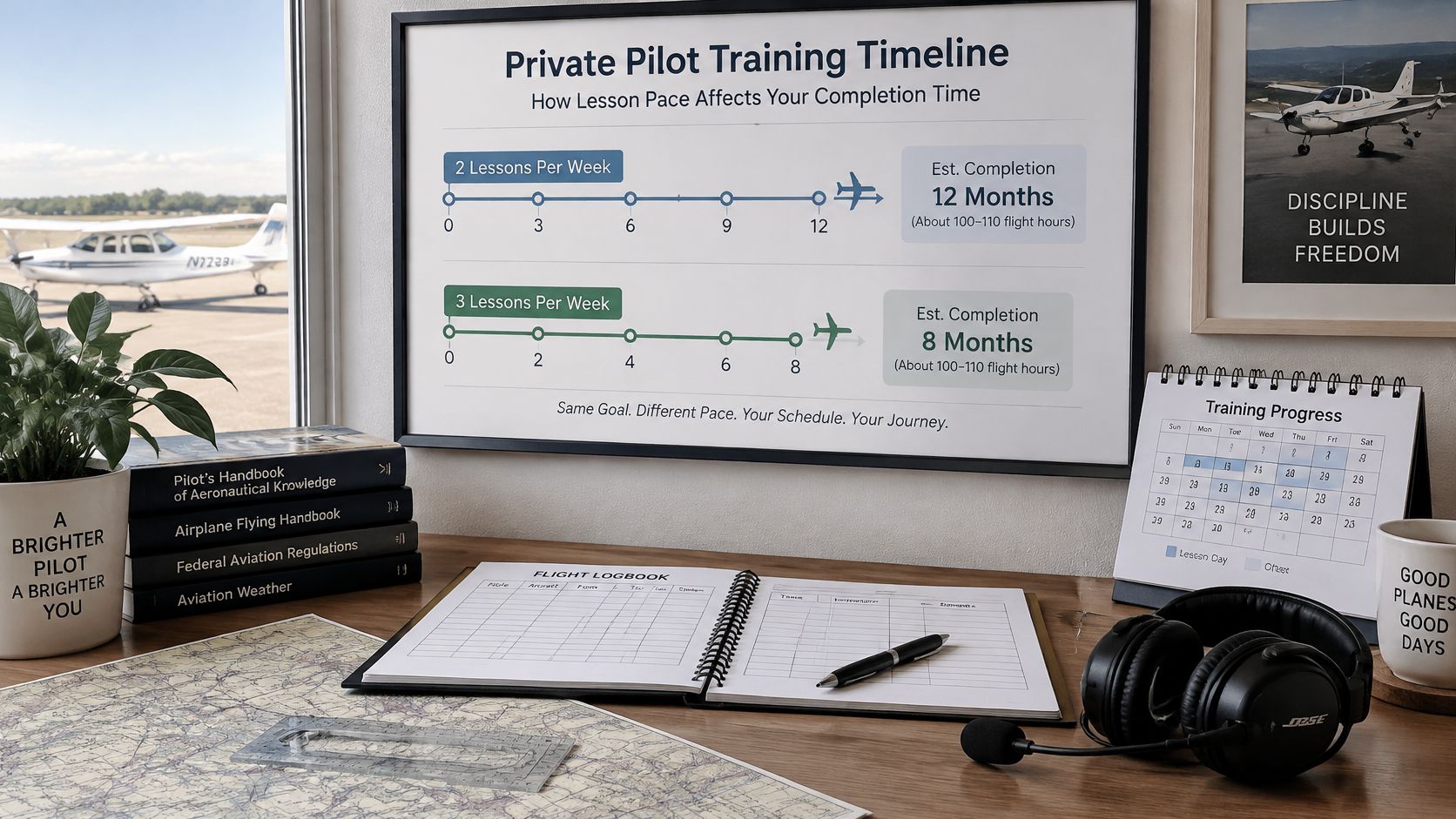
Those windows are planning guides, not guaranteed dates, and DuBois Aviation does not guarantee completion dates for the private pilot license. Two lessons per week can take six months or less, and three lessons per week can take about four months. No school figure is given for one lesson per week, so that row is treated as a longer window.
The Arithmetic Behind the Calendar
For illustration, a student flying 1.5-hour lessons three times a week logs about 4.5 hours each week. At that rate, the required flying alone would take roughly nine weeks. The actual calendar runs longer because ground study, repeated maneuvers, weather days, aircraft slots and examiner scheduling all sit between lessons.
A three-times-per-week student might spend the first stretch on fundamentals and solo preparation, the middle on navigation and cross-country work, and the final weeks on test preparation. A once-per-week student covers the same sequence, but each stage stretches because the first part of many lessons restores the previous week's skill level.
Students comparing paces can review the structure of accelerated private pilot flight training to see what a compressed schedule demands. The pace that holds for months beats the fastest pace on paper, because cancelled weeks cost review time that steady weeks don't.
Planning rule: Choose the weekly pace that survives work, family and weather, then protect it. Consistency shortens the calendar more reliably than intensity.
How DuBois Aviation Builds Toward Test-Ready Hours
A private pilot course runs as a sequence of checkpoints, and each checkpoint decides what the next block of hours is spent on. At DuBois Aviation, progress follows a set order: fly and study, solo the aircraft, learn to travel across Southern California, then schedule a checkride once the student meets the practical test standards.
- Fly and study: Early dual lessons pair aircraft handling with ground topics, so new concepts arrive before they are needed in the air. One-on-one instruction lets the lesson plan adjust to the student's pace instead of a fixed class schedule.
- Solo the aircraft: Before a student is cleared for solo, the school runs stage-check flights to review flying skills, procedures and decision-making. A completed stage check does not replace the required instructor training and endorsements, so the student still needs both in the logbook before flying alone under instructor supervision.
- Fly cross-country: Cross-country lessons across Southern California build planning, weather and radio judgment at unfamiliar airports. Because training happens at Chino Airport, a towered field, students practice radio and airspace work from the first lessons rather than cramming it near the end.
- Prepare for the checkride: Final training targets the practical test standards until performance is consistent. Before the FAA practical test, the school's checkride checkout reviews flight and ground preparation. It is separate from the examiner's checkride and is not a promise of passing. Its value is diagnostic: weak oral answers or rough maneuvers surface while there is still time to fix them.
Why the Sequence Helps Hour Planning
Each checkpoint gives the hour plan a reality test. A student delayed before solo knows early that the calendar will stretch, while a student passing checkpoints cleanly can book cross-country and test-preparation blocks with more confidence. The Jeppesen-based private pilot syllabus lays out those checkpoints in advance, and Pilot Training Tracker shows students which tasks are complete, which skills need practice and what stage comes next. The online flight schedule adds the other half of the picture, letting students see aircraft availability and when they are next scheduled so the sequence keeps moving.
Logbook and Endorsement Mistakes That Add Hours
The costliest mistake is treating the legal minimum as the target and booking a checkride around it. When proficiency or a category falls short, the test gets postponed and extra review flights follow. Four quieter errors cause the same kind of delay.
- Logging totals without categories: A bare total hides whether cross-country, night and instrument minimums are met, so record a category for every entry.
- Finishing test preparation too early: Preparation completed outside the allowed window before the test must be repeated, so schedule that block inside the window.
- Assuming one endorsement covers everything: A solo endorsement doesn't authorize solo cross-country flight, so confirm each endorsement before the flight that needs it.
- Skipping radio and weather practice: Cross-country and practice flights that ignore both skills leave gaps the examiner will find, so build them into the final lessons.
The endorsement point catches renters and students switching aircraft. The FAA student pilot certificate page explains that an instructor endorsement is required for solo flight in each make and model of aircraft, while a separate cross-country endorsement is needed for solo cross-country flights. A student can be legal to solo one airplane and still lack authorization for the planned flight.
Plan Your Hours Before You Book Your First Lesson
Students who finish near their planned timeline share one habit: they test the calendar before they pay for it. A short sequence does that work.
- Choose a sustainable pace: Pick a weekly lesson rhythm that can hold for at least three months, using the planning windows as a guide.
- Confirm the regulatory route: Decide whether the approved-school route applies and verify the school's approval status with the FAA.
- Ask what happens before lessons are scheduled: DuBois Aviation completes its provider notifications and verifies that all required authorizations are in place before training is scheduled, so ask how long that lead time runs.
- Build a buffered calendar: Add spare days for weather, maintenance and rescheduled lessons.
- Ask how the school measures readiness: Stage-check flights review flying skills, procedures and decision-making before solo, and a separate checkout reviews flight and ground preparation before the FAA practical test. Neither replaces the required instructor training and endorsements, and both belong on the calendar.
Treat the $20,000 figure as a planning estimate and ask how pace and aircraft choice affect it. Block-rate aircraft discounts can lower the total, with savings depending on aircraft choice and hours flown. Students can review private pilot training costs before that conversation.
Two low-pressure next steps work well: ask about course availability for the private pilot program, or check the flight schedule to see open slots. The enrollment form lists Private Pilot – Airplane, Instrument Rating – Airplane, Commercial Pilot – Airplane, Flight Instructor Training, Multi-Engine Training, Helicopter Training, and Other, so career-track students can map later ratings at the same time.
Frequently Asked Questions About Private Pilot Hours
Can a student earn the certificate at exactly the minimum?
Yes, provided every category, endorsement and proficiency standard is already met by that point. The minimum is an eligibility threshold, so a student who reaches it with inconsistent skills still flies more until each maneuver meets the practical test standard. Most students log additional time because at least one requirement or skill lags behind the rest.
Does the approved-school route mean less training?
It lowers the regulatory floor; the proficiency standard the examiner applies stays the same. The aeronautical experience requirements appear in 14 CFR 61.109 in the FAA regulatory database, and that text is worth reading before a student counts on any lower minimum. Weak skills still get repeated until they meet the standard.
Does simulator time count toward the required total?
Simulator credit counts only up to the limits set for each training route, so the allowable amount depends on the route and the device involved. Where a simulator always helps is between flights: DuBois Aviation offers a Gleim BATD at its facility, and rehearsing procedures on the ground makes the next aircraft hour more productive.
Does one endorsement cover a different aircraft?
No. Solo privileges apply per make and model, so a student endorsed in a Piper Cherokee still needs a separate endorsement before soloing a Cessna 150. Flying one aircraft consistently through the solo phase keeps that from becoming a scheduling problem later.
Is a medical certificate needed before solo flight?
Yes. Medical requirements sit in 14 CFR 61.23 and student pilot eligibility in 14 CFR 61.103, and the medical has to be in place before the first solo. Getting it early keeps paperwork from delaying a student who is otherwise ready, and the instructor can then align solo endorsements with the certificate timeline.
DuBois Aviation offers one-on-one private pilot training at Chino Airport that builds hour by hour toward solo, cross-country competence and a checkride-ready standard. Prospective students can ask about course availability or use the online flight schedule to plan a weekly lesson rhythm around the FAA hour requirements. Details on programs and enrollment are available at DuBois Aviation.