

A private pilot certificate typically takes about four to six months of training at two to three lessons per week, with 40 logged flight hours as the legal minimum under FAA Part 61. Why does a requirement measured in hours turn into a commitment measured in months?
Because flight hours, scheduled lessons, and demonstrated proficiency aren't the same thing. A student might reserve an aircraft regularly but lose flights to weather, need additional landing practice, or finish the flying requirements before an examiner is available. Answering how long to become a pilot starts with the intended certificate, then turns into a practical question about training frequency, preparation, and continuity.
Table of Contents
- How Long Each Pilot Certificate Takes at a Glance
- Private Pilot Hours, Frequency and Calendar Time
- Instrument, Commercial and Airline Milestones
- Building Hours From 250 to 1,500
- What Speeds Up or Delays Your Training
- Training Stages at DuBois Aviation in Chino
- Book a Discovery Flight to Set Your Timeline
Two practical options worth comparing
These are specific products pilots commonly compare for this type of flying. Confirm compatibility with your aircraft and instructor before ordering.
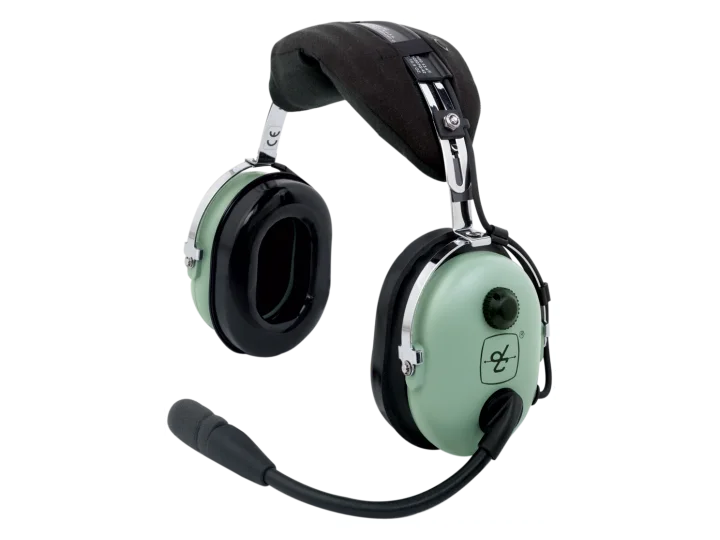 Student headsetDavid Clark H10-13.4 Aviation HeadsetCheck current availability on Amazon (paid link)
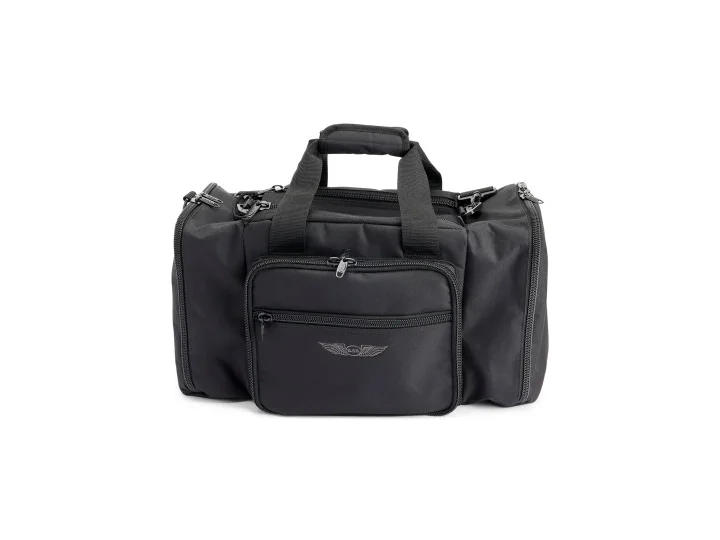 OrganizationASA Flight BagCheck current availability on Amazon (paid link)
How Long Each Pilot Certificate Takes at a Glance
The fastest way to understand the timeline is to separate two clocks. One clock counts required flight experience. The other counts real calendar time, shaped by lesson frequency, preparation, weather, aircraft availability, and examiner scheduling. A certificate works like a destination on a map. The hour minimum tells you the distance, while your weekly lesson rhythm tells you how long the trip may take.
Pilot certificates and ratings at a glance
| Certificate or rating | FAA hour requirement | Typical calendar time | Notes |
|---|---|---|---|
| Private pilot, airplane | Under the standard pathway, the private-pilot minimum is 40 total hours, as described in the FAA private-pilot regulation. Approved school programs can have a lower minimum. | About four to six months at two to three lessons weekly, using DuBois Aviation's planning guidance. | Required experience and checkride readiness both matter. |
| Instrument rating, airplane | 50 hours cross-country as pilot in command, including 10 in an airplane, plus the instrument experience and instruction specified in the FAA instrument-rating requirements. | A dedicated instrument-training block after a logbook review establishes remaining experience. | Existing qualifying cross-country experience can count. |
| Commercial pilot, airplane | The standard pathway requires extensive total experience, detailed under the commercial milestone below. | A sustained hour-building and advanced-training program, not simply an additional short course. | The starting logbook total strongly affects remaining time. |
| Multi-engine rating | Applicable add-on training, endorsements, and practical-test requirements determine the training plan. | A focused add-on course scheduled around demonstrated proficiency. | Prior experience and aircraft availability affect the finish date. |
| Airline transport pilot | 1,500 flight hours on the standard FAA pathway, described in the Bureau of Labor Statistics pilot career guide. | Commonly a multi-year journey from beginner to airline-track qualifications. | Airline hiring criteria are separate from certificate eligibility. |
A certificate and a rating do different jobs
A student who holds a private certificate can add an instrument rating to the same logbook. The certificate marks the level of qualification. The rating adds privileges to that certificate, such as instrument or multi-engine privileges.
These timelines focus on airplanes. Helicopter training and helicopter add-ons involve different aircraft handling and experience planning, so airplane estimates shouldn't be transferred directly to them.
A prospective student should identify the intended outcome first. A recreational flying goal requires a different commitment from a career plan that includes advanced ratings, instructor qualifications, and substantial experience building.
Private Pilot Hours, Frequency and Calendar Time
A lesson on the calendar and an hour in the logbook are related, but they are not the same thing. Under the standard Part 61 pathway, the private-pilot minimum is 40 logged flight hours, including 20 hours with an authorized instructor and 10 hours solo; required training includes 3 hours each of cross-country, night, and instrument-reference training, according to the FAA's hourly-requirements guidance. The flight time is the experience counted toward those requirements. The appointment around it also includes briefings, preflight inspection, radio work, postflight paperwork, and a debrief.
That distinction explains why a pilot can schedule lessons regularly and still watch the finish date move. The hour requirements describe experience that must be logged, while the calendar depends on how consistently that experience is built and retained. Skill works like a muscle memory loop: frequent repetition makes the next lesson easier to absorb, while long gaps can make the student spend time rebuilding what was already covered.
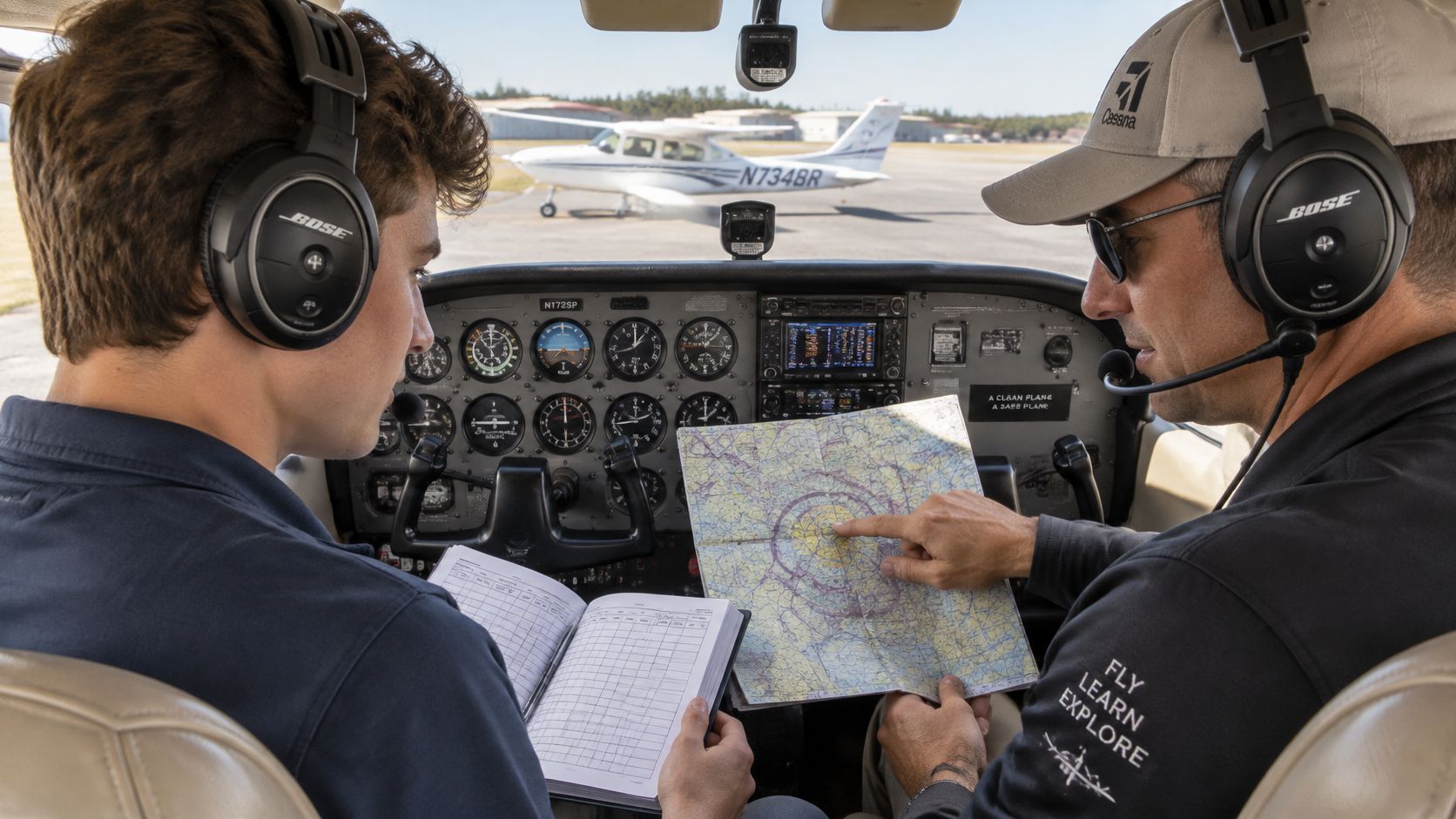
Why lesson frequency changes the finish date
A lesson block creates an opportunity to log time, but it does not guarantee useful repetition. Weather, aircraft availability, instructor scheduling, preparation, proficiency, and examiner scheduling all affect progress at DuBois Aviation. A missed week contributes no flight time, and a lesson spent reviewing rusty fundamentals may delay new material even though the student was present.
Use a simple worked example. Two lessons per week at 1.5 billable hours each creates six lesson blocks in a typical week, which is about nine hours of scheduled time across four weeks. If one week is cancelled, the student loses about three scheduled hours. That may sound small, but it can push the next stage of training back when the student needed those repetitions before moving on.
The same pattern applies to route work. A student planning a cross-country leg to a towered field may spend only part of the lesson flying the route. The instructor also checks weather judgment, navigation planning, radio calls, airport diagram use, workload management, and the student's ability to adjust when the clearance differs from the plan. Those checks turn a trip into training, and they take time.
Planning rule: Count realistic logged flight time and retained skills, not just the hours blocked on a calendar.
A practical method for estimating remaining training
- Establish the starting point. The instructor should compare the student's logbook and completed syllabus tasks with the applicable requirements.
- Estimate achievable weekly flying. Use actual availability for both instructor and aircraft, including time for briefing and preparation.
- Allow for interruptions. Include room for cancellations, review flights, maintenance, and practical-test preparation.
- Check financial sustainability. A schedule that forces a long pause midway through training isn't a reliable accelerated plan.
Hours alone do not settle readiness. A student with enough total time may still need solo cross-country experience, additional preparation, or more consistent performance.
What checkride readiness looks like
Readiness means the student can plan and conduct a flight, explain decisions, manage workload, and perform the required tasks consistently. Memorizing a maneuver sequence isn't enough if the student can't recognize an unstable situation or explain a safer alternative.
The instructor should be able to identify specific remaining gaps rather than recommend more hours. Clear objectives, such as improved approach planning or more consistent emergency procedures, make additional lessons purposeful.
Instrument, Commercial and Airline Milestones
After private training, the useful question becomes which qualification or experience category remains unfinished? Career progress isn't a single uninterrupted course with one universal end date.
Instrument training begins with a logbook review
Instrument students need both the applicable instrument experience and qualifying cross-country pilot-in-command experience. Those are different categories, and existing entries may satisfy part of the cross-country requirement.
An instructor should check aircraft category, pilot-in-command status, route, and documentation before assigning additional flying. Treating every cross-country entry as automatically eligible can produce an unpleasant surprise near the application stage.
The instrument-rating hours guide provides a useful starting point for organizing that discussion.
Instrument training also changes the workload. The student learns to manage aircraft control, navigation, communications, and approach procedures without relying on the normal outside visual picture.
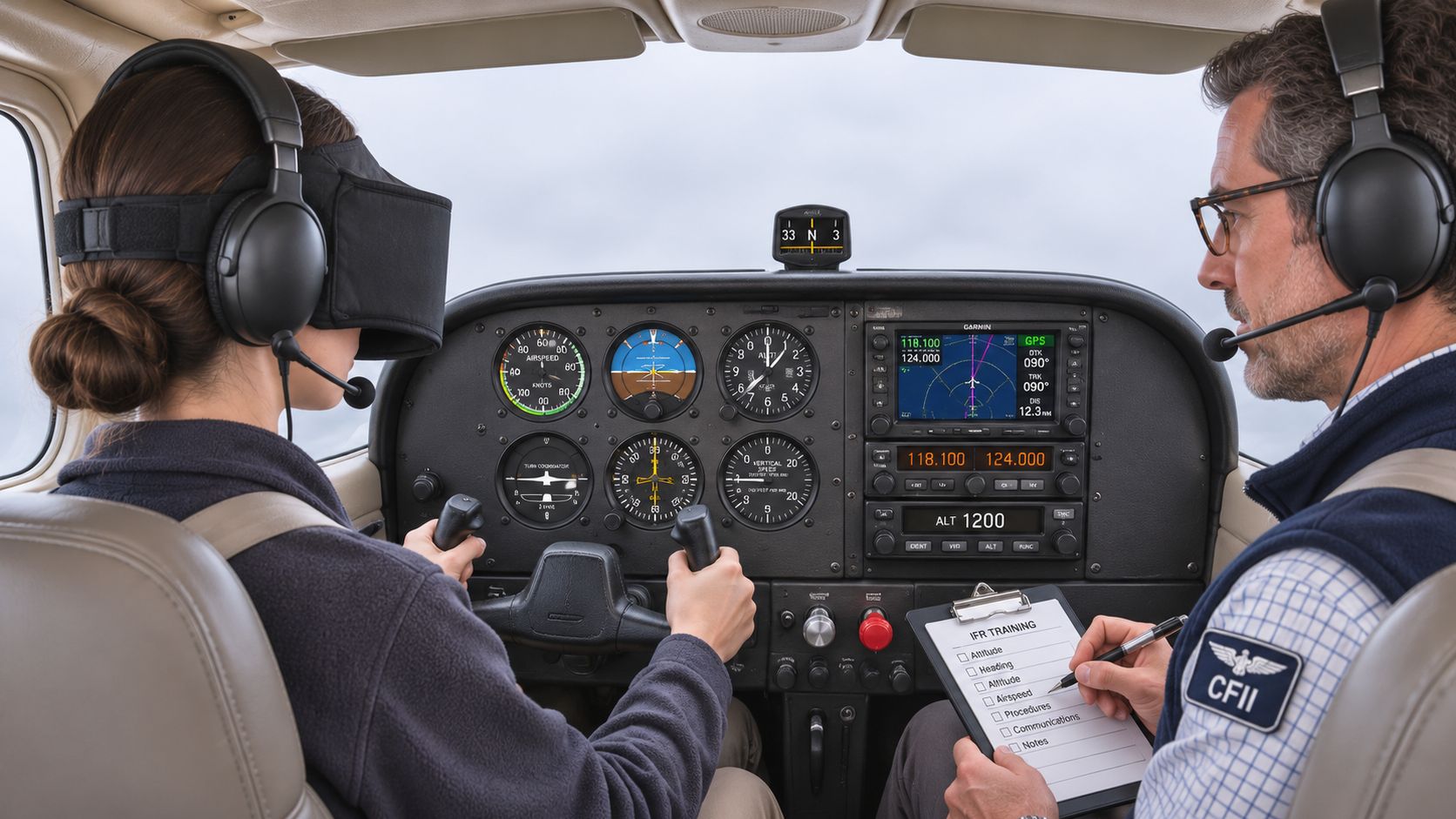
Commercial progress combines experience and precision
The commercial airplane certificate requires 250 total pilot hours under the standard Part 61 pathway, according to the FAA commercial-pilot guidance. Using that threshold, accumulating the total from zero at 10 flight hours per month takes 25 months, while 40 hours per month takes 6.25 months, before ground instruction, testing, weather, and maintenance.
Those calculations describe logged flying, not a complete training promise. A student arriving with qualifying experience has a different remaining schedule from someone beginning with an empty logbook.
Commercial preparation also involves more than accumulating time. The student must develop the precision, planning, aircraft knowledge, and decision-making expected at that certificate level.
Multi-engine training and flight instructor qualifications are common additions for career candidates. Their order should reflect the intended work, the aircraft available, and the qualifications needed for the next realistic opportunity.
A commercial certificate is a qualification milestone, not a guarantee of immediate employment.
Airline preparation includes more than flying
Airline candidates need a plan for experience building as well as recruitment preparation. Employers can evaluate communication, judgment, professionalism, and the applicant's ability to explain past decisions.
When applications become relevant, HireVue practice on Capstone Workforce offers an interview-preparation resource for candidates considering Delta Air Lines. That preparation belongs alongside, not in place of, technical study and flight experience.
The practical conclusion is straightforward: career candidates should budget for successive qualifications and a substantial experience-building phase, rather than assume commercial certification ends the journey.
Building Hours From 250 to 1,500
How long does it take to build from 250 to 1,500 hours? Between the commercial and standard airline-track totals, 1,250 hours remain. As an illustrative calculation, that gap represents approximately 31 months at 40 flight hours monthly, or 21 months at 60 flight hours monthly, with rounding and no allowance for interruptions. Think of the monthly total as the engine, and the logbook as the odometer. A strong month moves the number forward, while gaps caused by maintenance, weather, work, or family duties slow the trip.
A pilot-planning schedule might set a 60-hour month with 20 hours of instruction, 25 hours of cross-country flying, and 15 hours of instrument practice. One flight might be a cross-country to practice navigation and radio work. Another might be an instrument session focused on holding patterns, approaches, and precise course guidance. The point is to give each block a job that matches the experience category being built.
A pilot time-building plan can help organize the flying around remaining goals rather than accumulate undirected hours.
Common hour-building routes in practical order
- Flight instruction. For a pilot who earns the appropriate instructor qualifications and finds work, teaching can combine paid flying with continued development of procedural knowledge and judgment.
- Instrument and multi-engine instruction. CFII and MEI qualifications can support additional teaching opportunities where the pilot is qualified and suitable work exists.
- Corporate or charter support flying. Opportunities must match the pilot's certificates, ratings, experience, and the operation's requirements, so a pilot should read the qualification requirements before counting on any specific job.
- Purposeful personal flying. Cross-country trips and appropriate aircraft rental can help fill experience gaps when each flight targets a logbook need, such as building cross-country time, practicing instrument approaches, or refining commercial-level maneuver precision.
A CFI logs dual given and PIC time differently, so teaching hours must be checked against the logbook rules before being treated as qualifying experience. An instructor also prepares lessons, supervises appropriately, recognizes student errors, and makes conservative decisions. Teaching works best when the pilot wants that responsibility, with the hour total treated as one result of the work.
Total time alone doesn't settle eligibility
The logbook should make relevant experience categories easy to verify. Before assuming a total qualifies for the next certificate, the pilot should review pilot-in-command, cross-country, night, and instrument entries with a qualified instructor. Total time answers one question. The categories answer whether the experience fits the requirement.
Useful checkpoint: Track remaining qualifications and experience categories alongside total flight time.
This phase can occupy much of the career timeline because it requires sustained flying after initial certification. Compare planned monthly hours with actual logbook entries every month, then adjust the next plan before a small shortfall becomes a large scheduling problem.
What Speeds Up or Delays Your Training
Long gaps between lessons can add review because the student returns less familiar with procedures and cockpit workload. Two lessons per week can take six months or less to complete a private pilot license, while three lessons per week can take about four months. That works like rehearsing a piece of music: steady practice keeps the details fresh, while long breaks make the first part of the next session a reset.
The FAA private-pilot regulations establish experience and proficiency requirements. Minimum-hour totals set the floor for training, and instructor judgment, demonstrated skill, and required endorsements determine readiness.
Factors that change training time
These factors are useful for planning because they affect how steadily a student can turn lesson time into progress.
| Factor | Effect on calendar time | What to do |
|---|---|---|
| Training frequency | A three-week gap in lessons can add two review flights before the next cross-country lesson. | Reserve recurring lesson slots that remain sustainable. |
| Preparation between lessons | Weak reading or planning can turn flight time into ground review. | Complete assigned study and route planning before the appointment. |
| Instructor continuity | Handoffs may require extra assessment and briefing. | Maintain continuity when practical and keep clear training records. |
| Medical certificate timing | Unresolved eligibility can stop progress toward solo. | Address medical questions early. |
| Checkride scheduling | Examiner availability can separate readiness from completion. | Coordinate tentative timing with the instructor, then confirm readiness and eligibility. |
| Lesson structure | Unclear objectives can make a lesson feel productive without closing a specific skill gap. | Agree on the next objective and the standard for completing it. |
DuBois Aviation students can check the flight schedule to view availability and see when they are next scheduled. A recurring reservation still needs preparation and a workable backup plan. Progress also depends on preparation, proficiency, weather, aircraft availability, and examiner scheduling, so the calendar estimate should stay flexible as those conditions change.
Affordability is a scheduling issue
The FAA workforce-development presentation identifies rising flight-training costs and limited financial support as barriers to continued training. It also identifies obtaining the required medical certificate before an airplane student's first solo as an important timeline checkpoint.
Medical questions deserve early attention, especially when a student has a medical history that may require documentation or further review. The student should confirm the applicable certification path with an aviation medical examiner rather than assume eligibility.
Finances affect the calendar when lesson payments, review time, and schedule gaps stop a student from flying consistently. The relationship between training frequency and hourly rate matters because a lower-priced lesson can still produce slower progress if it leads to long gaps and repeated review. A realistic schedule keeps both the flying plan and the payment plan workable.
Common planning mistakes and their fixes
- Treating the minimum as a finish line. This creates pressure to test before consistent performance. Use instructor assessments and demonstrated proficiency instead.
- Spreading lessons too far apart. Lower monthly spending can come with repeated review. Select a cadence the student can maintain through completion.
- Postponing the medical. An unresolved eligibility issue can interrupt solo preparation. Address the medical timeline near the beginning.
- Assuming every cross-country entry qualifies. Incorrect classifications create experience gaps. Review pilot-in-command status and documentation before building the next stage.
- Confusing commercial certification with airline hiring. Certificate eligibility and employer selection have different requirements. Plan qualifications and job preparation separately.
- Budgeting only for the minimum. Additional practice can disrupt the schedule when it becomes a financial emergency. Plan the training rhythm with room for review.
A short planning checklist
- Recurring lessons reserved in the weekly schedule.
- Medical appointment arranged early enough to address questions.
- Logbook review completed with the instructor.
- Budget buffer available for cancellations, review, and additional preparation.
Training Stages at DuBois Aviation in Chino
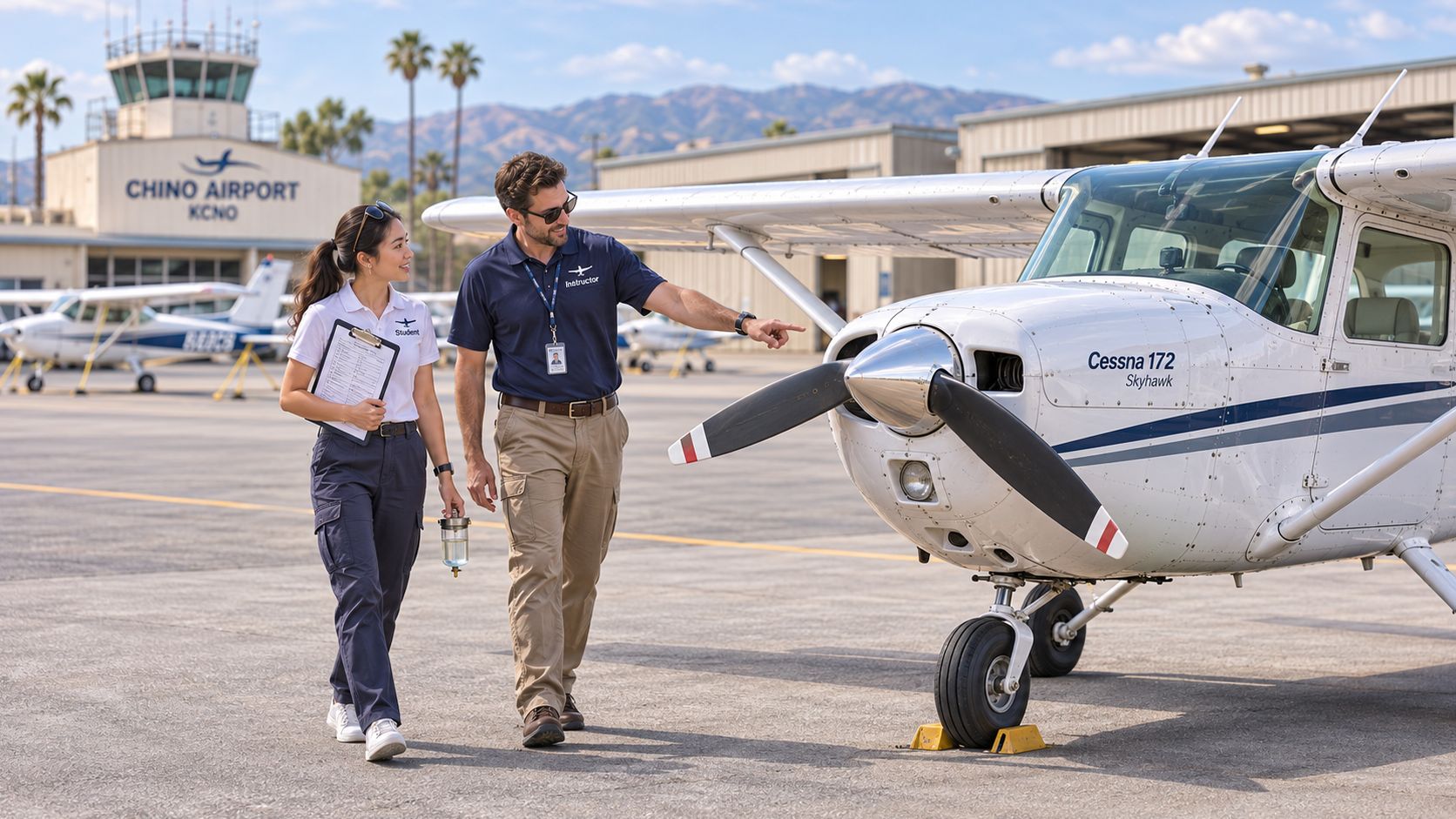
At DuBois Aviation, a student's progress follows a practical sequence: fly and study, solo the aircraft, learn to fly cross-country across Southern California, then schedule a checkride after meeting the practical test standards.
Each stage has its own job. Early lessons build control and procedure. Solo proves the student can operate safely with instructor support close behind. Cross-country training turns local practice into route planning, navigation, fuel decisions, and judgment in changing conditions. Checkride preparation then pulls those skills into a consistent performance the examiner can evaluate.
From initial lessons to solo
Early lessons combine aircraft control with procedures, situational awareness, and preparation. The instructor starts by narrowing the task list: one radar service call, one configuration change, one traffic pattern goal. As those pieces become repeatable, the student handles more of the flight without losing track of the aircraft.
Before solo clearance, DuBois Aviation conducts stage-check flights to review flying skills, procedures, and decision-making. Completing a stage check doesn't replace the required instructor training and endorsements.
Solo is a readiness milestone rather than an appointment promised at enrollment. A student who needs more practice should receive clear objectives for the next lesson.
Navigation and checkride preparation
After the initial stages, the student learns to plan and conduct flights across Southern California. Navigation preparation connects route selection, airport information, fuel planning, and changing conditions with decisions made in flight.
Chino's towered training environment adds a specific challenge. A student may be sequencing into the pattern behind Class D traffic on a busy afternoon while also managing airspeed, configuration, and radio calls. That is why phraseology and airport procedures deserve attention before the flight, not after the workload is already high.
Estimating progress by stage
A useful progress discussion separates completed tasks from skills that still need practice. The instructor can then identify the next bottleneck, whether it is aircraft control, ground knowledge, required experience, checkride readiness, or a skill that needs another lesson before it holds up under pressure.
Between solo and cross-country, the delay is often the jump from local pattern work to planning and executing a route. The student has to manage navigation, fuel, airport information, and changing conditions while also flying accurately. DuBois Aviation doesn't guarantee private-pilot completion dates. Preparation, proficiency, weather, aircraft availability, examiner scheduling, and the student's ability to retain skills between lessons all shape the calendar.
Pilot Training Tracker helps make that visible. Students can see completed tasks, skills that need practice, and the next stage of training. The tracker supports the conversation, but it does not replace instructor judgment, FAA requirements, or the readiness decisions needed before solo and a checkride.
A stage-based estimate works like a maintenance log. Establish the current stage, name the remaining tasks, then match those tasks with upcoming lessons. That gives the student a plan that changes with demonstrated progress, instead of assuming the calendar alone can produce readiness.
Book a Discovery Flight to Set Your Timeline
A discovery flight lets a prospective student sit with an instructor, see how lessons work, and ask about scheduling before choosing a training path. It also helps reveal practical questions that a certificate comparison can't answer, such as whether the proposed lesson schedule fits work and family commitments.
A practical planning sequence
- Write down realistic availability. Include travel, preparation, and study time, not just the flight appointment.
- Arrange the medical discussion. Establish an aviation medical examiner appointment and identify any questions that could affect the training path.
- Take a discovery flight. Observe the training pace and discuss the intended recreational or career goal.
- Request a written estimate. Ask for both an hour range and a calendar range, with aircraft time, instructor time, ground instruction, testing fees, and additional-lesson contingency identified.
DuBois Aviation recommends planning around $20,000 for an airplane private pilot certificate. That's a planning estimate, not a fixed-price package; aircraft choice, applicable block-rate savings, and hours flown affect the total.
Frequently asked questions
Can private pilot training fit around a full-time job?
Yes, provided the student can protect recurring lesson and study time. A modest schedule maintained consistently is more useful than frequent cancellations.
Does passing the knowledge test mean a student is nearly finished?
Not necessarily. Ground knowledge and flying proficiency develop together, but passing a written examination doesn't establish practical-test readiness.
Can existing flight time shorten the next rating?
Qualifying experience may reduce what remains. An instructor should review the entries before the student purchases additional flying.
Is accelerated training always faster overall?
Only when the student can sustain the pace and arrive prepared. An intensive reservation schedule won't compensate for unresolved eligibility or knowledge gaps.
What should a returning student do first?
Arrange a logbook and proficiency review. The instructor can identify retained skills and build a plan around actual needs.
DuBois Aviation offers one-on-one airplane and helicopter instruction at Chino Airport, from discovery flights through advanced ratings. Visit DuBois Aviation to ask about course availability, arrange a school tour, or request a training estimate matched to the intended certificate and realistic weekly schedule.


