
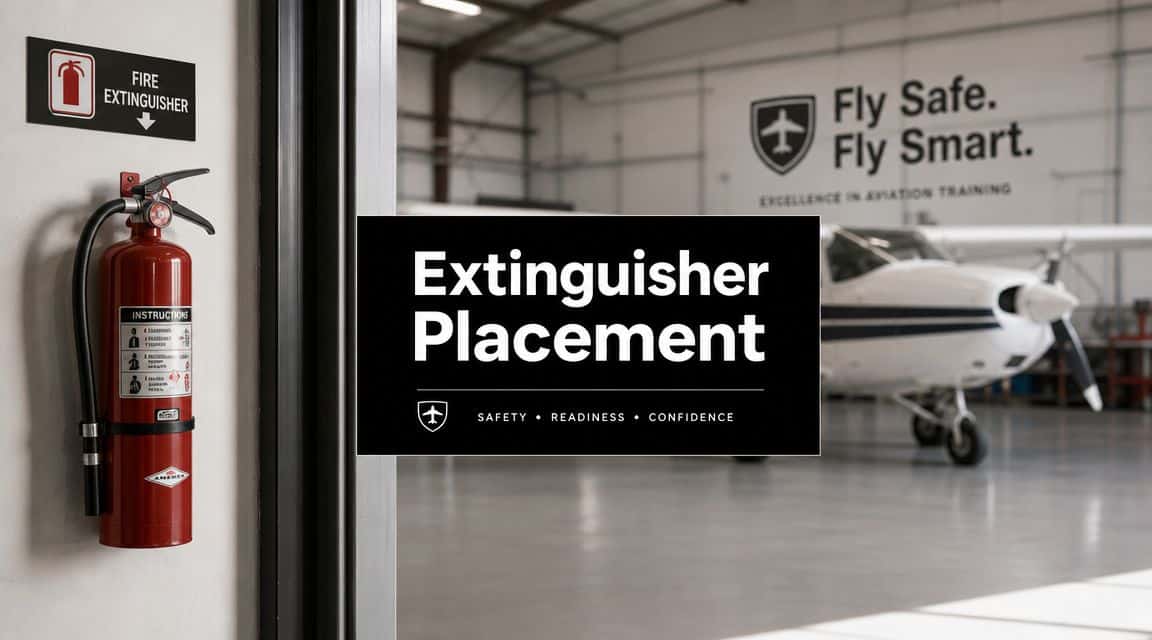
You notice the problem during a routine walkthrough. The classroom has an extinguisher by the exit. The front office has one near the copier. The hangar has a unit on the far wall, half hidden behind a tug. It looks like a fire plan, but it's really an office plan pasted onto an aviation operation.
That's where many flight schools get exposed.
A facility that trains in Piper Cherokees, Cessnas, and Robinson helicopters doesn't behave like a standard office suite. One doorway might open to a briefing room with paper, electronics, and coffee makers. The next opens to a hangar with fuel residue, maintenance chemicals, battery charging, and engine compartments. Generic placement advice often misses that mixed-use reality. As this OSHA-focused aviation gap discussion explains, most online guidance covers standard Class A, B, and K travel distances but doesn't answer where extinguishers should go in facilities with aircraft access, fuel handling, and maintenance activity.
That matters because a one-size-fits-all wall mount can leave the right extinguisher in the wrong place.
In practice, fire extinguisher placement at a flight school has to follow code and workflow at the same time. A unit can be technically present and still be functionally useless if a wing blocks the approach, a maintenance cart parks in front of it, or it's mounted where a student won't see it during a fast-developing fire. Good placement accounts for movement patterns, not just square footage.
In aviation spaces, the first question isn't “Do we have extinguishers?” It's “Can the right person reach the right extinguisher without crossing the hazard?”
That same mindset shows up in cockpit discipline and decision-making. If you train staff with the same communication habits taught in crew resource management fundamentals, extinguisher placement becomes easier to enforce because people start noticing blocked access, bad line-of-sight, and poor equipment positioning before an inspector does.
For facility managers who want a practical outside benchmark, it also helps to review how experts in fire safety and security integration approach visibility, access, and system design across complex sites. The core lesson carries over well to aviation. Fire protection works best when it's integrated into operations instead of treated as an afterthought.
Beyond the Basics of Fire Safety
Why aviation spaces break generic rules
A flight school usually combines several occupancy types in one address. You may have a reception area, briefing rooms, classrooms, a pilot lounge, a maintenance corner, a parts shelf, a battery charging bench, and a hangar floor where aircraft are moved constantly. The hazard doesn't stay consistent from room to room.
A classroom near dispatch may mainly present Class A style concerns such as paper products, furnishings, and ordinary combustibles. Step into the hangar and the profile changes fast. Fuel-adjacent activity, cleaning products, oil, engine work, and energized equipment create a different response problem. That's why “one every so often along the wall” is not a sound strategy.
The aviation environment also changes during the day. A clear path at 7 a.m. may be blocked by noon when a Cessna is repositioned, a Robinson is pulled out for a lesson, and a tow bar, ladder, and GPU end up parked where they shouldn't be.
What works and what fails
What works is zoning the facility by hazard and by likely human movement. People don't run straight lines in an emergency. They move from desks, aircraft doors, workbenches, and briefing tables. That's how placement should be judged.
What fails is relying on assumptions like these:
- One extinguisher per room is enough. Not if the room geometry forces someone to double back or cross toward the fire.
- Any visible wall is acceptable. Not if a parked wing or rotor arc makes the unit awkward to reach.
- The hangar door area is the best universal location. Sometimes it is, often it isn't. Traffic, obstruction risk, and hazard concentration matter more.
- Aircraft extinguishers solve the building problem. They don't. Aircraft units serve a different purpose and may not be accessible when the aircraft is parked, occupied, or being serviced.
A strong plan treats extinguishers as part of first response, not wall decor. That's the difference between checking a box and building a layout that helps people act correctly under pressure.
Hazard Assessment and Placement Principles
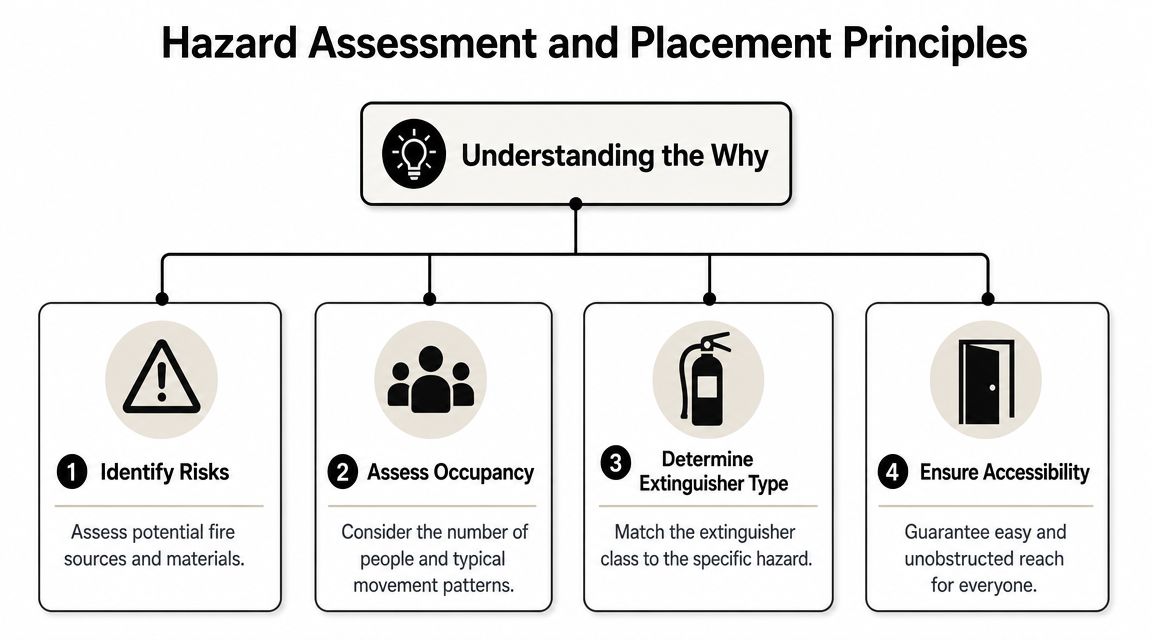
The first pass through a flight school shouldn't be about brackets and signage. It should be about identifying what can burn, how quickly conditions can change, and who will be closest when something goes wrong.
Read the facility by hazard zone
A useful walkthrough starts by labeling spaces by primary hazard rather than department name.
| Area | Likely concern | Placement mindset |
|---|---|---|
| Classroom or briefing room | Ordinary combustibles, small electronics | Keep units visible near normal exit paths |
| Hangar floor | Mixed hazards, changing aircraft positions, energized equipment | Protect travel paths and avoid obstruction by aircraft or gear |
| Maintenance bench | Flammable liquids, tools, electrical equipment | Put units where technicians can reach them without moving toward the fire |
| Battery charging area | Specialized battery-related risk and nearby combustibles | Keep a dedicated plan for that specific activity and don't rely on general room coverage |
| Kitchenette or break area | Cooking-related hazards if present | Treat separately from office or classroom coverage |
The code baseline still matters. NFPA 10 guidance uses a travel distance of no more than 75 feet for Class A hazards, and mounting height depends on extinguisher weight. Units under 40 pounds generally can have the top no more than 5 feet above the floor, while heavier units are capped at 3.5 feet, with the bottom at least 4 inches off the ground, as summarized in this NFPA 10 placement guide. OSHA's 1910.157 standard reinforces those dimensions in workplace practice.
Match the extinguisher to the hazard
Aviation operators get into trouble when they think distance is the whole issue. It isn't. Type matters just as much.
- Class A areas include offices, classrooms, and paper-heavy dispatch spaces.
- Class B conditions are common where flammable liquids are present or handled.
- Class C concerns often ride along with energized electrical equipment.
- Class K applies to cooking hazards, if your facility has that kind of setup.
- Class D deserves special attention anywhere metal fire risk is present, and many managers also use the term loosely when talking about specialized battery hazards. Don't do that casually. Match the extinguisher to the actual hazard, not to a guess.
Practical rule: If the fire scenario in your head starts with fuel, solvent, wiring, battery charging, or engine work, stop treating that area like a classroom with a red can on the wall.
Think in paths, not points
A hangar with one extinguisher at each end can still have a bad layout. Aircraft geometry changes reachability. A Piper wing can hide a unit. A Robinson on the floor can alter the route people take. A line technician may need to move around a tug, toolbox, or nosewheel tow bar before getting to the extinguisher.
That's why the most reliable layouts are built around likely occupant positions. Start where the instructor stands during a briefing, where a student exits the aircraft, where a mechanic works at the bench, and where line staff stage equipment. Then ask whether the route stays clear when the room is busy.
Decoding NFPA OSHA and FAA Regulations
A flight school can satisfy one rule set on paper and still create a bad extinguisher layout in the actual building. That usually happens when managers treat OSHA, NFPA, and FAA guidance as separate checklists instead of one placement standard applied across classrooms, hangars, shops, and aircraft.
What OSHA expects in day-to-day operations
OSHA 29 CFR 1910.157 is the workplace baseline. Inspectors are looking for extinguishers that employees can get to quickly, identify without hesitation, and use without crossing into the hazard itself.
OSHA states that employers must provide portable extinguishers and mount, locate, and identify them so they are readily accessible without exposing employees to injury. In a flight school, that changes how you judge a location. A unit by a classroom door may be fine. A unit in a maintenance bay that requires a technician to go past a fuel drain pan, battery cart, or running ground power unit is not a good location, even if the wall technically has an extinguisher.
The practical reading is simple. Accessibility is measured by the path a person takes during a fire event, not by the straight line on a floor plan.
OSHA also expects mounting and maintenance to follow recognized practice, which is why schools usually pair 1910.157 with NFPA 10 during setup and inspections. The OSHA text is available directly from the portable fire extinguishers standard at OSHA.
Where NFPA 10 helps you make placement decisions
NFPA 10 is the document I use when turning a broad safety requirement into a wall location, cabinet choice, or spacing plan. It gives managers the selection, installation, inspection, and travel-distance framework that OSHA does not spell out in the same practical way.
NFPA also addresses a point that matters in aviation buildings. Travel distance is based on how occupants reach the extinguisher within the space, not on an abstract radius drawn over an empty room. In a hangar with a Cessna 172 parked for dispatch, a Piper Archer on the other side, and a Robinson R44 near the corner, wings, rotor clearance areas, benches, and carts can all break up what looked like simple coverage. NFPA explains extinguisher distribution and travel distance in its portable extinguisher placement guide.
That is also why rated separations still matter. If your school has a parts room, flammable storage area, or shop opening into occupied training space, understand how fire door ratings fit into the larger protection plan. Extinguishers support the response. Compartmentation limits fire spread and keeps access routes usable.
What FAA guidance changes once the extinguisher is tied to the aircraft
FAA expectations apply differently inside the aircraft than they do on the wall of a hangar. The aircraft extinguisher has to be secure in turbulence and reachable in the occupied compartment during normal operation or an onboard fire event.
For larger aircraft, FAA regulations require hand fire extinguishers in accessible cabin locations. Even where a training aircraft is not subject to the same cabin extinguisher requirement as a transport-category airplane, the FAA's operating and airworthiness framework still pushes the same placement logic. Secure mounting matters. Reachability matters. A loose bottle under a seat or buried in baggage is poor practice and can become its own hazard.
FAA guidance and regulations on onboard fire extinguishers are addressed through the agency's regulatory material, including 14 CFR § 23.851 on fire extinguishers.
For a flight school manager, the practical rule is to separate building compliance from aircraft compliance. A compliant hangar wall unit does nothing for an instructor strapped into a Robinson cockpit or a student in the right seat of a Piper if the onboard extinguisher is missing, unsecured, or unreachable.
Aviation-Specific Placement Scenarios
The actual test of fire extinguisher placement is whether the layout still makes sense during a normal, messy operating day. A neat floor plan can look compliant and fail once aircraft, carts, students, and instructors start moving.
Hangar floor around parked aircraft
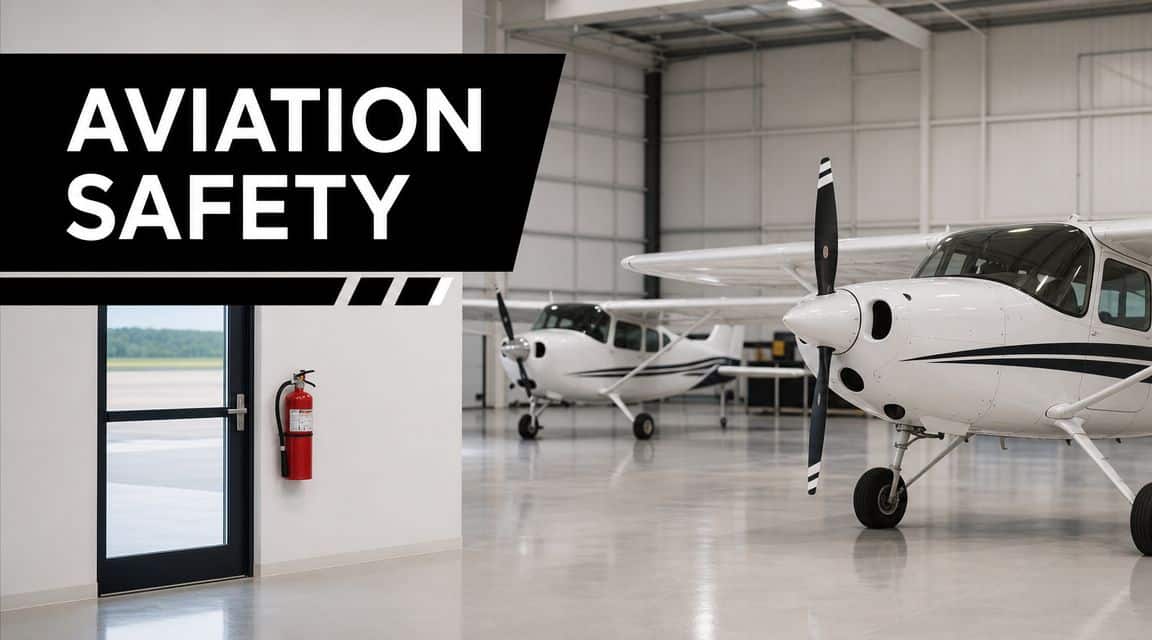
Take a common training hangar setup. A Piper Cherokee is parked nose-in near one side, a Cessna sits angled for the next lesson, and a Robinson helicopter occupies a corner with blades secured. The mistake is mounting one extinguisher where the wall looks open when the hangar is empty.
A better layout puts extinguishers where aircraft parking won't routinely block them. That usually means locating units near personnel paths, near exits, and near activity nodes instead of centering everything on wall symmetry. If a wingtip or rotor disk area can obstruct sightlines, move the extinguisher.
For open hangars, geometry matters as much as count. Coverage should fit how people move through the space, not just the room dimensions shown on a lease drawing.
Maintenance and battery charging areas
A maintenance bench has a different tempo. A technician may be bent over an open cowl, using solvents, handling parts, or working around energized systems. Battery charging areas raise another placement problem because the unit must be accessible without forcing someone to step deeper into the hazard zone.
Good practice in these areas usually means:
- Placing the extinguisher off to the side of the work area, not directly behind the bench where the fire may start.
- Keeping sightlines clear above stored equipment, so the unit remains obvious even when shelves and carts fill up.
- Separating general room coverage from task-specific hazards, especially where charging, fluid handling, or engine work happens regularly.
What doesn't work is relying on the extinguisher by the main hangar door to cover a maintenance corner.
Classrooms and briefing rooms
Briefing rooms often get the least thought because they feel low risk. They still need a clean, visible placement strategy. Students under stress tend to move toward exits they already know, so extinguisher locations near those routes make more sense than units hidden behind desks, whiteboards, or stackable chairs.
This is also where safety habits connect to pilot habits. The same discipline behind a classroom walkthrough mirrors the discipline behind a preflight. If your instructors already teach students to look for missed details before startup, it's worth reinforcing that same scanning culture with operational checks tied to spaces and equipment.
Inside the aircraft
Aircraft placement is its own category. The question isn't whether the airplane already has a fire extinguisher. The question is whether it's securely mounted, visible, and accessible in the occupied compartment.
That matters differently in different aircraft:
- Cessna cabins need access that isn't blocked by seat position or loose gear.
- Piper cabins often have storage temptations that can bury emergency equipment.
- Robinson helicopters have tighter cabin constraints, so secure mounting and unobstructed reach are even more critical.
In some airplanes, FAA guidance requires at least one hand extinguisher in the passenger compartment. That rule reminds managers that placement isn't only a wall issue. It's an operational reach issue.
If a pilot or passenger has to hunt for the extinguisher, dig around baggage, or unjam it from loose equipment, the placement is wrong even if the aircraft technically carries one.
Installation Mounting and Inspection Protocols
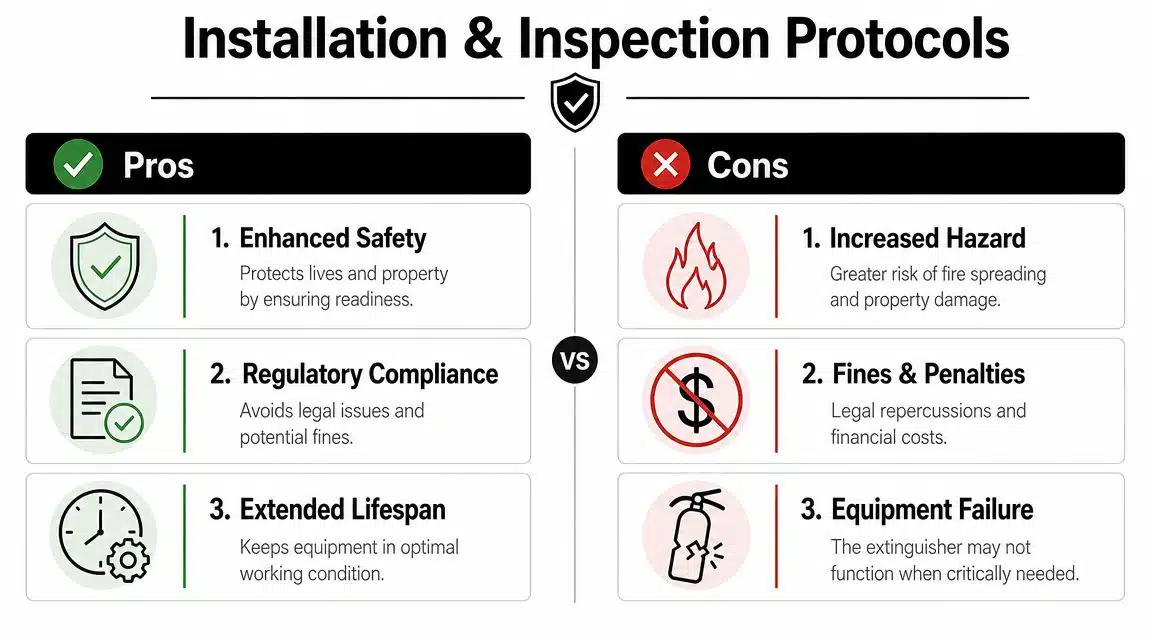
A flight school can choose sensible extinguisher locations and still fail an inspection because the unit was mounted where a person cannot pull it free under pressure. I see that problem more often in mixed-use facilities than in single-purpose buildings. Hangar staff want clearance from tow bars and wing tips. Instructors want walls kept clean. Maintenance wants equipment close to the work. Those priorities are understandable, but they can produce bad mounting decisions.
Mount it so people can remove it fast
NFPA 10 sets the baseline for mounting and inspection practice, and OSHA expects extinguishers to be mounted, located, and identified so they are readily accessible to employees. In a flight school, “readily accessible” needs a stricter reading than it does in a plain office. A wall cabinet that works in a classroom may be a poor choice beside a Cessna 172 wing root or a Robinson skid where clearance changes through the day.
Height matters. Bracket security matters. Clearance below the unit matters. So does the direction a person has to move to grab it.
In hangars, mount extinguishers where a technician can step to the unit, pull it cleanly from the bracket, and turn back without catching the bottle on a ladder, tool chest, or wing strut. In maintenance bays, protect the extinguisher from bump damage, but do not recess it so far that the handle is hard to grab with gloves on. In classrooms, keep the unit visible and low-stress to reach, not tucked behind a door swing or hidden by stacked briefing chairs.
Aircraft deserve the same discipline. A cockpit extinguisher that shifts, rattles loose, or requires two hands and a body twist to remove is poorly installed even if the bracket looks secure on paper.
What to check on a monthly walk
Monthly checks work best when they follow the same route every time. Start from the places where people work, not from the extinguisher.
- Walk the access path. In a hangar, that means checking around nose wheels, tow bars, battery carts, and the temporary clutter that appears during fueling, cleaning, and inspections.
- Pull-test the mounting point by hand. The bracket should hold the unit firmly and release it without a fight.
- Check sightlines to the sign and the extinguisher body. A Piper parked slightly off line can block more visibility than managers expect.
- Review the condition of the unit. Gauge, pin, seal, hose, label, and inspection tag all need a quick look.
- Note environmental wear. Dust, vibration, chemical residue, and sun exposure inside hangar-door lines age equipment faster than classroom conditions do.
For teams that want another maintenance perspective, a concise UK fire extinguisher compliance guide can be useful for comparing inspection habits and documentation discipline, even if your governing rules are U.S.-based.
Build the check into work that already happens
The schools that stay inspection-ready do not treat extinguisher checks as a separate safety project. They attach them to routines that already exist. Opening the hangar, positioning aircraft for the first lesson block, and closing out maintenance for the day are all good trigger points.
That checklist habit should feel familiar to any chief instructor or line supervisor. The same discipline behind pre-flight checks for a Cessna 172 applies here. Conditions change between shifts. A clear extinguisher at 0700 can be blocked by a parts cart at 0900.
I would rather see a short, repeatable inspection done every month by people who know the building than a polished form completed after no one looked at the bracket, the path, or the obstruction risk. In a flight school, good mounting and inspection protocol is daily operational control, not just paperwork for the file.
Quick-Reference Placement Checklist
A final walkthrough should be fast enough to use on a busy day and strict enough to catch actual failures.
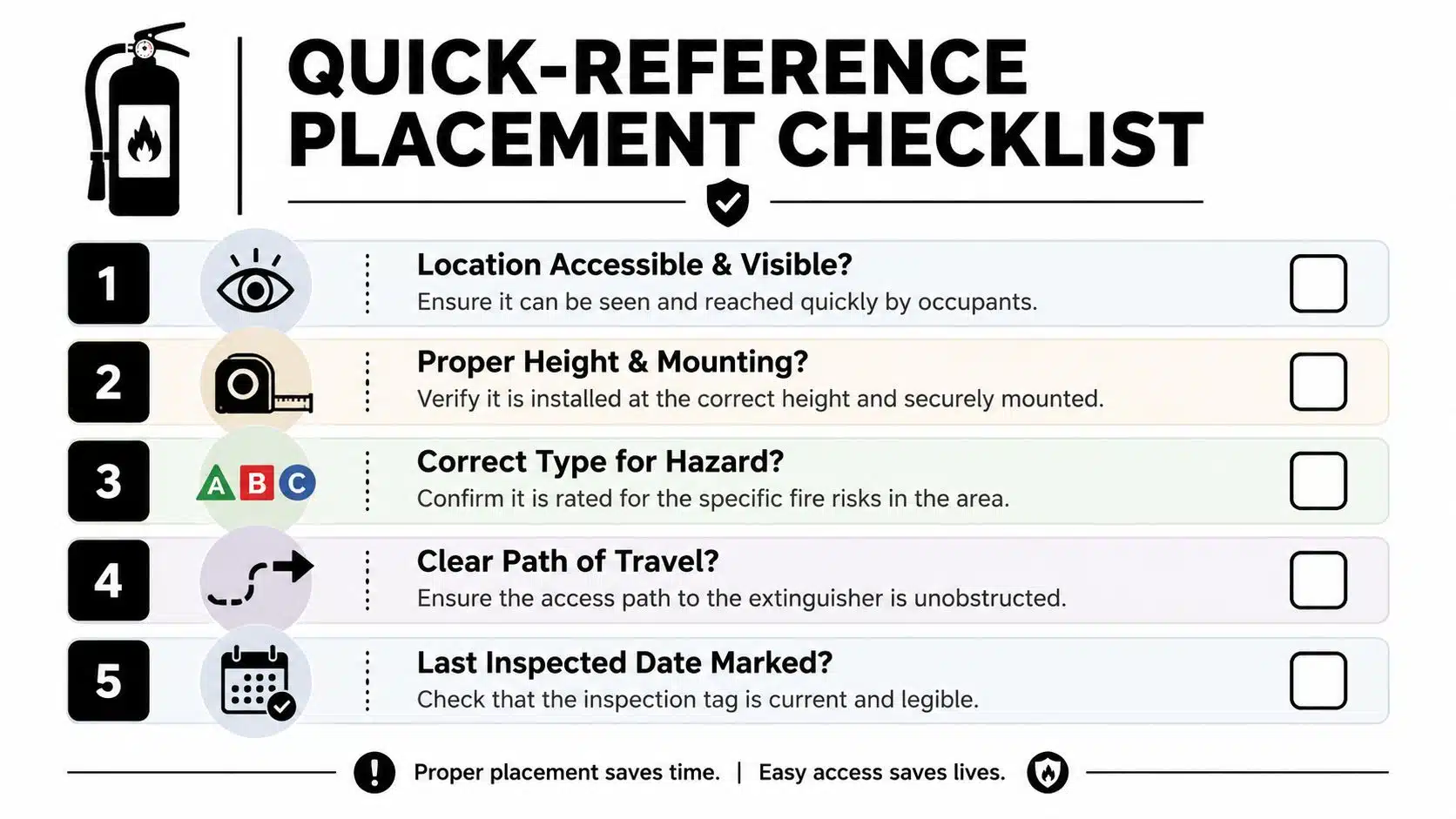
Walk the facility in this order
Hangar
- Check visibility from active work positions. Don't judge from an empty floor. Look from the aircraft door, tug lane, and maintenance corner.
- Confirm the path stays open. Wings, ladders, carts, and tow bars are the usual offenders.
- Make sure the unit suits the hazard. General room coverage and fuel-adjacent work are not the same problem.
Classrooms and briefing rooms
- Place units near normal exit routes. Students and staff move toward familiar doors in an emergency.
- Keep furniture from hiding the extinguisher. Chairs, cabinets, and teaching aids can erase visibility quickly.
Maintenance and charging areas
- Position the extinguisher so staff can reach it without moving toward the fire.
- Watch for clutter creep. Shelves and rolling boxes tend to migrate into access paths.
Aircraft
- Verify secure mounting in the occupied compartment where required.
- Check real reachability from normal seating and movement. A buried extinguisher doesn't count.
The reason this level of discipline matters is simple. Portable extinguishers were responsible for suppressing more than 93% of blazes in 2021, according to the fire extinguisher placement data summarized by InspectNTrack. That kind of performance only helps when the extinguisher is placed where people can get to it fast.
If your team already uses cockpit tools and electronic checklists, it can help to think about extinguisher checks the same way pilots think about gear setup and situational awareness with tools like an iPad for pilots. The tool only helps if it's where you need it, when you need it, and ready to use.
Proper fire extinguisher placement isn't a paperwork exercise. It's first-response engineering for the exact way your school operates.
If you're looking for flight training that treats safety as a daily operating standard instead of a marketing slogan, DuBois Aviation offers airplane and helicopter instruction, aircraft rental, and structured training at Chino Airport with an emphasis on practical proficiency, disciplined procedures, and real-world operational awareness.


