
Pressure altitude formula: the quick answer
Pressure altitude (ft) approximately equals field elevation (ft MSL) + (29.92 – altimeter setting in inHg) x 1,000. This is a useful approximation, not a substitute for the aircraft’s approved performance charts.
Two worked examples
- Lower pressure: 1,000 ft elevation and 29.42 inHg gives 1,000 + 500 = 1,500 ft pressure altitude.
- Higher pressure: 1,000 ft elevation and 30.12 inHg gives 1,000 – 200 = 800 ft pressure altitude.
These are hypothetical examples, not current airport weather. Lower-than-standard pressure increases pressure altitude. Temperature is not in this formula; it matters when using performance charts and determining density altitude. Pressure altitude is not height above terrain.
On the ground, an altimeter set to 29.92 indicates pressure altitude. Restore the appropriate setting before flight; do not change an operating altimeter merely to try this calculation in flight. Sources: FAA PHAK, Aircraft Performance and FAA AIM, Altimeter Setting Procedures.
You're probably here because you've heard the term in ground school, seen it in a performance chart, or had an instructor mention it before a summer departure. The phrase sounds technical, but the idea is practical. What is pressure altitude? It's one of the first numbers that tells you how your airplane is likely to behave before the wheels ever move.
If you rent aircraft, train in Southern California, or you're comparing airplanes to buy, this matters more than many pilots realize. A runway that looks generous on paper can feel very different when the air is thin, and the first step in understanding that difference is pressure altitude.
Your First Lesson in Aircraft Performance
A student pilot taxis out from a high-elevation airport on a warm afternoon. The airplane is legal, the engine run-up is normal, and the runway is the same runway it used on a cool morning months earlier. But the airplane won't perform the same way.
That's where many new pilots first run into the practical meaning of pressure altitude. It isn't just a written-exam term. It's the starting point for understanding why an airplane accelerates differently, climbs differently, and gives you a smaller margin when conditions aren't ideal.
Pressure altitude is one of those topics that seems abstract until the day your takeoff roll feels longer than expected.
Students often ask, “Why can't I just use field elevation?” Because the airplane doesn't care only about where the airport sits on a map. It also reacts to the atmospheric pressure acting on it that day. Performance charts are built around that pressure-based reference, not just the number listed for airport elevation.
Why pilots get tripped up
The confusion usually comes from the word altitude itself. In flying, that word can mean several different things depending on context. One number may help you clear terrain. Another may help you comply with airspace. Pressure altitude has a different job. It helps you begin the performance calculation process.
That matters to:
- Student pilots who are learning why a hot day changes takeoff planning
- Renters who may fly the same airplane under very different weather conditions
- Aircraft buyers who need to judge whether a specific airplane fits their real mission
- Aircraft sellers who should describe performance transparently and under standard references
The safety reason
A safe pilot doesn't stop at “the plane usually climbs fine.” A safe pilot checks the conditions, understands what the numbers mean, and compares them to the airplane's approved data. Pressure altitude is the first step in that chain.
If you remember one idea from this section, remember this. Pressure altitude is not trivia. It's the beginning of performance planning.
The Standard Datum Plane Explained
To understand pressure altitude, you need a common reference. Aviation uses the Standard Datum Plane, often shortened to SDP.
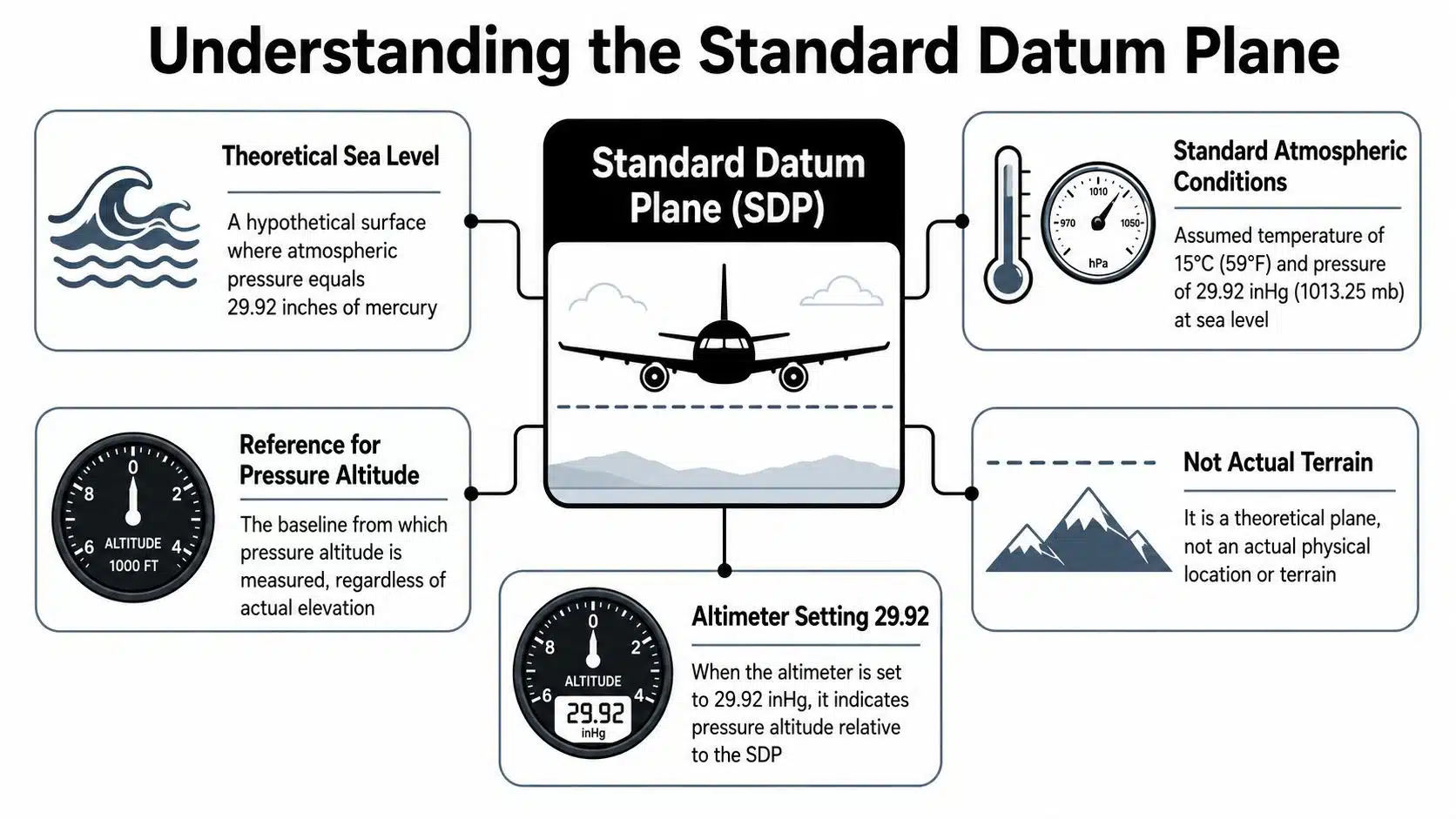
Think of the SDP as an imaginary baseline for the atmosphere. It isn't the ground, and it isn't the actual sea level under your airplane on a given day. It's a theoretical surface where atmospheric pressure is 29.92 inHg, which is also 1013.25 hPa or 1013.2 mb, as explained by Pilot Institute's discussion of the Standard Datum Plane and pressure altitude.
Why aviation needs an imaginary baseline
If every pilot used local weather pressure as the core reference for aircraft performance, comparisons would get messy fast. One airport could be under high pressure while another sits under lower pressure. Two identical airplanes at similar field elevations could perform differently because the atmosphere itself is different.
So aviation standardizes the reference point. That lets pilots, manufacturers, and instructors speak the same language when reading performance charts and planning flights.
Here's the simple version:
- Field elevation tells you where the airport sits above mean sea level
- Pressure altitude tells you where you are relative to the standard pressure reference
- Performance charts are built around that standardized pressure reference
What setting 29.92 really does
When you set 29.92 in the altimeter, you're telling the instrument to ignore the local barometric setting and show altitude relative to the standard datum plane. In plain language, you're asking, “Where am I in the standard atmosphere model?”
That's why pilots often say pressure altitude is the altitude the altimeter would indicate if set to standard pressure.
Practical rule: When the atmosphere matches standard conditions, true altitude and pressure altitude match. When it doesn't, they separate, and that difference starts to matter for planning.
A useful analogy is a measuring tape in a workshop. If everyone uses the same starting mark, parts fit together. If everyone starts from a different scratch on the bench, measurements stop making sense. The SDP is aviation's common starting mark.
Why students should care
Students sometimes memorize “29.92” without understanding why it matters. The better way to think about it is this: 29.92 is the shared benchmark that makes aircraft performance data usable. Without it, the POH charts you rely on would be far less practical.
That's also why pressure altitude shows up in so many planning tasks. It gives you a standard atmospheric baseline before you move on to the next question, which is how the airplane will perform in the temperature and loading conditions you have today.
Pressure Altitude vs Other Altitudes
Pilots use the word altitude constantly, but not all altitudes answer the same question. Mixing them up creates errors in planning and sometimes in the cockpit.
The easiest way to keep them straight is to ask, “What am I trying to know right now?” Are you trying to know what the altimeter shows? Your height above the ground? Your height above sea level? Or how the airplane is likely to perform?
Aviation Altitude Types at a Glance
| Altitude Type | What It Measures | Primary Use |
|---|---|---|
| Indicated | What the altimeter shows with the current setting | Everyday altitude reference in flight |
| Pressure | Altitude relative to the standard pressure reference | Performance planning and chart use |
| Density | Pressure altitude corrected for temperature effects | Estimating how the airplane will perform |
| True | Actual height above mean sea level | Terrain and chart awareness |
| Absolute | Height above the surface below you | Landing, low-level awareness, obstacle clearance |
The quick way to separate them
Indicated altitude is the number you read directly on the altimeter. This is the cockpit number you use all the time when flying an assigned altitude.
Pressure altitude is different. It strips away local pressure variation by using the standard reference. That's why it becomes the starting point for performance work.
Density altitude is where many students get tangled up. Pressure altitude does not tell you the whole performance story. Density altitude is the performance-focused number because it accounts for temperature on top of pressure.
If pressure altitude is the baseline, density altitude is the number that tells you how the airplane “feels” the air.
True altitude is your actual height above mean sea level. That matters for terrain and charted obstacle awareness.
Absolute altitude is your height above the ground directly beneath you. That's the one pilots often think of intuitively during landing or low-level maneuvering.
The confusion that matters most
The most common mix-up is between pressure altitude and density altitude. A pilot calculates pressure altitude and thinks the job is done. It usually isn't. Pressure altitude starts the process. Density altitude moves you toward the actual performance answer.
Another common issue is using indicated altitude in places where pressure altitude is required. Your POH doesn't want whichever number happens to be on the dial during normal operations. It wants the standardized pressure-based input that matches the chart design.
Airspace can also reinforce the need to understand these distinctions. When you study transitions into the higher-altitude system, standard pressure settings become part of the bigger picture. DuBois Aviation's guide to Class A airspace and standard altimeter use is a useful companion topic because it shows how standardized pressure references fit into real-world operations.
A student pilot memory aid
Use this simple cue:
- Indicated means “what I see”
- Pressure means “what the atmosphere standard says”
- Density means “how the airplane performs”
- True means “where I am over sea level”
- Absolute means “how high I am over the ground”
If you keep each altitude tied to a specific cockpit question, the terms stop blending together.
How to Calculate Pressure Altitude
There are two standard ways to calculate pressure altitude. One uses the altimeter directly. The other uses a simple formula.
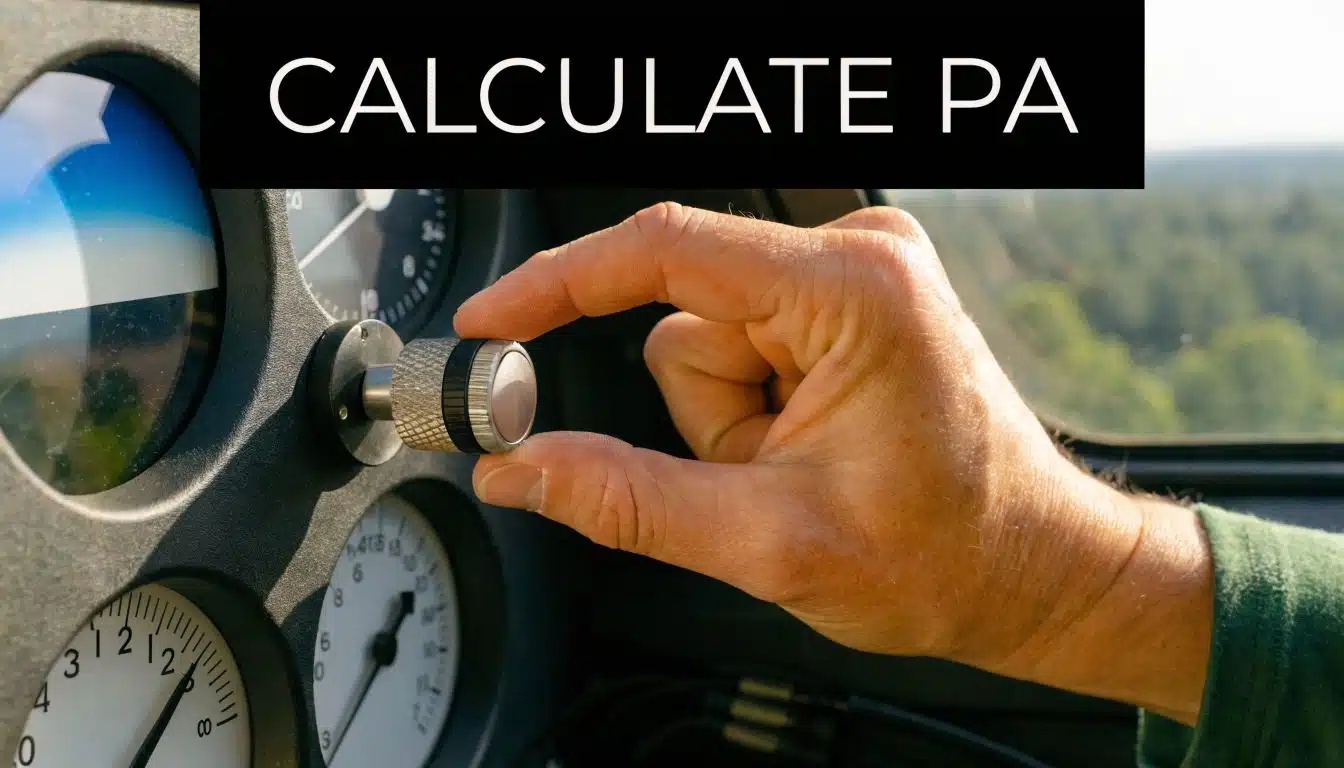
Both matter. The cockpit method helps you visualize what the instrument is doing. The formula helps during preflight planning, written test practice, and quick mental checks.
Method one with the altimeter
This is the direct airplane method.
Set 29.92 in the Kollsman window.
Don't use the local altimeter setting for this step.Read the altitude shown.
That indicated altitude is your pressure altitude.
That's the cleanest conceptual method because it turns the definition into something you can see. Set the instrument to standard pressure, then read the result.
Method two with the formula
Pilots also calculate pressure altitude with this formula:
PA = field elevation + 1000 × (29.92 − altimeter setting)
A practical benchmark used in aviation is that a 0.01 inHg change from standard shifts pressure altitude by roughly 10 feet, which is reflected in the Wikipedia explanation of pressure altitude and the common calculation formula.
That means:
- If the altimeter setting is lower than standard, pressure altitude goes up
- If the altimeter setting is higher than standard, pressure altitude goes down
Worked examples using Chino conditions
Let's use Chino-style planning logic without inventing local numbers.
If you know the airport field elevation and the current altimeter setting, plug them into the formula exactly as written. Suppose the altimeter setting is below 29.92. The subtraction term becomes positive, so you add that correction to field elevation. Your pressure altitude ends up higher than the airport's listed elevation.
On a strong high-pressure day, the opposite happens. The subtraction term becomes negative, so pressure altitude drops below field elevation.
A lower-than-standard altimeter setting means the airplane is operating in an atmosphere that acts like a higher altitude for pressure purposes.
Students often reverse the sign. That's the classic math error.
A quick mental shortcut
You don't always need full calculator precision to understand the trend.
- 0.01 inHg difference is about 10 ft
- 1.00 inHg difference is about 1,000 ft
That quick estimate helps you catch bad math before you carry it into a takeoff calculation.
A short visual review helps many students lock this in:
When to use which method
Use the altimeter method when you're in the airplane and want the most intuitive demonstration.
Use the formula when you're planning at home, checking a written test answer, or verifying software output. Many electronic flight planning tools will calculate pressure altitude for you, but it's still worth doing one manual check. If the app says the number barely changed on a very low-pressure day, that should raise a flag.
Why Pressure Altitude Governs Aircraft Performance
Pressure altitude matters because aircraft manufacturers build performance charts around it. Your POH isn't asking for field elevation alone. It wants the pressure-based starting point that matches the standard atmosphere model used to create the chart.
That's the part many pilots memorize without fully connecting. They learn the term, pass the exam, and then let the app do the rest. But in actual flying, understanding the relationship matters more than the button press.
The chain from pressure to performance
Here's the practical sequence a pilot follows:
Start with pressure altitude
This gives the standard pressure reference.Add the effect of temperature Now you're moving toward the condition the airplane experiences.
Use the POH chart
That's where takeoff roll, climb, and other performance data come into play.
Training organizations often stress that pressure altitude alone does not tell you aircraft performance. It is the pressure baseline that feeds into density altitude and performance charts, while density altitude is what drives takeoff and climb penalties, as noted in Flight Apprentice's explanation of pressure altitude and density altitude.
Why the POH cares
The POH has to organize performance around a repeatable reference. Pressure altitude gives that repeatability. If two pilots at different airports use the same charting system, they need the same baseline before temperature, weight, runway condition, and wind are layered in.
That's why a pilot who says, “The airport is only at this elevation, so we're fine,” may be skipping a critical step. The atmosphere may be acting like a higher place than the charted field elevation suggests.
The runway length hasn't changed. The atmosphere has.
The real-world effect in the cockpit
Higher pressure altitude moves you toward reduced performance. You may see a longer takeoff roll, a weaker climb, and less comfortable margins after liftoff. Those effects become more noticeable when combined with heat, higher aircraft weight, or less-than-ideal runway conditions.
This is also why modern tools shouldn't replace understanding. ForeFlight, panel avionics, or planning software can generate performance numbers quickly, but the pilot still has to decide whether the output makes sense. If a result looks optimistic for a hot, high, heavy departure, you need enough knowledge to question it.
That same habit of thinking carefully about limits helps in other performance areas too, including knowing when speed margins matter. DuBois Aviation's article on how to calculate maneuvering speed fits that broader idea. Different number, same discipline. Know what the airplane needs before you ask it to do the work.
Airmanship, not button pushing
Good airmanship means understanding why the chart asks for pressure altitude in the first place. Once you grasp that, you stop treating the number as paperwork and start using it as an early warning sign.
If the pressure altitude is higher than you expected, that should trigger better questions. How hot is it? How heavy are we? What does the POH say? Is this still a comfortable departure, or merely a legal one?
Common Pitfalls and Practice Problems
Most mistakes with pressure altitude are simple.
- Mixing up pressure altitude and density altitude. Pressure altitude starts the process. It doesn't finish it.
- Using the wrong sign in the formula. Lower-than-standard pressure raises pressure altitude.
- Stopping at field elevation. The airport's listed elevation is not enough for performance planning.
- Trusting software without a reasonableness check. Automation helps, but pilots still need judgment.
Try these quick checks:
Your airport field elevation is known, and the altimeter setting is exactly 29.92. What is your pressure altitude?
It matches field elevation.The altimeter setting is lower than 29.92. Should pressure altitude be above or below field elevation?
Above.You calculated pressure altitude correctly. Are you ready to predict takeoff performance?
Not yet. You still need to continue through the rest of the performance process.
Pressure altitude gets easier when you stop treating it like a definition to memorize and start treating it like a tool for safer decisions.
If you want help turning these concepts into practical flying skills, DuBois Aviation offers airplane and helicopter training, aircraft rental, and real-world instruction at Chino Airport that puts performance planning, airspace awareness, and safe decision-making into everyday practice.
Continue your training research
Try the aviation tools
Work through fuel, wind, altitude, and navigation calculations in one place.