
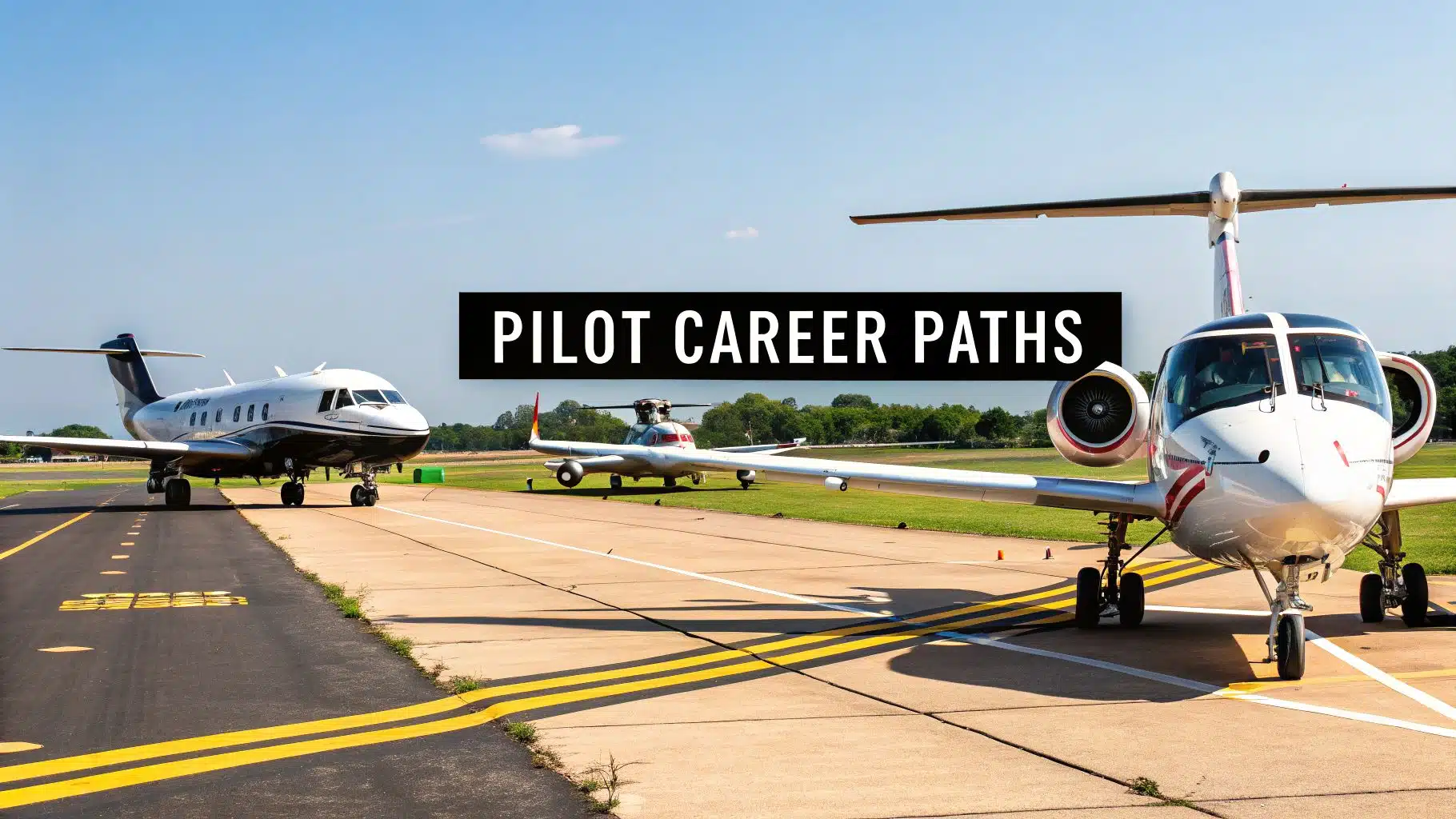
Choosing a career path in aviation is one of the most exciting decisions a pilot can make. While becoming an airline captain is a popular goal, the sky offers a broad array of opportunities, each with unique rewards, challenges, and lifestyles. This roundup explores the most in-demand aviation jobs for pilots, providing a clear roadmap for each-from salary expectations and hour requirements to the specific training needed to get there.
This guide provides actionable insights for pilots at every stage. Whether you're just starting your training at a school like DuBois Aviation at Chino Airport (KCNO) or you're a seasoned pilot looking to make a career change, you'll find the practical steps needed to move forward. We will detail the pathways to becoming everything from a commercial airline pilot to a helicopter EMS hero, a corporate aviator, and more.
We'll cover the distinct roles of a Commercial Airline Pilot, Cargo Pilot, and the critical job of a Flight Instructor, a common and effective way to build hours. You'll also learn about specialized fields like Corporate Aviation, Aerial Surveying, and Air Ambulance (HEMS) operations. For those considering a different path, we'll examine what it takes to become a Bush Pilot, a Military Aviator, or even a Test Pilot. Furthermore, this article addresses the practicalities of aircraft ownership, offering guidance on how to safely buy an airplane or helicopter. Our goal is to equip you with the knowledge to confidently chart your course in the world of professional aviation.
1. Commercial Airline Pilot (Captain & First Officer)
The role of a commercial airline pilot is one of the most recognized and sought-after aviation jobs for pilots. These professionals operate scheduled passenger and cargo flights for major carriers like Delta and United, or regional airlines such as SkyWest and Republic. The job involves far more than just flying; it includes managing crew operations, complex navigation, and ensuring the safety of all passengers and cargo.
The career path is a structured progression. It starts with a Private Pilot certificate and moves through Instrument, Commercial, and Multi-Engine ratings. The ultimate goal for most is the Airline Transport Pilot (ATP) certificate, which requires 1,500 flight hours. Aspiring pilots often build this time through various roles, including flight instruction. Programs like DuBois Aviation’s Airline Career Program are specifically designed to guide students efficiently from zero experience to being airline-ready.
Pathway and Requirements
Achieving an airline pilot position requires dedication and a clean record. Airlines look for candidates who demonstrate professionalism from their very first flight lesson.
- Flight Hours: Accumulate at least 1,500 total flight hours for an unrestricted ATP certificate.
- Certifications: Hold a Commercial Pilot Certificate with Instrument and Multi-Engine ratings.
- Medical: Maintain a First-Class Medical Certificate.
- Background: A clean driving record and the ability to pass a stringent background check are mandatory.
As you build your experience, your resume becomes your primary marketing tool. Detailing your flight time, certifications, and specific aircraft experience is critical. For guidance on crafting a document that stands out to recruiters, review these airline pilot resume examples to see how to best present your qualifications.
2. Cargo / Freight Pilot
The role of a cargo pilot is a vital and often overlooked corner of the aviation jobs for pilots landscape. These aviators operate aircraft dedicated to transporting freight, packages, and mail for global logistics giants like FedEx, UPS, and DHL. This career path involves flying a range of aircraft, from smaller turboprops to massive freighters like the Boeing 767F, often on demanding schedules that include frequent nighttime operations.
While the passengers are packages, the responsibility is immense. Cargo pilots must be masters of weight and balance, loading considerations, and navigating international routes. The career often offers a different lifestyle than passenger airlines, with unique schedules and destinations. Aspiring freight pilots can start with regional cargo carriers to build multi-engine and night proficiency, which are highly valued skills in this sector. Programs at DuBois Aviation provide the foundational multi-engine ratings needed to enter this pipeline.
Pathway and Requirements
Success as a cargo pilot hinges on reliability, precision, and the ability to operate independently. Major cargo carriers maintain standards similar to top passenger airlines, requiring professionalism and a strong flight record.
- Flight Hours: Accumulate at least 1,500 total flight hours for an ATP certificate, which is the standard for major carriers.
- Certifications: Hold a Commercial Pilot Certificate with Instrument and Multi-Engine ratings. Night proficiency is a significant plus.
- Medical: Maintain a First-Class Medical Certificate.
- Background: A clean record and the ability to pass comprehensive background checks are non-negotiable.
"A cargo pilot's office is the world at night. Your ability to consistently and safely meet a schedule is your most valuable asset. Emphasize your multi-engine time, night hours, and any experience with complex systems when you apply, as these are the skills that move the world's economy."
3. Flight Instructor (CFI / CFII / MEI)
Becoming a flight instructor is one of the most traditional and effective aviation jobs for pilots to build the necessary experience for an airline career. Certified Flight Instructors (CFIs) are responsible for teaching aspiring pilots the ground knowledge and in-flight skills required to earn their certifications. This role is fundamental to the aviation ecosystem, as every pilot begins their journey with an instructor.
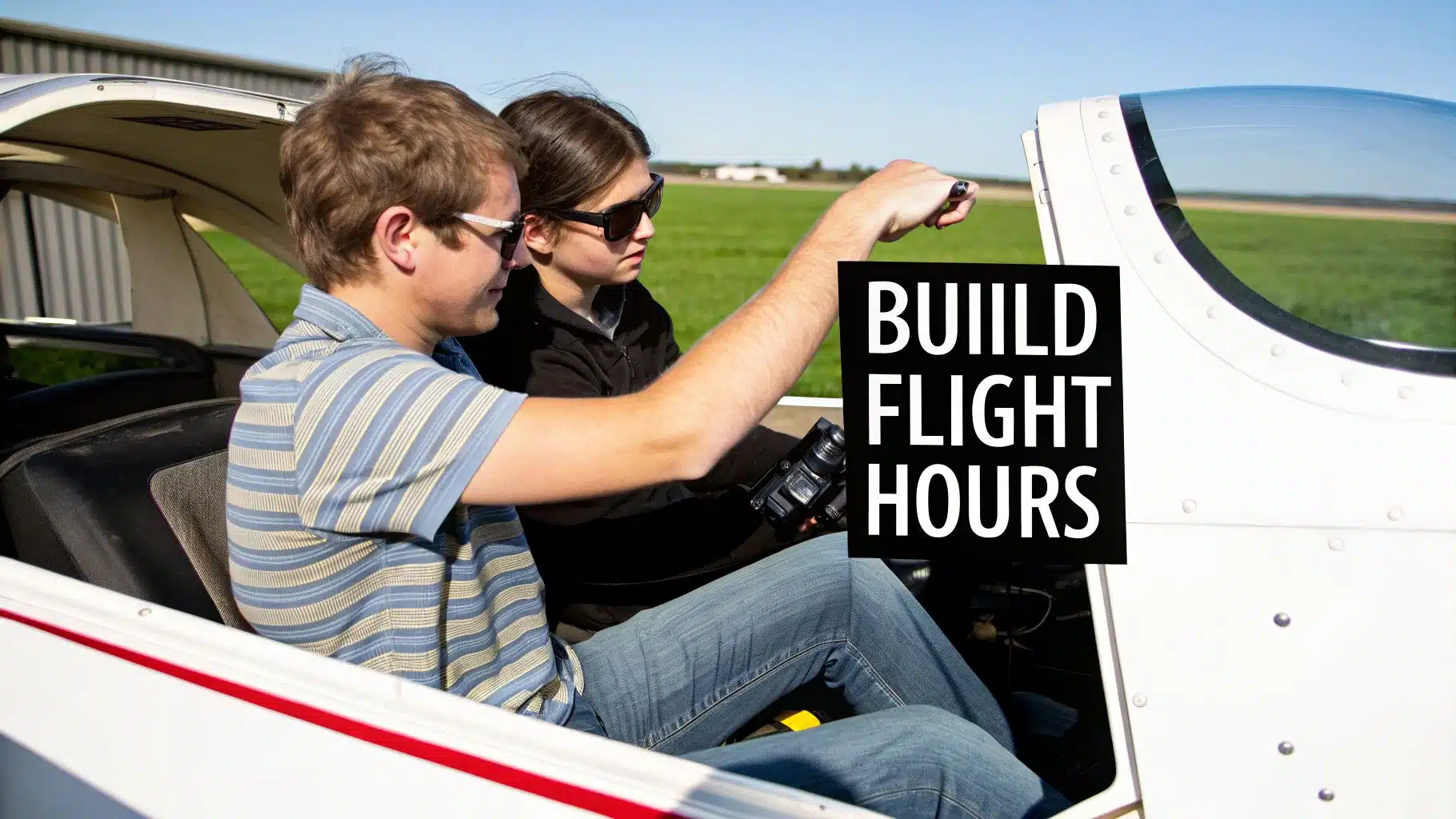
The job is a powerful way to accumulate flight hours while deeply reinforcing your own aeronautical knowledge. Instructors work at flight schools, as independent contractors at local airports, or in specialized simulator training centers. The experience gained is invaluable, honing stick-and-rudder skills, decision-making, and communication abilities that are highly prized by airline recruiters. Many pilots also find instructing to be a rewarding career in itself.
Pathway and Requirements
Obtaining a CFI certificate soon after your Commercial Pilot license is a strategic career move. It allows you to start earning income and building flight time immediately.
- Certifications: Hold a Commercial Pilot Certificate and an Instrument Rating. A CFI certificate is the primary goal, followed by CFII (Instrument) and MEI (Multi-Engine) to increase job prospects.
- Knowledge: Pass two written exams (Fundamentals of Instructing and the Flight Instructor-Airplane written test) and a rigorous practical exam (checkride).
- Medical: Maintain at least a Third-Class Medical Certificate (though a First-Class is recommended for those with airline ambitions).
- Instructional Skill: You must demonstrate the ability to teach effectively, not just fly proficiently.
Being an instructor not only prepares you for an airline interview, but it also gives you a unique insight into the general aviation community. You will interact with pilots who are buying or selling aircraft, providing you with a practical education on how to buy an airplane safely and understand the ownership process firsthand. This knowledge can be a significant advantage later in your career. For a detailed guide on the process, you can learn more about how to become a flight instructor and start your journey.
4. Helicopter Pilot
The world of helicopter piloting offers a dynamic and specialized career path distinct from fixed-wing aviation. These rotary-wing aircraft pilots are essential for a wide range of critical and exciting missions, including emergency medical services (EMS), law enforcement, firefighting, search and rescue, and scenic tours. Operators like Air Methods, local news stations, and the Coast Guard rely on skilled helicopter pilots who can handle demanding flight environments and precision maneuvers.
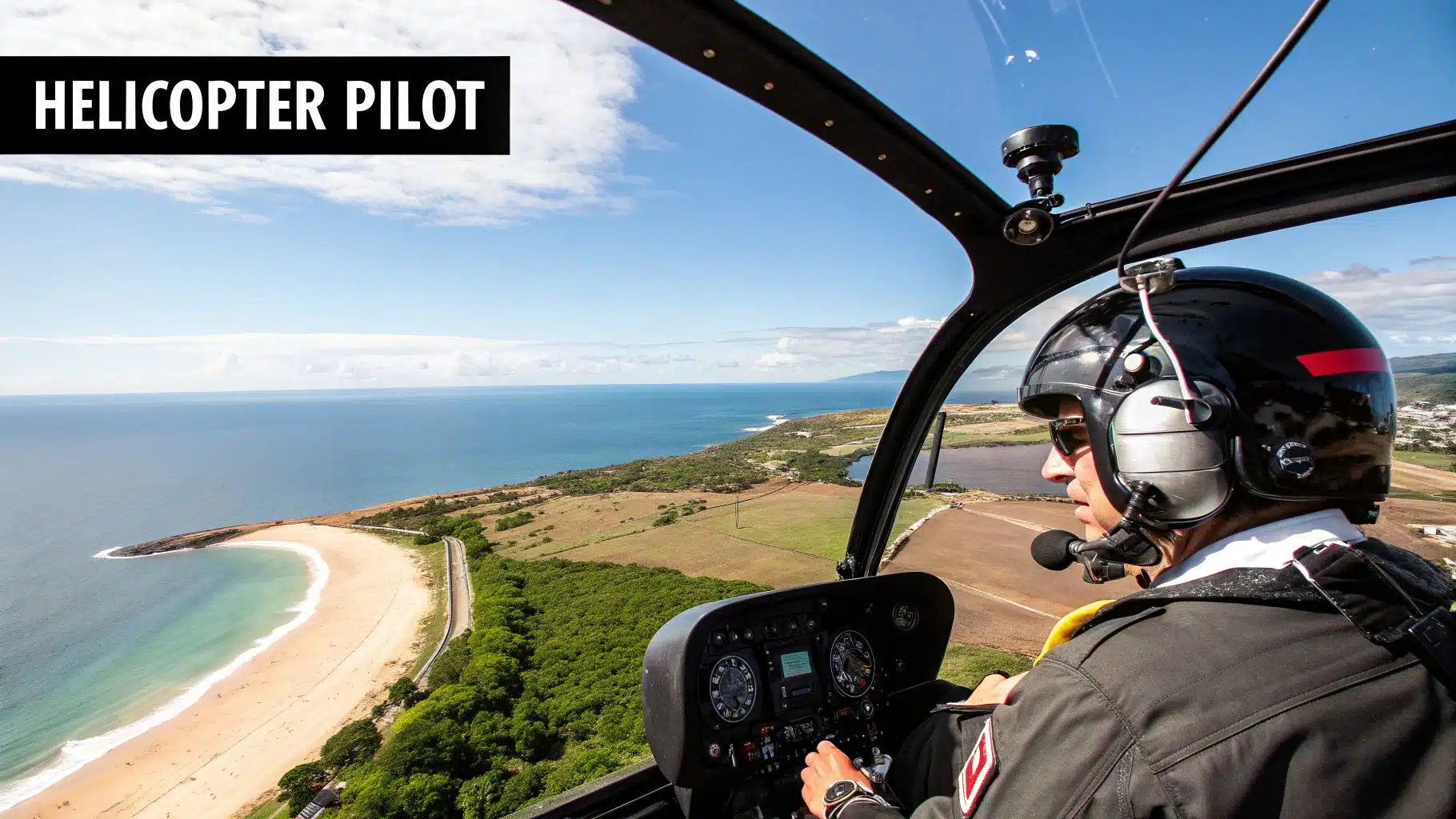
Unlike the structured routes of airlines, helicopter jobs often involve operating in challenging conditions, from urban rooftops to remote wilderness. This aviation job demands a high level of situational awareness and mastery of unique skills like autorotation and confined-area landings. For many, the variety and direct impact of the work make it an incredibly rewarding career.
Pathway and Requirements
Becoming a professional helicopter pilot requires specialized training focused on the unique aerodynamics and systems of rotary-wing aircraft. The path demands precision and a commitment to mastering emergency procedures.
- Flight Hours: A Commercial Helicopter Certificate typically requires at least 150 flight hours, though more are needed to be competitive.
- Certifications: Hold a Commercial Pilot Certificate with a Rotorcraft-Helicopter rating. An Instrument rating is highly recommended.
- Medical: Maintain a First or Second-Class Medical Certificate, depending on the operation.
- Specialized Skills: Mastery of autorotation, confined-area operations, and off-airport landings is crucial for safety and employment.
Helicopter pilots who also hold fixed-wing ratings significantly expand their career opportunities. If you're interested in this versatile path, you can explore the specifics of DuBois Aviation's commercial helicopter pilot training program to understand the requirements and training process.
5. Corporate / Executive Pilot
Becoming a corporate or executive pilot is an excellent alternative to the airlines and ranks among the most rewarding aviation jobs for pilots. These professionals fly business executives and high-net-worth individuals in company-owned or leased jets and turboprops. The role extends beyond the cockpit, often involving direct client interaction, trip planning, maintenance coordination, and delivering exceptional on-board service. Operations are typically smaller and more flexible than airlines, with destinations ranging from major hubs to smaller, private airfields.
This career path is ideal for pilots who excel in customer service and enjoy a dynamic, less structured work environment. The aircraft are often state-of-the-art, and compensation can be very competitive. Opportunities exist within Fortune 500 corporate flight departments, fractional ownership companies like NetJets, and private charter operators. Building turbine time through charter or fractional roles is a common stepping stone to a dedicated corporate flight department.
Pathway and Requirements
Success in corporate aviation demands a combination of technical skill and professional polish. Strong communication and a customer-first mindset are just as important as flying ability.
- Flight Hours: Most positions require a minimum of 1,500 to 2,500 hours, though some entry-level roles may have lower minimums.
- Certifications: An ATP certificate is standard. A Multi-Engine rating is essential, and specific aircraft type ratings are often required or sponsored by the employer.
- Medical: A First-Class or Second-Class Medical Certificate is typically required.
- Networking & Skills: Strong interpersonal skills are critical. Joining groups like the National Business Aviation Association (NBAA) is vital for networking and finding opportunities.
6. Test & Evaluation Pilot
A career as a test and evaluation pilot is one of the most demanding yet thrilling aviation jobs for pilots. These highly skilled aviators fly experimental, prototype, or modified aircraft to evaluate performance, handling characteristics, and overall safety. They work directly with engineering teams, collecting and documenting flight data that is critical to an aircraft's development and certification, from new Boeing models to advanced air mobility vehicles.
This field combines expert flying ability with a deep technical understanding of aerodynamics and aircraft systems. Famous aviators like Chuck Yeager have popularized the role, which serves as the final, critical step before an aircraft is deemed safe for production or operational use. Test pilots are found in military programs, with major manufacturers like Bombardier, and even in emerging sectors like commercial spaceflight with companies such as SpaceX.
Pathway and Requirements
Becoming a test pilot is a long-term goal that requires a specific and advanced skill set. It often involves a combination of military or high-performance civilian experience.
- Experience: Accumulate significant flight hours, especially in high-performance, complex, and multi-engine aircraft. Military experience is a common entry point.
- Education: A strong foundation in engineering or a related technical field is often required. Many test pilots hold advanced degrees.
- Training: Attend a recognized test pilot school, such as the U.S. Naval Test Pilot School or the U.S. Air Force Test Pilot School.
- Certifications: Hold an ATP certificate along with CFII/MEI ratings to demonstrate exceptional flying and instructional knowledge.
This career demands a unique blend of pilot proficiency and engineering acumen. As you gain experience, focus on opportunities that expose you to different aircraft types and flight-testing environments. Documenting this specialized experience is crucial when applying to highly competitive test pilot schools and positions.
7. Aerial Photography / Survey Pilot
For pilots with a keen eye for detail and a love for precision flying, a career as an aerial photography or survey pilot offers a unique and rewarding path. This is one of the more technical aviation jobs for pilots, involving flying aircraft equipped with high-resolution cameras and sensors. The work consists of capturing imagery and data for mapping, real estate, construction monitoring, and environmental surveys by flying precise grid patterns at specific altitudes and speeds.
This career is an excellent way to build flight hours while engaging in mission-oriented flying. The skills developed, such as precise aircraft handling and systematic flight planning, are highly valuable across the aviation industry. Pilots in this field contribute to diverse projects, from creating the imagery for Google Earth to monitoring agricultural health and capturing stunning aerial sequences for film and television.
Pathway and Requirements
Success in aerial survey flying demands a combination of piloting skill and technical understanding. Companies value pilots who can operate the aircraft and understand the mission's data collection objectives.
- Flight Hours: A Commercial Pilot Certificate is the minimum entry point, typically requiring 250 hours. Many roles prefer higher time, and it's a great way to build toward 1,500 hours.
- Certifications: A Commercial Pilot Certificate with an Instrument Rating is essential. A Multi-Engine rating is highly advantageous as many survey aircraft are twins.
- Skills: Expertise in flying precise headings, altitudes, and speeds is critical. Familiarity with camera and sensor systems is a major plus, and a drone certification can be a complementary asset.
- Networking: Building a professional network with surveying firms, real estate agencies, and film production companies can open up freelance and full-time opportunities.
Becoming proficient in survey flying requires mastering the art of "flying the box"—executing perfect grid patterns repeatedly. This discipline not only makes you a better pilot but also demonstrates a level of professionalism and precision that is highly sought after by employers in all sectors of aviation, including airlines.
8. Bush Pilot
For pilots who thrive on adventure and self-reliance, the role of a bush pilot represents one of the most challenging and rewarding aviation jobs for pilots. These aviators operate in the world's most remote regions, such as Alaska and Northern Canada, delivering essential supplies, medical aid, and personnel. They are masters of their aircraft, often landing on unprepared surfaces like gravel bars, glaciers, and water with minimal infrastructure or support.
This career demands exceptional stick-and-rudder skills, quick-thinking, and a deep understanding of aircraft mechanics. Bush pilots are not just flyers; they are resourceful problem-solvers who must be comfortable operating in isolation. Their work is critical, serving as a lifeline for communities that are inaccessible by other means. Building a reputation for reliability and sound judgment is paramount in this tight-knit community.
Pathway and Requirements
Becoming a bush pilot requires a specific set of advanced skills and a rugged mindset. Operators look for pilots who can handle both the aircraft and the unpredictable environments they fly in.
- Flight Skills: Develop strong fundamental skills, then pursue tailwheel and float-plane endorsements. Consistent practice of short-field and soft-field takeoffs and landings is essential.
- Certifications: A Commercial Pilot Certificate is the starting point. Instrument ratings are highly valuable for navigating challenging weather.
- Mechanical Aptitude: Gain practical knowledge of aircraft maintenance and troubleshooting. Being able to perform minor repairs in the field can be a lifesaver.
- Networking: Build connections within the bush flying community. Your reputation for safety and reliability is your most valuable asset.
A key part of bush flying involves operating specialized aircraft. For many pilots, the journey into this field begins with purchasing a suitable airplane. Understanding the acquisition process is vital. Gaining insight on how to buy an airplane the safe way ensures you invest in a reliable aircraft that meets the demanding needs of backcountry operations.
9. Medical / Air Ambulance Pilot (HEMS / MEDEVAC)
Medical pilots, also known as Helicopter Emergency Medical Services (HEMS) or MEDEVAC pilots, perform one of the most critical aviation jobs for pilots. These professionals operate specialized helicopters and fixed-wing aircraft to transport critically ill or injured patients. Working for EMS providers like Air Methods, hospital-based programs, or the Coast Guard, they combine precision flying with emergency response, often in high-stress environments. The job requires close coordination with medical teams to ensure patient safety and rapid transit to care facilities.
This career path is demanding but deeply rewarding. It typically requires significant experience, particularly for helicopter roles. Pilots often build their hours in other commercial operations before transitioning to HEMS. The work involves responding to accident scenes or facilitating inter-hospital transfers, demanding quick decision-making and exceptional aircraft handling skills, especially during night or adverse weather operations.
Pathway and Requirements
Achieving a HEMS pilot position requires a specific skill set and extensive experience, with an emphasis on safety and professionalism.
- Flight Hours: Most operators require a minimum of 2,000 total flight hours, with at least 1,000-1,500 as Pilot in Command (PIC) in helicopters.
- Certifications: A Commercial Helicopter Certificate with an Instrument rating is standard.
- Medical: Must hold a First-Class or Second-Class Medical Certificate.
- Experience: Significant night flying and cross-country experience are often mandatory. Night Vision Goggle (NVG) time is highly valued.
Becoming a medical pilot means you are the calm, steady hand in chaotic situations. Pursuing an EMT or basic medical certification can enhance your credibility and understanding of the mission, making you a more effective team member and a stronger candidate during the hiring process.
10. Military Pilot (Air Force, Navy, Army, Coast Guard)
Serving as a military pilot is a unique and demanding career path, offering some of the most advanced flight training and mission opportunities in the world. Military aviators in the Air Force, Navy, Army, and Coast Guard fly everything from high-performance fighters like the F-16 to heavy transport aircraft, helicopters, and reconnaissance platforms. This aviation job for pilots involves more than just flying; it is a commitment to national service that includes combat, transport, training, and emergency response roles.
The journey begins not in a flight school, but through a highly competitive selection process that tests academic, physical, and leadership potential. The government funds the entirety of the extensive training, which is known for its rigor and structure. Unlike civilian pathways, a military pilot career comes with a service commitment, typically several years after earning your wings. This path provides unparalleled experience, discipline, and access to aircraft technology not found in the civilian sector.
Pathway and Requirements
Entry into military aviation is rigorous and requires extensive preparation. Candidates must demonstrate exceptional character, physical fitness, and academic aptitude long before they ever sit in a cockpit.
- Education: A bachelor's degree, preferably in a STEM field, is required.
- Aptitude: High scores on military-specific aptitude tests like the Air Force Officer Qualifying Test (AFOQT) are critical.
- Medical: Must meet stringent military medical and physical fitness standards, which are often stricter than an FAA First-Class Medical.
- Citizenship: Must be a U.S. citizen and able to obtain a security clearance.
The discipline and experience gained as a military pilot are highly valued in the civilian world. Many veterans transition into airline, corporate, or other commercial roles after their service, often with a significant advantage in flight hours and advanced aircraft experience.
11. Flight Engineer / Flight Crew Member
While advanced automation has changed flight deck dynamics, the role of a Flight Engineer remains a vital and respected position within certain aviation jobs for pilots. These crew members are systems experts, responsible for monitoring and managing aircraft engines, pressurization, fuel, and other complex systems. This position is most common on legacy large transport aircraft, specialized cargo planes, and various military platforms where a dedicated systems specialist is crucial for safety and operational efficiency.
The career is not just about monitoring gauges; it involves deep technical knowledge and quick problem-solving. Flight Engineers work in a multi-crew environment, supporting the pilots by managing aircraft performance and handling in-flight anomalies. Roles like Loadmaster on cargo aircraft also fall into this category, focusing on weight, balance, and cargo systems. For aspiring pilots, this can be an alternate pathway to gain invaluable multi-crew experience and a profound understanding of aircraft systems before transitioning to the pilot's seat.
Pathway and Requirements
Securing a Flight Engineer position often requires specialized training and a knack for mechanical and systems-based thinking. This role is a testament to an individual's technical depth and ability to perform under pressure.
- Certifications: A Flight Engineer Certificate (Turbojet or Turboprop) is typically required, often obtained through specific employer or military training programs.
- Technical Training: Specialized instruction on the systems of a particular aircraft (e.g., a Boeing 747-200 or C-130 Hercules) is mandatory.
- Experience: Previous experience as an aircraft mechanic or in a technical military role is highly advantageous.
- Medical: A First or Second-Class Medical Certificate is usually required.
This career path highlights the importance of systems proficiency. As you document your experience, focus on your ability to manage complex systems and contribute to crew resource management. It demonstrates a level of technical expertise that is valuable in any flight deck role.
12. Loadmaster / Flight Crew Specialist
While not a traditional pilot role, the Loadmaster or Flight Crew Specialist is a critical aviation job that places you directly in the operational heart of military and civilian cargo missions. These specialists are experts in payload management, responsible for calculating weight and balance, supervising the loading and unloading of freight, and securing cargo for safe flight. They work on a variety of aircraft, from military transports like the C-130 to large civilian freighters operated by companies like FedEx or UPS.
This role is a unique pathway within aviation, blending hands-on logistics with flight operations. Loadmasters are an integral part of the flight crew, coordinating constantly with pilots and ground personnel to ensure mission safety and efficiency. It's a demanding job that requires precision, problem-solving skills, and a deep understanding of aircraft performance characteristics, particularly how payload distribution affects flight. For those with a technical mindset who enjoy a team environment, this is an excellent career adjacent to the cockpit.
Pathway and Requirements
Entry into this field often begins in the military but also has clear civilian routes. Success depends on meticulous attention to detail and strong communication skills.
- Experience: Gain experience with cargo handling, logistics, and weight-and-balance calculations. Military service is a common and effective starting point.
- Certifications: While not universal, certifications in handling hazardous materials (HAZMAT) and specialized cargo restraint systems are highly valuable.
- Skills: Develop exceptional coordination and communication abilities to work effectively between flight crews, ground teams, and mission planners.
- Technical Knowledge: A solid understanding of aircraft limitations and performance is necessary for safe and efficient cargo planning.
This role underscores a key principle for anyone in aviation: understanding the entire operational ecosystem. A pilot who grasps the complexities of weight and balance from a loadmaster's perspective is better prepared to manage their aircraft safely and efficiently.
12 Pilot Career Comparison
| Role | Complexity & Process 🔄 | Resource Requirements & Training ⚡ | Expected Outcomes ⭐ | Ideal Use Cases 📊 | Key Advantages / Tips 💡 |
|---|---|---|---|---|---|
| Commercial Airline Pilot (Captain & First Officer) | Very high — multi-crew ops, strict procedures, seniority system | Very high — PPL→Instrument→Commercial→Multi→ATPL, 1,500+ hrs, type ratings | High pay & stability ($78k–$250k+), strong benefits | Scheduled passenger & cargo airlines, international routes | Network early; prioritize multi‑engine and airline-specific requirements |
| Cargo / Freight Pilot | High — night operations, heavy-load management | High — multi‑engine, night proficiency, comparable hour requirements | Comparable pay to airlines ($70k–$220k), steady demand from e‑commerce | Freight carriers (FedEx/UPS), regional cargo, overnight logistics | Build night time and scheduling reliability; emphasize cargo ops experience |
| Flight Instructor (CFI / CFII / MEI) | Moderate — teaching and evaluation processes | Moderate — CFI/CFII/MEI; lower entry hours; hour‑building opportunity | Lower pay ($45k–$80k) but rapid flight‑hour accumulation | Flight schools, Part 141 programs, student training pipelines | Get CFII/MEI to expand marketability; focus on safety reputation |
| Helicopter Pilot | Moderate–high — rotary‑wing skills, autorotation proficiency | High per‑hour cost — rotary ratings, NVG for HEMS, specialized training | Moderate pay ($50k–$150k+), niche opportunities | EMS, law enforcement, tour operations, offshore support | Consider dual fixed/rotary ratings; master autorotations and confined‑area work |
| Corporate / Executive Pilot | Moderate — professional service expectations, on‑call duties | High — multi‑engine/turbine time, type ratings, customer service skills | High pay & predictable schedules ($80k–$180k+) | Corporate flight departments, fractional operators, charter | Obtain type ratings and turbine time; cultivate discretion & service skills |
| Test & Evaluation Pilot | Very high — flight envelope expansion, engineering coordination | Very high — test pilot school, advanced systems knowledge, high-performance hours | High pay & prestige ($100k–$200k+), specialized career path | Aircraft manufacturers, R&D, military test programs, eVTOL development | Attend test pilot school; build engineering literacy and high‑perf experience |
| Aerial Photography / Survey Pilot | Moderate — precise low‑level, repetitive grid flying | Moderate — camera/sensor knowledge, multi‑engine preferred, ~1,000+ hrs | Moderate pay ($50k–$120k+), project‑based work | Mapping, real estate, film, environmental & construction surveys | Develop sensor expertise; add drone capability as complementary service |
| Bush Pilot | High — remote ops, unimproved surfaces, self‑reliance | Moderate — tailwheel/float endorsements, rugged aircraft experience | Moderate pay ($60k–$130k+), unique skill development | Remote logistics (Alaska, northern Canada), float/backcountry ops | Practice short/soft‑field landings, carry mechanical troubleshooting skills |
| Medical / Air Ambulance Pilot (HEMS/MEDEVAC) | Very high — emergency response, high stress, 24/7 readiness | High — helicopter training, HEMS/NVG & mission‑specific certifications | Moderate–high pay ($55k–$150k+), strong job security, life‑saving impact | Aeromedical providers, hospital HEMS programs, search & rescue | Obtain HEMS and NVG training; develop calm decision‑making under pressure |
| Military Pilot (Air Force, Navy, Army, Coast Guard) | Very high — structured training, combat & deployed ops | Government‑funded but intensive — commissioning, SUPT, service commitment | Outstanding training & benefits, pathway to civilian aviation | National defense, tactical/transport missions, high‑performance flying | Maintain fitness/STEM background; plan for service commitment and transition |
| Flight Engineer / Flight Crew Member | Moderate — systems monitoring and multi‑crew coordination | Moderate — specialized systems training; lower initial cost than pilot route | Moderate pay ($50k–$90k+), systems expertise, pilot transition potential | Legacy transports, military multi‑crew aircraft, specialized cargo | Use role to gain systems knowledge and transition credits toward pilot training |
| Loadmaster / Flight Crew Specialist | Moderate — cargo planning, weight & balance management | Moderate — cargo handling, restraint & HAZMAT certifications where applicable | Moderate pay, essential operational role in cargo/military missions | Military transport, heavy‑lift civil cargo, specialized charter missions | Gain cargo restraint and hazardous materials certifications; build coordination skills |
Your Next Steps: From Aspiration to Aircraft Ownership and Beyond
This guide has charted a course through the diverse skies of aviation jobs for pilots, from the structured ascent to an airline captain's seat to the rugged independence of a bush pilot. We've explored the unique demands and rewards of roles like cargo, corporate, and helicopter piloting, each representing a distinct branch of a vast and exciting industry. The common thread connecting them all is a foundation of excellent training, strategic hour-building, and a persistent drive for professional growth. Your journey from holding a student pilot certificate to commanding a complex aircraft is a marathon, not a sprint, built one flight hour and one certification at a time.
The most critical takeaway is that your pilot certificate is not an endpoint; it's a license to learn. Whether you are building time as a CFI at a bustling airport like KCNO or flying survey missions over remote landscapes, every hour in the logbook is a lesson. This continuous learning is what transforms a competent pilot into a sought-after professional. As you advance, formalizing this process with a structured professional development plan becomes essential. This plan acts as your personal career roadmap, helping you set clear goals for ratings, type certifications, and leadership roles, ensuring you remain competitive and prepared for the next opportunity.
The Ultimate Goal: Navigating Aircraft Ownership
For some pilots, the pinnacle of an aviation career isn't just flying the aircraft; it's owning it. This ambition, whether for personal travel or to launch a business venture, introduces a new layer of complexity and responsibility. Moving from pilot to owner requires a different skill set, one that blends airmanship with sharp financial and legal acumen.
How to Buy an Airplane or Helicopter the Safe Way:
Define Your Mission: First, be brutally honest about your needs. Will you be flying short weekend trips or long cross-country routes? Will you operate from paved runways or grass strips? A clear mission profile narrows your search and prevents you from buying too much-or too little-aircraft for your needs.
Assemble Your Purchase Team: Never attempt to buy an aircraft alone. You need a trusted team, which includes:
- An Experienced Mechanic: Find an A&P (Airframe & Powerplant) mechanic who specializes in the make and model you're considering. They will conduct the critical pre-purchase inspection.
- A Reputable Escrow Agent: An aviation-specific escrow company will protect your funds and ensure the title is clear of any liens before closing the deal.
- An Aviation Attorney (Optional but Recommended): For complex transactions or partnership agreements, legal counsel can prevent costly future disputes.
Master the Pre-Purchase Inspection: This is the single most important step. A thorough "pre-buy" is far more detailed than an annual inspection. It involves a deep dive into the aircraft's logbooks to verify maintenance history, AD (Airworthiness Directive) compliance, and any damage history. The physical inspection will check for corrosion, engine health (via borescope and oil analysis), and the condition of all major components.
Key Insight: The pre-purchase inspection is not a negotiation tool; it is a pass/fail test for the aircraft. If an owner refuses to allow a thorough pre-buy by a mechanic of your choosing, walk away from the deal immediately.
Your journey in aviation is uniquely your own. The paths detailed in this article offer a glimpse into the many aviation jobs for pilots available, but your career will be defined by the choices you make, the training you invest in, and the opportunities you create for yourself. The sky is not the limit; it is the beginning.
Whether you're just starting your training, building hours for your dream job, or seeking recurrent training, DuBois Aviation provides the expert instruction and modern fleet to help you achieve your goals. Take the next step in your aviation journey by exploring our programs at DuBois Aviation today.


