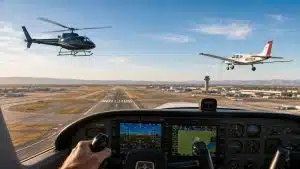

So, you're searching for a "helicopter discovery flight near me" and wondering what it's all about. Let me break it down for you. This isn't just a ride-along; a discovery flight is your very first lesson where you get to actually fly a helicopter.
What Is a Helicopter Discovery Flight?

Think of a discovery flight as the ultimate test drive for becoming a pilot. It's a genuine, hands-on experience that perfectly merges the thrill of a scenic flight with the real substance of a structured lesson. From the moment you lift off the ground, you're not a passenger—you are an active participant, learning what it truly feels like to be a pilot.
You’ll be sitting at the dual controls, right next to an FAA-Certified Flight Instructor (CFI) who guides you through every step. This direct, hands-on approach is what makes a discovery flight so special and sets it apart from any other flight you can take. It’s specifically designed to give you a true sense of what it takes to command these incredible machines.
More Than Just a Scenic Tour
Sure, you'll get some absolutely stunning views of local sights like Chino Hills and the Prado Basin, but the real purpose runs much deeper. This is a carefully planned lesson where you'll feel the effect of each control input and even perform basic maneuvers yourself. It's the perfect combination of pure excitement and practical flight training.
For many pilots, a discovery flight was the exact moment their journey began. It’s a fantastic, low-commitment way to answer that one huge question: "Is flying helicopters really for me?" This single experience often sparks a lifelong passion, sometimes even setting people on the path to aircraft ownership. For some, it’s the logical first step before they consider buying a helicopter.
A discovery flight isn't about passively watching the world go by from above. It’s about actively learning the delicate dance of the cyclic, collective, and pedals that makes helicopter flight so uniquely challenging and rewarding.
Who Is This Experience For?
Honestly, a discovery flight is for anyone who's ever looked up at a chopper and thought, "I wonder what that's like." It attracts a whole range of people, each with their own reasons for wanting to get in the cockpit.
This flight is a perfect fit if you are:
- An Aspiring Pilot: This is your first official lesson. The flight time is logged in a pilot logbook and counts directly toward your license.
- An Adventure Seeker: If you’re hunting for a truly unique and unforgettable experience, nothing beats the feeling of making a helicopter hover for the first time.
- A Creative Gift-Giver: It makes for an incredible birthday, anniversary, or graduation gift that offers a genuine adventure, not just another "thing."
- A Future Aircraft Owner: Thinking about buying a helicopter one day? This is an invaluable way to understand the machine's handling and operation before you even think about making such a big investment.
Your First Flight From Briefing to Landing
The buzz of a helicopter discovery flight starts long before the rotors do. From the moment you arrive at the airfield, you're stepping into the world of aviation. To give you a better sense of the day, let's walk through what you can expect, from meeting your instructor to the final touchdown.
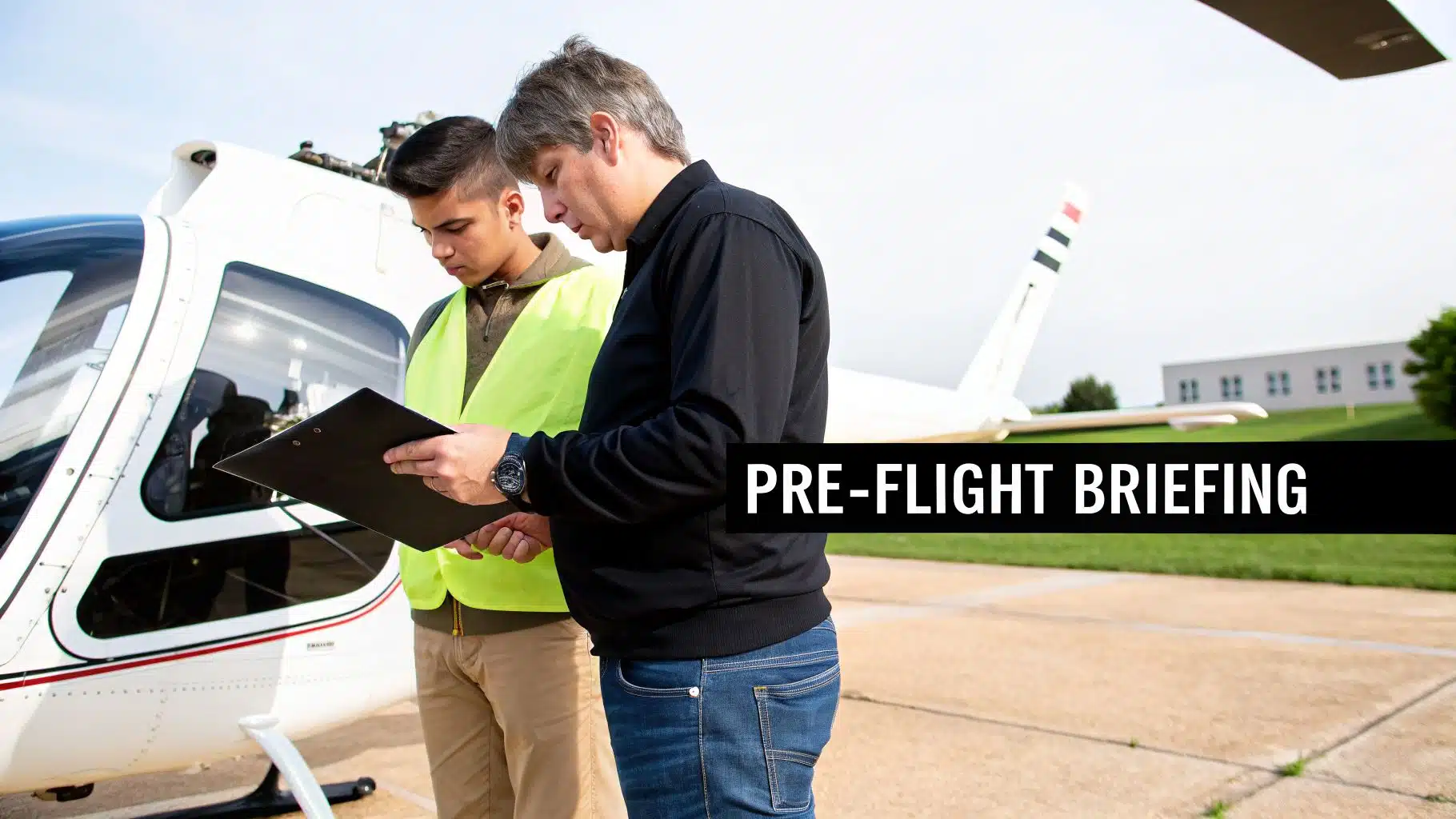
Your experience kicks off on the ground with a pre-flight briefing. This isn't a stuffy classroom lecture; it's a casual, one-on-one chat with your FAA-Certified Flight Instructor (CFI). They're your personal guide for the day, and they'll go over the flight plan, check the weather, and cover the essential safety protocols to make sure you're comfortable and confident.
Getting to Know the Helicopter
From there, you'll head out to the flight line for a pre-flight walk-around. This is your chance to get up close and personal with the incredible machine you’re about to fly. Your instructor will show you how everything works, turning a complex aircraft into something you can understand.
You’ll get a hands-on look at the key components:
- Main Rotor: The huge blades on top that generate lift.
- Tail Rotor: The smaller blades at the back that provide stability and directional control.
- Skids: The landing gear that gives the helicopter a solid footing on the ground.
This inspection isn't just a formality; it demystifies the helicopter and helps you feel connected to the aircraft before you even climb aboard. Here at DuBois Aviation, you'll most likely be flying one of the world-renowned Robinson helicopters, the undisputed gold standard for flight training.
You see, the piston helicopter market—perfect for these introductory flights—is almost entirely cornered by Robinson models. With 9,929 aircraft flying worldwide as of late 2023, they make up a staggering 85-90% of all certified piston helicopter production. Their reputation for reliability and safety is why top-tier flight schools, including ours, trust them. You can dive deeper into these figures in the complete Global Helicopter Market Report.
In the Cockpit and Up in the Air
Now for the moment you've been waiting for. Your instructor will get you strapped in and introduce you to the three primary flight controls: the cyclic, the collective, and the anti-torque pedals. They’ll explain what each one does in a simple, straightforward way.
This is the moment it all becomes real. With your hands on the controls and your instructor by your side, you're about to experience the unmatched thrill of vertical takeoff—a feeling no airplane can replicate.
Once you’re airborne, you’ll actually fly the helicopter. Your instructor will talk you through basic maneuvers like straight-and-level flight, gentle turns, and maybe even the challenge of a hover. You’ll feel the machine respond to every subtle input. It’s a delicate dance, and for a few minutes, you’re the one leading.
After your time in the air, your CFI will guide the helicopter back for a smooth landing. The day wraps up with a post-flight debrief where you can ask any final questions, talk about the flight, and find out what it takes to pursue your pilot's license if the bug has bitten you.
How to Choose the Right Flight School

When you search for a "helicopter discovery flight near me," you’ll get a list of options with a wide range of prices. It’s natural to gravitate toward the cheapest one, but when it comes to aviation, price should never be the deciding factor.
A great first flight experience—one that's safe, memorable, and truly inspiring—comes from a quality flight school. Think of it as the foundation for your entire journey into aviation. Choosing the right school from the start makes all the difference.
Look Beyond the Price Tag
So, what separates a basic provider from a premium flight school? It boils down to a few key things that have a massive impact on your safety and the quality of your flight.
Instructor Experience: The single most important element isn't the helicopter—it's the Certified Flight Instructor (CFI) sitting beside you. A great instructor is more than just a pilot; they're a teacher who can create a calm, confidence-inspiring environment that makes learning to fly feel intuitive.
Fleet Quality & Maintenance: The helicopter you fly is a direct reflection of the school's commitment to safety. A reputable school will be transparent about its maintenance standards. Don't be shy about asking how they care for their aircraft—their answer will tell you everything you need to know about their professionalism.
A discovery flight can be a one-time thrill or the first step toward a lifelong passion. The school you choose can become your long-term partner, guiding you from this first flight to potentially owning your own aircraft one day.
The Towered Airport Advantage
Where you fly is just as important as what you fly. Learning at a towered airport like Chino Airport (KCNO) throws you right into a real-world aviation environment from day one. This is a huge advantage.
You’ll be interacting with air traffic control (ATC), learning proper radio etiquette, and navigating a dynamic airspace. This kind of experience builds the kind of confidence and competence you simply can't get at a quiet, uncontrolled airfield. Flying out of KCNO prepares you to fly anywhere in the world.
To help you see the difference, here’s a quick comparison of what to look for when evaluating potential flight schools.
Comparing Discovery Flight Providers: What to Look For
This table helps you compare key features when choosing a helicopter discovery flight provider to ensure a safe and valuable experience.
| Feature | Basic Provider | DuBois Aviation (Premium Choice) |
|---|---|---|
| Instructors | May use newly certified or low-hour CFIs. | Highly experienced, career-focused CFIs with extensive teaching backgrounds. |
| Fleet | Older aircraft, potentially with less transparent maintenance records. | A modern, meticulously maintained fleet with an impeccable safety record. |
| Airport | Often operates from small, uncontrolled airfields. | Based at Chino (KCNO), a busy towered airport, providing real-world ATC experience. |
| Curriculum | May lack a formal curriculum for continued training. | Uses a structured, FAA-approved Jeppesen curriculum for a clear path to licensing. |
| Focus | Often focused on one-off tourist flights. | Focused on building long-term pilots with a comprehensive training program. |
Choosing a provider that excels in these areas ensures you're not just buying a flight—you're investing in a high-quality, safe, and educational experience.
A Path Forward: Structured Training
If your discovery flight sparks a desire to earn your pilot’s license, the school’s curriculum suddenly becomes critical. A provider that uses a structured, industry-leading program—like the Jeppesen materials we use at DuBois Aviation—gives you a clear and efficient roadmap to success.
This ensures your training is organized, comprehensive, and covers all FAA requirements without wasting your time or money. For a much deeper look into what makes a flight school truly great, check out our complete guide on how to choose a flight school.
Taking the time to weigh these factors will ensure your first helicopter flight is not only thrilling but also the perfect start to a safe and rewarding future in the skies.
Helicopter Piloting as a Career Path
That incredible feeling you get on a discovery flight? For many professional pilots, that wasn't just a one-time thrill—it was the moment they knew. It's the point where a lifelong dream suddenly feels real, tangible, and completely within reach.
Taking the controls for the first time is more than just fun; it’s your first lesson in a set of skills that are in high demand. Countless careers have been launched from the right seat of a helicopter during that very first introductory flight.
An Industry with Room to Grow
The demand for skilled helicopter pilots is strong, and all signs point to continued growth. This isn't just some small, niche corner of aviation; it's a critical and exciting field with a wide variety of mission types.
So, where can a helicopter pilot certificate take you? The career paths are more diverse than most people imagine:
- Emergency Medical Services (EMS): Flying air ambulances and being a crucial part of a life-saving team.
- Tourism and Charters: Giving people the experience of a lifetime with tours over stunning cityscapes and natural wonders.
- Law Enforcement and Firefighting: Providing essential air support for public safety and emergency response.
- Urban Air Mobility: Getting in on the ground floor of the future of transportation, flying air taxis in major cities.
A discovery flight is more than a scenic tour. It’s a behind-the-scenes look at a profession where no two days are the same, and the office view is always spectacular.
The numbers back it up, too. The global market for commercial helicopters is projected to climb from USD 39.51 billion in 2025 to USD 47.93 billion by 2030. That kind of growth, detailed in a recent industry analysis, is driven by the increasing need for helicopters in everything from emergency services to tourism—the very fields you could be working in.
Your simple search for a "helicopter discovery flight near me" could genuinely be the first step toward your life's work. If that first flight sparks something in you, we can help you map out the entire journey. Learn more about our commercial helicopter pilot training program and see how we guide pilots from their first hour all the way to a professional career.
A Smart Guide to Buying Your First Helicopter or Airplane
It’s a familiar story. A quick search for a "helicopter discovery flight near me" leads to an afternoon that changes everything. Once you’ve felt that incredible sensation of lifting straight up, of seeing the world spread out below you, and of actually holding the controls yourself… well, it’s hard to forget. For many, that thrill doesn’t just fade away; it sparks a serious question: "What would it take to own one of these machines?"
Buying a helicopter or an airplane is a huge step, but it's more achievable than most people realize with a solid plan. At a great flight school like DuBois Aviation, we do more than just teach you how to fly. We're here to guide you through the entire journey, from that first lesson right through to becoming an aircraft owner.
What's the Mission?
Before you scroll through listings, you have to get crystal clear on your mission. Why do you want an aircraft? Your answer will shape every single decision that follows, from the model you choose to your operating budget. Are you planning to use it for personal travel, advanced training, or business use? Knowing your mission from the get-go keeps you from buying an aircraft that’s too much—or not enough—for what you really need. This is the most critical part of the process.
The helicopter market is incredibly active. In 2025, North America's market is valued at USD 45.3 billion and is projected to climb to USD 49.3 billion by 2026. This high demand means popular new models can have production backlogs of 2-3 years, making a well-maintained, pre-owned helicopter a fantastic value. You can dig into the numbers yourself in the full helicopter market forecast on Fortune Business Insights.
The True Cost of Aircraft Ownership
The price tag you see on a listing is just the starting line. The real cost of ownership is a mix of fixed and variable expenses that you absolutely have to factor into your budget.
Think of it like buying a house. The purchase price is just the down payment. You still have to plan for insurance, taxes, and all the upkeep required to keep it in perfect condition.
A realistic budget for an aircraft has a few key parts:
- Purchase Price: What it costs to buy the aircraft.
- Insurance: This will vary based on the model, your experience as a pilot, and how you plan to use it.
- Hangar or Tie-Down: A safe place to store your aircraft and protect it from the weather.
- Scheduled Maintenance: This includes everything from annual inspections to major component overhauls.
- Fuel and Operating Costs: These are your variable costs—the more you fly, the more you’ll spend.
How to Buy an Airplane or Helicopter the Safe Way
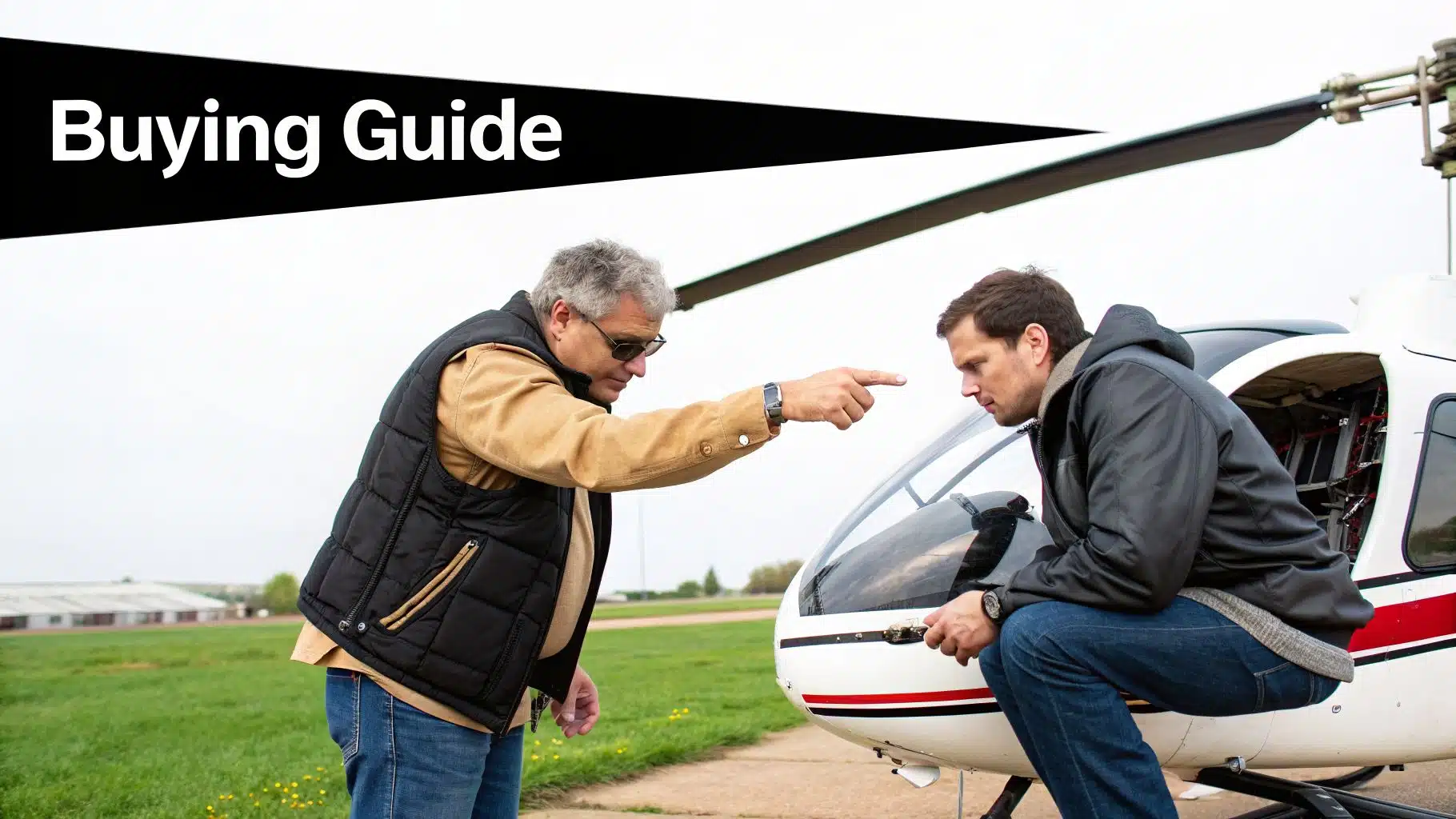
Once you’ve found an aircraft that seems like the right fit, there's one step you can never skip: the pre-buy inspection. This isn't just a quick look-over. It's a deep-dive examination of the entire aircraft and its logbooks, performed by a qualified, independent mechanic who knows that specific model inside and out. This inspection is your single best protection against a bad investment.
The cost of a pre-buy is nothing compared to the financial nightmare it can save you from. After a successful pre-buy, navigating the FAA registration paperwork is the final hurdle. For a detailed guide on navigating this complex process, learn more about buying a helicopter and ensure you make a smart, safe investment.
Common Questions About Discovery Flights
It's completely normal to have questions before you climb into a helicopter for the first time. We get it! We've heard them all, and we've put together answers to the most common ones we hear from people just like you. Our aim is to clear up any uncertainties so you can focus on the incredible experience ahead.
For many people, this flight is the moment a lifelong passion for aviation is born. It's often the first step people take before deciding to train for their license, and for some, it even plants the seed for future aircraft ownership.
Is a Helicopter Discovery Flight Safe?
Absolutely. There's no higher priority in aviation than safety, and that's the foundation of everything we do. You'll be flying with a highly experienced, FAA-Certified Flight Instructor (CFI) who has dedicated their career to safe flying and expert instruction.
The helicopters we use for training aren't just well-maintained; they follow a maintenance schedule that is far more rigorous than standard requirements. Before you even step into the cockpit, your instructor will conduct a detailed pre-flight safety briefing, walking you through everything you need to know to feel completely comfortable and secure.
Are There Any Age or Weight Restrictions?
Yes, there are some important limits we have to follow for safety. To actually take the controls, you'll generally need to be at least 16 years old, though younger kids can certainly come along for the ride as a passenger.
Weight limits are also critical for the safe operation and balance of the helicopter. These limits can change depending on the aircraft, particularly for two-seat trainers like the Robinson R22. It’s always best to give us a call and confirm the specific requirements for the helicopter you'll be flying in when you book.
What Should I Wear for My Flight?
Think comfort and common sense. You don't need any special gear, but here are a few simple guidelines:
- Clothing: Stick with comfortable, casual clothes you can move in easily.
- Footwear: You must wear closed-toe shoes. Sneakers are perfect. Please, no sandals, flip-flops, or high heels.
- Accessories: It's best to leave any loose items like scarves, large hats, or dangly jewelry at home, as they could be a hazard in the cockpit.
- Vision: We highly recommend bringing a pair of sunglasses. They'll cut down the glare and make it much easier to soak in the amazing views.
Does This Flight Time Count Toward a Pilot License?
It sure does! This is what truly separates a discovery flight from a simple air tour. Since you're flying with a certified instructor, every minute from engine start to shutdown is considered official flight instruction.
If you decide to go after your pilot's license, this flight becomes the very first entry in your official pilot logbook. It’s a real, tangible step toward earning your Private Pilot Certificate.
That means your search for a "helicopter discovery flight near me" isn't just for a one-off thrill—it could be the official start of your journey as a pilot. You can learn more about the introductory flight lesson cost and see how this experience is a direct investment in your training.
Ready to see Chino from the pilot's seat? Your adventure starts right here at DuBois Aviation. Book your Helicopter Discovery Flight today!