

Becoming a helicopter pilot is worth it for candidates who can finance a multi-year path through low-paying entry roles into higher-hour specialized sectors like EMS, offshore, or utility flying. It's a poor financial bet for anyone expecting quick returns on a $70,000 to $120,000 training investment.
The popular advice says a pilot shortage makes helicopter jobs plentiful. That advice leaves out the most important part of the career path. The strongest demand is for experienced pilots, not newly certificated graduates, so the practical question is whether a student can manage the low-pay bridge period between training and the specialized jobs that justify the investment.
Table of Contents
- The Hidden Gap Behind the Pilot Shortage Narrative
- What Helicopter Training Costs
- Helicopter Pilot Salary Across Career Stages
- Modeling Your Return on Investment
- Career Paths Available to Helicopter Pilots
- Your Decision Checklist and Next Steps
- Common Questions About Helicopter Pilot Careers
The Hidden Gap Behind the Pilot Shortage Narrative
A pilot shortage does not guarantee an easy first job. Industry coverage places the largest helicopter-pilot gap among experienced pilots with roughly 1,500 to 2,000 hours, while training programs continue producing new graduates (3G Helicopter Prep). That difference drives the financial calculation for anyone considering training.
A new commercial pilot may hold the certificate required to fly for compensation and still lack the experience employers want for premium missions. Early work often includes flight instruction, tours, or other entry-level assignments. These jobs build judgment and logbook experience, but their pay may not reduce a large training balance quickly.
The shortage sits farther up the ladder
Specialized operators value pilots who can manage demanding missions, changing weather, passengers, aircraft limitations, and operational pressure with limited supervision. That capability comes from repeated exposure, not from the commercial checkride alone. A beginner usually must spend time building hours before qualifying for higher-value work.
Practical rule: Treat the first professional job as a bridge to higher-value flying, not as proof that the training investment has already paid off.
The bridge period may be manageable with savings, outside income, family support, or a modest financing obligation. It becomes difficult when a pilot leaves training with substantial debt and no plan for lower initial earnings. Pilots considering broader financial planning may also review hero home loans for pilots, especially when aviation income affects long-term housing decisions.
Cash flow matters more than the headline
The “worth it” question depends on when income begins to catch up with the investment:
- Training phase: Money leaves the student's account before professional income starts.
- Bridge phase: The pilot earns experience in roles that may pay less than later specialties.
- Specialization phase: Higher-hour opportunities in EMS, offshore, utility, or corporate flying become more realistic.
- Long-term phase: Compensation can reflect experience, aircraft responsibility, mission complexity, and schedule demands.
The financial case can work, but only with a plan for every phase. A salary figure for an experienced pilot does not describe the first years after a commercial checkride. It describes the destination, while the low-pay bridge determines whether the pilot can reach it.
What Helicopter Training Costs
Rotorcraft training requires a larger financial commitment than many students expect. Recent U.S. estimates place a private helicopter certificate at roughly $18,000 to $32,000, with many students landing around $22,000 to $26,000 (helicopter pilot license cost estimates). A commercial path commonly reaches $65,000 to $110,000 before paid flying begins, depending on training pace, aircraft rates, instructor time, weather, proficiency, and included ratings.
A separate estimate places a zero-to-commercial-and-CFI path at roughly $70,000 to $95,000, with the full pipeline often taking 12 to 24 months (helicopter pilot training costs). Another industry estimate puts full rotorcraft training around $80,000 to $120,000 (helicopter pilot program cost discussion). The ranges show why students should compare the complete program, not an introductory price that excludes later requirements.
Helicopter Training Cost Breakdown by Certificate Level
| Certificate or Rating | Estimated Cost Range | Typical Timeline |
|---|---|---|
| Private helicopter certificate | $18,000 to $32,000 | Varies by student pace |
| Commercial helicopter path | $65,000 to $110,000 total | Varies by program and training continuity |
| Zero-to-commercial-and-CFI path | $70,000 to $95,000 | 12 to 24 months |
| Full rotorcraft training estimate | $80,000 to $120,000 | Depends on the selected program |
These ranges overlap because schools package training differently. One quote may cover a commercial certificate alone, while another includes instructor preparation or additional experience-building. Request a written breakdown of aircraft time, instructor time, stage checks, checkride preparation, written tests, headset or equipment needs, and likely additional training.
Why rotorcraft costs create a larger hurdle
Helicopter training is hour-intensive, and aircraft time is often more expensive than airplane time. Interruptions create another expense. Long gaps between lessons can require review, while weather, maintenance, instructor availability, and aircraft scheduling can slow progress and extend the period before paid work.
Budget beyond the certificate price. Include living expenses during accelerated training, transportation, exam fees, and the possibility that proficiency takes longer than planned. Students comparing course structure, aircraft access, instructor availability, and progression from private through commercial work can review DuBois Aviation's helicopter pilot training program. That comparison matters because the initial training bill is only the first financial hurdle. The low-pay bridge after certification determines how long the investment remains under pressure.
Helicopter Pilot Salary Across Career Stages
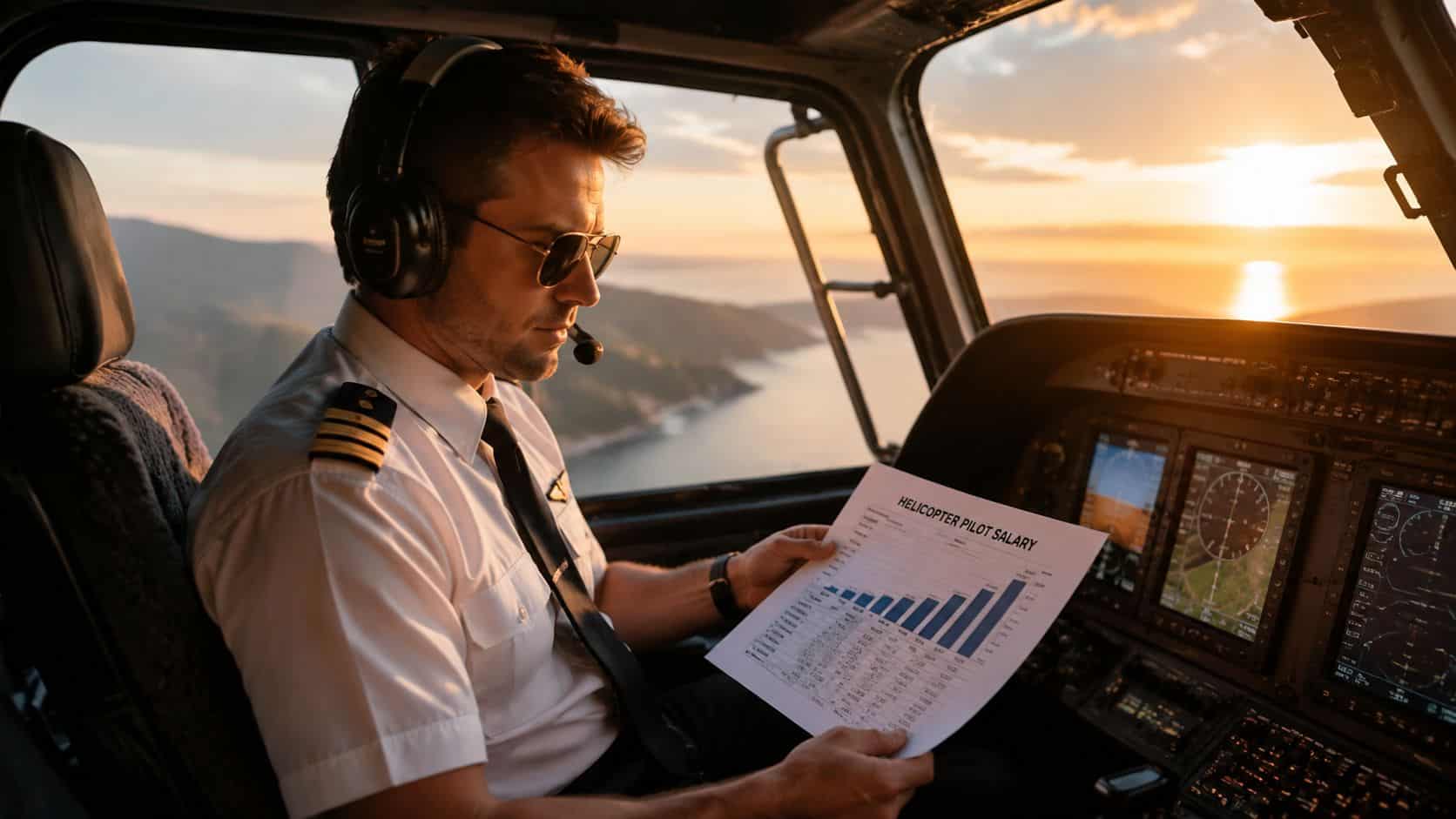
Helicopter compensation changes sharply with experience and mission type. Commercial pilot compensation data, the occupational category that includes helicopter pilots, reached a median annual wage of $122,670 in May 2024 (Pilot Institute salary overview). That figure is useful for understanding the broader occupation, but it shouldn't be treated as a new graduate's expected first paycheck.
Entry-level pilots often begin in roles such as flight instruction or sightseeing tours. Available salary information places early-career helicopter-pilot earnings around $25,000 to $65,000 annually, while a separate 2025 to 2026 salary survey describes new instructor pathways around $35,000 to $45,000 (helicopter pilot program and career discussion). The difference reflects location, employer, schedule, experience, and the exact job.
Compensation follows the mission
The career progression generally looks like this:
| Career stage | Common work | Financial reality |
|---|---|---|
| Early career | Flight instruction, tours, entry-level commercial work | Often about $25,000 to $65,000 annually |
| Developing experience | More demanding commercial operations and increased responsibility | Earnings vary widely by mission and employer |
| Experienced pilot | EMS, offshore, utility, corporate, and other specialized work | The largest share in 2024 to 2025 surveys earned between $110,000 and $200,000 annually |
The $110,000 to $200,000 range represented the largest share of pilots in 2024 to 2025 helicopter salary surveys and was reported as up 10% from 2023 (Pilot Institute helicopter salary data). Those figures show why experienced rotorcraft pilots can build attractive careers, but they also show why the student must survive the earlier stage.
EMS work may offer mission purpose and structured operations, but it can involve night flying, weather decisions, patient-related pressure, and irregular schedules. Offshore work can bring extended time away from home. Utility flying may involve external-load operations and demanding terrain. Corporate flying can offer a different passenger and scheduling environment, but access depends on experience, professionalism, and aircraft qualifications.
Students should compare these paths by lifestyle as well as pay. The higher-paying seat may require relocation, difficult schedules, or a willingness to accept operational demands that don't suit every pilot.
For active job research, aviation jobs for pilots provides a relevant place to examine how employers describe available roles and qualifications.
Modeling Your Return on Investment
The return on a helicopter career is determined during the low-pay bridge period, not by the eventual premium salary. Training costs arrive before specialized employers consider a pilot, and the student must fund that gap without assuming an immediate jump in earnings.
A commercial path may require $65,000 to $110,000, while a full rotorcraft program may reach $80,000 to $120,000 (training cost estimates; independent program cost discussion). Those figures create a substantial payback hurdle. The relevant calculation includes loan interest, living costs, time spent building experience, and the income available before a higher-paying seat becomes realistic.
Three financial profiles
The cash-flow-supported student continues working while training, limits borrowing, and builds a reserve for the first professional period. Training may take longer, but the student has more freedom to reject unsafe, unstable, or financially unsuitable work. That flexibility can matter during the bridge period, when experience matters more than immediate pay.
The accelerated student may complete a zero-to-commercial-and-CFI path within the commonly cited 12-to-24-month window (helicopter pilot cost and timeline estimates). Concentrated training can preserve skill continuity. It also requires dependable aircraft access, instructor availability, personal stamina, and enough money to keep flying when weather, maintenance, or slower progress extends the plan.
The heavily financed student carries the greatest exposure. Loan payments can begin while income remains limited, while premium sectors still require the experience and judgment the student has not yet accumulated. A salary forecast is not a repayment plan.
The calculation that matters
Before enrolling, write down:
- The total expected training cost, including more than the private certificate.
- The amount available without borrowing.
- The monthly payment created by any loan.
- The income available during training and the bridge period.
- The time you can tolerate before specialized work becomes realistic.
- A contingency reserve for delays, maintenance, weather, and additional instruction.
A useful model compares three points: total cash invested, cumulative income during the bridge period, and the point at which higher earnings begin to offset the initial deficit. Use conservative assumptions. Reaching a premium role may take longer than the training schedule, and relocation or schedule demands can add costs that a brochure does not show.
Recreational flying uses a different calculation. A private helicopter certificate may suit someone who values access, challenge, and personal flying enough to accept that it may never produce a financial return. A career student is funding a long sequence of qualifications and experience, not buying a guaranteed salary.
Ownership introduces another cost layer. Students considering ongoing helicopter access should examine maintenance responsibilities and operating economics through Robinson helicopter maintenance information, rather than treating the training bill as the full cost of rotorcraft participation.
Career Paths Available to Helicopter Pilots
A helicopter career isn't one job. It is a collection of missions that require different temperaments, experience, aircraft knowledge, and tolerance for schedule demands.
Flight instruction is the most common bridge for many new commercial pilots. A CFI teaches hovering, takeoffs, landings, autorotations, navigation, emergency procedures, and judgment while managing the student's workload. The work develops communication and decision-making, but instructor pay can remain modest compared with later specialized roles.
Tour flying adds passenger management and repeated operations in familiar areas. The pilot must make every flight feel smooth while maintaining safety discipline, controlling noise exposure where applicable, and making conservative decisions when visibility or wind changes. The work may suit pilots who enjoy public interaction, but it can be seasonal or location-dependent.
Specialized missions demand maturity
EMS pilots operate in a high-consequence environment. They may coordinate with medical crews, work from unfamiliar landing sites, and make weather and performance decisions under time pressure. The mission can be profoundly meaningful, but the schedule and responsibility aren't casual extensions of sightseeing work.
Offshore pilots transport crews and equipment over water, often with extended periods away from home. The environment requires disciplined procedures, aircraft systems knowledge, and comfort with weather and route planning.
Utility flying can include powerline, survey, construction, agriculture, or external-load work. The pilot may operate near obstacles, coordinate closely with ground personnel, and manage aircraft performance in conditions that leave little room for improvisation.
Law enforcement and corporate flying add their own demands. Law-enforcement operations can involve surveillance, coordination, and public-safety missions. Corporate flying places a premium on discretion, passenger service, schedule management, and professional presentation.
Adding helicopters to an airplane certificate
An airplane pilot considering a rotorcraft add-on must still treat helicopter training as a serious technical transition. FAA guidance in the helicopter Airman Certification Standards states that applicants for an additional category or class must comply with 14 CFR 61.63 as applicable, pass the practical test, and complete the required training and endorsement process (FAA Commercial Helicopter ACS).
FAA-referenced commercial helicopter add-on training includes one 2-hour daytime cross-country flight over more than 50 nautical miles, one 2-hour nighttime cross-country flight over more than 50 nautical miles, and 5 hours of instrument training in a helicopter or approved simulator or device (FAA add-on requirement discussion). The add-on can build on existing aviation knowledge, but airplane experience doesn't remove the need to master helicopter aerodynamics, energy management, hovering, and emergency procedures.
Your Decision Checklist and Next Steps
The right decision starts with a written assessment, not a motivational slogan. A student should be able to explain how training will be funded, how the bridge period will be handled, and which professional missions justify the commitment.
Financial questions
- Total commitment: Has the student priced the entire intended path, including commercial and instructor qualifications?
- Income gap: Can the student manage entry-level pay without relying on the highest published salary?
- Borrowing exposure: Would loan payments remain manageable if training takes longer than expected?
- Reserve funds: Is there money available for interruptions, extra instruction, and ordinary living expenses?
Career questions
- Mission fit: Does the student prefer instruction, tours, EMS, offshore, utility, law enforcement, or corporate work?
- Location flexibility: Can the student relocate if the first useful opportunity isn't nearby?
- Schedule tolerance: Can the student handle nights, weekends, extended trips, or irregular operations?
- Experience plan: What specific job or training arrangement will help build the hours required for higher-value seats?
Training-school questions
Visit the facility and ask to inspect the aircraft, maintenance process, scheduling system, instructor availability, and training syllabus. A busy towered airport such as Chino Airport can expose students to structured radio work, traffic sequencing, and instrument procedures, while local terrain and Southern California weather add useful operational variety.
A discovery flight should come before a major financial commitment. The prospective student can assess comfort with hovering, workload, noise, motion, and cockpit procedures while asking an instructor how the school handles progress reviews and additional training.
DuBois Aviation offers helicopter instruction, airplane training, aircraft rental, an in-house simulator, and access to Robinson and Enstrom helicopters at Chino Airport. Students comparing programs should focus on documented aircraft availability, instructor continuity, realistic scheduling, and a clear path from first lesson to commercial and CFI training.
Common Questions About Helicopter Pilot Careers
Is helicopter training harder than airplane training?
The skills are different rather than harder. Helicopters demand continuous coordination of controls, precise energy management, hovering proficiency, and an understanding of rotorcraft-specific aerodynamics. The FAA Helicopter Flying Handbook is the agency's primary rotorcraft training reference and covers subjects such as helicopter aerodynamics, autorotations, and emergency procedures (FAA Helicopter Flying Handbook).
How does medical certification affect the decision?
Medical eligibility should be addressed early with an aviation medical examiner. The appropriate certificate depends on the privileges sought and the type of flying planned, so students shouldn't build a costly training plan around assumptions about medical qualification.
Does military helicopter experience transfer to civilian work?
Military experience can provide valuable aircraft, mission, crew, and operational background. Civilian employers still evaluate the applicant's certificates, ratings, logged experience, aircraft qualifications, and ability to meet the requirements of the specific operation.
Are some helicopter careers safer than others?
Risk varies by operation, aircraft, maintenance, weather, mission pressure, training, and organizational discipline. The FAA's safety materials address topics including operations near accident scenes, unapproved parts, and peer-pilot safety outreach, demonstrating that rotorcraft safety extends beyond aircraft control into maintenance awareness and operational discipline (FAA Safety Team helicopter resources).
Is becoming a helicopter pilot worth it for a career changer?
It can be, provided the candidate accepts the financial runway and low-pay bridge period. The strongest plan begins with a discovery flight, a medical conversation, a written training budget, and direct questions for several schools about aircraft access, instructor continuity, and realistic entry-level employment.
DuBois Aviation provides helicopter discovery flights and structured instruction for private, instrument, commercial, and add-on training, along with airplane and multi-engine programs at Chino Airport. Visit DuBois Aviation to ask about course availability, schedule a school visit, and request training information before committing to the helicopter pilot path.