There's a reason people are drawn to flying helicopters. It’s the unique challenge and the incredible capability—the ability to lift straight up, hover in place, and touch down in spots most aircraft can't reach. If you’ve felt that pull, now is an incredible time to turn that interest into a career. The demand for skilled pilots is higher than it's been in years.
Your Guide to Helicopter Pilot Training
The path from your first introductory flight to earning a paycheck in the cockpit is a demanding but incredibly rewarding one. It’s an adventure that opens doors to exciting jobs in tourism, emergency medical services, energy sectors, and more. Think of this guide as your roadmap, laid out by people who have been there. We'll break down the licenses you need, the costs to anticipate, and the real-world skills you'll build along the way.
An Industry Ready for New Pilots
Let's be clear: the need for new pilots isn't just talk. The global pilot training market was valued at US$7.4 billion in 2026 and is on track to hit US$14.3 billion by 2030.
What that means for you is opportunity. The helicopter sector, in particular, is growing at a blistering pace with a projected 14.8% compound annual growth rate (CAGR). This isn't just a number; it represents real job security and career potential for pilots entering the field now.
More Than Just a Certificate
Earning your pilot certificate is a huge achievement, but it’s just the first step. A successful career in aviation is built on a foundation of continuous learning, professional networking, and a deep understanding of the business side of things—including aircraft ownership.
Sooner or later, your career might involve buying or selling a helicopter. That’s a complex process that goes far beyond the initial price tag. You need to know how to manage a pre-purchase inspection, evaluate component times, and understand overhaul schedules. This is the kind of practical knowledge that separates a pilot from a true aviation professional.
A well-structured training program doesn't just teach you to fly; it prepares you for a lifelong career in aviation, equipping you with the skills to make informed decisions both in the air and on the ground.
This guide is built to give you that complete picture. By understanding the whole journey, you can choose a training program that truly aligns with your goals, whether that’s flying tours over the city or working your way to the airlines.
The first major milestone on this path is earning your private pilot certificate. You can learn more about the specific requirements for a private pilot helicopter license and see exactly what it takes to get started.
Climbing the Helicopter Certification Ladder
Think of your journey to becoming a professional helicopter pilot less like a single destination and more like climbing a ladder. Each rung represents a new certificate, a new set of skills, and new privileges, all built on the foundation of the last. The FAA designed this progression for a reason: it ensures you build your abilities and experience safely and logically, one step at a time.
This path typically begins with your Private Pilot License, moves on to the Commercial, and for many, includes becoming a Certified Flight Instructor. Before we dig into the specifics of each certificate, it helps to see where helicopter training fits into the broader world of aviation.
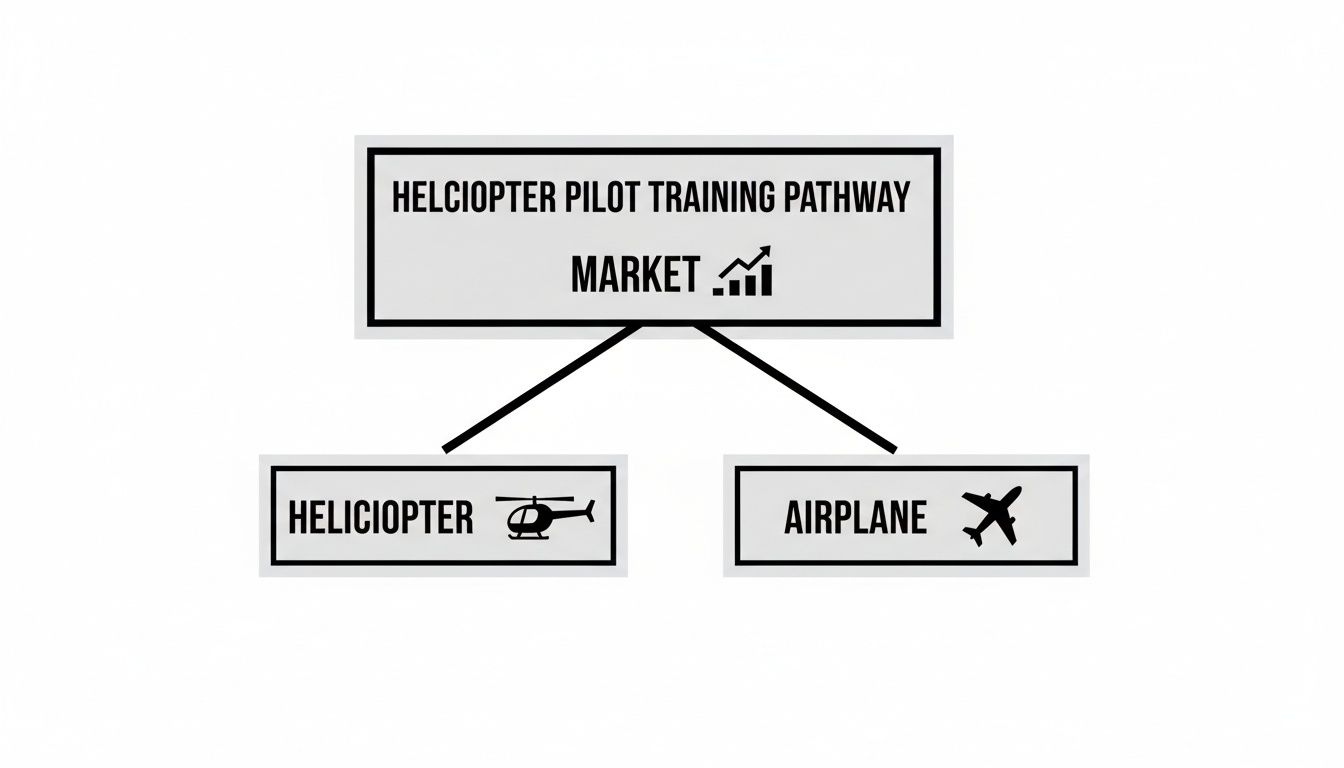
As you can see, while airplanes and helicopters share the sky, they represent distinct training paths and career opportunities. Now, let's get back to your journey.
Your First Step: The Private Pilot License (PPL-H)
Your first real taste of freedom in the sky comes with the Private Pilot License for helicopters (PPL-H). This is your ticket into the world of aviation and the bedrock for everything that follows.
With a PPL-H, you can fly for your own enjoyment. You can take friends and family up for a sightseeing flight, travel for personal reasons, and act as Pilot in Command (PIC) of the helicopter. The one major rule? You can't be paid for flying.
To earn it, the FAA sets a few minimums:
- A total of 40 hours of flight time.
- At least 20 hours of that must be with a certified instructor (dual instruction).
- You'll also fly for 10 hours completely on your own (solo flight).
After logging the time and passing a written knowledge test, you’ll take a practical exam with an FAA examiner, known as a checkride. Passing your PPL-H checkride is a huge milestone—it proves you have the fundamental skills to fly a helicopter safely.
The Professional Goal: The Commercial Pilot License (CPL-H)
When you’re ready to turn your passion into a profession, the Commercial Pilot License (CPL-H) is your target. This is the non-negotiable credential that legally allows you to get paid for your flying skills. It’s a testament to a much higher level of proficiency and aeronautical decision-making.
As you'd expect, the requirements are a big step up. The FAA mandates a minimum of 150 total flight hours, with 100 of those hours logged as Pilot in Command. The commercial checkride is also far more demanding, testing your ability to fly with greater precision under conditions that simulate real-world job pressures.
Want a deeper dive into what it takes? Check out our guide on commercial helicopter pilot training.
The Smart Next Step: The Certified Flight Instructor (CFI) Rating
So you have your brand-new commercial license. What now? While you can get a job, most entry-level positions in tourism, electronic news gathering, or utility work require more flight hours than a new CPL pilot has. This is where the Certified Flight Instructor (CFI) rating comes in. It’s the most common—and arguably the best—way to bridge that experience gap.
Becoming a flight instructor is more than just a job; it's a rite of passage. It solidifies your own knowledge, builds critical decision-making skills, and allows you to earn a living while building the flight hours needed for advanced career opportunities.
As a CFI, you don’t just build hours; you build them while teaching others, getting paid, and mastering your own craft. It rapidly gets you to the 1,000+ hour mark that opens doors to the industry's best jobs and makes you a far more competitive and skilled pilot.
Decoding the Cost of Your Helicopter Training
Let's get right to it—the question on every aspiring pilot's mind: what does it really cost to learn to fly a helicopter? The final number can look intimidating on paper, but it’s crucial to understand that you don't pay it all at once.
Think of it less like buying a car and more like paying for a college degree. You cover the costs semester by semester, or in this case, lesson by lesson. This makes the entire process far more manageable.
Itemizing Your Training Expenses
The bulk of your budget will go toward two things: the helicopter itself and your instructor's time. Both are billed by the hour, which puts you in control of the pace and the cash flow.
The single biggest variable is the aircraft you fly. Different helicopters have vastly different operating costs, and that's reflected in the hourly rental rate.
- Robinson R22: This is the workhorse of the training industry. It’s a fantastic, no-frills machine with lower operating costs, making it the most budget-friendly option for getting your private and commercial licenses.
- Enstrom F-28A: Known for its incredible stability and robust safety record, the Enstrom is a more forgiving aircraft to learn in. It feels more substantial in the air, offering a different kind of training experience that many students find confidence-boosting.
Beyond the aircraft rental, you’re also investing in your Certified Flight Instructor (CFI). Their time, both in the cockpit and on the ground for pre- and post-flight briefings, is where the real learning happens. This is where you transform textbook knowledge into life-saving skills.
Practical Financing and Payment Strategies
Almost nobody writes a single check for their entire flight training. The industry standard, and the way we operate at DuBois, is a pay-as-you-go model. You simply pay for each lesson when you take it. This approach lets you fit your training into your personal budget without needing a massive loan upfront.
The investment in quality instruction pays dividends. While dual instruction costs for helicopters can average $80-$150 per hour, the career return is significant. Helicopter pilots in fields like tours or EMS often log the 1,000+ hours needed for top-tier jobs faster than in many other aviation sectors. You can explore more on market dynamics and pilot career progression in this detailed rotorcraft market report.
Of course, financing can make the path even smoother. There are more funding avenues available today than ever before. For a complete rundown, take a look at our guide on financial aid for pilot training.
Here are some of the most common routes students take:
- Aviation-Specific Loans: Lenders like AOPA Finance and Pilot Finance, Inc. understand the training process and have programs built specifically for student pilots.
- Scholarships: Don't leave free money on the table! Organizations like the EAA, Women in Aviation International (WAI), and The Ninety-Nines offer millions in scholarships every year.
- GI Bill® Benefits: If you're a veteran, your benefits can be a game-changer. The GI Bill® can be used to fund your professional training, including the Instrument Rating and Commercial Certificate, after you’ve earned your private pilot license.
By paying as you go and exploring these smart financing options, a career in the pilot’s seat is well within your reach.
What to Expect in the Air and on the Ground
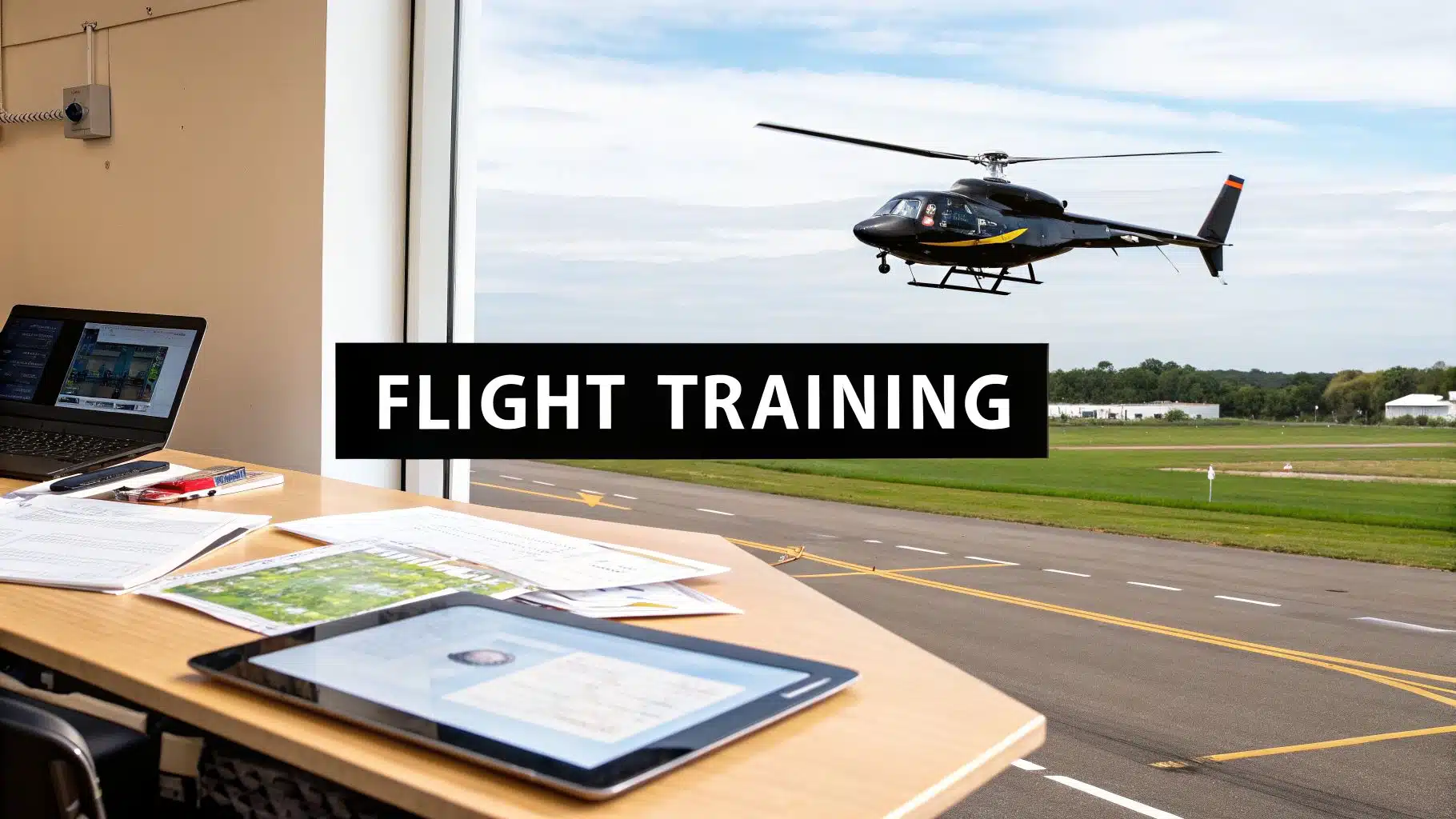
This is where the real work—and the real fun—begins. Learning to fly a helicopter isn't just about logging hours; it's a constant cycle of learning on the ground and then immediately applying that knowledge in the air. Get ready for a rhythm of studying, briefing with your instructor, flying the mission, and then debriefing to see what went right and where you can improve.
Every ground lesson is designed to give you the mental tools you'll need for your next flight. One minute you're deep in a textbook understanding aerodynamics, the next you're in the cockpit putting that theory into practice.
The Foundation of Knowledge: Ground School
Before you even touch the controls, you have to build a rock-solid base of aeronautical knowledge. Ground school isn't just about passing a test; it’s about genuinely understanding the forces of flight, the rules of the sky, and the machine you're commanding. It's the "why" that makes the "how" possible.
We blend classic classroom instruction with modern tools like Computer Based Training (CBT) to make sure you have the theory down cold.
You'll get a handle on topics like:
- Aerodynamics: How a complex rotor system creates lift and how your inputs make the helicopter move.
- Weather Theory: This is huge. You'll learn to read forecasts like a pro, spot dangerous conditions, and make smart go/no-go decisions.
- FAA Regulations: Mastering the rules of the road for the sky—airspace, communication, and right-of-way.
- Aircraft Systems: Getting to know your specific helicopter inside and out, from the engine to the emergency gear.
Think of this knowledge as the blueprint for every successful flight you'll ever have.
Mastering the Machine: In the Air
This is where it all comes together. Your time in the helicopter is where abstract concepts become real, tangible skills. Every lesson builds on the last, taking you from basic control to complex maneuvers, all under the expert guidance of your Certified Flight Instructor (CFI).
You start with the fundamentals and work your way up. It’s an intense, hands-on process that demands your full attention. Unlike flying an airplane, helicopter training involves unique skills like hovering and autorotations that can only be perfected through dedicated practice in dynamic conditions.
Some of the key flight skills you’ll master are:
- Pre-Flight and Post-Flight Procedures: Developing the disciplined habit of meticulously inspecting the aircraft before you fly and securing it properly when you're done.
- Basic Maneuvers: Learning to fly straight and level, execute precise turns, and manage climbs and descents smoothly.
- Hovering: The signature skill of any helicopter pilot. You'll spend a lot of time learning the delicate dance required to hold the machine perfectly still just feet above the ground.
- Autorotations: This is your most critical emergency procedure. You’ll practice handling a simulated engine failure, using the rotor's momentum to glide the helicopter to a safe landing. It’s a skill that requires absolute confidence and precision.
The Role of Simulators and the Airport Environment
Flight simulators have become an indispensable part of modern training. They are the perfect place to drill procedures and emergency scenarios without the cost or risk of being in the actual aircraft. You can practice an engine failure or navigate tough weather over and over, building muscle memory that will be there for you when you need it most.
Simulators provide a safe space to fail. They let you push the boundaries and learn from mistakes without real-world consequences, accelerating your understanding of complex emergency procedures.
The airport itself is also a critical part of your training. Learning at a busy, towered airport like Chino (KCNO) throws you right into the deep end of real-world aviation. From your very first flight, you’ll be talking to Air Traffic Control (ATC) and navigating alongside other aircraft. This kind of experience builds a level of confidence and competence you just can't get at a sleepy, uncontrolled airfield.
So You've Got Your Certificate—Now What?
Earning your commercial pilot certificate is the moment you've been working for. It’s your official ticket to get paid for flying, but it’s really just the beginning of your professional journey. That new certificate opens the door to your first flying job, where you'll start building the flight time and real-world experience needed to land the more advanced gigs down the road.
For most new commercial pilots, the first step is becoming a Certified Flight Instructor (CFI). It’s a classic for a reason. Teaching others is one of the best ways to sharpen your own skills, and you're getting paid to build flight hours. It's a true win-win. Other great entry points are flying air tours, giving people breathtaking views of scenic spots, or getting into agricultural flying like crop dusting and farm surveys.
Pathways to the Big Leagues
Once you hit that magic number—typically around 1,000 flight hours—the career landscape really opens up. This is the milestone that proves you have the seasoning and judgment for high-stakes flying. The skills you painstakingly built as an instructor or tour pilot are exactly what these advanced jobs demand, and the need for qualified pilots in these fields is always strong.
With that kind of experience, you can move into some truly incredible roles:
- Emergency Medical Services (EMS): This isn't just a job; it's a calling. As an EMS pilot, you're a critical part of a medical team, flying in high-pressure situations where every second counts.
- Law Enforcement: From police chases and surveillance to search and rescue operations, pilots are essential to modern law enforcement and government agencies.
- Offshore Oil and Gas: You'll be the lifeline for offshore platforms, transporting crews and vital equipment in some of the most challenging weather you can imagine.
- Corporate and VIP Transport: Flying executives or private clients in state-of-the-art aircraft is all about precision, professionalism, and top-tier customer service.
A Pilot's Guide to Buying and Selling an Aircraft
At some point in your career, you might decide to buy your own helicopter or airplane. Whether it's for personal flying or a business venture, this is a huge step. Knowing how to navigate the aircraft market safely is a skill every serious aviator should have.
For a prospective buyer, the process must be grounded in caution and thoroughness. Rushing into a purchase without a clear plan is a recipe for costly surprises down the road.
To buy an aircraft the right way, you need a plan. First, know your mission—what will you use it for? This will narrow down the right model. The next step is non-negotiable: get a comprehensive pre-purchase inspection from a qualified mechanic who knows that specific aircraft type inside and out. This inspection tells you the real story about the airframe, engine, and—most importantly—how much time is left on expensive, life-limited parts.
When it's time to sell, honesty and professionalism are key. Put together a clean, detailed spec sheet, get all your maintenance logbooks in order, and set a fair price based on the market and your aircraft's history. A well-maintained and well-documented machine will always attract serious buyers, making the sale a smooth process for everyone.
A Pilot's Guide to Buying and Selling a Helicopter
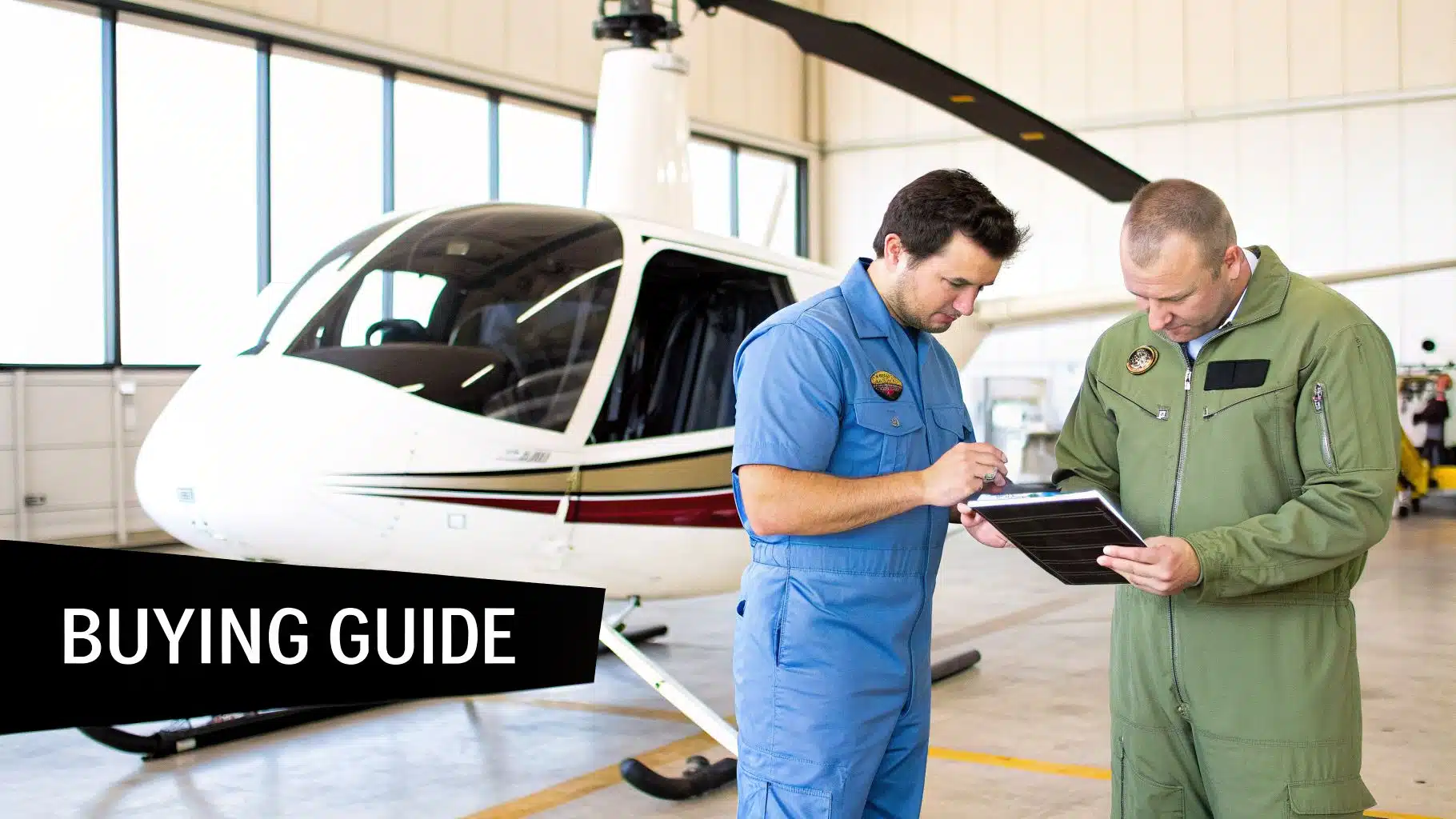
Once you have your ratings and some solid experience under your belt, the thought eventually crosses every pilot's mind: owning your own aircraft. Whether it's for weekend getaways, a new business venture, or expanding a commercial fleet, buying a helicopter is a huge step.
It’s also a step where things can go wrong—fast. The aircraft market has its own set of rules, and a bad purchase can lead to absolutely eye-watering expenses that will ground your dream before it ever gets off the ground.
How to Buy a Helicopter the Safe Way
The key is to treat the buying process with the same discipline you use in the cockpit. Excitement is your enemy here; a methodical process is your best friend. Think of it like a cross-country flight—you’d never depart without a detailed flight plan, and you shouldn't even think about buying an aircraft without one.
It all starts with one simple question: What is the mission? Seriously, what are you going to do with the helicopter? Are you flying yourself to meetings, running tours, or doing agricultural work? Your answer will immediately narrow the field from a small two-seater like a Robinson R22 to a larger, more capable turbine machine.
After you've zeroed in on a specific helicopter, you move to the single most important step in the entire process: the pre-purchase inspection (PPI). Whatever you do, don't skimp here. You need to find and hire an independent, trusted mechanic who specializes in that exact make and model.
A great pre-purchase inspection isn't just a look-see; it's a deep-dive forensic investigation into the aircraft's past, present, and future. It's the only thing that stands between you and a hidden financial disaster.
The inspection itself is exhaustive. Your mechanic will crawl over every inch of the airframe, engine, and avionics. But just as important, they will pour over the maintenance logbooks, searching for a complete history, verifying compliance with service bulletins, and ensuring all airworthiness directives have been addressed.
Understanding Component Times and Overhaul Schedules
Here’s where helicopters are fundamentally different from cars. A helicopter is a collection of parts, and many of those parts have a strict expiration date. We call them life-limited components, and they include big-ticket items like rotor blades, gearboxes, and transmissions. Each has a "time before overhaul" (TBO) or a hard retirement life, measured in flight hours or years.
This is where many first-time buyers get burned. A helicopter might be listed at a fantastic price, but a look at the component times tells a different story. An upcoming engine overhaul can easily cost $50,000, and a new set of main rotor blades can be even more. That "bargain" just became a money pit.
As part of the PPI, your mechanic’s report should give you a clear picture of every major life-limited part, including:
- Total hours on each component.
- Hours remaining until the next overhaul or replacement is due.
- A realistic estimate of what those future maintenance bills will look like.
This data is your leverage for negotiating a fair price, and it gives you a clear-eyed view of the true cost of ownership. A cheap helicopter with "timed-out" parts is no deal at all. By following these steps with the same focus you bring to your helicopter pilot training, you’ll make a smart investment that keeps you flying safely for years to come.
Common Questions About Helicopter Pilot Training
Stepping into the world of aviation always brings up a lot of questions. We get it. Here are some clear, no-nonsense answers to the things we hear most often from aspiring helicopter pilots.
How Long Does It Take to Become a Commercial Helicopter Pilot?
The timeline really boils down to one thing: how much time you can put in. If you’re able to go all-in with a full-time training schedule, you could find yourself going from zero experience to a commercially licensed pilot in about 6 to 12 months.
Of course, most people need to fit training around a job and family. A part-time schedule is totally doable, it just stretches the timeline out, usually to somewhere between one and two years. Your personal pace will always be influenced by factors like weather, aircraft availability, and how consistently you can hit the books and get in the air.
What Are the Medical Requirements?
To legally fly an aircraft, you have to hold a valid FAA Medical Certificate. It’s not as intimidating as it sounds, and the type you need depends on what you want to do.
- Third-Class Medical: This is your ticket to a Private Pilot License (PPL-H). It's the baseline requirement for anyone who wants to fly for fun.
- Second-Class Medical: If you plan to fly for hire, you’ll need a Commercial Pilot License (CPL-H), which requires at least a Second-Class Medical.
You'll get your certificate from an FAA-designated Aviation Medical Examiner (AME). It's basically a standard physical exam to make sure your health, vision, and hearing are up to the standards needed to safely operate an aircraft.
Is It Harder to Fly a Helicopter Than an Airplane?
It’s not so much harder as it is different. Flying a helicopter definitely has a steeper initial learning curve. That’s because you have to learn to use all four flight controls at the same time with constant, tiny adjustments, especially when learning to hover. It’s a skill that requires a real sense of finesse.
I’ve always said that an airplane wants to fly, but a helicopter is just a collection of parts trying to fall out of the sky. Your job is to continuously convince it otherwise with very precise inputs.
Once you get the feel for it, though, it becomes second nature. The book-work side of things—aerodynamics, weather, navigation, and FAA regulations—is pretty much the same for both. It’s a unique challenge, and that’s what makes it so rewarding for the pilots who master it.
Can I Use My GI Bill® Benefits for Helicopter Training?
Yes, absolutely. Many veterans use their GI Bill® benefits to fund their professional flight training, but you need to know how it works. Typically, you must pay for your Private Pilot License out-of-pocket first.
Once you have your PPL-H, your benefits can often be applied toward advanced ratings like the Instrument Rating and Commercial License, as long as you're training at an approved Part 141 flight school. We always advise you to check directly with the Department of Veterans Affairs (VA) and your school to confirm all the details and eligibility requirements.
Ready to stop dreaming and start flying? At DuBois Aviation, we provide the one-on-one instruction and real-world experience you need to succeed. Get started by booking a discovery flight today at https://duboisaviation.com.