
When people hear the term "paid pilot training," their minds often jump to the idea of someone paying you to learn to fly. While that would certainly be nice, the reality is a bit different—and frankly, a lot more strategic.
Think of it as a direct investment in a fast-track, lucrative career as an airline pilot. It’s an accelerated program designed from the ground up to create professional pilots, efficiently and effectively.
What Is Paid Pilot Training, Really?
Imagine the difference between taking a few general classes at a community college versus enrolling in a specialized medical residency. One path allows for broad exploration, while the other is an intense, structured journey designed to produce a surgeon.
Paid pilot training is the residency of the aviation world. It’s an immersive, focused experience with one clear outcome in mind: a professional career.
This is a world away from casual, pay-as-you-go flight lessons that move at your own pace. Structured programs are built for speed. They’re designed to take you from zero experience all the way through your required certifications—Private Pilot, Instrument Rating, Commercial Pilot, and often Certified Flight Instructor (CFI). The goal isn't just to learn to fly; it's to become a professional aviator ready for the airlines as quickly as possible.
A Career Path, Not Just a Hobby
So, where does the "paid" part come in? It refers to the ultimate goal: landing a paid position as a professional pilot. The training itself is a significant upfront financial commitment, but it's an investment made with the expectation of a very high return once you’re in the cockpit.
This is especially true for those making a career change. The structured nature of these programs helps you quickly get up to speed, and your previous professional experience often contains valuable transferable skills for career change that can be a real asset in the demanding flight training environment.
Why Now Is the Time to Invest
This accelerated path has never been more valuable, and the reason is simple: a massive, industry-wide pilot shortage. The demand for new pilots isn't just a talking point; it's a statistical reality.
Boeing's latest forecast projects a staggering global need for 649,000 new pilots over the next 20 years. In North America alone, that number is 127,000 pilots needed by 2042.
This huge demand is fueled by a wave of mandatory pilot retirements and steady growth in air travel. The U.S. Bureau of Labor Statistics echoes this, projecting about 16,800 openings for airline and commercial pilots each year over the decade. For aspiring pilots, this means airlines are actively and aggressively looking for qualified candidates, making now an incredible time to invest in a structured program at a school like DuBois Aviation.
Paid Pilot Training Pathways at a Glance
Navigating the different ways to become a professional pilot can feel overwhelming. To help clarify, here’s a quick breakdown of the most common paid training pathways. This table will give you a bird's-eye view of your options before we dive deeper into the specifics of each.
| Training Pathway | Best For | Typical Timeline (Zero to ATP Minimums) | Key Feature |
|---|---|---|---|
| Airline Cadet Program | Aspiring airline pilots seeking a direct path to a specific carrier. | 18-24 months | Conditional job offer from an airline early in training. |
| Accelerated Flight School | Students who want a fast, focused, and immersive training environment. | 18-24 months | All-inclusive curriculum designed for career-focused individuals. |
| Aviation University/College | Students who want a traditional 4-year degree alongside their flight training. | 4-5 years | Combines flight ratings with a Bachelor's degree; may offer R-ATP eligibility. |
| Modular / Pay-As-You-Go | Individuals needing maximum flexibility to train around a job or other commitments. | 24-36+ months | Self-paced; pay for each lesson or rating individually. |
Each of these routes can lead to the right seat of an airliner, but they cater to different timelines, budgets, and learning styles. The key is finding the one that aligns perfectly with your personal and professional goals.
Comparing Your Pilot Training Program Options
So, you’ve decided to chase a career in aviation. That’s the first big step. Now comes an equally important one: choosing how you'll get there. The path you take will define your timeline, your total investment, and what your day-to-day life looks like on the journey to the cockpit.
There are really three main routes people take. Getting to know the rhythm and structure of each—University Aviation Programs, Accelerated Career Programs, and Airline Cadet Programs—is the key to finding the right fit. Let's break down what a typical day feels like in each one so you can see where you might belong.
University Aviation Programs: The Four-Year Degree Path
Think of the traditional college experience, but with flight time mixed in. A university aviation program wraps your flight training right into a four-year bachelor's degree. Your schedule will be a blend of standard academic classes like aerodynamics, aviation law, and meteorology, alongside your scheduled flight lessons.
A typical day might start with a 9 a.m. lecture on aircraft systems, followed by an afternoon flight block with your instructor. The evenings are for homework, studying, and regular campus life. It’s a structured pace, but definitely more relaxed than some of the other options.
- Pros: You walk away with a valuable college degree. This can also qualify you for a Restricted Airline Transport Pilot (R-ATP) certificate, which could lower your required flight hours from 1,500 down to 1,000. Plus, you get the full campus social and networking experience.
- Cons: This is the longest and often the most expensive path. Training can get bogged down by academic schedules, weather delays, and having to compete with a large student body for aircraft and instructors. A four-to-five-year commitment is significant.
Accelerated Career Programs: The Fast Track
Now, imagine your only job is becoming a pilot. That’s the core of an accelerated program, like the kind we offer here at DuBois Aviation. Your days are completely immersive, focused entirely on aviation, and designed to take you from zero experience to being airline-ready in as little as 18-24 months.
A day in an accelerated program is packed. You might have ground school in the morning, a flight lesson before lunch, a solo cross-country flight in the afternoon, and then spend the evening studying for your next checkride. It’s incredibly demanding and requires your full dedication.
For students who are laser-focused on reaching an airline career as fast as possible, accelerated programs offer the most direct route. The immersive environment builds skill and confidence at an incredible pace.
This model is all about efficiency. Schools like DuBois Aviation create a clear pipeline through your ratings—Private, Instrument, Commercial, and Multi-Engine—and often give you the chance to become a Certified Flight Instructor (CFI) to build your hours. Picking the right school is a huge decision, and getting some expert advice on how to choose a flight school that matches your goals is a smart move.
Airline Cadet Programs: The Direct Hire Pipeline
Finally, there’s the airline cadet program, which creates a direct link to a specific airline. With this model, you apply directly to an airline's program. If you're accepted, you often get a conditional job offer before your training even begins. The airline then partners with a specific flight school to handle your training from start to finish.
Your day-to-day life will feel a lot like an accelerated program, with intense, full-time flight and ground school. The biggest difference is that the airline’s own procedures and culture are baked into your training from day one. You aren’t just learning to be a pilot; you're learning to be a pilot for that specific airline.
- Pros: That conditional job offer provides incredible peace of mind. Your training path is crystal clear, and you have a direct line to your future employer right from the start.
- Cons: These programs are extremely competitive to get into. You're also committed to a single airline, which could be a drawback if other carriers present better opportunities down the road. If you decide to leave the program, you'll likely lose that conditional offer.
The True Cost of Becoming an Airline Pilot
Alright, let's talk about the two biggest questions every aspiring pilot has: how much does it cost, and how long does it take? Forget the vague estimates you’ve seen online. Getting a handle on the real financial and time commitment is the most important first step you can take.
Think of it less like a single, massive expense and more like a series of investments. Each pilot certificate is a building block, and you fund them one at a time. You start with the foundation, your Private Pilot License, and build your way up to the professional ratings that get you hired.
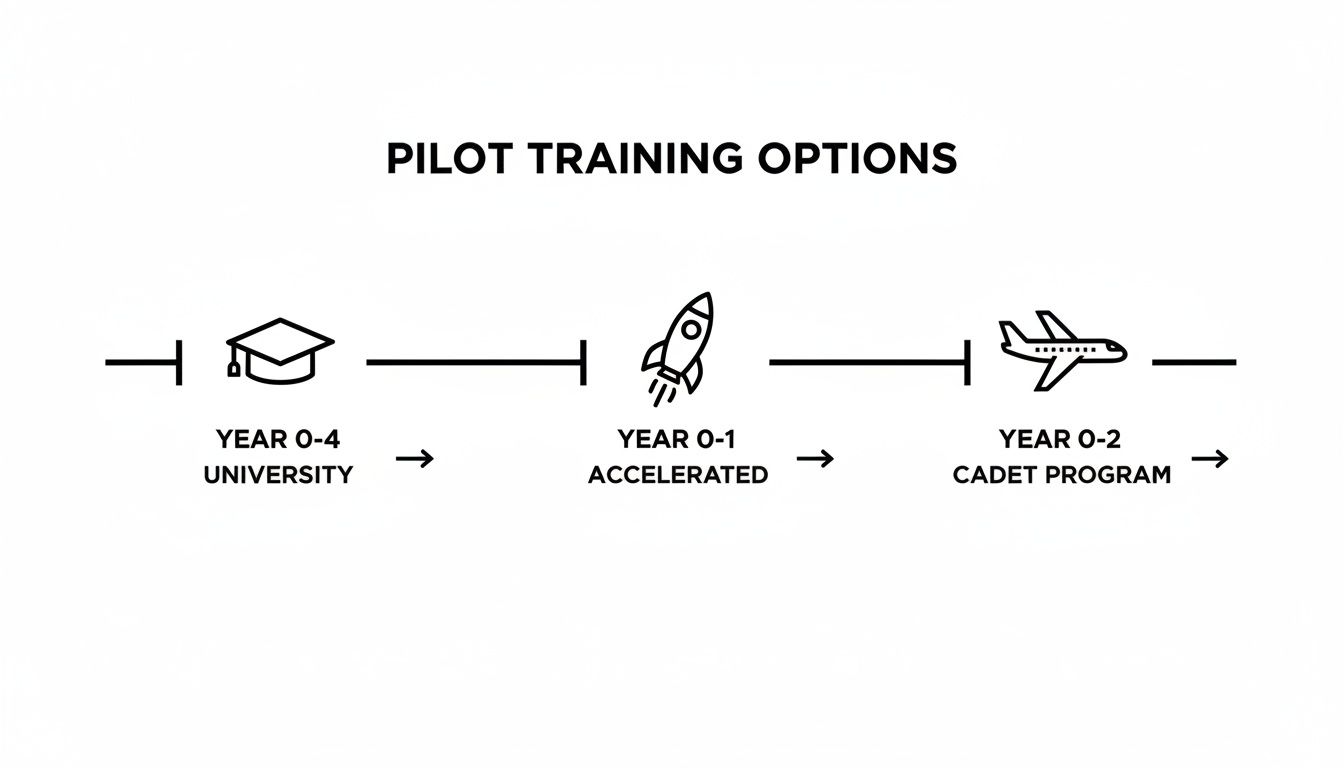
The graphic above lays out the most common training pathways. As you can see, programs like university aviation degrees and accelerated flight schools have very different timelines. The key takeaway? The fastest routes, like accelerated and cadet programs, demand a full-time, heads-down commitment.
Breaking Down the Costs by Certification
Your journey from the ground to the flight deck involves earning several key certificates and ratings. Each one is a milestone with its own price tag and training schedule. Here’s what the typical path looks like:
Private Pilot License (PPL): This is where it all begins. It’s your license to fly single-engine planes on your own and is the foundation for everything that follows.
Instrument Rating (IR): This is non-negotiable for a professional career. The IR teaches you how to fly the plane solely by referencing your instruments, which is essential for flying through clouds or in poor weather.
Commercial Pilot License (CPL): This is the license that legally allows you to get paid to fly. It demands a higher level of precision and more flight hours than your PPL.
Multi-Engine Rating (MER): Since airlines fly planes with more than one engine, you'll need this rating. Most pilots earn it right after their CPL.
Certified Flight Instructor (CFI): While not technically required to fly for an airline, becoming an instructor is the industry-standard way to build the 1,500 flight hours airlines require for hiring. Plus, you get paid to fly while you do it.
The good news is that after a few years of steady increases, flight training costs have finally started to stabilize. In fact, a recent industry analysis shows that the price and time for primary training have held steady over the past year. This is a welcome development for anyone planning their career, as it makes budgeting for a program at a school like DuBois Aviation far more predictable. You can read more about the recent stabilization of flight training costs and see why now is a great time to start.
Here is a closer look at what you can expect to invest in terms of both time and money for each step of your training, based on recent industry data.
Estimated Training Costs and Duration by Certification (2026)
This table breaks down the median costs and typical timelines for each major pilot certification. Keep in mind these are based on full-time training and can vary based on your location and individual progress.
| Pilot Certification | Median Cost (2026) | Typical Training Duration (Full-Time) | Flight Hour Requirement |
|---|---|---|---|
| Private Pilot License (PPL) | $18,000 | 2-3 months | 40-60 hours |
| Instrument Rating (IR) | $15,000 | 2 months | 40 hours (simulated/actual) |
| Commercial Pilot License (CPL) | $45,000 | 4-6 months | 250 hours (total) |
| Multi-Engine Rating (MER) | $6,000 | 1-2 weeks | 10-15 hours |
| Certified Flight Instructor (CFI) | $10,000 | 1-2 months | No additional hours |
These figures provide a realistic financial roadmap. As you can see, the journey is a series of manageable steps, not one giant leap.
The Zero-to-Hero Timeline
So, how quickly can you go from your very first flight lesson to being qualified for an airline job? It really boils down to your chosen path and how much effort you put in.
A motivated, full-time student in an accelerated program can realistically go from zero experience to meeting airline minimums in 18 to 24 months.
That aggressive timeline means treating flight school like a full-time job. You'll be flying several times a week, attending ground school, and hitting the books hard every day. It's intense, there's no doubt about it. But it's also the most direct route to the right seat of an airliner and the salary that comes with it.
How to Fund Your Pilot Training Dream
Let's talk about the elephant in the room: the cost. Seeing the total price tag for a professional pilot program can be intimidating, but it's important to reframe that number. This isn't just an expense; it's a serious investment in a career with incredible earning potential, especially as pilot salaries continue to climb.
The most important thing to realize is that you don't need $100,000+ sitting in your bank account on day one. Almost nobody does. Instead, think of funding your training like building a house—you pay for the foundation first, then the framing, and so on. You'll secure financing for your Private Pilot License, and once that's complete, you'll move on to funding your Instrument Rating. This stage-by-stage approach makes the entire journey far more manageable.
Finding the Right Loan: From Banks to Aviation-Specific Lenders
For many people, the first thought is a student loan, much like for a university degree. While some traditional banks or credit unions might offer personal loans, they don't always cover vocational training like flight school. That’s where specialized aviation lenders really shine.
Organizations like the Aircraft Owners and Pilots Association (AOPA) have financing programs built specifically for student pilots. They understand the costs, the timeline, and the value of a paid pilot training program.
- You'll generally need a good credit score to qualify, and sometimes a co-signer can help.
- The application process is what you'd expect: a credit check and details about the flight school you've chosen.
- The big advantage is that these lenders get it. They know aviation and may offer more suitable terms.
- The trade-off is that interest rates can sometimes be higher than federal loans for a four-year college.
Don't Leave Free Money on the Table: Scholarships
Seriously, you have to pursue scholarships. This is essentially free money for flight training, and there are hundreds of them out there. These are offered by countless organizations that are passionate about bringing up the next generation of pilots.
Major groups like the Experimental Aircraft Association (EAA), Women in Aviation International (WAI), and the National Gay Pilots Association (NGPA) give out millions of dollars every single year. And they aren't all for valedictorians; many scholarships are based on financial need, where you live, or simply your demonstrated passion for flying. For a great starting point, check out our complete guide on financial aid for pilot training.
A pro tip I give all my students: look for smaller, local scholarships from EAA chapters, aviation clubs, or even businesses at your local airport. The award might be smaller, but the competition is way lower, which dramatically boosts your odds.
Thinking Outside the Box: Creative Funding Paths
Beyond loans and scholarships, many of our most successful students have pieced together their funding with a bit of creativity. Your own savings are your most powerful tool. If you're planning ahead, setting up a dedicated sinking fund is a smart way to systematically save for your training goal without derailing your other finances.
Here are a few other paths we've seen work well:
- A Loan from Family: This can be a great option, often with the best terms you'll ever find. The key is to treat it like a business transaction. Draft a formal agreement that outlines the loan amount and a repayment schedule to ensure everyone is on the same page and relationships stay strong.
- Lines of Credit: If you're a homeowner, a home equity line of credit (HELOC) can be a source of funds, often at a lower interest rate than an unsecured personal loan.
- GI Bill® Benefits for Veterans: If you're a veteran, your GI Bill® benefits can be a fantastic way to cover your training costs. It’s absolutely critical to work with a VA-approved school, like DuBois Aviation, to make sure your program qualifies and to get help navigating the VA's specific requirements for reimbursement.
By looking at all these options, you can start to build a realistic financial plan. It might be a mix of savings, a small loan, and a scholarship or two, but it’s how you turn the dream of flying into a real, achievable plan.
Safely Buying or Selling Your Own Aircraft
For many pilots, the dream doesn't end with getting your certificates. The journey that often starts with paid pilot training naturally evolves into the next big milestone: aircraft ownership. Owning your own plane can be a fantastic way to build hours more affordably, start a small aviation business, or just experience the pure freedom of flight on your own terms.
But let's be clear: buying or selling an aircraft isn't like buying a car. It's a major financial transaction, much more like purchasing a home. It demands careful research, professional guidance, and a safety-first mindset to make sure you're protected. Whether you're looking for your first set of wings or selling a trusted companion, knowing the right way to approach the process is everything.
How to Buy an Airplane the Safe Way
The excitement of buying your first aircraft is incredible, but it's crucial to channel that energy into a solid plan. Cutting corners can lead to huge financial headaches and, more importantly, serious safety issues down the road. Here's a roadmap to follow for a secure and successful purchase.
Figure Out Your Mission: Before you even start scrolling through listings, ask yourself: what is this plane for? Are you a time-builder aiming for the airlines? Do you need a reliable cross-country machine for family getaways? Your answer will determine the type, size, speed, and avionics you need.
Get Your Financing in Order: Just as with a house, getting pre-approved for a loan is a critical first move. It sets a realistic budget so you're not wasting time on planes you can't afford. It also shows sellers you're a serious buyer, which gives you a lot more leverage when it's time to negotiate.
Find an Expert for Your Corner: You don't have to hire a buyer's agent, but a good one is worth their weight in gold. These acquisition consultants live and breathe the aircraft market. They can spot red flags a mile away, help you navigate the paperwork, and represent your best interests from the first offer to the final handshake.
The Make-or-Break Pre-Purchase Inspection
If there's one piece of advice to take away from all this, it's this: never, ever buy an aircraft without a thorough pre-purchase inspection (PPI). A PPI is a comprehensive examination performed by an independent, trusted A&P mechanic who works for you, not the seller.
A PPI isn't about finding reasons to walk away from the deal. It's about getting a completely transparent view of the aircraft's true condition so you can make a smart decision and accurately budget for any future maintenance.
The mechanic will go over the airframe, engine, and all its systems with a fine-toothed comb. Just as crucial, they will meticulously review the maintenance logbooks. Gaps in the logs or sloppy entries are a huge red flag that could point to a hidden damage history or neglected repairs.
Getting to the Finish Line
Once the PPI is done and you’ve agreed on a final price, you'll move into the closing process. This is where you absolutely need professionals to handle the details and protect your investment.
- Title Search: An aviation title company dives into the FAA's records to confirm the aircraft has a clean title. You need to be sure there are no outstanding liens or claims against it before you take ownership.
- Escrow Services: Always use a reputable escrow service for the actual transaction. You place the funds with a neutral third party, and they only release the money to the seller once the title has officially been transferred into your name. It’s the single best way to ensure a secure exchange.
For pilots looking to base a new aircraft in Southern California or seeking expert acquisition services, it's worth checking out the specialists at Threshold Aviation Group located at Chino Airport, which has decades of experience in aircraft sales, management, and maintenance.
Tips for Selling Your Aircraft
On the flip side, if you're the one selling, a little prep work goes a long way toward getting a top-dollar offer and ensuring a quick, smooth sale.
- Organize Your Paperwork: Get your logbooks in perfect order. Make sure every entry is accounted for, and consider digitizing them. Buyers and their mechanics will scrutinize these documents, and having them ready shows you’ve been a meticulous and transparent owner.
- Make it Shine: Invest in a professional detail. A clean, polished aircraft makes an incredible first impression and immediately suggests that the plane has been well-maintained.
- Build a Great Listing: Your ad needs more than just basic specs. Take high-quality photos and videos from every angle, inside and out. Write a detailed description of the avionics, recent maintenance, and specs. Be upfront and honest about the aircraft's condition—it builds trust and attracts serious buyers.
Why Your Training Environment Is Critical for Success
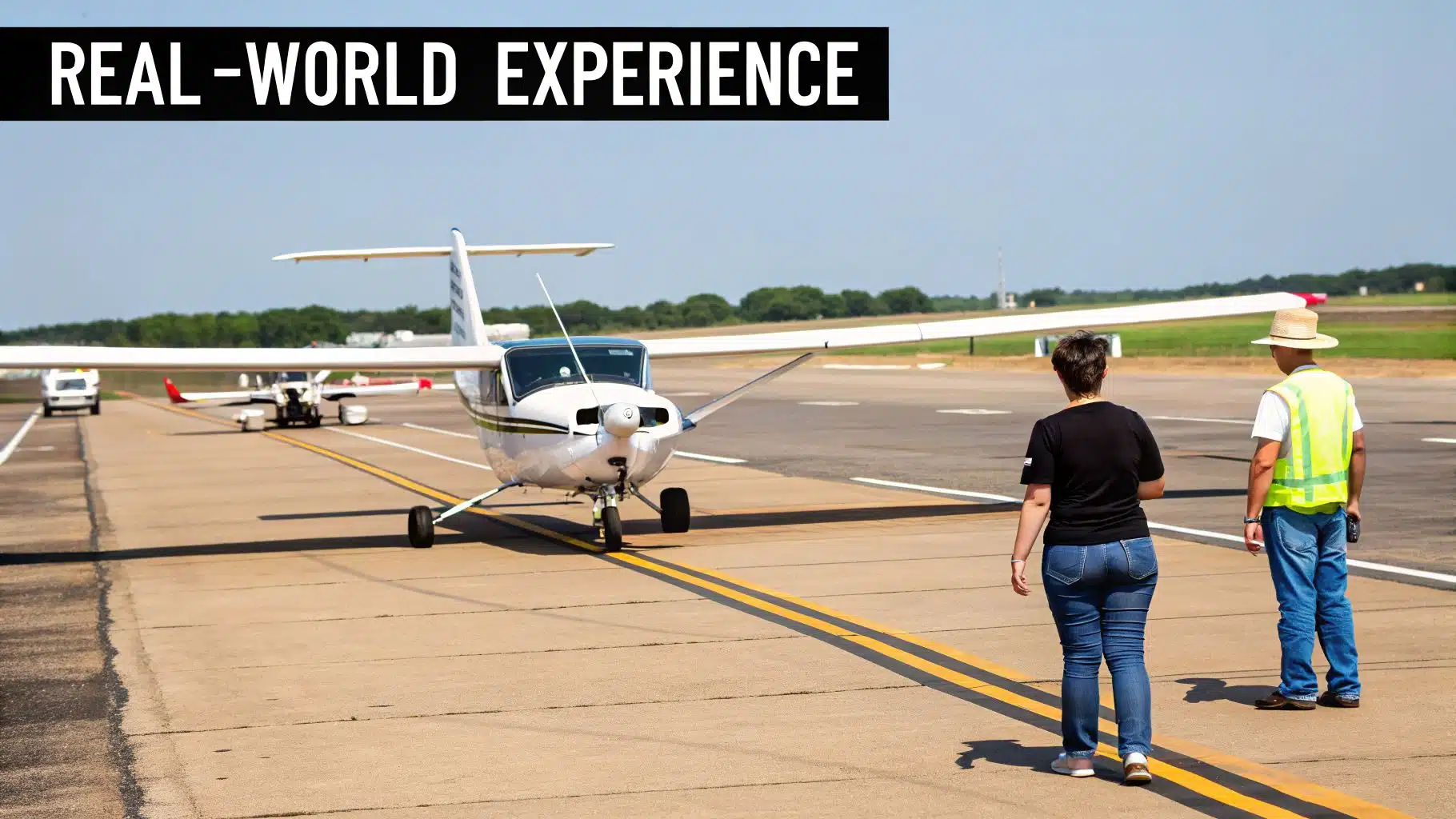
Where you learn to fly is every bit as important as how you learn. A paid pilot training program is all about getting you into a professional cockpit, and the environment you train in directly shapes your career readiness. Think of it like this: a chef can learn basic knife skills at home, but they only become a professional by working on a busy, high-pressure restaurant line.
The same holds true for aviation. Training at a sleepy, non-towered airstrip is certainly peaceful, but it doesn’t reflect the reality of a professional pilot's day-to-day. Your goal isn't just to accumulate flight hours; it's to build the specific skills and confidence needed to operate safely in the real world. This is where choosing the right school, like DuBois Aviation, becomes one of the most important decisions you'll make for your career.
The Advantage of a Busy Airspace
Right from your first lesson at DuBois Aviation, you’ll be immersed in the environment at Chino Airport (KCNO). This isn’t just some local runway; KCNO is a bustling, towered Class D airport with three runways and a full suite of instrument approaches.
The real-world experience gained at a towered airport is immense. It forces you to master ATC communication, sequence with other aircraft, and navigate complex procedures from day one, building a foundation of professionalism that casual training environments simply cannot replicate.
What this means is that you won't just be practicing radio calls—you'll be living them. You'll constantly be interacting with a mix of aircraft, from other students to corporate jets, developing the razor-sharp situational awareness and radio skills that airlines demand. It builds a kind of "mental muscle" that makes the eventual leap to an airline cockpit feel like a natural next step, not a giant leap.
A Diverse Fleet Builds Versatile Pilots
Another piece of the puzzle is the aircraft you fly. If you only ever train in one type of plane, you’re developing a very narrow skillset. At DuBois Aviation, we see our diverse fleet as a core part of our career-focused curriculum.
- Single-Engine Trainers: You'll build your foundation in time-tested aircraft like the Piper Cherokee and Cessna 150, truly mastering the fundamentals of flight.
- Multi-Engine Aircraft: Your transition to the Piper Apache for the multi-engine rating is a seamless and logical progression, giving you the specific experience needed for airline-track careers.
- Helicopter Training: For those with different career goals or who want to add a unique rating, we also offer training in Robinson and Enstrom helicopters, opening up entirely different opportunities.
This variety deliberately molds you into a more adaptable, well-rounded pilot. By getting comfortable with different systems, performance characteristics, and flight decks, you become a more capable and marketable aviator, fully prepared for whatever challenges your career brings.
Your Pilot Training Questions, Answered
As you get closer to making a decision about your aviation future, it's completely normal to have a few last-minute questions. We get it. Here are some straightforward answers to the most common things aspiring pilots ask us, designed to help you move forward with confidence.
Should I Buy a Plane for Training or Just Rent?
For anyone just starting their paid pilot training, renting is the way to go. Period. When you rent from a flight school like DuBois Aviation, you can put all your energy into what matters: learning to fly. You don't have to worry about the massive hidden costs and headaches of ownership like maintenance, insurance, and hangar space.
Down the road, once you’re a licensed pilot looking to build serious flight time or flying often, ownership might start to make sense. It all boils down to a simple calculation: do you fly enough hours each year to justify the fixed costs of owning your own aircraft? For most, that comes much later in their flying career.
What's the Safest Way to Buy an Airplane?
Buying an aircraft is a huge step, and you need to approach it with the same diligence you would use to buy a house, not a car. It requires a careful, safety-focused process.
- Know Your Mission: First, be crystal clear about what you'll use the plane for. Are you building hours for a commercial rating, flying the family on weekends, or using it for business trips? The answer will point you to the right type of aircraft.
- Get Your Finances in Order: Secure a pre-approval for your loan before you even start looking. This sets a realistic budget and proves to sellers that you're a serious buyer.
- Never Skip the Pre-Purchase Inspection (PPI): This is non-negotiable. A qualified, independent mechanic needs to perform a deep dive into the aircraft and its maintenance logbooks to find any potential red flags.
- Use Title and Escrow: Protect your investment. A professional title and escrow service will ensure the aircraft has a clean history and that the funds are transferred securely.
How Can I Prepare My Plane to Get the Best Price When Selling?
If you're on the other side of the transaction, a little preparation goes a long way toward a smooth sale and attracting top-dollar offers. It’s all about transparency and presentation.
Your aircraft’s logbooks are your single most important sales tool. Make sure every maintenance record is organized and complete—consider scanning them to share easily with potential buyers. A pristine set of books builds confidence and justifies your asking price.
Beyond the paperwork, spend the money on a professional detailing. A sparkling clean aircraft makes an unforgettable first impression. When you write your listing, be honest and thorough, and use high-quality photos that show off the plane’s best features.
If you’re wondering whether now is the right time to get into aviation, the numbers speak for themselves. The pilot training market was valued at $8.09 billion in 2023 and is expected to soar to $25.9 billion by 2032. This isn't just growth; it's a massive signal of the opportunity waiting for new, qualified pilots. You can learn more about the global pilot training market expansion on dataintelo.com.
Ready to stop dreaming and start flying? At DuBois Aviation, we offer the structured programs, modern fleet, and supportive environment you need to launch a rewarding career. Explore our training options or schedule your own discovery flight by visiting us online today at https://duboisaviation.com.