
The dream of becoming a pilot is exhilarating, but figuring out how to pay for it can feel as complicated as navigating a storm. Think of this guide as your co-pilot, here to show you that a fully funded flight path is absolutely within your reach. The secret isn't finding one magic pot of money; it's about strategically piecing together multiple resources to build your own financial runway.
Charting Your Course to a Funded Cockpit
That pull to get into the cockpit is powerful, but the cost can feel like a major headwind. It’s easy for aspiring aviators to feel grounded before they even start, looking at the price tags for flight school. But with a solid plan, you can break that massive number down into manageable steps. The key is knowing what financial tools are out there and putting together a funding strategy that fits you.
This is about more than just getting a single loan. A smart financial plan often blends specialized aviation loans, scholarships, personal savings, and maybe even unique opportunities like airline sponsorships. By exploring every option, you can assemble the capital you need to earn your wings without hitting a lot of financial turbulence along the way.
Visualizing Your Funding Options
To help you see how all these pieces can fit together, the chart below lays out the main ways you can fund your pilot training. It covers everything from direct financing to some alternative career routes you might not have considered.
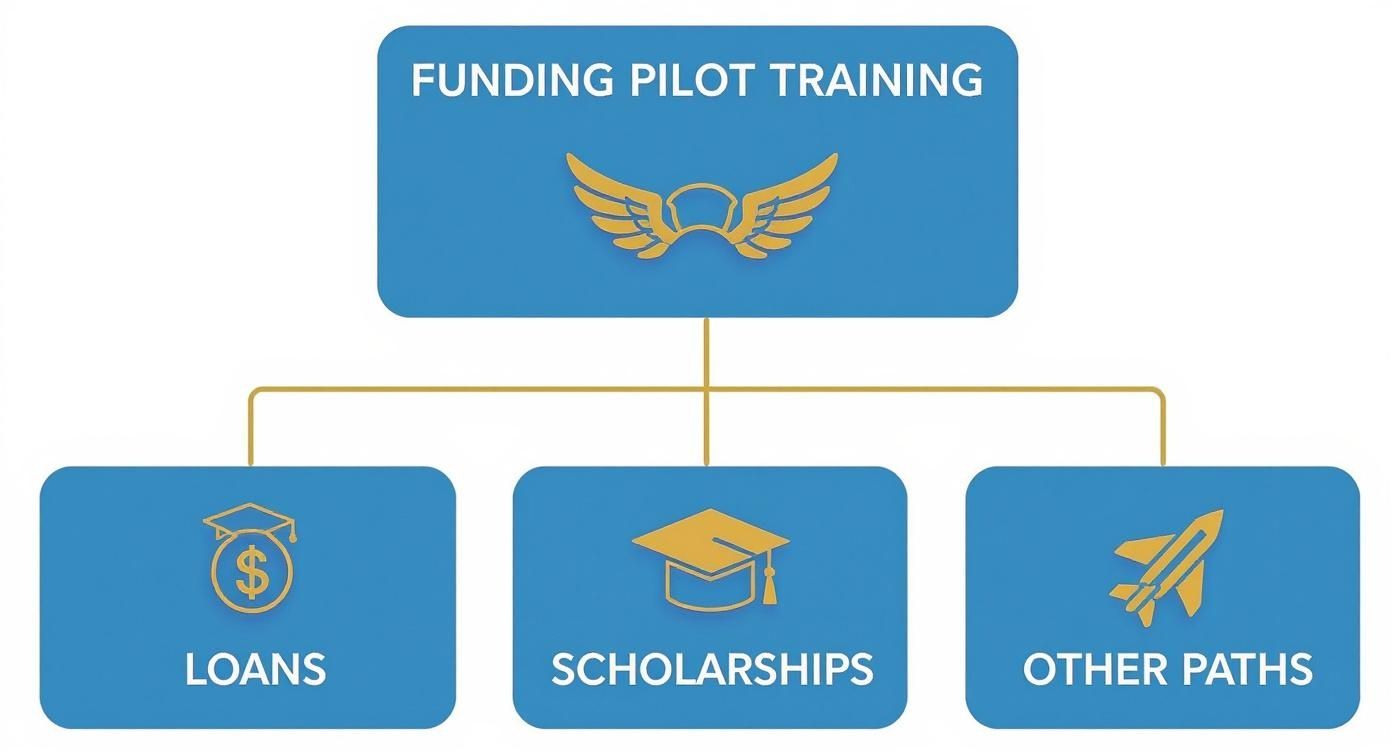
As you can see, loans are a common starting point, but don't overlook scholarships and other niche paths. They provide critical support that can seriously reduce your overall debt and get your career off the ground faster.
To give you a quick overview, here's a simple breakdown of the main financial aid categories available to student pilots.
Pilot Training Financial Aid Options at a Glance
| Aid Type | Best For | Key Feature | Repayment Required? |
|---|---|---|---|
| Scholarships & Grants | Everyone—especially those with strong academics or a compelling story. | Free money that doesn't need to be paid back. | No |
| Federal Student Loans | Students attending accredited university aviation programs. | Fixed interest rates and flexible repayment options. | Yes |
| Private Student Loans | Students at non-accredited flight schools or those needing to cover gaps. | Higher loan limits but often variable interest rates. | Yes |
| Airline-Sponsored Programs | Aspiring pilots willing to commit to a specific airline post-training. | Potential for tuition reimbursement or direct funding. | Often, via a service commitment. |
This table is just a starting point, but it helps clarify how different funding sources serve different needs on your journey to the flight deck.
The Scale of the Aviation Industry
The global demand for skilled pilots is soaring, and it's fueling a massive industry. In fact, the global pilot training market was valued at around USD 9.37–9.41 billion in 2024. That huge number shows just how much is being invested in the next generation of aviators. For you, this growing market means more resources and dedicated financial products are hitting the scene. You can explore more data about the pilot training market to see just how fast it's expanding.
Buying an Aircraft as an Investment
For some pilots, purchasing an aircraft after getting their license becomes a strategic financial move. Owning your own plane or helicopter can be a smart way to build flight hours far more cheaply than renting. Of course, you have to know how to buy an airplane the safe way, which takes serious research.
A thorough pre-buy inspection by a certified mechanic is non-negotiable. It's the single most important step in protecting your investment and ensuring your safety in the air.
This is way more than just kicking the tires. A proper inspection can uncover hidden mechanical problems that could cost you a fortune in repairs later on. It also ensures the aircraft's logbooks are complete and that it meets all airworthiness standards, giving you both peace of mind and financial security. Specialized lenders, like Stratus Financial, can even help with aircraft acquisition. It's worth it to explore your financing options for pilots to learn more about this path.
Calculating the True Cost of Your Pilot License

Before you even start looking for financial aid, you need to map out your own financial flight plan. Just like a pilot runs through a meticulous pre-flight checklist, you have to account for every single cost that comes with earning your wings. It’s about much more than the advertised tuition—it's about understanding the total, all-in investment.
Creating a detailed budget is probably the single most important document you’ll put together. Think of it as the foundation for every loan application you fill out and every scholarship essay you write. Without it, you're flying blind and risk the costly scenario of running out of money mid-training, which often leads to delays and having to re-learn skills you’ve already paid for.
Breaking It Down, Certificate by Certificate
The path to the airline cockpit isn't one giant leap; it's a series of ratings and certificates, and each one comes with its own price tag. Looking at the total figure can feel overwhelming, so let's break it into more manageable steps.
- Private Pilot License (PPL): This is where it all starts. Your PPL is the foundation for everything that follows and your first big financial hurdle.
- Instrument Rating (IR): This is a non-negotiable for a professional career, allowing you to fly in cloudy weather and navigate without visual reference to the ground.
- Commercial Pilot License (CPL): The certificate that officially allows you to get paid to fly.
- Multi-Engine Rating (ME): A must-have for any aspiring airline pilot, this qualifies you to fly planes with more than one engine.
- Certified Flight Instructor (CFI/CFII/MEI): Many new pilots get these ratings to build flight hours. It's a smart way to turn a training expense into a source of income by teaching others.
- Airline Transport Pilot (ATP): The pinnacle of pilot certification. This is your ticket to the major airlines and requires a minimum of 1,500 flight hours.
Each of these steps involves flight time, instructor fees, ground school, and exam costs. The total can swing wildly depending on the flight school, its location, and the aircraft you train in. All in, you should realistically budget for a total cost between $70,000 to $120,000 to get from zero experience to a commercial license.
Uncovering All the Hidden Expenses
Your budget has to go way beyond just the time you spend in the air. Too many aspiring pilots get tripped up by the secondary costs that seem small on their own but add up fast.
A classic rookie mistake is only budgeting for the absolute minimum flight hours the FAA requires. The reality is, most students need 15-20% more flight time than the minimums to feel truly proficient and confident for their check-ride.
Building this buffer into your budget from day one is the best way to avoid nasty financial surprises down the road. Here’s a quick checklist of other crucial expenses you need to factor in:
- Ground School Materials: This covers everything from textbooks and online courses to flight planning software.
- Aviation Headset: This isn't just an accessory; it's essential equipment. A good one will protect your hearing and ensure clear communication, costing anywhere from $300 to over $1,200.
- Exam and Check-ride Fees: You’ll have to pay separately for every written exam and for the final practical test with a Designated Pilot Examiner (DPE).
- Medical Certificate: An Aviation Medical Examiner (AME) has to sign off on your health before you can fly solo.
- Renter’s Insurance: Most schools will require you to have this policy in place before you take an aircraft up on your own.
If you’re just getting started, one of the best things you can do is get a real feel for the cockpit. Look into the introductory flight lesson cost to see what’s included in that first experience. It’s more than just a fun flight; it's a valuable data point for your budget. When you show up to a lender or a scholarship committee with a detailed, realistic financial plan, you’re not just asking for money—you’re proving you have the foresight and planning skills of a professional pilot.
Navigating Aviation Loans and Financing
For most aspiring pilots, private loans are the engine that gets their career off the ground. While scholarships and grants are a huge help, the reality is that the steep upfront costs of flight training often make financing a necessary part of the plan. This is where truly understanding aviation-specific loans becomes your most important co-pilot.
One of the first things that trips people up is realizing that traditional federal student aid—the kind you get through FAFSA for a four-year university—usually doesn't apply to standalone flight schools, even certified Part 141 programs. It’s a surprise for many, but don't worry. A whole market of private lenders has stepped up specifically to fill this gap.
Understanding Private Aviation Loans
Private loans for flight training come from banks, credit unions, and—most importantly—specialized financial institutions that get the unique career path of a pilot. They know you won't be earning a six-figure salary right away. Because of this, they offer terms and repayment plans designed for a student pilot's reality.
When you start comparing loan options, you need to put on your detective hat and look past the total loan amount. The details are what matter for your long-term financial health.
Here’s what to zero in on:
- Interest Rates: Is the rate fixed (it never changes) or variable (it can go up or down)? A lower fixed rate can literally save you thousands of dollars over the years.
- Repayment Terms: This is a big one. Many aviation lenders offer in-school payment deferment, which means you make tiny payments—or none at all—while you’re training. This feature is a lifesaver when you’re trying to focus on studying and flying.
- Loan Limits: Does the loan cover the full cost of your training? Make sure it can fund everything from your Private Pilot License through your commercial ratings, with a little extra built in for those just-in-case flight hours.
- Eligibility Criteria: Lenders look at your credit score and history. If you're just starting out and don't have much credit history, bringing in a co-signer with a solid financial standing can dramatically boost your approval odds and land you a much better interest rate.
Student loans are an incredible tool, but it pays to be meticulous. Before you sign anything, make sure you've weighed the interest rates and repayment schedules carefully. You can get a deeper dive into the different loan products out there by reviewing these insights on flight school financing options.
A Trusted Partner in Aviation Financing: Stratus Financial
Trying to sort through all the private lenders can feel overwhelming. That’s why finding a specialist who lives and breathes aviation financing can make all the difference. Stratus Financial is a great example—they focus exclusively on funding the next generation of pilots. They already know the process, the real-world costs, and the career you’re working toward.
Because this is their entire world, Stratus Financial builds its loan products with student pilots in mind. Their application is straightforward and designed to give you a clear answer without a lot of hassle.
This screenshot shows just how simple they make the first step.
You can pop in your loan amount and get a quick look at your potential options, no confusing forms required. To see what you personally qualify for, you can start your application with Stratus Financial and often get a decision in minutes. We've also put together more pilot financing resources and partnerships for you to explore all the possibilities.
When you work with a specialized lender like Stratus, you're not just a loan number. They become part of your support crew, providing financial tools designed to help you succeed from your first flight lesson to your airline career.
Buying an Aircraft With Financing
Down the road, you might even think about buying your own plane to build hours more affordably. Knowing how to buy an airplane the safe way is a skill in itself, and financing is a huge piece of that puzzle.
Specialized lenders can also help with aircraft acquisition loans, guiding you toward a smart investment. This path isn’t for the faint of heart—it requires a thorough pre-buy inspection and a crystal-clear understanding of what ownership really costs, from maintenance and insurance to hangar fees.
Securing Scholarships and Grants for Flight School
https://www.youtube.com/embed/fJWltIwo5-I
If loans are the fuel that gets you through training, think of scholarships and grants as the tailwind that pushes you forward with less financial drag. This is the best kind of financial aid for pilot training for one simple reason: it's money you don't have to pay back.
Winning these awards isn’t about luck. It's about playing the game smartly. You need a solid strategy, a compelling story, and a good dose of persistence. Scholarship committees aren't just looking for a 4.0 GPA; they're looking to invest in the future leaders of the aviation community. You have to show them that's you.
Where to Find Top Aviation Scholarships
Your hunt for scholarships should begin with the biggest players in aviation advocacy. These organizations are deeply committed to nurturing the next generation of pilots and offer some of the most generous awards out there.
Start by getting these names on your radar:
- Aircraft Owners and Pilots Association (AOPA): As a powerhouse in general aviation, AOPA offers a huge variety of flight training scholarships, from awards for high school students to funding for advanced ratings.
- Experimental Aircraft Association (EAA): Famous for its passionate grassroots community, the EAA provides scholarships that cover the spectrum, from your very first flight lesson to specialized maintenance certifications.
- Women in Aviation International (WAI): WAI is dedicated to promoting women across all aviation fields and runs a massive scholarship program every year, backed by major airlines, manufacturers, and top industry names.
- Organization of Black Aerospace Professionals (OBAP): Focused on creating a more diverse and inclusive sky, OBAP provides crucial scholarships, mentorship, and career opportunities for aspiring Black aerospace professionals.
These are the heavy hitters, but don't stop there. Many smaller, local aviation clubs and even your neighborhood FBO might offer awards. It never hurts to ask around at your local airport.
Crafting a Winning Application
Your application is so much more than a list of achievements; it's your shot at telling a story that sticks. Committee members sift through hundreds of these, and the ones that grab their attention are the ones that feel personal. They want to see your passion, understand your drive, and get a sense of your vision for a future in the cockpit.
Your personal essay is the heart and soul of your application. This is your chance to show the committee who you are beyond the paperwork. Dig deep and explain why you want to fly, talk about the challenges you've faced, and connect the dots for them on how this specific scholarship will help you achieve your goals and contribute back to the aviation world.
This is where you make your case. Don't just say you're passionate—prove it. Tell them about the feeling of your first discovery flight or the exact moment you knew this was your path. Authenticity is magnetic, and genuine enthusiasm is what will make your application stand out from the stack.
Getting Powerful Letters of Recommendation
A strong letter of recommendation is critical—it’s outside proof that you've got what it takes. The key is to not just ask for a letter but to set your recommenders up for success. Pick people who know you well and can speak to your character and work ethic, like a flight instructor, a mentor, or a teacher.
Make their job easy by giving them:
- A copy of your resume and your personal essay.
- Information about the scholarship you're targeting.
- A clear, polite deadline for when you need the letter.
When a recommender is well-informed, they can write a specific, impactful letter that sings your praises and highlights the very qualities the committee is looking for. This little bit of prep work can make a huge difference in your chances of winning.
Exploring Alternative Paths to the Cockpit

While loans, scholarships, and grants are the well-trodden paths, they aren't the only ways to get into the cockpit. Some of the most powerful opportunities involve thinking a bit differently. These alternative routes can cover your entire training cost and even provide a direct, structured career path right out of the gate.
Sure, they often require a significant commitment of your time or service, but the trade-off can be a debt-free start to an amazing career. For the right person, these strategies are the most effective form of financial aid for pilot training you can find.
Serving Your Country in the Skies
One of the most respected and established ways to become a pilot with zero out-of-pocket cost is by joining the military. The U.S. Air Force, Navy, Marine Corps, and Army all run some of the most advanced flight training programs on the planet.
In exchange for a service commitment—which is typically around 10 years after you earn your wings—the military pays for everything. This isn't just about avoiding a bill; it's a complete career immersion. You'll fly high-performance aircraft in demanding situations, gaining experience and leadership skills that are gold in the civilian world once your service is complete.
"Joining the military to fly isn't just a funding strategy; it's a career and lifestyle choice. You receive elite training and fly aircraft most civilian pilots only dream of, all while serving your country."
Airline-Sponsored Cadet Programs
With a growing need for qualified pilots, major airlines have started getting into the training game themselves. They’re building their own talent pipelines through cadet programs, creating a clear and direct path from the classroom to a major airline cockpit.
These programs differ from airline to airline, but they usually involve a partnership with a specific flight school. The airline might offer tuition reimbursement, a living stipend, or even pay for your training directly. In return, you agree to fly for them for a set number of years once you've built up your flight hours. It's a fantastic way to get job security baked right into your training plan.
Comparison of Pilot Training Funding Paths
To help you visualize these different routes, here's a breakdown of the primary career and funding pathways. Each has its own unique set of benefits and commitments.
| Pathway | Upfront Cost | Pros | Cons / Commitment |
|---|---|---|---|
| Traditional Civilian | High ($80k – $120k+) | Maximum flexibility, choose your own timeline and school. | Requires significant loans, scholarships, or personal savings. |
| Military Service | Zero | World-class training at no cost, guaranteed job, unparalleled experience. | 10-year service commitment, rigorous physical and mental requirements. |
| Airline Cadet Program | Low to Medium | Direct path to a major airline, financial assistance, job security. | Contractual commitment to one airline for several years, highly competitive. |
| Work-for-Training | Low | Reduced costs through labor exchange, valuable industry connections. | Slower training pace, requires balancing work and study. |
Ultimately, the "best" path depends entirely on your personal circumstances, career goals, and what you're willing to trade—be it time, service, or money—to achieve your dream of flying.
Grassroots Funding Strategies
Beyond these structured programs, you can get creative and find hands-on ways to chip away at your training costs. It takes some hustle, but every little bit helps.
- Work at a Fixed-Base Operator (FBO): Most local airports have FBOs that handle fueling, ground services, and customer support. Many offer their employees discounted flight training or let them trade work hours directly for time in the air. It’s a classic way to get your foot in the door.
- Aviation Work-Study: Some larger flight schools, especially a certified Part 141 flight school, have work-study options. You might help with administrative or operational tasks in exchange for a break on tuition.
- Build a Personal Savings Plan: It sounds basic, but it works. Setting up a dedicated savings account and being aggressive with your goals can help you pay for smaller items like checkride fees, headsets, or books, which keeps your loan balance down.
These alternatives require investing something other than money—your service, your time, or just plain hard work. But for many aspiring pilots, they are the key to launching a career without the heavy burden of debt.
How to Safely Buy Your First Aircraft
For a lot of newly minted pilots, owning a plane isn't just a daydream—it's a smart career move. Buying your own aircraft can be one of the best ways to build the flight hours you need to go pro, often making more financial sense than renting by the hour. But let's be clear: this is a huge decision, both financially and from a safety perspective, so you need to approach it with a solid, well-thought-out plan.
Think of it like planning a challenging cross-country flight. You wouldn't just jump in and go; you'd map out every single leg of the journey. The same goes for buying a plane. From figuring out what you actually need to getting a fine-toothed-comb inspection, every step matters. Skipping the prep work is how a great investment turns into a dangerous, money-pit of a mistake.
Defining Your Mission and Budget
Before you even think about scrolling through aircraft listings, you need to define your mission. What's the plane for? Are you just grinding out hours to get to the airlines? Planning weekend getaways with the family? Or maybe a bit of both? Your answer narrows down the type of aircraft you should be looking for, whether it's a simple two-seat trainer or a more capable cross-country machine.
Once you know the what, it's time to create a brutally honest budget. The sticker price is just the beginning. The real cost—the total cost of ownership—is what you really need to plan for. These are the recurring expenses that can sneak up on you fast.
- Insurance: This cost is heavily influenced by your flight experience and the type of aircraft.
- Maintenance: You'll need to budget for the annual inspection, plus have a healthy reserve for whatever decides to break unexpectedly.
- Hangar or Tie-Down Fees: You need a safe place to park your investment, and that comes with a monthly bill.
- Fuel: This is one of your biggest and most variable operating costs.
The Non-Negotiable Pre-Buy Inspection
If you only listen to one piece of advice here, make it this one: never, ever buy an aircraft without a thorough pre-buy inspection. And it absolutely must be done by an A&P (Airframe and Powerplant) mechanic who you trust and who is completely independent of the seller. This isn't just a good idea; it's the most critical step in protecting yourself.
A pre-buy isn't just kicking the tires and checking the oil. It's a deep dive into the aircraft's entire history—logbooks, airframe, engine, and all its systems. The goal is to uncover any hidden problems that could drain your bank account or, even worse, put you in danger.
This inspection is your shield against buying a plane with a sketchy past or a mountain of deferred maintenance. Do yourself a favor and find a mechanic who specializes in the exact make and model you’re looking at. Their expertise is invaluable. The inspection report gives you the leverage to either negotiate a fair price or, just as importantly, the confidence to walk away from a deal that’s too good to be true.
When it comes to paying for the plane, you'll find that aircraft financing is its own unique world. Many pilots start building relationships with lenders during their training, which can smooth the path to an aircraft loan later on. For example, a company like Stratus Financial doesn't just fund pilot training; they also provide financing for aircraft purchases. It's worth a look to explore their financing options just to get a feel for how the process works.
Pilot Training Funding: Your Questions Answered
Let's be honest, figuring out the money side of flight training can feel just as complicated as learning to fly. To help clear the air, here are some straightforward answers to the questions we hear most often from aspiring pilots.
Can I Use Federal Student Loans for Flight School?
For the most part, the answer is no. Federal aid, the kind you get by filling out a FAFSA, is typically tied to degree programs at accredited colleges and universities.
Most flight schools, whether they operate under Part 61 or Part 141, are considered vocational training. This means you’ll need to look at private financing options instead. That’s where specialized lenders like Stratus Financial come in—they create loans specifically for this career path. You can explore financing for pilots through Stratus to see what a dedicated aviation loan looks like.
Should I Secure All My Funding Before I Start?
Absolutely. This is one of the single best pieces of advice we can give you. Nothing kills momentum—and drains your wallet—like having to pause your training because the money ran out.
Flying is a skill that rusts quickly. If you take a long break, you'll end up paying to repeat lessons just to get back to where you were.
The smart approach is to budget for your entire training journey, from your very first flight to your commercial license. Add a solid cushion for unexpected costs (they always pop up!), and secure the full amount before you even think about starting. This way, you can keep your training consistent and avoid expensive delays.
What Do Lenders Look for in a Pilot Loan Application?
When you apply, lenders are essentially trying to answer one question: "Is this person a reliable borrower?" To do that, they'll dig into a few key areas of your financial health.
They'll be looking at your:
- Credit score
- Credit history
- Debt-to-income ratio
Many student pilots are young and haven't had much time to build a strong credit profile, which can be a hurdle. This is where a co-signer can make all the difference. Bringing on a co-signer with a solid financial track record dramatically increases your odds of getting approved. Even better, it can help you lock in a lower interest rate, which could save you thousands of dollars over the years.
At DuBois Aviation, we're committed to turning your dream of flying into a reality you can afford. For more details on taking the first step toward a career in the cockpit, check out our website or give us a call today.