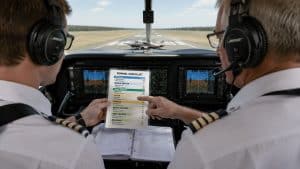
If you’re serious about becoming a professional pilot, you’ll quickly hear about Part 141 flight schools. These aren't your casual weekend flying clubs; they are highly structured, FAA-certified institutions designed for students who want a career as an airline pilot.
This path is tailor-made for students with a clear career goal, whether that's flying for the airlines or piloting professional helicopters. It all boils down to following a strict, step-by-step curriculum approved by the FAA, creating the most direct route to the professional flight deck.
The Blueprint for a Professional Pilot Career
Think of Part 141 training as building your career from a meticulously designed blueprint. Every ground lesson and every flight is a pre-planned step in a much larger, cohesive program. Unlike more flexible training routes, this structured approach guarantees a consistent and high-quality education for career-focused students.
This system ensures every student hits specific performance milestones before moving on to the next stage. It’s this methodical process that makes it a perfect fit for aspiring airline pilots. The disciplined environment instills the kind of procedural thinking and standardization that major operators expect right from the start.
Structured for Success
At the heart of any Part 141 program is its FAA-approved syllabus. This isn't just a general guide; it's a mandatory roadmap that spells out the exact sequence and content of your training. This structure is what gives Part 141 its biggest advantages:
- Predictable Progress: You’ll advance through clearly defined stages, mastering one concept completely before building on it with the next.
- No Gaps in Knowledge: The curriculum is engineered to cover every base, making sure you are thoroughly prepared for each checkride and rating.
- A Professional Atmosphere: You’ll be surrounded by other career-focused students, creating an environment that feels a lot like an airline training center.
FAA Oversight and Modernization
In the U.S., Part 141 regulations have long been the bedrock of professional flight training, championing standardized learning and the highest safety standards. These schools are regularly audited by the Federal Aviation Administration (FAA) to make sure they're sticking to the script.
The FAA is also looking ahead, constantly working to modernize these rules to integrate new technologies and smarter training techniques. The ultimate goal is to produce even more competent pilots while making the training process more efficient. You can get a deeper look into the future of flight training on EAA.org.
The biggest upside to the Part 141 path is its efficiency. Because the FAA has already validated the entire training structure, students can often earn their commercial pilot certificates with fewer total flight hours. That saves a significant amount of time and money in the long run.
For a quick breakdown of how this compares to the alternative, let's look at the two main training pathways side-by-side.
Part 141 vs Part 61 at a Glance
| Feature | Part 141 Flight School | Part 61 Flight Training |
|---|---|---|
| Structure | Highly Structured: Follows a strict, FAA-approved syllabus. | Highly Flexible: Training is tailored to the student's pace and schedule. |
| Oversight | FAA-Approved: School, curriculum, and chief instructors are certified by the FAA. | Individual Instructor: Training is overseen by an independent, FAA-certified instructor. |
| Minimum Hours | Lower Minimums: E.g., a commercial certificate can be earned in as little as 190 hours. | Higher Minimums: Requires 250 hours for the same commercial certificate. |
| Best For | Career-focused students who thrive on structure and want the fastest path to the airlines. | Students with irregular schedules, hobbyists, or those who prefer a more personalized pace. |
| Pace | Generally faster and more consistent, often with full-time programs. | Varies greatly depending on student and instructor availability. |
Ultimately, whether your goal is the flight deck of a commercial airliner or the cockpit of a search-and-rescue helicopter, a Part 141 program offers the most direct and reliable route. Even for students who might buy or sell aircraft later on, the deep operational knowledge gained here is invaluable. You're investing in a structured education that will pay dividends for your entire career in the skies.
Inside the Part 141 Structured Curriculum
The curriculum at a Part 141 flight school is anything but random. It's a meticulously planned roadmap, audited and approved by the FAA itself, designed to build a complete pilot from the ground up. Think of it as constructing a house; you have to pour a solid foundation before you can even think about putting up the walls.
You’ll move through very specific, sequential stages. It all starts with intensive ground school to build your theoretical knowledge. From there, you'll often step into simulators to practice procedures in a controlled setting before, finally, applying everything you've learned in the actual aircraft. This systematic progression is the secret sauce of Part 141, and it's the same whether you're learning to fly airplanes or helicopters.
From Ground School to the Flight Line
Your journey to the cockpit begins in the classroom. This isn't just about memorizing facts from a textbook; you're diving deep into the physics of flight, the complexities of weather, the art of navigation, and the dense but critical federal regulations. This ground instruction is what gives you the "why" behind every single action you'll take in the air.
This phase is built around structured lesson plans, mandatory stage checks, and written exams that you must pass before moving on. The system ensures that every student, whether their goal is the airlines or a career as a professional helicopter pilot, achieves the same high level of understanding. The ultimate goal is to build a pilot who always thinks ahead of the aircraft.
This infographic lays out the clear, three-stage path from theory to a professional career that a Part 141 curriculum provides.
This structured path guarantees that your practical skills are built upon a rock-solid theoretical foundation, preparing you for the real demands of a professional aviation career.
Applying Theory in a Real-World Cockpit
Once you’ve proven you know your stuff on the ground, you transition to hands-on flight training. This is where the theory truly comes to life. Your flight lessons aren't just joyrides; each one has a specific, syllabus-driven objective.
For example, one lesson might be focused entirely on mastering stalls, while the next is dedicated to practicing emergency procedures. You simply won't move on to complex cross-country navigation until you've proven you can handle the aircraft with absolute confidence during these fundamental maneuvers.
A key advantage of Part 141 is standardization. Every student learns to perform the same maneuver to the exact same FAA-approved standard. This consistency is precisely what airlines and corporate flight departments are looking for when they hire.
Of course, this level of structure requires a significant operation to keep students progressing smoothly. Just look at major flight schools like the University of North Dakota, which operates a massive fleet of over 125 aircraft to serve around 1,400 students. It shows the immense resources needed to maintain a steady, high-quality training pipeline. To get a sense of the scale of these programs, you can check out this overview of top U.S. flight school operations on PilotMall.com.
The Helicopter Training Path
The Part 141 structure is just as effective for aspiring helicopter pilots. The core principles of a sequential, FAA-audited curriculum are identical, but the practical skills are tailored to the unique challenges of rotary-wing aircraft.
The training syllabus for a helicopter rating is highly specialized and includes:
- Mastering the Hover: You'll spend extensive time on hovering, air taxiing, and the all-important autorotations.
- Confined Area Operations: There are specific lessons dedicated to landing and taking off in tight, restricted spaces.
- Unique Emergency Procedures: You'll get rigorous practice on procedures exclusive to helicopters, like handling a tail rotor failure.
This focused approach ensures that by the time you're ready for your checkride, you're not just a pilot—you're a proficient helicopter pilot prepared for a professional career in emergency medical services, tourism, or corporate transport. For anyone curious about the initial steps, understanding how long it takes to get a private pilot license can provide a good baseline for the first phase of this journey. Ultimately, this structured environment is designed to create disciplined, knowledgeable, and safe pilots who are ready for any challenge the industry throws their way.
The Payoff: Why Part 141 is a Smart Career Move
If you’re serious about a career in the cockpit, going the Part 141 route isn't just another option—it's a strategic move. The benefits go way beyond just following a syllabus. They directly shape how quickly you get hired, how much you spend, and what your career path looks like from day one.
The biggest win? Lower flight hour requirements. Because the FAA has already put the school’s entire training program under a microscope and given it the stamp of approval, they trust the process. This means you can earn your certificates with fewer hours in your logbook than pilots training under different rules.
A Faster Track to the Airlines
That reduction in hours is a really big deal. For instance, you can earn your Commercial Pilot Certificate at a Part 141 school with as few as 190 total flight hours. The standard for Part 61 training is 250 hours. That 60-hour difference saves you a massive amount of time and money.
For any student aiming for an airline or professional helicopter job, that efficiency changes everything. You can hit your career goals months ahead of schedule, which means you start earning a pilot’s salary sooner and, just as importantly, start building seniority. It’s the most direct path from the classroom to a professional flight deck.
This quicker timeline couldn't be more relevant. The demand for new pilots is soaring, thanks to a rebound in air travel and a global need for well-trained aviators. The civil aviation flight training market, currently valued at USD 3 billion, is expected to skyrocket to USD 6.2 billion by 2034. Part 141 schools are essential for creating that pipeline of qualified pilots. You can get a deeper look into these global civil aviation training trends on gminsights.com.
Unlocking Better Ways to Pay for Training
Here’s another huge advantage for students: more financing options. A lot of Part 141 schools, especially the ones connected to colleges, are accredited educational institutions. That status opens up funding opportunities you simply can't get with other types of flight training.
This is often what makes a pilot career possible in the first place. Some of the most common funding sources include:
- Federal Student Loans: You can use traditional student aid to manage the high upfront costs, just like you would for a university degree.
- Private Education Loans: Lenders like Sallie Mae have established relationships and specific loan products for students attending accredited Part 141 programs.
- Veterans' Benefits: If you're an eligible veteran, you can use programs like the Post-9/11 GI Bill to cover a huge chunk of your training expenses.
This access to funding shifts flight training from a stressful pay-as-you-go struggle into a manageable educational investment.
For many aspiring pilots, the ability to use the GI Bill or secure a student loan is the number one reason they choose a Part 141 school. It creates a clear financial path forward without the constant pressure of paying out-of-pocket for every flight.
Building a Foundation for a Lifelong Career
Finally, the Part 141 environment itself is a major plus. The structured, by-the-book training instills a kind of discipline and procedural thinking that airlines and corporate flight departments love to see. From your very first lesson, you learn to do things the professional way—the foundation of aviation safety culture.
This professional mindset prepares you for the demanding world of an airline cockpit long before you ever get there. Whether you're flying airplanes or helicopters, graduating from a reputable Part 141 program tells employers you’ve been trained to the highest standard. It gives you a real competitive edge in the job market, showing you’re not just a pilot, but a professional aviator ready to get to work.
How to Choose the Right Part 141 Program
Let's be honest: not all Part 141 schools are the same. Picking the right one is a huge step toward launching your career, and it's a decision that goes way beyond a glossy brochure. You need to find a program that doesn't just teach you the mechanics of flying but truly molds you into a professional pilot, ready for the cockpit.

This means you have to dig a little deeper. The best place to start? The aircraft you'll actually be flying. Your training aircraft is your office, your classroom, and your laboratory all in one, so its condition and technology matter—a lot.
Evaluating the Training Fleet
The state of a school's fleet speaks volumes about their commitment to quality. While a well-maintained older aircraft can be a fantastic trainer, a program that offers a blend of classic and modern technology gives you a much broader, more valuable education.
Pay close attention to the cockpit avionics. Will you be training on traditional "steam gauges," or will you get your hands on modern glass cockpits like the Garmin G1000? If your goal is the airlines, getting that glass cockpit experience early is a massive advantage, as it’s what you’ll find in virtually every modern airliner flight deck.
For anyone interested in helicopters, the questions get even more specific. Does the school have a dedicated, well-kept fleet of rotary-wing aircraft? Find out which models they fly (like the Robinson R22 or an Enstrom) and how often they're available. Understanding the full range of aviation training programs for both planes and helicopters gives you a complete picture of what they can offer.
Instructor Quality and Availability
Your flight instructors will be the most critical figures in your training journey. They're not just teachers; they're mentors. A low student-to-instructor ratio is a great sign you'll get the one-on-one attention you need. A good benchmark to look for is around 1 instructor for every 5 to 7 students.
When you visit, make it a point to meet some of the instructors. Ask about their professional backgrounds. The best ones often bring years of airline, corporate, or military experience to the table, and that real-world wisdom is priceless. Also, ask about their availability. A school stretched thin on instructors can lead to maddening delays that throw your entire timeline off track.
The single most important factor in your training success is the quality of your flight instructor. A great instructor doesn't just teach you maneuvers; they teach you how to think, act, and make decisions like a professional pilot.
Safety Culture and School Atmosphere
Finally, get a feel for the school’s safety culture. This isn't just a buzzword; it’s the underlying mindset that puts safety first, always. A rock-solid safety culture is non-negotiable and the true hallmark of a professional aviation organization.
Here are a few signs of a great safety environment:
- A formal Safety Management System (SMS): This proves they have a structured, proactive process for managing risk.
- Impeccable maintenance: The aircraft should look clean and well-cared-for. Ask to see the maintenance logs—transparency is key.
- Open communication: Everyone, from students to instructors, should feel comfortable reporting a safety concern without any fear of pushback.
As you dive into your research, comparing different schools can feel overwhelming. This table breaks down the most critical factors to help you make an informed decision.
Key Evaluation Criteria for a Part 141 School
| Criteria | What to Look For | Why It Matters for Your Career |
|---|---|---|
| FAA Certification | Active Part 141 certificate for the specific courses you need. | This is non-negotiable. It guarantees a structured curriculum and eligibility for reduced flight hour minimums. |
| Aircraft Fleet | A mix of modern (glass cockpit) and traditional aircraft. Clean, well-maintained planes with transparent maintenance records. | Glass cockpit experience is essential for airline careers. A well-kept fleet reflects a high standard of safety and professionalism. |
| Instructor Quality | Experienced instructors with diverse backgrounds (airline, corporate, etc.). A low student-to-instructor ratio (1:5 to 1:7). | A great instructor is a mentor who shapes your decision-making skills. Good availability means you can progress without delays. |
| Safety Culture | A formal Safety Management System (SMS), a proactive reporting culture, and an emphasis on safety over scheduling. | A strong safety culture is the foundation of a professional pilot's mindset. It's the most important habit you will ever learn. |
| Facilities & Atmosphere | Clean, professional training facilities. Access to simulators, dedicated briefing rooms, and a supportive student environment. | You'll spend hundreds of hours here. A positive, professional atmosphere enhances learning and keeps you motivated. |
| Career Placement | Established relationships with regional airlines, a dedicated career services department, and a strong alumni network. | Your goal is a job. A school with proven industry connections can give you a direct pathway to your first pilot position. |
Ultimately, choosing a school is also about the right fit. Take a tour, talk to current students, and ask plenty of questions. Do they seem happy, supported, and confident in their training? This is the place where you’ll build the foundation for your entire aviation career, so make sure it feels like home.
Articles for Buying and Selling Aircraft
Graduating from a Part 141 flight school marks the beginning of your professional journey. As your career progresses, you may consider buying or selling an airplane or helicopter. Navigating this market requires careful research and a solid understanding of the process. Below are some articles to guide you, whether you're looking for your first personal aircraft or managing a commercial fleet.
Buying Your First Airplane or Helicopter
Purchasing an aircraft is a major investment. It involves more than just finding a plane you like; it requires due diligence to ensure you're making a sound financial and safety decision.
- Market Research: Start by exploring online marketplaces and publications to understand current pricing for different models, from Cessna 172s to Robinson R44s. This research helps you set a realistic budget.
- Pre-Buy Inspection: This is the most critical step. A thorough pre-buy inspection by a qualified, independent mechanic can uncover hidden issues with the airframe, engine, or avionics, saving you from costly surprises down the road.
- Understanding Ownership Costs: The purchase price is just the beginning. Factor in recurring costs like insurance, hangar fees, fuel, and a reserve for scheduled and unscheduled maintenance.
Selling an Aircraft: Getting the Best Value
When it's time to sell, preparation is key to maximizing your return. A well-presented aircraft with complete records will always attract more serious buyers.
- Documentation is Everything: Organize all logbooks, maintenance records, and compliance documents. Complete and transparent records build buyer confidence and can significantly increase the value of your aircraft.
- Presentation Matters: A clean, well-maintained aircraft makes a strong first impression. Invest in a professional detailing service and take high-quality photos for your listings.
- Pricing Strategy: Price your airplane or helicopter competitively based on its condition, total time, and the current market. Being realistic about its value will help you close a sale more quickly.
Whether buying or selling, knowledge is your most valuable asset. A solid Part 141 education provides a strong technical foundation, but understanding the aircraft market is a skill developed over time. Use reputable resources and expert advice to guide your decisions.
Your Takeoff into a Professional Aviation Career
Let's bring it all in for a landing. When you're serious about flying for a living, a Part 141 flight school is the most direct and proven path to the professional cockpit. Its structured curriculum, close FAA oversight, and career-oriented environment are all designed for one purpose: to set you up for success.
This isn't just about learning to fly; it's about becoming the kind of pilot that major airlines and top helicopter operators want to hire. The discipline and procedural fluency you build in a Part 141 program are exactly what the industry demands.
Your Path to the Professional Cockpit
At this point, you know the difference between a good program and a great one. Whether your dream is to fly for the airlines or command a specialized helicopter, the Part 141 route provides a clear, efficient roadmap to get there.
You’re now ready to ask the right questions—to really dig into a school’s fleet, its safety culture, and the real-world experience of its instructors. This is about making a smart investment in an education that will pay dividends for your entire career. We've even looked ahead at resources for pilots ready to buy or sell airplanes and helicopters, preparing you for every stage of your aviation life.
The sky isn't the limit; it's your future office. The structured journey through a Part 141 program is the most reliable way to get there, turning your ambition into a professional reality with skill and confidence.
The pre-flight check is complete. It's time to take what you've learned and start your journey. That next step could be scheduling a discovery flight or simply calling an admissions advisor to talk about your goals. Your future in the cockpit is waiting.
Frequently Asked Questions
When you're starting out, the world of flight training can feel like a maze of regulations and options. Here are some straightforward answers to the questions we hear most often about choosing a Part 141 flight school.
Is Part 141 Training More Expensive Than Part 61?
Not always. It's easy to look at the hourly rate for an aircraft at a Part 141 school and think it's pricier, but that doesn't tell the whole story.
The real value is in the efficiency. Because the curriculum is so structured and FAA-approved, you often reach your goals with fewer total flight hours. For a lot of aspiring commercial pilots, this means the final cost ends up being very similar to—and sometimes even less than—a Part 61 program.
Can I Get a Helicopter License Through a Part 141 School?
Absolutely. Many top-tier Part 141 schools run excellent helicopter programs right alongside their fixed-wing courses. You get the same methodical, FAA-audited training path, just geared toward rotary-wing aircraft.
These programs focus on the unique skills helicopter pilots need, like autorotations, hovering, and operating in tight spaces. It’s the perfect foundation for a career in air tours, emergency medical services, or corporate transport.
People often think Part 141 is just for future airline pilots. The truth is, the structured, by-the-book approach is incredibly valuable for building the precision and discipline that professional helicopter pilots rely on every day.
How Long Does It Take to Become a Commercial Pilot?
Your timeline really comes down to how much you can commit. A full-time student in an accelerated Part 141 program could go from zero experience to a commercial pilot certificate in as little as 6 to 12 months.
If you're training part-time, it will naturally take longer. But the good news is that the built-in structure keeps you moving forward at a steady, predictable pace. To get a feel for the first steps in the process, check out our guide on how to get your pilot's license.
Can I Use the GI Bill for Part 141 Flight Training?
Yes, and this is a huge benefit. Many accredited Part 141 schools, particularly those connected to a college, are approved to accept VA benefits like the Post-9/11 GI Bill.
This opportunity can completely change the game for veterans, putting an aviation career within financial reach. Using your hard-earned benefits to cover a large chunk of your training costs can turn a lifelong dream into a real, achievable plan.
At DuBois Aviation, we provide comprehensive Part 141 training for both airplanes and helicopters, helping aspiring aviators launch their professional careers. Learn more about our FAA-approved programs and start your journey today at https://duboisaviation.com.