
Earning your pilot's license is the first real milestone on a clear, structured path that can take you from a wide-eyed student to a seasoned professional in the right seat of an airliner. It’s a journey built on a logical progression of licenses and ratings, each designed to systematically build your skills and confidence. If you've found yourself asking, "How do I even start getting my pilot's license?" understanding this roadmap is the perfect place to begin.
Your Career Roadmap From Student to Professional Pilot
Deciding to become a professional pilot is a huge step, and frankly, there's never been a more exciting time to do it. The demand for qualified pilots is through the roof right now, which means incredible opportunities for career-focused students just starting out. This isn't just about finding a job—it's about committing to a rewarding, lifelong career that demands dedication, precision, and a genuine passion for being in the air. Your journey kicks off with foundational training and moves through several key milestones, with each new rating building on the skills you've already mastered.
Whether your ultimate goal is to command a commercial jet or fly a helicopter, the basic pathway looks pretty similar at the start.
It all begins with earning your Private Pilot License (PPL). This is your license to learn and explore, allowing you to fly for fun and even take friends and family up with you—you just can't get paid for it yet.
Next, you’ll tackle the Instrument Rating (IR). This is a game-changer. It’s a critical rating that teaches you how to fly the aircraft solely by reference to your instruments, giving you the skills to navigate through clouds and less-than-perfect weather safely.
The final major step for anyone with professional ambitions is the Commercial Pilot License (CPL). This is your ticket to the big leagues. Earning your CPL means you can finally be paid to fly, opening the door to countless careers in aviation.
The Growing Demand for Pilots
Honestly, the timing for starting flight training couldn't be better. The pilot training market is absolutely booming, driven by a global surge in air travel and expanding airline fleets. To put it in perspective, the market in North America alone is on track to grow from $1,466.28 million in 2021 to an incredible $2,332.32 million by 2025. This isn't just a random statistic; it points to an urgent, industry-wide need for new pilots to fill cockpit seats and keep things moving.
A question we get all the time is about the timeline for that first big step. While everyone’s journey is different, you can learn more about how long it takes to get a private pilot license to help set some realistic expectations for your own training.
Helicopter and Airplane Paths
While the names of the licenses are similar, the training for airplanes (fixed-wing) and helicopters (rotary-wing) is very different. Helicopter training dives deep into unique skills you won't find anywhere else, like hovering, vertical takeoffs, and autorotations. It prepares you for specialized roles in tourism, emergency medical services, or utility work.
On the other hand, airplane training follows a more traditional path, usually geared toward careers with airlines, corporate flight departments, or cargo operations. We’ll break down these specific training phases in more detail as we go.
Your Personal Pre-Flight: Getting Cleared for Aviation School
Before you even think about stepping into a cockpit, you’ve got to clear a few things on the ground first. Think of it like your own personal pre-flight inspection—a series of essential checks to make sure you’re legally and medically good to go. This isn't just about ticking boxes; it's about building a solid foundation for your entire flying career without hitting any unexpected turbulence down the road.
The first few requirements set by the Federal Aviation Administration (FAA) are pretty straightforward. You need to be at least 16 years old to fly solo and 17 years old to get your Private Pilot License. You also have to be proficient in English—reading, writing, and speaking—since it’s the universal language of the skies.
The FAA Medical Certificate: A Non-Negotiable First Step
While the age and language rules are simple, the most critical hurdle to clear early on is the FAA medical certificate. Seriously, this is something you should have in hand before you start spending real money on flight lessons. It's the official word that you meet the health standards required to safely command an aircraft.
The type of certificate you need really depends on where you see yourself flying in the future. There are three classes:
- Third-Class: This is your entry ticket. It’s the minimum for student pilots and anyone flying for recreation.
- Second-Class: If you plan to fly for a living in commercial roles—think aerial photography, banner towing, or survey flights—you'll need this one.
- First-Class: This is the top tier. It is absolutely mandatory for anyone aiming to become an airline pilot.
If your dream is the airlines, get your First-Class medical from day one. It's the only way to confirm you meet the most stringent health standards before you invest years and a small fortune into training. Trust me, the last thing you want is to discover a disqualifying medical issue when you’re already deep into your commercial license training. That’s a truly devastating setback.
What to Expect During Your Medical Exam
Getting your certificate involves an exam with an FAA-designated Aviation Medical Examiner (AME). You can easily find one near you using the FAA's online search tool. The exam is thorough, covering everything from your vision and hearing to your cardiovascular and neurological health.
Be ready to be an open book about your medical history. Many common issues, like wearing glasses or managing a condition with approved medication, are often perfectly fine. The key is full disclosure. Your AME is there to work with you and can guide you through the process of getting a waiver or Special Issuance if necessary.
This whole process is a lot like the meticulous physical checks a pilot performs on their aircraft. In aviation, knowing your own condition is just as vital as knowing your machine's, which you can learn more about in our guide to the pre-flight checks for a Cessna 172.
A Note for Aspiring Helicopter Pilots
Thinking of flying helicopters? The medical rules are exactly the same. Whether your goal is flying scenic tours or becoming an EMS pilot, the class of medical you need is tied to the job, not the aircraft. That EMS helicopter pilot, for example, will need at least a Second-Class medical certificate.
Once you’ve cleared these initial checks—age, language, and especially the medical certificate—you’ve officially been cleared for takeoff on your aviation journey. You’re ready for the exciting stuff: ground school and your very first flight.
Nailing Your Airplane and Helicopter Training
With the initial paperwork and your medical certificate sorted, it's time for the real fun to begin. This is where you start building the core skills and knowledge that transform you from an enthusiast into a capable pilot. The journey is a blend of serious study on the ground and hands-on skill-building in the air, whether you're learning to fly airplanes or helicopters.
For every major license or rating you go for—Private, Instrument, and Commercial—the process is the same. You have to prove your stuff in three ways: a written knowledge exam, an oral exam with an FAA examiner, and finally, the practical flight test, which everyone in aviation just calls the checkride. It’s a thorough system, but it’s designed to make sure you're safe, sharp, and ready to take on the responsibility of being a pilot.
Ground School: Building Your Foundation
Before you can truly master an aircraft, you have to understand the forces that make it fly. That's what ground school is all about. It’s where you’ll dig into the essential theory so you know the why behind everything you do in the cockpit.
You'll cover some critical topics, including:
- Aerodynamics: The physics behind lift, weight, throughst, and drag.
- Aircraft Systems: Getting to know the engine, electrical systems, and instruments inside and out.
- Weather and Meteorology: Learning to read charts and make smart go/no-go decisions.
- FAA Regulations: The rules of the sky are just as important as knowing how to fly.
- Navigation and Flight Planning: How to plot a course, manage fuel, and navigate different types of airspace.
This classroom knowledge is what prepares you for the FAA written exam, a multiple-choice test you have to pass before you can even think about scheduling your final checkride.
This visualization gives you a great overview of the typical path from getting your first license to becoming a commercial pilot.
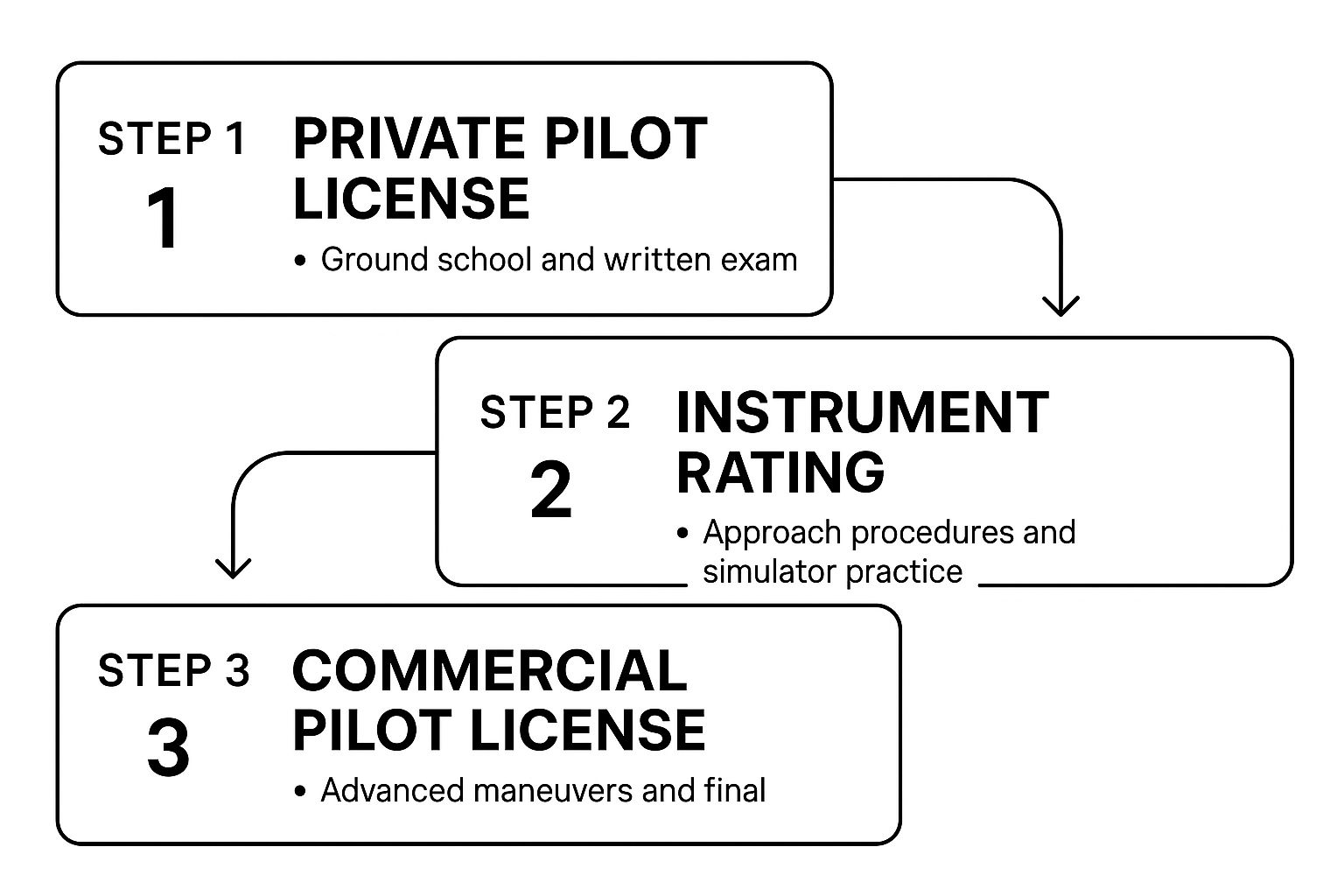
As you can see, each rating builds directly on the one before it, adding new layers of skill and knowledge that you'll need for a professional career.
Flight Instruction: Where Theory Meets Reality
This is the part everyone looks forward to. Flight instruction is where you finally get into the cockpit with a Certified Flight Instructor (CFI) and put all that ground school theory into practice. Each lesson follows a rhythm: a pre-flight briefing to discuss the plan, the actual flight where you practice maneuvers, and a post-flight debrief to review what went well and what needs work.
You’ll start with the basics—climbs, turns, and descents—and steadily progress to more complex skills. If you're flying airplanes, that means nailing takeoffs and landings, stall recoveries, and emergency procedures. For helicopter students, the focus is a bit different; you'll spend a ton of time mastering hovering, autorotations (the helicopter's version of gliding to a safe landing), and operating in tight spaces.
The real goal of flight training isn't just to teach you how to move the controls. It’s about developing solid aeronautical decision-making (ADM)—the kind of clear thinking that leads to safe, smart choices on every single flight.
The Major Milestones: Private, Instrument, and Commercial
Your path to becoming a professional pilot is marked by three crucial licenses and ratings. Each one is a major accomplishment.
-
Private Pilot License (PPL): This is your ticket to the sky. A PPL lets you fly an aircraft and carry passengers, just not for money. It's the first and most important step, proving you have the fundamental skills to fly safely.
-
Instrument Rating (IR): Getting your instrument rating is a huge leap forward. It qualifies you to fly in the clouds and other low-visibility conditions by relying solely on your instruments. If you want to be a professional pilot, this rating is an absolute must-have.
-
Commercial Pilot License (CPL): This is the license that turns your passion into a profession, allowing you to get paid to fly. Earning a CPL demands a much higher level of precision and a deeper understanding of advanced maneuvers, aircraft systems, and commercial regulations.
While the specific skills you learn will differ between airplanes and helicopters, the milestones are quite similar. This table breaks down what you can generally expect for each.
Key Milestones in Fixed-Wing vs. Rotary-Wing Training
| Training Milestone | Airplane (Fixed-Wing) Focus | Helicopter (Rotary-Wing) Focus | Approximate Minimum Flight Hours (FAA Part 61) |
|---|---|---|---|
| Private Pilot | Basic maneuvers, takeoffs/landings, stall recovery, cross-country navigation. | Hovering, basic maneuvers, autorotations, confined area operations. | 40 hours |
| Instrument Rating | Flying solely by reference to instruments, holding patterns, instrument approaches. | Instrument flight rules (IFR) flight, precision and non-precision approaches. | 40 hours (simulated/actual instrument) |
| Commercial Pilot | Advanced maneuvers (e.g., chandelles, lazy eights), complex aircraft operations. | Advanced autorotations, pinnacle and confined area landings, sling load basics. | 250 hours (Airplane), 150 hours (Helicopter) |
Each of these steps requires a serious commitment, but completing them brings you one step closer to your career goals. Whether you're mastering a steep turn in a Cessna or a perfect hover in a Robinson, the fundamental process of learning, practicing, and proving your skills remains the same.
Thinking About Future Aircraft Ownership?
As you get further into your training, you might even start thinking about owning your own aircraft. For anyone looking to buy or sell airplanes, it's crucial to understand the market, how to conduct a pre-buy inspection, and all the paperwork involved. Likewise, pilots in the rotary-wing world can find great advice in articles on buying or selling helicopters. These resources offer practical insights to help you make smart decisions, whether you're buying for training, business, or personal flying.
Planning Your Finances for the Flight Deck
Let's get down to brass tacks: money. Becoming a professional pilot is a serious investment, and mapping out your budget is just as critical as any pre-flight check. The total cost to get all your licenses and ratings can swing quite a bit, so getting a handle on the key expenses right from the start is the best way to plan your path forward.

No matter if your heart is set on flying airplanes or helicopters, the fundamental costs are quite similar. Your total investment really boils down to three main things.
The Big Three: Core Training Costs
- Aircraft Rental: This is the hourly rate you pay to use the training aircraft, and it's almost always the biggest chunk of your budget. A basic trainer like a Cessna 150 will cost less per hour than a more advanced plane. Helicopter rentals? They're typically in a higher price bracket altogether.
- Instructor Fees: You're not just renting a machine; you're investing in an expert. This fee covers your Certified Flight Instructor's (CFI) time, both in the air and for those crucial pre- and post-flight briefings on the ground.
- Exams and Gear: This covers everything else you’ll need to get certified. Think written exam fees, the Designated Pilot Examiner (DPE) fee for your final checkride, and essential supplies like a good headset, charts, and study materials.
Because these costs are hourly, your final bill is directly linked to how much time it takes you to get truly proficient in the cockpit.
Why You’ll Fly More Than the FAA Minimum
The FAA mandates minimum flight hours for every license—for instance, 40 hours for a Private Pilot License under Part 61. But here's a crucial piece of advice: treat that number as the absolute floor, not the target.
The reality is, the national average to earn a PPL is closer to 60-80 hours. Plan for that from day one. Budgeting for a realistic number helps you avoid financial stress later and lets you focus on what really matters: becoming a safe, skilled pilot, not just checking a box.
This holds true for both airplanes and helicopters. In fact, the unique challenges of rotary flight, like mastering a stable hover, often mean helicopter students need that extra time to build the muscle memory and confidence required to pass their checkride.
Comparing Costs: Airplane vs. Helicopter Training
While both paths can lead to an amazing career, the price tags are quite different. Helicopter training is consistently more expensive per hour. This is due to the complex mechanics of rotary-wing aircraft, which leads to higher maintenance and operational costs.
Here’s a quick side-by-side look:
| Cost Element | Airplane Training (e.g., Cessna) | Helicopter Training (e.g., Robinson R22) |
|---|---|---|
| Aircraft Rental (Hourly) | Typically lower; varies by model. | Generally higher; a major cost driver. |
| Instructor Fee (Hourly) | Varies by experience and location. | Often comparable to airplane CFI rates. |
| Total Investment | A substantial, but more moderate, investment. | A significantly higher total investment. |
The final numbers can vary. In the U.S., a private pilot's license might cost anywhere from $5,000 to $10,000 or more, depending on the aircraft and local rates. It's a big investment, but it's for a career in high demand. Industry forecasts show a need for 674,000 new pilots worldwide in the next 20 years, which is why training programs are expanding globally. You can see the full pilot career demand outlook on Captechu.edu.
Accelerated vs. Part-Time Training
Your training schedule also plays a big role in your final cost and timeline.
An accelerated program is like a full-time job. You're flying several times a week, fully immersed in the material. This intensity can actually be more cost-effective because you're less likely to forget skills between lessons, which can reduce the total hours you need to log.
On the other hand, part-time training offers flexibility. You can fly once a week or whenever your budget and schedule allow. While this approach spreads the cost out over time, the long gaps between lessons often mean you spend more time reviewing, which can add to your total flight hours. The right path really depends on your personal finances, how you learn best, and your other life commitments.
We know that figuring out the finances can feel like a huge hurdle, but you don't have to do it alone. We've put together resources to help, and we encourage everyone to explore the available flight school financing options to build a plan that works. Getting your budget sorted is the first real step toward making that dream of a career in the cockpit come true.
A Pilot's Guide to Aircraft Ownership for Training or Business
While most student pilots start out renting, a surprising number find that buying their own aircraft makes a lot of sense, both financially and practically. For those on a career track or even for flight schools, ownership can be a smart play.
But let’s be clear: jumping into the world of aircraft sales isn’t like buying a car. Whether you’re looking to buy or sell airplanes and helicopters, the stakes are much higher, and the process demands a solid plan and a sharp eye. If you've ever asked, "how can I get my pilot's license more affordably?" ownership could be a long-term solution, but you need to know what you’re getting into.
Buying Your First Aircraft
The absolute first thing to do is define the aircraft's mission. What is this plane for? Are you looking for a simple, reliable trainer like a Cessna 172 to build flight hours? Or do you need a more complex helicopter for commercial work once you're certified? Nailing down your primary goal narrows the field and stops you from paying for capabilities you’ll never use.
Once you know what you’re looking for, the hunt begins. You can find great options on online marketplaces or through aircraft brokers. When you find a promising aircraft, there is one step you absolutely cannot skip: the pre-buy inspection.
A pre-buy is a nose-to-tail inspection done by an independent, trusted mechanic—ideally one who specializes in that exact model. This is non-negotiable. Think of it as your best defense against discovering a six-figure problem after you’ve signed the papers.
With a clean inspection, it's time to sort out financing and insurance. Aircraft loans are a different beast than car loans, so you'll need to work with lenders who specialize in aviation. Insurance is just as critical and will be based on your experience, the aircraft type, and its intended use. Just be ready for this part of the process to take a little time.
Selling an Aircraft
Now, if you're the one selling, a little prep work goes a long way toward getting a fair price and making the sale go smoothly. An aircraft's value is all about its condition and its history, so you have to present that story well.
Your single most valuable asset here is a complete and meticulously organized set of maintenance logs. These books are the official biography of your aircraft.
- Complete Logs: They need to show every inspection, repair, and modification ever done. No gaps.
- Organized Records: A buyer's mechanic needs to be able to easily review the aircraft's entire history. A shoebox full of receipts won't cut it.
- Damage History: Always be upfront about any past damage and how it was repaired. A well-documented repair is infinitely better than one that looks like it was hidden.
To get your aircraft in front of buyers, you'll need high-quality photos and a detailed listing that hits the highlights—engine time, avionics, recent work, and so on. Being quick to respond to questions and flexible for showings will help you land a serious buyer.
Finally, you have to nail the legal transfer. The sale requires a bill of sale and re-registering the aircraft with the FAA. Many people use an aviation escrow service to handle the money and paperwork. It’s a great way to protect both you and the buyer, ensuring all the i's are dotted for a clean transfer of ownership.
Answering Your Top Questions About Flight School
The path to becoming a pilot is an incredible journey, but it naturally comes with a lot of questions. Before you dive in, you'll be thinking about your education, your health, and what kind of flight school is the right fit. Getting straight answers to these common questions is the best way to start your training with confidence.
Many people think you need to be a perfect student with flawless health to even consider a career in aviation. The good news? The reality is often far more flexible. Let's clear up some of the most common questions we hear from people just like you.
Do the Airlines Really Require a College Degree?
For a long time, having a four-year degree was an unwritten rule if you wanted to fly for a major U.S. airline. But things have changed. Faced with a high demand for pilots, many carriers—even the biggest names in the industry—have dropped that requirement to open the doors for more talented aviators.
While a degree is no longer a hard stop, it can still give you a competitive edge, especially if it’s in a field like aerospace engineering. That said, nothing is more important than your FAA certificates, your ratings, and your flight time. The real golden ticket for any aspiring airline pilot is logging the 1,500 hours you need for your Airline Transport Pilot (ATP) certificate.
What if I Wear Glasses or Have Color Blindness?
This is probably one of the biggest anxieties we see, but vision issues are rarely the deal-breaker people fear. The FAA’s medical standards are built around safety, not perfection. For most people, your vision just needs to be correctable to 20/20 with glasses or contact lenses. Simple as that.
Color vision is a little more nuanced. If you struggle with the standard color plate tests (the classic ones with the colored dots), don't panic. You can often take an operational color vision test with an FAA inspector to demonstrate that you can identify critical light signals used in aviation. Your best first step is to talk openly with an Aviation Medical Examiner (AME) before you commit significant time and money to training.
What’s the Real Difference Between Part 61 and Part 141?
You'll hear these terms everywhere. They're just FAA regulations that define how a flight school can structure its training. One isn't better than the other; they're just different roads leading to the exact same pilot’s license.
- Part 141: Think of this as a structured, university-style program. These schools use a formal, FAA-approved curriculum. It's often a great fit for full-time students who are on a career track, as it can sometimes help you qualify for licenses with fewer flight hours.
- Part 61: This route is all about flexibility. Your instructor has the freedom to customize the training plan to your personal learning style and schedule. This is a perfect option if you need to fit your flight lessons around a job, family, or other commitments.
The choice between Part 61 and Part 141 is all about what works for you. It boils down to your learning style, your schedule, and how quickly you want to reach your goals. Both are fantastic ways to become a safe, professional pilot.
At the end of the day, whether you're learning to fly a helicopter or an airplane, the mission is to become a competent and confident pilot. The path you choose—from your education to your flight school—should be the one that gets you there successfully.
At DuBois Aviation, our instructors have heard every question in the book, and we're here to help you build a training plan that makes sense for your goals. Explore our airplane and helicopter programs today to get started.