
You've got the commercial certificate. The temporary airman certificate is still crisp, your logbook finally says you can get paid to fly, and then reality shows up. Most of the jobs you want aren't hiring a pilot with low time and a fresh checkride story. They're hiring someone who can step into a crew environment, handle procedures, and make a captain's workload lighter instead of heavier.
That's where sic pilot jobs matter.
For a lot of pilots, the right seat is the bridge between training and a real professional cockpit. It's where you stop thinking like a student and start operating like crew. You learn pace, discipline, standardization, and how real operators manage pressure. If you've been around aviation events, even public-facing experiences like full motion simulators for events can give outsiders a glimpse of how much coordination and procedure matter once a cockpit becomes a two-pilot workspace.
The challenge is knowing how to move from a commercial certificate to a competitive application. If you're still mapping that early stage, a grounded overview of how to become a commercial pilot helps frame what you've finished and what employers still expect before they'll trust you in the right seat.
From Commercial Certificate to Cockpit Seat
A new commercial pilot usually asks the same question in different words. “How do I get from here to a turbine cockpit without wasting years?” That's the right question, because the answer isn't just “build hours.” It's build the right hours, in the right environment, with the right habits.
SIC work is one of the best strategic moves available because it puts you in multi-crew operations early. You're not just chasing numbers in a logbook. You're learning checklist discipline, standard phraseology, passenger handling, dispatch coordination, and the rhythm of professional flying.
Many pilots still default to a single path. Instruct, wait, then apply broadly. While instructing can be excellent, it is not the only route. SIC positions provide exposure to turbine aircraft, charter culture, and the kind of operational judgment employers interview for.
The pilots who move fastest usually aren't the ones who rush. They're the ones who choose each next step with intent.
The key is to stop thinking of SIC as a fallback job. It's not. It's a career stage. If you approach it that way, you'll build a profile that makes sense to a chief pilot instead of just hoping someone overlooks your low time.
What a Second-in-Command Actually Does
An SIC is not a passenger with a headset. A good captain notices the difference immediately.
In a healthy cockpit, the SIC works like an apprentice in a demanding trade. You're watching, anticipating, cross-checking, speaking up when needed, and taking ownership of your side of the operation. Some captains teach actively. Others expect you to learn by being prepared. Either way, your job is to make the flight safer and smoother.

Before the engines start
Most new pilots underestimate how much an SIC earns trust before the airplane moves.
A useful SIC shows up early, reviews weather thoroughly, confirms routing, checks NOTAMs, helps verify fuel and performance, and handles the details that keep the crew ahead of the airplane. On a charter trip, that may also include catering checks, passenger timing, baggage coordination, and making sure the airplane is stocked and presentable.
The strongest copilots don't wait to be told every task. They know the flow and support it.
A solid understanding of crew resource management in real flight operations matters here because the cockpit isn't a place for silent guessing. It's a place for disciplined communication.
In flight
In the air, your role depends on the operator, aircraft, and leg. You may fly one leg and monitor the next. You may handle radios while the captain flies. You may run checklists, monitor systems, back up navigation changes, call out altitudes, verify approach setup, and catch small errors before they become big ones.
That last part matters most.
A captain wants an SIC who can say, “That altitude doesn't match the clearance,” or “We're not configured yet,” in a calm voice at the right moment. Professional copilots protect the operation through attention, not ego.
Practical rule: If you're waiting to be useful until someone gives you the controls, you're already behind.
After landing
The job keeps going after shutdown. Good SICs help close the loop. That means post-flight inspections, securing the aircraft, logging discrepancies clearly, tidying the cabin, updating paperwork, and preparing for the next leg or next day.
Attitude is showcased in this context.
Pilots who treat “non-flying” tasks as beneath them don't last in most charter or corporate environments. Operators remember the SIC who handled the airplane professionally and also took care of the details without grumbling.
Decoding SIC Requirements and FAA Regulations
A lot of confusion around sic pilot jobs comes from mixing up three different things. Legal minimums. Company minimums. Insurance minimums. They aren't the same, and they rarely line up neatly.
Part 91, Part 135, and why the label matters
Under Part 91, many corporate and private operations have more flexibility in how they run trips. That doesn't mean they're casual. It means the regulatory framework is different from charter. A flight department may still impose strict internal SOPs and high hiring standards even when the FAA rulebook gives them more room.
Under Part 135, charter and air taxi operators work inside a more structured environment. Training, checking, duty, recordkeeping, and operational control are tighter. If you want early professional multi-crew experience, many pilots look to these operations first.
Part 121 is the airline world. It's highly standardized and outside the scope most low-hour commercial pilots can enter directly.
What 14 CFR 61.55 means in practice
If you're going to act as SIC in certain aircraft, 14 CFR 61.55 matters. It governs SIC qualifications in aircraft that require more formal training and qualification. In practical terms, it's one of the rules that turns “I'm a commercial pilot” into “I'm legal and prepared to sit in this specific right seat.”
The part many pilots miss is that meeting the FAA baseline doesn't make you competitive by itself. It makes you legal. Operators still have to decide whether you fit their aircraft, operation, and insurer.
The higher the performance and complexity, the tougher that standard gets. Some turbojet SIC roles are built for experienced pilots, not time-builders. According to an Indeed roundup of SIC pilot job postings, Tenax Aerospace lists 3,000 total hours, including 1,500 multiengine turbine hours, while Jet Linx G200 roles require 1,500 total time, 500 PIC, 500 multi-engine, and 100 turbine hours. The same source notes that pilots with less than 1,000 PIC turbine hours face a 2.5x higher incident rate in Part 135 operations, which helps explain why high-performance turbojet employers screen so hard.
Why one pilot qualifies and another doesn't
Two pilots can hold the same certificate and still be worlds apart as applicants.
One pilot may have low total time but strong instrument habits, multi-engine recency, polished CRM, and a recommendation from a line captain. Another may have more hours but little multi-crew exposure, weak scan discipline, and no relevant network. The first may get the call.
That's also why a pilot can be legal for a lower-end SIC opportunity but nowhere near competitive for a Challenger or Gulfstream seat.
A practical way to think about requirements is this:
- FAA compliance gets you in the game.
- Insurance compatibility keeps your application alive.
- Operational maturity gets you hired.
Don't read one job posting and assume it represents the market. SIC hiring is segmented. Turboprop time-building jobs and premium jet jobs live in different worlds.
The Landscape of SIC Employers Pay and Outlook
The SIC market is broad, and that's both the good news and the trap. If you search without a plan, the job board makes everything look like one category. It isn't. A seasonal helicopter SIC role, a PC-12 right seat, and a Challenger seat in Van Nuys are all “SIC jobs,” but they demand different backgrounds and offer very different lifestyles.
Where the jobs are
The overall outlook is steady. The Bureau of Labor Statistics outlook for airline and commercial pilots projects 4% growth from 2024 to 2034 with about 18,200 openings each year. That doesn't mean every pilot walks into a jet seat. It means professional flying continues to create openings as pilots retire and move between roles.
Compensation depends heavily on aircraft type, employer, and location. The same BLS page reports median commercial pilot wages of $122,670 in May 2024. In business aviation, SIC compensation can be higher on certain aircraft. The verified data tied to that BLS source states that Citation CJ3 SICs average $129,800 to $161,000 annually, and Pilatus PC-12 SICs can earn up to $188,300 in the 2026 BizJetJobs survey.
For a pilot comparing pathways, that spread matters. You can review a broader discussion of first officer salary differences across sectors if you're trying to map what type of operation fits your long-term goals.
Comparison of typical SIC pilot job opportunities
| Sector | Typical Aircraft | Minimum Hours (Total) | Annual Salary Range | Typical Schedule |
|---|---|---|---|---|
| Seasonal utility or helicopter support | Utility helicopters | Lower-end opportunities can start around the lower published SIC entry range | $32 to $36 per hour in the PJ Helicopters California example | Seasonal, mission-driven |
| Entry-level charter or feeder-style SIC | Caravan, King Air, similar turboprops | Some operators start around 500 to 1,500 hours depending on role | Often lower than premium business aviation roles | Rotation or irregular charter schedule |
| Business aviation turboprop SIC | Pilatus PC-12 | Varies by operator and insurer | Up to $188,300 in the verified 2026 survey data | Often structured but variable |
| Light jet business aviation SIC | Citation CJ3 | Varies by operator, type, and market | $129,800 to $161,000 | On-call, rotation, or managed schedule |
| Premium charter jet SIC | Challenger 300 | Higher-end experience requirements | $150,000 to $200,000 in the Van Nuys example | Premium market, often location-sensitive |
What the lifestyle trade-offs look like
Higher pay usually comes with tighter standards and less tolerance for inexperience. Those jobs may want local residency, prior type exposure, or a background that reassures both chief pilot and insurer.
Lower-time SIC jobs can get you in the system faster, but they may involve more irregular flying, relocation, lower starting pay, or flying that's operationally rough around the edges. That doesn't make them bad jobs. It means you should treat them as stepping stones and evaluate what they add to your résumé.
A useful question is not “What pays most right now?” It's “What gets me to the next cockpit with the strongest logbook and reputation?”
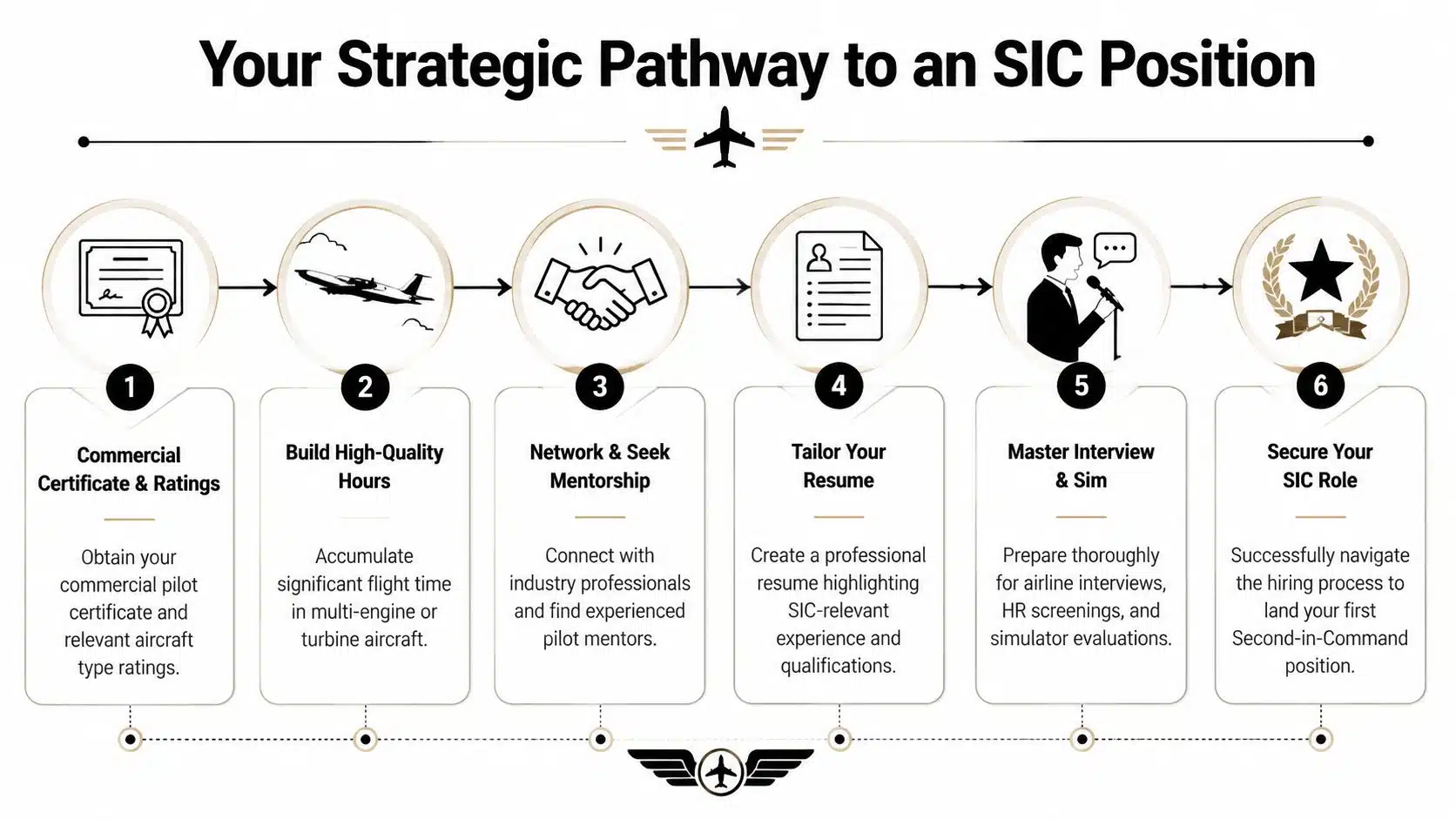
Your Strategic Pathway to an SIC Position
The jump from commercial pilot to employable SIC is rarely one big move. It's a stack of smaller moves made in the right order.
Build hours that answer hiring objections
Not all logged time helps equally. If an operator flies twins, your single-engine sightseeing hours won't carry the same weight as recent multi-engine work. If the operation is IFR-heavy, sloppy instrument currency will show up fast in training.
Prioritize time that closes known gaps:
- Multi-engine time matters because many SIC jobs sit in twins or turbine equipment, and employers often use multi time as a rough filter.
- Instrument proficiency matters because charter and corporate flying punish weak scan habits.
- Busy airspace exposure helps because pilots who've worked in towered environments usually adapt faster to crew SOPs, ATC pace, and cockpit workload.
That's why environment matters nearly as much as aircraft. Training and time-building in a busy, towered airport environment sharpens radio work, sequencing, and task management in a way quiet uncontrolled fields often don't.
Choose the right time-building method
Most low-hour commercial pilots have three broad options. Instruct. Find niche commercial work. Or target lower-threshold SIC opportunities.
Each has trade-offs.
Instructing builds communication skill and procedural discipline. It also keeps you flying consistently. Niche flying can broaden your judgment but may not always line up with the aircraft category you want next. Lower-end SIC roles can accelerate crew exposure, but some won't teach much if the operation uses the right seat as ballast instead of crew.
A smart strategy mixes them. Instruct if it keeps you current and sharp. Add multi-engine flying deliberately. Stay close to instrument procedures. Keep your record clean.
The best time-building isn't just legal. It's relevant.
Use formal SIC training the right way
At some point, aircraft-specific qualification becomes part of the conversation. Verified data from the NBAA overview of SIC type ratings under 14 CFR 61.55 notes that acquiring an SIC type rating can involve as little as 8 hours of ground and 5 hours of flight training. The same verified source states that inadequate SIC performance is linked to 22% of business aviation CFIT events, which is exactly why serious operators care about training quality, not just paperwork. It also notes that completing an ATP-CTP course can boost hireability by 40% in business aviation according to NBAA surveys.
That doesn't mean you should chase every available course and spend money blindly.
Use training when it solves a hiring problem. If a target operator values formal SIC qualification, recent sim work, or ATP-CTP preparation, then it may be worth the investment. If you still lack the basic hour categories the employer requires, extra credentials won't rescue the application.
Network like a future crewmember
Networking in aviation is less about “meeting people” and more about being remembered as prepared, humble, and reliable.
That starts with simple habits:
- Show up professionally at local airports, safety events, and training centers.
- Ask specific questions about operations, not vague questions about “getting in.”
- Follow up cleanly with a short thank-you and an updated résumé when relevant.
- Protect your reputation because pilots talk, and they should.
The recommendation that gets interviews usually sounds boring. “This pilot is sharp, easy to work with, and does what he says.” That's enough to open a lot of doors.
A Pilot's Guide to Buying an Airplane Safely
At some point, many professional pilots stop asking only how to get hired and start asking a different question. “Should I own an aircraft?” For some, that means personal travel. For others, it means leasing back, supporting a business, or owning a machine that keeps them current on their own schedule. The same thinking can apply to helicopters if your mission supports rotary ownership.
Start with mission, not paint or speed
The safest aircraft purchase starts with a brutally honest mission profile. What are you going to do with it?
If your flying is mostly short regional trips, a simple fixed-gear single may be the right answer. If you need useful load and weather capability, that points elsewhere. If you're considering a helicopter, ask whether you actually need rotary capability or you're just attracted to it. Helicopters can be fantastic tools, but they punish casual ownership decisions.
Write down the mission in plain language. How many seats you need. Typical trip length. Expected weather. Runway environment. Whether you need IFR capability. Whether you need low operating complexity or can realistically manage a more demanding aircraft.
Buy for the mission you fly most often, not the fantasy mission you talk about at the hangar.
The pre-buy inspection is not optional
A pre-purchase inspection by an independent mechanic is where many bad deals either get exposed or accidentally become your problem.
Independent matters. Don't use the seller's mechanic unless that person is working for you and your interests are clearly protected. Pick a shop or mechanic with direct experience in the aircraft type, engine, and avionics package you're evaluating. If you're buying a helicopter, use a mechanic who understands that specific make and model well enough to spot expensive surprises.
A real pre-buy should include records review, airworthiness status, damage history review, corrosion awareness, engine condition, propeller status where applicable, avionics verification, and a hard look at deferred maintenance habits. If the seller resists a proper inspection, walk away.
Understand ownership costs before you close
The purchase price is only the first bill. Ownership also brings hangar or tie-down costs, insurance, maintenance reserves, annual inspections, subscriptions, database updates, training, and downtime risk.
Buyers commonly make two mistakes:
- They buy too much airplane and then can't operate it comfortably.
- They buy a “deal” with hidden maintenance exposure that swallows the savings.
A better approach is conservative. Buy an airplane you can maintain correctly without resenting it. If you plan to use financing, get that lined up early. If you plan to hold the aircraft for business use, talk with qualified legal and tax professionals about ownership structure before signing documents.
This overview is a useful visual primer on aircraft buying considerations:
Protect the transaction
Safe aircraft buying is really a sequence of controlled checks.
- Use a clear purchase agreement that spells out deposit handling, inspection rights, discrepancy handling, and who pays for what.
- Verify title and registration status before funds move.
- Confirm insurability early because insurance can become the hidden deal-breaker.
- Plan transition training before first flight as owner, especially if the aircraft is complex, high-performance, or unfamiliar.
The best aircraft buyers stay unemotional until the paperwork is complete and the inspection is done. That's true for airplanes and helicopters alike.
Nailing Your SIC Application and Interview
A lot of pilots think the hiring decision starts in the simulator. Usually it starts on the résumé.
Chief pilots and recruiters don't have time to decode a messy flight history. If your hours are hard to follow, your application feels riskier than it should. That's one reason some strong pilots lose to weaker ones who present their qualifications more effectively.
Build a résumé that reads like a cockpit brief
For sic pilot jobs, your résumé should make the important categories obvious. Total time. PIC. Multi-engine. Instrument. Turbine if you have it. Recency. Checkride history if requested. Certificates and medical status should be easy to verify at a glance.
Formatting matters more than pilots like to admit. A hiring manager should understand your profile in seconds, not minutes. If you want a non-aviation perspective on readability and structure, JobWinner's resume optimization tips for jobseekers offer useful reminders about clarity, tailoring, and making the document easy to scan.
Address the gap honestly
There's a significant split in the market. Verified job data from Indeed's California SIC listings shows that some Part 135 jobs in California require 750+ hours because of insurance, while high-end charter roles in Van Nuys offer $150,000 to $200,000 but want type experience and local residency. That gap is exactly why low-hour pilots need a strategy, not optimism.
Don't hide where you are. Frame it properly.
If you're not yet a premium jet candidate, say so through your choices. Apply to roles where your time, training, and temperament fit. Show that you understand the operator's mission and why your background matches that mission.
A résumé gets attention. A coherent career story gets interviews.
Prepare for two interviews at once
Most SIC interviews test two separate things. Technical readiness and cockpit maturity.
Technical preparation means knowing the fundamentals cold. Regulations that affect the operation. IFR thinking. Weather interpretation. Aircraft systems if they've told you the type. Basic performance logic. You don't need to sound like a test bank. You need to sound safe.
Cockpit maturity shows up in behavioral questions. They want to know whether you can take instruction, disagree respectfully, manage task saturation, and own mistakes without getting defensive.
Before any interview, do these five things:
- Study the operator so your answers fit their world.
- Review your logbook until every number on your résumé is familiar.
- Practice CRM stories drawn from training, instructing, or prior work.
- Prepare smart questions about training flow, schedule, and standards.
- Treat the sim evaluation like crew flying, not an ego performance.
The pilot who gets hired is often the one who feels easiest to train.
Your Action Plan for Launching a Pilot Career
The path into sic pilot jobs is practical if you keep it simple and deliberate.
Start with the essentials. Build a commercial foundation that's useful in hiring. Then build time that supports the kind of flying you want next, not just time that fills pages. Verified market data shows SIC jobs commonly start in the 500 to 1,500 total hour range, and the spread is wide. In California, PJ Helicopters lists seasonal SIC roles at $32 to $36 per hour, while Latitude 33 Aviation in Van Nuys lists Challenger 300 SIC positions at $150,000 to $200,000 annually according to Flying Magazine's overview of second-in-command pilot jobs.
Use that spread as motivation, not confusion.
Here's the checklist that works:
- Finish your ratings cleanly and protect your training record.
- Build relevant time with strong instrument habits and, when possible, multi-engine exposure.
- Target the right employers instead of spraying applications everywhere.
- Present your experience clearly so a chief pilot can understand your value quickly.
- Prepare for interviews as a crewmember who can learn, communicate, and support the operation.
Keep your standards high early. That's what carries you into the better seats later.
If you want a structured plan for building the flight experience, ratings, and cockpit habits that support real SIC opportunities, DuBois Aviation can help you map the next step based on your current time, goals, and the kind of flying you want to pursue.