

You've got the commercial certificate in hand, your logbook is finally starting to look serious, and every job listing seems to want more time, better experience, and a recommendation from someone already inside the operation. That's where most aspiring SIC candidates get stuck.
The good news is that pilot jobs sic are still a real path into the industry. The bad news is that the path isn't just “get hours and apply.” You need the right ratings, the right kind of time, a clean application strategy, and enough judgment to avoid bad aircraft deals if ownership enters your plan. That last part matters more than people think. A lot of pilots eventually look at buying an airplane or helicopter for personal use, training access, or business flying, and they make the purchase with less discipline than they used in their checkride prep.
This is the practical roadmap I'd give any serious student or low-time commercial pilot who wants the right seat job, wants to move up, and wants to make smart decisions around aircraft ownership along the way.
Defining the SIC Role and Today's Pilot Job Market
You'll hear SIC used interchangeably with Second-in-Command and, in many operations, First Officer. The title sounds simple. The job isn't.
An SIC is the second required pilot in a crew operation. That can mean airline flying, charter, corporate, cargo, air ambulance, and some specialized operations. On paper, you assist the captain. In practice, you manage radios, flows, checklists, callouts, FMS programming, weather review, approach setup, abnormal procedures, and cockpit discipline. A strong SIC makes the whole flight deck calmer, cleaner, and safer.
What the right seat actually looks like
The day-to-day work changes by sector:
- Regional airline SIC usually means structured SOPs, multiple legs, recurrent training, and a clear crew environment.
- Charter SIC often means more variety, more schedule unpredictability, and more exposure to customer-facing operations.
- Corporate SIC can be polished and rewarding, but departments vary widely in expectations and culture.
- Cargo SIC can build excellent instrument discipline, though schedule and overnights may be less appealing to some pilots.
The mistake new commercial pilots make is treating all SIC jobs as equal. They aren't. Some jobs build turbine procedures and crew habits fast. Others give you time in type but weak mentorship. Some look glamorous from the outside and turn into contract traps.
What the market is actually telling you
The broad hiring picture still supports committed entrants. The U.S. Bureau of Labor Statistics projects overall employment of airline and commercial pilots to grow by 4 percent from 2024 to 2034, creating approximately 18,200 job openings each year on average, and lists the median annual wage for airline pilots, copilots, and flight engineers at $226,600 in May 2024 according to the BLS outlook for airline and commercial pilots.
That doesn't mean every low-time pilot gets an interview. It means the career field still has real openings, with turnover and retirements continuing to create movement. Early on, your focus shouldn't be top-end pay. It should be getting into an operation that improves your judgment, procedural discipline, and hiring value.
Practical rule: Your first SIC job should make you more employable after a year, not just busier.
If you're still deciding what kind of flying work fits your path, this overview of aviation jobs for pilots is a useful place to compare career directions before you commit to one lane.
Building Your Foundation with Essential Certificates
Most pilot jobs sic don't go to the pilot who rushed through ratings. They go to the pilot who built a clean foundation and can show consistent performance under workload.
The ratings that actually matter
Start with the basics, but understand why each one matters.
Your Private Pilot Certificate teaches aircraft control, traffic pattern discipline, and aeronautical decision-making. It's the first point where employers can later see what kind of habits you built. Sloppy checklist use and weak radio work usually start here.
The Instrument Rating is where your employability begins to separate from the crowd. SIC work lives in procedures, briefings, clearances, weather interpretation, and cockpit workload management. If your instrument scan falls apart when ATC speeds things up, you're not ready for a serious right seat.
A structured instrument rating course matters because instrument training isn't just about passing the checkride. It's where you learn to stay organized under pressure.
Next, you earn the Commercial Pilot Certificate. At this stage, you must fly with precision rather than just competence. Employers view commercial privileges as permission to hire you, though they do not see it as proof that you are polished.
Finally, the Multi-Engine Rating is often the gatekeeper. Many SIC roles, especially in charter, cargo, and air ambulance pipelines, expect multi-engine competence because that's the environment they operate in. If you want right-seat access beyond simple single-engine work, multi is hard to avoid.
Legal minimums vs interview reality
The FAA minimum path gets you eligible for certificates. It doesn't make you competitive.
Right now, the hiring environment rewards pilots who show more than just completed checkrides. New commercial certificates reached record levels, while ATP certificates plummeted 31% from 2023 peaks, reflecting cooled major airline hiring and tougher competition for regional SIC roles, as noted in this pilot job outlook discussion.
That shift matters. When major airline hiring cools, pressure moves backward through the pipeline. Regionals get more selective. Charter operators get pickier. Low-time pilots need stronger resumes.
Here's what that means in practice:
- Don't stop at bare proficiency. If your commercial maneuvers are legal but rough, keep training.
- Get instrument sharp, not instrument current. There's a big difference.
- Build multi-engine credibility early if that's the segment you want.
- Keep your records clean. Logbook errors, missing endorsements, and training gaps create needless friction.
The strongest entry-level pilot resumes show a pattern: steady training, no long dead periods, reliable instructor references, and clear progression from private through commercial and multi.
What works and what wastes time
What works is continuity. Fly often enough that each lesson builds on the last one.
What wastes time is bouncing between schools, chasing the cheapest aircraft without considering dispatch reliability, or delaying instrument proficiency because “I'll tighten that up later.” Later usually arrives during an interview sim or a training event, when mistakes become expensive.
If you're serious about the right seat, build your certificates in a sequence that produces judgment, not just plastic cards.
Strategic Time-Building for a Competitive Edge
A lot of pilots ask how many hours they need. The better question is what those hours taught them.
Hours logged in quiet, forgiving airspace don't carry the same value as hours earned where you had to manage pace, sequencing, radio congestion, runway changes, and real-world distractions. Employers know this. Check airmen know it faster.

Why quality time beats passive time
Job ads often throw out a simple hour threshold, but operators still reject pilots who haven't developed cockpit usefulness. Listings commonly show minimums like 500 hours, yet low-time pilots are often turned away when they lack proficiency in busy airspace, and 70% of Part 135 SIC operations occur in similar environments, according to this SIC pilot jobs reference.
That's why towered-airport experience matters. Busy airspace forces you to tighten every part of your flying:
- Radio discipline gets better because you can't hesitate on frequency.
- Traffic awareness improves because sequencing changes quickly.
- Approach readiness improves because you must stay ahead of the airplane.
- Crew communication gets cleaner because there's no room for vague language.
A pilot who's built time in that environment usually adapts faster to charter, regional, and turbine training.
Best time-building paths for future SICs
Not every hour-building path serves the same goal.
A lot of pilots become instructors, and for good reason. Teaching forces you to know the material cold and repeat fundamentals until they become instinct. If you want a direct route into teaching while building flight time, learning how to become a flight instructor is usually the most efficient place to start.
Other pilots go into survey flying, ferry flying, aerial observation, or safety pilot work. Those can be useful, but only if they build the habits operators want. Repetitive VFR point-A-to-point-B flying can leave real gaps if you're not also sharpening procedures and systems knowledge.
Busy-airspace time tends to reveal whether a pilot is organized or just comfortable.
How to make your logbook stronger without inflating it
Employers don't only scan totals. They look for signals.
A stronger low-time logbook usually has a mix of:
- Instrument experience that reflects real procedural use
- Cross-country flying that shows planning discipline
- Multi-engine exposure if your target job involves twins or turbine aircraft
- Instruction or mentorship references from pilots people trust
Keep your entries clean. Track aircraft type accurately. Make endorsements easy to verify. If you're using an electronic logbook, audit it like an examiner will.
One more trade-off matters here. Some pilots chase easy hours because they want the total to move fast. That can work for insurance thresholds. It doesn't always work for interviews. The pilot who can brief clearly, catch checklist deviations, and stay composed in a high-workload approach often beats the pilot with a slightly bigger number in the logbook.
Targeting SIC Jobs and Nailing the Application
Once your training base is solid, pilot jobs sic stop being a broad search and become a targeting problem. You're not just looking for an opening. You're looking for the right first operation.
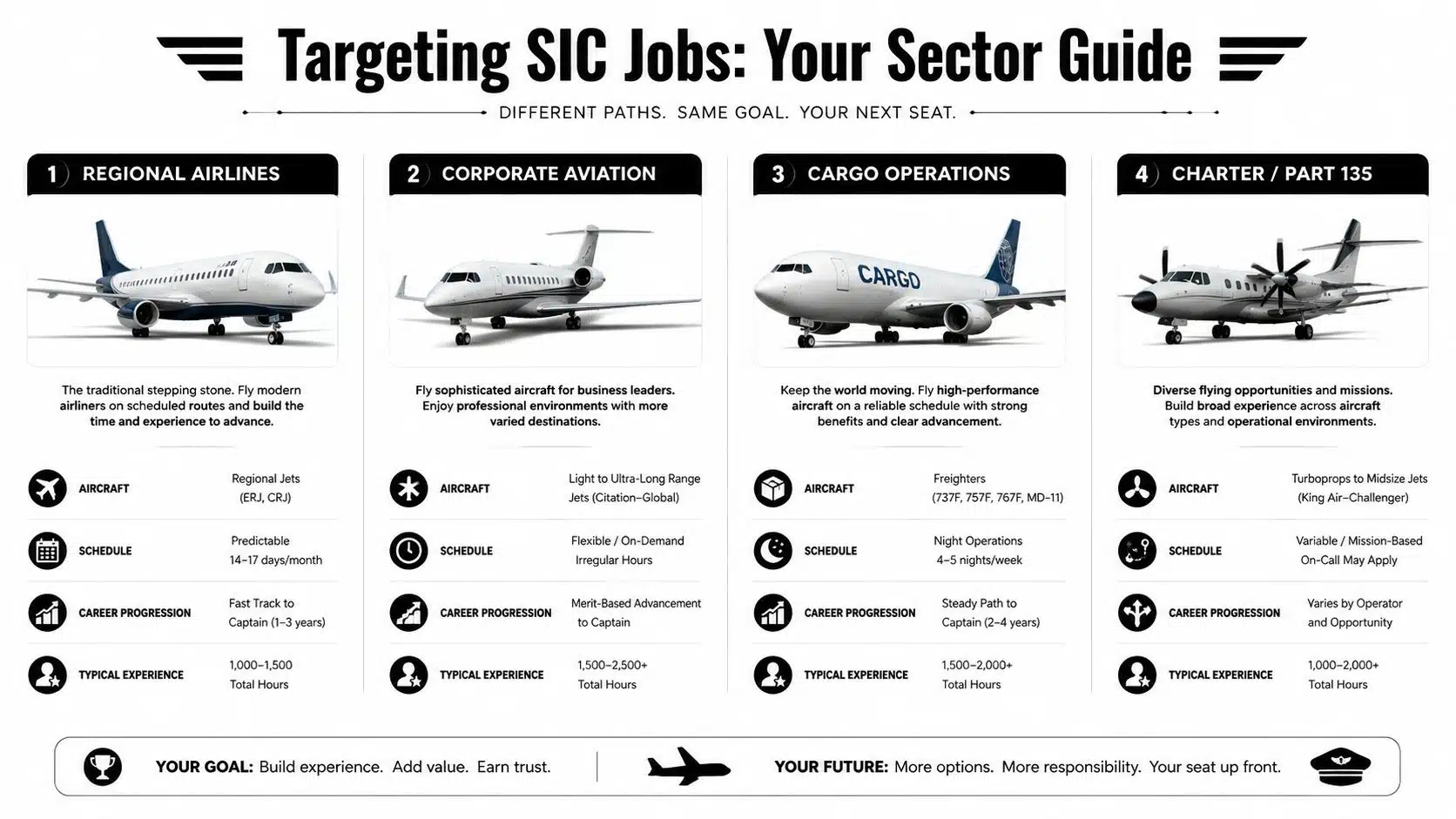
Comparing the main SIC paths
Some pilots want a straight airline progression. Others want schedule flexibility, customer variety, or better long-term corporate quality of life. Each path carries trade-offs.
| Sector | Typical Schedule | Starting Pay Range | Career Progression | Lifestyle |
|---|---|---|---|---|
| Regional Airlines | Bid-based, multi-leg days, reserve common early | Varies by carrier and contract | Structured path, turbine crew environment, possible flow or major transition | Predictable systems, less control over early schedule |
| Corporate Aviation | On-call or department-specific | Varies widely by operator | Can lead to long-term department role or captain seat in business aviation | Can be excellent or frustrating, depends heavily on flight department culture |
| Cargo | Often overnight or irregular blocks | Varies by operation | Strong IFR and systems experience, useful turbine path | Less glamorous, often efficient for skill growth |
| Charter Part 135 | Rotating or demand-based | Varies by fleet and company | Broad aircraft exposure, can build customer-service and operational flexibility | Schedule can be unstable, quality varies a lot |
The “best” job depends on what you want next. A regional job is strong if you want standardization and a known training system. Charter can be better if you want broader operational exposure earlier. Corporate can be excellent if you find a professional department. Cargo often attracts pilots who care more about flying quality than optics.
Building an application that gets read
Most pilot resumes fail because they look like generic corporate resumes with flight hours added at the bottom. Recruiters and chief pilots want fast signals.
Your resume should show:
- Certificates and ratings near the top
- Total time and relevant breakdowns that match the posting
- Aircraft flown, especially complex or multi-engine types
- Training roles and safety-related duties
- Clean formatting that works in applicant tracking systems
If you want to pressure-test formatting before you send applications, this Europass guide to passing recruiter robots is helpful for understanding how ATS screening tools read resumes.
Keep the writing plain. “Provided exceptional aviation solutions” says nothing. “Commercial pilot with instrument and multi-engine ratings, instruction experience, and towered-airport operations background” says something useful.
Here's the video I often recommend to pilots who need a grounded view of aviation career positioning before they start applying.
Networking isn't optional
This is the hidden part of hiring that low-time pilots underestimate. Industry experts report that approximately 80% of successful pilot hires are recommended candidates, while only 15% are qualified minorities and 5% are non-recommended applicants, according to this discussion on pilot career success and recommendations.
Those numbers tell you something blunt. Cold applications alone aren't enough in many corners of the industry.
That doesn't mean fake networking. It means real professional relationship-building:
- Stay in contact with instructors who know your habits
- Talk to former students and alumni who moved into charter, regional, or corporate jobs
- Show up prepared when you meet chief pilots or line pilots
- Follow up without pestering
A recommendation only helps if the person making it trusts your judgment, your cockpit behavior, and your reliability.
The pilots who move fastest usually do two things well. They train seriously, and they stay visible to people who can vouch for them.
How to Buy an Airplane the Safe Way
A surprising number of working pilots eventually decide to buy an aircraft. Sometimes it's for personal travel. Sometimes it's for time access, business use, or a long-term ownership plan with partners. If you approach the purchase casually, you can buy yourself years of maintenance surprises.

Start with mission, not paint
The safest purchase starts with a brutally honest mission profile.
Ask yourself:
- How many seats do you need
- What trips will you really fly
- Do you need IFR capability or just want it
- Will you own solo, with a partner, or through a business
- Do you have access to maintenance support for that make and model
People get into trouble when they buy for ego, resale fantasy, or a single “someday” mission. If most of your flights are short solo trips, don't buy a complex machine that forces unnecessary cost and training burden.
If you're early in the search and want a broad market-oriented overview, this 2026 guide to buying a plane offers a helpful starting point for thinking through listings and purchase criteria.
Budget for ownership, not just acquisition
The sale price is only the opening move.
Your real ownership budget needs to include insurance, hangar or tie-down costs, scheduled maintenance, unscheduled maintenance, inspections, subscriptions, training, and likely upgrades. Helicopter buyers need to be even more disciplined because maintenance planning and parts support can become the deciding factor in whether ownership feels rewarding or exhausting.
Buy the airplane you can maintain well, not the airplane you can barely afford to acquire.
The pre-buy inspection is where deals live or die
Never treat a pre-purchase inspection as optional. Never use the seller's mechanic as your only source of truth.
A serious pre-buy should include:
- Logbook review for continuity, damage history, and inspection status
- Airframe and engine inspection by a mechanic familiar with the type
- Avionics and equipment verification against what the listing claims
- AD compliance review
- Title and lien review
- Corrosion and storage history check, especially for older aircraft
Choose an independent A&P, and if the airplane is complex or uncommon, choose one with type-specific experience. A cheap pre-buy can become an expensive ownership lesson.
Paperwork and closing discipline
Before funds move, verify title, registration path, bill of sale details, operating documents, and any ownership entity questions with the right professionals. If partners are involved, define scheduling, maintenance responsibility, upgrade authority, and exit terms in writing before the deal closes.
That sounds less exciting than shopping aircraft photos. It's also how you keep a clean purchase from turning into a legal and financial mess.
Securing the Offer and Understanding Your Contract
By the time you get an offer, the hardest work should already be done. What's left is proving you can handle the assessment process and reading the contract carefully enough to protect yourself.
What interview programs are really measuring
Modern pilot hiring doesn't rely on one conversation and a handshake. Current hiring programs use multi-stage assessments that include cognitive tests and simulator evaluations, and data-driven assessment methods have been shown to reduce simulator training failures by up to 28% and cut overall training attrition by 22%, according to this research on pilot selection methodology.
That tells you what companies value. They want evidence that you can process information, follow procedures, communicate clearly, and stay trainable.
During the sim, recruiters and evaluators usually care less about perfection than people think. They're watching whether you:
- Take correction well
- Use callouts consistently
- Stay ahead of the aircraft
- Recover from mistakes without unraveling
- Behave like a crew member, not a solo hero
If the sim starts going badly, slow your pace, return to basics, and become more organized. Evaluators notice composure.
What to review before you sign
Pilot contracts deserve a close read. Focus on the terms that affect your freedom and income, not just the headline pay.
Check these points:
- Training bond language and repayment triggers
- Base or domicile rules
- Reserve expectations and schedule protections
- Upgrade conditions
- Per diem, benefits, and travel reimbursement
- Termination clauses and probation terms
- Confidentiality obligations and records handling
For the confidentiality side, this practical guide on protecting sensitive business information is a useful reference for understanding the kind of agreement language companies may include in onboarding documents.
If anything in the contract looks vague, ask. If the company resists basic clarification, that's information too.
If you're building toward your first SIC role, sharpening instrument skills, adding multi-engine time, or planning a smarter aviation path from day one, DuBois Aviation is a strong place to train with one-on-one instruction at a busy towered airport. The goal isn't just to earn another rating. It's to leave better prepared for real hiring standards and the cockpit demands that come after them.