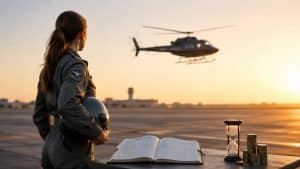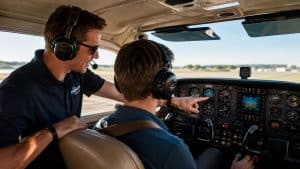
For passengers on major U.S. scheduled airlines, the risk of a fatal accident is statistically near zero. In 2023, major airlines recorded a 0.0 fatal accident rate per 100,000 flight hours, and there were no onboard fatalities on commercial scheduled airlines in the United States.
That doesn't mean your concern about commercial airline crashes is irrational. It means the actual story of modern aviation is very different from the one our emotions often tell us. A crash makes headlines because it's rare, dramatic, and profoundly human. Safe flights, which happen every day in enormous numbers, barely register in memory.
The better question isn't only “How safe is flying?” It's “What makes it so safe?” That answer is where aviation becomes fascinating. The safety of commercial flight didn't happen by luck. Pilots, mechanics, manufacturers, regulators, dispatchers, and instructors built it through disciplined systems, standard procedures, and training that turns good judgment into habit.
If you've ever watched an airliner depart and wondered how people can trust such a machine, that trust comes from a culture. It starts with careful design and regulation, but it lives in the cockpit. Pilots train to think ahead, manage risk, communicate clearly, and stay calm when conditions change. That same safety culture is what makes flight training so compelling. Learning to fly isn't stepping into danger. It's stepping into one of the most methodical safety systems ever created.
Understanding Your Concerns About Flying
Fear of flying usually isn't fear of routine travel. It's fear of losing control. You can't see the pilots working, you can't inspect the aircraft yourself, and you can't feel all the layers of planning behind a normal airline departure. That gap between what's happening and what you can observe is where anxiety grows.
Commercial airline crashes also get discussed in a distorted way. A single event can dominate news coverage for days, while years of uneventful, safe airline operations pass with little attention. So a nervous traveler often ends up with a vivid mental picture of a rare event and only a vague understanding of the systems that prevent it.
Why fear and facts often feel mismatched
Your brain is built to react strongly to dramatic stories. Aviation safety, by contrast, is built on quiet repetition. Checklists. briefings. callouts. simulator sessions. maintenance logs. weather reviews. recurrent training. None of that is dramatic, but that's exactly why it works.
Commercial aviation is safest when it feels ordinary. Routine is not a sign that people are taking shortcuts. It's a sign that disciplined systems are doing their job.
Readers also get confused because “aviation” is a broad term. A major scheduled airline isn't the same thing as a private flight, a training flight, a sightseeing helicopter operation, or a small aircraft used for personal travel. When people hear about an aircraft accident, they often lump every category together. That makes the whole industry seem more dangerous than it is.
What the topic really reveals
The topic of commercial airline crashes can lead to a more reassuring insight. Every rare airline accident is studied intensely. Aviation doesn't bury lessons. It turns them into procedures, equipment upgrades, better cockpit communication, and stronger training standards.
That's why the modern story of flying is so encouraging. Safety didn't improve because people hoped it would. It improved because aviation treats mistakes, weak points, and near misses as things to learn from. If you're curious about becoming a pilot, that should inspire confidence. Flight training at its best isn't thrill-seeking. It's learning how professionals think.
The Data-Driven Reality of Aviation Safety
When you look at long-term data, the pattern is clear. Commercial flying has become far safer over time, even as air traffic has grown. A major Airbus commercial aviation accident analysis shows that the global airline accident rate was roughly 1.8 accidents per million departures in the early 2000s and fell to around 1.0 per million departures by the late 2010s. The same analysis reports that the global commercial fleet experienced zero fatal accidents in 2023.
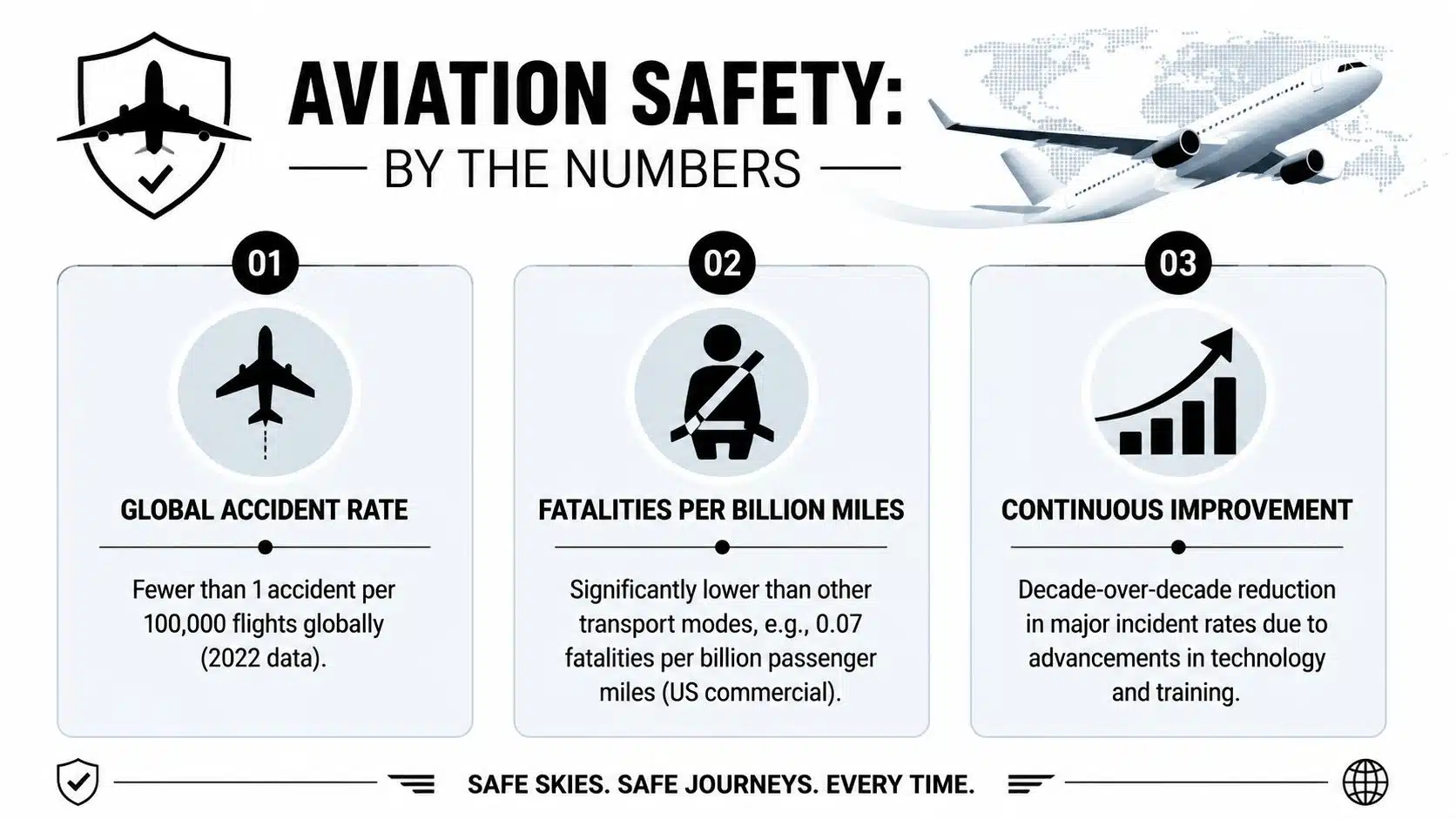
That long arc matters more than any single headline. Across 1958 to 2024, the same Airbus analysis recorded 6,700 commercial aviation accidents worldwide, but only about 1,300 involved passenger fatalities. It also notes that in 2024 accident activity increased somewhat, with 12 hull losses and four accidents involving fatalities, yet the total number of fatalities remained low compared with historical peaks. In plain language, commercial airline crashes are highly visible, but they are also statistically rare events in modern scheduled airline operations.
What the numbers mean in practice
A statistic like “per million departures” can feel abstract, so translate it into a habit of thinking. Every takeoff is one departure. Aviation safety analysts study huge numbers of departures because a single flight doesn't tell you much. Trends over many years do.
That's also why serious aviation organizations rely on structured methods instead of impressions. If you want to understand how analysts separate signal from noise, this overview of an AI-driven statistical analysis approach is a useful companion. It helps explain why disciplined data work matters when evaluating rare events.
Here's the important interpretation:
- Lower accident rates over time: The trend line moved down, not up.
- Fatal events are rarer still: Not every accident involves fatalities, and the deadliest historical eras don't represent current airline operations.
- Modern systems compound safety: Certification, avionics, maintenance standards, crew coordination, and training reinforce each other.
Why safety improved so much
The data didn't improve because aircraft just got newer. Safety improved because the industry built layers.
A commercial flight today operates inside a web of defense. Designers build aircraft with redundancy. Maintenance teams document and inspect. Dispatch and weather planning reduce avoidable exposure. Air traffic control structures traffic flow. Pilots use standard calls, checklists, and crew procedures that are practiced until they become second nature.
Practical rule: In aviation, safety usually comes from many small correct actions in sequence, not one heroic recovery at the last moment.
That idea helps nervous travelers the most. The average passenger imagines safety as depending on one pilot making a brilliant decision under pressure. In reality, airline safety is built so that people don't have to rely on brilliance alone. They rely on preparation, standardization, and layers of verification.
How Professional Pilot Training Creates Safety
The public often credits technology first, and technology matters. But aircraft don't interpret weather, brief an approach, reject a bad plan, or decide to go around. Pilots do. Training is what turns safety systems into safe action.
In the United States, the National Safety Council's aviation safety data show that in 2023 there were 327 civil aviation deaths, but none occurred on a commercial scheduled airline. The same data show major airlines had a 0.0 fatal accident rate per 100,000 flight hours in 2023. That record reflects many things, but one of the most important is disciplined professional training.
Training is not just stick-and-rudder skill
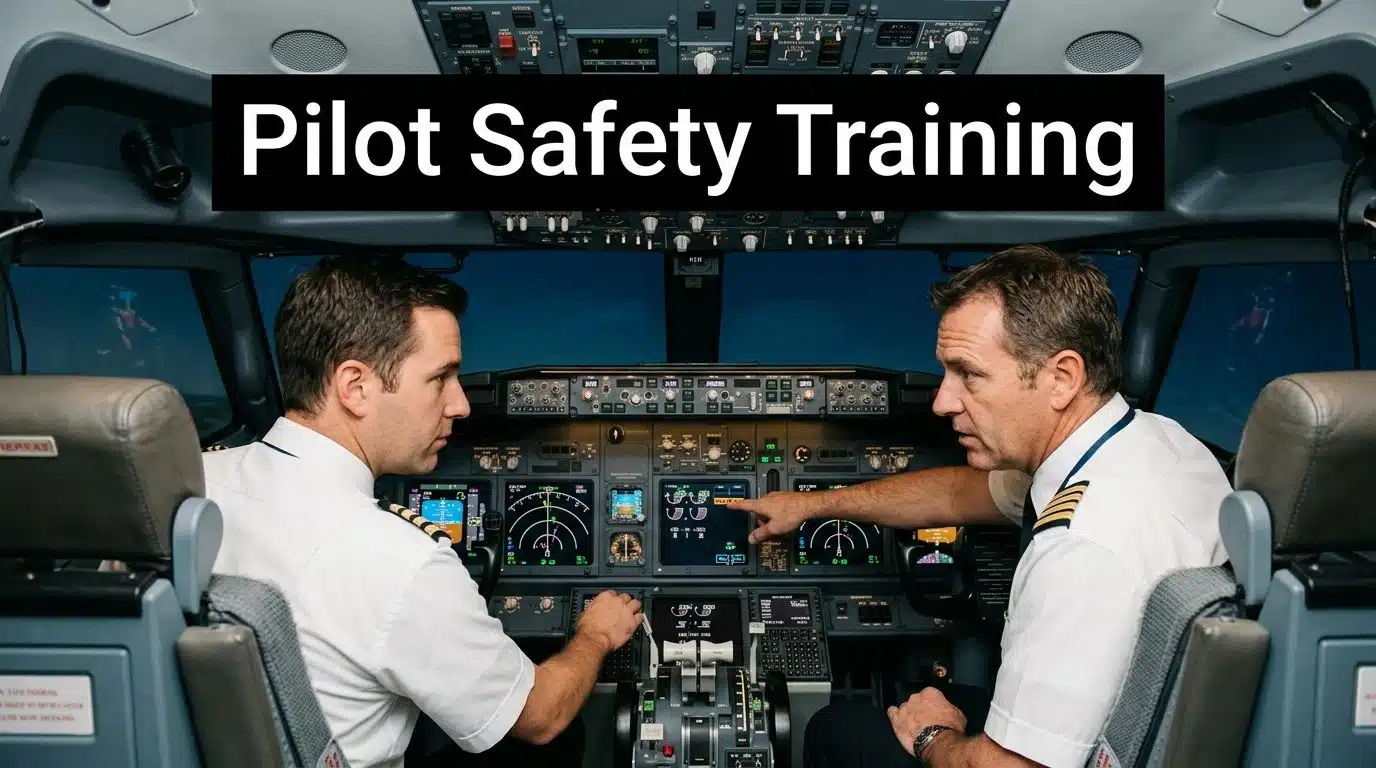
New students sometimes think pilot training is mainly about physically flying the airplane. That's only part of it. A strong pilot learns to manage workload, stay ahead of the aircraft, and make conservative decisions before a situation turns serious.
Professional training develops several habits at once:
- Situational awareness: Knowing where you are, what the airplane is doing, and what's coming next.
- Risk management: Recognizing when weather, fatigue, distraction, or pressure is degrading safety.
- Communication discipline: Using clear, standard phraseology with instructors, other pilots, and controllers.
- Emergency readiness: Practicing abnormal and emergency scenarios until the response is calm and structured.
A pilot doesn't become safer by feeling fearless. A pilot becomes safer by noticing small deviations early and correcting them before they grow.
Why progression matters
The usual progression from private pilot to instrument flying to commercial training works because each stage adds a different mindset. A private pilot learns aircraft control and basic judgment. Instrument training sharpens precision and teaches the pilot to trust procedures and instruments when outside visual cues are limited. Commercial training raises the standard again, emphasizing consistency, professionalism, and smoother decision-making under higher expectations.
That's also why standard operating procedures matter so much. Instructors and flight operations teams depend on repeatable routines, not improvisation. If you want a simple look at why structured habits improve consistency, this article on streamlining operations with SOPs gives a clear business-side parallel that applies surprisingly well to aviation.
A safe pilot doesn't ask, “Can I get away with this?” A safe pilot asks, “What's the cleanest, most conservative way to do this well?”
Students considering advanced training can see how that mindset develops in a formal commercial pilot training path. The key point isn't the credential alone. It's the discipline behind it. Airline safety starts long before someone ever sits in an airline cockpit.
Your Path to the Skies at DuBois Aviation
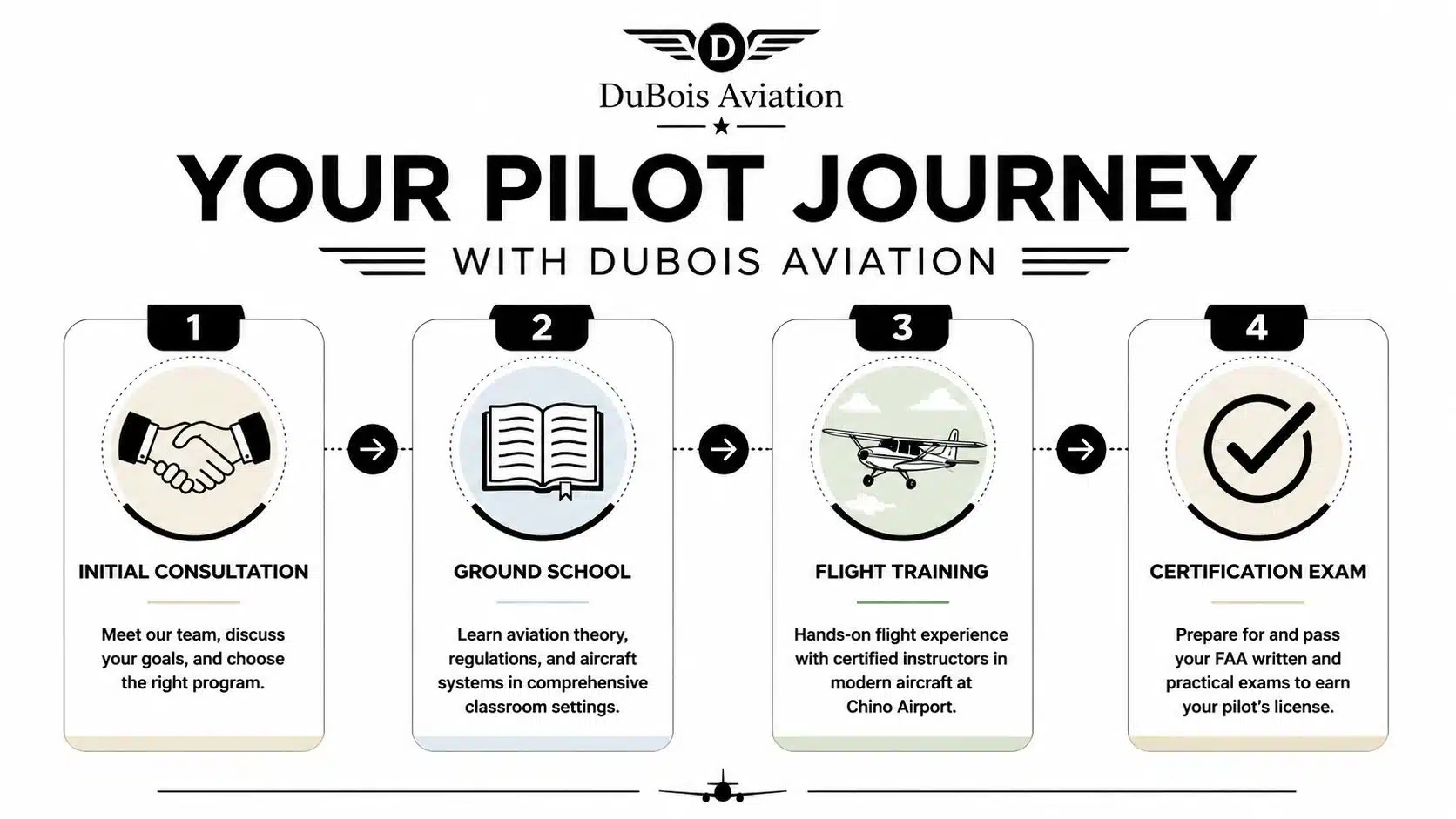
Aviation feels more attainable when you break it into steps. Many do not start with a clear picture of every certificate, rating, and endorsement. They start with interest. Then they need a path that makes sense.
The journey usually begins with an introductory flight experience and a conversation about goals. Some people want a personal license for weekend travel. Some want instrument proficiency and a more capable skill set. Others are aiming at a professional cockpit and need a long-range training plan. The good schools make those paths feel concrete instead of mysterious.
The first step is exposure, not pressure
For many future pilots, a discovery flight is the best starting point because it replaces abstract fear with direct experience. You see how the preflight works. You hear radio communication. You feel what normal climbs, turns, and descents are like. A lot of anxiety disappears once aviation becomes tangible.
After that, training usually settles into two linked parts. Ground learning covers weather, regulations, aerodynamics, aircraft systems, planning, and decision-making. Flight lessons turn those concepts into habits. Neither part works well alone. The student who only wants to “just fly” misses the reasoning behind good decisions. The student who only studies books never develops timing and feel.
What each certificate changes for you
Different certificates and ratings open different doors. It helps to think of them less as badges and more as layers of capability.
| Training stage | What it adds |
|---|---|
| Private Pilot | The foundation for flying yourself and passengers under appropriate conditions |
| Instrument Rating | Precision, procedural discipline, and stronger weather and navigation capability |
| Commercial Pilot | A higher standard of performance and professionalism |
| Multi-engine or helicopter training | Aircraft-specific skill sets that expand what you can operate |
The emotional shift is important too. Students often begin by asking whether they'll be “good enough.” Over time, that question changes. They start asking better ones. Is this weather acceptable for my current proficiency? Is my approach stabilized? Do I need more margin today? That's what real training does. It changes how you think.
Different goals, same safety culture
Not every student wants the same aviation life.
- The personal traveler might want a private certificate and later an instrument rating for safer, more flexible trips.
- The career-minded student may move from primary instruction into commercial, multi-engine, and structured time-building.
- The rotorcraft enthusiast may prefer helicopter training and scenic or utility-oriented flying.
- The younger learner or family may begin with camps, introductory experiences, or a gift flight before committing to a longer plan.
The best training path is the one that matches your real goal, your schedule, and your learning pace. Fast isn't always better. Consistent is better.
That's why a good training environment matters. Students need aircraft availability, scheduling that works with ordinary life, instructors who teach clearly, and a culture that doesn't glorify unnecessary risk. They also need to see that professional habits apply from the first lesson, not only at the commercial stage.
Aviation can look elite from the outside. In practice, it's built one lesson at a time. Learn the checklist. Brief the departure. Fly the heading. Debrief truthfully. Fix one thing. Repeat. That steady rhythm is how people move from curiosity to competence.
The DuBois Advantage Training at Chino Airport
Where you train shapes the pilot you become. An airport environment teaches constantly, even before the engine starts. Taxi routes, radio calls, traffic awareness, runway discipline, and changing weather all sharpen judgment when students train in a busy, structured setting.
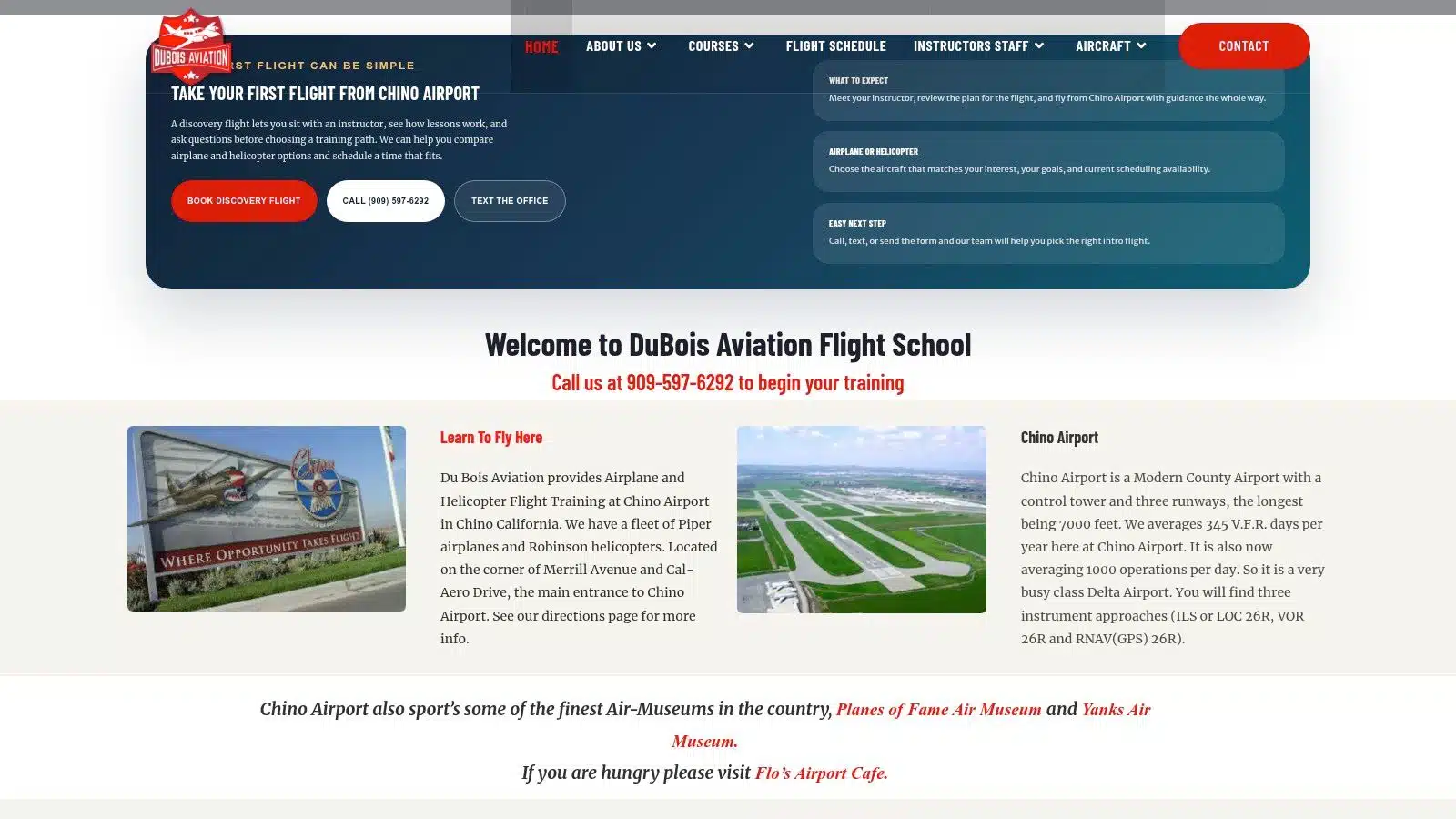
At Chino Airport, that environment is part of the education. Training at a towered Class D airport gives students regular exposure to real-world radio communication and airspace habits from the beginning, rather than postponing them until later. That tends to build confidence the right way. Not by making flying feel easy, but by making complexity familiar.
A training day with variety
A student in this kind of setting might brief a local lesson in a Piper Cherokee, taxi with active radio work, practice maneuvers in nearby training areas, then return for pattern work with tower instructions that demand good listening and timing. Another day might involve instrument procedures, simulator time, or a cross-country in a different aircraft type.
That variety matters. The school's environment includes airplane and helicopter instruction, a fleet with models such as Piper Cherokee, Cessna 150, Mooney M20B, Piper Apache, and rotorcraft from Robinson and Enstrom, plus an in-house simulator and flexible scheduling. A student who learns across that kind of operation sees that safety is not one narrow skill. It's a way of approaching aircraft, procedures, and changing conditions.
Why simulators and facilities matter
The simulator is especially valuable because it lets instructors pause, repeat, and isolate a scenario without the pressure of managing every variable in the air. Students can work on instrument scans, procedures, abnormal situations, and cockpit flows in a controlled setting, then carry that learning into the aircraft.
A closer look at the school's training environment and facility at Chino Airport helps illustrate why the setting itself becomes part of the curriculum.
Later in the training flow, students also benefit from seeing how an organized school runs. Aircraft scheduling, maintenance coordination, instructor availability, and recurring standards all signal the same thing. Professional flying is built on dependable systems.
This short video gives a better feel for the atmosphere and operation.
Some airports are convenient places to log hours. Others teach you how to operate in the real world. That difference shows up later in confidence and cockpit discipline.
From Pilot to Owner Safely Buying Your First Aircraft
For some pilots, renting remains the smartest option for a long time. For others, ownership becomes the next logical step. That's especially true when flying frequency rises, missions become more specific, or a pilot wants control over equipment, scheduling, and long-term maintenance decisions.
Buying an airplane or helicopter safely requires the same mindset that makes aviation safe in the first place. Slow down. Verify everything. Assume paperwork matters because it does. Never treat appearance as proof of condition.
How to buy an airplane the safe way
Start with mission, not ego. A clean, modest aircraft that fits your actual flying is usually a better first purchase than a complex machine that exceeds your current experience. The right question isn't “What looks impressive?” It's “What can I operate well, maintain responsibly, and use often?”
Then work through a disciplined review:
- Define the mission clearly: Local training, weekend trips, instrument travel, or rotorcraft operations all point to different aircraft choices.
- Use a qualified mechanic for a pre-buy inspection: A seller's confidence is not an inspection. You want an independent evaluation of condition, records, and airworthiness.
- Review maintenance logs carefully: Gaps, unclear entries, or inconsistent documentation should slow the deal down.
- Check compliance items: Airworthiness status, recurring inspections, and aircraft-specific requirements all need careful review.
- Think beyond the purchase moment: Availability of parts, insurance considerations, training needs, and recurrent proficiency all affect whether ownership stays enjoyable.
People looking to buy or sell airplanes and helicopters often underestimate how much of a good transaction happens before money changes hands. The safest buyers are methodical. The safest sellers are transparent.
The paperwork is not optional
The legal transfer of ownership matters just as much as the mechanical side. In the United States, the FAA requires aircraft sales to be recorded with an Aircraft Bill of Sale (Form 8050-2) and the Aircraft Registration Application (Form 8050-1) to update ownership in the National Aircraft Registry, as outlined in this FAA aircraft sale documentation reference. The same verified guidance notes that properly submitted registration paperwork typically takes 10 to 14 days.
That requirement serves more than bureaucracy. It helps preserve a clear ownership chain and proper safety documentation. If a buyer rushes past title, registration, and record review, the risk isn't only legal. It can affect insurability, future resale, and confidence in the aircraft's history.
When expert guidance helps
First-time buyers often benefit from working with experienced aircraft brokers, instructors, or maintenance professionals who know how to evaluate an airplane or helicopter as a complete package. A polished exterior, upgraded avionics, or enthusiastic sales language can distract from bigger questions about records, supportability, and fit.
If you're actively exploring the market, a curated aircraft sales resource for airplanes and helicopters can help you compare options more intelligently.
Buy the aircraft you can understand, inspect, and operate responsibly. In aviation, ownership works best when pride follows discipline.
Start Your Aviation Journey with Confidence
Commercial airline crashes draw attention because they're serious and emotionally powerful. But if you stay with the evidence and the logic behind it, the broader lesson is reassuring. Modern commercial aviation is extraordinarily safe because the industry has spent decades building systems that reduce risk, catch errors, and train people to operate with discipline.
That's the part many outsiders never get to see. Safety in aviation isn't a slogan. It's a daily practice. Pilots brief, cross-check, communicate, and prepare because professionalism beats improvisation. The same culture that protects airline passengers is the one that shapes strong new pilots in training aircraft, simulators, and classrooms every day.
If flying has always interested you, this should move the question away from fear and toward participation. You don't have to stay on the outside of aviation, wondering how it all works. You can experience the structure, the calm, and the professionalism for yourself. A discovery flight is often enough to turn abstract concern into practical understanding.
Learning to fly won't make you careless about risk. It tends to do the opposite. It teaches you why aviation works so hard to manage risk well, and why that effort has made commercial flight one of the safest forms of transportation in the world.
If you're ready to replace uncertainty with firsthand experience, DuBois Aviation is a strong place to begin. Whether you want a discovery flight, airplane training, helicopter instruction, or a long-term path toward professional flying, the school offers a structured, safety-focused environment at Chino Airport that helps students build real confidence from day one.