

You've got the certificate, the weather looks decent, and the airplane rental search still feels weirdly opaque. That's normal. The first surprise with airplane rental near me isn't usually distance, it's the maze of checkout rules, fuel policy, insurance questions, and airport-specific habits that decide whether you can get the keys.
The practical question is never just “what's nearby.” It's, “Which operator has the right aircraft, will approve my paperwork, and can hand me an airplane I'm qualified to fly without turning the whole thing into a long delay?” At a busy GA airport, that answer changes with the airplane type, the local fleet, and how the school or club manages scheduling.
Table of Contents
- What Renting an Airplane Locally Actually Looks Like
- Documents and Endorsements You Need Before You Rent
- Decoding Hourly Rates, Fuel Policy, and Minimums
- The Checkout Flight and What It Really Tests
- Why the Airport You Choose Changes the Rental Experience
- Booking Tips That Actually Save Time and Money
- Getting Started with Du Bois Aviation at KCNO
What Renting an Airplane Locally Actually Looks Like
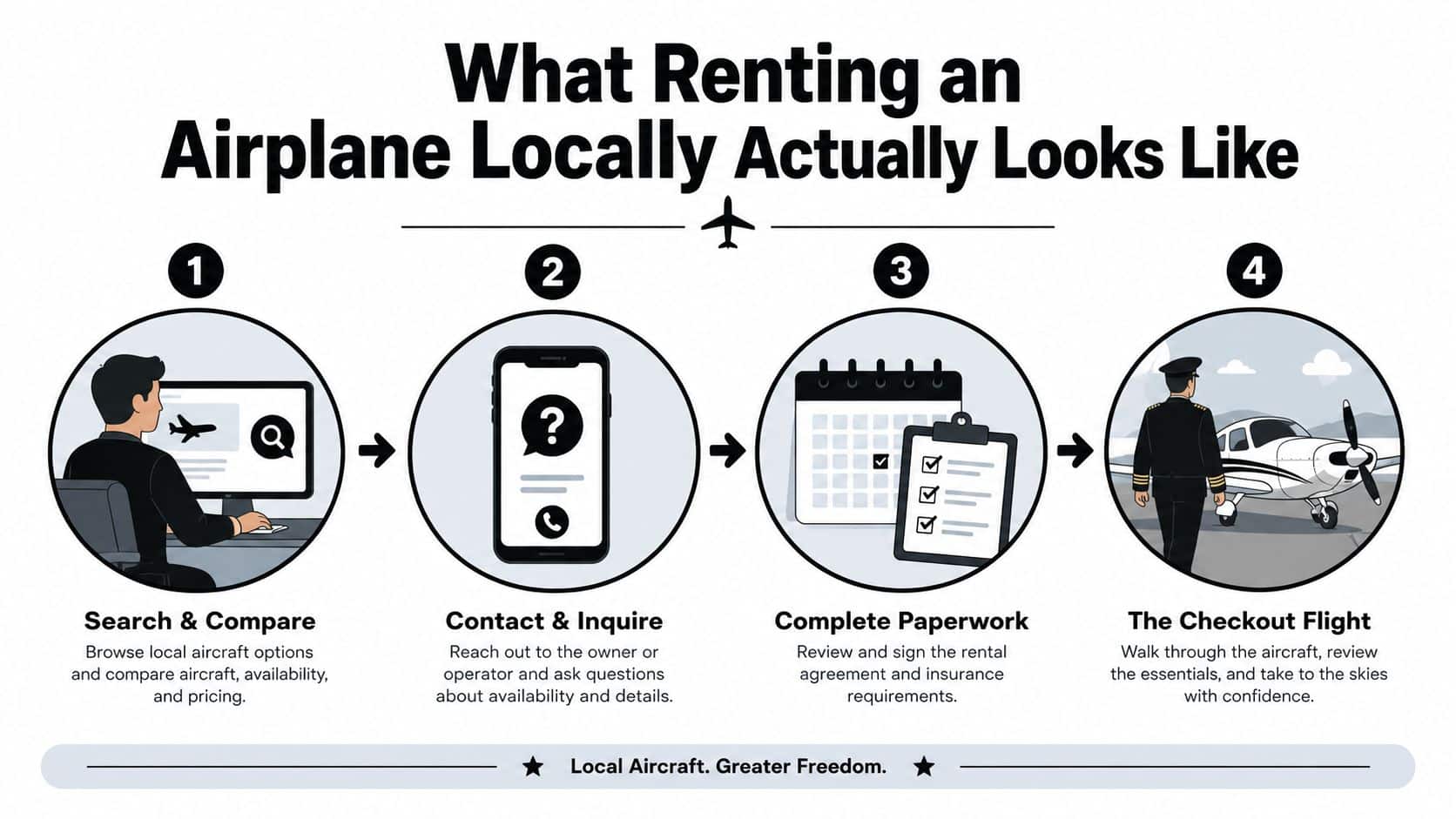
A freshly certificated pilot usually starts the same way, a quick search, a few tabs open, and a lot of rates that look similar until you read the fine print. One airplane shows a low hourly number, another adds a fuel charge, and a third requires a checkout before you can even ask for a reservation. That's why local rental is really a matchmaking problem between your qualifications, the exact aircraft, and the airport operator that's willing to rent it to you.
What the first search usually leads to
The first useful filter isn't always the city, it's the operator type. A flight school, flying club, or FBO may all show up in the same area, but their rules can be completely different. One may rent to certificated pilots only, another may reserve airplanes for members, and another may require a checkout before you can schedule anything.
Public fleet pages also show why “near me” can be misleading. A basic trainer and an IFR-equipped cross-country airplane are not interchangeable, even if they sit on the same ramp. RentPlanes describes a nationwide marketplace across more than 10,000 regional airports RentPlanes, which is a useful reminder that local access is broad, but aircraft availability still depends on the exact airport and the exact mission.
The real sequence at the desk
The rental process usually starts with a call or request, then moves to paperwork review, then to a checkout discussion. Operators want to know what you've flown recently, whether you need training in that model, and whether the airplane is available when you need it. At that point, the lowest posted rate matters less than whether the school can approve you without surprises.
Practical rule: treat the first phone call like a qualification interview, not a reservation request.
That's also why busy airports often feel tighter than they look online. A local fleet can be healthy on paper and still feel constrained on a weekend because a few instructors, students, and renters are all trying to use the same machines. In practice, the right rental is the one that fits your logbook, your timing, and the airport's operating rhythm.
Documents and Endorsements You Need Before You Rent
Most rental friction starts before you ever step onto the ramp. The front desk isn't looking for enthusiasm, it's looking for the document stack that proves you're legal, current, and covered. A clean rental file usually means fewer delays, fewer callbacks, and less awkward standing around while someone hunts for missing paperwork.
The core documents
Have these ready before you ask about a rental:
- Pilot certificate, because the operator needs to verify the certificate level you hold.
- Current medical, because an expired medical stops a rental conversation fast.
- Government photo ID, because schools routinely check identity against the certificate.
- Logbook or sign-off records, because the operator may want to see recency and prior aircraft experience.
- Non-owned aircraft insurance, because many rental operators won't dispatch without it.
The insurance discussion is its own topic, and it comes up early for a reason. Operators want to know whether your policy covers the airplane, the hull value, and the liability structure they expect. That conversation matters before scheduling, not after the airplane is already reserved.
Endorsements and aircraft-specific approval
Some airplanes need more than a certificate and a good attitude. High-performance, complex, and high-altitude aircraft can require the relevant 14 CFR 61.31 endorsements, and the school will usually want to see those in writing rather than taking your word for it. Even a pilot who's competent in one trainer can get turned away from a more demanding model if the logbook doesn't match the airplane.
Missing documentation is one of the fastest ways to lose a rental slot, and it's usually avoidable with a preflight paperwork check.
A smart first move is to review your certificate requirements and make sure your records are aligned with the airplane you want. If you need a refresher on the paperwork side, pilot license requirements are worth checking before you book anything. The goal is simple, arrive with a complete file, not a promise to bring the missing page later.
Decoding Hourly Rates, Fuel Policy, and Minimums
The quote on the board is rarely the full cost. Rental pricing shifts with aircraft type, fuel policy, block pricing, and any minimum-time rule tied to the reservation. A rate that looks low at first can end up costing more once fuel, instruction, or a minimum charge is added back in.
Wet versus dry, block versus hourly
A wet rate includes fuel in the rental price, which makes budgeting easier. A dry rate leaves fuel cost to the renter, which can look cheaper upfront but usually demands tighter planning. Block pricing can work if you know you will fly enough hours to justify it, while a straight hourly quote is simpler if you rent only now and then.
| Posted Hourly Rates by Aircraft Type | Typical hourly rate | Sample operator example | Cost driver |
|---|---|---|---|
| Single-engine trainer | $120–$200 per hour | A Cessna 172SP listed at $140–$160 per hour Flying Magazine | Basic trainer, simpler systems, lighter operating cost |
| Entry-level trainer | Around $145 per hour | A Cessna 152 listed at $155 per hour or $145 per block hour Long Island Aviators | Lower complexity and lower equipment load |
| Mid-range single-engine | Around $190–$199 per hour | Several Cessna 172 variants listed at $190–$199 per hour Long Island Aviators | Avionics, configuration, and operator overhead |
| Higher-complexity single-engine | Often near the upper end of local single-engine pricing | A Cirrus SR22 listed at $330 per hour | More advanced systems and equipment |
| Twin-engine piston | $200–$500 per hour | A Grumman Cougar GA-7 listed at $334 per hour or $324 per block hour | Two engines, more systems, higher maintenance burden |
Flying Magazine notes that recreational pilots average about 50 flight hours per year, which puts annual rental spending in the roughly $6,000–$25,000 range depending on aircraft type and location Flying Magazine. That is a better budgeting lens than staring at a single hourly number in isolation.
The questions that expose hidden costs
Ask whether the rate is wet or dry, whether there is a daily minimum, and whether a fuel surcharge gets added at return. Meriden Aviation Center, for example, states that it charges a $10 per hour fuel surcharge and offers half-day, full-day, and discounted 10-hour prepaid blocks Meriden Aviation Center. That kind of detail changes the math quickly, especially on short trips.
The biggest pricing mistakes happen at the fuel line. A renter who assumes the airplane comes back full, or assumes the operator will absorb the difference, can erase the value of a good posted rate in a single sortie. A practical comparison starts with the fuel policy, then looks at how you fly, including how far you plan to go and how much reserve you want to keep. For a closer look at how fuel choices affect rental cost, fuel management strategies are worth reviewing before you book.
If you are comparing operators, fuel policy deserves the same attention as the airplane itself. The rental that looks cheaper on the board may be the more expensive option once the return fuel rule, minimum time, and block-hour terms are all in play.
The Checkout Flight and What It Really Tests
The checkout is where the operator decides whether you can safely use their airplane without putting the aircraft, the schedule, or your own confidence at risk. A good checkout isn't ceremonial. It's a practical look at whether you understand the model, the cockpit flow, and the habits that matter in that exact airframe.
Ground review before the prop turns
A common benchmark is a structured ground lesson followed by a flight, and one rental provider's published process uses 1 hour of ground instruction plus 1 hour of flight before a renter can schedule independently EB Flight. That split makes sense because the ground time catches the issues that don't show up until you're discussing systems, limitations, or procedures with an instructor who knows the airplane well.
The ground portion usually covers weight and balance, normal procedures, emergency items, avionics, and the airplane's quirks. A pilot who knows how to fly generally can still miss small but important details in a different model, like switch logic, flap behavior, or cockpit layout. That's why “I've flown similar planes” doesn't carry as much weight as a proper model-specific briefing.
What the flight is really checking
The flight portion usually goes to the pattern, where the instructor can watch landings, radio work, airspeed control, and response to surprise changes. That's where a renter shows whether they can handle the airplane without overcontrolling it or getting rattled by normal tower traffic. A towered airport makes the evaluation more realistic, because radio discipline and workload management show up immediately.
A checkout flight should feel like a safety event, not a pop quiz.
Incomplete documentation, missing renter's insurance, and underestimating aircraft-specific handling are the most common failures, which is why pilots are better off selecting the exact model they want to fly and preparing for that model instead of hoping a generic certificate will be enough. One of the easiest ways to make the checkout go well is to arrive ready for the airplane you requested, not a vague version of it.
Why the Airport You Choose Changes the Rental Experience
A lot of guides treat “near me” like a radius problem. In real life, the airport is the experience. A towered, multi-runway field forces you to handle real traffic, real radio work, and real scheduling pressure, which can be exactly what a new renter needs or exactly what makes a low-hour pilot uneasy.
KCNO changes the job
Chino Airport, KCNO, is a busy towered Class D airport with three runways and multiple instrument approaches. That setup matters because it gives renters a realistic operating environment from day one, including pattern discipline, frequency work, and the patience to fit into a live traffic flow. It's not a quiet strip where you can disappear into the pattern, and that's part of the value.
For a renter, that can feel demanding at first. A steady stream of helicopter, fixed-wing, and training traffic can make the airport seem busy, but it also creates the kind of repetition that builds reliable habits. The key is whether the school structures your pattern work and radio practice so the airport becomes training, not chaos.
Why some airports rent better than others
Two airports can sit a short drive apart and still feel completely different once you're in the cockpit. One may have a broad fleet, an active tower, and instructors who are used to low-hour renters. Another may have airplanes available but be a poor fit because the exact model you need isn't on the line.
Practical takeaway: location is less about miles and more about whether the airport's operating environment matches your mission.
This is also where search results can mislead you. A field that looks close on a map may not be the one with the right checkout structure, the right airframe, or the right traffic environment for your goals. If you want realistic airport work, the airport itself is part of the training.
Booking Tips That Actually Save Time and Money
The best booking habits are boring, and that's exactly why they work. Good renters reduce friction before it starts, which means fewer cancellations, fewer rushed briefings, and fewer surprises when the airplane comes back wet, late, or short on fuel. The best local rental experience is usually built on consistency, not luck.
What saves the most aggravation
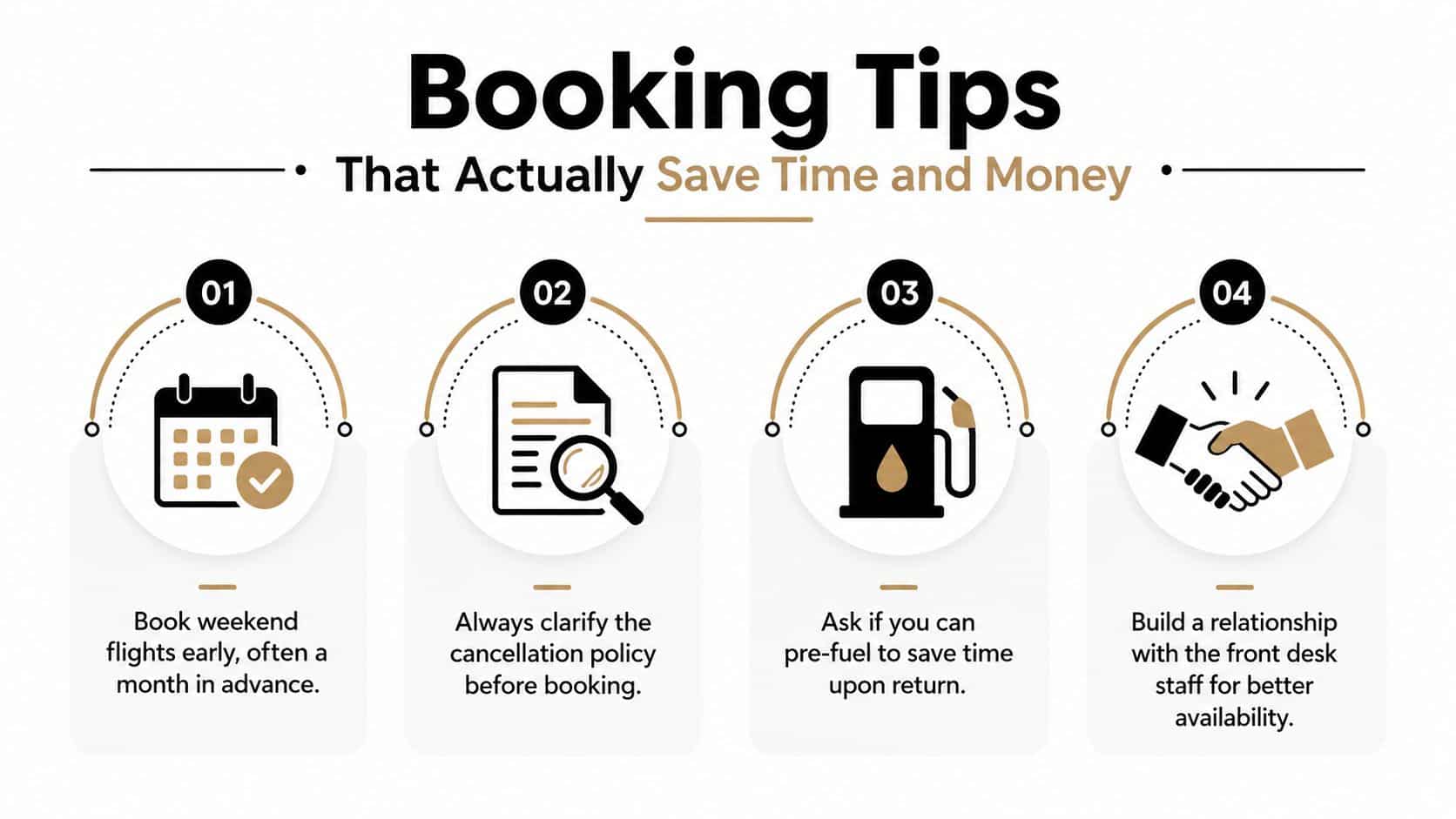
- Book weekend flights early, because popular local airplanes tend to disappear fast when everyone wants the same pattern time.
- Ask about cancellation policy first, because the cheapest rate means little if the terms are strict.
- Use simulator time to stay current, so you're not burning Hobbs time on basic proficiency work.
- Stay with the same model when you can, because repeating the same airplane usually keeps the checkout easier to maintain.
The front desk relationship matters more than most pilots admit. People who answer phones every day know which renters are reliable, which airplanes are tied up, and how the schedule really works when weather or maintenance changes the plan. A respectful, organized renter tends to get smoother treatment than someone who only shows up when they need the cheapest airplane.
If you're comparing operators and want the local listing side to be easier to find, it can also help to find a trusted SEO partner who understands local search visibility. For the renter, though, the practical questions are still the same: What happens if you cancel, what documents do you need, and what airplane will you be approved to fly?
Getting Started with Du Bois Aviation at KCNO
Du Bois Aviation at Chino Airport combines rental and training in a full-service flight school environment, with a fleet that includes Piper Cherokees, a Cessna 150, a Mooney M20B, and a Piper Apache, plus an in-house simulator and seven-day scheduling. For renters, that means the local checklist, checkout, and scheduling process lives in one place instead of being spread across multiple vendors.
Pilots interested in specific aircraft can review Piper rental options before they visit. That matters because the exact model determines how the checkout goes, how the airplane handles, and what kind of flying the school will approve.
The first visit usually starts with document review and a conversation about the airplane you want to fly, then moves into the checkout sequence if your paperwork is in order. The school's experienced CFIs, including CFI, CFII, and MEI staff, guide that process, and the online flight schedule makes it easier to see what's open before you make the drive. If you're certificated and ready to rent, or if you're a student who wants to train in a towered airport environment, the path is straightforward.
The same airport also supports scenic helicopter discovery flights over Chino Hills and the Prado Basin, plus the Flyers Club for ongoing community and mentorship. If you want a local place where the airplane, the checkout, and the schedule all line up, visit DuBois Aviation and start with the aircraft that fits your mission.
DuBois Aviation gives local pilots a place to rent, train, and get checked out in aircraft that match real-world missions at KCNO. If you're ready to rent an airplane near you, or you're starting training and want a busy towered airport from day one, visit DuBois Aviation and see which aircraft and scheduling options fit your next flight.


