

A student pilot returning from a solo cross-country may worry about weather, fuel, and runway position, but there's another practical question: who pays if the aircraft is damaged? Aircraft hull insurance covers physical damage to the aircraft itself, while liability insurance addresses damage or injury caused to other people or property. Every owner, renter, flight student, and flight school operator should understand the difference before an incident occurs, because the deductible, insured value, pilot requirements, and repair process can affect both finances and training schedules.
Table of Contents
- Introduction to Aircraft Hull Insurance
- Understanding Aircraft Hull Insurance Key Concepts
- Coverage Scope and Claim Settlements
- Policy Structures Types and Exclusions
- Underwriting Factors and Cost Drivers
- Special Considerations for Flight Schools Rentals and Helicopter Operations
- How to Obtain Coverage and Document Aircraft Condition
- Conclusion and Frequently Asked Questions
Introduction to Aircraft Hull Insurance
Aircraft hull insurance protects the insured aircraft against covered physical damage or total loss. The aircraft may be damaged during flight, taxiing, parking, towing, or another covered operation, depending on the policy wording. Liability coverage serves a different purpose. It responds to covered claims involving other people or their property, not the value of the aircraft itself.
A student returning from a solo cross-country could make a hard landing that damages the landing gear or propeller. Hull coverage may address the aircraft damage, subject to the policy's terms and deductible, while liability coverage may become relevant if the incident also damages a hangar, vehicle, or another aircraft.
Hull insurance has historically been a major part of aviation insurance pricing. One industry explanation says it can represent about 65% to 75% of an aircraft policy's total cost (EAA's explanation of aircraft physical damage coverage). That makes the coverage more than a technical detail. For flight schools and rental operators, it can influence aircraft availability, renter requirements, and the financial consequences of a grounded airplane.
Understanding Aircraft Hull Insurance Key Concepts
The easiest way to understand hull insurance is to compare it with collision coverage on a car. Collision coverage addresses damage to the insured car. Aircraft hull insurance performs a similar function for the insured airframe, engine, avionics, and permanently installed equipment, subject to the policy's definitions and exclusions. Liability coverage, by contrast, addresses covered damage or injury involving others.
Several terms deserve careful attention:
- Agreed value: The owner and insurer establish the aircraft's insured value when the policy is written. If a covered total loss occurs, the policy generally pays that agreed amount, less the applicable deductible, without deducting depreciation (Marsh's explanation of agreed-value aircraft hull coverage).
- Actual cash value: Settlement is based on the aircraft's value when the loss occurs. Market changes and depreciation can therefore affect the amount available after a claim.
- Hull exposure: This is the financial risk tied to damage to the aircraft itself. A high-value turbine aircraft creates a different exposure from a basic training airplane because replacement, repair, and salvage decisions involve more capital.
- Deductible: The portion of a covered loss that the insured absorbs before the policy responds. It may be a flat amount or a percentage of the insured hull value.

Practical rule: The policy's valuation language matters most before a loss, when the owner can still correct an unrealistic insured value.
A glossary can help new renters distinguish terms such as liability, deductible, and physical damage. Pilots who want a broader reference can browse insurance definitions from Mai & Associates, then confirm the aircraft-specific wording with an aviation insurance professional.
Coverage Scope and Claim Settlements
A student finishes a training flight with a gear-up landing. The aircraft may still be repairable, but the propeller, engine, landing gear, belly structure, and related systems could all require inspection. A hull claim then becomes a practical sequence: confirm the event is covered, identify the damaged components, obtain repair estimates, and apply the policy conditions and deductible. The repair facility and insurer must agree on the covered work before the aircraft returns to service.
Partial loss
A partial loss means the aircraft can be repaired instead of being treated as a total loss. The insurer may review estimates, inspect the damage, approve covered work, and settle the claim after applying the deductible. The final payment does not automatically equal the repair invoice. Under the policy structure, the deductible may be based on the insured hull value rather than only on the cost of the repair. Avsure's deductible discussion explains this type of aviation deductible arrangement.
Repair duration matters as much as the settlement amount for a flight school or rental operator. A damaged propeller may need a specialist inspection or replacement, and a parts delay can keep an otherwise repairable trainer on the ground for weeks. Students may lose lesson continuity, a checkride slot may need to be rescheduled, and the operator may have to move bookings to another aircraft. During claim discussions, ask who selects the repair facility, how parts are approved, and whether the policy addresses downtime or only physical damage.
Total and constructive total loss
A total loss generally means the aircraft is destroyed or cannot be economically restored under the policy's terms. A constructive total loss can involve a more difficult calculation. The policy may treat the aircraft as a total loss when restoration costs reach or exceed its replacement or appraised value. It may also address an aircraft that is effectively lost when search, salvage, transportation, and restoration costs approach that value, as described in SkyWatch's explanation of hull coverage.
A total-loss or constructive-total-loss settlement may use the agreed aircraft value, less the deductible, subject to the contract. Salvage rights, wreck removal, and ownership of damaged components still depend on the policy and settlement process. For a renter, the operational result is immediate: a financially covered aircraft can remain unavailable while adjusters, engineers, parts suppliers, and approved repair facilities resolve the claim. A fleet manager should therefore track both claim value and the aircraft's expected return-to-service date.
Policy Structures Types and Exclusions
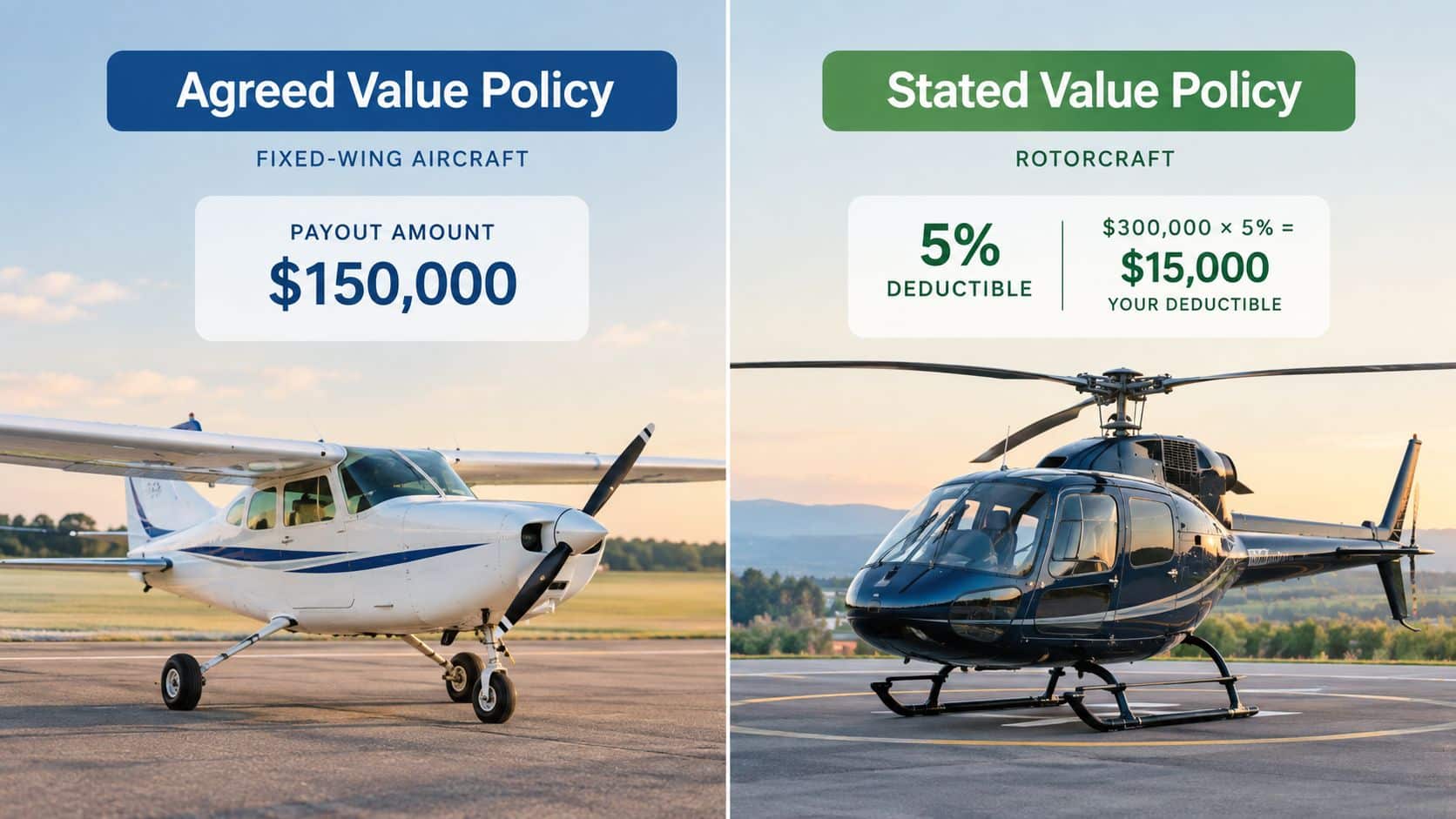
Policy structure determines how predictably an owner can recover after a covered loss. Agreed value sets the aircraft's value with the insurer before the policy begins. If a covered total loss occurs, the settlement generally uses that agreed amount, less the deductible, without a depreciation deduction. Marsh's agreed-value coverage explanation explains this structure.
A stated-value policy can produce a different result. The declaration page may show a figure, while the settlement still depends on the valuation wording, policy conditions, and evidence available after the accident. During procurement, ask the broker to show exactly how a partial loss, repair, and total loss would be valued.
Deductible design
A deductible is the operator's first repair bill under the policy. Aviation policies may tie it to the insured hull value instead of using one flat amount. Fixed-wing aircraft often use about 1% of hull value with a minimum deductible, while helicopters and higher-hazard operations may use 5% or even 10%. The actual amount must come from the quotation and policy wording, not from a general example.
| Aircraft operation | Common deductible pattern |
|---|---|
| Fixed-wing aircraft | About 1% of hull value, with a minimum |
| Helicopters or higher-hazard uses | 5% or 10% may apply |
That amount affects both premium and cash flow. A rental pilot should check whether the rental agreement transfers the deductible to the pilot. A flight school should explain the responsibility before dispatch, then record the explanation in its rental or checkout process.
Exclusions and conditions
Common limitations include wear and tear, corrosion, mechanical breakdown without resulting covered damage, intentional acts, unauthorized use, and operations outside the approved purpose. Pilot qualifications, approved uses, maintenance compliance, and required endorsements may also affect coverage.
For a school fleet, compare these conditions with daily operations. If students perform supervised solo flights, rental pilots use the aircraft, or maintenance delays return to service, the application and policy should describe those realities accurately. Rental agreements also need clear deductible language. Disclosure requirements can make that responsibility a formal contract issue, as reflected in aircraft insurance wording and rental disclosure material.
Underwriting Factors and Cost Drivers
Underwriters evaluate the aircraft and the way people use it. The same model can present a different risk depending on its age, insured value, maintenance history, pilot population, training role, operating environment, and frequency of use. A school aircraft used repeatedly for takeoffs, landings, maneuvers, and student practice creates a different exposure from an aircraft flown occasionally by a highly experienced owner.
Key considerations include:
- Aircraft age and condition: Older aircraft may require closer review of maintenance records, corrosion control, parts availability, and modification history.
- Hull value: A higher insured value increases the insurer's potential payment after a severe loss.
- Pilot experience: Total time, aircraft-specific experience, instrument qualifications, recurrent training, and claims history can affect underwriting.
- Training use: Student operations involve frequent cycles and supervised learning. The application should describe the actual use rather than a more favorable version of it.
- Terrain and airport environment: Mountainous terrain, busy airports, confined areas, and specialized helicopter operations can change the exposure.
- Maintenance history: Complete logs and documented inspections help the underwriter understand the aircraft's condition and maintenance discipline.
Premium share by coverage component
Hull coverage often dominates the premium because it protects the aircraft's physical value. An industry article places the historical hull share at about 65% to 75% of total aircraft insurance cost (EAA's aircraft physical damage insurance overview).
| Coverage Component | Percentage of Premium |
|---|---|
| Hull coverage | About 65% to 75% |
| Other policy components, including liability | Remaining share |
This table is a pricing benchmark, not a quote. Actual terms depend on the aircraft, operation, pilots, valuation, deductible, and underwriting information.
Helicopter owners and operators should also account for maintenance planning and component support. A school evaluating rotorcraft exposure may find it useful to review Robinson helicopter maintenance information alongside its insurance and dispatch procedures.
Special Considerations for Flight Schools Rentals and Helicopter Operations
A rental airplane can be repairable and still be unusable for the business. A student's hard landing may leave the aircraft waiting for inspection, parts, engineering approval, or a repair slot. During that period, the school may need to reschedule lessons, move students to another aircraft, delay a checkride, or absorb lost availability. Hull insurance addresses covered physical damage, but it doesn't automatically replace every revenue stream or training opportunity lost during downtime.
The operational cost of a grounded aircraft
Consider a training aircraft with a damaged landing gear after a landing incident. The hull claim may help fund the physical repair, yet the operator still needs answers about:
- Repair duration: Does the policy address delays, or only the physical loss?
- Substitute aircraft: Can the school use another aircraft, and who pays the added operating cost?
- Student scheduling: Will the student lose continuity before an instrument lesson or practical test?
- Rental obligations: Does the renter owe a deductible, administrative charge, or other amount under the agreement?
- Maintenance capacity: Is the selected facility equipped for the aircraft and its systems?
Most aircraft hull insurance discussions understate this gap between repairability and operational usability. Market commentary has highlighted rising claim severity and the importance of downtime for operators, particularly when parts and repair capacity remain constrained (Price Forbes' airline risk update).

A helicopter student faces additional questions about maneuvering, landing areas, component inspections, and the operation's approved use. Technical suppliers and maintenance organizations may also support rotorcraft manufacturers and operators. For general background, readers can review AAM's services for helicopter OEMs from American Additive Manufacturing.
For renters at a flight school, the aircraft's insurance structure should be reviewed before the first dispatch. DuBois Aviation provides aircraft rental at Chino Airport, where renters can ask how the school's agreements address deductibles, approved pilots, and damage reporting.
How to Obtain Coverage and Document Aircraft Condition
A coverage application should read like a clear preflight briefing. The insurer needs an accurate picture of the aircraft, its pilots, and its planned work. If a modification, training use, or regular pilot is omitted, underwriting may require clarification later, and a claim can take longer to resolve.
A practical procurement sequence
Gather aircraft records. Collect maintenance logs, inspection records, modification documents, component histories, registration details, equipment lists, and current hours. Organized records let an underwriter trace the aircraft's condition without guessing. They also help a repair facility determine what work is needed after a loss.
Describe the operation accurately. State whether the aircraft will be used privately, for rental, instruction, commercial activity, ferry flights, helicopter training, or another purpose. A flight school should describe dispatch patterns and student use plainly. Coverage that matches the schedule is easier to apply when an aircraft is damaged and removed from service.
List pilots and qualifications. Provide requested certificate, rating, flight-time, aircraft-experience, training, and claims information. A renter should confirm that the school's policy permits the intended operation and pilot status before accepting the aircraft.
Set a defensible hull value. The agreed value should reflect a realistic replacement or appraisal basis. A value set too low may leave a funding gap during repairs or replacement. A value set too high can increase cost and raise underwriting questions.
Complete the inspection and condition record. Photograph the airframe, propeller, landing gear, windscreen, paint, avionics, interior, and visible damage before coverage begins. Record squawks and equipment serial numbers. These images work like a before-flight walk-around, giving the owner, school, and insurer a shared reference if damage appears later.
Read the final wording. Check the deductible, approved uses, pilot conditions, exclusions, salvage provisions, notice requirements, and claim-reporting process. Tools that streamline insurance policy applications can organize the submission, but the applicant remains responsible for accurate information.
A practical condition checklist should cover:
- Airframe: Record dents, cracks, corrosion, leaks, and existing repairs.
- Paint and finish: Photograph fading, peeling, chips, and prior cosmetic damage.
- Avionics: Record installed equipment and serial numbers.
- Propeller and engine: Note hours, inspection status, and visible condition.
- Landing gear: Photograph tires, brakes, struts, and existing damage.
- Logs: Preserve current airframe, engine, propeller, and maintenance records.
- Aircraft use: Document who flies the aircraft and for what purpose.
DuBois Aviation's aircraft maintenance records resource helps students and renters understand why maintenance documentation matters. Rental agreements should also state who bears the deductible. Confirm that responsibility before dispatch, so a student or renter is not learning about the financial obligation after an incident.
Conclusion and Frequently Asked Questions
Aircraft hull insurance protects the aircraft, but effective protection depends on more than selecting a policy. The owner or operator must choose a defensible value, understand the deductible, disclose operational specifics, review exclusions, and plan for the possibility that repairs will ground the aircraft longer than expected. Agreed-value wording can reduce valuation disputes, while careful records make the aircraft's condition and use easier to verify.
Frequently asked questions
Does hull insurance automatically cover every ferry flight?
No. Coverage depends on the policy's approved uses, pilot conditions, aircraft condition, and any required notice or authorization. The operator should confirm ferry-flight terms before departure.
What should a student do after a partial-loss incident?
Protect people first, secure the aircraft, notify the flight school or owner, and report the event through the policy's required process. The student shouldn't authorize repairs or admit liability without guidance from the responsible operator and insurer.
Does hull insurance pay for lost training time?
Not automatically. Physical-damage coverage may address the aircraft repair, while downtime, substitute aircraft, business interruption, or rental-revenue issues may require separate wording or a different coverage structure.
How does hull coverage relate to a maintenance reserve?
Hull insurance responds to covered accidental damage under the policy. A maintenance reserve generally funds expected maintenance obligations, so it isn't a substitute for hull coverage or a guarantee that every repair invoice will be paid.
Can a repairable aircraft still create a major operational loss?
Yes. A parts delay, inspection requirement, or limited repair capacity can keep an aircraft unavailable even when restoration remains practical. Flight schools and rental operators should evaluate downtime exposure alongside the hull limit.
Students, renters, and career-track pilots can ask DuBois Aviation about aircraft availability, training operations, and the insurance responsibilities connected with rental and instruction. Visit DuBois Aviation to request training information, discuss course availability at Chino Airport, or schedule a school tour.


