
Incomplete or missing logbooks can cut a jet's market value by 20% to 50%, according to Aspen Aero Group's discussion of industry data from Camp Systems International. That single fact changes how pilots should think about aircraft maintenance records. These aren't just binders full of signatures. They are proof of airworthiness, proof of care, and in many transactions, proof of value.
For pilots who plan to rent, buy, sell, or operate airplanes and helicopters, the logbooks deserve the same attention as the engine, avionics stack, and paint. A clean airframe with weak records can become a hard sell. A rental aircraft with current inspections but sloppy discrepancy sign-offs deserves a closer look. And if you're trying to buy an airplane the safe way, the records are where the story starts.
Table of Contents
- Why Maintenance Records Are an Aircrafts Most Valuable Asset
- The Anatomy of Aircraft Maintenance Records
- How to Read and Interpret Logbook Entries
- A Buyers Guide to Spotting Logbook Red Flags
- The Renter Pilots Essential Logbook Check
- Best Practices for Owners and Flight Schools
- Your Ultimate Pre-Purchase Logbook Checklist
Why Maintenance Records Are an Aircrafts Most Valuable Asset
While engine time, panel upgrades, paint, and damage history usually drive the first round of buyer attention, the logbooks are what let anyone verify those claims. In practice, records influence price, insurability, dispatch confidence, and legal exposure long before a deal closes.
On a pre-buy, I have seen clean airplanes lose momentum fast once the paperwork starts falling apart. Missing entries force a buyer, mechanic, lender, or insurer to fill gaps with assumptions, and assumptions get expensive. Lower offers follow. Sometimes financing or coverage gets harder to place. Sometimes the aircraft stays on the market because nobody wants to inherit an unclear maintenance history.
That value loss is only part of the problem.
Records also establish whether the aircraft's airworthiness story holds together under scrutiny. A well-kept machine with poor documentation can still create serious trouble if no one can trace inspections, component changes, major repairs, or return-to-service entries with confidence. After an incident, those missing details stop being an administrative nuisance and start looking like liability.
For sellers, organized records shorten arguments and support the asking price. For buyers, they define how much risk sits behind the number on the listing. For renters, they provide a quick reality check on whether the operator appears disciplined or casual about maintenance control.
Practical rule: If the records do not clearly support the aircraft's history, treat the airplane as higher risk until a mechanic proves otherwise.
The strongest logbook sets tend to do several things well. They make valuation easier because the aircraft's history is easier to verify. They help mechanics confirm inspection and component status without reconstructing years of work from scraps. They also leave a clearer trail if a dispute shows up after a sale, an insurance claim, or an FAA inquiry.
Paper quality matters too. Older records are often scanned, emailed, or copied so many times that key signatures, dates, and part numbers are hard to read. Before a pre-buy, many owners and brokers now extract PDF text, tables, and images to make review faster and to catch missing pages before the aircraft goes under contract.
Experienced mechanics know this point well. We do not judge an aircraft by cosmetics alone, and we do not trust a verbal maintenance history without books that support it. In the market, good records help protect value. In the hangar, they help support safe decisions. In a dispute, they often become the first documents everyone asks to see.
The Anatomy of Aircraft Maintenance Records
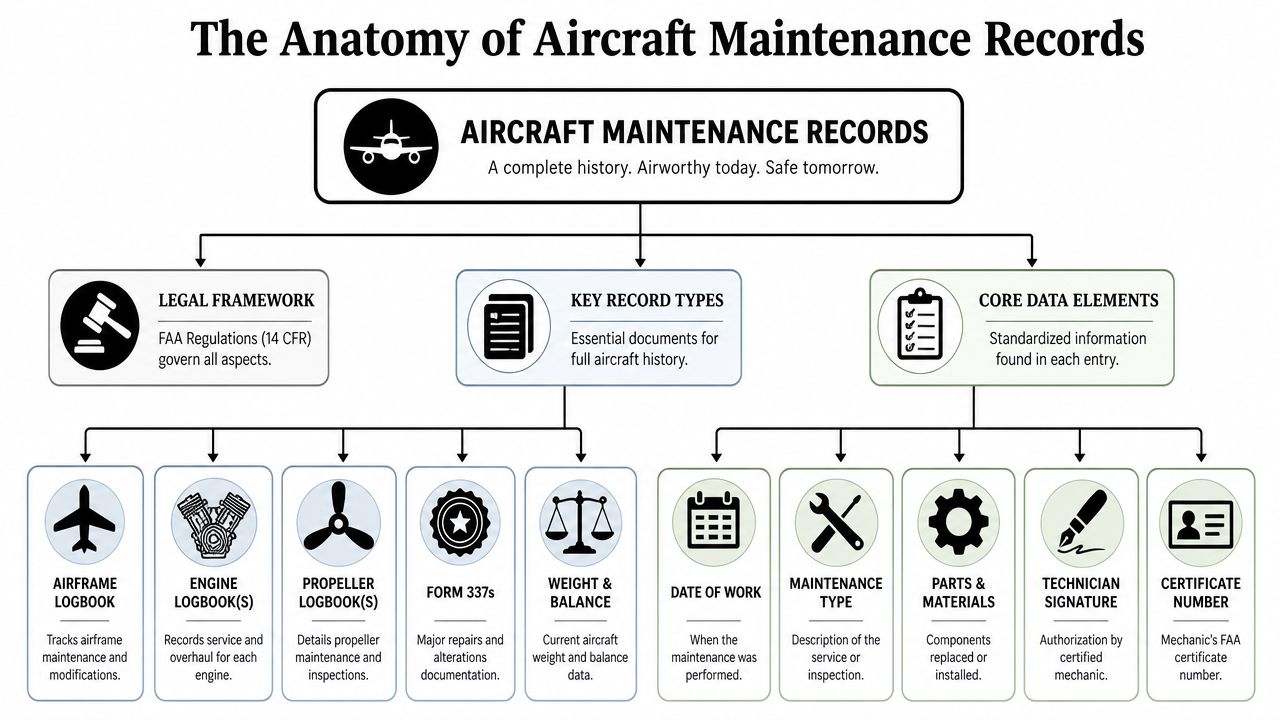
Aircraft maintenance records are part title history, part medical chart, and part legal file. If you don't know what belongs in the stack, it's easy to miss the page that matters most.
Under FAA retention rules discussed in relation to 14 CFR Part 91.417, records such as total time-in-service, life-limited part status, and major alterations documented on Form 337 must be kept for the life of the aircraft, while routine maintenance records generally only need to be kept for one year or until superseded. That split is one of the most important concepts in recordkeeping. Not every missing page is equally serious.
Permanent records versus temporary records
Permanent records stay with the aircraft because they answer long-range questions. What's the total time on the airframe, engine, propeller, or rotor system? What major repairs or alterations were made? What is the current status of life-limited parts? These are the records that future buyers, mechanics, lenders, and insurers care about.
Temporary records are still important, but they serve a shorter operational purpose. They document routine maintenance, preventive work, and minor repairs. If that work is repeated or replaced by later work, the FAA doesn't expect every short-lived entry to follow the aircraft forever.
A practical way to think about it is this:
| Record type | Why it matters | Typical retention role |
|---|---|---|
| Airframe, engine, propeller, or rotor time | Establishes service history | Long-term |
| Life-limited parts status | Shows replacement and remaining life tracking | Long-term |
| Form 337 major repairs and alterations | Documents structural or configuration changes | Long-term |
| Routine service entries | Supports recent maintenance traceability | Short-term |
What should be in the stack
A workable records package usually includes airframe, engine, and propeller logbooks. On helicopters, rotor system records take the same kind of importance. You should also expect to see Form 337s for major repairs or alterations, current weight and balance information, and supporting paperwork for installed equipment and maintenance actions.
Entries themselves should identify the date of work, what was done, the aircraft or component time as applicable, and the person authorized to approve the work. If you're reviewing scanned books, using a tool that can extract PDF text, tables, and images can make it much easier to search old entries, compare serial numbers, and flag missing forms before a mechanic starts the deeper review.
The best record sets are boring in a good way. They're orderly, legible, and easy to follow across years of ownership.
That kind of continuity tells you the operator took both maintenance and documentation seriously.
How to Read and Interpret Logbook Entries
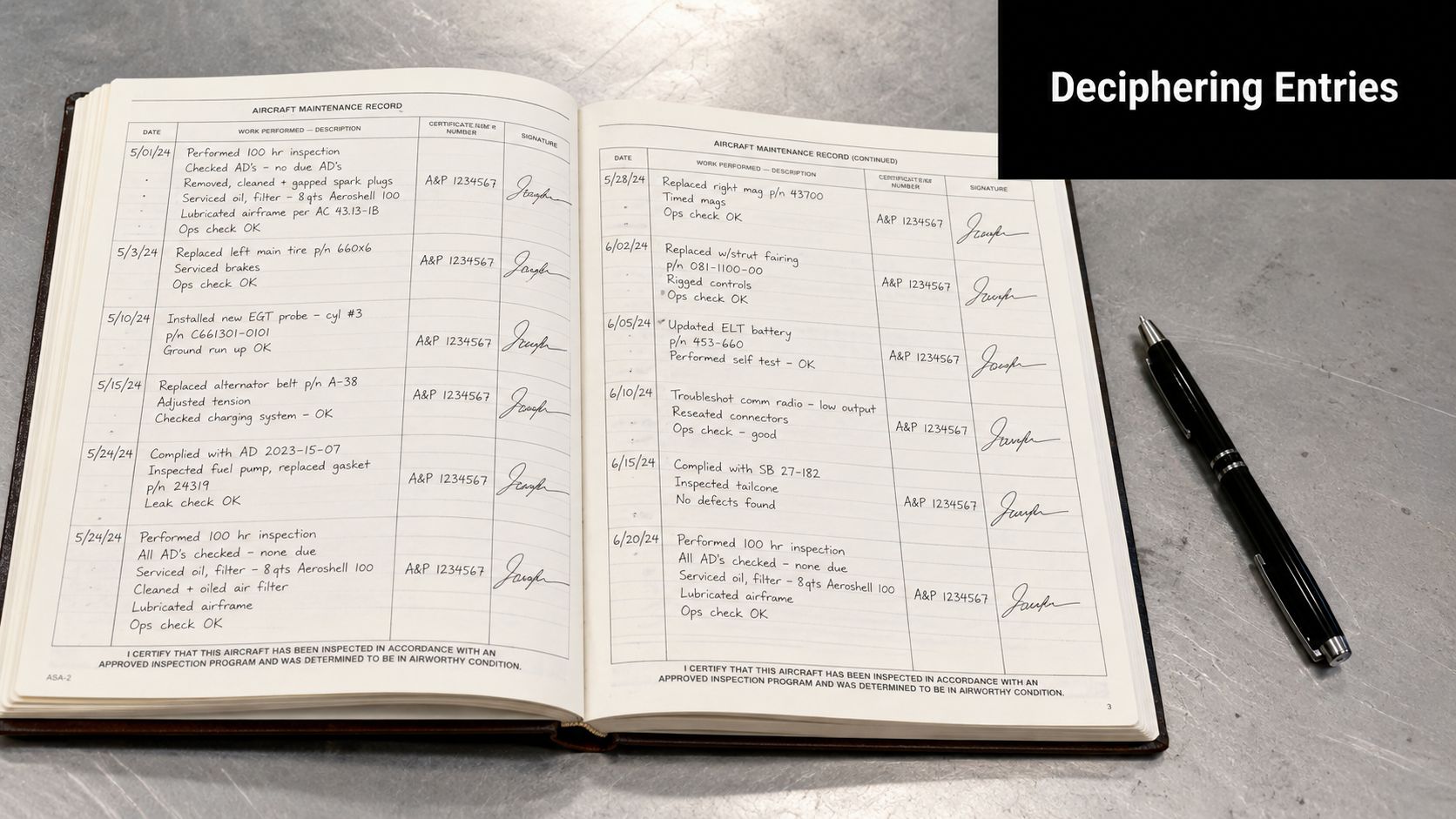
A logbook page shouldn't look like a wall of mystery text. Once you know what to hunt for, you can read it the way a mechanic does. You're looking for clarity, continuity, and evidence that required work was completed by someone with the right authority.
What a valid entry should show
At minimum, a useful maintenance entry tells you when the work was performed, what was inspected, repaired, replaced, or adjusted, and who signed it off. A vague line with no meaningful description may satisfy nobody when questions come later.
A strong entry is specific enough that another mechanic can pick up the trail. It doesn't need to read like a novel. It does need to identify the maintenance action clearly enough to show what was accomplished and what the aircraft's status became afterward.
Use this quick screen when reading any line item:
- Check the description: It should say more than “fixed issue” or “serviced aircraft.”
- Check the approval: The sign-off should identify the mechanic or authorized person.
- Check consistency: The aircraft time and sequence of entries should make sense from one page to the next.
If you're flying rented aircraft, it also helps to understand what related systems require documented compliance outside the basic engine and airframe flow. For example, transponder and altimeter-related records often tie into broader inspection discipline, and that's why pilots who want a better grasp of dispatch readiness often review maintenance topics like pitot static system testing alongside the logbooks.
The entries that matter most
The most important items are usually the ones tied directly to legal airworthiness. According to Sofema Aviation Services, Continuing Airworthiness Records must include the current status of all Airworthiness Directives with specific method-of-compliance details, and any unaddressed AD makes the aircraft legally non-airworthy. The same source notes that maintenance organizations must keep copies of release documentation for at least three years.
That means “AD complied with” isn't enough if the entry leaves out how compliance was achieved or whether recurring action is due again. The wording has to support the aircraft's actual status.
Other entries that deserve close attention include:
- Service Bulletin references: These may affect reliability, future maintenance planning, or buyer confidence.
- Form 337 mentions: Any note about a major repair or alteration should match an actual 337 in the file.
- Component changes: Serial numbers, part changes, and overhaul references should align with the component books.
If an entry raises more questions than it answers, don't treat it as harmless shorthand. Treat it as a lead.
That mindset keeps buyers from assuming, renters from rushing, and owners from discovering documentation problems only after a deal or claim goes sideways.
A Buyers Guide to Spotting Logbook Red Flags
Buying an airplane or helicopter safely starts long before the test flight. It starts at a table with records spread out, a flashlight on the wing, and a mechanic willing to be skeptical. The cleanest pre-buy inspections combine physical inspection with disciplined logbook review. One without the other leaves blind spots.
A key document many buyers skip is the run out sheet, also called a due list. As discussed in this industry video on run out sheets and maintenance program access, it lists scheduled maintenance items, intervals, and due dates, and it's separate from the historical logbooks. That matters because the books tell you what happened. The run out sheet tells you what's about to cost you money.
What makes an A and P stop and ask questions
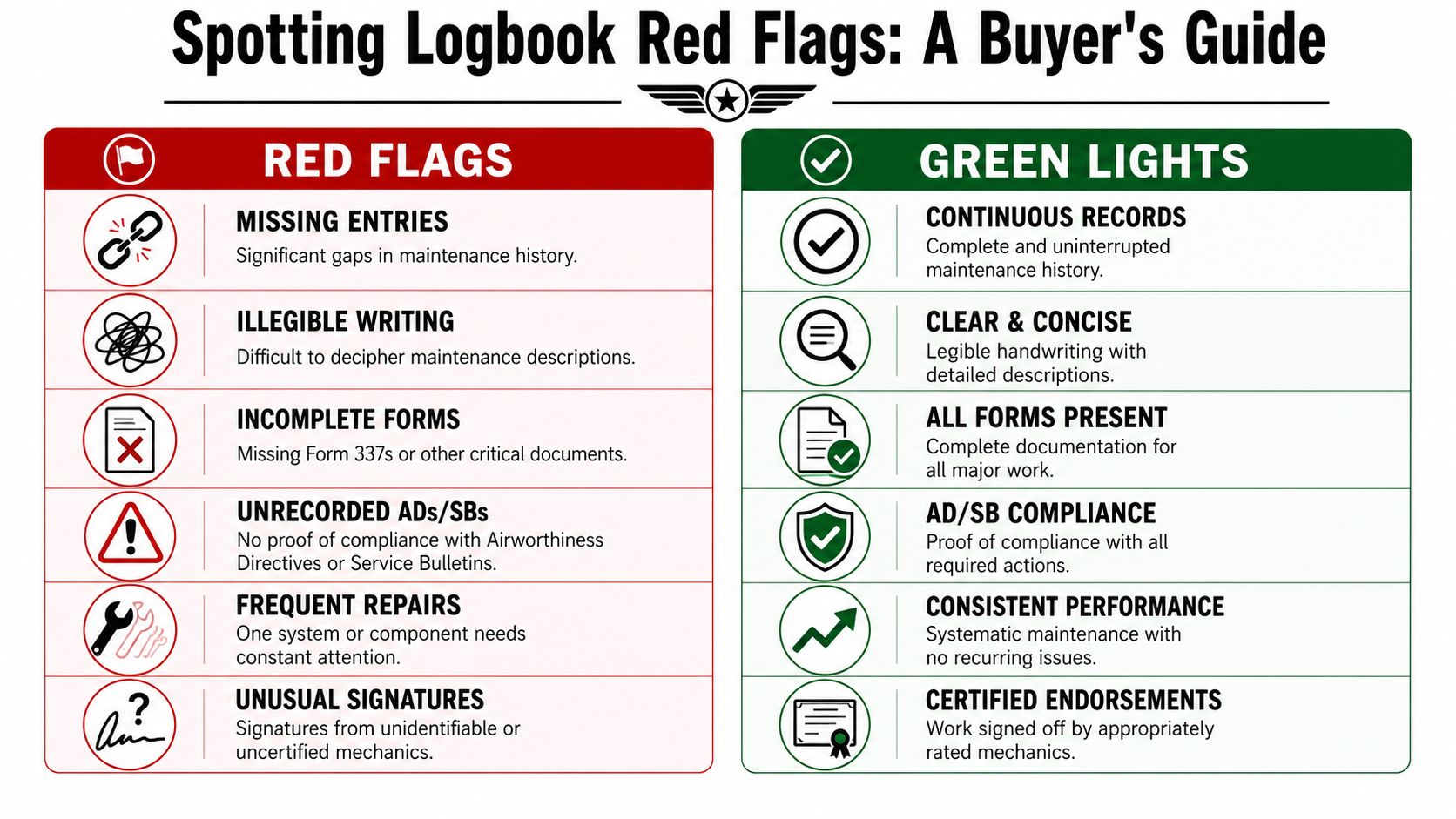
The first red flag is a gap. Missing months may be explainable. Missing years usually aren't. If the aircraft changed hands, sat idle, or went through a rebuild, there may be a story behind it, but the paperwork still has to support the story.
The second red flag is handwriting or wording that hides more than it reveals. Experienced mechanics know the difference between concise and evasive. “Repaired as necessary” is weak. “Inspected, removed, replaced, tested, and returned to service” is stronger only if it identifies the actual work and affected component.
Buyers should also be alert for recurring fixes to the same system. One alternator issue over a long period may be ordinary. Repeated entries pointing to the same electrical problem, rigging complaint, brake issue, or cylinder concern can tell you the aircraft has a pattern, not an isolated event.
A practical pre-buy review usually includes these checks:
- Time continuity: Match airframe, engine, and propeller times across entries and inspections.
- Damage traceability: If a repair is referenced, look for the supporting 337 or detailed paperwork.
- Signature legitimacy: Make sure the sign-offs identify someone whose authority is clear.
- Book integrity: Watch for pages inserted out of sequence, photocopies with no originals, or records that seem reconstructed.
Why the run out sheet matters
The run out sheet is where buyers stop thinking only about history and start thinking about ownership. An aircraft can have decent historical records and still carry a stack of near-term inspections, component limits, or recurring actions that hit right after closing.
That's especially important for helicopter buyers, because component scheduling and life-limited tracking can make the next phase of ownership look very different from what the ad suggested. A seller may present “fresh annual” as reassurance. The run out sheet may show a different reality if several scheduled items are due soon after delivery.
A safe purchase isn't just about proving what was done. It's about understanding what will come due next.
If you're serious, have a mechanic go beyond a quick skim. Buyers on this Pilots of America discussion about buying a plane also point out that you can spend $10 at the FAA registry website to obtain the aircraft's registration history, including Form 337 entries, liens, loan history, and prior ownership details. That external cross-check often reveals whether the stack in front of you is complete enough to trust.
And don't underestimate the labor involved. A pilot discussion on r/flying about buying an airplane notes that a mechanic may spend about 6 hours digging through the books during a pre-buy. That sounds like a long time until you compare it with the cost of discovering a logbook problem after the sale.
The Renter Pilots Essential Logbook Check
Renters don't need to conduct a pre-purchase audit. They do need to confirm that the aircraft they're about to fly is properly released, current where it needs to be current, and free of unresolved discrepancies that should ground it.
What to review before you take the keys
Start with inspection currency. The exact documents and format vary by operator, but the principle doesn't. Confirm that required inspections are current and that the aircraft's in-service time hasn't rolled past the next due point without action.
Then read the discrepancy flow, not just the dispatch sheet. If the previous pilot wrote up a squawk, make sure there's a proper sign-off, deferral, or grounding action that makes sense. “Known issue” isn't a release to service.
A short renter checklist looks like this:
- Inspection status: Verify the aircraft is current for the inspections required for its operation.
- Open squawks: Read the write-up and the corrective action, not just the summary line.
- Time due items: Compare current Hobbs or tach with any posted due lists or maintenance status sheets.
When to walk back into the office
If the paperwork is incomplete, unclear, or inconsistent, stop. Ask. A good rental operation won't resent the question. They'll respect it.
The same goes for helicopters. Renters and club pilots sometimes assume the operator has the paperwork covered, and usually that's true. But pilots still have a duty not to launch with unanswered airworthiness questions. A two-minute check can prevent a bad dispatch decision.
Best Practices for Owners and Flight Schools
Owners and flight schools live with the long-term consequences of every maintenance entry. The work may be done correctly, but if the records are sloppy, the organization still absorbs the risk later during audits, sales, incidents, and insurance reviews.
One overlooked problem is wording. As noted in this discussion of why aircraft maintenance records matter in sales and liability, many guides explain the FAA rules but don't connect vague or inconsistent logbook entries to civil liability or insurance claim denials. That's the part operators ignore at their own expense.
Paper records versus digital control
Paper logs still matter because originals carry weight and many legacy records exist only on paper. But paper alone is fragile. Pages get lost, coffee gets spilled, and old handwriting doesn't become easier to read with age.
Digital systems help with indexing, backup, and retrieval. They also make it easier to hand a buyer, lender, or mechanic a clean package instead of three mixed boxes and a promise that “everything is in there somewhere.” For organizations managing larger fleets or maintenance-heavy operations, principles used to secure IT operations with CMMS are useful because they emphasize controlled workflows, audit trails, and repeatable documentation habits.
A balanced approach usually works best:
| Approach | Strength | Weak spot |
|---|---|---|
| Paper originals | Historical authenticity | Vulnerable to loss and poor organization |
| Scanned archives | Easy sharing and backup | Depends on scan quality and indexing |
| Structured digital tracking | Fast search and due control | Requires disciplined data entry |
Flight schools and helicopter operators also benefit from keeping maintenance process visibility close to the operational side. Teams involved in dispatch and upkeep often build better continuity when they understand the standards expected in specialized work such as Robinson helicopter maintenance.
Write entries like they may be read in court
That isn't paranoia. It's professional discipline.
Entries should be clear, specific, and complete enough that another mechanic, inspector, owner, or attorney can understand what was done and what airworthiness conclusion followed. Shortcuts in wording may save a minute today and cost months later.
Good documentation is part of the maintenance, not the paperwork that happens after the maintenance.
The operators with the fewest record problems usually follow simple habits. They standardize terminology, review sign-offs before the aircraft leaves, and keep supporting documents filed where someone else can easily find them.
Your Ultimate Pre-Purchase Logbook Checklist
A safe aircraft purchase is a sequence, not a moment. You ask for records early, review them before emotions take over, and use the physical inspection to confirm that the paperwork matches the machine. That applies whether you're buying a trainer, a cross-country piston single, or a helicopter.
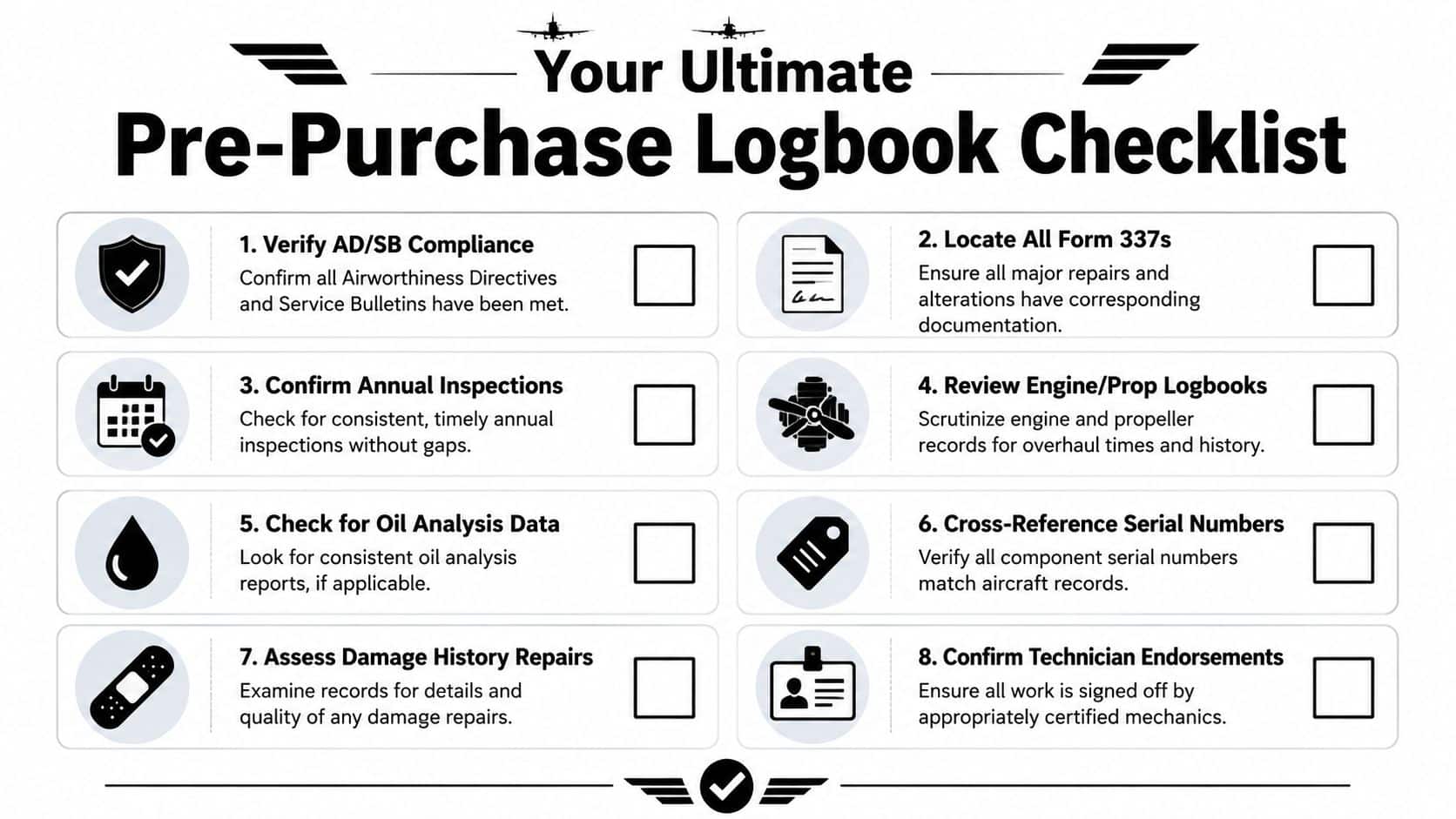
AOPA's guidance on buying a used aircraft is clear that a thorough pre-purchase inspection should include a differential compression check on each cylinder and a close review of Form 337s, AD compliance, service bulletin status, and component serial numbers in the logbooks. If a seller discourages that level of review, that by itself is useful information.
Before you travel to see the aircraft
Ask for scanned logs, current status sheets, and a list of installed equipment before spending money on travel. If the seller can't produce organized records, assume the in-person review won't get easier.
Also think about data handling. Aircraft sale files often include personal information, registration history, and financial records, so a basic understanding of understanding data privacy solutions helps buyers and sellers share documents more carefully during the transaction.
Use this early screening list:
- Request the complete record set: Airframe, engine, propeller, rotor-related, and supporting forms.
- Ask for current status information: Inspection status, AD status, and due items.
- Confirm document quality: Legible scans save time and reveal the true organization of the books.
At the inspection table and on the hangar floor
You compare story to evidence. If the seller says “no damage history,” the books and the airframe should agree. If the seller says “up to date on everything,” the due lists and compliance entries should support that claim.
Focus on these points:
- Verify AD and service bulletin status: The list should be current and traceable.
- Locate all Form 337s: Any major repair or alteration should have paperwork to match.
- Cross-check serial numbers: Components installed on the aircraft should match the records.
- Review engine and propeller history: Look for continuity, overhaul references, and unexplained changes.
- Assess repairs carefully: A repaired aircraft isn't automatically a bad aircraft. An undocumented repair is.
If you're joining a shared ownership or rental-style community after purchase, it also helps to understand how clubs manage dispatch, scheduling, and pilot use standards. Reviewing how organizations like the Yellow Jacket Flying Club present aircraft access and pilot expectations can sharpen your own questions about operational recordkeeping and stewardship.
Questions for the mechanic doing the pre-buy
Don't ask only, “Would you buy it?” Ask narrower questions that force concrete answers.
- Where are the documentation gaps?
- Which entries concern you and why?
- Do the physical findings match the books?
- What is likely to come due soon based on the records you reviewed?
- Would you want more documents before closing?
The best pre-buy mechanics don't just inspect the aircraft. They reconcile the aircraft with its paper trail.
That's how to buy an airplane the safe way. The same standard applies if you're shopping for a helicopter. Trust records that are complete, coherent, and easy to verify. Treat confusion as cost, because that's exactly what it becomes after the sale.
If you want flight training, aircraft rental, or guidance from a team that works in the actual world of pilot decision-making every day, DuBois Aviation offers airplane and helicopter instruction, rental access, and a practical training environment at Chino Airport that helps pilots build good habits from the start.


