

You're probably in one of two spots right now. Either you're staring at a logbook entry and wondering whether the pitot static test is still current, or you're flying behind instruments often enough that you want to know what the shop is doing when the aircraft goes down for inspection.
That's a smart question to ask. In visual conditions, a small error in the pitot-static system might show up as a nuisance. In instrument conditions, that same error can subtly corrupt the three instruments pilots depend on most: airspeed, altitude, and vertical speed. For a rental fleet, that matters because high cycle use exposes more opportunities for moisture, loose fittings, damaged port seals, and rushed handling. For a private owner, it matters because these systems often get ignored until a due date or a squawk forces attention.
Pitot static system testing transitions from abstract regulation to practical maintenance. The best operators treat it as both a compliance event and a systems check that reveals how the airplane will behave when the pilot needs it most. That includes certified aircraft, experimental aircraft with their own regulatory wrinkles, and aircraft changing hands during a sale.
Table of Contents
- Why IFR Safety Starts on the Ground
- Pre-Test Prep and Required Equipment
- Performing the Pitot and Static System Checks
- Interpreting Results and Fixing Common Faults
- Logbooks Records and Recurrent Training
- Buying an Airplane The Safe Way
Why IFR Safety Starts on the Ground
A pilot can be on a stable instrument approach, fully configured, power set, scan under control, and still be working from bad information if the pressure system isn't accurate. That's what makes pitot-static integrity different from cosmetic maintenance. The pilot doesn't have an outside visual reference to cross-check. The airplane can feel normal while the instruments drift in the wrong direction.
That's why the FAA treats this as a hard calendar item, not a suggestion. Under 14 CFR § 91.411, the pitot-static system and altimeter instrument must be tested and inspected within the preceding 24 calendar months for aircraft operating under IFR in controlled airspace, and that requirement also applies to aircraft with installed transponders, as summarized by the EAA explanation of transponder and pitot-static tests.
The safety logic is straightforward. Pressure instruments don't need a dramatic failure to become dangerous. A small leak, moisture in a line, a damaged static port seal, or contamination in the pitot tube can distort indications enough to change pilot decisions during climb, descent, or approach.
Practical rule: If you fly IFR, track the 91.411 due date with the same discipline you use for annuals and required inspections. Waiting until a checkride, a trip, or a weather day is how airplanes get grounded at the worst time.
Modern panels don't change that. A glass panel still depends on reliable pressure inputs, just as legacy instruments do. The presentation may be cleaner, but the underlying system is still vulnerable to the same plumbing issues that affect older airplanes. If you're comparing avionics presentation styles, the difference between displays and underlying air data becomes clearer in this look at glass cockpit vs steam gauges.
What owners often miss
The regulation is easy to reduce to paperwork, but the fundamental issue is trust. When a pilot enters cloud, the aircraft's pressure instruments become the substitute for outside vision. If the airplane's static system leaks beyond tolerance, or if the altitude reporting side is out of spec, that trust breaks.
For owners and renters, the practical takeaway is simple:
- Know the due date: Check the logbooks before an IFR trip, not after.
- Treat squawks seriously: Unusual altitude, airspeed, or VSI behavior deserves follow-up.
- Don't separate compliance from safety: The legal requirement exists because these errors can become flight path errors.
Pre-Test Prep and Required Equipment
Good pitot static system testing starts before any pressure is applied. Poor setup, not a complicated defect, causes a lot of failed or misleading tests. In the shop, I see the same preventable problems over and over: the wrong adapter on the port, a hose with contamination in it, an alternate static source left in the wrong position, or a technician chasing a leak that is just a bad connection at the test set.
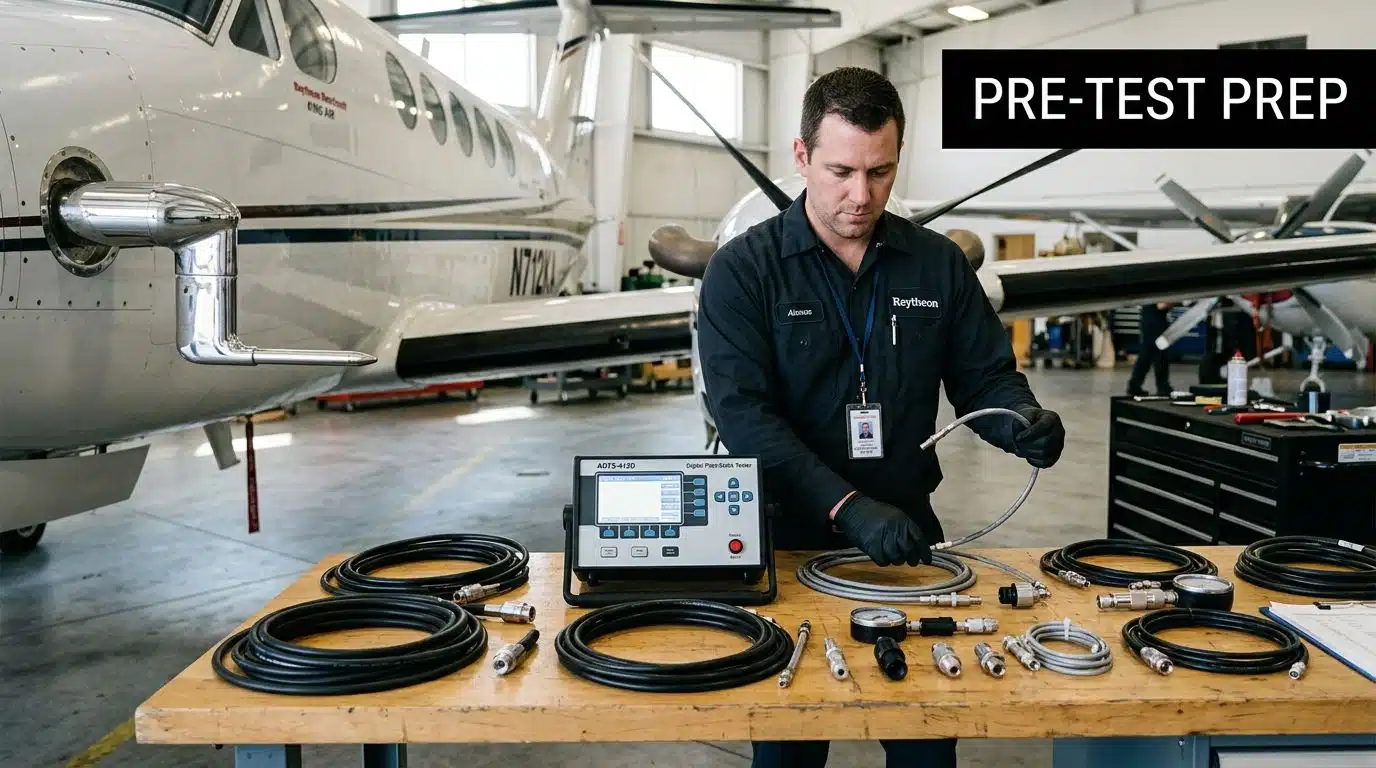
The inspection starts with your eyes
Start at the airplane, not the tester.
Before connecting anything, inspect the pitot tube, static ports, visible plumbing, and instrument area for obvious defects. A visual check catches the problems that waste the most time later. Insect nests in parked trainers, paint or wax partly covering a static port, moisture in low spots, and loose fittings behind the panel are all common on aircraft that fly often and get handled by a lot of different people.
Flight school and rental airplanes deserve extra suspicion here. They sit outside more, get washed more, use pitot covers more, and see more hurried preflights than a privately owned hangared airplane. That does not mean the system is unreliable. It means the prep has to be consistent.
Use a deliberate walkaround and inspection routine:
- Pitot tube condition: Check for insects, tape residue, dents, loose mounting, missing or damaged drain provisions, and any sign the cover was forced on or removed carelessly.
- Static port condition: Look for dirt, wax, paint buildup, damaged edges, cracked sealant where applicable, or skin deformation around the port.
- Accessible line routing: At service panels or under the panel, look for unsupported tubing, rubbing, kinked lines, brittle hoses, or signs of past repairs.
- Instrument and fitting condition: Older airplanes often leak at instrument case fittings, encoder connections, or aging plastic line junctions rather than at the external ports.
If you find a clear defect, fix that first. A certification test is not the place to prove a damaged system is still "close enough."
The equipment has to match the airplane
The heart of the job is a calibrated pitot-static test set, but the test set alone does not make the result valid. The rest of the setup matters just as much: correct adapters, clean hoses, serviceable seals, caps or plugs if the procedure calls for them, and the aircraft maintenance data for that make and model.
That last item gets skipped too often. General test habits are useful, but aircraft-specific instructions keep you from introducing damage, isolating the wrong part of the system, or missing details such as multiple static sources, standby instruments, alternate static valves, or air data computers that need a certain configuration before testing.
A practical bench and cart setup should include:
- A current, calibrated digital tester suitable for pitot, static, and transponder/encoder work if you are doing the full 91.411 and 91.413 package.
- Aircraft-specific adapters that seal correctly without distorting the port or pitot opening.
- Clean, dry hoses and fittings reserved for this work, not shop air odds and ends pulled from a drawer.
- Protective caps, plugs, and seals required by the approved procedure or manufacturer instructions.
- The maintenance manual, ICA, or approved test instructions open during the setup, not recalled from memory.
- Basic lighting and inspection tools so you can verify port condition and plumbing before the first pressure change.
One bad seal can make a healthy airplane fail.
Setup mistakes that create bad results
The common errors are simple, and they show up in both owner-assisted maintenance and busy avionics shops.
- Wrong adapter selection: A universal fitting that almost fits is a leak source waiting to happen.
- Dirty or moisture-contaminated hoses: The test equipment can introduce contamination into a clean aircraft system.
- Skipping configuration checks: Alternate static left open, standby instruments left connected when they should be isolated, or multiple system branches not accounted for.
- No reference to aircraft data: The sequence and limits can differ enough to matter, especially on newer panels and some experimental installations.
- Testing through known damage: A bent static port, cracked line, or loose fitting should be repaired before any certification attempt.
Experimental aircraft add another layer. The test principles are the same, but the installation may not match the routing, fittings, or instrument combination a technician expects from a factory trainer. Homebuilt panels often mix legacy instruments, EFIS displays, and nonstandard plumbing runs. That makes pre-test inspection more important, not less.
For buyers, this section matters during a pre-purchase inspection too. If the airplane is advertised as IFR capable, inspect the pitot-static system with the same seriousness you would give the engine logs or corrosion survey. A current signoff helps, but it does not replace looking at the actual ports, tubing condition, and panel installation quality. On a hard-used trainer or rental fleet airplane, that close look often explains why the next certification is easy or why it turns into a troubleshooting session.
Performing the Pitot and Static System Checks
The airplane is on the ramp at 7 a.m., the owner wants to launch IFR by lunch, and the altimeter/transponder check is due this month. This is the point where a careful, methodical test matters. A pitot-static check is a controlled simulation of flight pressures. Done correctly, it confirms the system can hold pressure, respond predictably, and support the instruments and avionics that depend on it.
For rental fleets and flight school airplanes, I pay extra attention to repeat-use wear. Ports get bumped during washing, hoses get stressed behind the panel, and adapters see more connect and disconnect cycles than they do on a privately flown weekend airplane. On a pre-purchase inspection, the same test can tell you whether an airplane has only stayed current on paperwork or whether the system is truly in good shape.
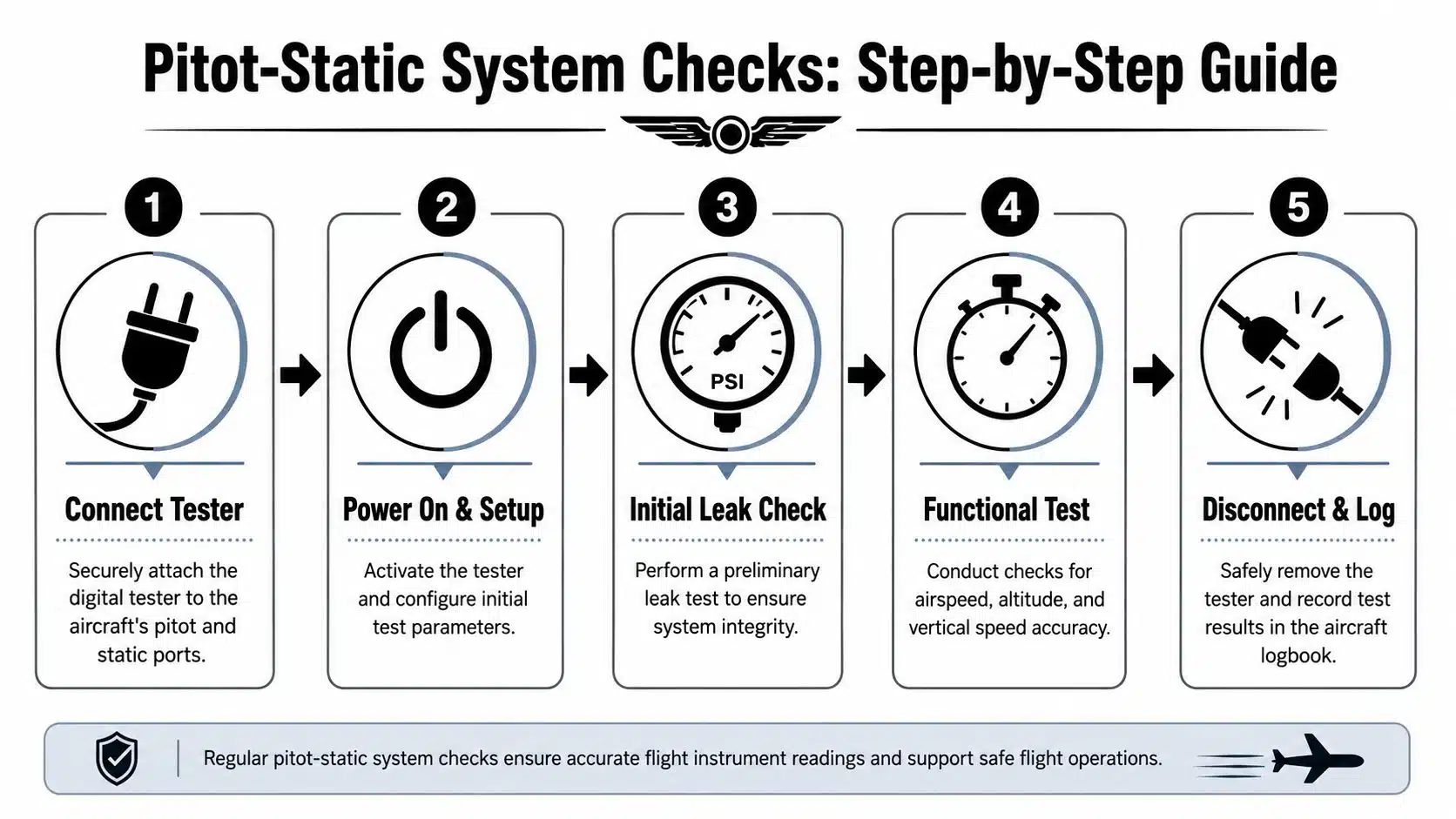
Start with the static side
I start on the static side because that system touches more than many owners realize. It feeds the altimeter and VSI directly, and it also provides the static reference for airspeed. If the static side is wrong, several indications can be wrong together.
A practical sequence looks like this:
Connect the tester with the correct adapters
Use fittings that match the aircraft's ports and seals. A bad adapter setup can waste half an hour and make a healthy airplane look leaky.Verify the aircraft configuration
Confirm alternate static is in the expected position, standby instruments are accounted for, and any branch plumbing is identified before you apply a pressure change.Establish the test point slowly
Bring the static system to the specified simulated altitude called for by the procedure you are using. On many unpressurized aircraft, the check is commonly run at 1,000 feet above ambient. Slow changes reduce the chance of instrument damage and make it easier to catch setup problems early.Isolate and hold
Once the system is stabilized, place the equipment in leak test mode or isolate the applied condition as the tester requires. Watch for drift, not just an immediate jump.Compare the result to the allowed tolerance
For an unpressurized aircraft, Appendix E to 14 CFR Part 43 sets the static system leakage limit at 100 feet in 1 minute. For pressurized aircraft, the allowable loss is 100 feet or 2 percent of cabin differential pressure altitude, whichever is greater, in 1 minute, under the same appendix: https://www.ecfr.gov/current/title-14/chapter-I/subchapter-C/part-43/appendix-Appendix%20E%20to%20Part%2043
Here is the quick reference I give new owners and instrument students:
| Aircraft Type | Maximum Allowable Leak |
|---|---|
| Unpressurized aircraft | 100 feet in 1 minute |
| Pressurized aircraft | 100 feet or 2% of maximum differential altitude, whichever is greater, in 1 minute |
Pressurized airplanes need more than a generic shop habit. The test point is tied to the aircraft's approved limits, and the wrong setup can give you a result that looks valid but is not.
If you are new to the subject, it helps to understand how the system references altitude in the first place. A short review of pressure altitude and how static pressure relates to indicated altitude makes the leak test logic easier to follow.
Then check the pitot side
The pitot side is checked by applying pressure that corresponds to airspeed and confirming the indication tracks correctly. The exact points and tolerances depend on the installed equipment and the approved test procedure. A basic trainer with round gauges is one thing. A glass-panel airplane with an air data computer, standby instruments, and multiple branches is another.
What I watch for in the shop is behavior. Does the indication come up smoothly, or does it lag and then jump? Does it hold steady at a test point, or does it bleed off? Does one display agree with the standby instrument, or is one side telling a different story?
Those details matter more on high-use fleet aircraft. Moisture in the pitot line, a partially restricted mast drain, or a fitting behind the panel that was disturbed during avionics work can create an intermittent complaint that only shows up during a hold. Quick sweeps through the numbers miss that.
If the indication looks right only while the tester is actively driving pressure, the system still needs work.
Who can perform the test
For aircraft operated under IFR, the inspection and test requirements come from 14 CFR 91.411. That regulation also identifies who may perform and approve the work: the manufacturer, a properly certificated repair station, or a certificated mechanic holding an airframe rating if the work is within that mechanic's authority: https://www.ecfr.gov/current/title-14/chapter-I/subchapter-F/part-91/section-91.411
Experimental and amateur-built owners often encounter difficulties. The airplane category does not erase the IFR inspection requirement if the aircraft is operated where 91.411 applies. The installation may be custom, the plumbing may be different from a certified trainer, and the panel may mix EFIS equipment with older backup instruments. The test still has to be done correctly, and the person signing it off still has to be authorized to do so.
For private owners, the practical question is simple. Before booking the work, confirm both the technical standard and the approval path for that specific aircraft. For flight schools and rental operators, standardizing that process across the fleet saves money because the shop spends time testing, not sorting out configuration surprises on the day of inspection.
Interpreting Results and Fixing Common Faults
A failed test result is useful. It narrows the search. What wastes time is treating every leak like a mystery inside the wing or every bad airspeed check like an instrument overhaul problem. Most faults come from ordinary places: seals, fittings, contamination, moisture, and damaged components at the ends of the system.
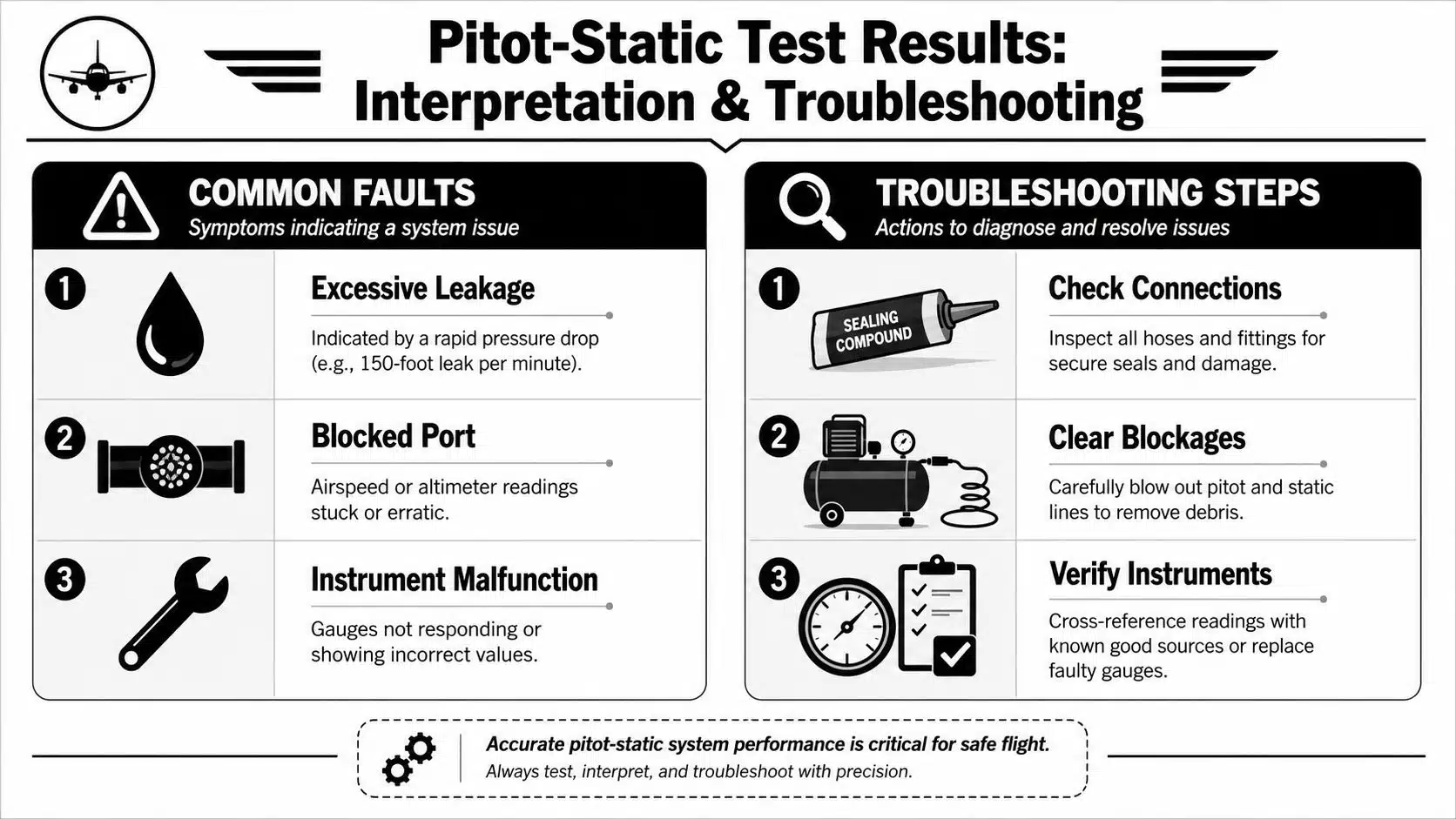
What a failed leak check is telling you
If an unpressurized aircraft loses more than 100 feet during the one-minute hold, it didn't miss by a little. It failed the tolerance. The next step isn't rerunning the same test repeatedly and hoping for a better number. The next step is isolating the leak path.
A practical diagnostic order usually saves time:
- Connections first: Test setup leaks are common. Recheck adapters, hose ends, and seals.
- External ports next: Static port seals, mounting surfaces, or contamination can create obvious problems.
- Behind the panel: Loose B-nuts, aging tubing, and brittle O-rings often hide there.
- Instrument side: Older altimeters, VSIs, or related fittings can leak internally or at the case connection.
One of the most common maintenance errors is poor sealing during connection, especially when a technician is using a drain or tee connection and hasn't isolated the system properly. That can spoil the integrity of the test and lead you toward the wrong repair.
Why alternate static deserves its own test
Alternate static systems get too little attention. Pilots often think of them as a simple backup path with no meaningful instrument consequence. That's a bad assumption.
A key issue with alternate static use is that instrument indications can shift in a direction that increases risk. Testing often reveals that altimeters read slightly high, which means the aircraft may be lower than indicated, and airspeed indicators read higher than actual speed. That error pattern is described in Pilot John's discussion of alternate static system testing and instrument error.
That matters most during approach, climb near terrain, or any abnormal procedure where the pilot has already lost some confidence in the airplane.
Alternate static isn't just a backup switch. It changes what the pilot sees, and the pilot needs to know the direction of that change before an emergency makes the decision for them.
If the airplane has an alternate static source, test it intentionally and brief it in training. Don't leave it as a line item nobody discusses.
Common fault patterns in the real world
Pitot-static faults usually leave clues if you look at the symptom instead of jumping straight to parts replacement.
- Erratic or stuck indication: Start by checking for blockage or moisture.
- Slow response: Look for partial obstruction, water, or a restricted fitting.
- Repeat leak failures after reconnection: Suspect adapter sealing, damaged tubing, or an instrument case leak.
- Normal primary static behavior but odd alternate static behavior: Inspect the alternate source plumbing and valve arrangement specifically.
A lot of “instrument problems” turn out to be plumbing problems. And a lot of “line problems” turn out to be contamination problems.
If you need a better conceptual grasp of why these static-source errors affect what the altimeter shows, this explanation of what pressure altitude is helps connect the maintenance side to the cockpit side.
Logbooks Records and Recurrent Training
A clean test without a clean record isn't complete. The airplane needs a proper maintenance entry, and the operator needs a tracking method that won't let required dates drift out of view. In a flight school or rental environment, sloppy records create two problems at once. They expose the operator to compliance risk, and they train renters to think required inspections are bookkeeping trivia.
What belongs in the records
The logbook entry should clearly identify what was tested, when it was tested, and who performed the work. It should also state the result in plain language. Ambiguous wording causes trouble later during sales, checkrides, audits, and maintenance reviews.
For fleet operators, the bigger issue is system discipline. Calendar-based requirements are easy to miss when aircraft are flying every day and dispatch is focused on availability. The answer isn't heroic memory from one chief instructor or one mechanic. The answer is a recurring tracking method that flags upcoming due items early enough to schedule work without disrupting the fleet.
A professional operation treats this as part of dispatch readiness, right alongside other required records.
Why flight schools should teach from the maintenance event
This inspection is also a teaching opportunity. Renters and instrument students should know what the pitot-static system feeds, what common failures look like, and what alternate static can do to indications in actual use.
That training doesn't need to become an A&P school lecture. It just needs to be practical:
- Review failure modes: Explain what blocked pitot, blocked static, and static leaks do to the instruments.
- Discuss cockpit response: Cover when a pilot should suspect a system problem and how to cross-check.
- Brief alternate static use: Make sure pilots understand the indication bias before they need it.
- Tie it to legal readiness: Students working on instrument privileges should understand how required inspections support legal IFR operations and recurrent proficiency, which connects naturally with IFR currency requirements.
Good records protect the operator. Good training protects the pilot. The strongest safety culture does both at the same time.
For private owners, the same principle applies on a smaller scale. Keep a maintenance summary, know your due dates, and brief yourself on system quirks after any repair or test. A logbook isn't just proof for the FAA. It's the memory of the aircraft.
Buying an Airplane The Safe Way
You are standing on the ramp with a seller who swears the airplane is "IFR ready." The panel is clean, the paint shines, and the radios light up. Then you open the logs and find an overdue altimeter and transponder check, a vague write-up on a static leak repair, or no clear record of who signed off the last pitot-static test. That is where a good deal starts to change shape.
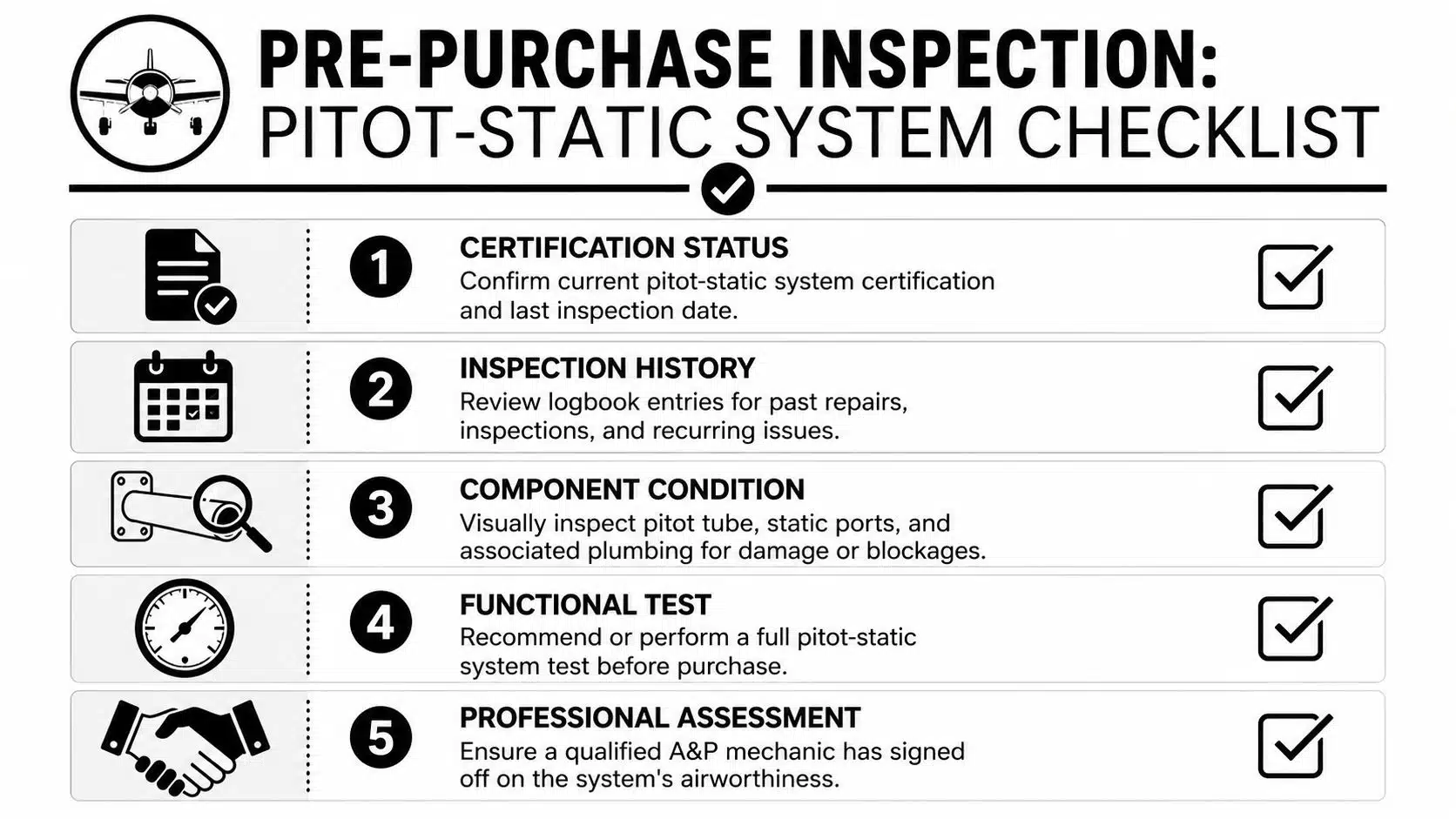
For a private owner, that may mean unexpected catch-up maintenance right after closing. For a flight school or rental fleet, it can mean immediate downtime on an airplane that needs to earn its keep. On a high-use trainer, an out-of-date pitot-static inspection is rarely an isolated paperwork miss. It often points to a maintenance program that is reacting late instead of staying ahead.
Start the buying process in the records, not at the spinner. The FAA's Airplane Flying Handbook discussion of preflight and airworthiness responsibility is a good reminder that legal and safe operation begins with confirming the aircraft's condition and documentation. For an IFR-capable airplane, review whether the required inspections are current, whether discrepancies were described clearly, and whether repeat write-ups suggest a problem that was chased instead of fixed.
What to verify before you agree to a deal
A proper pre-purchase inspection should look at the machine and the paper trail together. The AOPA Air Safety Institute's aircraft ownership resources and the EAA's guidance for buying a used aircraft both support the same basic rule. Buy condition and records, not appearance.
Use a checklist that covers at least these items:
- Pitot-static and altimeter inspection status: Verify the sign-off required under 14 CFR 91.411 if you plan to fly IFR.
- Transponder test status: Confirm the 14 CFR 91.413 check is current, and make sure the log entry identifies the work performed.
- Engine condition: Include a differential compression check and a review of trend data, borescope findings, and oil history if available.
- Repair and alteration history: Review Form 337s, major repairs, STCs, and any recurring squawks tied to instruments, plumbing, or panel work.
- AD compliance: Confirm each applicable AD was addressed properly and at the right interval.
- Periods of inactivity: Sitting airplanes develop their own problems, especially in static lines, drain points, seals, and instruments.
For experimental aircraft, slow down and read the operating limitations, equipment list, and logbooks with care. The rules are different from standard category aircraft, but sloppy records are still sloppy records. If the airplane is represented as suitable for IFR, confirm the installed equipment, required inspections, and documentation support that claim.
I also like to fold pitot-static review into the pre-purchase scope instead of treating it as an avionics-shop issue for later. On older trainers and rental aircraft, small leaks and instrument errors often show up only after a proper system test. Finding that before the sale gives the buyer a better negotiating position and keeps the first annual from turning into a surprise invoice.
How records reflect reality for buyers and sellers
The sales listing shows features. The logbooks show habits.
A well-kept aircraft usually leaves a pattern. Inspections are on time. Discrepancies are described in plain language. Return-to-service entries identify what was repaired, tested, and signed off. If I see years of thin entries, unclear wording, or missing support for avionics and air data work, I assume I have not heard the full story yet.
That matters even more for flight school airplanes and rentals because utilization hides wear. A trainer can look active and healthy while carrying deferred record cleanup, repetitive instrument complaints, or rushed repairs between dispatches. Buyers stepping into fleet use should review not just whether inspections were done, but how consistently the operator handled downtime, defects, and repeat discrepancies.
Sellers benefit from the same standard. Organized logs, current inspections, and clear maintenance history reduce friction and support the asking price. Buyers are not only purchasing an airframe and engine. They are accepting the maintenance discipline attached to both.
If you want flight training, aircraft rental, or practical guidance from a team that operates in real-world Southern California airspace, DuBois Aviation offers airplane and helicopter instruction, rental access, and recurrent support at Chino Airport. It's a solid place to sharpen instrument knowledge, build safer habits, and train in the kind of environment where systems knowledge matters.