
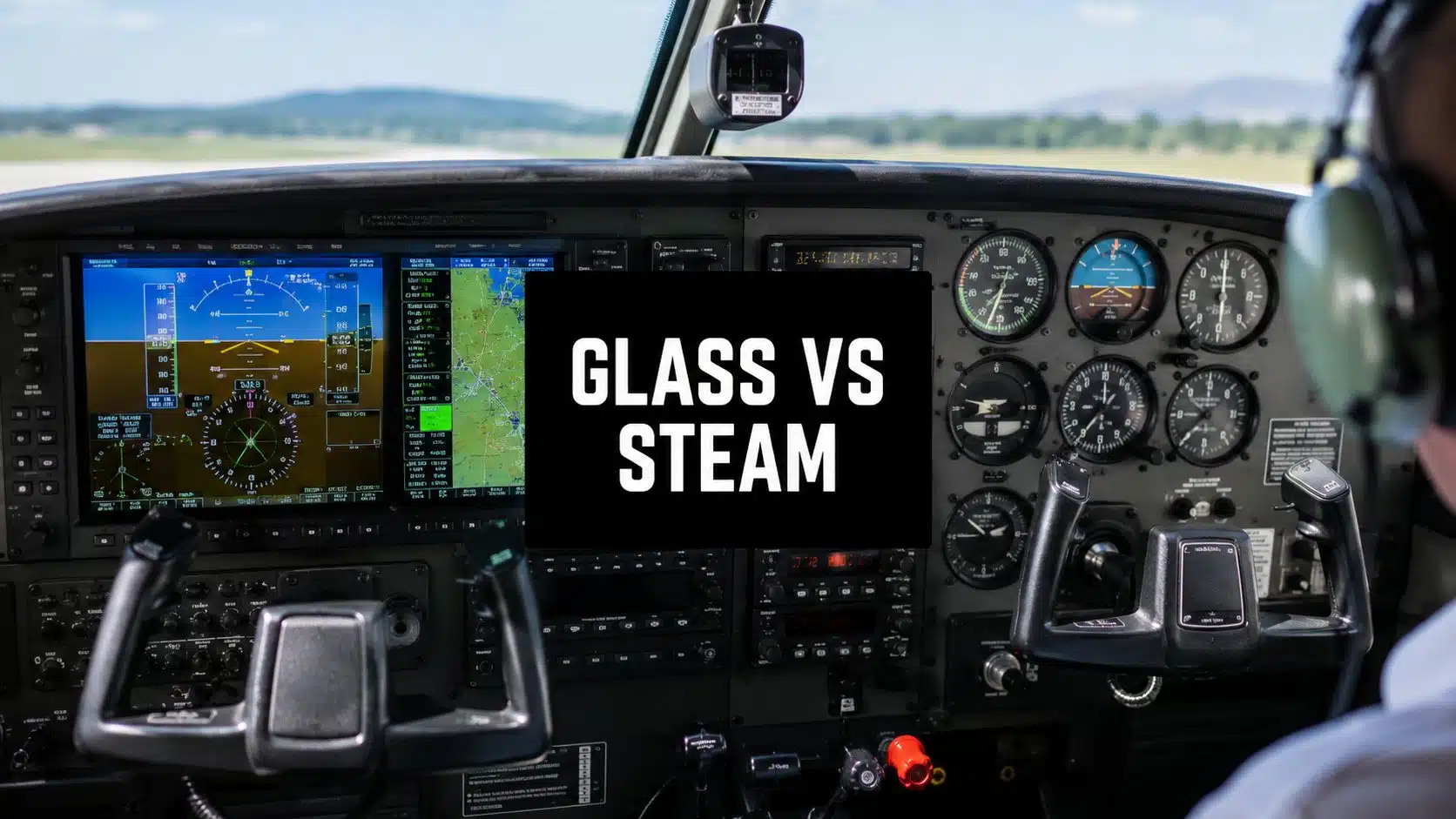
You're probably looking at a training schedule right now and seeing two very different airplanes. One has the familiar round dials. The other has bright screens, a moving map, and a panel that looks closer to what modern aviation uses every day. That choice feels bigger than it should, especially when you start hearing strong opinions from other pilots.
Some pilots will tell you steam gauges build “real” fundamentals. Others will tell you a glass cockpit is the only sensible way to train now. Neither answer is complete. In actual flight training, especially at a busy airport like KCNO, the better question is simpler: which setup helps you build safe habits, strong aircraft control, and good judgment that still holds up when something quits?
The glass cockpit vs steam gauges debate isn't about nostalgia or trend. It's about workload, failure points, maintenance reality, and how you train. If you understand those trade-offs early, you'll make better decisions for private, instrument, commercial, and even future aircraft ownership.
The Choice Every New Pilot Faces
A new student often starts with a practical question, not a philosophical one. Which airplane should I book for the next lesson?
At KCNO, that question matters because your training environment is already busy. You're working tower communications, traffic flow, runway changes, and real-world airspace from day one. In that setting, the panel in front of you changes how quickly you gather information and how much mental bandwidth you have left for flying the airplane.
Two panels, two different learning experiences
A classic Cherokee with steam gauges teaches you to read separate instruments and build a disciplined scan. You don't get one clean picture. You build the picture yourself from airspeed, attitude, altitude, heading, and performance trends.
A glass-equipped trainer changes that experience. The airplane still demands the same stick-and-rudder skill, but the information arrives in a more integrated form. Navigation, attitude, altitude trend, and engine data can sit in one organized place instead of being spread across the panel.
A student doesn't become sharper just because the panel is older. A student becomes sharper when the training forces accurate scan habits, disciplined procedures, and honest correction of mistakes.
The questions that actually matter
Before choosing sides, ask these:
| Question | Steam gauges | Glass cockpit |
|---|---|---|
| How do I gather flight information? | From separate round dials | From integrated displays |
| What usually fails first? | Mechanical and vacuum-related items | Electrical or display-related items |
| What skill does it sharpen fastest? | Traditional scan discipline | Situational awareness and avionics management |
| What can go wrong in training? | Students fixate on one gauge | Students fixate on screens and menus |
| Best use in a training plan | Raw flying and backup proficiency | Navigation, IFR flow, workload management |
The right answer for most students isn't “pick one forever.” It's build competence in both, then learn when each one helps you and when each one can mislead you.
Understanding the Instrument Panel Technology
Steam gauges and glass cockpits both tell you the same story about the airplane. They just tell it in very different ways.
What steam gauges are doing
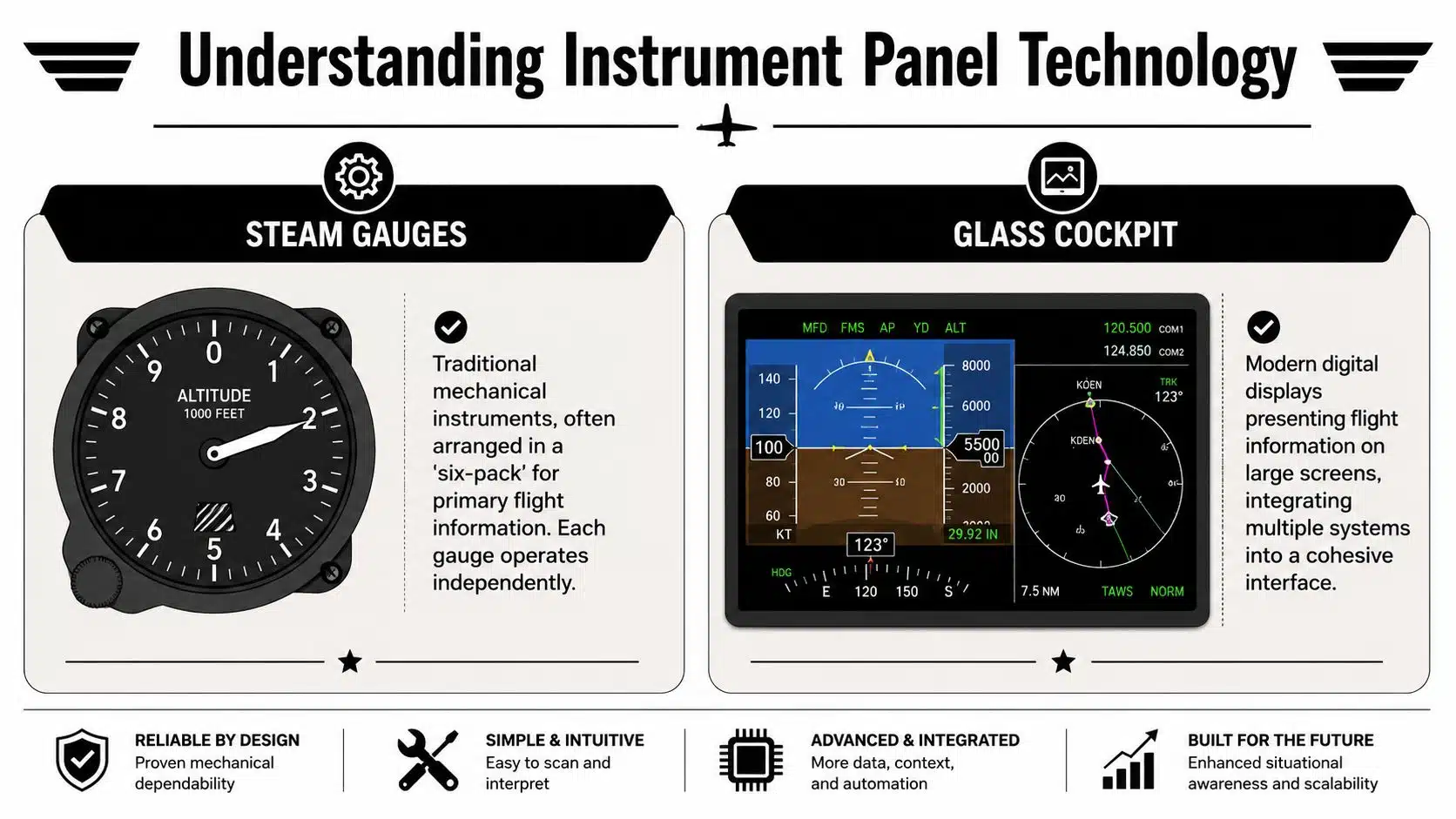
A traditional panel usually centers on the six-pack. That means six primary instruments arranged so the pilot can scan attitude, airspeed, altitude, vertical speed, heading, and turn information in a repeatable pattern.
Each gauge works as its own unit. That simplicity is part of the appeal. If one instrument goes bad, the others may still be there. But the pilot has to mentally combine separate clues into one usable picture of the airplane's attitude and performance.
Many steam-gauge airplanes also depend on a vacuum system to run gyroscopic instruments. That's one reason older panels demand a stronger understanding of partial-panel flying and system awareness.
What a glass cockpit changes
A glass cockpit consolidates the same core information into large digital displays, usually a Primary Flight Display and Multi-Function Display. Instead of reading six isolated gauges, you read one organized presentation that blends flight data, navigation, and often engine information.
Glass cockpits consolidate the traditional six-pack into integrated LCD displays fed by dual air-data and attitude systems, reducing pilot scan time by approximately 40% and lowering workload during demanding phases of flight, as described in this overview of glass cockpit instrument design.
That reduction in scan time is the biggest practical difference for a student. You spend less effort collecting data and more effort deciding what to do with it.
Why the software and hardware matter
Modern avionics aren't just screens. They depend on sensors, processors, software logic, and failure management. If you want a better sense of what's happening behind the panel, these expert insights on embedded firmware are useful because they explain the software layer that turns raw aircraft data into stable cockpit information.
For many pilots, that deeper understanding also improves how they use tablets in the cockpit. If you're building a workflow around panel avionics plus an iPad, this guide on using an iPad for pilots helps connect those tools without letting the tablet become a distraction.
Steam gauges ask you to synthesize. Glass asks you to manage.
The student-level takeaway
If you're brand new, don't overcomplicate this. Steam gauges present information one instrument at a time. Glass presents it as a system. Neither one flies the airplane for you. Both can support excellent training if you learn what the panel is showing, what it's hiding, and what backups remain when something fails.
A Head-to-Head Comparison for Pilots
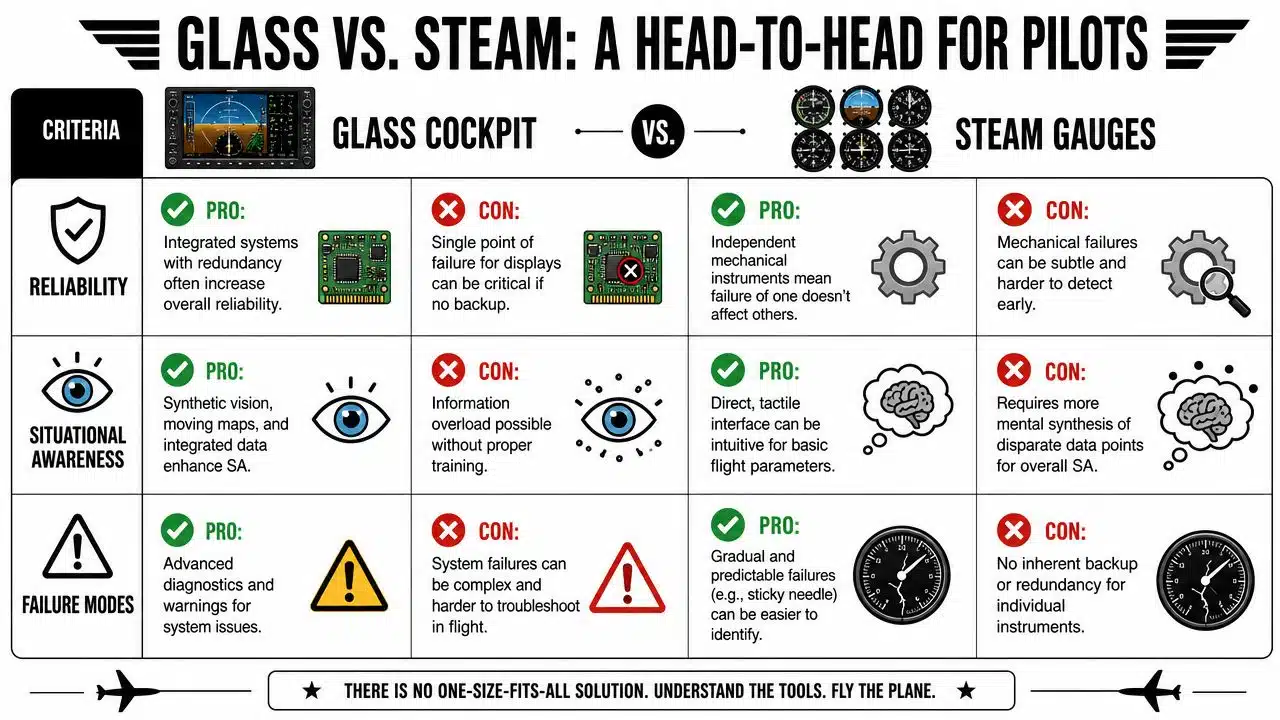
The cleanest way to compare glass cockpit vs steam gauges is to judge them by what matters in the airplane: reliability, situational awareness, and failure modes.
Reliability in the real world
The biggest weakness in many steam-gauge aircraft isn't the round dial itself. It's the system behind it. Vacuum pumps have an average lifespan of only 2,000 to 3,000 flight hours, and FAA data in the provided brief indicates that over 35% of total failures in steam gauge aircraft are tied to vacuum pump malfunctions, compared with fewer than 5% of failures in glass-equipped aircraft resulting from electrical system issues.
That's not an academic distinction. When a vacuum pump fails, the pilot may lose critical gyro-based information at the worst possible time. In a training environment, that can cancel a lesson. In actual instrument conditions, it can become a serious workload event fast.
Operational reality: A system that fails less often is easier to schedule, easier to trust, and easier to train in consistently.
Glass systems also tend to include power redundancy and display redundancy. If one display goes down, data may shift to another screen rather than vanish outright.
Situational awareness
Glass cockpits typically present a clear advantage. A steam-gauge pilot has to read six or more separate sources and build a mental picture from them. That's a valid skill, and it matters. But it takes more effort.
A glass cockpit can present attitude, altitude trend, heading, course guidance, engine data, and moving-map context together. That integrated picture is especially useful in busy airspace, instrument procedures, and cross-country work where attention gets divided.
Quick comparison
| Criteria | Steam gauges | Glass cockpit |
|---|---|---|
| Information flow | Separate instruments | Centralized displays |
| Pilot workload | Higher mental synthesis | Lower scan burden |
| Navigation context | More interpretation required | More immediate visual context |
| Best suited for | Raw scan discipline | High-workload environments |
Failure modes
Steam-gauge failures are often straightforward in concept. A heading indicator can precess. A gyro can tumble. A needle can stick. In some ways, those failures are easier to identify because the symptom is visible in one instrument.
Glass failures can be more complex. A display issue, sensor disagreement, or AHRS problem may affect multiple data presentations at once. That can feel more dramatic to a new pilot, even if the system still has backup pathways available.
Train for the failure you're most likely to mismanage, not the one you're most comfortable talking about on the ground.
Which one is better
For pure reliability and awareness, glass has the edge. For teaching students to respect raw indications and maintain discipline without a large integrated display, steam still has value.
The mistake is thinking one platform solves everything. Steam can hide old-system fragility behind familiar dials. Glass can tempt a student to chase menus instead of flying attitude and power. The stronger pilot recognizes both traps.
How Each System Impacts Your Flight Training
The old line says you should learn on steam first because that's the only way to build real fundamentals. That advice doesn't hold up well anymore.
A 2024 AOPA study found that 68% of students trained initially on Garmin G1000-equipped aircraft achieved instrument ratings faster, with no significant difference in manual flying proficiency during checkrides, and the FAA's 2025 advisory recommends hybrid training models, according to this breakdown of glass cockpit and steam gauge training outcomes.
What actually builds skill
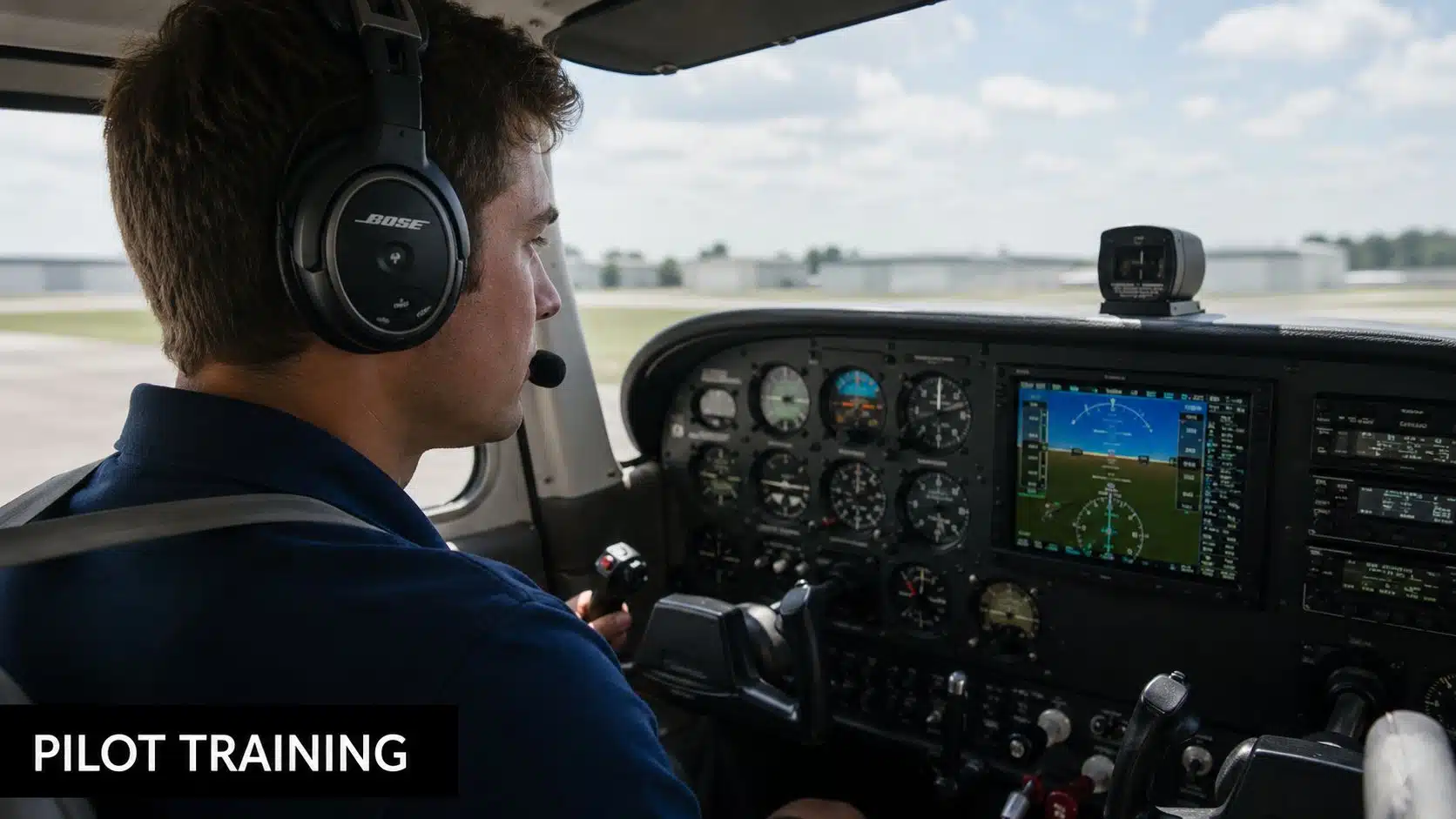
Students don't become good because the panel is analog. They become good because the instructor controls the training environment.
A weak glass-cockpit curriculum lets students hide behind automation, magenta lines, and button pushing. A weak steam-gauge curriculum lets students survive with an ugly scan, poor systems understanding, and no real transition plan for modern avionics.
The better approach is hybrid on purpose.
How to train on glass without becoming screen-dependent
Use these rules early:
- Fly attitude and power first: Treat the display as information, not salvation. If the airspeed and altitude trend look wrong, verify with pitch and performance.
- Delay automation: Don't rush into every available mode. Learn what the airplane is doing before adding autopilot or advanced navigation functions.
- Practice reversion: If the display layout changes, you should know where core flight information moved and how to stabilize the airplane first.
What steam still teaches well
Steam gauges force a disciplined instrument scan. They also expose weak cross-check habits quickly. If you stare at one dial too long, your altitude or heading drifts and the airplane tells on you.
That matters for VFR students and even more for instrument students. You still need the ability to interpret raw information without a polished graphical layout.
A DPE doesn't care whether your panel is old or new. The examiner cares whether you stay ahead of the airplane.
Transitioning between both systems
If you rent different aircraft, transition skill matters almost as much as platform skill. A smart training plan includes dedicated flights where the only goal is adapting scan, callouts, and cockpit flow between panel types.
For instrument students, it's also worth spending focused time on instrument flying training that includes both avionics management and partial-panel proficiency. That combination is what produces a pilot who can handle checkrides, rentals, and real weather decisions without getting overloaded.
The practical answer isn't steam or glass. It's whether your training makes you precise in one and adaptable in the other.
Cost Maintenance and Availability at DuBois Aviation
Pilots often reduce this topic to hourly rate. That's too narrow.
The purchase side of a glass cockpit can be higher. A 2025 NATA report found that glass cockpits can cost 30% to 40% more initially, but their average annual maintenance cost is 25% lower than steam gauges. The same source reports a 92% mean time between failure for critical avionics in glass cockpits versus 78% for steam gauges, with vacuum pump failures driving much of the downtime in older systems, as summarized in this review of maintenance and reliability differences between glass and steam panels.
What students usually miss
The hidden cost in flight training isn't just money. It's interruption.
If an airplane goes down for unscheduled maintenance, your lesson gets pushed, your sequence breaks, and your progress slows. That's a training cost even if it never appears as a line item on an invoice. For a student trying to keep momentum through private or instrument training, availability matters a lot.
Why “cheaper” can become more expensive
A steam-gauge airplane may look like the budget-friendly choice. Sometimes it is, especially for basic VFR time-building. But if the airplane is more vulnerable to vacuum-system downtime, that lower apparent cost can come with more schedule disruption and more maintenance-related uncertainty.
Consider the trade-offs this way:
- Lower entry cost: Steam often wins on simplicity and acquisition history.
- Lower long-term interruption risk: Glass often wins when the airplane flies frequently.
- Training efficiency: The more often you can fly as scheduled, the better your retention.
What works best at a busy school
For a high-utilization training fleet, reliability isn't a luxury. It affects dispatch, lesson continuity, and student confidence. That's why the maintenance side of the glass cockpit vs steam gauges conversation deserves more attention than it usually gets.
If you're choosing between airplanes for training, ask one practical question: which one is more likely to be ready when I show up, and which one supports the kind of flying I'm trying to learn? That answer is often more useful than arguing over panel preference.
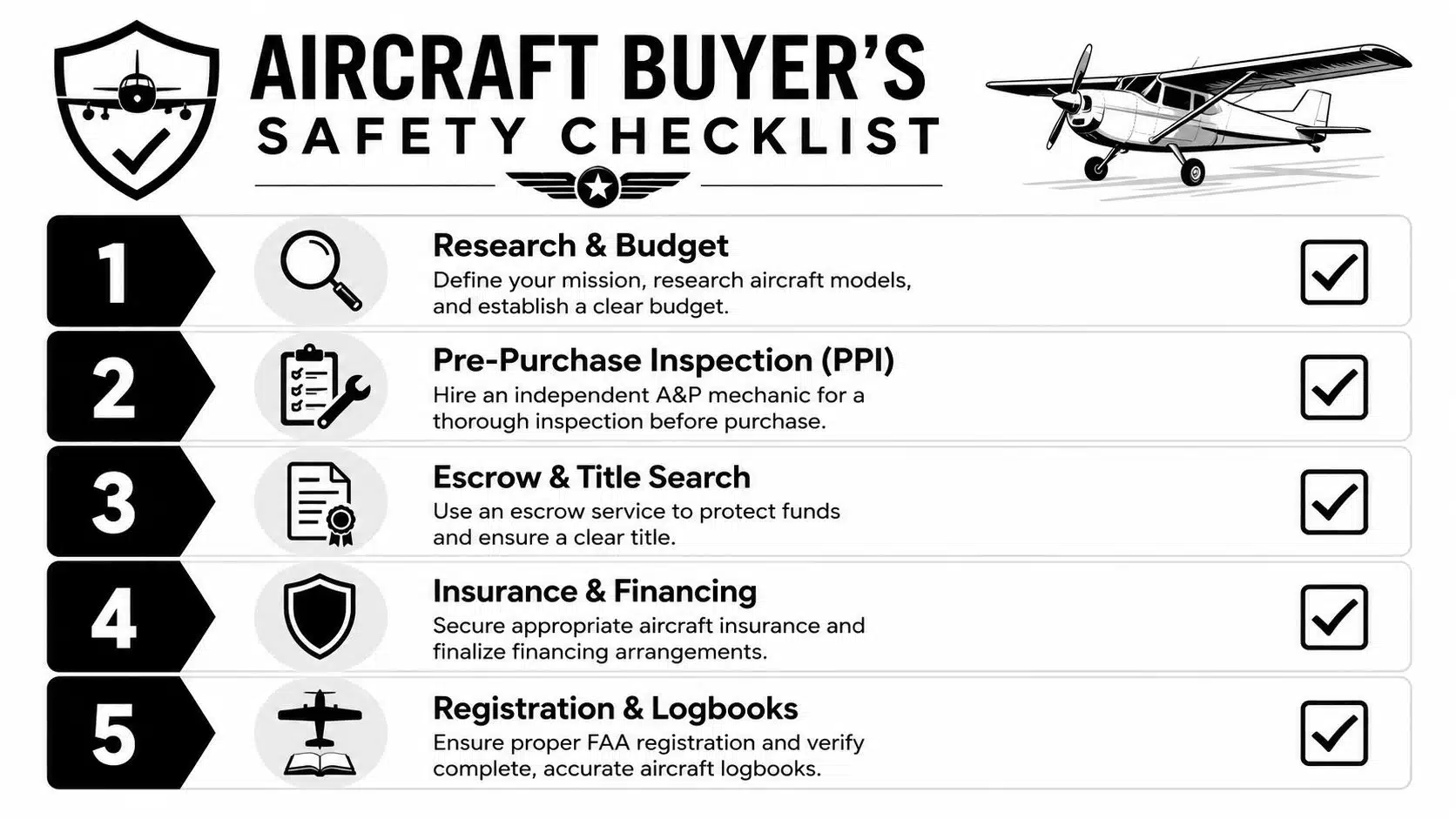
How to Buy an Airplane the Safe Way
A lot of student pilots eventually want to own. Some want to buy a first airplane after the private certificate. Others start looking at a complex airplane, a time-building platform, or even a helicopter later on. The panel matters, but the buying process matters more.
If you're looking at airplanes or helicopters for sale, don't get distracted by fresh paint, avionics photos, or a nice logbook summary from the seller. Buy on condition, maintenance history, and an independent inspection.
The non-negotiable inspection rule
A pre-purchase inspection must include a differential compression check on every cylinder, and the inspection must be done by a shop totally unaffiliated with the seller, as outlined in AOPA's guidance on buying a used aircraft safely.
That independence matters. A seller's mechanic may know the airplane well, but your mechanic works for one person only: you.
If the shop has any loyalty to the seller, the inspection has already lost value.
A practical buying checklist
Start with mission, not panel
Decide what the aircraft needs to do. Local VFR? IFR travel? Commercial time-building? Backcountry isn't the same mission as instrument cross-country, and neither is the same as helicopter training.
Review logs before emotion takes over
Missing years, major gaps, or vague entries deserve scrutiny. Avionics upgrades can look impressive, but they don't erase neglected maintenance.
Use an independent shop
This is where many buyers get lazy. Don't. Arrange the pre-buy with a mechanic or shop that has no connection to the seller.
Inspect engine health directly
The differential compression check isn't optional. It gives you a hard mechanical checkpoint on the engine's internal condition.
Expect to walk away
That's the buyer's greatest protection. If the airplane or helicopter has sketchy records, unclear damage history, or a seller who resists an independent inspection, move on.
For sellers too
If you're preparing to sell an aircraft, the cleanest way to protect value is transparency. Organized logbooks, clear maintenance documentation, and willingness to support an independent pre-buy reduce friction and build trust. The best sale isn't the fastest one. It's the one that survives scrutiny.
Your Path Forward and Simulator Lesson Plan
For most students, the strongest path isn't choosing a side. It's building a sequence.
Start by learning to control the airplane precisely. Add navigation and instrument workflow. Then train for failures in both environments until neither panel can surprise you. That approach lines up with how modern pilots operate.
NTSB data shows Controlled Flight Into Terrain accidents are 15% less frequent in glass cockpit aircraft, and the Garmin G1000 has been installed in over 60% of new Cessna 172S aircraft since 2004, making it a major part of the modern training environment. Those figures support a simple conclusion: glass is worth mastering because it's common and because it helps in complex scenarios. But that doesn't remove the need for raw-data skill and backup competence.
A practical recommendation
If your goal is private pilot training only, don't avoid glass and don't depend on it. Learn basic aircraft control in any stable trainer, then make sure you can interpret both display types without hesitation.
If your goal includes instrument, commercial, or airline-track flying, glass proficiency needs to become normal early. Modern avionics are part of the job. But you should still schedule flights or simulator sessions that remove the easy cues and force disciplined partial-panel work.
Simulator lesson plan
The simulator is where you can build this without wasting aircraft time or waiting for the right failure to happen naturally. A focused instrument rating simulator session should include specific scenarios, not random button pushing.
Use a sequence like this:
Vacuum pump failure in a steam-gauge profile
Fly straight-and-level, then hold heading and altitude after losing gyro-based references. The point is scan discipline and composure.PFD or AHRS failure in a glass-cockpit profile
Reconfigure, identify remaining backups, and continue the flight without fixation on the failed screen.Busy-airspace approach workload
Practice navigation changes, radio work, and checklist flow while maintaining aircraft control first.No-automation instrument segment
Hand-fly the airplane using raw guidance so the panel supports you instead of carrying you.
The best simulator lesson is the one that exposes the habit that would hurt you in the airplane.
Final judgment
In a pure glass cockpit vs steam gauges argument, glass usually wins on reliability, awareness, and operational continuity. Steam still wins as a training tool when it's used deliberately to sharpen scan and backup skill.
So train like a modern pilot. Learn the screens. Respect the round dials. Never let either one become a crutch.
Whether you're comparing training aircraft, planning an instrument path, or thinking about how to buy an airplane the safe way, DuBois Aviation gives pilots access to airplane and helicopter training, rentals, and simulator work at KCNO with the kind of real-world environment that builds adaptable skills.


