
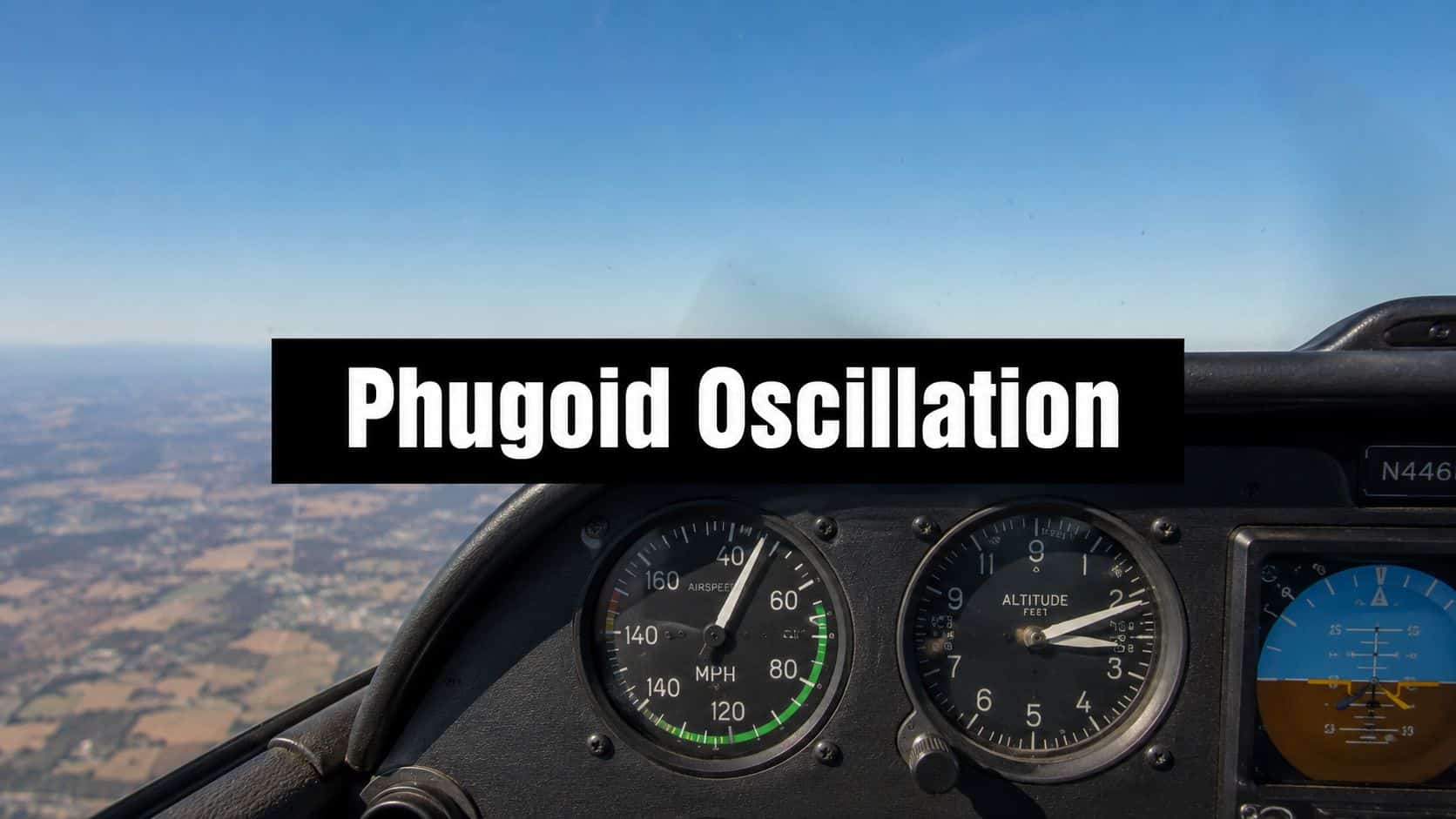
You're probably here because you've seen it, or you're about to. You trim the airplane, settle into cruise, and the nose starts a slow rise. Airspeed eases back. Then the nose lowers, the airplane picks up speed, and altitude drifts the other way. Nothing feels violent. It just feels odd.
Student pilots often assume something is wrong when they first notice that motion. Usually, the opposite is true. In many training airplanes, that slow, repeating exchange is a normal part of longitudinal stability. If you understand what the airplane is doing, you're far less likely to chase it with the yoke and make a manageable situation worse.
That matters in training, in instrument flying, and even when you're shopping for an airplane or helicopter. A pilot who understands stability doesn't just pass checkrides more smoothly. That pilot makes better decisions in the cockpit and during pre-purchase test flights.
What Is This Gentle Seesaw in the Sky
A student and I are in straight-and-level cruise. The trim is set. Hands are light on the controls. A bump of turbulence nudges the nose, and then we watch the airplane start a lazy, almost rhythmic cycle. It climbs a little while losing speed, then descends a little while regaining speed.
That motion is called a phugoid oscillation.
It isn't usually an emergency. It's one of the airplane's basic motion modes, and in a training environment it's often a useful teaching moment. A properly trimmed airplane is trying to find its way back to equilibrium after a disturbance such as a gust, a rough control input, or a power change that altered pitch attitude.
What it feels like to a student pilot
The first thing students notice is how slow it is. This isn't a quick bobble in pitch. It feels more like the airplane is breathing. If you look outside, you may only notice a slight drift in nose attitude and horizon placement.
Inside the cockpit, the pattern is clearer. Altitude wanders gently. Vertical speed changes sign. Airspeed moves opposite the altitude trend.
Cockpit reminder: If the motion is slow and smooth, don't assume it needs an aggressive correction.
Why this matters early in training
Many pilot errors start with misidentification. If you think a phugoid is a serious pitch upset, you may start correcting at the wrong time and in the wrong amount. That can turn a stable, lightly damped motion into a pilot-made problem.
This is why instructors teach students to recognize the airplane's natural behavior before trying to “fix” it. A phugoid isn't proof that the airplane is failing. In many cases, it's proof that the airplane is behaving like a stable training aircraft should.
The Physics of an Aircrafts Long Slow Breath
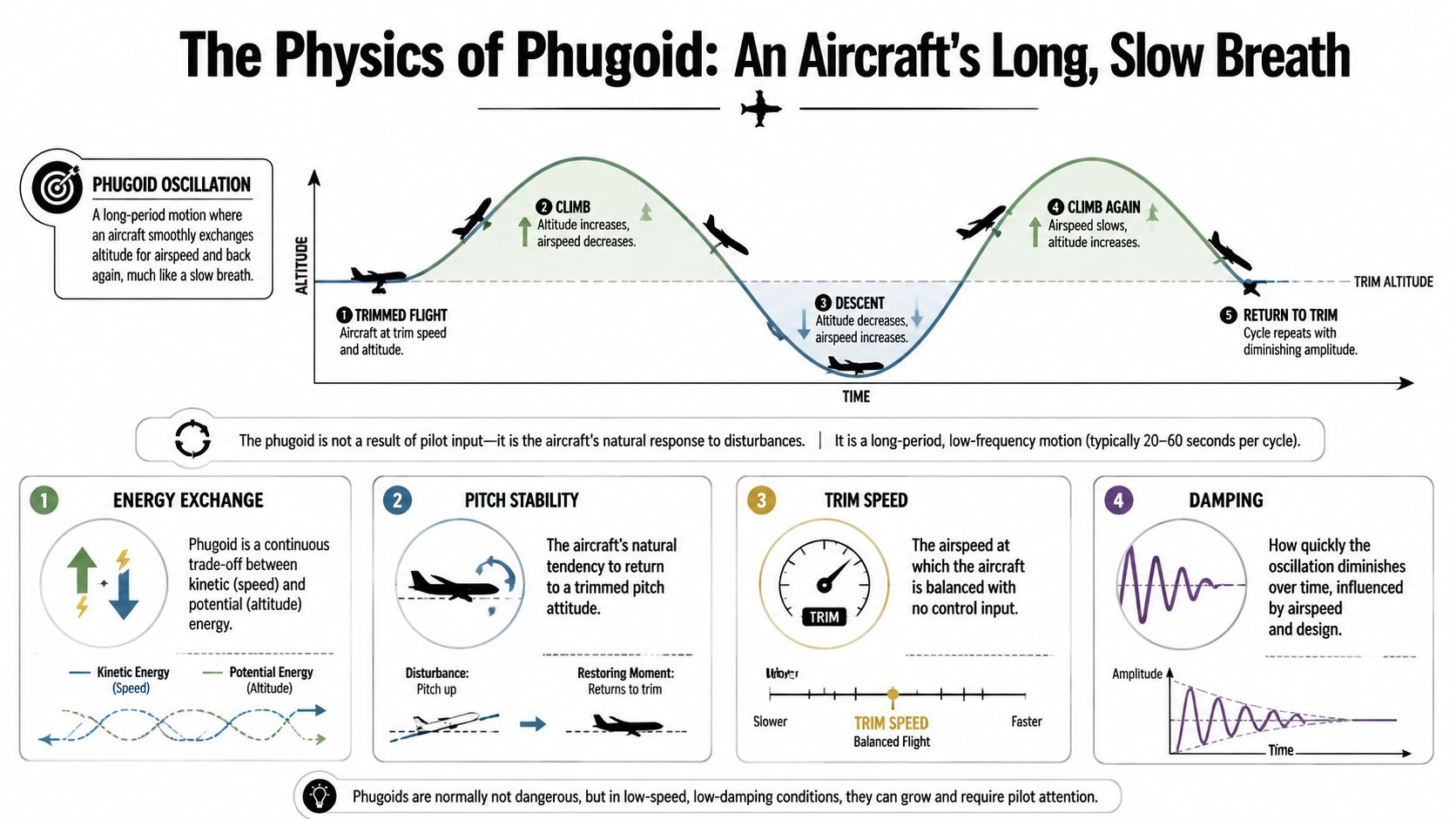
A phugoid is easiest to understand as an energy trade. The airplane is swapping kinetic energy, speed, for potential energy, altitude, and then swapping it back again. A glider on a shallow rise and fall is a close comparison. The path changes slowly, even though the airplane may feel almost trimmed the whole time.
What trips up many student pilots is the difference between pitch attitude and angle of attack. During a phugoid, the nose attitude can drift up and down while the wing's angle of attack changes only a little. If that distinction feels slippery, this explanation of angle of attack and relative wind helps make it clearer.
That matters in the cockpit. If you assume every nose movement means a large angle-of-attack change, you can misread a mild phugoid as a stall-related problem and start chasing it with unnecessary control inputs.
The airplane's lift changes because speed changes. As the airplane picks up speed, the wing can produce more lift even without a large change in angle of attack. That extra lift bends the flight path upward. As the airplane climbs, it gives that speed back. Then lift decreases, the flight path arcs down again, and the cycle continues.
A simple cockpit version looks like this:
- The nose drops slightly and the airplane accelerates.
- Increased speed raises lift.
- The airplane starts climbing and trading speed for altitude.
- Airspeed bleeds off.
- With less speed, lift decreases and the airplane starts descending again.
This is why instructors often call it the airplane's long, slow breath. The motion is gradual enough that students in training aircraft sometimes miss the beginning of the cycle unless they cross-check outside attitude with the airspeed indicator, altimeter, and VSI.
Several ordinary events can start the motion. A gust can nudge the airplane away from trimmed flight. A rough pitch input can set the energy exchange in motion. A power change can do it too, especially if the nose is allowed to wander before the airplane settles.
For flight training, the useful lesson is not memorizing every aerodynamic detail. It is learning to recognize when the airplane is showing you a stability characteristic instead of asking for an immediate correction. In a DuBois Aviation lesson or simulator session, this becomes a practical exercise. Hold a trim condition, introduce a small disturbance, and watch what the airplane does before touching the controls again. You learn how lightly damped motion looks, how long one cycle takes, and how easy it is for a pilot to make it worse by overcontrolling.
The same idea matters during a pre-purchase test flight. A stable airplane should respond predictably to a small disturbance in trimmed cruise. If the pitch motion grows instead of settling, feels unusually weak in damping, or requires constant correction to stop wandering, that deserves a closer look by a qualified mechanic and instructor before money changes hands.
Spotting the Difference Phugoid and Short-Period Modes
Not every pitch oscillation is a phugoid. A big part of cockpit judgment is knowing whether you're seeing a slow energy exchange or a quicker pitch response that needs a different interpretation.
The fastest way to separate them is to ask two questions. How fast is it happening? And what are the instruments emphasizing?
What the instruments show you
During a phugoid, the altimeter swings gently, the VSI cycles through shallow climbs and descents, and the airspeed indicator moves inversely to altitude. AOPA also notes that the recommended response is often to freeze the yoke and let the airplane's stability settle the motion naturally in many situations, as explained in this AOPA article on aircraft control technique.
That's different from the more abrupt feel of a short-period pitch motion, where the pilot's attention goes first to pitch attitude and rapid nose movement.
Phugoid vs. Short-Period Oscillation
| Characteristic | Phugoid Oscillation | Short-Period Oscillation |
|---|---|---|
| Time scale | Slow, often tens of seconds | Fast, often felt within a few seconds |
| Main exchange | Airspeed and altitude | Pitch attitude, pitch rate, and angle of attack |
| What you feel | A gentle, floating rise and fall | A sharper pitch bobble |
| What stands out on instruments | Altimeter, VSI, and airspeed trend | Rapid pitch response and quicker attitude changes |
| Angle of attack behavior | Nearly constant through much of the cycle | Changes more noticeably |
| Common pilot mistake | Overcontrolling a stable motion | Misreading a more dynamic pitch response as minor |
| Typical first response | Hold steady and assess | Depends on context and severity |
A cockpit rule that helps
If the motion feels lazy and the airspeed trend is trading against altitude, think phugoid first. If the nose is moving quickly and the pitch response feels immediate, you're likely dealing with something else.
A slow problem invites patience. A fast problem demands recognition.
Students often get into trouble because they react to both motions the same way. That's where overcontrol begins. Correct identification comes before correct recovery.
In the Cockpit Recognizing and Recovering Safely
When a phugoid starts, the airplane usually gives you plenty of warning if you know where to look. The visual picture may be subtle. The instruments tell the story much more clearly.
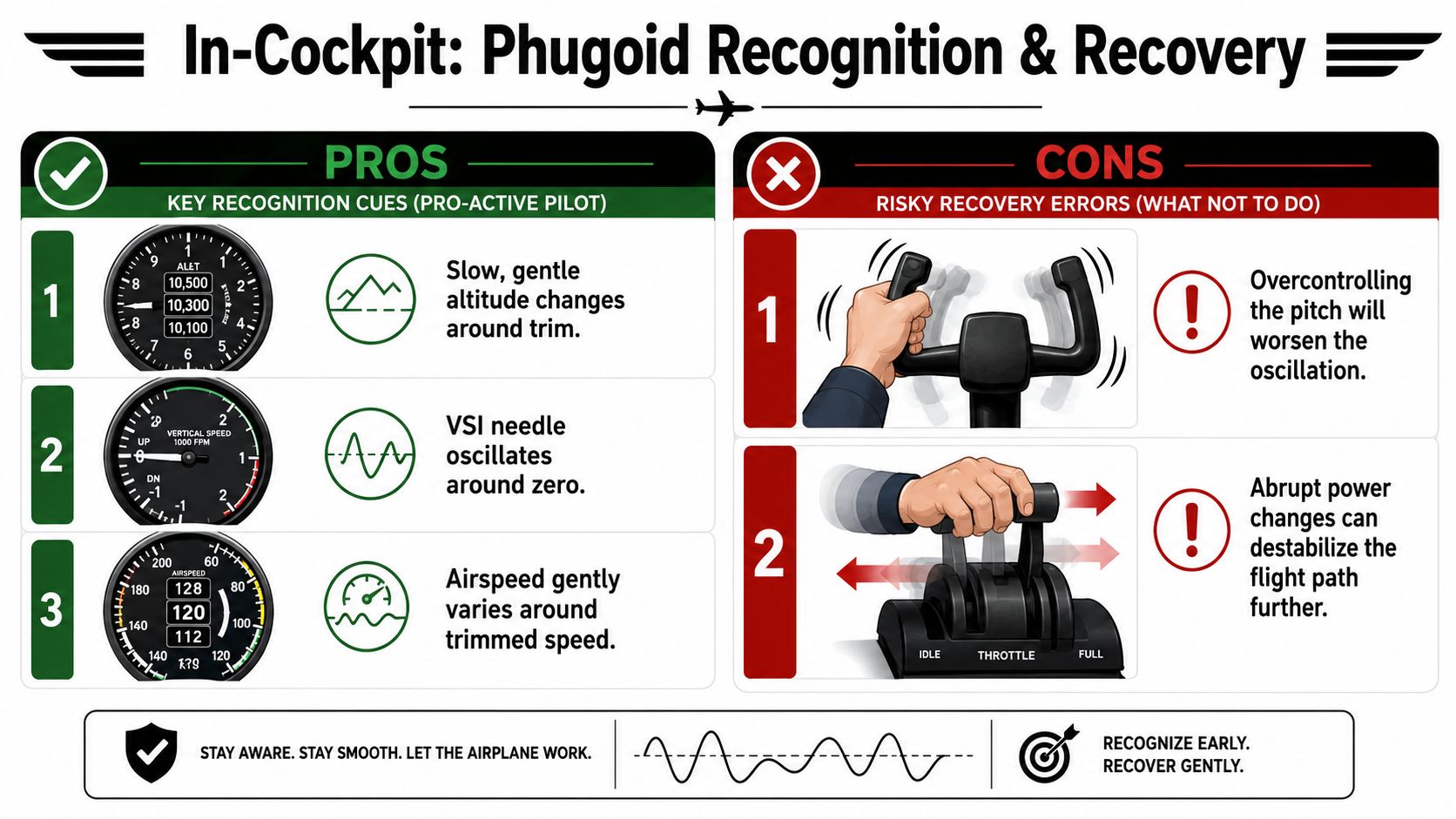
You'll typically notice a gentle swing on the altimeter, a cyclical VSI trend, and an airspeed indication that moves opposite the altitude change. In actual instrument conditions, that matters even more because the motion can be too mild to feel dramatically in your seat.
The first response is often restraint
In a stable airplane with room beneath you, the best move is often the hardest one for a new pilot. Stop chasing it. Neutralize the yoke and let the airplane's longitudinal stability do its job.
That advice feels passive, but it's indeed disciplined flying. Many phugoids get worse because the pilot keeps correcting at the top and bottom of the swing. By the time the correction takes effect, the airplane is already moving the other way.
When you do need to intervene
There are times when you don't want to wait. Close to the ground, on approach, or anytime terrain and safety margins are tight, you may need a more active response.
The practical technique is to use small, timely control force at the midpoint of the motion, not at the extremes. That means a slight forward pressure as the nose passes the horizon moving upward, or the opposite as the cycle reverses. The goal is to interrupt the energy exchange at equilibrium rather than amplify it at the edges.
A useful companion skill is unusual attitude recovery, because both situations punish delayed or exaggerated inputs.
Errors that create pilot-induced oscillation
The common trap is simple. The pilot sees altitude moving, pulls. Then sees speed bleeding off, pushes. Then sees the descent start and pulls again. The airplane and pilot get out of phase.
That risk doesn't disappear in advanced aircraft. Even modern fly-by-wire aircraft can exhibit phugoid modes, and pilot-induced oscillations often stem from mistimed corrective inputs during phugoid cycles, with instrument lag in some glass-cockpit environments making that worse, according to this discussion of phugoid and PIO in modern systems.
Practical rule: Small inputs, timed well, beat large inputs made late.
A simple in-cockpit checklist
- Recognize the pattern: Slow altitude drift, shallow VSI swing, inverse airspeed trend.
- Stabilize your hands: Relax your grip and stop “helping” the airplane every few seconds.
- Protect safety margins: If the ground is nearby, manage power and go around if needed.
- Correct only with timing: If you intervene, do it lightly and near the midpoint of the cycle.
Practice Phugoid Recovery at DuBois Aviation
You are in a training flight, trimmed for cruise, and the nose starts a slow wander above and below the horizon. Airspeed trades with altitude. Nothing feels violent, but the pattern keeps going because each correction comes a beat too late. That is exactly the kind of mistake a pilot should rehearse before it happens in busy airspace or on an aircraft demo flight.
Reading the concept helps. Practicing it under supervision builds judgment.
At DuBois Aviation, phugoid training works best as a progression. You first learn to see the motion early, then to leave it alone long enough to understand what the airplane is doing, and only then to add the small, well-timed correction that settles it down. Student pilots, instrument pilots, and aircraft owners all benefit from that sequence for the same reason. It teaches patience in pitch control.
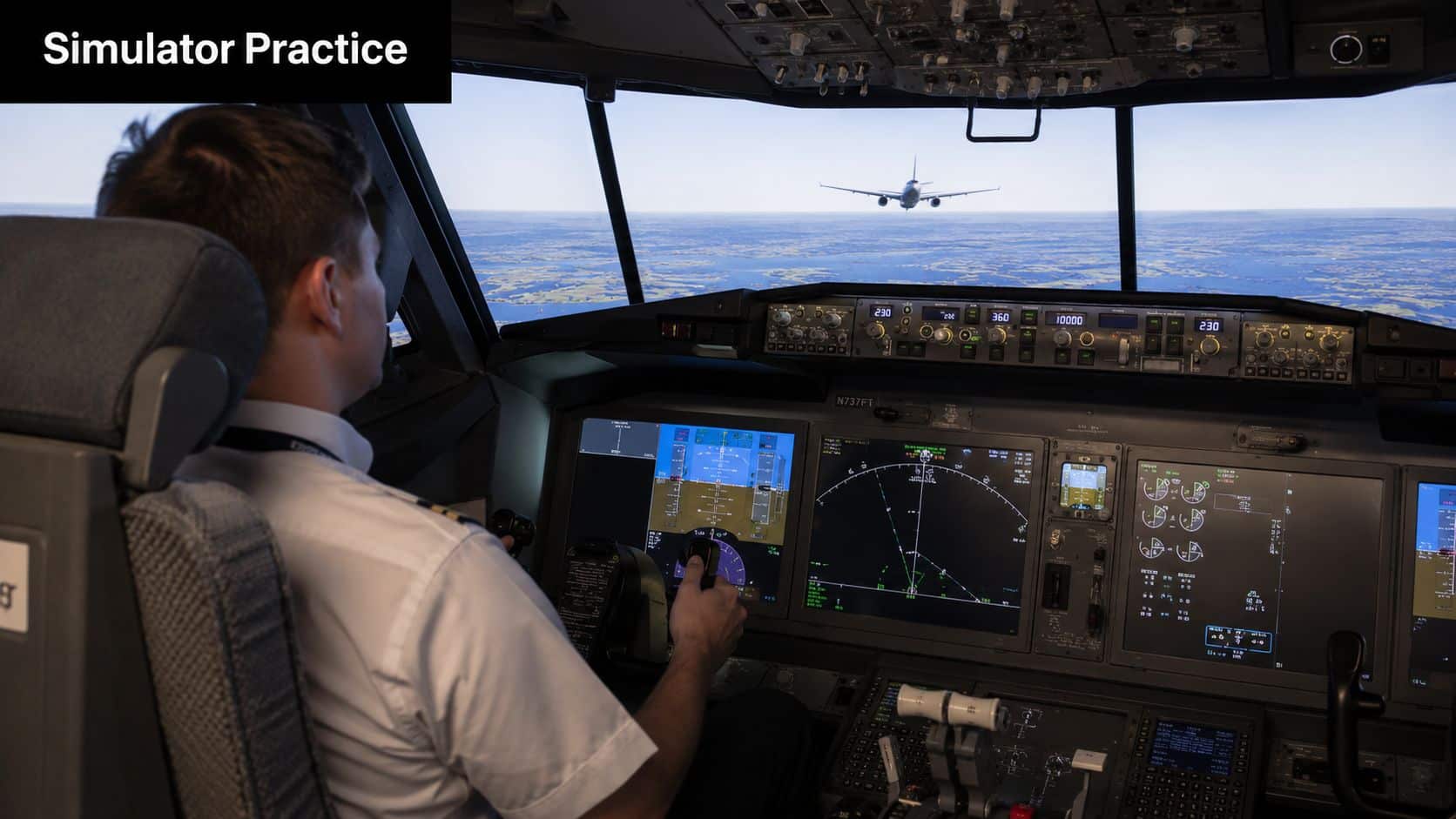
Why simulation matters for this skill
A phugoid is well suited to simulator practice because the lesson is about timing, sight picture, and restraint. In the airplane, traffic, bumps, and workload can interrupt the exercise. In a simulator, the instructor can set up the same disturbance again and again until you recognize the rhythm without guessing.
That repetition matters. A pilot who chases every small altitude change often creates a larger problem than the airplane started with.
Using the Redbird flight simulator for pitch stability practice, you can trigger a mild phugoid with a trim change, a brief pitch input, or a power change, then watch how the airplane responds when you keep your hands quiet. You can freeze the moment, discuss it, reset, and try again. That makes it much easier to connect the theory to what you will see on the gauges and through the windshield.
Pilots can then carry the lesson into familiar trainers such as the Cessna 150 or Piper Cherokee. The goal is not to make the airplane oscillate for drama. The goal is to recognize a long-period pitch disturbance, avoid overcontrolling it, and recover with the same measured technique in the cockpit.
A practical training flow
A useful lesson sequence looks like this:
- Start in the simulator: Practice recognizing the slow exchange between airspeed and altitude without the distractions of weather or traffic.
- Repeat the setup: Induce the motion several ways so you learn the pattern, not just one cue.
- Move to the airplane: Recreate only mild disturbances with an instructor and compare what you saw in simulation to the actual sight picture and control feel.
- Add workload carefully: Once the basic recovery is consistent, practice while scanning instruments, talking through the problem, or handling simple task loading.
Here's a short look at simulator flying in action.
Why this belongs in serious training
This exercise sharpens more than recovery technique. It teaches disciplined observation. Instrument students learn to trust trend recognition instead of reacting to every needle movement. Commercial students learn smoother pitch control. Pilots transitioning to faster or heavier aircraft learn that a slow oscillation can still become a safety issue if they fight it.
It also has value beyond training flights. If you are evaluating an airplane before purchase, one part of the test flight is simple: does the aircraft feel naturally settled in pitch, or does it invite constant correction? A pilot who understands phugoid behavior is better prepared to assess trim response, longitudinal stability, and whether the airplane returns toward equilibrium in a calm, predictable way.
That is practical knowledge. It helps in the lesson, in the simulator, and during a serious pre-purchase flight when handling qualities matter as much as appearance or avionics.
Buying an Aircraft Test Flying for Stability
If you're learning how to buy an airplane the safe way, don't limit the decision to paint, avionics, or logbooks. Stability and handling belong on the checklist too.
A buyer who only reads paperwork can miss the part that matters most once the wheels leave the runway. You need to know how the aircraft feels in pitch, how it trims, how it responds to a disturbance, and whether it settles naturally or keeps inviting overcontrol.
What to do before you buy
AOPA recommends that a pre-purchase inspection include at least a differential compression check on each cylinder so you can assess the true condition of the engine. That guidance appears in AOPA's advice on buying a used aircraft.
That's the mechanical side. The handling side matters just as much.
Another practical recommendation is to fly the aircraft yourself, provided you have the proper licensure, so you can evaluate handling characteristics, instrument responsiveness, and overall comfort before finalizing the deal, as described in this article on how to buy a plane in six steps.
What to evaluate on the test flight
You don't need to perform an engineering analysis. You do need disciplined observations.
- Trim behavior: Does the airplane settle where you expect, or does it feel like it always wants chasing?
- Pitch response: Are control pressures normal and predictable?
- Longitudinal stability: After a mild disturbance, does it tend to return calmly toward trimmed flight?
- Instrument scan: Do the indications behave smoothly and make sense together?
When a prospective aircraft feels “mushy,” twitchy, or oddly tiring to fly, pay attention. Handling quality is part of airworthiness in the real-world sense, even when paperwork looks clean.
This also applies to helicopters and sellers
People looking to buy or sell airplanes and helicopters benefit from the same mindset. Buyers should insist on a thorough inspection and a meaningful demonstration flight. Sellers should expect serious buyers to ask detailed questions about trim, control harmony, and maintenance history.
For airplane buyers, a pre-purchase flight is one of the best times to assess whether the aircraft's longitudinal behavior matches its intended mission. A trainer should feel forgiving. A cross-country machine should feel settled and easy to trim. If the aircraft resists that basic expectation, keep digging before money changes hands.
Why Understanding Phugoid Makes You a Better Pilot
Pilots who understand phugoid oscillation fly with better timing and less drama. They stop treating every slow deviation like a crisis. They read the instruments as a pattern instead of isolated warnings. Most of all, they stop creating problems with unnecessary control inputs.
That skill shows up everywhere. It improves cruise handling, instrument scanning, approach discipline, upset prevention, and aircraft evaluation during a test flight. It also builds trust in what a stable airplane is designed to do when you let it work.
A phugoid is not the airplane falling apart. It's a reminder that flight is full of energy exchanges, trim relationships, and delayed responses. The pilot who understands that becomes smoother and safer.
Good airmanship isn't just knowing how to move the controls. It's knowing when not to.
Whether you're starting private training, working toward an instrument or commercial certificate, renting an aircraft, or figuring out how to buy an airplane the safe way, this concept belongs in your toolkit. Learn to recognize the gentle seesaw. Learn when to leave it alone. Learn when a small, well-timed correction is enough.
If you want hands-on flight training, simulator practice, aircraft rental, or guidance as you work toward a pilot certificate, advanced rating, or aircraft ownership decision, DuBois Aviation offers airplane and helicopter training at Chino Airport with experienced instructors, Jeppesen-based instruction, and an in-house simulator.


