

You rotate onto the centerline at Chino after sunset. Run-up is complete, radios are busy, and you're already a step ahead of the airplane because departures around KCNO don't give you much room for sloppy thinking. You bring the power in, the airplane accelerates, and your body gets pressed back into the seat.
For a moment, something feels off.
The pitch feels steeper than it should. Maybe a lot steeper. Your hands want to nudge the nose forward even though the attitude indicator says the airplane is where it belongs. That conflict between what you feel and what the panel shows is one of the most dangerous traps in aviation.
Student pilots often think this only happens to people who are careless, tired, or inexperienced. That's not true. This is a human hardware problem. Your inner ear can give you a completely convincing false picture of what the airplane is doing, especially during takeoff, climb-out, or a go-around when outside visual references disappear.
As a flight instructor, I want you to treat this topic the way you treat stall awareness or runway incursion avoidance. Not as trivia. As survival knowledge. If you fly Pipers, Cessnas, or Robinsons around a busy field, especially at night or in reduced visibility, you need to know what somatogravic illusion feels like, why it happens, and what you'll do the instant it starts.
That Unsettling Feeling on Takeoff
A lot of pilots meet somatogravic illusion before they ever learn its name.
You're on departure. Maybe it's a dark night. Maybe the city lights are uneven and the horizon is hard to sort out. Maybe you've just lifted off in a Cherokee or a Cessna and the airplane is climbing normally. Then acceleration builds, and your body sends you a message that feels urgent and physical. It tells you the nose is too high.
That sensation can be powerful enough to create doubt in a disciplined pilot. You look at the panel, and the attitude indicator says your pitch is normal. Airspeed is where it should be. Vertical speed makes sense. But your body still says, “No, this is too much. Push.”
That's the trap.
What the moment feels like
In the cockpit, it usually doesn't arrive as a dramatic mental event. It arrives as a simple urge.
- The seat pressure changes: Acceleration pushes you backward, and your brain starts interpreting that pressure as a pitch change.
- The outside world offers little help: On a dark departure, the windshield may show only scattered lights and black space.
- Your hands want to fix a problem that doesn't exist: The airplane feels overpitched even when the instruments say it isn't.
A student will often ask, “Wouldn't I know it's an illusion?” Not always. That's why this one is so dangerous. Illusions don't announce themselves politely. They feel like reality.
Practical rule: When acceleration and darkness show up together, expect your body to become an unreliable witness.
This matters most in the first moments after liftoff, when altitude is limited and there's no time to sort out a bad control input. If you lower the nose because you trust the sensation instead of the instruments, you can put a perfectly healthy airplane into a dangerous descent.
For you as a pilot, the lesson is simple. If the airplane's performance and attitude instruments agree with each other, but your body disagrees, your body loses that argument.
How Your Brain Can Lie to You
Your inner ear does a good job on the ground. In an airplane, especially at night or in haze, it can give you a convincing but false story.
The part that matters here is the otolith organs. They sense linear acceleration. In plain English, they notice when you are being pushed backward or forward. What they cannot do well, on their own, is sort out whether that force came from a change in pitch attitude or from the aircraft accelerating.
A carpenter's level provides a simple analogy. The bubble shifts when the tool tilts. Your inner ear has sensors that also shift with force. In flight, that creates a problem. A backward tilt and forward acceleration can create a similar signal, so the brain can confuse one for the other when outside visual cues are weak.
For a DuBois Aviation pilot, that is not abstract theory. It is the kind of mistake that can show up in a Cherokee departing Chino into a dark basin, a Cessna climbing through haze east of the field, or a Robinson lifting into a night departure with few ground references.
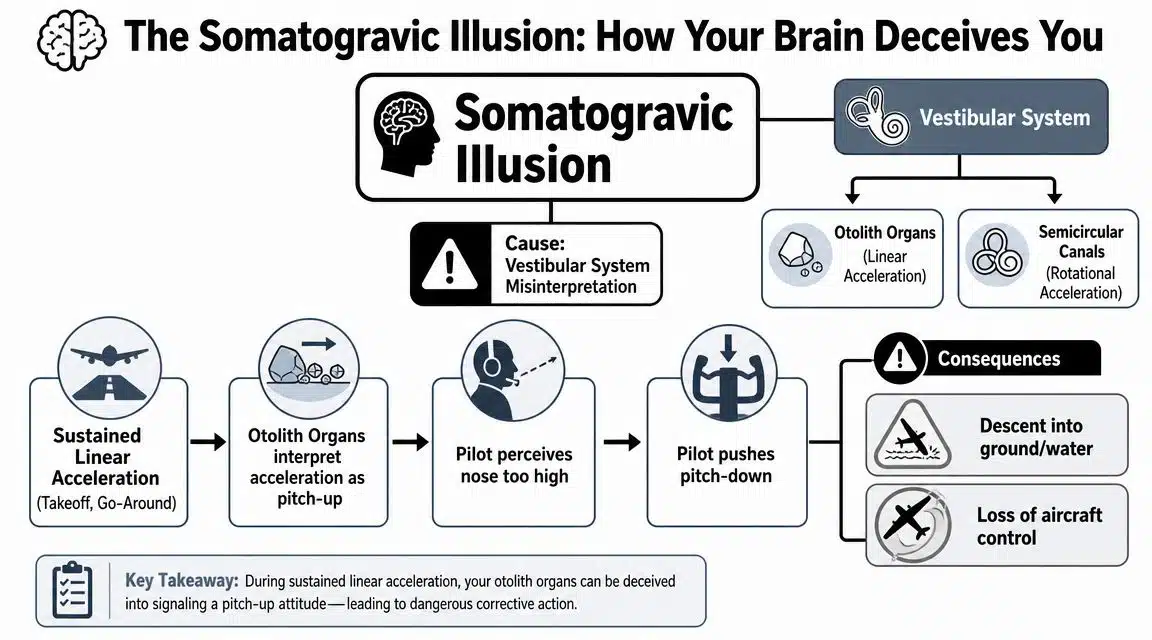
Your body can struggle to tell the difference between two very different situations:
- The airplane is pitching up
- The airplane is accelerating forward
If those sensations overlap, your brain may choose the wrong explanation. That is how a normal climb can feel too steep, even when the attitude indicator, airspeed, and performance all agree that the airplane is right where it should be.
Why the illusion can build
One point confuses students all the time. The false sensation does not always hit at the exact instant you add power. It can strengthen as acceleration continues and outside references stay poor.
In the cockpit, that means the pressure to "fix" the pitch may grow a few moments after liftoff or after go-around power is applied. You are still flying a normal profile, but your body becomes more confident that something is wrong. That confidence is what makes the illusion dangerous.
Here is the pattern pilots usually face:
| What's happening | What you may feel | Unsafe reaction |
|---|---|---|
| Normal acceleration on takeoff | Nose is rising too much | Push forward |
| Normal go-around power application | Excessive pitch-up | Lower the nose |
| Deceleration in some cases | Nose is dropping | Pull too much |
For you, the lesson is practical. Sensation is not proof.
Your inner ear senses motion. Your instruments show attitude and performance.
That distinction keeps pilots alive. If you fly around KCNO, you already know how fast workload can stack up. Traffic calls, runway changes, a busy radio, and reduced visibility can all pull your attention outside when the panel is the one source telling the truth. Good IFR currency habits and instrument scan discipline help even when the flight is legally VFR, because the skill you need is the same. Cross-check, confirm, and resist the urge to "correct" a pitch problem that exists only in your inner ear.
In a Piper, Cessna, or Robinson, the rule does not change. If the instruments and aircraft performance agree, trust them over the feeling in your body.
High-Risk Scenarios for Every Pilot
You depart Chino before sunrise in a Cessna 172. Tower is busy, the panel lights are bright, the city glow washes out the horizon, and the airplane starts accelerating hard after rotation. For a moment, your body says the nose is climbing too much. If you answer that feeling with forward pressure instead of an instrument cross-check, you can turn a normal takeoff into a low-altitude emergency.

Initial takeoff and climb
This is the setup student pilots and experienced pilots both need to respect. The airplane accelerates, outside references are weak, and your inner ear can misread that acceleration as a pitch change. In plain cockpit terms, the aircraft may be doing exactly what you asked, while your body insists it is doing something else.
What does that mean for you in a Piper or Cessna? Expect the risk to peak in the first seconds after liftoff, especially on dark nights, in haze, or anytime the horizon is hard to pick out beyond the Chino Basin. If the attitude indicator, airspeed, and vertical performance match the takeoff you briefed, hold the attitude you planned. Do not chase a sensation.
Busy local airspace makes this harder. A traffic call, a frequency change, or a quick glance outside for sequencing can break your scan right when the false cue gets strongest.
Go-arounds and missed approaches
Go-arounds catch pilots because the transition is abrupt. One second you are descending and slowing. The next, you add full power, manage pitch, clean up configuration, and talk on the radio, all at low altitude.
That combination is a trap for somatogravic illusion. Your body may interpret the acceleration as excessive nose-up pitch, even when the aircraft is on the right attitude. In a Cherokee, Archer, or Skyhawk, that can tempt you to lower the nose more than you should. In the clouds, at night, or over poorly lit terrain, that mistake can develop fast.
For DuBois Aviation pilots, the lesson is practical. Treat every go-around as an instrument procedure first and a visual maneuver second when outside cues are weak. Staying sharp on IFR currency and instrument scan habits matters here because the skill that saves you is disciplined cross-check under pressure.
Helicopter transitions and abrupt acceleration changes
Robinson pilots face the same human-factor problem, even though the control inputs look different. During acceleration, deceleration, or transition to forward flight, your body can create a false pitch story that does not match the aircraft attitude.
The margin is often smaller in a helicopter. You are lower, closer to obstacles, and sometimes operating in lighting conditions that hide the horizon. That means there is less time to sort out whether the sensation is real. The safer habit is simple. Confirm attitude and performance on the instruments before you make a correcting input.
Conditions that stack the odds against you
The common thread is not pilot experience alone, and it is not one aircraft model. The risk grows when several factors show up together.
- Night departures from KCNO or nearby airports: Ground lights can replace a true horizon with a misleading visual picture.
- Takeoffs into haze or IMC: You may lose outside references almost immediately after rotation.
- Go-arounds over dark areas: Acceleration arrives when workload is already high.
- High cockpit workload: Radios, traffic, flap retraction, checklist items, and heading assignments can interrupt your scan.
- Any flight where you are rusty on instruments: The illusion is harder to resist when your cross-check is slow or incomplete.
A good way to frame it is this. Somatogravic illusion works like a false alarm in your vestibular system. The danger comes when you treat the alarm as confirmed without checking the panel.
In low visibility or at night, your survival skill is not guessing correctly. It is holding attitude by reference to instruments until the outside picture becomes trustworthy again.
Lessons Learned from Tragic Accidents
Pilots sometimes hear about somatogravic illusion and file it away as a human factors footnote. It isn't. It has shown up repeatedly in fatal accidents, including transport-category events involving professional crews.
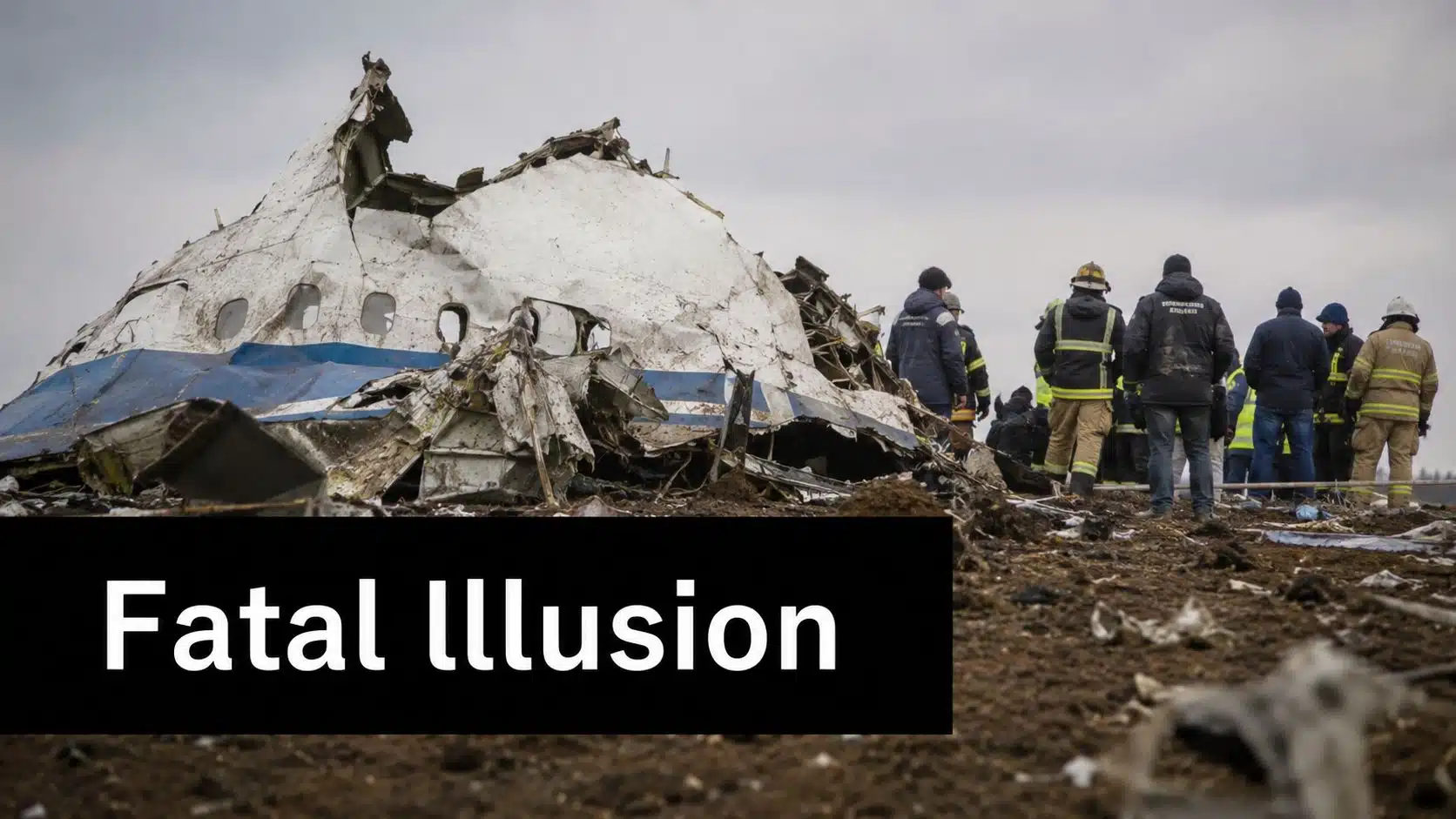
The pattern is painfully consistent
The setup often looks ordinary at first. The aircraft accelerates during takeoff or a go-around. Outside references are weak. The pilot experiences a false sensation of excessive nose-up pitch. In response, the pilot makes a nose-down input.
At low altitude, even a modest but incorrect forward input can be unrecoverable.
A 2016 Flight Safety Foundation analysis of somatogravic-illusion accidents found that the illusion was cited as a causal factor in 7 large transport-aircraft accident reports and 4 serious incidents since 1 January 2000, with the loss of 481 lives. The same paper identified 44 additional documented fatal accidents in other flight phases where somatogravic illusion was cited as a factor. It also concluded that the rate of these accidents had changed little over time, even though the hazard has been known since the 1940s.
That should get every pilot's attention. This isn't a newly discovered trap. It's a longstanding one that keeps killing people.
What student pilots should learn from that history
You don't need to memorize every accident report to learn the right lesson. The useful lesson is the chain.
- Acceleration creates a false sensation
- Outside cues are missing or misleading
- The pilot reacts to the sensation
- The airplane departs from a safe attitude
- Altitude runs out
That chain can happen in an airliner, but the same human factors apply in a training airplane or helicopter. The smaller aircraft may even give you less time to recognize and reverse the error.
The tragedy in these accidents wasn't a mysterious mechanical failure. It was a human sensory system doing exactly what it sometimes does under the wrong conditions.
The cockpit takeaway
When you read accident summaries, don't stand outside them and think, “I would never do that.” A better response is, “Under the same conditions, my body would probably tell the same lie.”
That mindset is healthier because it leads to procedure. It pushes you toward a disciplined scan, stabilized pitch targets, and rehearsed responses during night departures and go-arounds.
Professionalism starts there. Not with confidence in your sensations, but with respect for their limits.
Training Your Brain to Trust Your Instruments
You can't remove somatogravic illusion from human physiology. You can train around it.
That training has to be specific. “Trust your instruments” is good advice, but it's incomplete unless you know what that looks like in the first seconds after takeoff or during a missed approach. In real flying, your defense is a cockpit routine that's simple enough to execute under pressure.
Build a repeatable scan
In acceleration phases with weak outside cues, your attitude indicator becomes the anchor. Don't glance at it once. Use it as the primary reference, then confirm with supporting instruments.
A basic pattern might look like this:
- Start with attitude: Confirm the pitch attitude you expect for takeoff or go-around.
- Check performance: Airspeed, altimeter, and vertical speed should support what the attitude indicator is telling you.
- Return to attitude: Don't drift into chasing a single secondary instrument.
- Keep the scan moving: A frozen stare is almost as dangerous as no scan.
If you fly a six-pack panel, the method is the same. If you fly a glass display, the method is still the same. Technology helps presentation. It doesn't remove the need for discipline.
Use brief callouts
Verbal callouts can interrupt the impulse to react to a false sensation. In instruction, I like short phrases because they keep the pilot ahead of the airplane.
Examples include:
- “Set pitch, check attitude.”
- “Instruments agree.”
- “Ignore the feeling, fly the panel.”
- “Power, attitude, performance.”
Those aren't magic words. They work because they direct attention back to verifiable information.
Here's a strong way to think about it in training:
When your body says “push,” but the attitude indicator, airspeed, and altitude trend say “hold,” hold.
Practice the trap on purpose
This is one reason simulator work matters so much. In a simulator, an instructor can create the exact circumstances that feed somatogravic illusion without exposing you to real risk. You can rehearse a night takeoff, an unexpected go-around, or a departure into immediate instrument conditions and learn what the urge feels like before it ever surprises you in an aircraft.
Pilots who want to sharpen that skill set should get structured instrument flying training that includes takeoff attitude control, missed-approach transitions, and partial-panel discipline.
This short video gives a useful visual explanation of the concept and why instrument trust matters:
Tailor the habit to the aircraft
The details vary a bit by machine.
| Aircraft type | What to guard against | Best response |
|---|---|---|
| Piper and Cessna trainers | Pushing after liftoff because climb feels too steep | Hold known pitch attitude and verify with performance instruments |
| Complex or faster airplanes | Overcontrolling during high workload transitions | Trim, stabilize, and keep the scan centered on attitude |
| Robinson helicopters | Misreading acceleration or deceleration cues during transitions | Stay disciplined with instrument and attitude references when visuals weaken |
A practical game plan for your next flight
Before any night departure, low-visibility departure, or go-around, brief yourself with something this simple:
- What attitude am I expecting after power application?
- Which instrument will I trust first if my body disagrees?
- What will I say to myself if the sensation feels wrong?
- What performance indications should confirm I'm on profile?
That briefing takes only a few seconds. It gives your brain a script before stress shows up.
The key is repetition. Don't save this for checkrides or instrument lessons. Use it often enough that the response becomes automatic.
Making Instrument Discipline Your Default
The safest pilots don't wait until they feel disoriented to become disciplined. They make instrument discipline their default before the airplane moves.
That's the deeper lesson behind somatogravic illusion. Your body isn't broken. It's limited. In the wrong conditions, it can produce a false but convincing message. A professional pilot mindset accepts that without ego and responds with procedure.
What this means in daily flying
If you're departing at night, climbing into reduced visibility, or executing a go-around, treat the attitude indicator and supporting instruments as your primary truth. Not your backup truth. Your primary truth.
A strong pilot identity includes habits like these:
- Briefing high-risk phases before takeoff
- Holding known pitch attitudes instead of improvising
- Using a steady instrument scan under workload
- Refreshing skills before they fade
If you haven't tested those skills recently, an instrument proficiency check is a smart way to pressure-test your scan and sharpen your response in the exact situations that can turn dangerous fast.
Good airmanship isn't trusting how confident you feel. It's trusting the process that still works when your senses don't.
Somatogravic illusion has fooled experienced pilots for decades. It can fool any pilot who gives it the chance. Your edge is knowing when it appears, recognizing what it feels like, and refusing to let sensation overrule the panel.
If you want to build that kind of cockpit discipline with one-on-one instruction, simulator practice, and real-world training in Chino's busy environment, DuBois Aviation can help you sharpen the instrument habits that keep pilots safe in airplanes and helicopters alike.