
If you're dreaming of a career as an airline pilot or want to master the art of helicopter flight, your first big decision is where to train. Choosing a Chino Airport flight school isn't just about finding a place to learn—it's about immersing yourself in a challenging aviation environment from day one. This guide is for aspiring professional pilots who want to build the real-world skills that airlines and top helicopter operators demand.
Why Future Pilots Choose Chino Airport
Where you start your flight training can set the tone for your entire career. For so many pilots with their eyes on the airlines or specialized helicopter work, Chino Airport (KCNO) is the clear choice. It’s more than just a place to log hours; it's a complete training ecosystem. The real value is its mix of location, history, and operational complexity that prepares you for what a professional flying career is actually like.
Forget quiet, isolated airstrips. At Chino, you're dropped right into the middle of Southern California's bustling airspace. This environment forces you to develop the sharp situational awareness and crisp communication skills that are non-negotiable for an airline or commercial helicopter career.
A Legacy of Aviation Excellence
When you train at Chino, you're walking on historic ground. That rich heritage creates an inspiring atmosphere where the past and future of flight come together. During World War II, the airport was a vital military training base called Cal-Aero Field. The academy here trained over 10,365 fighter and bomber pilots, cementing its place in aviation history. You can learn more about this incredible legacy on the San Bernardino County Airports website. That tradition of turning out top-tier pilots is alive and well today.
Training at a busy, historically significant airport like Chino gives you an immediate leg up. You aren't just memorizing procedures from a book; you're living them every day in a complex, real-world setting.
This visual shows how all of Chino's best qualities combine to create the perfect training ground for pilots serious about their careers.
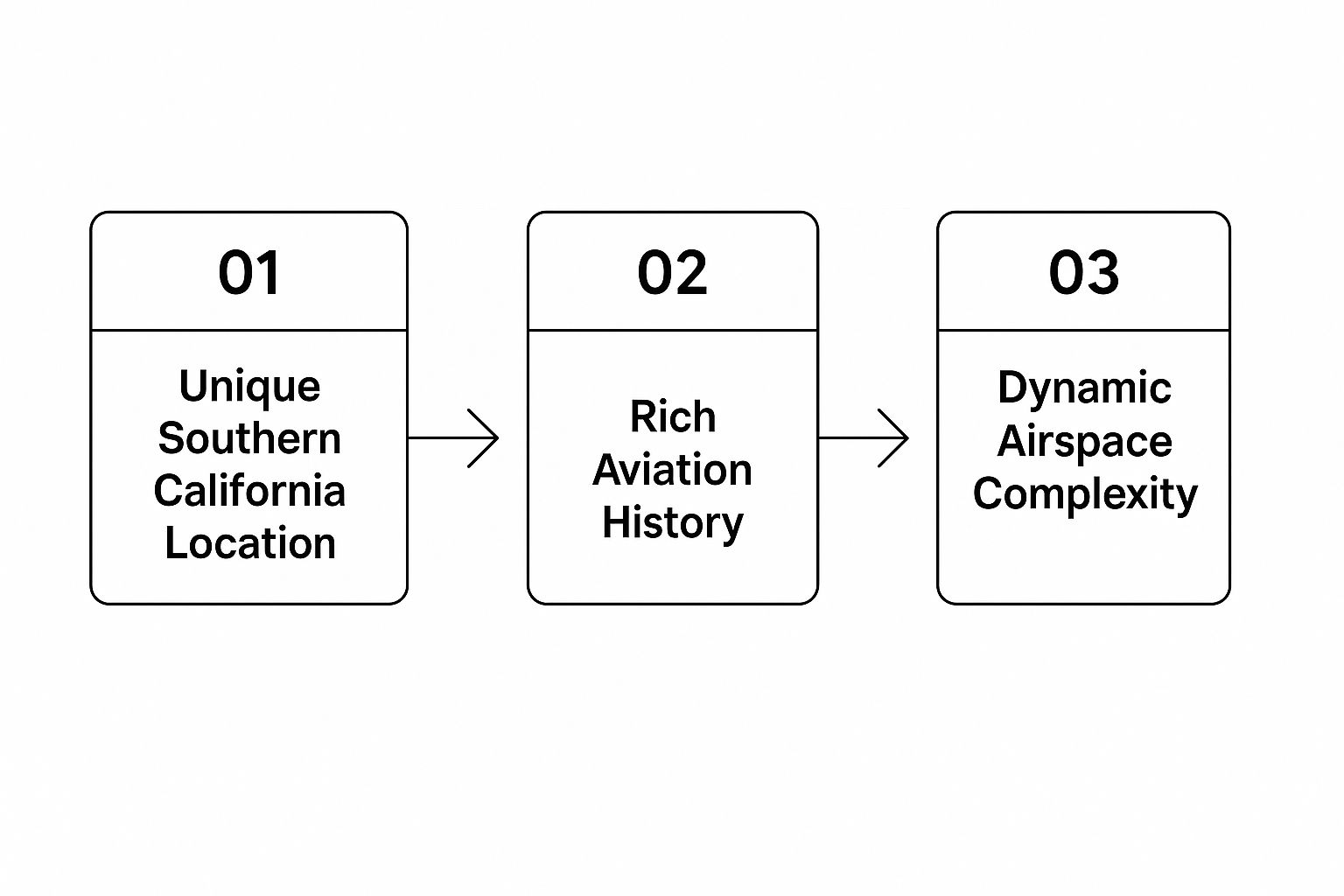
As you can see, it all starts with the airport's prime location and rich history, which feeds into the dynamic airspace that truly defines the training experience for career-focused students.
The Ideal Training Environment
This unique combination makes any Chino Airport flight school a smart move for any student pilot aiming for a professional career. The benefits aren't just theoretical; they're practical advantages you'll use throughout your career:
- Real-World Airspace: You’ll be flying out of a Class D towered airport, right under some of the busiest airspace in the country. This means you get constant, daily practice talking to air traffic control—a core skill for any professional pilot.
- Diverse Operations: You’ll share the traffic pattern with everything from single-engine trainers and helicopters to sleek corporate jets and historic warbirds. This exposure prepares you for the varied environments you'll encounter in your career.
- Career Immersion: The airport is a hive of activity. It’s a natural place to network with people from maintenance shops, charter companies, and other corners of the aviation world, opening doors for your future.
At the end of the day, training at Chino means you're not just learning how to operate an aircraft. You're learning how to be a professional pilot, armed with the confidence and skill to handle the demands of an airline or commercial helicopter cockpit.
Your Roadmap to an Airline Pilot Career
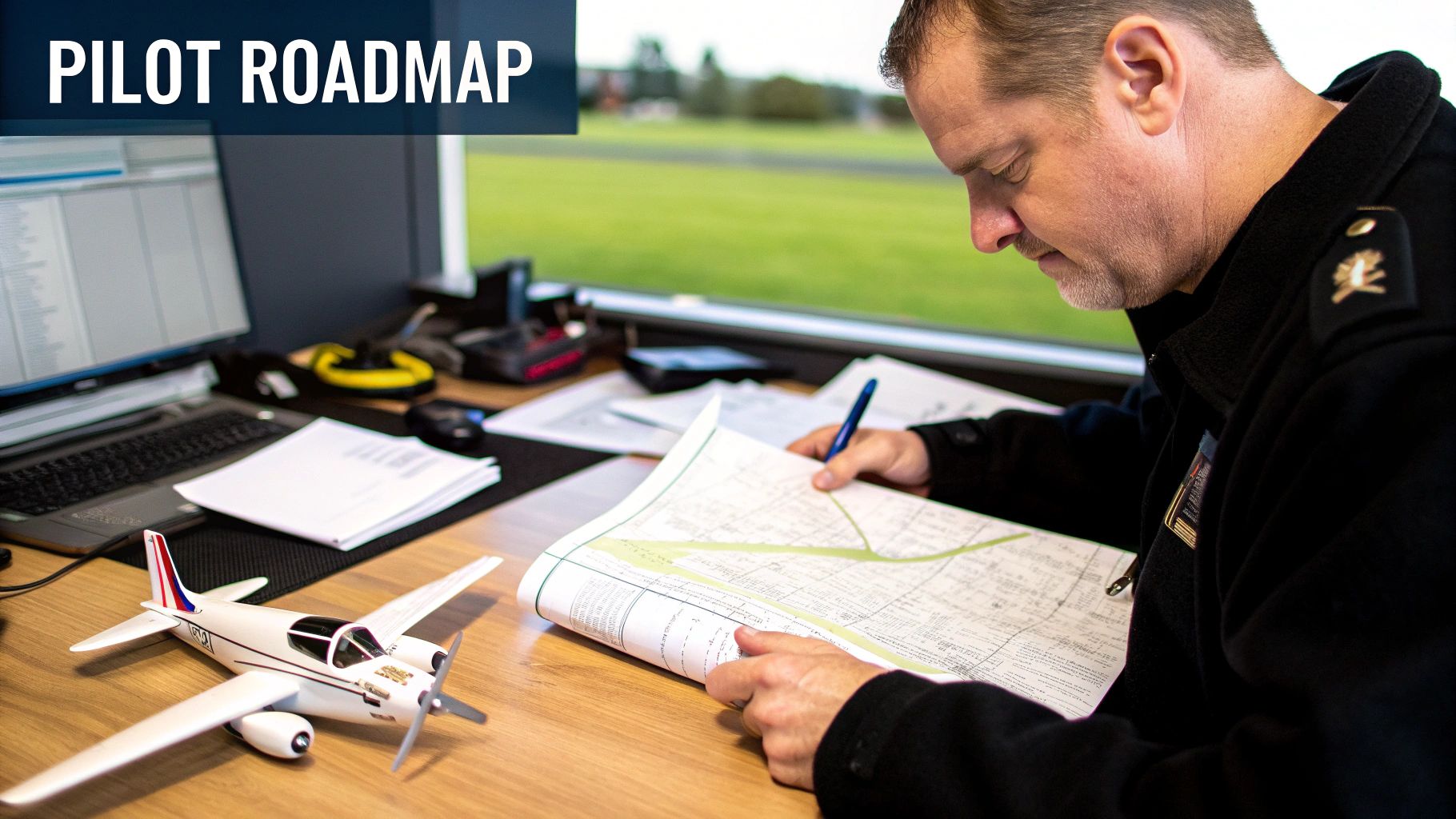
If you've ever dreamt of sitting in the captain's seat, you should know the path to getting there is a well-defined journey. It’s less of a single race and more of a series of crucial milestones, with each new certificate building directly on the last. Think of it as a modern-day apprenticeship, progressing from a novice just learning the ropes to a true master of the craft.
This isn't just about collecting licenses. It’s about progressively layering knowledge and real-world experience. At a Chino Airport flight school, that journey gets a serious boost from the very environment you train in. The complex radio chatter and busy traffic patterns of Southern California airspace aren't obstacles; they're incredible teachers that prepare you for the demands of professional aviation from day one.
The Foundation: Private Pilot License
Every pilot’s career starts here, with the Private Pilot License (PPL). This is the bedrock of your entire aviation journey. While the PPL allows you to fly for fun, for career students it's the essential first step where you build foundational airmanship.
During this phase, you'll get a solid handle on the fundamentals: takeoffs, landings, navigation, and basic maneuvers. But it’s about more than just moving the controls. You're developing "stick and rudder" skills, learning to think like a pilot, and truly understanding aerodynamics and weather. The FAA sets the minimum at 40 flight hours, but most students find they need between 55-70 hours to feel truly confident and proficient.
Adding Precision: Instrument Rating
Once you have your PPL, the next step toward the airlines is the Instrument Rating (IR), which turns you into an all-weather pilot. This is where you learn to fly precisely by reference to your instruments, without needing to look outside.
Picture flying through thick clouds with zero visibility. That’s what an Instrument Rating prepares you for. This rating is absolutely non-negotiable for an airline career, as professional pilots have to operate safely no matter what the weather looks like. Your IR training will dive deep into advanced navigation, instrument approach procedures, and the highly structured communication required by air traffic control.
An Instrument Rating isn't just another certificate; it's a fundamental shift in how you fly. It instills a level of discipline, precision, and procedural knowledge that is the absolute hallmark of a professional aviator.
Going Pro: Commercial Pilot License
With your instrument rating secured, it's time to make your passion a profession with the Commercial Pilot License (CPL). This is the license that legally allows you to be paid for your flying skills. The flight maneuvers for the CPL are much like what you did for your PPL, but they’re held to much tighter, more exacting standards required for a professional career.
To even be eligible, you’ll need a minimum of 250 total flight hours, proving you’ve put in the time to gain significant experience. This is the stage where your skills are honed to a truly professional level, showing you can handle an aircraft safely and efficiently for hire.
Building Hours: Certified Flight Instructor
So, how do you get from a 250-hour commercial pilot to the 1,500 hours the airlines require? This is where the Certified Flight Instructor (CFI) rating comes in. It’s hands-down the most common and effective way to bridge that gap. As a CFI, you get paid to teach new students while logging the flight hours you need for your airline career.
This experience is invaluable. There's no better way to master a concept than to teach it to someone else. Being an instructor also develops essential soft skills—communication, leadership, and sharp decision-making—that are exactly what airlines look for in a future captain.
The journey from a brand new student to an airline-ready pilot is a clear, step-by-step process. Here’s a quick breakdown of how it typically unfolds at Chino.
Airline Pilot Certification Pathway at Chino
| Training Stage | Primary Goal | Typical Flight Hours |
|---|---|---|
| Private Pilot License (PPL) | Master fundamental flight skills and VFR flight. | 40 – 70 hours |
| Instrument Rating (IR) | Learn to fly solely by instruments in all weather. | PPL + 40-50 hours |
| Commercial Pilot License (CPL) | Achieve professional-level proficiency to fly for hire. | 250 total hours |
| Certified Flight Instructor (CFI) | Build flight time and experience while teaching others. | 250+ hours |
| Airline Transport Pilot (ATP) | Meet airline hiring minimums and qualify as a first officer. | 1,500 total hours |
Once you’ve built the required time, the final piece of the puzzle is often mastering larger, more complex aircraft through dedicated multi-engine pilot training. This rating is the gateway to flying the regional and major airline jets you've been working towards. Each certificate is a critical stepping stone, transforming you from an eager student into a competent and confident professional pilot.
Mastering Vertical Flight with Helicopter Training
While an airline career is a popular goal, a professional helicopter pilot career offers an equally thrilling—and highly skilled—path in aviation. Helicopter training at a Chino Airport flight school opens up a world of dynamic flying, incredible versatility, and career opportunities that are anything but typical.
Flying a helicopter isn't just a variation of flying an airplane; it's like learning an entirely new language. Airplanes generate lift by moving forward, but helicopters do it with spinning rotor blades. This fundamental difference requires a delicate touch and a constant dance between the cyclic, the collective, and the anti-torque pedals to hold a stable hover or fly with precision. It's a skill that, once mastered, is incredibly rewarding.
This unique skill set is your key to a huge range of exciting careers. Professional helicopter pilots are always in demand in specialized fields where the ability to take off, land, and hover in tight spots isn't just a convenience—it's a necessity.
Diverse Careers in Rotorcraft Aviation
Once you're a commercially licensed helicopter pilot, the job possibilities are as varied as the landscapes you'll fly over. These roles demand a high level of skill and a calm head under pressure, making the training both intense and deeply fulfilling.
- Emergency Medical Services (EMS): You're on the front lines, airlifting patients from accident scenes or making critical hospital transfers. It's a high-stakes job that demands precision flying in tough conditions, often with just a moment's notice.
- Law Enforcement: From aerial surveillance and search-and-rescue to supporting ground units during a pursuit, police pilots provide a vital eye in the sky.
- Aerial Tourism: Imagine being the guide for breathtaking scenic flights over coastlines, cities, or natural wonders. You're not just a pilot; you're part of an unforgettable experience.
- Utility Operations: This is a massive field. One day you might be inspecting remote power lines, the next you could be helping a construction crew lift heavy equipment to an inaccessible location.
Each of these jobs relies on the helicopter's unique ability to go where planes simply can't, making it an essential tool for modern industry and public service.
The Helicopter Pilot Certification Journey
The path to becoming a professional helicopter pilot is similar to the fixed-wing world but with its own set of ratings. It all starts with the Private Pilot Rotorcraft Certificate, which is the foundational license. This is where you'll get a feel for the fundamentals—hovering, autorotations (the helicopter's version of gliding), and navigating from the air.
Ask any helicopter pilot about their first time hovering, and they'll probably laugh. It's often compared to trying to balance a bowling ball on top of a beach ball. It’s a true test of fine motor control that’s completely different from anything in an airplane.
Once you have your private certificate, the next big step is the Commercial Pilot Rotorcraft Certificate. This is your professional ticket, requiring more flight hours and a much higher degree of precision. Many pilots also add an Instrument Rating to their license, which is critical for flying in bad weather and often a must-have for EMS or corporate jobs.
Why Chino Is an Ideal Helicopter Training Ground
Learning to fly helicopters at Chino Airport gives you a real-world edge. The local terrain is the perfect classroom. A quick flight can take you into mountains that demand careful performance calculations or into confined areas that put your precision and judgment to the test. This kind of practical experience is what builds real confidence for a professional career.
The airport itself is also a huge plus. As of late 2016, Chino Airport saw an average of 451 daily movements, with general aviation—which includes flight training—making up a whopping 99% of that traffic. Even though helicopters are a smaller part of the 590 based aircraft, their presence adds to a dynamic environment where you'll get comfortable operating alongside all kinds of traffic. You can see more stats on Chino Airport's operations on Wikipedia.
This constant exposure to a busy, towered airport, combined with challenging local geography, means you’ll graduate ready for the industry’s real demands. To see the specific aircraft and curriculum, you can explore detailed information on helicopter training programs right here at Chino. Learning to master vertical flight here isn’t just about getting a license—it’s about launching a dynamic and successful career.
A Look at the Training Fleet and Facilities
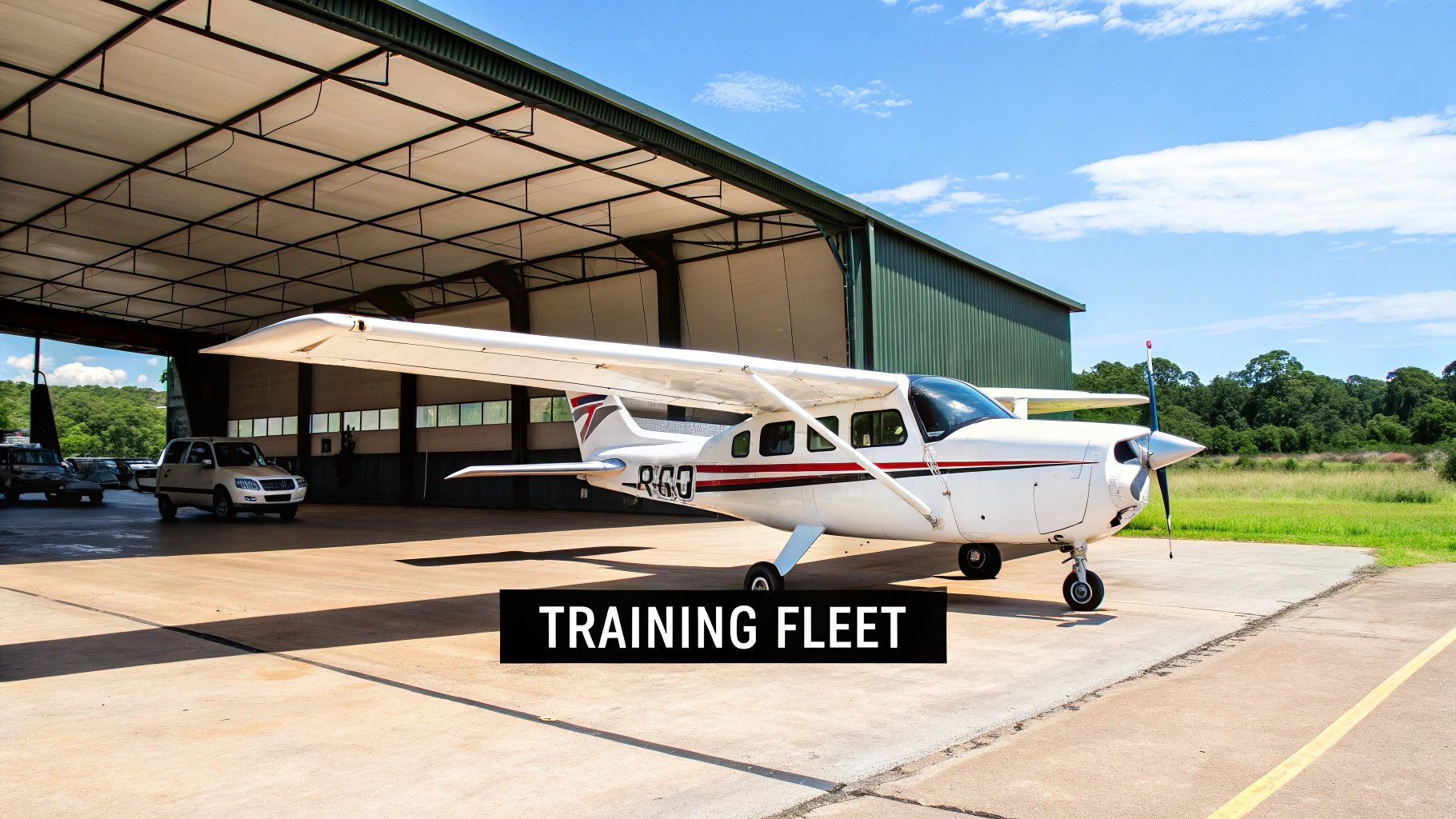
Any seasoned pilot will tell you that a pilot is only as good as their tools. At a Chino Airport flight school, the aircraft and ground facilities aren't just tools; they're the very foundation of your career. Getting to know the fleet is about more than just memorizing model numbers—it's about understanding why certain aircraft are handpicked to forge the skills of tomorrow's airline and helicopter pilots.
Think of these aircraft as your real-world classrooms. This is where theory gets put into practice, from the thrill of your first takeoff to the finesse of a perfect autorotation. The design, reliability, and handling of your training aircraft are absolutely critical. They're chosen specifically for their stability, forgiving nature, and stellar safety records, making them the perfect platforms for launching a professional career.
The Workhorses of Fixed-Wing Training
For anyone dreaming of the airline cockpit, the journey almost always starts in a single-engine piston aircraft. These planes are the global backbone of flight training, built to be predictable and tough enough to handle the endless practice maneuvers that student pilots put them through on their way to a commercial license.
You'll almost certainly see a Cessna 172 on the ramp, and for good reason. It’s often called the most successful aircraft in history, largely because its high-wing design offers fantastic stability and a great view, which really helps build confidence for new pilots. It’s a forgiving machine, meaning it gives you plenty of warning before getting into trouble and gives you time to correct your mistakes.
You’ll also find mainstays like the Piper Cherokee series in many training fleets. Their low-wing design handles a bit differently, which is great for rounding out your skills and giving you a broader feel for different aircraft. Both are trusted platforms for mastering the fundamental skills you'll need for your Private Pilot License and Instrument Rating.
Mastering Vertical Flight in Specialized Helicopters
Helicopter training demands a completely different skill set, which naturally requires a different kind of aircraft. The learning curve can be steep, so you need a machine that’s both responsive and incredibly reliable to prepare you for a commercial pilot role. This is where the Robinson helicopter series truly excels.
The Robinson R22 and its bigger brother, the R44, are the undisputed industry standard for rotorcraft training. Their controls are sensitive and provide immediate feedback, which is exactly what you need to develop the fine motor skills for holding a stable hover—something many pilots call the toughest part of learning to fly a helicopter. Their proven safety record and operational history make them the obvious choice for building a solid foundation in vertical flight.
A great training aircraft isn't the fastest or the most powerful. It's the one that teaches the fundamentals best, with predictable behavior that lets a student safely learn from mistakes and build crucial muscle memory.
Ground-Based Resources That Set You Up for Success
Success in the air always starts with solid preparation on the ground. Modern flight training at Chino is backed by advanced technology that lets you learn and practice in a safe, controlled environment long before you ever leave the ground.
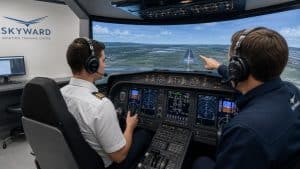
Modern flight simulators have become an essential part of the curriculum. They let you run through complex procedures and emergency scenarios—like an engine failure right after takeoff or navigating in zero visibility—without burning a drop of fuel. This kind of repetition builds the critical decision-making skills that you’ll rely on in the real cockpit.
Of course, behind every great flight is a team of dedicated maintenance pros. An in-house maintenance department ensures that every single aircraft is kept in pristine condition, meeting and exceeding strict FAA standards. This absolute commitment to safety and reliability means you can focus 100% on your training, knowing your equipment is ready for anything.
To get a closer look at what you'll be flying, you can explore the training fleet and their specifications in detail.
Gaining a Competitive Edge at Chino Airport
Getting your pilot’s license is a huge milestone, but let’s be real—in this industry, employers are looking for more than a piece of paper. They want pilots who are sharp, adaptable, and already comfortable in the real-world operational environment. This is exactly where training at a Chino Airport flight school gives you an undeniable head start. You're not just learning to fly; you're immersed in a dynamic aviation ecosystem from day one.
This place is a living, breathing community. Every day you're at the airport, you're sharing the space with charter companies, high-tech maintenance shops, and corporate flight departments. This creates natural networking opportunities you just won’t find at some sleepy, isolated airstrip. A casual chat with a jet mechanic or a charter pilot over coffee can teach you things you’ll never find in a textbook.
Real-World Airspace, Real-World Skills
One of the biggest advantages of learning to fly at Chino is its Class D airspace, which sits right under some of the busiest, most complex airspace in the entire country. This isn't some simulator scenario; it's the daily reality that will sharpen your skills faster than you can imagine.
From your very first flight, you'll be on the radio with air traffic control (ATC), sequencing with all kinds of aircraft, and navigating a genuinely busy traffic pattern. That constant practice builds a level of radio confidence and situational awareness that makes Chino-trained pilots stand out. While other new pilots might feel overwhelmed in a high-density environment, you'll feel right at home because you grew up in one.
Think of it like learning to drive. You could learn on quiet country roads, or you could learn in the middle of a bustling city. Both teach you the rules of the road, but only the city prepares you for the reflexes, quick decisions, and constant communication that define a true professional.
A Diverse Aviation Community
Just look around you on any given day at Chino. You'll taxi past sleek corporate jets, powerful multi-engine turboprops, agile helicopters, and even historic warbirds from the local air museums. This kind of exposure is an education in itself, giving you a much broader perspective on the aviation industry as a whole.
This rich mix of activity has deep roots. San Bernardino County has been shaping Chino Airport's growth since 1961, transforming it from an old military base into the bustling aviation hub it is today. Now, it’s home to everything from flight schools and aircraft sales to specialized military modification centers and crop dusting operations. You can learn more about Chino Airport's multifaceted operations on Wikipedia.
Preparing Helicopter Pilots for Any Challenge
For those of you aiming for the helicopter cockpit, Chino’s environment is just as powerful. The skills required to operate a rotorcraft in a busy, towered airport are exactly what employers in law enforcement, air ambulance services, and tourism are looking for.
Better yet, the unique blend of a complex airport and the varied terrain just a short flight away creates an incredible training ground. Helicopter students get to practice:
- Precision Operations: Mastering confined area landings and takeoffs in challenging local terrain.
- High-Altitude Performance: Gaining a firsthand understanding of how density altitude impacts helicopter performance on flights into the nearby mountains.
- Integrated Airspace Navigation: Learning to transition smoothly between the freedom of uncontrolled airspace and the structured environment of the airport.
It's this daily mix of practical challenges that turns a student into a confident professional. When you graduate from a Chino Airport flight school, you don’t just walk away with a license. You leave with a genuine competitive edge, built on a foundation of real-world experience and a network of connections to help you launch your career.
Your Top Questions About Flight Training in Chino
Deciding to become a professional pilot is a huge step, and it's totally normal to have a ton of questions. After all, it's a major investment of your time and money. We get it.
Here, we’ve put together honest, straightforward answers to the questions we hear most often from aspiring pilots thinking about training at Chino Airport. Let’s clear up the details so you can confidently map out your path to the cockpit.
How Much Does Flight Training Actually Cost?
This is usually the first question on everyone's mind, and for good reason. It's best to think of flight training not as one single price tag, but as a series of steps you take, each with its own cost. While the final number depends on your personal pace and the aircraft you fly, we can give you a solid ballpark figure for planning.
If you're aiming for the airlines, going from zero experience to a Commercial Pilot License (CPL) with an Instrument Rating will typically run between $70,000 and $90,000. That estimate covers everything—flight time, instructor fees, ground school, books, and exam fees—to get you professionally qualified and ready for a job.
For aspiring helicopter pilots, the journey is similar but the costs are a bit different due to the aircraft. Earning your Commercial Helicopter License usually lands in the $80,000 to $100,000 range. The higher cost comes down to the complex mechanics and higher operating expenses of helicopters.
How Long Will It Take to Become a Pro Pilot?
Your training timeline really comes down to you—how much time can you dedicate? Someone who can commit to full-time training will naturally finish faster than a part-timer, and the environment at a Chino Airport flight school is set up to support both.
For a full-time student dreaming of an airline career, a realistic timeline breaks down like this:
- Private Pilot License: 3-4 months
- Instrument Rating: 2-3 months
- Commercial Pilot License: 3-4 months
All in, a focused student can go from their first flight to holding a Commercial Pilot License in less than a year. The timeline for helicopter training is very similar, just with a focus on mastering the unique skills of rotary-wing flight.
The real goal isn't just to log hours; it's to become proficient. Consistency is everything. Flying three or four times a week builds skill and muscle memory way more effectively than flying once every couple of weeks.
Are There Ways to Finance My Training?
Absolutely. We know flight training is a significant financial commitment, and there are several ways to manage the cost. Many of our students successfully fund their training with specialized aviation loans designed specifically for pilot programs.
Companies like Sallie Mae and Meritize offer career-focused student loans that can cover the entire cost. Some students also use personal loans or lines of credit. We always recommend digging into these options to see what makes sense for your financial situation. And while scholarships can be competitive, organizations like the AOPA (Aircraft Owners and Pilots Association) are fantastic resources for finding financial aid.
What Does a Typical Training Day Look Like?
A day in the life of a flight student is a busy mix of classroom theory and real-world flying. The whole schedule is designed to make sure what you're learning sticks.
You might start your day with a pre-flight briefing with your instructor. You'll go over the plan for that day's lesson—maybe you're practicing emergency procedures, flying solely by instruments, or nailing down your landings. This ground time makes sure you've got the theory down before you put it into practice.
Next, you head out to the aircraft for a pre-flight inspection before taking off for your lesson, which is usually about an hour or two in the air. Once you’re back on the ground, a post-flight debrief helps you lock in what you learned, pinpoint areas to work on, and set the goals for your next flight. Sprinkled in between flying, you’ll be hitting the books for ground school, studying for written exams, or getting time in the flight simulator. It's this balanced approach that shapes you into a smart, skilled, and confident pilot.
Ready to take the first step toward the cockpit? At DuBois Aviation, we provide personalized, one-on-one instruction to help you achieve your career goals. Learn more about our comprehensive airplane and helicopter training programs.