
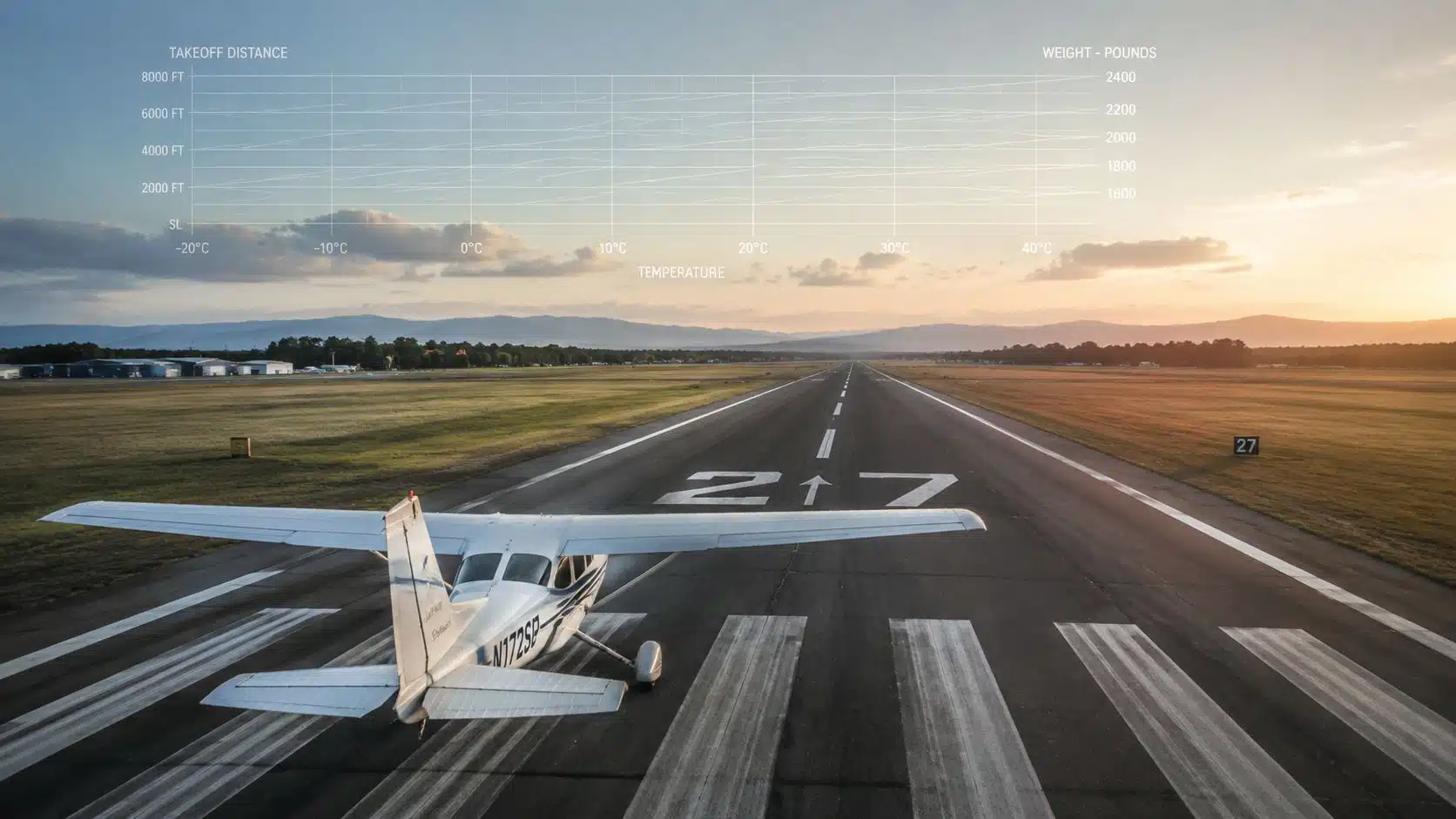
The first time a student pilot looks at a runway at Chino Airport, it's easy to think the hard part is already printed on the chart. You see a number, copy it into your notes, and assume that's the runway you have. Then an instructor asks about weight, temperature, wind, slope, and which runway you're using, and the simple answer gets a lot less simple.
That's the right moment to learn the habit. Runway length requirements aren't a fixed label on the pavement, they're the result of a performance check you make for the aircraft, the weather, and the runway itself. At a busy field like KCNO, where mixed traffic and multiple runways make everyday decisions feel critical, that way of thinking matters from the very first lesson.
Table of Contents
- The Runway Number on the Chart Is Not the Whole Story
- How FAA Planning Defines Runway Length Requirements
- Reading the Performance Chart the Right Way
- Worked Examples for the Training Aircraft You Will Actually Fly
- Why a Dry Runway Number Is Not the Real Number
- Putting It Together at Chino Airport
- How DuBois Aviation Builds Performance Planning Into Every Lesson
The Runway Number on the Chart Is Not the Whole Story
A student at Chino might look up the runway length, write it down, and feel done before the preflight even gets interesting. That number is useful, but it's not the whole answer. The runway you can use depends on the airplane, the conditions, and the part of the pavement that's available.
Published length, available length, required length
The charted number is the runway's published length. The available length can be smaller if part of the pavement is displaced, closed, or otherwise not usable for the phase of flight you're planning. The required length is what your airplane needs today, and that's the number that matters before you taxi.
That difference is where many new pilots get tripped up. They assume the airport's number is a promise, when it's really just the starting point for the decision. On a calm morning in a light trainer, the margin may feel generous. On a hot afternoon with more weight aboard, the same runway can feel very different.
Practical rule: Never ask, “How long is this runway?” Ask, “How long is this runway for this airplane, at this weight, in these conditions?”
That mindset is exactly how airport planners think, and it's how pilots should think too. A runway is not a static object in flight planning, it's a performance environment. The airplane, the weather, and the runway surface all change what the number means.
A good way to picture it is this, the runway length printed on a chart is like the size of a parking space on a map. Your airplane still has to fit it today, with the conditions that exist right now. If you only memorize the charted length, you miss the part that keeps flight planning honest.
How FAA Planning Defines Runway Length Requirements
The FAA doesn't treat runway length as a single universal number. Its primary planning guidance, FAA Advisory Circular AC 150/5325-4B, uses the critical aircraft concept, which means planners identify the aircraft expected to use the runway regularly over at least five years, then select the airplane or family of airplanes that needs the longest runway at maximum certified takeoff weight (MTOW). You can see the circular itself in the FAA's advisory circular library and the related planning document for the same framework in the FAA runway length advisory circular and the FAA AC 150/5325-4B PDF.
Why the FAA starts with the critical aircraft
That approach makes sense because airports serve different missions. A field that mostly supports light training aircraft doesn't need the same pavement as one that regularly handles larger commercial jets. The planning question is never just, “How long can we build?” It's, “Which aircraft must this runway reliably support?”
The FAA method also looks beyond the airplane itself. It uses aircraft grouping, MTOW, useful load, and airport conditions such as gradient and pavement condition to shape the recommendation. In other words, the runway length result depends on the mission and the environment, not a universal hard minimum. The same airport can need different runway lengths if the fleet mix changes or the design mission changes.
A useful student-pilot version of that logic is simple. Before takeoff, identify the most demanding part of your flight today, then check the performance data that matches that demand. If you're flying a light trainer, that airplane is your critical aircraft for the day. If the runway is short, contaminated, or affected by slope, the same logic tells you to be more careful with your planning, because the answer isn't just about charted pavement.
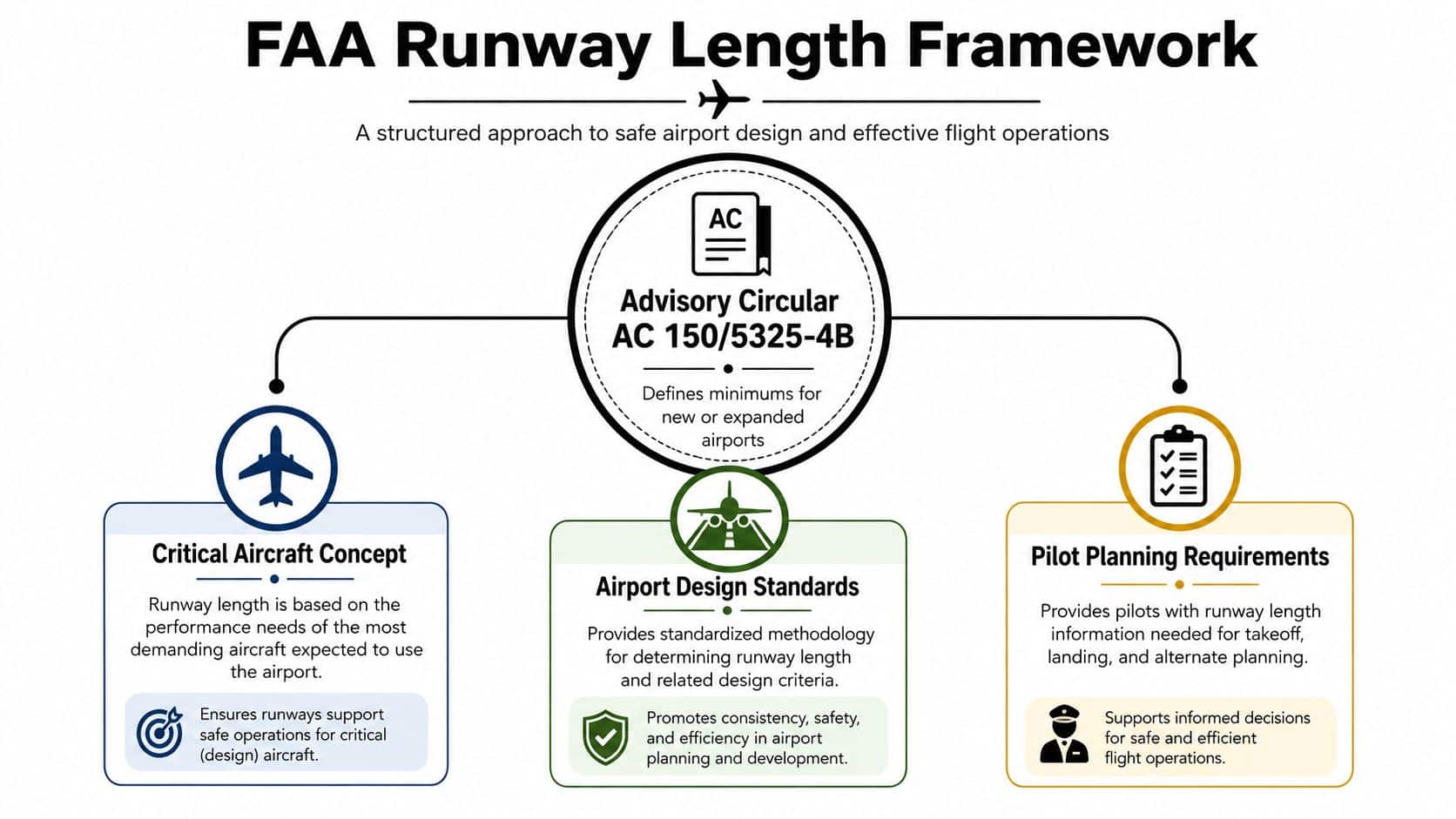
The FAA's framework is a planning tool, not a magic rulebook. Airport designers use it to decide what the runway should support over time, and pilots use the same logic in miniature every time they compare an aircraft's needs to the runway in front of them. For more on the altitude side of that calculation, see pressure altitude basics.
Reading the Performance Chart the Right Way
A performance chart is where the runway question becomes personal. It turns a general runway into a specific answer for your airplane, your weight, and today's weather. If the FAA framework is the airport's logic, the performance chart is the pilot's version of the same idea.
One chart, several moving parts
The chart doesn't give one fixed number because flight performance doesn't work that way. It changes with pressure altitude, temperature, weight, wind, and runway condition. That's why charts are organized by conditions instead of by airport name. They're meant to help you find the cell that matches your flight, not hand you a single answer for every day.
A tire-pressure chart for a car offers a useful comparison. A full load on a hot road doesn't call for the same setting as an empty car on a cool morning. The airplane is the same way. Heavier weight usually means more runway. Hotter air usually means more runway. A headwind can help, while a tailwind takes margin away. A wet runway changes the answer again, because braking and rollout are different when the surface isn't dry.
Good cockpit habit: Read the chart with the same calm order every time, altitude first, temperature second, weight third, then wind and runway condition.
That habit matters a lot at inland Southern California airports, where a warm afternoon can change the performance picture even when the runway looks unchanged. The pavement hasn't moved, but the airplane's relationship to it has. That's why looking at the chart is never busywork, it's part of deciding whether the runway is long enough in practice.
The safest way to use a performance chart is to work slowly and compare every input to the actual flight. If you round carelessly or skip a condition because it feels minor, you're no longer using the chart. You're guessing with a nicer format.
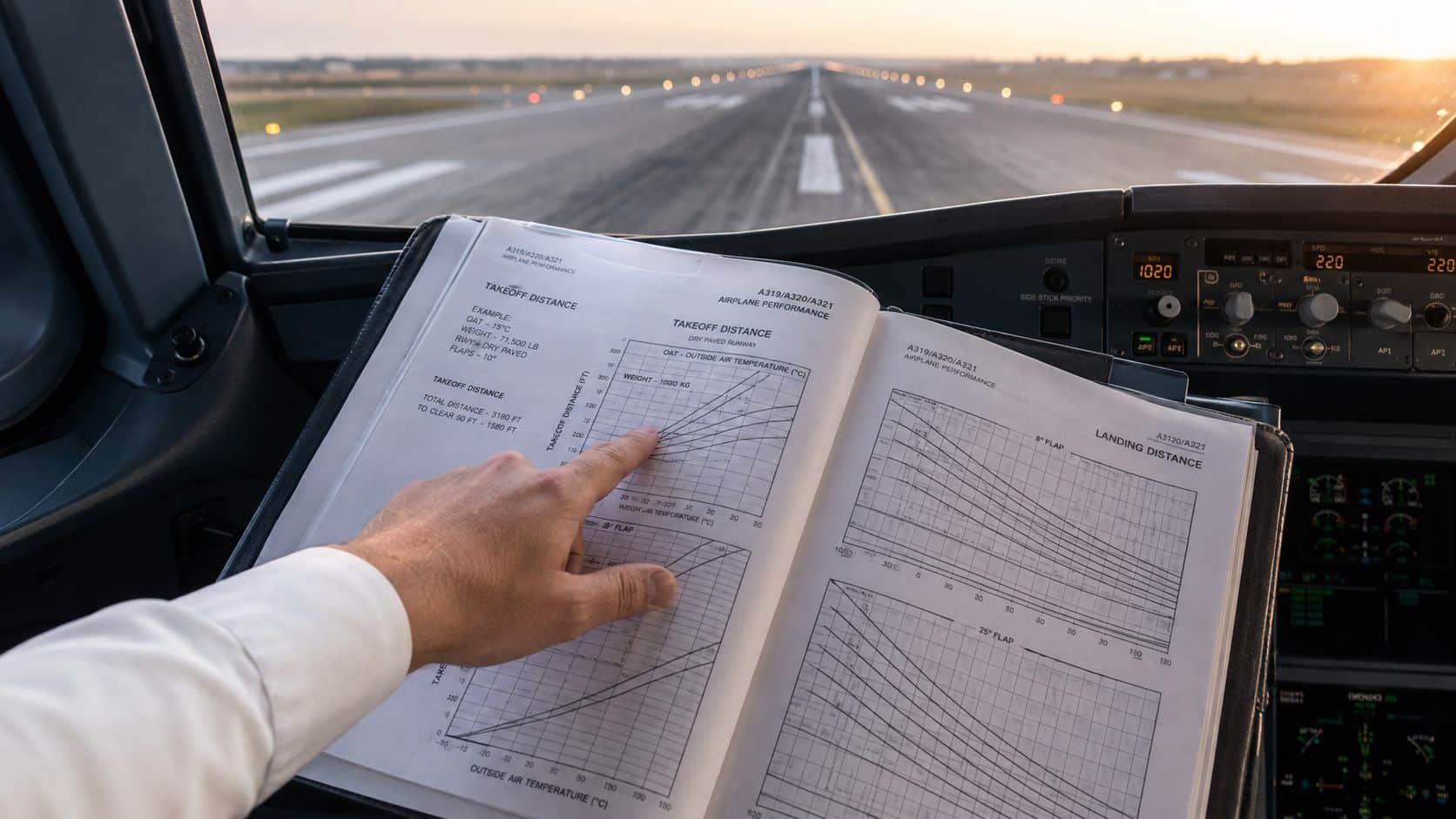
For a deeper walk-through of how those numbers get read, the chart-focused discussion at aircraft performance charts is a helpful companion. The key idea is simple, the chart doesn't replace judgment, it organizes it.
Worked Examples for the Training Aircraft You Will Actually Fly
The fastest way to understand runway length is to stop treating it like an abstract airport topic. Walk it through the airplane you're likely to fly. The method stays the same whether you're in a small trainer, a multi-engine airplane, or a helicopter, even though the details of the chart change.
Small trainers and the habit of checking weight
A Cessna 172 or Piper Cherokee forces the right mental discipline because the airplane feels manageable until the conditions stack up. A cool morning may give you comfortable margin, while a hotter day and a heavier loading can shrink it. That's why student pilots should always compare the chart to the exact flight, not a remembered “usual number.”
A Cherokee at a higher training weight on a warm Chino afternoon may call for a different runway choice than the same airplane on a cool morning. The aircraft hasn't changed, but the performance picture has. That's the lesson: weight and temperature move the answer.
Multi-engine and helicopter planning use the same logic
A Piper Apache adds another layer of seriousness because multi-engine operations usually force pilots to think more carefully about margins and execution. The logic is still the same, though. You check the performance data, you compare it to the runway or landing area, and you make the decision before you move.
A Robinson R22 helicopter changes the mental model, but not the discipline. Hover and takeoff performance don't look like fixed-wing runway performance, yet the pilot still has to ask whether the operating area gives enough room for the planned maneuver. The habit is identical, even when the chart doesn't resemble a runway table at all.
| Aircraft category | Typical takeoff length | Typical landing length |
|---|---|---|
| Small training airplane | Short runway range for light operations | Short runway range for light operations |
| Light twin-engine trainer | Longer than a small trainer, depending on load | Longer than a small trainer, depending on load |
| Small helicopter | Not a runway-based calculation in the usual sense | Not a runway-based calculation in the usual sense |
The exact number comes from the airplane's own manual and the day's conditions, not from a generic memory aid. That's the point of the exercise. If you practice the same workflow in every lesson, the chart stops feeling like a test and starts feeling like a tool.
Instructor's habit: if the result is close, don't talk yourself into it. Recheck the inputs, then choose the option with room left over.
Why a Dry Runway Number Is Not the Real Number
A dry runway can still be the wrong runway if you're planning from the bare landing distance alone. Flight Safety Foundation's ALAR briefing note says required landing runway length is the actual landing distance multiplied by 1.67 in dry conditions and 1.92 in wet conditions, which means wet-runway planning needs about 15% more runway than the dry-factor method alone (Flight Safety Foundation ALAR briefing note). That's not a theoretical detail, it's the margin that keeps a landing plan realistic.
Why safety margins belong in the number
The reason is simple. Landing isn't a perfect math problem. Flare timing, braking effectiveness, surface condition, and pilot technique all vary. A safety factor makes room for that variability instead of pretending it doesn't exist.
The same caution shows up in runway planning more broadly. FAA guidance for runway design is built around performance inputs and planning assumptions, not a single raw number that never changes. That's also why pilots should avoid treating the shortest possible landing distance as enough. The number on the page is not the same thing as the number you want under your wheels.
A dry runway may look long enough when you first glance at it. Once the surface is wet, or the margin gets eaten up by technique and conditions, the usable cushion gets much thinner. That's why professional planning always asks for more than the minimum.
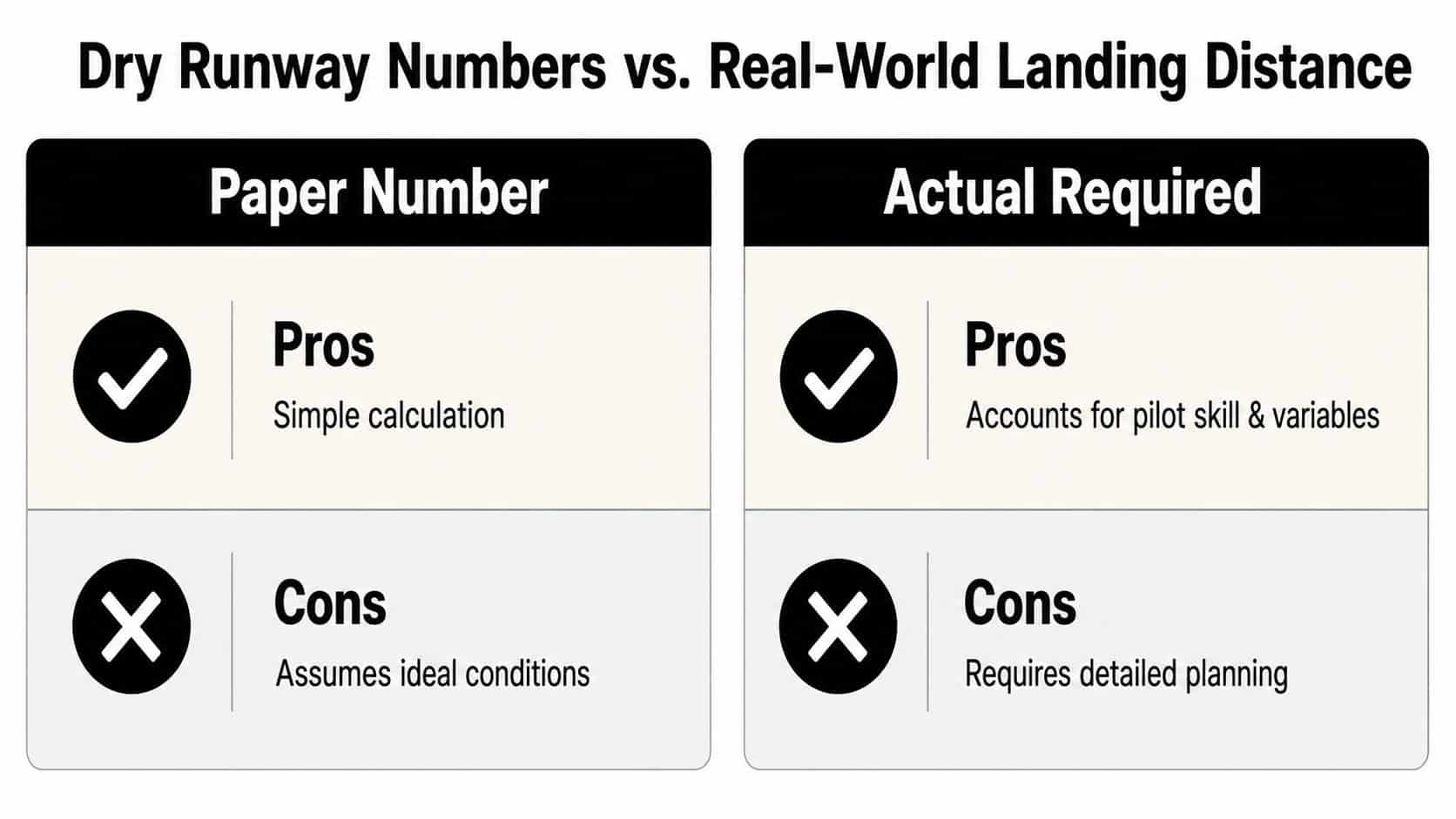
The landing-distance discussion at landing distance calculation is a useful reminder that the runway number you trust should already include the room real flying demands. If it doesn't, you're not planning conservatively enough.
Putting It Together at Chino Airport
At Chino, the runway choice is part of the performance decision, not a separate chore. There are three runways at the field, and the decision between them can change your usable margin before you even start moving. A student who only looks at one published length misses the key question, which runway gives the best combination of length, wind, and usable pavement for this flight.
A real preflight decision
Start with the aircraft weight after fuel and passengers. Then check the temperature, the wind, and whether the runway condition favors one direction over another. If a runway gives you more headwind and more usable length, that's often the safer choice, even before you think about the rest of the day's traffic.
Threshold markings, displaced thresholds, slope, and the actual usable surface all matter here. A charted length only helps if it matches the part of the runway that counts for your phase of flight. Good instructors train that habit early, so the student doesn't treat runway choice as something to improvise under pressure.
The strongest lesson at a busy airport is that runway planning is never isolated. You're not just asking whether the airplane can do the job. You're asking whether it can do it with margin, on the runway that makes the most sense right now.
A pilot who builds that habit will be calmer in the cockpit and more consistent on checkride day. The decision becomes ordinary, which is exactly what it should be. Routine performance planning is one of the easiest ways to stay ahead of the airplane.
How DuBois Aviation Builds Performance Planning Into Every Lesson
At Chino Airport, DuBois Aviation makes runway planning part of normal training, not a special topic reserved for checkride prep. One-on-one instruction, the in-house simulator, and a mixed fleet of fixed-wing trainers and helicopters make it easy to compare performance thinking across different aircraft and conditions. That repetition matters, because the habit only sticks when students use it on ordinary flights.
A student who learns to check the chart, compare the conditions, and pick the runway with margin is building a career skill, not memorizing a number. That same habit carries into the private pilot checkride, instrument work, and the rest of a flying life. It's the kind of discipline that makes short fields, warm days, and busy airports feel manageable instead of rushed.
If you want to train runway planning the way working pilots do it, DuBois Aviation can help you build that habit from the start. Explore DuBois Aviation to see how flight instruction at Chino Airport turns performance planning into a routine part of every lesson.