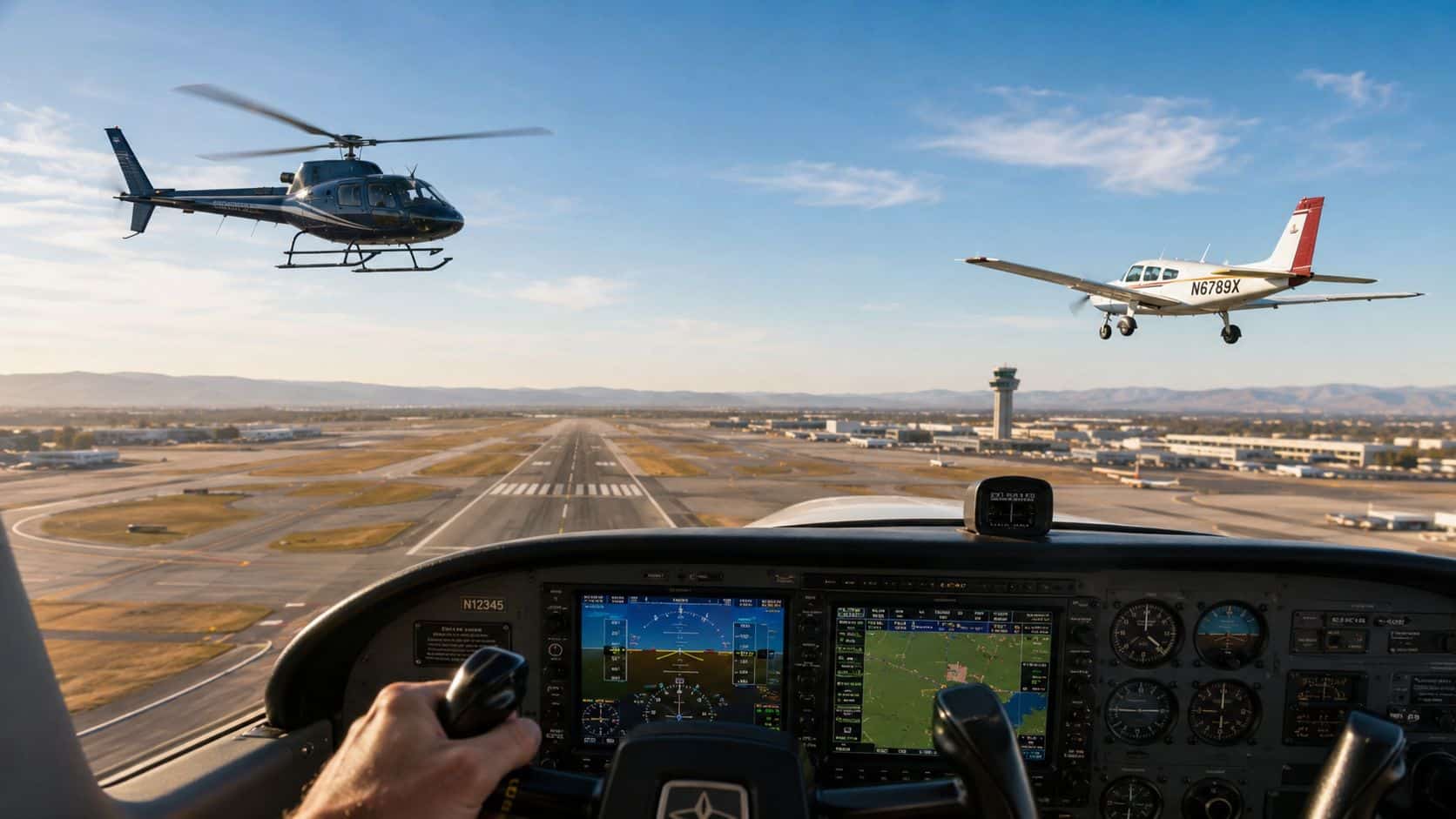
You're base to final at a towered airport, the radio won't stay quiet, and the traffic picture keeps changing. A helicopter is drifting across your pattern, another airplane is lining up straight-in, and your tablet shows an ADS-B target that doesn't seem to match what you can see. That's the world of collision avoidance techniques, not a clean diagram in a handbook.
Good pilots don't treat collision avoidance as one trick. They stack visual scanning, right-of-way judgment, traffic technology, and trained maneuvering so each layer covers the limits of the others. At a place like Chino Airport, where fixed-wing traffic, helicopter operations, and towered procedures all overlap, that layered mindset matters every time you turn downwind, extend base, or merge into the pattern.
Table of Contents
- Why Collision Avoidance Demands More Than Rules
- Effective Visual Scanning Patterns
- Right-of-Way Rules and See-and-Avoid in Practice
- Using Traffic Technology Without Over-Reliance
- Avoidance Maneuvers and Helicopter Considerations
- Human Factors That Undermine Collision Avoidance
- Building Proficiency Through Deliberate Training
Why Collision Avoidance Demands More Than Rules
A student on downwind at a busy field does not get one traffic problem, then a pause. The workload stacks. A helicopter crosses low and slow, a faster airplane slides in on a straight-in, and the student still has to hold altitude, make the right radio calls, and decide whether the spacing is safe. In a Class D pattern like Chino Airport, that is the core task, sorting out several threats at once while still flying the airplane. That is why collision avoidance techniques cannot be reduced to memorizing right-of-way categories.
The first mistake many pilots make is assuming the rule book solves the encounter by itself. It does not, because the rule book does not account for cockpit glare, blind spots, tailwinds, or another pilot who may also be maneuvering. A good CFI teaches that avoidance is a mix of lookout discipline, radio awareness, technology interpretation, and the habit of treating any single clue as only part of the picture.
Layered thinking beats single-skill flying
That layered approach fits the history of airborne collision avoidance too. Early collision avoidance prototypes led to coordinated international work by ICAO, including the Seventh Air Navigation Conference in 1972, the 74 recommendations tied to secondary surveillance radar and ACAS, SICASP in 1981, Circular 195 in 1985, and a worldwide operational evaluation in the late 1980s and early 1990s (ICAO ACAS history). That progression points to the same lesson you feel in the pattern, manual discipline became a coordinated safety system only after multiple layers were built and tested.
Practical rule: if one traffic source seems to tell a complete story, assume it is incomplete until your eyes, radios, and scan pattern agree.
That matters in both airplane and helicopter training. Helicopters can change geometry quickly, fixed-wing aircraft usually cannot, and busy Class D traffic mixes both in the same slice of sky. A helicopter on short final, a trainer turning base, and a straight-in arrival can all fit into the same visual scene, but each one demands a different read on closure, altitude, and timing. The answer is not a single magic maneuver. It is learning how the layers work together before the airspace gets crowded.
Effective Visual Scanning Patterns
A student can move their eyes all day and still miss traffic. Scanning only works when the eyes pause long enough for the brain to register movement, shape, and relative drift against a busy cockpit background, especially when radios, checklists, and instrument cross-checks are competing for attention.
Divide the windscreen into sectors
FAA-style guidance cited by AOPA recommends a sector-based scan, not a random sweep. Divide the sky into sections, pause in each one, and look deliberately through that sector rather than skimming past it (AOPA collision avoidance technique guidance). In each sector, extend your focus about 10 degrees above and below the horizon, because traffic does not always sit exactly on the horizon line.
That pattern fits the way traffic appears in a busy Class D pattern. On downwind, base, and final, the most likely conflicts often sit in predictable places, so start there and work outward. Head movement matters too. A slight turn can reveal an aircraft hidden by the window frame, the glareshield, or your headset position.
Keep the scan active after the first sighting. A target that is visible once can disappear behind cockpit structure, and the second look is often the one that matters.
Night scanning needs different habits
At night, the eye's center blind spot becomes more noticeable because the scene is darker and small lights are easier to lose. AOPA's guidance recommends offsetting the gaze about 10 degrees to help with that problem, and keeping the windshield clean so light is not scattered by dirt or bugs (AOPA collision avoidance technique guidance). The same guidance also stresses a sterile cockpit during critical phases and using ADS-B as a cross-check, not a substitute.
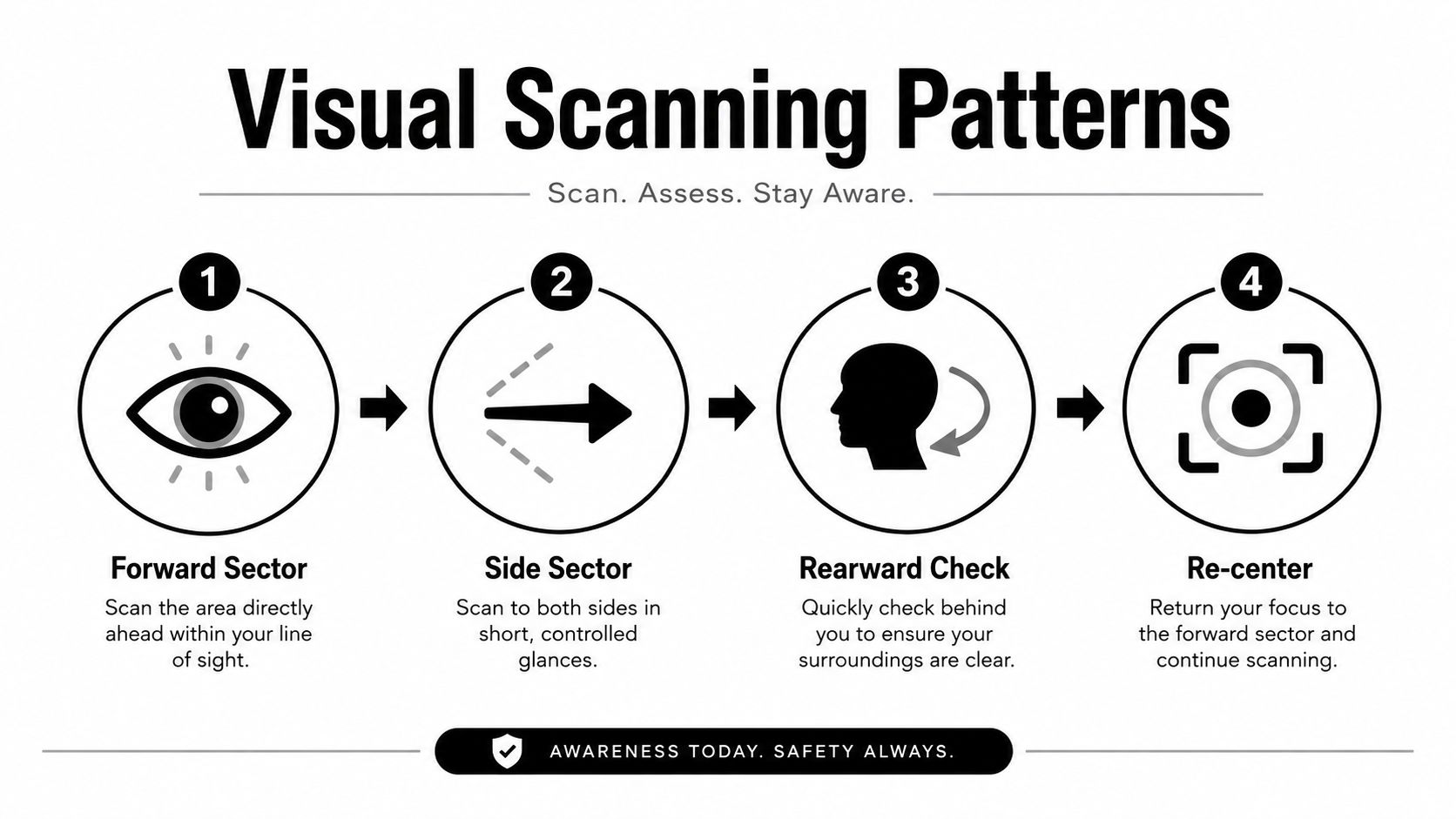
A practical routine is easy to build. Look forward, check the side sectors, glance rearward when your cockpit and aircraft type allow it, then re-center your scan on the most likely conflict area. That is how a busy towered pattern starts to make sense. You are not hunting one airplane, you are checking several layers at once, visual traffic, radio picture, cockpit technology, and the human tendency to focus on the wrong thing for too long.
Right-of-Way Rules and See-and-Avoid in Practice
Right-of-way rules look tidy on the page. In a busy pattern, they become a moving target. Head-on, converging, overtaking, and landing priority all seem straightforward until two airplanes both start making defensive moves at once, or a helicopter crosses the pattern where a student expected only fixed-wing traffic. That is the point where see-and-avoid has to carry most of the load.
The legal side still matters. Pilots are required to maintain vigilance to “see and avoid” other aircraft under FAR 91.113(b), and that duty does not disappear just because ATC is talking to you. The controller helps organize traffic, but the pilot still has to keep the scan alive.
When the textbook answer is not enough
A clean rule hierarchy does not match the way traffic unfolds. A faster airplane on a straight-in may conflict with pattern traffic that is already established. Two aircraft may both maneuver, which changes the geometry faster than the radio can explain it. Helicopters add another wrinkle, because they can operate in places and altitudes that fixed-wing pilots may not expect.
The better question is simple. What is the other aircraft doing, and what could it do next? That mindset fits the published history of collision avoidance, from early ACAS work to later standardized systems, because the world always includes imperfect human behavior and changing traffic flow.
| Situation | What the rule says | What the cockpit reality demands |
|---|---|---|
| Head-on | Both aircraft avoid leftward closure | Confirm the other pilot's intent, then act early |
| Converging | The aircraft with the other on its right gives way | Keep scanning because the other pilot may still turn |
| Overtaking | The overtaking aircraft stays clear | Watch for speed changes and wake effects |
| Landing sequence | Landing traffic gets priority | Verify whether the aircraft is fully established or still repositioning |
A good local resource on the rule basics is the right-of-way rules guide, but the skill is applying those basics while the situation changes. The pilot who keeps scanning after the first correction usually sees the next problem before it becomes urgent.
Using Traffic Technology Without Over-Reliance
Traffic displays are useful because they compress a lot of uncertainty into bearing, altitude, and trend information. They're also dangerous when pilots start treating them like truth instead of clues. ADS-B In, TCAS, and TIS all help, but none of them eliminates the need to look outside.
What each system is good at
ADS-B In gives you a richer traffic picture when the other aircraft is equipped and broadcasting. TCAS is the airborne collision avoidance architecture that evolved from the early ACAS work and became central to commercial aviation, with later analysis showing that when both aircraft carry TCAS 2, collision risk is about 97% lower than without the system, while ACAS Xa reduces relative risk by about 98.5%, roughly 40% better than TCAS 2 (FAA TCAS II v7.1 booklet). TIS can add traffic awareness in some environments, but like the others, it only sees what the system is designed to see.
What they can't see
None of these systems is magic. An aircraft without the right equipment, or with malfunctioning equipment, may be missing from your display even though it's very much in the pattern. That's why the outside scan still matters on every approach, especially at a place where helicopters and airplanes share the same airspace.
| Traffic Technology Comparison for GA Pilots | What It Detects | Key Limitation | Best Use Case |
|---|---|---|---|
| ADS-B In | Broadcast-equipped traffic and relative motion | Misses non-equipped or poorly equipped traffic | Pattern awareness and en route cross-checking |
| TCAS | Transponder-equipped traffic and conflict cues | Depends on transponder performance and installation context | Higher-density traffic and airborne conflict alerting |
| TIS | Traffic information from supporting surveillance | Limited availability and incomplete picture | Supplemental traffic awareness where available |
A practical habit is to correlate the display with a real visual cue before you trust the trend arrow. If the screen says traffic is three o'clock and level, then your scan should go there immediately. If you still can't see it, keep looking outside, because the display may be incomplete rather than wrong.
Avoidance Maneuvers and Helicopter Considerations
There is no universal evasive move that solves every encounter. The right response depends on closure rate, relative altitude, where the other aircraft is already drifting, and what else is around you. That's true in airplanes, and it's even more obvious in helicopters, which can sometimes alter the geometry faster than fixed-wing aircraft can.
Match the maneuver to the encounter
For head-on encounters, early lateral separation is usually the cleanest answer. For crossing traffic, a climb or descent may be safer than a shallow turn if the airspace below or above is clear. For overtaking, the goal is to stay predictably out of the lead aircraft's path, not to force a dramatic move that creates another conflict.
A mixed pattern is where judgment matters most. If a helicopter is hovering or transitioning near runway traffic, a fixed-wing pilot should not assume the helicopter will behave like an airplane. The better response is to widen the mental picture, keep scanning, and avoid locking onto one moving target while forgetting the others.
Practical rule: after any avoidance maneuver, scan again immediately. The aircraft you just reacted to may also turn, and the maneuver can create a new conflict on a different bearing.
A good helicopter-specific training environment teaches this directly. Robinson helicopter transition training gives students a chance to see how rotorcraft positioning, low-speed control, and pattern flow change the avoidance picture in ways a fixed-wing pilot might not expect (Robinson helicopter training). That same mixed-airspace awareness becomes more important when you're around busy airports with helicopter arrivals, pattern work, and intersecting departures.
For crews that want to sharpen judgment beyond the cockpit, a structured resource like emergency response security training can help reinforce calm decision-making under pressure. The point isn't to turn aviation into a checklist contest, it's to train yourself to recognize threat geometry before panic narrows your options.
Human Factors That Undermine Collision Avoidance
A pilot can know every rule and still miss the airplane. That usually happens because the problem isn't knowledge, it's expectation bias, distraction, glare, or blind spots. The eye and brain are good at finding what they expect to find, not necessarily what is present there.
The cockpit can lie to you in quiet ways
Empty sky creates a kind of visual laziness. The eye keeps searching, but there's little contrast to grab onto, and cockpit structure can hide traffic long enough for the closing geometry to change. Windshield contamination and glare make that worse, and no traffic display can fully remove a blind area caused by the airframe itself.
AOPA's guidance already leans on the idea that see-and-avoid remains the primary layer in manned aviation, with ADS-B only as a supplement (AOPA collision avoidance technique guidance). That lines up with the broader situational-awareness problem, because a pilot who is mentally committed to one traffic picture will often ignore small contradictions until they become large ones.
Countermeasures that actually help
- Break expectation bias: if you expect traffic only on final, force a full scan of the sectors where you least expect it.
- Protect attention: a busy towered frequency can saturate your working memory, so finish one task before starting the next.
- Use the display correctly: treat ADS-B as a cue to look outside, not as a reason to stop looking.
- Keep the view clear: clean windshields and sensible cockpit organization matter more than many admit.
A useful companion read is what situational awareness means in aviation, because collision avoidance starts long before the other airplane appears in the windscreen. The pilot who stays skeptical of his own assumptions usually spots the mismatch sooner.
Building Proficiency Through Deliberate Training
Collision avoidance gets better when you train it on purpose. You don't become sharp at traffic detection by hoping the pattern is quiet, and you don't build solid maneuver judgment by only reading about it. A useful progression starts simple and gets harder as your scan, radios, and decision-making mature.
Build it in stages
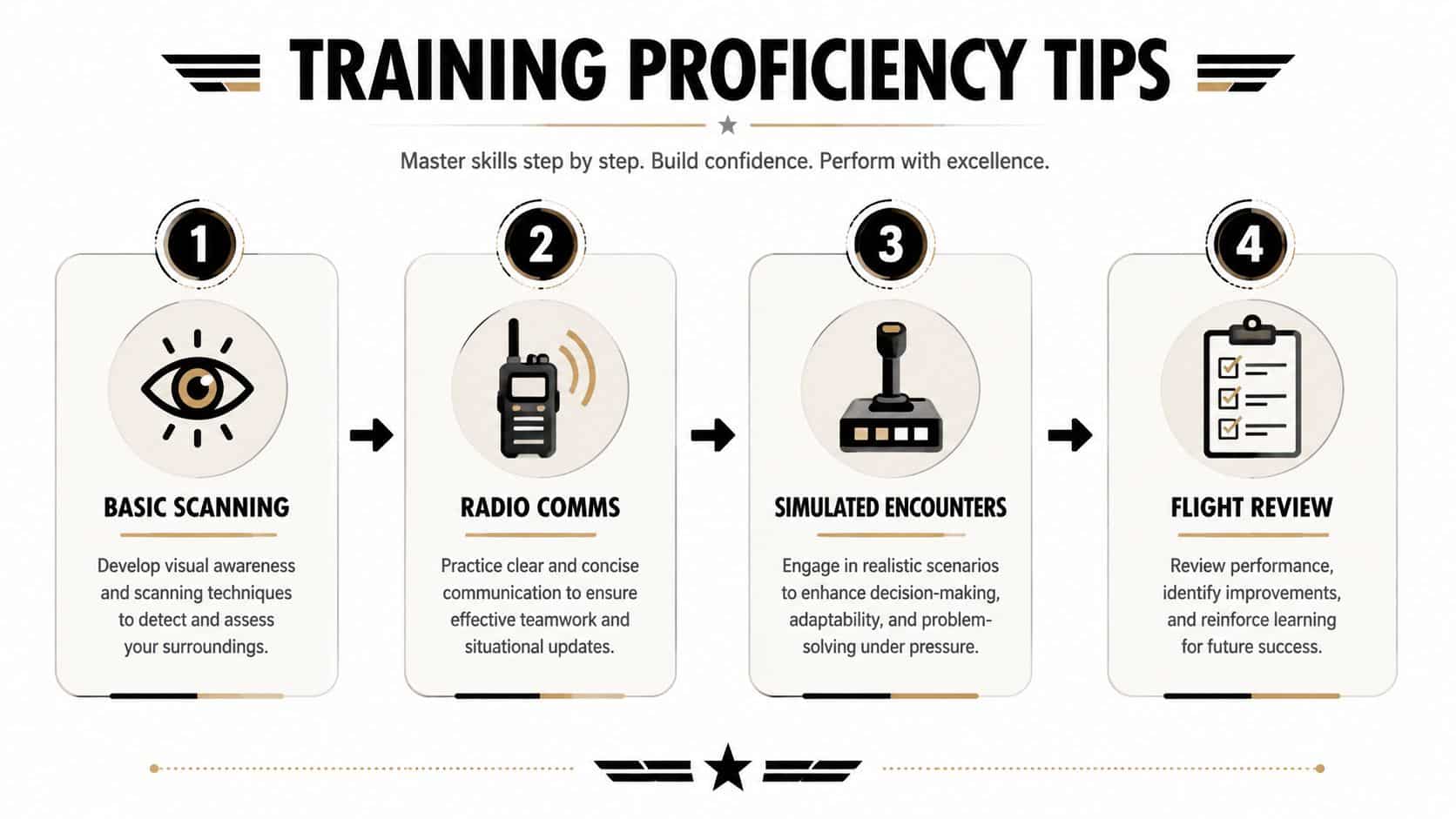
Start with basic scanning in low-traffic airspace, where you can work on sector discipline without being rushed. Then move into busier pattern work, where the challenge is talking, flying, and scanning without letting any of them collapse. Simulator sessions help here because you can build multiple threat scenarios without creating real conflict.
A practical syllabus can look like this:
- Basic scanning. Call out traffic sectors while the airplane is stable and the workload is low.
- Radio management. Make position reports and listen for traffic while keeping the outside scan alive.
- Simulated encounters. Add converging, overtaking, and pattern-intercept situations in a simulator or with an instructor.
- Flight review. Debrief every traffic encounter, even the ones that felt routine.
Turn each flight into a traffic lesson
During cross-country legs, say where you think the threat is before your instructor does. In the pattern, notice whether you searched the correct sector first, or whether your eyes went where you hoped the traffic would be instead of where it was. After landing, talk through the specific moment when you first saw the aircraft and what cue made it visible.
If you want a fast way to organize those lessons into a repeatable format, a resource like build a training manual fast can help you structure your notes so they're easy to review later. The goal is not paperwork, it's making your scan habits visible enough that you can fix them.
If you're training in Southern California and want that same layered approach in real towered-airport traffic, visit DuBois Aviation to explore airplane and helicopter instruction, aircraft rental, and training that builds real collision-avoidance judgment in the pattern, on the radios, and in the cockpit.


