
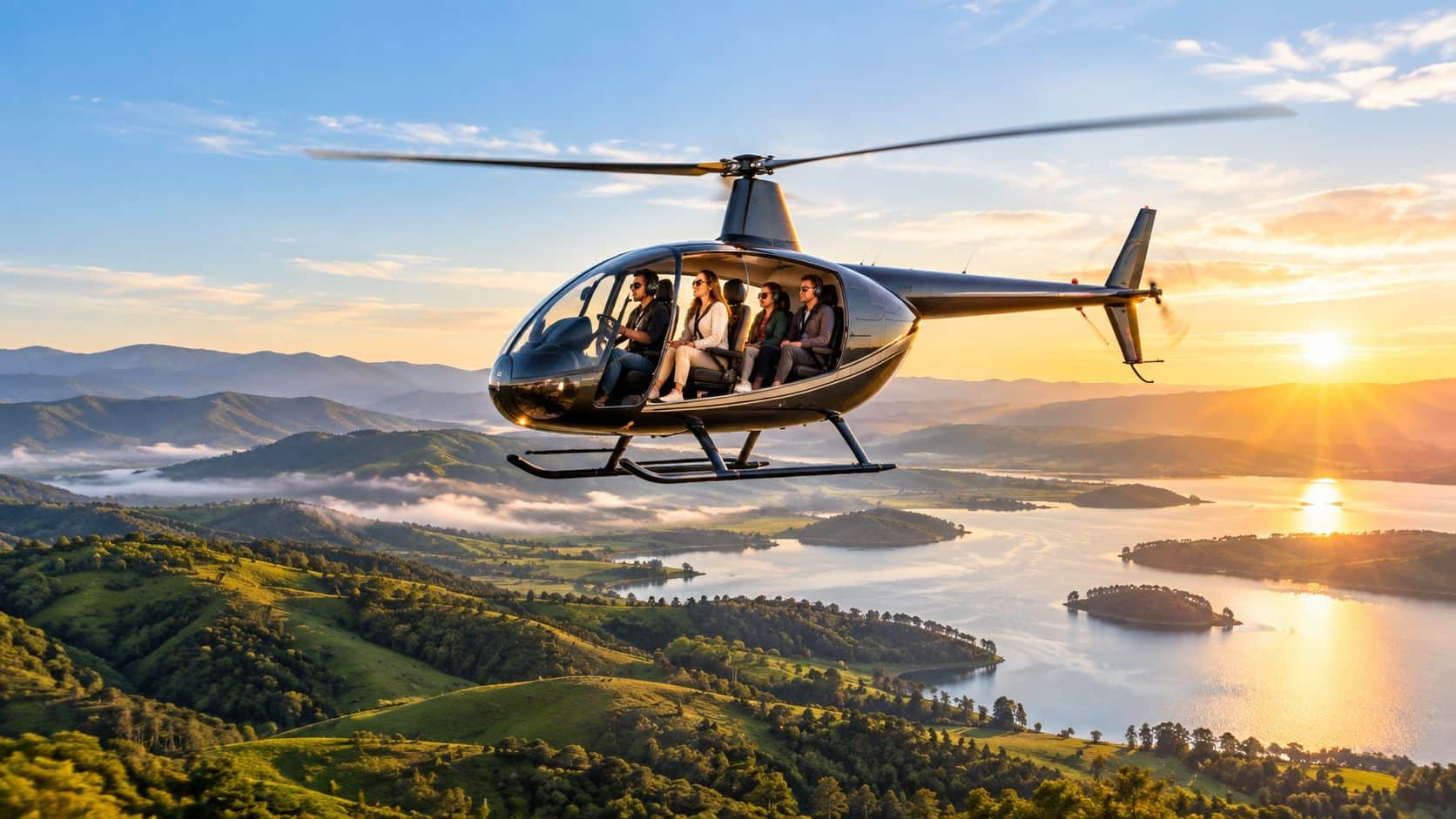
16 fatal crashes killed 46 tourists and 9 pilots in a 28-year Hawaii sightseeing-helicopter study, while rule changes later reduced the crash rate by 47%, from 3.4 to 1.8 crashes per 100,000 flight hours. Scenic helicopter flights are paid sightseeing tours regulated by the FAA as commercial air-tour operations, not informal rides or ordinary student flights.
A first-time passenger usually begins with check-in, a weight confirmation, and a safety briefing before walking to the helicopter. After boarding, the pilot secures the doors or confirms the doors-off setup, connects the headset, checks the microphone, and explains how to speak during the flight. The helicopter lifts vertically, turns toward the route, settles into cruise, and follows a planned path that gives each passenger useful views before returning for a controlled landing.
The experience combines aircraft operation, low-level scenic viewing, and pilot narration. The aircraft may be a light piston helicopter with a compact cabin, so noise is substantial even through headsets. The pilot remains responsible for aircraft control, navigation, weather decisions, passenger coordination, and safe spacing, even while describing landmarks.
Table of Contents
- What a Scenic Helicopter Flight Actually Is
- The Chino Hills and Prado Basin Route Experience
- Pilot Credentials and the Safety Rules Behind the Flight
- Booking, Pricing, and Planning Around Weather
- Who These Flights Are Really For
- Preparing for the Day and What Comes After
What a Scenic Helicopter Flight Actually Is
Under FAA air-tour rules, a sightseeing flight conducted under visual flight rules in an airplane or helicopter for compensation or hire is an air tour. That means a public scenic helicopter flight is a commercial aviation operation, with requirements that differ from a private flight arranged among friends or a discovery flight designed to introduce a prospective student to flight training. The regulatory definition is summarized in the FAA air-tour rule reference.
The passenger experience normally follows a predictable sequence:
- Check-in and passenger information: The operator confirms identities, passenger totals, and any restrictions that affect seating or loading.
- Safety briefing: Passengers learn how to use restraints, headsets, doors, and emergency equipment. The briefing also covers movement near the aircraft.
- Boarding: Ground personnel direct passengers to the helicopter, because rotorcraft require disciplined approach and departure paths.
- Engine start and headset check: The pilot verifies communication before taxiing or lifting off.
- Takeoff and cruise: The helicopter climbs, turns toward the scenic route, and adjusts altitude and speed for terrain, airspace, noise, weather, and visibility.
- Return and landing: The pilot rechecks the landing area, settles the aircraft, and waits for rotor movement to stop before passengers exit.
A short local tour may use a compact seating arrangement with the pilot in front and passengers behind or beside the pilot, depending on the aircraft. Operators typically describe the product by flight time or route rather than promising that every passenger will see precisely the same view. A helicopter can slow, turn, and reposition more easily than a fixed-wing aircraft, but the pilot still has to preserve safe margins.
Doors on and doors off
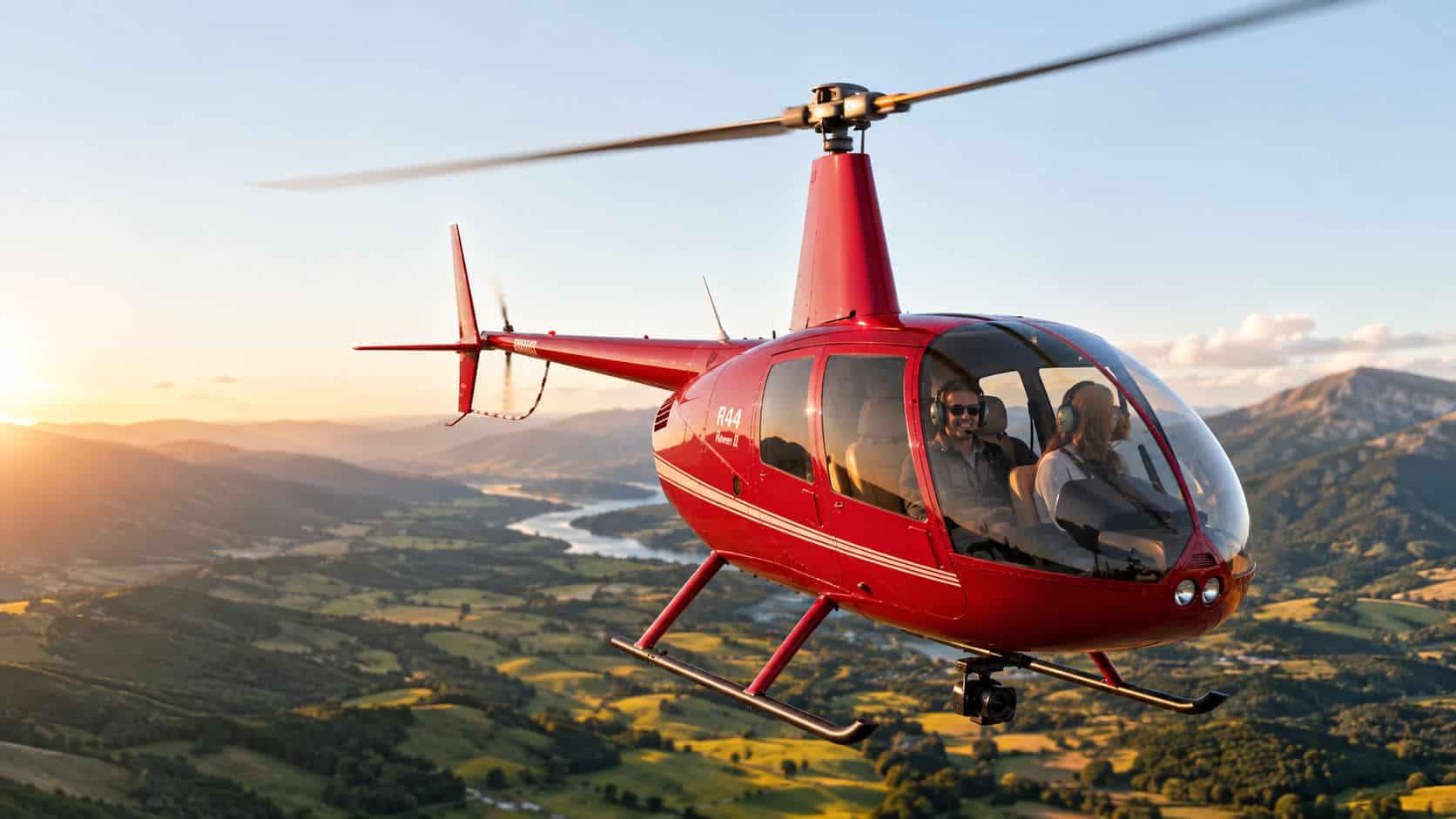
With doors installed, passengers experience a framed view through the cabin windows and a more enclosed environment. With doors removed, airflow and sound become more noticeable, loose items become a serious hazard, and cameras need secure straps. The pilot and ground crew decide whether a doors-off operation is appropriate for the aircraft, route, weather, and passenger group.
A scenic flight also isn't the same as a helicopter lesson. Someone seeking a first introduction to helicopter control may prefer a helicopter discovery flight, where an instructor can explain basic controls and training pathways. A sightseeing passenger, by contrast, should expect the pilot to retain operational control while providing a guided view of the surroundings.
The Chino Hills and Prado Basin Route Experience
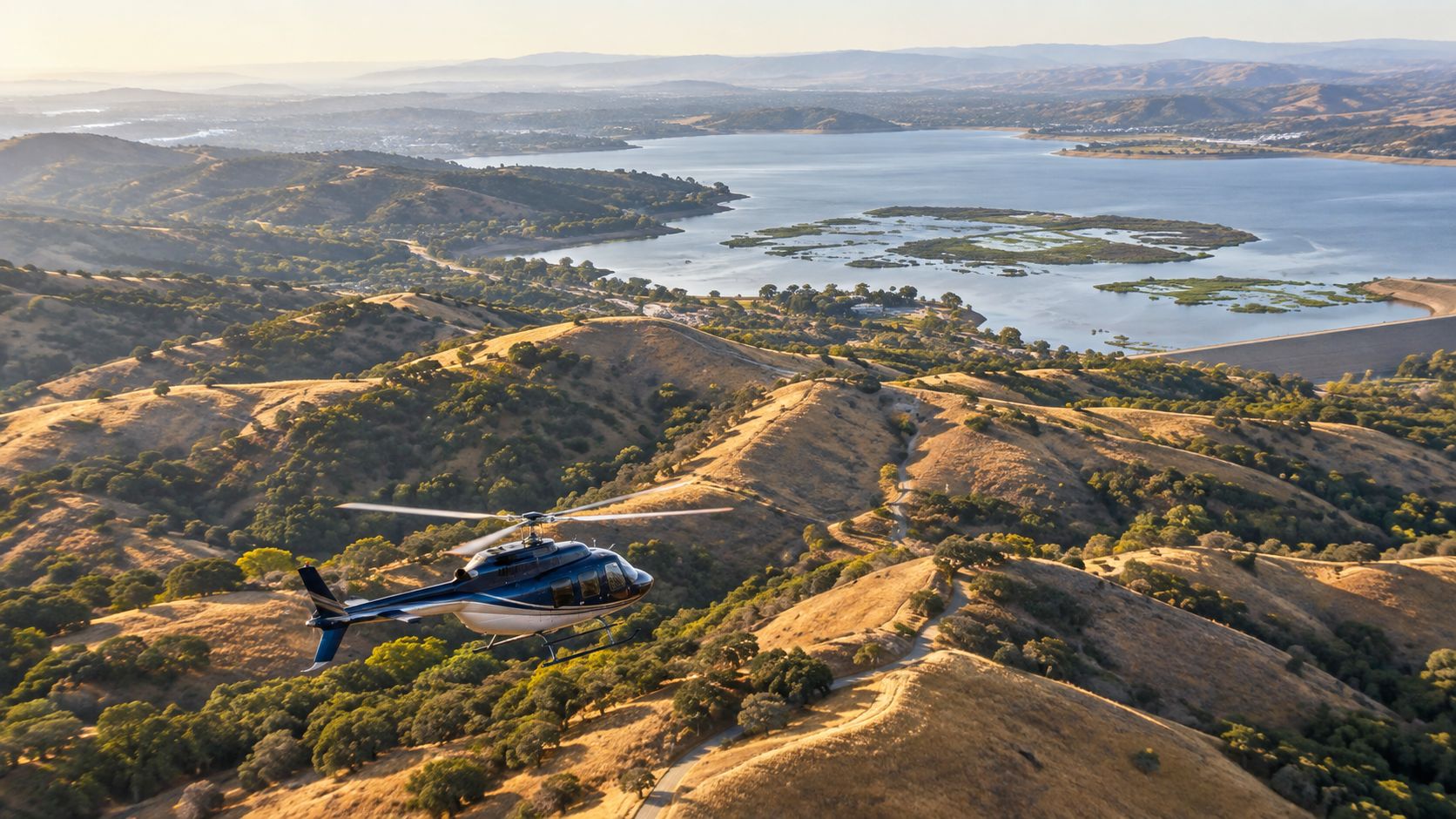
A flight over the Chino Hills and Prado Basin can feel like reading a map in three dimensions. Chino Hills State Park shows rolling ridges, folded slopes, and open ground. Farther along, Prado Basin presents reservoir water, wetlands, flood-control features, and broad areas of low-lying terrain. The change helps first-time passengers connect what they see from the cabin with how water, roads, and development fit together.
The outbound leg may follow ridgelines and reveal where neighborhoods meet undeveloped hills. The return can show the basin from another angle, including its water features. The pilot chooses the route according to airspace, traffic, weather, noise-sensitive areas, and aircraft requirements. A published route is therefore a planning guide, not a promise that every turn or viewpoint will be identical.
Reading the terrain from the cabin
Prado Basin gives passengers a practical way to recognize habitat and water-management features that are harder to understand from ground level. A pilot's narration can connect a reservoir, wetland, ridgeline, or flood-control channel to its surroundings, rather than presenting each view as an isolated picture.
Inland visibility does not always match coastal visibility. Marine moisture, haze, and low cloud can affect coastal routes, while inland air may sometimes provide clearer separation between ridges and distant landmarks. Those conditions can change before departure or during the flight, so the pilot continues checking visibility and cloud conditions.
Light changes the view as well. Morning sun can show contours through softer shadows, while afternoon light may sharpen ridge profiles and longer patterns across the terrain. Passengers bringing cameras should learn how to capture and edit aerial photos and secure every item so it cannot shift inside the helicopter.
Information about Threshold Aviation at Chino can help visitors understand the airport setting and nearby flight-training activity. During the flight, watch the route as a pilot would: identify landmarks, anticipate turns, and compare nearby features with distant ones. Altitude changes that relationship, much like moving a map closer or farther from your eyes.
Pilot Credentials and the Safety Rules Behind the Flight
A passenger doesn't need to memorize every aviation certificate, but a provider should be able to explain who conducts the flight and under which operating rules. A commercial helicopter tour pilot generally needs the appropriate commercial rotorcraft certificate, a current FAA medical certificate, and the flight experience required for the privileges being exercised. The operator also carries responsibility for aircraft maintenance, operational control, dispatch decisions, and passenger procedures.
Altitude rules shape what passengers see. FAA guidance generally requires aircraft over congested areas to remain at least 1,000 feet above the highest obstacle within a 2,000-foot radius, while aircraft over open areas must remain at least 500 feet from any person, vessel, vehicle, or structure. Helicopters can operate below those general minima under helicopter-specific allowances and approved operating conditions, which helps explain why a tour can be built closer to terrain than a fixed-wing sightseeing profile. The FAA's minimum-altitude and helicopter noise guidance provides the regulatory context.
Noise planning is part of the passenger experience and the community relationship. FAA helicopter guidance recommends remaining as high as practical over noise-sensitive areas, increasing speed during the final 1,000 feet of descent by 10 to 15 knots when practical, and keeping rotor torque as low as safety allows. These recommendations must remain subordinate to aircraft control and safety.
Ground safety matters before takeoff
Ground personnel control passenger movement because rotor systems and aircraft positioning create hazards that aren't obvious from a terminal or parking area. FAA airport guidance recommends keeping spectators at least 200 feet away and emergency vehicles 100 feet away during relevant helicopter operations, as described in the FAA Aeronautical Information Manual airport guidance.
| Requirement | Scenic Air Tour | Discovery Flight |
|---|---|---|
| Primary purpose | Paid sightseeing for passengers | Introductory flight that may include instruction |
| Pilot responsibility | Commercial operation, route, narration, and passenger safety | Instructional supervision and aircraft control |
| Passenger briefing | Required operational and emergency information | Required safety information, plus lesson-specific briefing |
| Route design | Scenic route constrained by airspace, terrain, weather, and noise | Training route and maneuvers selected for learning |
| Loading controls | Passenger weight, balance, and seating affect the flight | Student and instructor loading still require weight-and-balance planning |
A school offering commercial helicopter pilot training can explain how commercial privileges develop beyond the passenger experience. A Part 91 air tour, a flight school discovery flight, and a Part 135 carrier may face different operational frameworks, but none should be evaluated by advertising language alone. Passengers should ask about pilot qualifications, aircraft maintenance, weather cancellation practice, briefing procedures, and how the operator manages ground movement.
Booking, Pricing, and Planning Around Weather
Booking starts with the route and purpose, not just a calendar slot. The passenger chooses a preferred date, identifies the number of riders, discloses total passenger weight accurately, and asks whether the flight is priced per aircraft or per seat. Operators often structure local helicopter sightseeing around the aircraft and flight profile, so the number of people sharing the cabin can affect the total cost and loading plan.
Weight information matters because the pilot must keep the helicopter within approved gross-weight and center-of-gravity limits. A passenger shouldn't guess, minimize, or omit a weight detail to preserve a booking. Accurate information helps the operator choose seating, confirm whether the flight can depart as planned, and avoid a last-minute operational change.
Weather decisions belong to the operator
A scenic helicopter flight is normally a visual flight, so visibility, ceilings, wind, turbulence, and route-specific conditions all matter. A commonly discussed VFR visibility benchmark is roughly 3 statute miles, but the legal and operational requirements depend on the applicable airspace, operating rules, aircraft, pilot, and local conditions. The operator, not the passenger, makes the final go or no-go decision.
Chino Valley weather can vary by season and time of day. Winter mornings may offer cool air and clear visibility. Summer afternoons can bring thermals, stronger surface heating, and marine-layer effects moving inland. Spring Santa Ana wind events can produce conditions that make a scenic route unsuitable. Helicopter-specific wind limits vary by model, while warm days can create density-altitude concerns that reduce performance margins.
Planning rule: A weather postponement protects the quality of the flight and the safety margin. It isn't a failure of the booking process.
Passengers should call ahead when a forecast is uncertain, arrive early enough for the briefing, and wear layers that can adapt to changing temperatures between the lobby, ramp, and cabin. A separate Hollywood helicopter tour guide can help a traveler compare the planning questions that arise in a different Southern California sightseeing environment, but the same principle applies everywhere: the route is only as reliable as the weather and operating conditions on the day.
The FAA's Special VFR rule also allows helicopter operations below basic VFR minimums in defined circumstances when ATC issues a clearance, the helicopter remains clear of clouds, and the flight stays within the specified surface-area boundaries below 10,000 feet MSL. That provision doesn't mean a tour should depart in marginal conditions. It describes a regulatory option, not a promise that every scenic flight will operate.
Who These Flights Are Really For
A scenic helicopter flight can serve several different goals, and the right product depends on what the passenger wants to learn or remember. A short local flight suits someone who wants an aerial introduction without committing to a full day. A gift voucher fits an anniversary, retirement, birthday, or other milestone because the recipient can schedule around personal availability and weather.
Families need a more careful pre-booking conversation. Operators may set age, seating, or weight restrictions for younger children, and cabin access can vary by aircraft. A passenger with mobility concerns should call before arriving, explain the assistance needed, and confirm whether boarding, seating, and exit procedures are practical for that helicopter.
Matching the flight to the objective
| Passenger goal | More suitable option | Reason to choose it |
|---|---|---|
| Local sightseeing | Short scenic route | Focuses on nearby landmarks and a manageable time in the cabin |
| Special occasion | Gift voucher or scheduled tour | Leaves room to coordinate the date with the recipient |
| Pilot exploration | Discovery or introductory lesson | Adds an educational discussion about controls, training, and certificates |
| Photography | Doors-off option when available | Removes window reflections, but requires secured equipment |
| Student development | Supervised training flight | Supports instruction and may allow appropriate time to be logged under the instructor's guidance |
A helicopter student may be less interested in narration than in understanding attitude, power, pedal coordination, and the path toward solo and commercial privileges. That passenger should ask whether the flight is instructional, whether a flight instructor will be present, and what records apply. A sightseeing tour shouldn't be represented as logged training because the passenger sits near the controls.
Aviation enthusiasts may prioritize a doors-off cabin and clear sightlines, while gift buyers may care more about timing and comfort. Career-track prospects may use a discovery flight to decide whether rotorcraft training deserves further research. In each case, the pilot's job remains the same: maintain control, manage risk, and give passengers an accurate picture of what the aircraft can and can't do.
Preparing for the Day and What Comes After
Preparation starts with clothing. Closed-toe shoes provide a stable footing around the ramp, while loose hats, scarves, and dangling straps can become distractions or hazards near an aircraft. Passengers should secure bags and clothing, follow ground staff directions, and avoid carrying anything that can move into the rotor wash or cabin airflow.
Photography requires its own checklist:
- Secure the camera: Use a neck strap or wrist strap, especially if the doors are removed.
- Leave loose accessories behind: Unsecured hats, phones, bags, and straps can create problems in an open cabin.
- Clean the viewing area: With doors on, window reflections and glare affect images. With doors off, airflow and vibration affect camera handling.
- Listen before shooting: The pilot's instructions take priority over a photograph, even when a landmark appears suddenly.
Motion sickness isn't common for every passenger, but ridge crossings, thermals, and turbulence can increase the chance of discomfort. A light meal about an hour before departure is generally more practical than flying on an empty stomach or immediately after a heavy meal. Passengers should also tell the operator about relevant health or mobility concerns before the flight, rather than waiting until boarding.
The landing isn't the end of the learning
After shutdown, the pilot can explain the route, answer questions about the aircraft, and clarify what conditions affected the flight. That cool-down conversation often helps a passenger distinguish normal helicopter sensations, such as vibration and rotor noise, from issues that deserve a question.
Someone who wants more than sightseeing can use the debrief to ask about an introductory lesson, private pilot training, instrument work, commercial certificates, or helicopter add-on options. A person who enjoyed the view can ask about another route, a different time of day, or an aircraft configuration that fits the next occasion.
The most useful next step is specific. A prospective student can request training information and compare the discovery experience with a structured lesson. A returning passenger can confirm route availability, accessibility, photography policies, and weather procedures before scheduling again.
DuBois Aviation offers scenic helicopter discovery flights over the Chino Hills and Prado Basin, along with helicopter instruction that can introduce passengers to formal pilot training. Visit DuBois Aviation to ask about current flight availability, aircraft options, accessibility questions, or the next step toward a helicopter certificate.


