You've saved for months, cleared your schedule, and finally decided to learn to fly a helicopter. Then the choices arrive: different aircraft, hourly rates, training packages, simulator claims, and promises about career results. The best helicopter training isn't the program with the lowest advertised price or the newest-looking aircraft. It's the one that combines reliable equipment, disciplined instruction, realistic airport experience, and a plan that continues beyond the checkride.
For a recreational pilot, that may mean flexible scheduling and a clear private-pilot path. For a career-track student, it must also address instrument training, commercial proficiency, instructor ratings, aircraft availability, and the time-building required for professional employment. A discovery flight can help confirm that rotorcraft flying feels right. A helicopter discovery flight near Chino can also give a prospective student a practical look at the aircraft, briefing process, and instructor relationship before committing to a larger program.

Table of Contents
- Introduction, Finding Your Path to the Cockpit
- What Defines Quality Helicopter Training
- Comparing Top Southern California Helicopter Schools
- How to Evaluate Any Helicopter Training Program
- Matching Training Programs to Your Flying Goals
- Why DuBois Aviation Excels in Helicopter Training
- Frequently Asked Questions About Helicopter Training
Introduction, Finding Your Path to the Cockpit
The right school should answer four questions clearly:
- Can the aircraft support consistent training?
- Will instructors teach sound habits rather than just prepare students for a checkride?
- Does the program use simulation and ground training intelligently?
- Does the airport environment prepare pilots for the flying they truly want to do?
Those questions matter because helicopter training has evolved from a specialized military pipeline into a structured worldwide training industry. The Navy began helicopter training in 1943, and the Coast Guard was directed to establish a helicopter pilot training program effective January 1, 1944. One early rule allowed a fixed-wing pilot to qualify as a helicopter pilot after 25 hours of dual and solo flight time, while new standards issued by 1948 showed how quickly rotary-wing instruction was becoming more formalized. The National Helicopter Association Historical Society timeline documents those early milestones.
The lesson is still relevant. Strong training systems rely on repeatable standards, qualified instructors, dependable aircraft, and progression that can be measured. A school that only sells introductory flight time may help a student pass an early milestone, but it may not explain how to become employable.
Practical rule: The best school for a first helicopter lesson isn't automatically the best school for an instrument rating, commercial certificate, or instructor career.
Southern California adds useful pressure to the decision. Training around a towered airport, active radio environment, varied traffic, and instrument procedures can feel demanding at first. That workload, managed correctly, builds cockpit organization that transfers to real operations.
What Defines Quality Helicopter Training
Quality helicopter training rests on four connected pillars: fleet reliability, instructor expertise, simulator integration, and airport environment. None of them works in isolation. A capable instructor can't maintain progress if the aircraft is repeatedly unavailable, and a good simulator can't replace sound airborne decision-making.
Fleet reliability and useful variety
A school should explain which helicopters students will fly, how maintenance interruptions are handled, and whether the fleet supports later ratings. Exposure to different rotorcraft systems can be valuable, particularly for students considering commercial work or instructor certification. The important question isn't whether a fleet looks impressive on a website. It's whether students can schedule dependable lessons in aircraft appropriate to each stage.
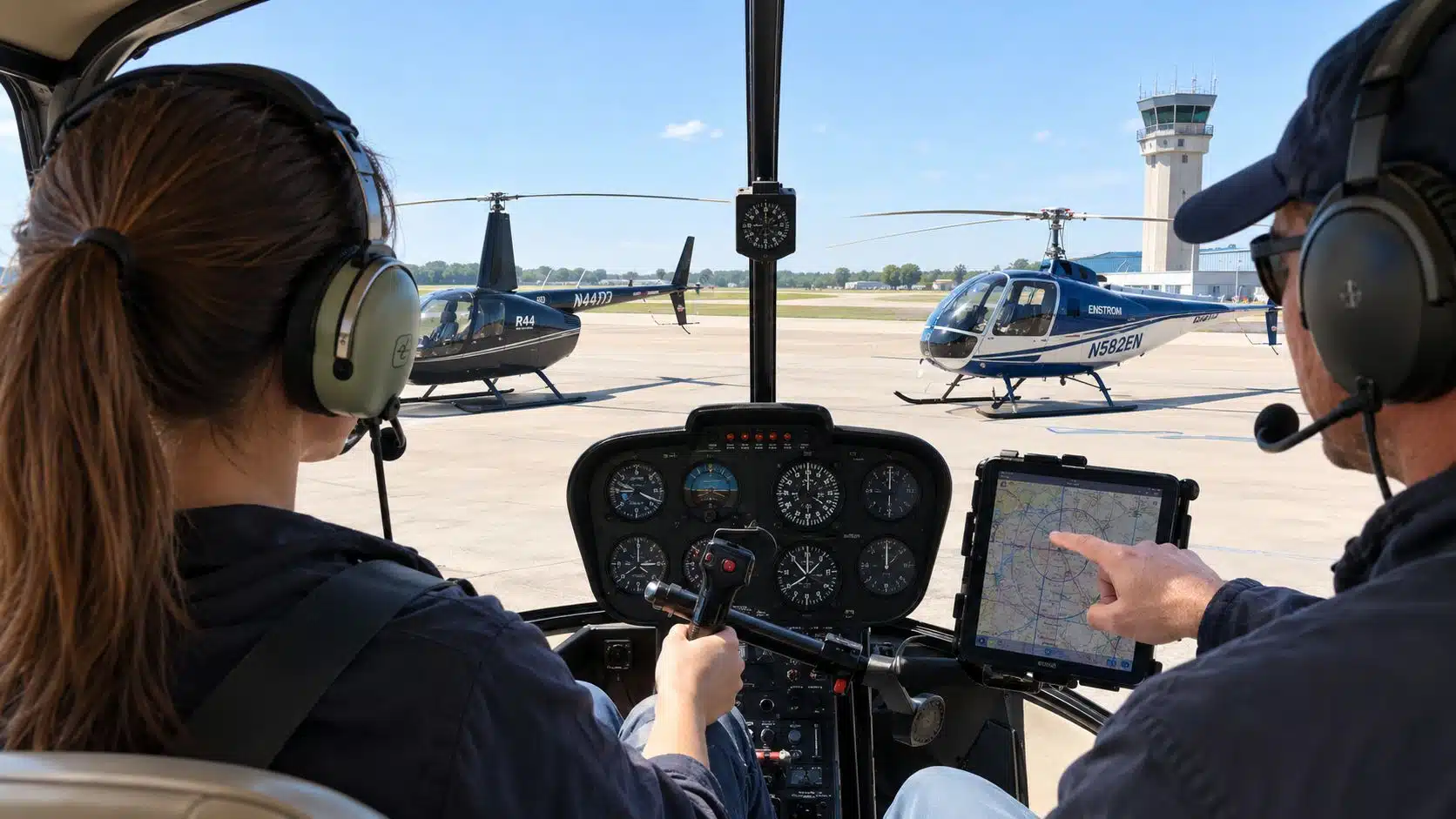
A program with both Robinson and Enstrom helicopters can expose students to meaningful differences in systems, handling, cockpit layout, and operating procedures. That experience should be introduced deliberately, not treated as a novelty. Students need to understand which skills transfer and which procedures remain aircraft-specific.
Instructors who teach beyond the maneuver
A flight instructor's value extends past demonstrating hovering, climbs, autorotations, or landings. Strong instructors teach students to brief the flight, identify threats, make conservative weather decisions, manage workload, and explain the reasoning behind each action.
Prospective students should ask:
- Who will provide most of the instruction? Frequent instructor changes can disrupt continuity.
- How are progress checks conducted? A school should identify weak areas before the practical test.
- What happens after a missed lesson or unsatisfactory stage check? The answer reveals whether the program has a recovery process.
- How does the curriculum prepare students for advanced ratings? Career goals should influence early habits.
Simulators as a training tool
Simulation is most useful when it supports a specific learning objective. Students can rehearse cockpit flows, radio procedures, instrument scan, navigation setup, and abnormal situations without using aircraft time for every repetition. The simulator shouldn't replace aircraft handling. It should make airborne lessons more focused.
For organizations assessing training equipment outside a traditional school setting, a resource such as corporate helicopter simulator rental can help illustrate how professional teams use simulated environments for procedural practice.
The global helicopter training market was estimated at $1.5 billion in 2022, with approximately 500,000 training hours conducted annually, according to industry market data on helicopter training. That scale confirms that helicopter instruction is a mature training ecosystem. For students, the practical conclusion is simple: choose a provider that uses technology to improve proficiency, not one that advertises simulation as a substitute for instruction.
Airport environment
A busy, towered Class D airport such as Chino Airport gives students regular exposure to radio work, traffic sequencing, airport movement, and operational decision-making. A quieter uncontrolled field may provide efficient maneuver practice, but it can leave students underprepared for the communication and workload of more active airports.
The best environment depends on the lesson. Early hovering may benefit from a controlled setting with room to concentrate. Later training should include the procedures, communications, and traffic awareness that pilots will face after certification.
Comparing Top Southern California Helicopter Schools
Students often ask which school is best. The more useful question is which school's training model matches the intended outcome. A recreational student may value flexible scheduling and a simple entry path. A career-track student needs dependable aircraft access, instrument progression, simulator support, and a route toward instructor qualifications.
The matrix below is a decision framework, not a claim that one provider suits every pilot. Schools can change fleets, staffing, pricing, and availability, so each item should be confirmed directly before enrollment.
| School | Fleet Highlights | Simulator Access | Airport Environment | Pricing Model | Best For |
|---|---|---|---|---|---|
| DuBois Aviation | Robinson and Enstrom helicopters, plus fixed-wing aircraft | In-house simulator | Towered Class D airport with active operations | Transparent pricing discussed during planning | Students seeking personalized helicopter and airplane progression |
| Dedicated helicopter school | Rotorcraft-focused fleet, often with more than one training type | Varies by provider | May range from towered to uncontrolled fields | Hourly, package, or staged pricing | Students focused exclusively on rotorcraft |
| Large academy-style provider | Standardized fleet with defined progression | Often integrated into curriculum | Usually selected for training throughput | Program or fixed-cost structure | Students able to maintain a demanding schedule |
| Independent local operator | Smaller fleet and direct instructor access | May be limited or outsourced | Often chosen for convenience | Flexible hourly billing | Recreational students and renters |
| Mixed airplane and helicopter school | Fixed-wing and rotorcraft options | Varies by fleet and program | Can provide broader airport exposure | Certificate-by-certificate planning | Pilots pursuing airplane and helicopter ratings |
A Southern California student should compare more than hourly rates. The helicopter training program in California provides one example of how a school can connect helicopter instruction with broader fixed-wing and advanced-rating options.
What each student should verify
A promising matrix entry still needs direct verification:
- Fleet availability: Ask how often aircraft are unavailable for maintenance and how the school reschedules affected lessons.
- Instructor continuity: Find out whether students receive a primary instructor and how substitutions work.
- Simulator purpose: Request examples of which lessons include simulator sessions and why.
- Airport workload: Ask whether students train in towered airspace, practice instrument procedures, and receive meaningful radio instruction.
- Full cost structure: Request aircraft, instructor, fuel, insurance, materials, written-test, and practical-test costs separately.
- Career progression: Ask what graduates do after the commercial certificate and how the school supports time-building.
A school that can't explain its progression may still offer competent individual lessons. It shouldn't, however, be treated as a complete career pipeline without further evidence.
How to Evaluate Any Helicopter Training Program
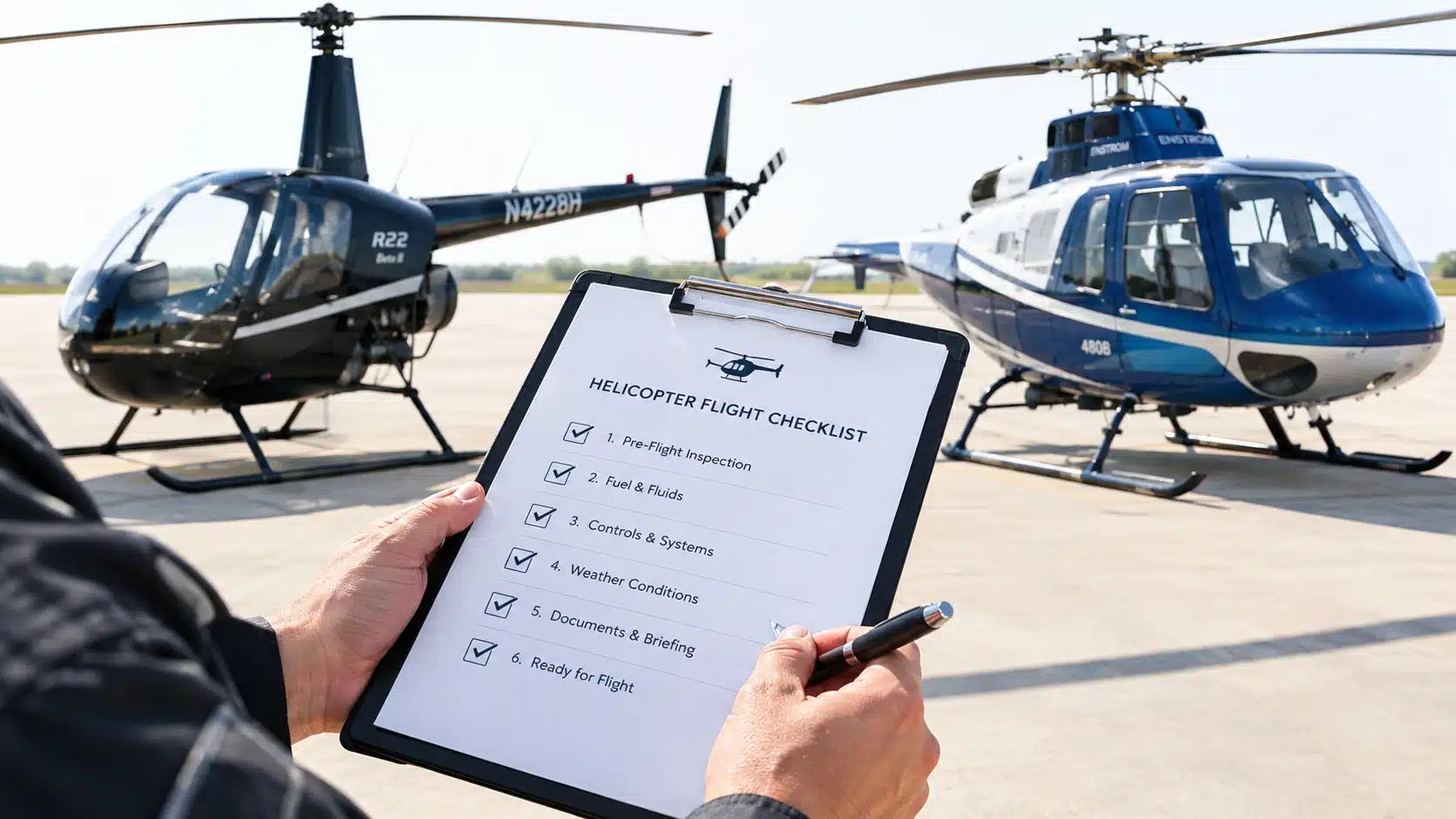
A campus tour and a first flight can reveal a lot, but they shouldn't replace a structured evaluation. Prospective students should leave the first conversation with written answers to six questions.
Start with the aircraft
Ask whether the school operates both Robinson and Enstrom helicopters, and ask what each type is used for. The answer should connect aircraft selection to training objectives, not merely list tail numbers.
A prospective student should also ask:
- How are maintenance inspections scheduled?
- What happens when a helicopter becomes unavailable?
- Can students continue ground or simulator work during an aircraft interruption?
- Are aircraft records and dispatch procedures handled consistently?
A dependable fleet supports learning continuity. Repeated gaps can cause students to lose proficiency and repeat lessons.
Examine instructor standards
Ask about instructor qualifications, recent practical-test experience, and availability outside scheduled flight time. Students need instructors who can identify unsafe habits early and prepare them to make decisions without prompting.
One-on-one instruction can be especially useful when the instructor tracks specific issues across lessons. That arrangement works only when the school maintains clear records and gives students an honest progress assessment.
Demand a real simulator plan
Simulator access should come with a curriculum, not just an equipment tour. Ask how many simulator sessions are assigned during each phase, what tasks they cover, and how the instructor connects the session to the next aircraft lesson.
The helicopter training device market has been forecast at USD 1.2 billion in 2024 and USD 3.2 billion by 2033, representing a projected 10.7% CAGR, according to helicopter training device market research. The same source estimates roughly 900 approved helicopter simulators worldwide as of 2024 and reports typical training completion at 100 to 150 helicopter flight hours. Those figures are market benchmarks, not a promise of the hours any individual student will need.
A simulator can reduce unnecessary aircraft repetition while preserving procedural practice. It can't create the physical feel of a hover or replace aircraft-specific emergency training.
Check the operating environment
A towered Class D airport with multiple runways and instrument approaches gives students a broader operational education. Ask whether the program includes radio work, pattern integration, airspace transitions, and instrument procedures rather than keeping every lesson in an isolated practice area.
For students researching specialized training locations, Dade Collier Training And Transition airport offers an example of the kind of airport-specific information worth reviewing when comparing operating environments.
Get the complete cost
A low aircraft rate doesn't reveal the total cost. Request a written estimate that separates:
- Aircraft time: Include wet or dry billing terms and minimum charges.
- Instructor time: Ask whether briefing and debriefing are billed separately.
- Simulator time: Confirm the device type and instructional rate.
- Insurance and materials: Identify recurring and one-time charges.
- Checkride expenses: Include examiner fees and aircraft preparation.
- Training interruptions: Ask how weather, maintenance, or instructor absence affects billing.
Match the curriculum to the standard
The FAA's Rotorcraft Category Helicopter Rating Practical Test Standards became effective May 31, 2024, as shown in the FAA test standards listing. The practical test isn't a school's private invention. The program should map lessons, stage checks, oral preparation, and flight tasks to the applicable FAA standard.
A school earns trust by showing students exactly how training objectives connect to the practical test and to safe operation after the test.
Matching Training Programs to Your Flying Goals
The right program depends on what the pilot wants to do after the certificate. Three students can sit in the same briefing room and need three different training plans.
The recreational student
A recreational student usually needs flexibility, regular practice, and a clear private-pilot target. Weekend availability can work, but long gaps between lessons create avoidable review work. A discovery flight should be followed by a conversation about medical eligibility, budget, scheduling, aircraft availability, and the student's intended use of the certificate.
The critical milestone isn't merely the first solo. It's the development of repeatable preflight, hover, takeoff, landing, navigation, and emergency habits. A student who wants to rent after certification should also ask how the school handles checkout requirements and ongoing proficiency.
The career-track candidate
A professional candidate should plan beyond the commercial certificate from the beginning. Instrument training, commercial maneuvers, advanced ratings, instructor preparation, and time-building all affect employability.
Historical military training demonstrates why structured progression matters. Fort Wolters opened as the U.S. Army Primary Helicopter Center/School on September 26, 1956, trained more than 40,000 helicopter pilots during 17 years of operation, and handled approximately 95% of helicopter pilots who flew in Vietnam, according to the Fort Wolters training history. At peak activity in 1968, the school sent 608 pilots per month to Fort Rucker. Training at Wolters lasted 16 weeks, followed by 16 weeks of advanced training at Fort Rucker.
Modern civilian training isn't identical to that military pipeline, but the principle transfers: standardized progression and throughput matter.
The fixed-wing pilot adding helicopters
A fixed-wing pilot doesn't start from zero. A helicopter add-on is governed by 14 CFR §61.63, and the FAA Commercial Pilot Rotorcraft-Helicopter ACS states that applicants adding a category or class must comply with that regulation as applicable. The FAA commercial helicopter ACS provides the controlling reference.
The add-on pathway carries forward relevant aeronautical knowledge, but it doesn't remove the need to demonstrate helicopter-specific skills. Hovering, autorotations, helicopter control coordination, and emergency procedures require dedicated preparation.
A helicopter add-on rating can make sense when the pilot has a defined use for rotorcraft privileges. It becomes a poor decision when the pilot assumes prior airplane experience will eliminate the need for disciplined helicopter practice.
Why DuBois Aviation Excels in Helicopter Training
For a Southern California student who wants a personal training relationship without giving up realistic airport exposure, DuBois Aviation presents a coherent option. Its helicopter fleet includes both Robinson and Enstrom aircraft, allowing students to encounter more than one rotorcraft platform as their training develops.
The instructional model is one-on-one. That matters because helicopter students need immediate correction during hovering, transitions, approaches, and emergency work. Instructors with instrument and multi-engine qualifications can also support progression beyond private helicopter training when a student's plan includes advanced certificates or ratings.
A practical training environment
Chino Airport provides towered Class D operations, three runways, and multiple instrument approaches. Students must learn to manage communications, traffic, airport procedures, and aircraft control together. That combination can be more demanding than an isolated training field, but it builds habits that support later instrument and commercial work.
The in-house simulator adds another layer. Students can rehearse procedures, instrument tasks, radio flows, and cockpit organization without using aircraft time for every repetition. The value comes from integration. A simulator session should prepare the student for an upcoming flight or reinforce a task that needs additional procedural practice.
Continuity from first lesson to advanced work
A student may begin with a private helicopter goal and later decide to pursue instrument, commercial, CFI, CFII, or MEI training. A school that supports multiple stages can reduce the disruption associated with changing aircraft, instructors, records, and operating procedures.
Flexible seven-day scheduling helps students maintain momentum around work, school, and family obligations. Transparent pricing discussions also give students a better basis for planning than a single headline hourly rate.
The employability question
Passing a checkride is a milestone, not a hiring guarantee. The current career gap is concentrated among experienced pilots, while training pipelines continue producing new graduates. One industry source identifies the most significant shortage around pilots with approximately 1,500 to 2,000 hours, as discussed by DuBois Aviation's helicopter career guidance.
That should change how students judge a school. The strongest program for an entry-level student is one that explains what comes next:
- Time-building: How can a new commercial pilot build useful experience?
- Instructor ratings: Does the school offer a path toward CFI and advanced instructor qualifications?
- Instrument proficiency: Will the pilot be prepared for more demanding operations?
- Transition strategy: Does the school help the student understand different aircraft, operators, and mission types?
- Professional habits: Does training include planning, communication, risk management, and maintenance awareness?
The purpose of training isn't to collect certificates. It's to build a pilot who remains safe, adaptable, and employable after the checkride.
Frequently Asked Questions About Helicopter Training
How much does helicopter training cost?
Helicopter training can exceed $100,000 and may take several years, according to industry reporting on pilot shortages and training models. Total cost depends on aircraft rates, instructor time, scheduling consistency, simulator use, checkride expenses, and the ratings included. A written estimate is more useful than a single hourly price.
Can a student complete private helicopter training in six months?
Some students may progress quickly with consistent availability, while part-time students usually need longer. Weather, maintenance, instructor scheduling, study habits, and checkride preparation all affect the calendar. The school should explain the expected sequence rather than promise a fixed outcome.
Is a fixed-wing certificate required before helicopter training?
No. A fixed-wing certificate isn't required to begin a private helicopter path. Existing airplane pilots may use the add-on route under 14 CFR §61.63, but they still must prove helicopter-specific proficiency.
What's the difference between a discovery flight and training?
A discovery flight is an introductory experience and an opportunity to evaluate the aircraft, instructor, and school environment. Training begins with a defined syllabus, logbook entries, ground instruction, recurring lessons, and progress toward FAA certification.
DuBois Aviation offers one-on-one airplane and helicopter instruction, simulator-supported progression, aircraft rental, and advanced rating pathways at Chino Airport. Prospective pilots can visit DuBois Aviation to ask about course availability, schedule a school visit, and build a training plan based on their goals, timeline, and career expectations.