You've earned a commercial certificate, but your next training decision isn't obvious. Should the multi-engine add-on come now, after more instrument practice, or alongside a broader airline pipeline? A multi-engine commercial rating adds an airplane multiengine class rating to an existing certificate. It also forces a major change in workload, because one engine failure creates asymmetric thrust, changing the airplane's control, performance, and priorities immediately.
Table of Contents
- Transitioning to the Multi Engine Cockpit
- FAA Prerequisites and Certification Pathways
- Mastering Asymmetric Thrust and Engine Out Procedures
- Typical Syllabus and Flight Hour Breakdown
- Career Pathways and Airline Pipeline Strategy
- Training at Chino Airport with DuBois Aviation
- Frequently Asked Questions About Multi Engine Training
- Is a separate medical certificate required for multiengine training?
- Is the commercial multiengine rating a separate certificate?
- What should the oral exam preparation include?
- How does the FAA treat a center thrust limitation?
- Should the multi-engine add-on come before MEI training?
- What should a student ask before scheduling?
Transitioning to the Multi Engine Cockpit
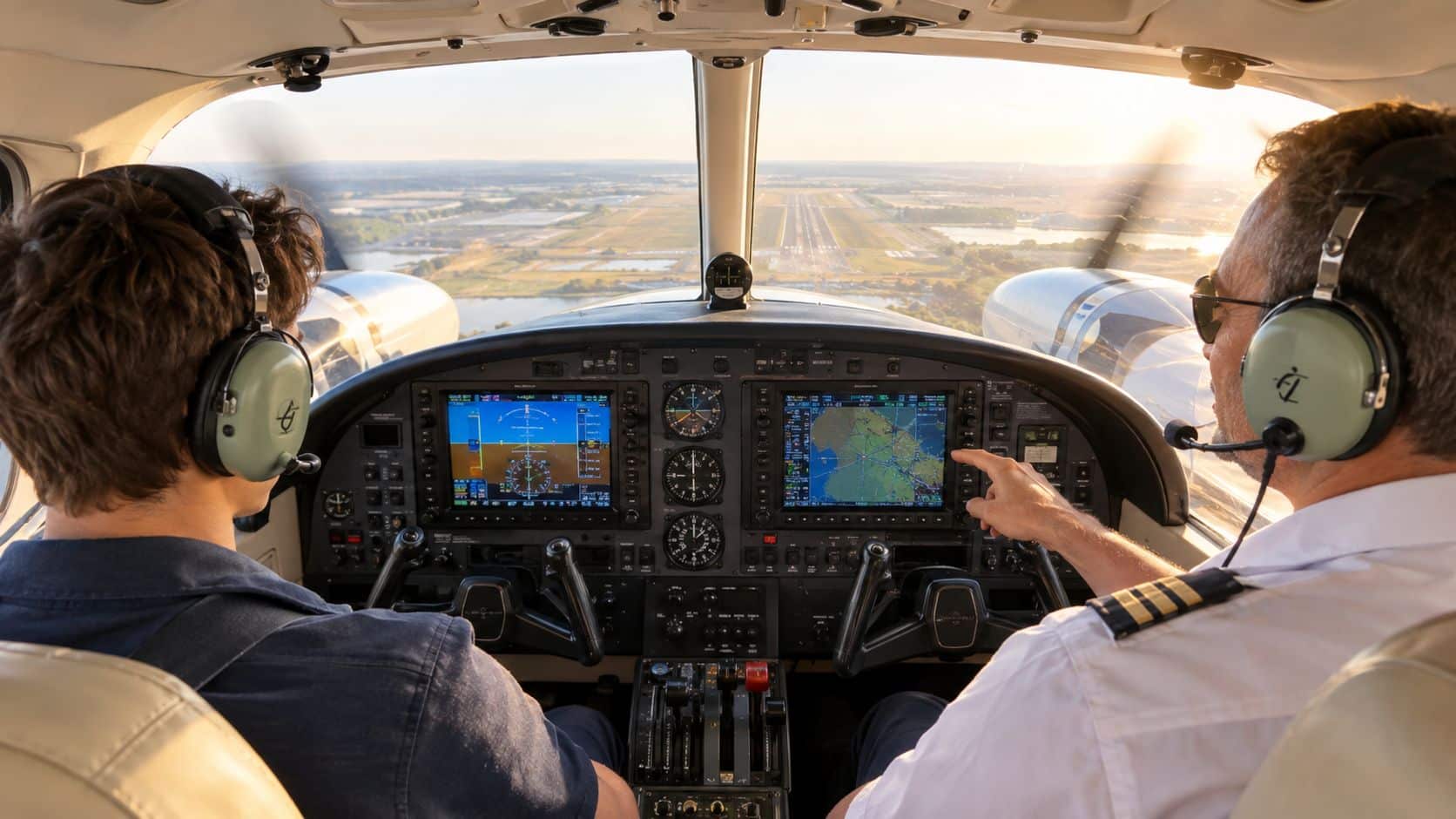
A single-engine commercial pilot entering a twin-engine trainer often expects more power and better climb performance. The first lesson usually corrects that assumption. The pilot now manages two powerplants, two propellers, additional systems, retractable landing gear, engine instruments, and a more demanding checklist flow, often while communicating with ATC and maintaining an instrument scan.
Two practical options worth comparing
These are specific products pilots commonly compare for this type of flying. Confirm compatibility with your aircraft and instructor before ordering.
 Premium ANR headsetLightspeed Zulu 4 ANR Aviation Headset - Dual GA PlugCheck current availability on Amazon (paid link)
 Premium headsetBose A30 Bluetooth Aviation Headset - Dual PlugCheck current availability on Amazon (paid link)
In a Piper Apache, the physical difference becomes clear during basic handling. Power changes require coordinated attention to both engines. A small mismatch in thrust can affect yaw. Gear and propeller controls add tasks that were previously absent, and an engine failure turns an ordinary climb into a time-critical control exercise.
The rating means more than adding another line to a certificate. It demonstrates that the pilot can operate an airplane in which the engines don't always contribute equally and in which the remaining engine may not provide enough performance to climb comfortably.
The first workload increase
The transition typically challenges three habits:
- Power management: Both engines must be monitored and adjusted as a pair, while each engine's indications still require individual attention.
- Directional control: Asymmetric thrust produces yaw and roll tendencies. The pilot must control the airplane first, then diagnose the failure.
- Prioritization: Airspeed, bank, rudder pressure, configuration, and engine identification compete for attention during an abnormal event.
The most common early mistake is trying to complete the checklist before establishing control. A pilot who lets airspeed decay while reaching for a lever has allowed the airplane's performance problem to become a control problem.
Practical rule: In a twin, aircraft control comes before troubleshooting. The checklist supports the decision, but it doesn't replace disciplined flying.
What the rating changes operationally
A multi-engine pilot must understand how configuration affects performance. Gear, flaps, cowl flaps, propeller settings, and excess drag can determine whether the airplane climbs, maintains altitude, or descends after an engine failure. That makes performance planning central to commercial training, not an academic exercise.
The rating also creates a foundation for later professional work. Charter, cargo, instructional, and airline environments all require pilots to manage systems while sharing tasks, communicating clearly, and making conservative decisions. The cockpit may eventually become a turbine flight deck, but the habits begin in the piston twin.
FAA Prerequisites and Certification Pathways
A multi-engine rating is usually an add-on class rating, not a separate pilot certificate. A pilot who holds the appropriate certificate can add Airplane Multiengine Land privileges by completing the required training, obtaining the proper endorsement, and passing the practical test.
The correct training plan depends on the certificate goal. Adding multiengine privileges to an existing commercial certificate follows a different path from earning an initial commercial certificate with multiengine privileges. Confirm that objective before scheduling an accelerated course.
Part 61 add-on planning
For a commercial pilot adding multiengine privileges, 14 CFR 61.129 specifies 10 hours of multiengine complex or turbine training and 5 hours of instrument training in a multiengine airplane for the commercial multiengine path. The rule's broader aeronautical experience requirements still apply to an initial commercial certificate. Aircraft-specific training alone does not satisfy every requirement.
That distinction affects both timing and cost. A commercial single-engine pilot with the required experience may need a focused add-on. A pilot pursuing an initial commercial multiengine certificate may need a longer, integrated course. Before recommending a schedule, the instructor should review the logbook, certificates, instrument qualification, cross-country experience, and intended practical test.
Use this decision sequence:
- Define the certificate objective. Identify an add-on rating or an initial commercial multiengine certificate.
- Audit the logbook. Check commercial, instrument, cross-country, and multiengine experience against the applicable rule.
- Complete the required instruction. Record multiengine complex or turbine and instrument training where the pathway calls for it.
- Obtain the endorsement. The instructor is confirming practical-test readiness, not just course attendance.
- Prepare for both test portions. Systems knowledge, performance planning, emergency procedures, and judgment must connect in the oral and flight exams.
Students comparing schedules and prerequisites can also review DuBois Aviation's multi-engine rating requirements.
Part 141 initial commercial training
An approved Part 141 course uses an FAA-approved syllabus and defined stage structure. For an initial commercial multiengine course, Appendix D to Part 141 specifies at least 55 hours of flight training, 10 hours of instrument training with a view-limiting device, and 10 hours in a multiengine complex or turbine-powered airplane.
The appendix also calls for a daytime cross-country and a nighttime cross-country, each more than 100 nautical miles straight-line distance from the departure point. It requires 3 hours of multiengine airplane training within 60 days of the practical test. These are minimum course requirements. They do not guarantee checkride readiness at the minimum.
Part 61 can suit an experienced commercial pilot seeking a targeted add-on. Part 141 can give an initial commercial student a structured syllabus and clearer progress checks. Either route still demands aircraft-specific proficiency, sound risk decisions, and enough practice to perform consistently under evaluation. That timing matters for airline preparation, because the rating should build disciplined systems management and decision-making before interviews, not merely add a logbook entry.
Mastering Asymmetric Thrust and Engine Out Procedures
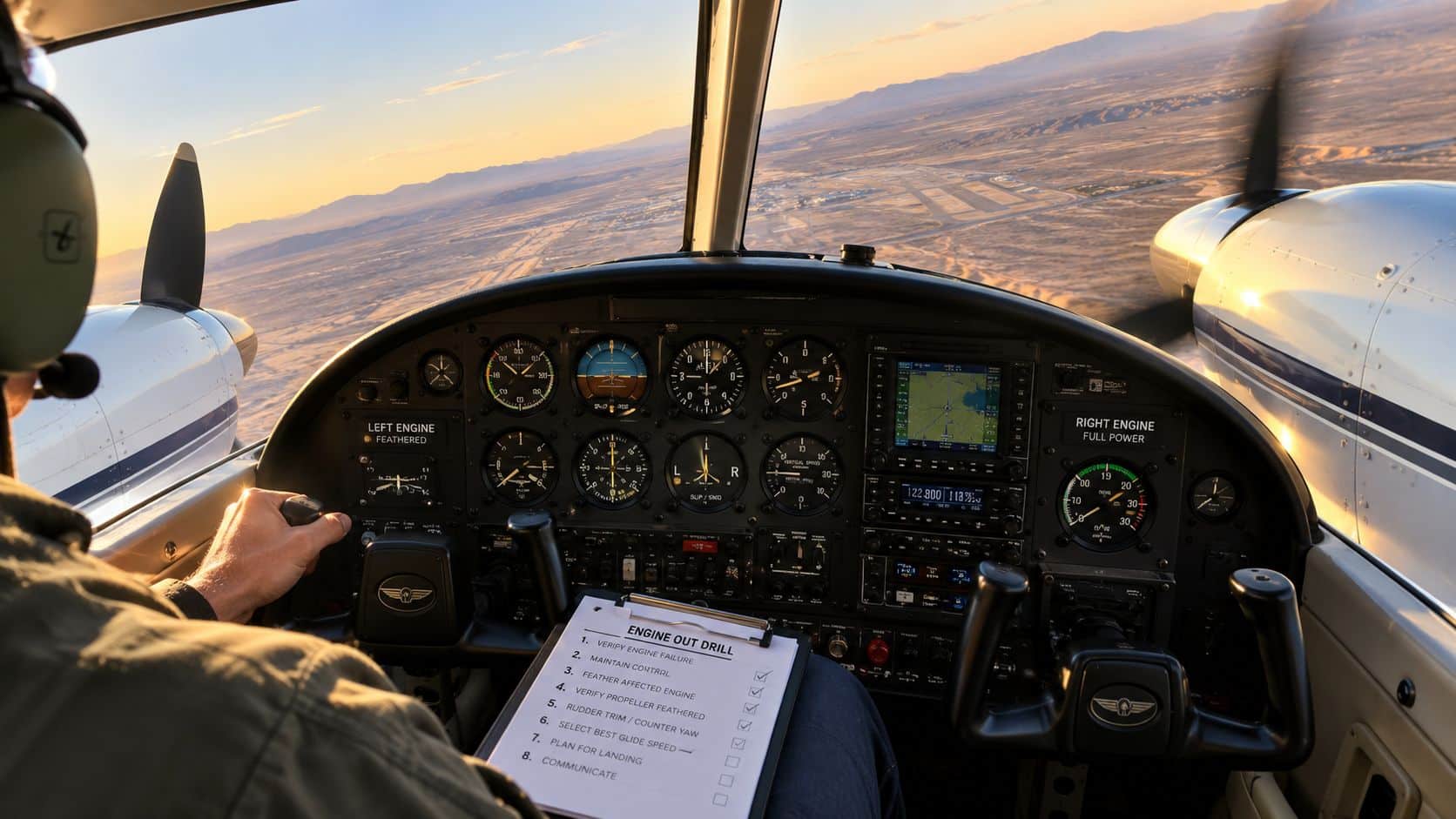
A twin can remain controllable after an engine failure, but the remaining performance may be limited. The defining challenge is asymmetric thrust. One operating engine continues producing thrust on one side, creating yaw, roll, higher rudder demand, and a rapid loss of climb capability.
FAA commercial multiengine guidance describes the single-engine climb standard for Part 23 commuter-category twins as a 1.5% climb gradient at 5,000 feet pressure altitude in cruise configuration, as stated in the FAA commercial multiengine airplane guidance. This standard shows why weight, density altitude, configuration, and aircraft condition matter. After an engine failure, the airplane may maintain altitude only, or continue descending despite correct control inputs.
Vmc is a control limit, not a target
Vmc, the minimum control speed under specified conditions, marks the boundary of directional control. It is not an emergency speed to pursue. If airspeed decays while asymmetric thrust remains high, the airplane can become uncontrollable.
The first response is aircraft control:
- Maintain control: Apply the required rudder and establish the bank toward the operating engine specified by the aircraft's procedures.
- Protect airspeed: Lower the nose when necessary to prevent a stall and restore controllability.
- Identify the failed engine: Use the aircraft indications and the accepted confirmation process instead of relying on instinct.
- Reduce drag: Configure deliberately. Landing gear, flaps, a windmilling propeller, and unnecessary accessories can consume the remaining performance.
- Secure or feather correctly: Confirm the failure, then follow the aircraft checklist and training procedure.
Practice must occur at an altitude and power setting that permit recovery, under an instructor's direction. Simulated failures are structured exercises, not casual demonstrations. The training objective is to build recognition, control, communication, and decision-making without adding unnecessary risk.
Feathering preserves performance margin
A windmilling propeller produces substantial drag. If the failed engine's propeller can be feathered, aligning its blades with the airflow reduces that drag and may determine whether the airplane can attempt a controlled climb or must descend. Feathering depends on the aircraft systems, engine confirmation, checklist discipline, and available altitude.
Aircraft-specific engine-out flows are covered in DuBois Aviation's engine failure procedures guide, while the approved flight manual governs the actual checklist. Students should know which indications identify the failed engine, how the propeller system responds, and which configuration supports the airplane's demonstrated performance.
This sequence also matters beyond the practical test. Airline interviewers are assessing whether a pilot can control the aircraft, apply disciplined verification, and make a performance-based decision under pressure. A multi-engine add-on has greater career value when scheduled after foundational commercial skills are reliable and before airline preparation begins.
Typical Syllabus and Flight Hour Breakdown
A focused add-on and an initial commercial multiengine course require different training plans. An add-on student may already have commercial maneuvers, instrument procedures, and checkride discipline. An initial commercial student must develop those skills within the multiengine course itself.
A practical syllabus usually runs four strands in parallel:
- Commercial VFR: Visual navigation, takeoffs, landings, and traffic-pattern precision.
- Commercial maneuvers: Steep turns, slow flight, stalls, and aircraft control at commercial standards.
- Commercial IFR: Instrument procedures, approaches, missed approaches, and workload management.
- Commercial multiengine operations: Engine-out recognition, Vmc awareness, propeller management, and single-engine performance.
Combining these objectives makes each flight more useful. A student can fly an instrument approach in the twin, then apply the same workload-management habits during a commercial maneuver or an asymmetric-thrust exercise. The instructor should still keep the lesson focused, so repetition builds proficiency rather than producing a checklist of disconnected tasks.
Comparing the pathways
| Training Pathway | Minimum Flight Hours | Instrument Requirement | Cross-Country Requirement |
|---|---|---|---|
| Part 61 add-on to an existing commercial certificate | 10 hours of multiengine complex or turbine training for the commercial multiengine path, plus broader applicable experience requirements | 5 hours of instrument training in a multiengine airplane for the commercial multiengine path | Depends on the certificate and experience pathway |
| Part 141 initial commercial multiengine course | At least 55 hours of flight training | 10 hours with a view-limiting device | Day and night cross-country flights, each more than 100 nautical miles straight-line distance |
The hour totals describe minimum frameworks, not guaranteed completion times. A typical add-on syllabus runs 10 to 15 flights focused on engine-out flows, single-engine performance, commercial standards, and practical-test preparation. An initial Part 141 course spreads the same objectives across 55 hours of integrated commercial and instrument training.
What works in the aircraft
Every flight needs a defined purpose. A strong lesson connects each maneuver to professional cockpit work: steep turns develop precision, instrument approaches expose workload weaknesses, and engine-out drills test aircraft control before procedure execution. That sequence matters during airline interviews, where asymmetric-thrust management reveals how a pilot prioritizes control, verification, communication, and performance.
The final phase should include aircraft-specific flows, oral preparation, performance planning, and recent multiengine training before the practical test. Part 141 students must complete 3 hours of multiengine training within 60 days of the practical test. Scheduling those flights early enough to preserve proficiency prevents an avoidable lapse before the checkride.
Career Pathways and Airline Pipeline Strategy
A multi-engine rating matters, but it is not the finish line. Boeing projects a need for 674,000 new pilots over 20 years in its Pilot and Technician Outlook, which points to continued demand without promising any one applicant an airline seat.
Hiring pressure is real, and it still favors pilots who show more than logged time. Airlines look at the quality of the logbook, recent flying, turbine preparation, professionalism, records, and interview performance. A twin rating helps, but it has to sit inside a larger career plan.
The timing depends on where the student is now.
If you already hold a commercial single-engine certificate, the add-on can broaden your privileges and set up later multiengine work or advanced instruction. If you are still building an instrument foundation, finishing that piece first often makes the twin transition easier because the scan and approach flow are already organized. If you plan to instruct, adding the rating before MEI training can support a path to teaching multiengine students and building relevant experience. If the goal is the airline cockpit, the rating should fit into a sequence that also includes instructor credentials, time-building, turbine transition, and interview preparation.
Raw multiengine hours help, but hours by themselves do not show airline readiness. A pilot who can explain engine-out priorities, brief an approach clearly, divide tasks, and keep cockpit communication disciplined is closer to line-oriented thinking than someone who only accumulates time. That difference shows up quickly in interviews and in training events.
Asymmetric thrust is where the practical connection becomes obvious. An interviewer may not ask for a textbook definition. A better answer describes what happens after an engine failure, which task comes first, how the crew confirms the failed engine, and when performance limits change the plan.
The sequence matters: fly the airplane, identify the problem, manage configuration, communicate, then continue with the checklist and landing plan. In an airline cockpit, that same order becomes crew resource management. One pilot flies, the other verifies, communicates, and manages systems.
The best return comes from treating every multiengine lesson as a rehearsal for the next stage. Record what went wrong, practice short and clear briefings, and connect each engine-out drill to cockpit coordination. The rating opens the door. It does not replace the preparation required to walk through it.
Training at Chino Airport with DuBois Aviation
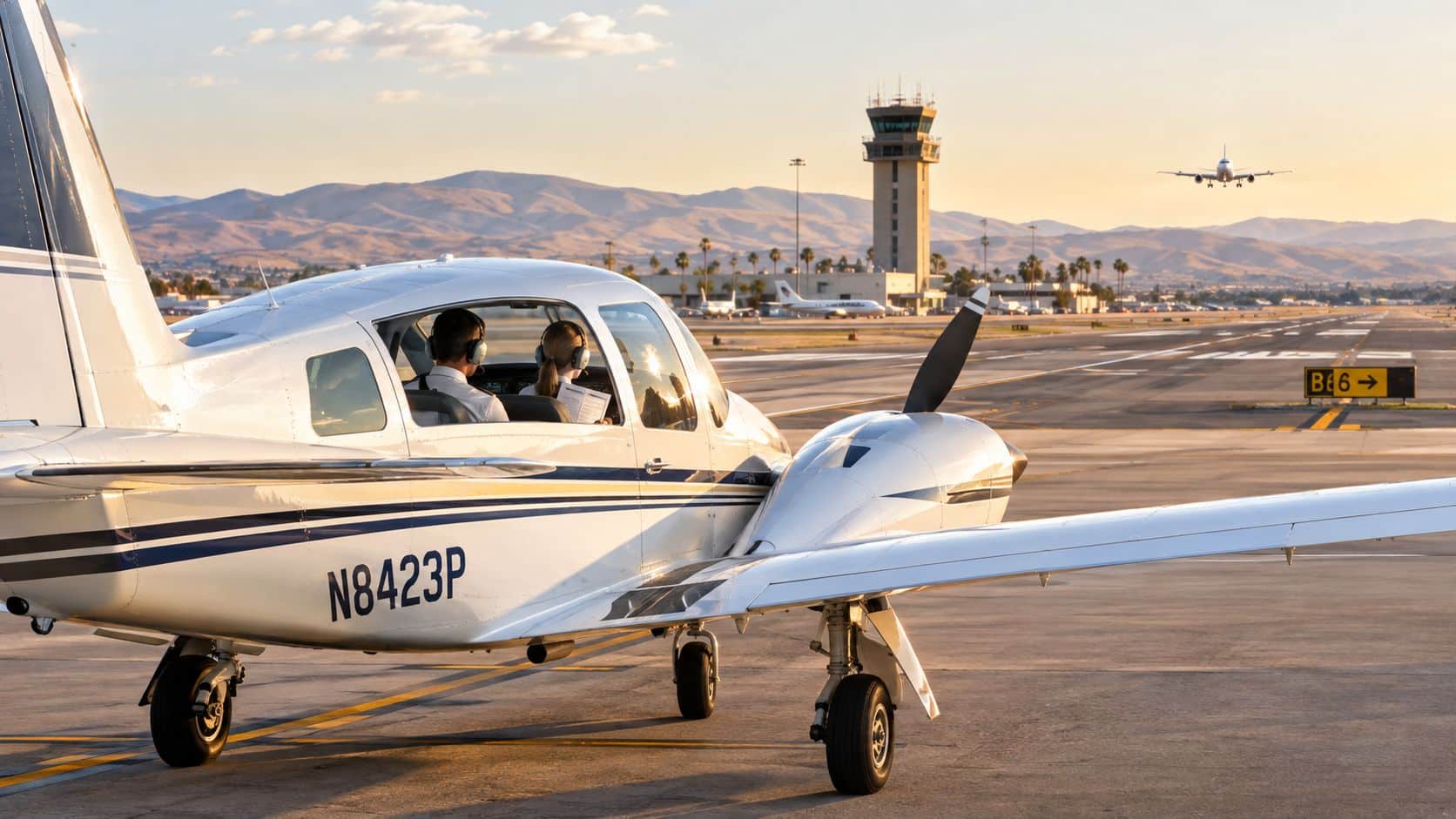
Chino Airport gives multiengine students a practical operating environment. A busy, towered Class D airport requires clear radio calls, accurate readbacks, disciplined taxi planning, and attention to surrounding traffic. Those habits matter because professional pilots rarely operate in isolation from ATC, other aircraft, changing runway assignments, and complex departure or arrival flows.
DuBois Aviation provides multiengine instruction using a Piper Apache, along with commercial and instructor training options. Students can review the DuBois Aviation student pilot training resources for Chino Airport when comparing how local operations fit into a broader career plan.
Why the local environment matters
A student who trains only in quiet airspace may become proficient at maneuvers but less comfortable managing the communication and planning demands of a commercial departure. Chino operations can require the pilot to combine aircraft configuration, engine monitoring, runway awareness, and ATC instructions without losing the larger plan.
The training environment should also support consistency. Flexible scheduling helps the student avoid long gaps between lessons, while one-on-one instruction allows the instructor to focus on the pilot's specific weaknesses, whether those involve rudder coordination, instrument workload, checklist flow, or radio discipline.
The most useful fleet decision is the one that matches the training objective. A student preparing for a commercial multiengine checkride needs an aircraft in which systems, performance, and emergency procedures can be taught deliberately. The aircraft's condition, availability, and instructor familiarity matter as much as its model name.
A short video can help prospective students understand the airport environment and the type of operational setting involved in training.
Before reserving lessons, the student should bring a current logbook review and a clear career objective. The instructor can then determine whether the immediate priority is the add-on, instrument proficiency, commercial maneuver refinement, or a sequence leading toward MEI training.
Frequently Asked Questions About Multi Engine Training
Is a separate medical certificate required for multiengine training?
A pilot doesn't obtain a special “multi-engine medical.” The applicable medical qualification depends on the operation and privileges being exercised. Students should confirm current medical and eligibility requirements with an aviation medical examiner and review the applicable FAA rules before beginning professional operations.
Is the commercial multiengine rating a separate certificate?
No. It's generally an add-on class rating placed on an existing pilot certificate. The training and practical-test requirements depend on whether the pilot is adding the rating to an existing commercial certificate or pursuing an initial commercial multiengine certificate.
What should the oral exam preparation include?
The oral portion should cover Vmc, engine failure recognition, single-engine performance, propeller feathering, systems, limitations, weight and balance, weather decisions, and emergency procedures. The applicant should be able to explain why each action matters, not just recite a memorized sequence.
How does the FAA treat a center thrust limitation?
The FAA commercial airplane practical-test guidance distinguishes a Commercial Airplane Multiengine Land Rating without a center thrust limitation from other testing situations. Applicants should review the FAA commercial airplane practical test standards and ACS materials with their instructor and confirm that the aircraft configuration matches the practical-test requirements.
Should the multi-engine add-on come before MEI training?
Yes, the multiengine rating is the foundation for a multiengine instructor path. The timing still depends on instrument proficiency, commercial experience, aircraft availability, and the student's broader plan. Adding the rating without a clear next step can create training time without a defined career benefit.
What should a student ask before scheduling?
Ask which certificate pathway applies, what aircraft will be used, how recent training must be before the checkride, how the instructor will teach engine-out procedures, and how the rating fits into commercial, CFI, CFII, or MEI goals. Those answers are more useful than comparing an advertised minimum in isolation.
DuBois Aviation offers private, instrument, commercial, and multi-engine training at Chino Airport, including preparation for aircraft systems, performance planning, and engine-out procedures. Students can visit DuBois Aviation to request training information, discuss course availability, or arrange a school tour before choosing the right point in the career pipeline for the multi-engine add-on.