
Thinking about a career in the cockpit? Imagine taking the controls of an aircraft, looking down at the iconic California coast, knowing you're on the path to becoming a professional pilot. This isn't just a daydream—it's the first real step toward a career as an airline or commercial helicopter pilot, and Southern California is one of the best places in the world to make it happen.
Let’s walk through exactly how you can go from an aspiring student to a professional pilot, right here in SoCal.
Your Aviation Career Takes Flight in Southern California
Starting your journey as a pilot in Southern California means you're training in a region that's absolutely saturated with aviation history and modern innovation. The combination of clear, flyable weather and incredibly diverse airspace creates a training environment that’s hard to beat, whether you see yourself in an airline cockpit or at the controls of a helicopter.
Think of this guide as your co-pilot. We'll break down the different training paths for aspiring professional pilots, explain the licenses you'll need, and give you a clear roadmap for choosing the right flight school and understanding the costs involved. It all starts with knowing why this region is such a unique place to learn.
Why Train in Southern California?
Southern California isn't just a sunny spot on the map; it’s a global hub for the aerospace industry, with a legacy stretching back to the earliest days of flight. This isn't just history—it's a living, breathing part of the training experience. For example, learning out of an airport like Van Nuys, which sees around 230,000 takeoffs and landings each year, throws you right into the thick of real-world aviation. It’s an invaluable experience you just can't get everywhere.
For an aspiring professional pilot, this environment offers serious advantages:
- Ideal Flying Weather: With more than 300 days of sunshine annually, you'll spend less time on the ground waiting for weather to clear. That means you can complete your career-focused training faster and more consistently.
- Complex Airspace: You'll learn to navigate some of the busiest and most complex airspace in the nation. If you can fly confidently here, you’ll be prepared for just about anything your career as an airline or commercial pilot throws at you.
- Robust Aviation Community: You’re not just learning in a vacuum. You’re surrounded by a massive network of professionals—from your instructors to airline pilots at the next hangar over—which opens the door to incredible mentorship opportunities.
Training here isn't just about logging hours; it's about becoming part of a legacy. The skills you master navigating the busy corridors between San Diego and Santa Barbara are the very ones that will define your competence as a professional pilot for the rest of your career.
Before you dive in headfirst, it’s always a good idea to get a real feel for the cockpit. Taking one of the many available introductory flying lessons is the perfect first step. It’s a low-commitment way to confirm your passion for an aviation career, meet instructors, and get a taste of the journey that lies ahead.
Choosing Your Cockpit: Airplane Versus Helicopter
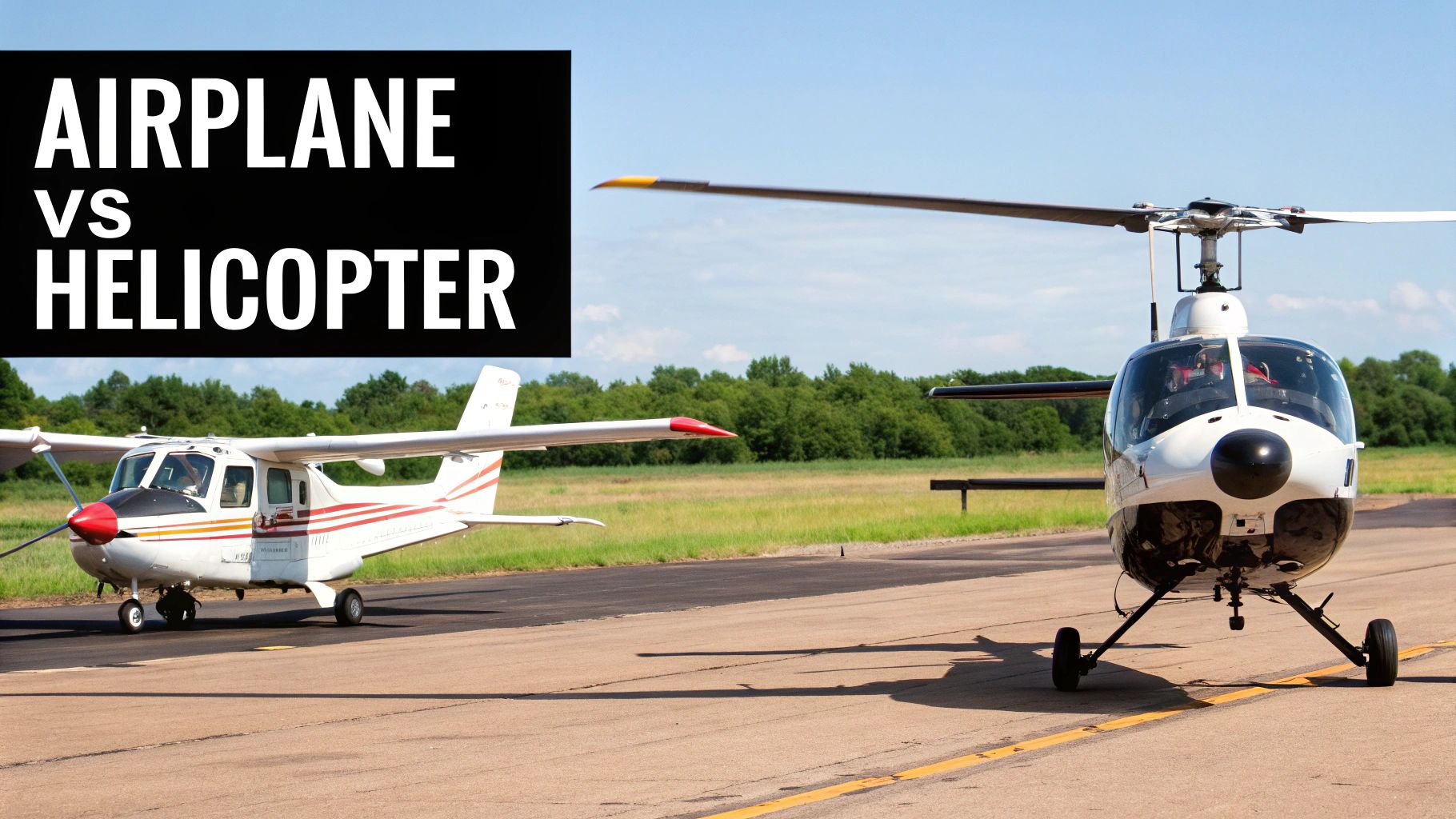
Before you ever step into a flight school, you’ve got a big decision to make. It’s a choice that will define not just how you fly, but where you fly and what your day-to-day life as a professional pilot looks like. Do you picture yourself behind the controls of a fixed-wing airplane, charting a course to become an airline pilot? Or are you drawn to the incredible agility and mission-critical work of a commercial helicopter pilot?
They're both amazing aircraft, but they open the doors to completely different professional worlds.
Think of an airline pilot as a long-haul strategist. Much of their job is about managing sophisticated systems, planning for weather across vast distances, and working seamlessly with a crew on established routes. The training is built around procedural perfection and mastering the instruments that let you fly in any weather. It's a career of meticulous planning and flawless execution.
On the other hand, a helicopter pilot is often a tactical expert. Their work is up-close, personal, and requires constant, hands-on control in dynamic situations. Imagine flying for emergency medical services, law enforcement, or news gathering over Los Angeles. These missions demand split-second decision-making and a level of situational awareness that is second to none. The helicopter flight training you get in Southern California is specifically designed to build these high-stakes professional skills.
A Tale of Two Careers
The day-to-day reality for these two types of pilots couldn't be more different. An airplane pilot aiming for the airlines is on a well-defined path, moving from smaller regional jets to larger long-haul aircraft. The career is structured, with predictable schedules and a clear ladder to climb.
Helicopter pilots often find themselves in specialized, niche roles. One day you might be giving tours over the Santa Monica Pier, and the next, you could be helping with aerial firefighting in the nearby mountains. The work is less routine and demands a knack for thinking on your feet. It's a perfect fit for a student who wants a career with variety and a constant, hands-on challenge.
The choice between fixed-wing and rotorcraft is about more than just the machine; it’s about the professional lifestyle you want to build. To help you see the differences more clearly, here’s a breakdown of what each career path typically looks like.
| Attribute | Airplane Pilot (Airline Career Focus) | Helicopter Pilot (Commercial Career Focus) |
|---|---|---|
| Training Focus | Heavy emphasis on instrument flight rules (IFR), complex systems management, and crew coordination. | Focus on precision maneuvering (hovering, autorotations), low-altitude operations, and external load work. |
| Typical Career Path | Flight instructor -> Regional Airline -> Major Airline. A very structured, seniority-based progression. | Flight instructor -> Tours/Utility/ENG (Electronic News Gathering) -> EMS/Fire/Law Enforcement. |
| Work Environment | High-altitude, long-distance flights between airports. Structured, scheduled, and team-oriented cockpit. | Low-altitude, localized, and mission-driven flights. Often solo work in unpredictable environments. |
| Key Skills | Procedural discipline, automation management, long-term planning, and communication. | Exceptional hand-eye coordination, rapid decision-making, and adaptability to changing conditions. |
As you can see, while both careers require a deep commitment to safety and professionalism, the skills you develop and the jobs you'll do are worlds apart.
Training That Shapes Your Future
Your initial flight training is tailored to these distinct career outcomes from day one.
-
Airplane Pilot training for aspiring airline professionals will quickly immerse you in instrument flying, which is the bedrock of a professional airline career. You'll master procedures, navigation, and how to operate safely in busy airspace and bad weather.
-
Helicopter Pilot training puts a premium on mastering the unique flight characteristics of the aircraft. For a commercial career, you’ll spend countless hours perfecting hovering, practicing emergency procedures like autorotations, and learning to operate in confined spaces.
The bottom line is this: your decision isn't just about what you want to fly. It's about the kind of professional life you want to lead. Whether you're drawn to the structured world of the airlines or the dynamic missions of a helicopter pilot, your choice of aircraft sets the foundation for your entire aviation journey.
Decoding Pilot Licenses and Ratings
Becoming a professional pilot isn’t a single giant leap; it’s more like climbing a ladder, one rung at a time. Each new license or rating you earn builds on the last, unlocking new privileges and proving you’ve mastered more complex skills. This clear, structured progression is your roadmap to the flight deck of an airliner or commercial helicopter.
Think of it like getting your driver's license. You start with a learner's permit, then get your license to drive on sunny days, and later add special endorsements to drive in tricky conditions or handle a big rig. For pilots, the journey to a professional career follows a similar, well-defined path.
The infographic below lays out this step-by-step FAA certification ladder.
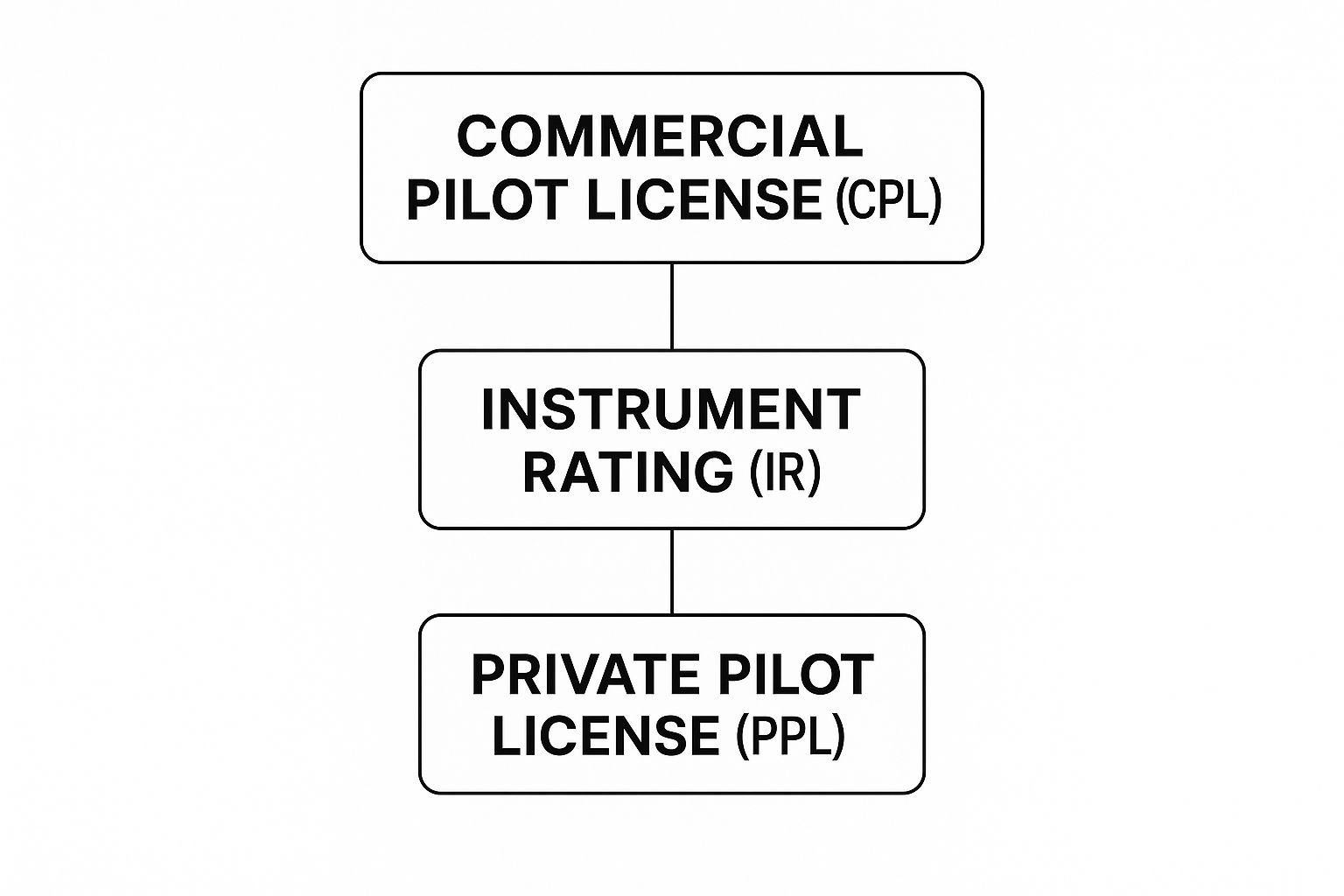
As you can see, each certificate serves as the foundation for the next, creating a direct pathway toward a career in the skies.
The Foundation: Your Private Pilot License
Every pilot’s story starts with the Private Pilot License (PPL). This is the bedrock of your flight training and the first major milestone for any student. Earning your PPL proves you have the fundamental skills to safely act as the Pilot in Command of an aircraft.
With a PPL, you can fly on your own or take friends and family up for a ride. The one thing you can't do is get paid for it. This certificate is all about mastering the basics—flight control, navigation, and decision-making in good weather.
Adding a Critical Skill: The Instrument Rating
Next up for a career-bound student is the Instrument Rating (IR). If the PPL is about learning to fly by looking out the window, the IR is about learning to fly by looking inside at your instruments. For anyone with airline ambitions, this rating isn't optional; it's essential.
An instrument rating gives you the legal authority and the skill to fly through clouds and poor visibility, a situation pilots call Instrument Meteorological Conditions (IMC). You learn to rely completely on your instruments to navigate and control the aircraft without seeing the ground at all. It’s this skill that allows the aviation system to run safely and on schedule, even when the weather doesn't cooperate.
An Instrument Rating transforms you from a fair-weather pilot into a capable aviator who can handle the demanding, real-world conditions of a professional career. It's the difference between a hobby and a profession.
Going Pro: The Commercial Pilot License
The final step in this core progression is the Commercial Pilot License (CPL). This is the one that lets you officially get paid to fly. Getting here requires a much higher level of precision and aeronautical knowledge than the PPL.
The training involves perfecting advanced maneuvers and demonstrating an expert command of the aircraft. Once you have your CPL, a whole new world of job opportunities opens up. You could fly for aerial survey companies, tow banners, or—a very common first step for future airline pilots—become a flight instructor to build flight time.
Earning your CPL is a huge achievement, marking your official entry into the world of professional aviation. You can dive deeper into what it takes to become a commercial pilot in our comprehensive guide.
How to Find the Right Southern California Flight School
Choosing where to do your flight training is easily the most critical decision you’ll make on your journey to becoming a professional pilot. The right school is so much more than just a place to log hours; it's your launchpad. It will mold your habits, kickstart your professional network, and truly set the tone for your entire aviation career.
If you're aiming for a career as an airline or commercial helicopter pilot, your choice will likely come down to two FAA-approved pathways: Part 141 and Part 61. Think of Part 141 schools as the university route—highly structured, with a rigid syllabus approved by the FAA. This is a fantastic fit for career-focused students who want a direct, efficient path to the airlines.
Part 61, on the other hand, is more like working with a private tutor. It’s far more flexible with scheduling and pacing, which can be a huge plus for some. However, it demands a lot more self-discipline to stay on track. For aspiring pilots seeking helicopter flight training, both paths can create excellent pilots, but the structured nature of a Part 141 program often aligns perfectly with the discipline required for commercial operations.
Key Factors for Career-Focused Students
When your goal is the professional cockpit, you need to look at flight schools with a different eye. It's not just about the sticker price; it's about the long-term value you're getting for your career. The quality of the instructors, the condition of the aircraft, and the school’s deep-seated safety culture are simply non-negotiable.
Here are the things you absolutely need to dig into:
- Instructor Experience: Don't be shy—ask about the backgrounds of the Chief and Assistant Chief Flight Instructors. Are they veterans with real-world airline or commercial helicopter time? Their experience and mentorship are pure gold for a student pilot.
- Fleet Maintenance and Availability: A well-maintained fleet that's actually available to fly is critical. You can't build hours toward your career if the aircraft are always in the shop. Ask about their maintenance standards and how they balance repairs with student scheduling.
- Safety Record and Culture: A top-tier safety culture is something you can feel. It’s in the tidiness of the hangars, the seriousness of pre-flight briefings, and the overall attitude. Ask them about their safety management system.
The real acid test for any school is a discovery flight. Getting in the air with an instructor gives you an immediate feel for their teaching style, the aircraft's condition, and the professionalism of the whole operation. That single flight is worth more than a thousand brochures.
The Southern California Advantage
Training in Southern California means you're plugging directly into a world-class aerospace ecosystem. The region's aerospace industry is a genuine hotbed of innovation. You have tech hubs like Silicon Beach, which is home to over 500 startups constantly pushing the limits of aviation technology.
This forward-thinking environment creates a culture that trickles down into the local flight training community, preparing student pilots for the advanced cockpits of tomorrow. You can learn more about the revival of SoCal's aerospace industry and see how it's shaping modern pilot training.
Breaking Down the Cost of Your Pilot Training

Let's talk about the bottom line. Becoming a professional pilot is a serious investment in your future, and it’s smart for students to go in with their eyes wide open about the costs involved. Knowing the financial commitment from day one helps you plan effectively and keeps you focused on your training, not on surprise expenses.
The two biggest line items on your budget will be aircraft rental and your instructor's time, both of which are billed hourly. Beyond that, you'll also need to budget for ground school books and software, fees for written exams, and the final checkride with an FAA examiner.
A Look at the Numbers for Airplane and Helicopter Training
For anyone dreaming of the airline world, the journey from zero experience to a Commercial Pilot License is a step-by-step process. Each new certificate adds to the total cost. The same is true for career-focused helicopter flight training, though the hourly rates for helicopters are usually higher because the machines are more complex.
To give you a realistic picture, here's a general cost breakdown for each path, assuming you're starting from scratch. Remember, these are ballpark figures. Your personal pace and the flight school you choose will determine your final cost.
Estimated Flight Training Costs in Southern California
This table outlines the typical investment needed to become a commercial pilot, for both airplanes and helicopters.
| License / Rating | Estimated Cost Range (Airplane) | Estimated Cost Range (Helicopter) |
|---|---|---|
| Private Pilot License (PPL) | $15,000 – $20,000 | $25,000 – $35,000 |
| Instrument Rating (IR) | $12,000 – $17,000 | $15,000 – $20,000 |
| Commercial Pilot License (CPL) | $25,000 – $35,000 | $30,000 – $40,000 |
| Total Estimated Investment | $52,000 – $72,000 | $70,000 – $95,000 |
As you can see, there’s a noticeable difference in the overall investment between fixed-wing and rotorcraft training—something to think about as you decide which cockpit is right for your career goals.
How to Fund Your Aviation Career
Figuring out how to pay for flight training is a hurdle for almost every student pilot, but don't let it ground your dream. There are plenty of options out there to help you fund your education.
Planning your finances is as critical as planning your cross-country flights. A solid funding strategy removes stress and allows you to focus completely on mastering your skills in the air.
Here are a few of the most common ways students fund their training:
- Aviation Loans: A number of banks and credit unions offer loans specifically for flight students. They understand the payment structure of training and often have more flexible terms than a standard personal loan.
- Scholarships: You'd be surprised how many aviation scholarships are available. Organizations like the Aircraft Owners and Pilots Association (AOPA) and Women in Aviation International (WAI) give out millions every year.
- Veteran Benefits: If you're a veteran, your GI Bill® benefits could cover a huge chunk of your training costs, provided you enroll at an approved flight school.
By doing your homework and building a budget, you can turn your ambition of becoming a professional pilot into a financial reality.
Your Pre-Flight Checklist Before You Enroll
So, you're ready to stop dreaming and start flying toward your career? Great. But before you officially sign up for flying lessons southern california, there are a few things you should knock out first. Getting these squared away now shows you're a serious student and makes sure everything goes smoothly from day one.
Think of it like this: no pilot just hops in a plane and goes. They do a careful pre-flight inspection every single time. This is your personal pre-flight check for your training journey.
Get Your Medical Certificate
First things first, go see an Aviation Medical Examiner (AME) and get your FAA medical certificate. This isn't optional—you absolutely need it to fly an aircraft by yourself. For aspiring career pilots, it's best to get a First Class medical from the start to ensure you meet airline standards. The last thing you want is to invest time and money only to discover an issue later.
Take a Discovery Flight
Next up, book a discovery flight. If you've narrowed your choices down to a couple of schools, fly with them. This is more than just a fun flight; it's your chance to see how they operate. You'll get a real sense of the school's vibe, the instructor's personality, and the quality of their aircraft. This is especially true for anyone wanting to fly helicopters—you need to feel what it's like in the pilot's seat.
A discovery flight is the best way to gut-check your decision. It helps you confirm that a school's culture and teaching style are the right fit for you before you put down any serious money.
Gather Your Documents
Finally, get your paperwork together. You’ll need to prove you're a U.S. citizen, which means having an original birth certificate or a valid passport handy. Having these documents ready to go will save you from annoying delays when you're ready to enroll.
Ticking off these boxes is just like running through the pre-flight checks on a Cessna 172; it’s all about making sure you’re fully prepared for a successful flight.
Got Questions About Flight Training in California? Let's Talk.
If you're a student thinking about becoming a pilot, you've probably got a long list of questions. That’s a good thing. It means you're taking this seriously. Let's tackle some of the most common ones we hear from people just starting out.
How Long Does It All Take?
This is usually the first thing student pilots ask. If you're going all-in, training full-time with the goal of an airline career, you can realistically go from zero experience to a commercially licensed pilot in about 12 to 18 months. That timeline gets you your Private Pilot License, Instrument Rating, and Commercial Pilot License.
Of course, life happens. If you’re training part-time, fitting lessons around a job or school, it might take closer to two years or more. There's no single "right" timeline—it's all about what works for you.
What's Different About Airline or Helicopter Training?
Good question. You don't just learn to "fly" in general; you train for the specific seat you want to sit in.
If your dream is the airline cockpit, your training will be structured for it from day one. Career-focused programs are built to develop the precise skills airlines need, which means a heavy focus on flying by instruments and mastering crew resource management—how to work seamlessly with a co-pilot.
On the other hand, helicopter flight training is a completely different world. The licenses have similar names (Private, Instrument, Commercial), but the skills couldn't be more distinct. Helicopter training is all about precision hovering, mastering emergency maneuvers like autorotations, and learning to operate safely in tight spaces. These are the make-or-break skills for careers in tourism, law enforcement, or emergency medical services.
The best training is a direct line to your end goal. Whether you see yourself behind the yoke of an airliner or at the cyclic of a helicopter, those first lessons are laying the foundation for that specific career.
Am I Too Young or Too Old to Start?
This one's simple: nope. You can start learning at any age. The only hard rules are set by the FAA. You have to be 16 years old to fly solo and 17 to get your Private Pilot License.
For an airline career, the big milestone is the Airline Transport Pilot (ATP) certificate, which requires you to be 23 years old. We see students start right out of high school and others who are starting a second career later in life. What matters isn't the year you were born, but your passion and commitment to learning to fly.
Ready to stop asking questions and start finding answers in the cockpit? At DuBois Aviation, we provide personalized, career-focused flight training for both airplanes and helicopters. Find out more at https://duboisaviation.com.

