
So, you’re dreaming of a career in the cockpit. It’s an incredible goal, and like any great journey, it has a clear flight plan. The path from your very first lesson to flying for an airline is a step-by-step process that builds your skills, knowledge, and confidence one rating at a time.
Most pilots aiming for the airlines will need to log around 1,500 flight hours, but it all starts with that first license.
Two practical options worth comparing
These are specific products pilots commonly compare for this type of flying. Confirm compatibility with your aircraft and instructor before ordering.
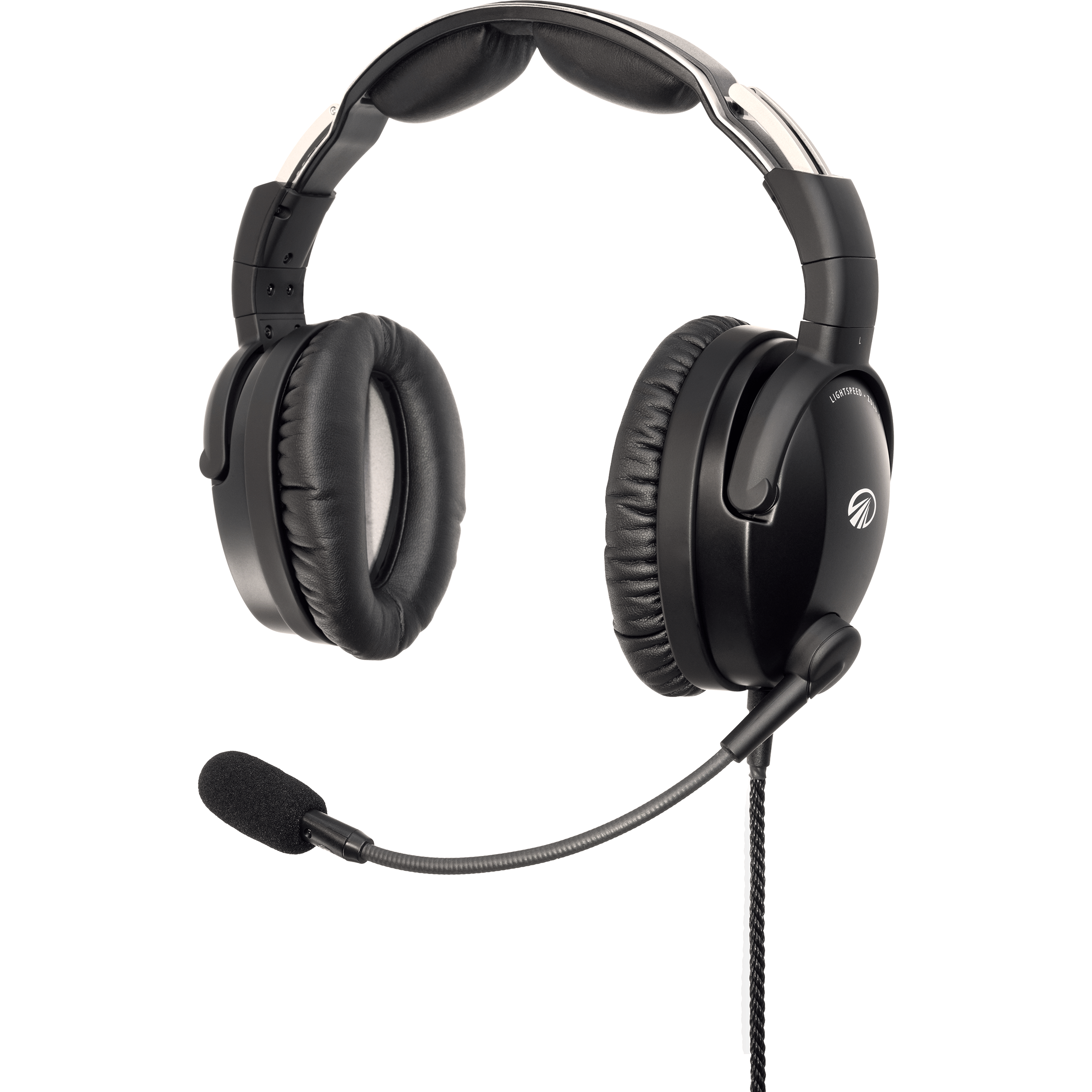 Premium ANR headsetLightspeed Zulu 4 ANR Aviation Headset - Dual GA PlugCheck current availability on Amazon (paid link)
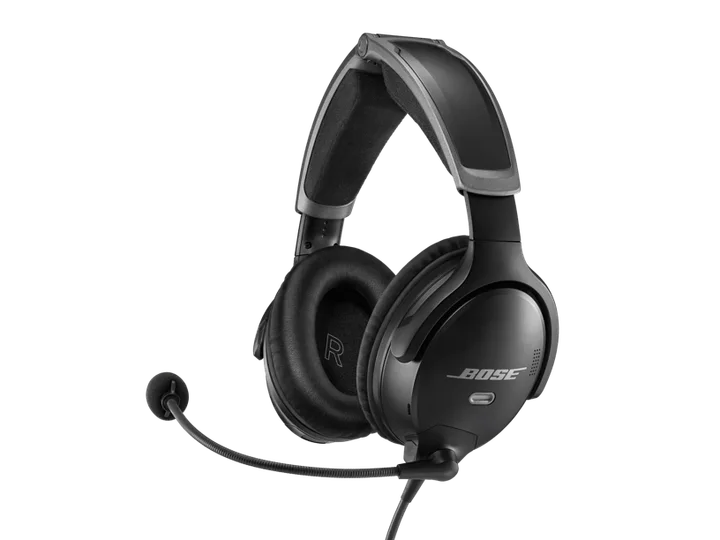 Premium headsetBose A30 Bluetooth Aviation Headset - Dual PlugCheck current availability on Amazon (paid link)
Your Flight Plan to the Cockpit
Think of your pilot training not as one giant leap, but as a series of well-defined waypoints. Each license and rating you earn is a crucial building block, laying the foundation for the next, more advanced skill set. This isn’t just about accumulating hours in a logbook; it’s about genuinely mastering the art and science of aviation.
Before you even touch the controls, there are a few basic prerequisites like age and medical fitness to clear. Once those are squared away, your real training begins. You’ll progress through three core certifications:
- Private Pilot License (PPL): This is where it all begins. You’ll learn the fundamentals of flight, navigation, and safety, earning the freedom to fly recreationally.
- Instrument Rating (IR): A game-changer. This critical rating trains you to fly safely through clouds and in low-visibility weather, relying solely on your cockpit instruments.
- Commercial Pilot License (CPL): This is the license that officially allows you to get paid for flying.
This infographic gives you a great bird’s-eye view of the entire process, from that initial spark of interest to logging the hours needed for a professional career.
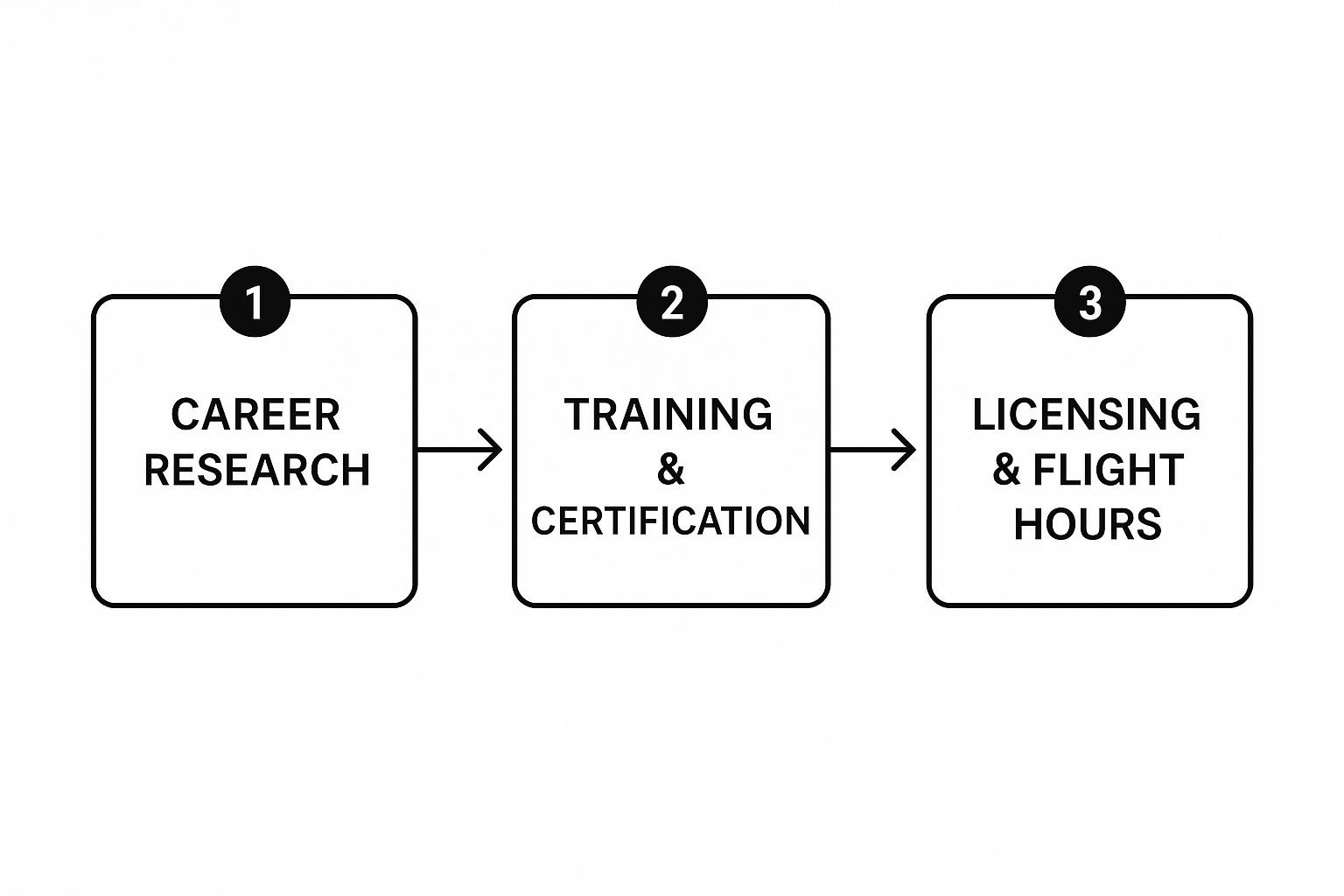
As you can see, the path is a logical sequence of research, hands-on training, and real-world experience. It’s a challenging but attainable goal for anyone with the right dedication.
Setting Realistic Expectations
Having a clear picture of this structure is vital for managing your expectations, both in terms of time and financial commitment. With global demand for pilots on the rise, the training industry has grown to match. In fact, the pilot training market was valued at around USD 9.37 billion in 2024 and is expected to keep growing.
The ultimate goal for most aspiring commercial pilots is the Airline Transport Pilot (ATP) certificate. This is the highest level of pilot certification and the one required by major airlines.
To get your ATP, you’ll generally need 1,500 hours of total flight time. To help you visualize the journey ahead, here’s a quick breakdown of the major milestones you’ll encounter.
Airline Pilot Career Milestones At a Glance
| Milestone | Primary Goal | Typical Duration | Key Outcome |
|---|---|---|---|
| Student Pilot & PPL | Learn the fundamentals of flight and earn your first license. | 3-6 Months | Ability to fly solo and with passengers for recreation. |
| Instrument Rating (IR) | Master flying in adverse weather by instrument reference. | 3-6 Months | Confidence and legal ability to fly in IFR conditions. |
| Commercial Pilot License (CPL) | Meet higher standards of airmanship to fly for compensation. | 3-6 Months | Legally able to work and be paid as a pilot. |
| Hour Building | Accumulate flight experience to meet ATP requirements. | 12-24 Months | Reach 1,500 total hours (or R-ATP minimums). |
| Airline Transport Pilot (ATP) | Achieve the highest pilot certification for airline careers. | 1-2 Months | Qualified to fly for a major U.S. air carrier. |
Each of these stages comes with its own set of challenges and triumphs. Throughout this guide, we’ll dive deep into what each step involves.
If you’re ready to see how a structured program can guide you through this process, take a look at our enrollment process to get started.
Laying the Groundwork: Are You Eligible?
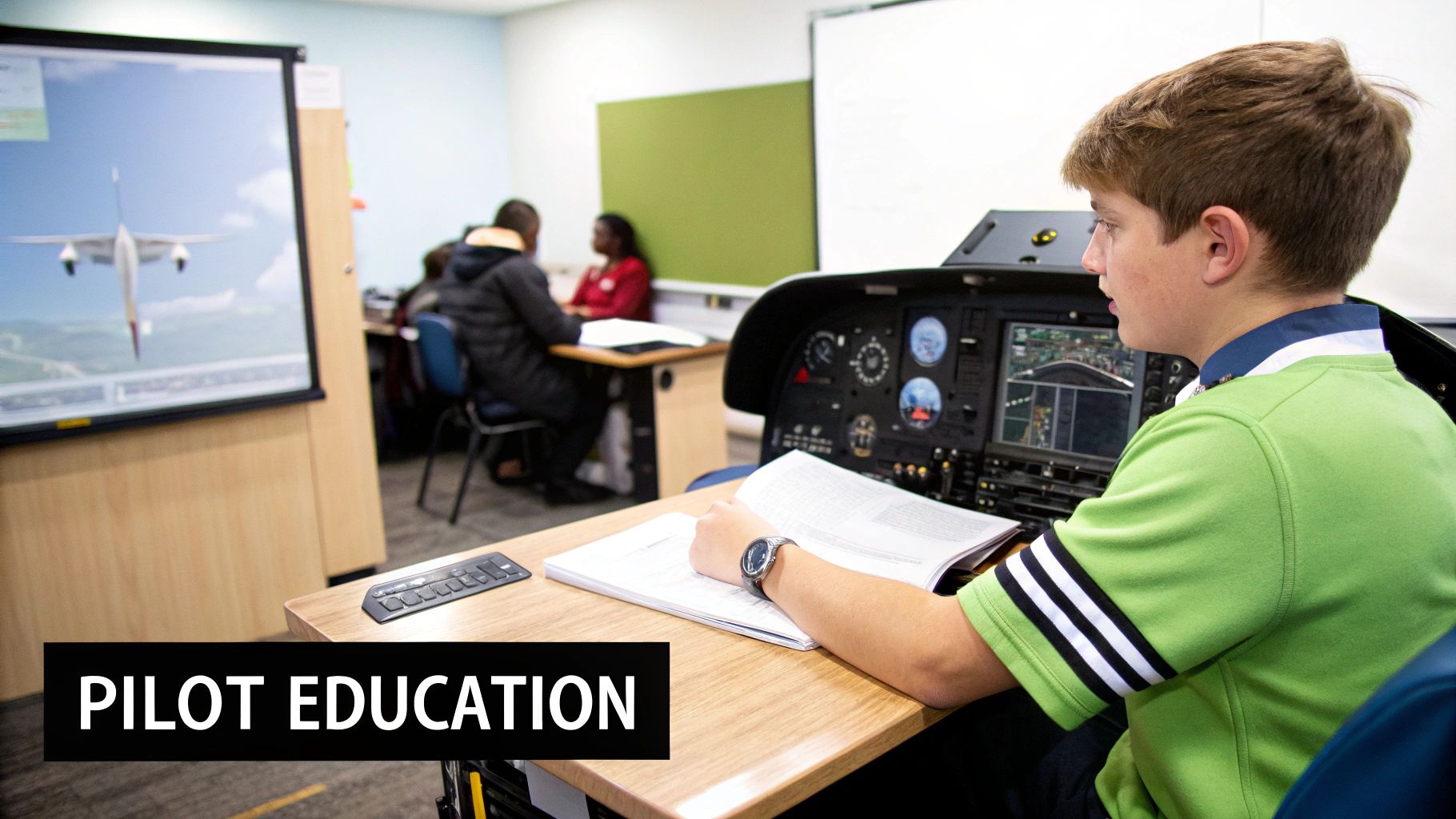
Before you ever step into a cockpit, your journey to becoming a commercial pilot starts with ticking some crucial boxes on the ground. Think of these as the gate checks before you can even head to the runway. The Federal Aviation Administration (FAA) sets these standards not to be difficult, but to ensure every pilot has the fundamental capabilities for the intense training that lies ahead.
First up, age. You can start training and fly solo at 16, but you must be at least 17 years old to get your Private Pilot License. For a Commercial Pilot License, the minimum age is 18. The big one, the Airline Transport Pilot (ATP) certificate—the ticket to the major airlines—requires you to be at least 23 years old.
You’ll also need to be fluent in English. This is non-negotiable. From communicating with air traffic control to coordinating with your crew, clear, concise English is the language of the skies and a cornerstone of aviation safety.
Beyond a High School Diploma
Officially, a high school diploma or GED is all you need to get started. But let’s be realistic—the industry is competitive. Major airlines and corporate flight departments overwhelmingly favor candidates who hold a four-year college degree.
It doesn’t even have to be in aviation. While a degree in aeronautical science looks great, a degree in history, business, or engineering shows you have the discipline and critical thinking skills to succeed. It’s a clear differentiator that will give you a serious edge when you’re up against a pile of other qualified applicants.
The Make-or-Break Medical Certificate
This is the big one, and I always tell aspiring pilots to tackle it first: the FAA Medical Certificate. You can’t log a single hour of flight time toward a license without one. Getting this certificate confirms you are physically and mentally fit to safely command an aircraft.
There are three classes, and it’s vital to know the difference:
- Third-Class: This is your entry ticket. It’s required for student and private pilots and has the most relaxed standards.
- Second-Class: You’ll need this to get paid to fly. It’s the minimum for a Commercial Pilot License.
- First-Class: This is the gold standard, mandatory for anyone who wants to be an airline captain. It has the toughest requirements, especially for vision and cardiovascular health.
My Advice: Don’t wait. Get a First-Class Medical Certificate before you spend a dime on flight training. It’s the best way to uncover any potential medical roadblocks early on, so you don’t invest thousands of dollars only to find out you have a disqualifying condition.
An Aviation Medical Examiner (AME) will conduct the exam, which involves a review of your medical history, vision and hearing tests, and a general physical. Be completely honest on your application. Hiding a condition is a surefire way to get permanently disqualified. While things like color blindness or certain neurological disorders can be an issue, waivers are sometimes available. Discuss any concerns with your AME. Once that certificate is in your hand, you’ve got the green light to really start flying.
Earning Your Wings Through Flight Training
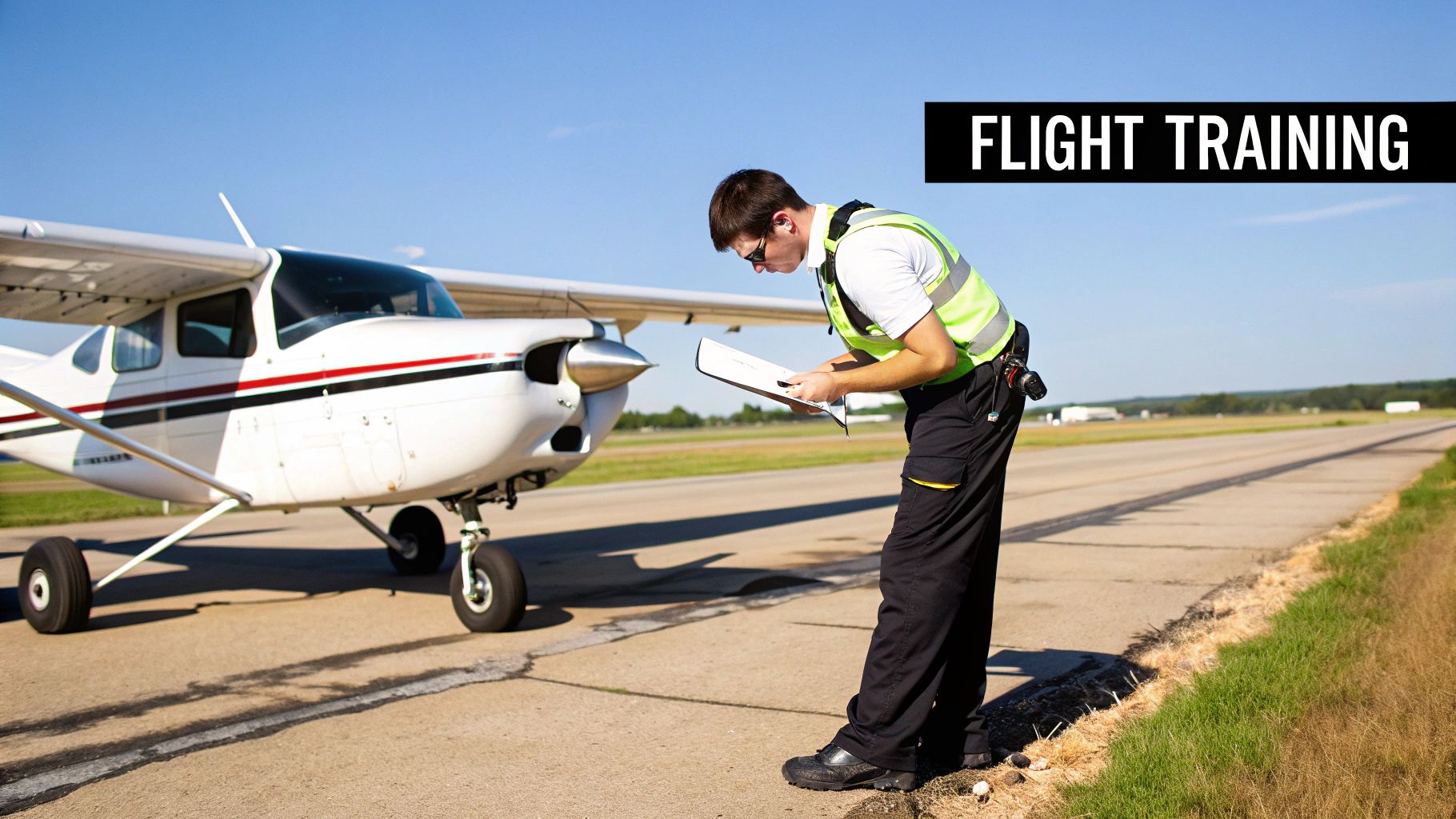
This is where the rubber (or, in this case, the wheels) meets the runway. Your flight training is a carefully structured journey that takes you from a complete novice to a professional aviator, layering skills and qualifications one on top of the other.
Every license and rating you earn is a building block. You start with the absolute basics and steadily progress, with each certificate acting as a license to learn more. It’s a challenging, rewarding process that builds not just skill, but real-world confidence.
The Foundation: Your Private Pilot License
Every single pilot, from a weekend enthusiast to a 747 captain, started in the exact same place: earning their Private Pilot License (PPL). This is your driver’s license for the sky.
The PPL is where you master the fundamentals—basic maneuvers, takeoffs, landings, and how to navigate using visual landmarks. You’ll spend countless hours with an instructor, learning not just what to do, but why you’re doing it. The FAA minimum is 40 hours, but most people realistically take 50 to 70 hours to feel truly proficient.
Once you pass your checkride, a practical exam with an FAA examiner, you can fly for fun and even take friends and family up with you. The one thing you can’t do is get paid.
Flying Without Visuals: The Instrument Rating
With your PPL in hand, you’re ready for what many pilots consider the most transformative part of their training: the Instrument Rating (IR). This rating teaches you how to fly the aircraft solely by reference to the instruments in the cockpit, without ever needing to see the horizon.
This is the skill that allows you to fly through clouds and in low visibility—conditions that would ground a non-instrument-rated pilot. It’s a massive confidence booster and forces you to become an incredibly precise pilot.
The Instrument Rating is more than just a certificate; it’s a new way of thinking. It trains your brain to ignore misleading physical sensations and rely entirely on what the instruments are telling you is true.
This phase is heavy on procedures, radio navigation, and interpreting complex approach charts. It’s tough, but it’s what makes you a truly capable, all-weather aviator.
Getting Paid to Fly: The Commercial Pilot License
Now we’re talking. The Commercial Pilot License (CPL) is the certificate that officially allows you to fly for hire. As you can imagine, the standards are much higher here.
Your flying has to be sharper, your knowledge of regulations deeper, and your decision-making more professional. To even be eligible for the exam, you need to have logged at least 250 hours of total flight time (this can be as low as 190 hours in certain structured programs).
Passing your CPL checkride is a huge milestone. You can now legally be paid for your flying, opening the door to entry-level pilot jobs where you’ll build the experience needed for an airline career.
Choosing Your Flight School: Part 61 vs. Part 141
One of the first big decisions you’ll make is what kind of flight school to attend. The FAA oversees two distinct pathways: Part 61 and Part 141. Both get you the same licenses, but the journey is quite different.
Making the right choice really boils down to your schedule, budget, and learning style. A Part 61 school offers incredible flexibility, making it perfect for someone training around a full-time job. On the other hand, a Part 141 program is highly structured and often faster, which is ideal for students who want to immerse themselves full-time.
Here’s a breakdown of the key differences:
Choosing Your Flight School Part 61 vs Part 141
| Feature | Part 61 Program | Part 141 Program |
|---|---|---|
| Structure | Highly flexible and self-paced. | Rigid, syllabus-based curriculum with defined stages. |
| FAA Oversight | Less direct oversight of the training process. | Requires regular FAA approval and audits. |
| Minimum Hours | Higher FAA minimums (e.g., 250 hours for CPL). | Lower FAA minimums (e.g., 190 hours for CPL). |
| Ideal For | Part-time students or those with irregular schedules. | Full-time students seeking a fast-tracked, structured path. |
Neither path is inherently “better”—it’s all about what’s better for you. If you want to see what a structured curriculum looks like, exploring the details of a comprehensive flight training program can give you a clearer picture.
Adding Advanced Qualifications
For an airline career, a CPL isn’t the final stop. The first essential add-on is the Multi-Engine Rating (MER). This is exactly what it sounds like: a rating that qualifies you to fly aircraft with more than one engine, which includes pretty much every modern airliner.
Next comes the big one: the Airline Transport Pilot (ATP) certificate. Think of this as the Ph.D. of aviation. The requirements are steep: you must be at least 23 years old and have a minimum of 1,500 hours of flight time.
This final certificate is your ticket to the right seat of an airliner. The demand for qualified pilots has never been higher, with the global pilot training market valued at USD 6.55 billion in 2021 and projected to grow significantly. You can learn more about these trends in the global pilot training market report. Earning your ATP marks the successful end of your training and the start of your professional airline career.
Financing Your Aviation Dream
Let’s be upfront about the single biggest hurdle for most aspiring pilots: the cost. Earning your wings is a serious financial commitment, and having a solid funding strategy is just as critical as mastering your flight maneuvers.
The total investment to go from zero experience to a commercial multi-engine pilot typically lands somewhere between $70,000 and $100,000. This all-in number accounts for aircraft rental, instructor fees, exam costs, and all the necessary gear like headsets and charts.
So, where does all that money go? The biggest slice of the pie is aircraft rental. You can expect to pay anywhere from $150 per hour for a simple trainer to over $400 per hour for a complex multi-engine plane. On top of that, you’ll have your instructor’s time, which usually adds another $60 to $90 per hour.
Deconstructing the Total Cost
To really understand the financial journey, it helps to see how the costs break down by each certificate and rating. Keep in mind these are just ballpark figures—your actual costs will depend on your flight school, location, and your own pace of learning.
- Private Pilot License (PPL): This first major step usually runs between $15,000 and $20,000.
- Instrument Rating (IR): Expect to add another $12,000 to $15,000 to learn to fly solely by reference to your instruments.
- Commercial Pilot License (CPL): This is the most significant investment, often $40,000 to $50,000 or more, because it includes a lot of “time building” to reach the required flight hours.
- Multi-Engine Rating (MER): A relatively quick but intense add-on, this rating can cost $4,000 to $7,000.
Seeing those numbers stacked up can feel intimidating, but don’t let it ground you before you even start. Countless pilots have found creative ways to fund their training. The key is to be resourceful and explore every possible option.
Real-World Funding Strategies
Very few people write a single check for their entire flight training. The far more common approach is to patch together funding from a few different sources, which makes the overall cost feel much more manageable.
Student loans are a well-trodden path. While traditional federal student aid usually doesn’t apply to most flight schools (known as Part 61 schools), many private lenders have loan products specifically for aspiring pilots. Banks like Sallie Mae and Wells Fargo, among others, offer specialized aviation loans.
Don’t overlook scholarships! There are hundreds of aviation-specific scholarships available every year from groups like the Aircraft Owners and Pilots Association (AOPA), Women in Aviation International (WAI), and the Experimental Aircraft Association (EAA). They’re awarded for everything from academic merit to financial need, and even a few small awards can really make a difference.
Airline-sponsored cadet programs are also becoming a popular route. These partnerships can provide financial assistance or even a conditional job offer in exchange for your commitment to fly for them once you’re qualified. It’s a great way to line up both your funding and your first job.
Creating Your Financial Flight Plan
Before you take your first discovery flight, you need a financial flight plan. Start by getting a detailed, line-by-line cost estimate from any school you’re considering. Make sure it includes not just flight time, but also exam fees, books, supplies, and a cushion for unexpected things like weather delays.
Here are a few steps to get you started:
- Start Saving Now: The more you can pay out-of-pocket, the less you’ll have to borrow. Every dollar you save upfront is a few dollars you won’t pay back in interest later.
- Shop Around for Loans: Don’t just go with the first lender you find. Compare interest rates, repayment options, and eligibility rules from multiple aviation lenders.
- Make Applying for Scholarships a Habit: Don’t just apply once. Keep searching and applying for scholarships throughout your entire training journey.
Sorting through all these financial details can feel overwhelming, but you don’t have to do it alone. Many flight schools provide guidance, and you can learn more about specialized funding by exploring your flight school financing options. With a smart plan in place, your dream of becoming a pilot can become a financial reality.
Building Hours and Launching Your Career
Getting your Commercial Pilot License (CPL) is a massive milestone, but in the world of professional aviation, it’s really just a license to learn. To get a seat at a major airline, you’ll need an Airline Transport Pilot (ATP) certificate, which means logging about 1,500 flight hours. So how do you close that huge gap from the 250 or so hours you have now?
This next chapter is all about building quality time and officially starting your career. You’ll be flying professionally, getting paid for it, and sharpening your skills in real-world scenarios. It’s a grind, for sure, but it’s the essential process that turns a pilot into a true aviator.
The Tried-and-True Path: Certified Flight Instructor
For the vast majority of new commercial pilots, the first paid gig is becoming a Certified Flight Instructor (CFI). There’s a good reason for this—it’s hands-down one of the most effective ways to build hours while cementing your own knowledge.
When you teach someone else to fly, you’re not just watching the Hobbs meter tick up. You are forced to master every concept on a much deeper level. Try explaining aerodynamics or a complex instrument approach to a brand-new student; it solidifies your own understanding in a way that just reading a textbook never could. The hours come in steadily, and you develop critical decision-making and communication skills from the right seat.
Working as a flight instructor isn’t just about building hours; it’s about building command authority. You learn to anticipate student mistakes, manage risk in real-time, and make critical decisions that keep everyone safe—all skills that are highly valued by airlines.
Other Ways to Build Your Logbook
While being a CFI is the most common route, it’s far from the only one. There are plenty of other entry-level pilot jobs out there that offer unique and valuable experience.
- Banner Towing: This job demands incredible precision, flying low and slow. It’s often seasonal work, but it’s a fantastic way to rack up Pilot-in-Command (PIC) time quickly.
- Aerial Survey and Photography: Think pipeline patrols or mapping flights. This kind of work hones your navigational skills and attention to detail as you fly very specific grid patterns for hours on end.
- Skydiving Operations: Flying a jump plane means lots of takeoffs and landings, often in busy airspace. It’s an amazing way to sharpen your stick-and-rudder skills.
- Ferry Pilot: Delivering aircraft from one place to another will give you incredible cross-country experience. The work can be a bit less consistent, but the adventures are unmatched.
Each of these jobs offers a different flavor of flying and exposes you to new operational challenges. The right fit really depends on where you live, what interests you, and what kind of pilot you want to become.
Gearing Up for Your First Airline Job
As that 1,500-hour mark gets closer, your focus will naturally shift to landing that first airline job. This is where your professionalism, your logbook, and your interview skills all come together. The good news is that the pilot job market is strong, largely fueled by a boom in air travel and a wave of retirements.
The global demand for commercial pilots is staggering. Boeing’s latest outlook predicts a need for 674,000 new pilots worldwide over the next twenty years, with North America needing around 123,000 of them. This need is made even more urgent by retirements—over 17,000 airline pilots are expected to hit the mandatory retirement age by 2030. You can get more details on this growing pilot demand from Capitol Technology University.
But to stand out, you’ll need more than just the hours. Your resume needs to be perfect, clearly showing your total flight time, PIC hours, and any special roles you’ve held, like being an instructor or check airman.
The airline interview is a multi-stage gauntlet. You should be ready for:
- The HR Interview: They want to see if you’re a good fit for the company culture. Expect situational questions like, “Tell me about a time when…”
- The Technical Interview: Get ready to be grilled on FAA regulations, aircraft systems, and aerodynamics. You have to know your stuff, cold.
- The Simulator Evaluation: You’ll be paired with another pilot in a full-motion simulator to see how you handle instrument flying, crew resource management (CRM), and unexpected emergencies.
Preparation is absolutely everything. Rehearse your interview answers, bury your nose in technical manuals, and try to get some practice in a simulator if you can. Nailing this final test is what stands between you and the right seat of an airliner, finally launching the career you’ve worked so incredibly hard for.
Your Top Questions About a Pilot Career, Answered
You’ve read about the training, the exams, and the flight hours. But what’s it really like to be a commercial pilot? Beyond the technical side of things, most aspiring aviators want to know about the lifestyle and the day-to-day realities of the job.
Let’s pull back the curtain and talk about the practical questions that will help you decide if this is the right career path for you.
What Is a Pilot’s Daily Life Really Like?
If you’re picturing a life of constant glamour and spontaneous trips, it’s time for a reality check. A pilot’s day is built on structure, precision, and a whole lot of preparation. The workday starts long before you ever step onto the aircraft.
Hours before a flight, you’re already deep into the details—analyzing weather reports, reviewing the flight plan, and calculating the exact fuel needed. Then comes the crew briefing, where you sync up with your first officer and flight attendants to go over the day’s flights, any potential weather hiccups, or other operational details. This routine is the bedrock of aviation safety.
Once you get to the plane, you’ll do a meticulous walk-around inspection and then run through extensive pre-flight checklists in the cockpit. Honestly, the actual flying can often feel like the calmest part of the day. After you land, the process reverses with post-flight duties before you do it all over again for the next leg. It’s a career of disciplined routine, not constant adventure.
Do I Absolutely Need a College Degree?
This is one of the most common questions we get, and the answer isn’t a simple yes or no. Officially, the FAA does not require a college degree to earn your Airline Transport Pilot (ATP) certificate. The real answer, however, lies in the competitive landscape of the industry.
For years, the major airlines—we’re talking Delta, American, and United—have almost exclusively hired pilots with a bachelor’s degree. It doesn’t usually matter what you majored in; the degree itself signals that you have the discipline and commitment to handle a tough academic workload.
While a degree isn’t a legal requirement, think of it as a major competitive advantage. When the industry hits a slow patch and hiring tightens, pilots without a degree are often the first to be passed over. It’s a key part of making your resume as strong as possible for the top-tier airlines.
In today’s high-demand environment, some regional airlines might be more flexible. But if your long-term goal is a career at a major carrier, getting that four-year degree is still a very smart move.
Regional vs. Major Airlines: What’s the Difference?
Hardly anyone walks straight out of flight school into the cockpit of a Boeing 777. The well-trodden career path for most new airline pilots starts at a regional airline, which is where you cut your teeth and build invaluable experience.
Here’s how they stack up:
- Regional Airlines: These carriers are the workhorses of the industry, operating smaller jets (think 50-76 seats) on shorter routes. They connect smaller cities to the big hubs, essentially acting as a “feeder” system for the major airlines. The pay is lower and the schedules can be grueling, but this is where you gain the critical real-world experience you need to move up.
- Major Airlines: These are the big household names flying large aircraft on national and international routes. The difference is night and day—the pay scales, benefits, and overall quality of life are significantly better. For most pilots, landing a job at a major is the ultimate career goal.
Think of your time at a regional airline as your professional proving ground. It’s where you master the complexities of the airline system and build the flight time that makes you a top candidate for the majors.
How Long Does the Whole Process Take?
The journey from your first discovery flight to the right seat of an airliner is a marathon, not a sprint. If you’re a dedicated, full-time student, you can expect a timeline that looks something like this:
- Getting Your Core Licenses and Ratings: Earning your Private Pilot License (PPL), Instrument Rating (IR), and Commercial Pilot License (CPL) typically takes around 12 to 18 months.
- Building Your Flight Hours: This is often the longest stretch. After your CPL, you need to log flight time to reach the 1,500 hours required for an ATP certificate. Most pilots do this by working as a flight instructor, which can take another 18 to 24 months.
All in, you’re looking at a realistic timeline of three to four years of dedicated work. Of course, this can shift depending on how often you fly, your financial situation, and the job market for time-building roles. But it’s a good reminder of the serious commitment this incredible career requires.
Ready to stop wondering and start flying? At DuBois Aviation, we provide the structured training and experienced mentorship to guide you through every step of this journey. Learn more about our programs at https://duboisaviation.com.
Article created using Outrank


