Thinking about a career in the cockpit? It's an incredible journey that takes you from private pilot all the way to a commercial license, where you can actually get paid to fly. The path is clear and structured, but it absolutely demands dedication. Let's break down exactly what it takes to turn that passion into a profession.
Your Journey to the Flight Deck Starts Now
The dream of a career in the skies is more within reach than you might think. For aspiring commercial pilots, the process is a steady climb—building skills, knowledge, and flight time one step at a time. It’s a path that starts with mastering the fundamentals in something like a Piper Cherokee and eventually leads to handling complex aircraft with professional poise. Think of this guide as your personal roadmap.
We'll focus specifically on the advantages of training right here in Southern California. Flying out of a busy airport like Chino (KCNO) from day one throws you right into the mix of controlled airspace, which really sharpens your skills fast. This isn't just about logging hours; it's about building the kind of real-world airmanship that airlines and charter operators are desperately looking for.
Two practical options worth comparing
These are specific products pilots commonly compare for this type of flying. Confirm compatibility with your aircraft and instructor before ordering.
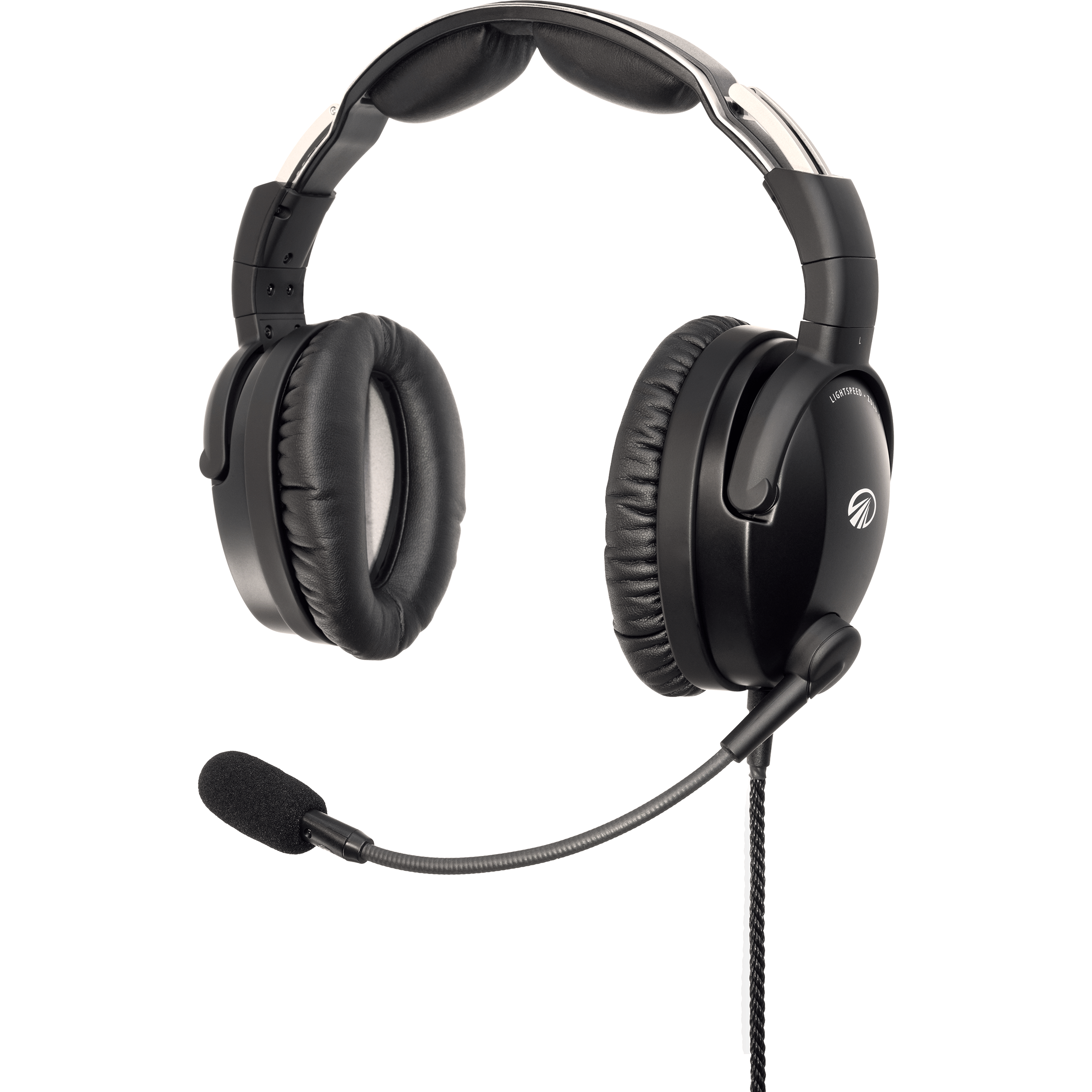 Premium ANR headsetLightspeed Zulu 4 ANR Aviation Headset - Dual GA PlugCheck current availability on Amazon (paid link)
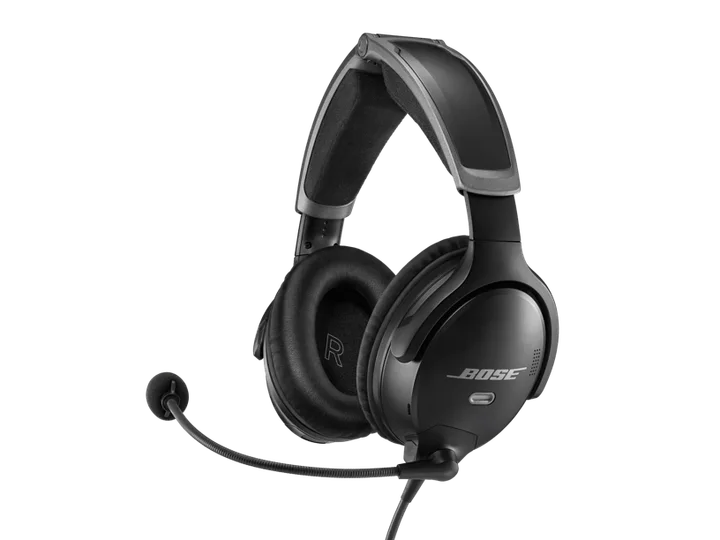 Premium headsetBose A30 Bluetooth Aviation Headset - Dual PlugCheck current availability on Amazon (paid link)
Mapping Your Path to a Commercial License
There's never been a better time to be a pilot. The industry is facing a massive demand for skilled aviators, with Boeing projecting a need for about 660,000 new pilots worldwide over the next two decades. This isn't just a number; it's a huge opportunity fueled by growing fleets and a wave of retirements. For anyone starting their training now, the career prospects are fantastic.
The graphic below lays out the core milestones you'll hit on your way to becoming a professional pilot.
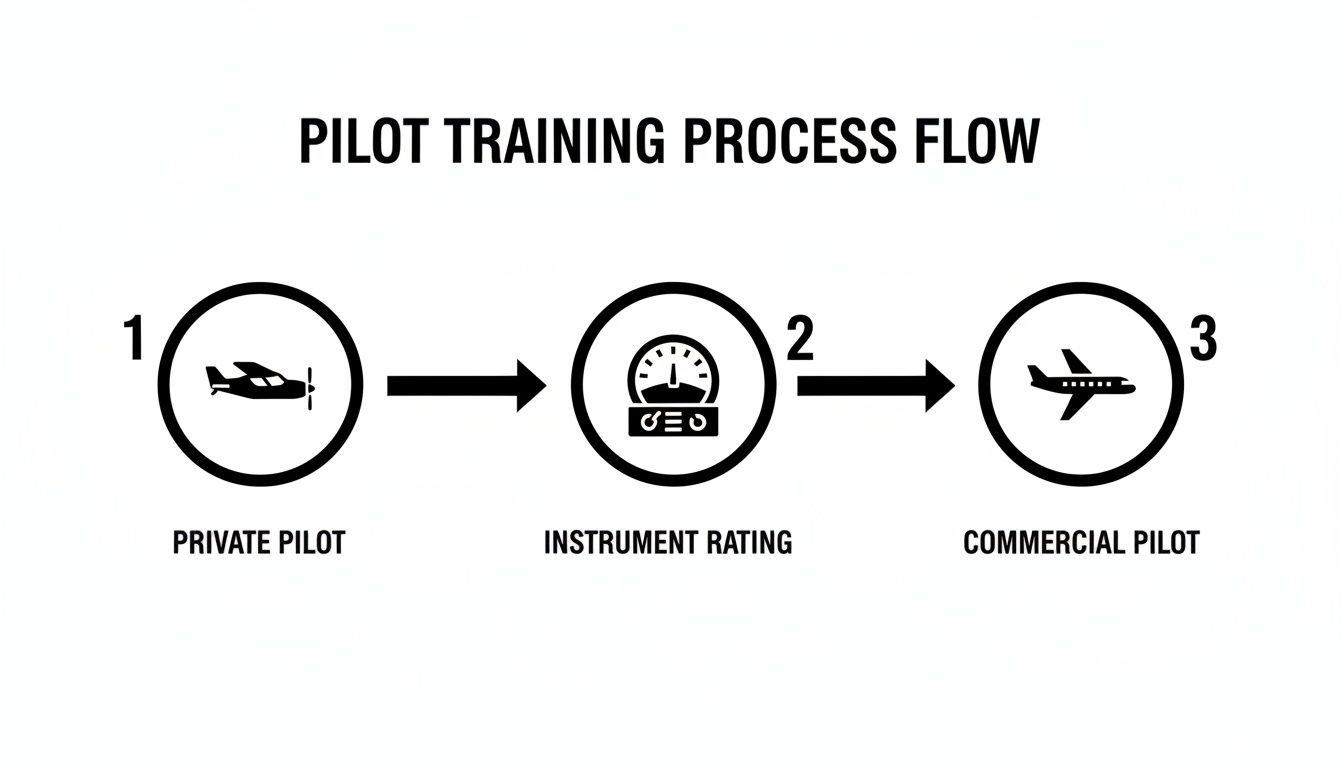
As you can see, it’s a logical progression. You start as a Private Pilot to nail the basics, then get your Instrument Rating to fly without visual references, and finally, you earn that Commercial certificate that lets you fly for hire.
To give you a clearer picture, here's a quick breakdown of what each stage involves.
Commercial Pilot Training Milestones at a Glance
| Milestone Certificate/Rating | Primary Focus | Approximate Flight Hours |
|---|---|---|
| Private Pilot Certificate | Mastering fundamental aircraft control and VFR rules | 40-60 hours |
| Instrument Rating | Flying solely by reference to instruments (IFR) | 40-50 hours of IFR training |
| Commercial Pilot Certificate | Advanced maneuvers and professional-level precision | 250 total hours (FAA minimum) |
Each step is designed to build on the last, creating a solid foundation of skill and confidence for the flight deck.
This entire path is about more than just checking boxes and meeting FAA minimums. It's about developing the sharp judgment and proficiency that define a true professional. If you're just getting started, it's a good idea to look into the first steps of taking flying lessons in Southern California. For more general aviation industry information and resources, the Flycraft website is also a great place to explore. This comprehensive approach ensures you’re not just ready for your checkride, but for a long and successful career.
Building Your Foundation with a Private Pilot License
Every professional pilot’s journey starts in the exact same place: the Private Pilot License (PPL). Forget the complex systems of an airliner for now; this is where you build the bedrock of your entire career. The PPL is all about mastering the fundamentals of stick-and-rudder flying, developing discipline, and forging the airmanship that will keep you safe for decades to come.
This is where theory meets reality. All those concepts you read about in books—lift, drag, weather, regulations—suddenly click into place when you're at the controls.
Before you start, there are a few boxes to check. The FAA requires you to be at least 17 years old to earn your private license and be proficient in English (reading, writing, and speaking). You’ll also need to pass an aviation medical exam, so it's smart to get that done early to make sure there are no surprises down the line.
From Ground School to the Cockpit
Your training essentially runs on two parallel tracks—what you learn on the ground and what you practice in the air.
Ground school is your academic foundation. Using top-tier materials from Jeppesen, you’ll dig into the science and rules of aviation. This isn’t just about memorizing facts for a test; it’s about understanding why an airplane flies and how to operate it safely.
- Aerodynamics: You’ll get a real feel for how lift, weight, thrust, and drag work together.
- Weather Theory: This is one of the most critical skills—learning to read forecasts and make smart go/no-go decisions.
- FAA Regulations: These are the rules of the road for the sky, and you need to know them cold.
- Aircraft Systems: You'll learn the nuts and bolts of your training aircraft, like the Cessna 150, from the engine to the electrical system.
As you absorb this knowledge, you’ll be putting it to immediate use in the cockpit with a certified flight instructor. Training at a dynamic, towered airport like Chino (KCNO) gives you a huge head start. Right from day one, you're talking to air traffic control and sharing the pattern with everything from small planes to corporate jets. That kind of real-world pressure builds confidence you just can’t replicate at a quiet, uncontrolled airfield.
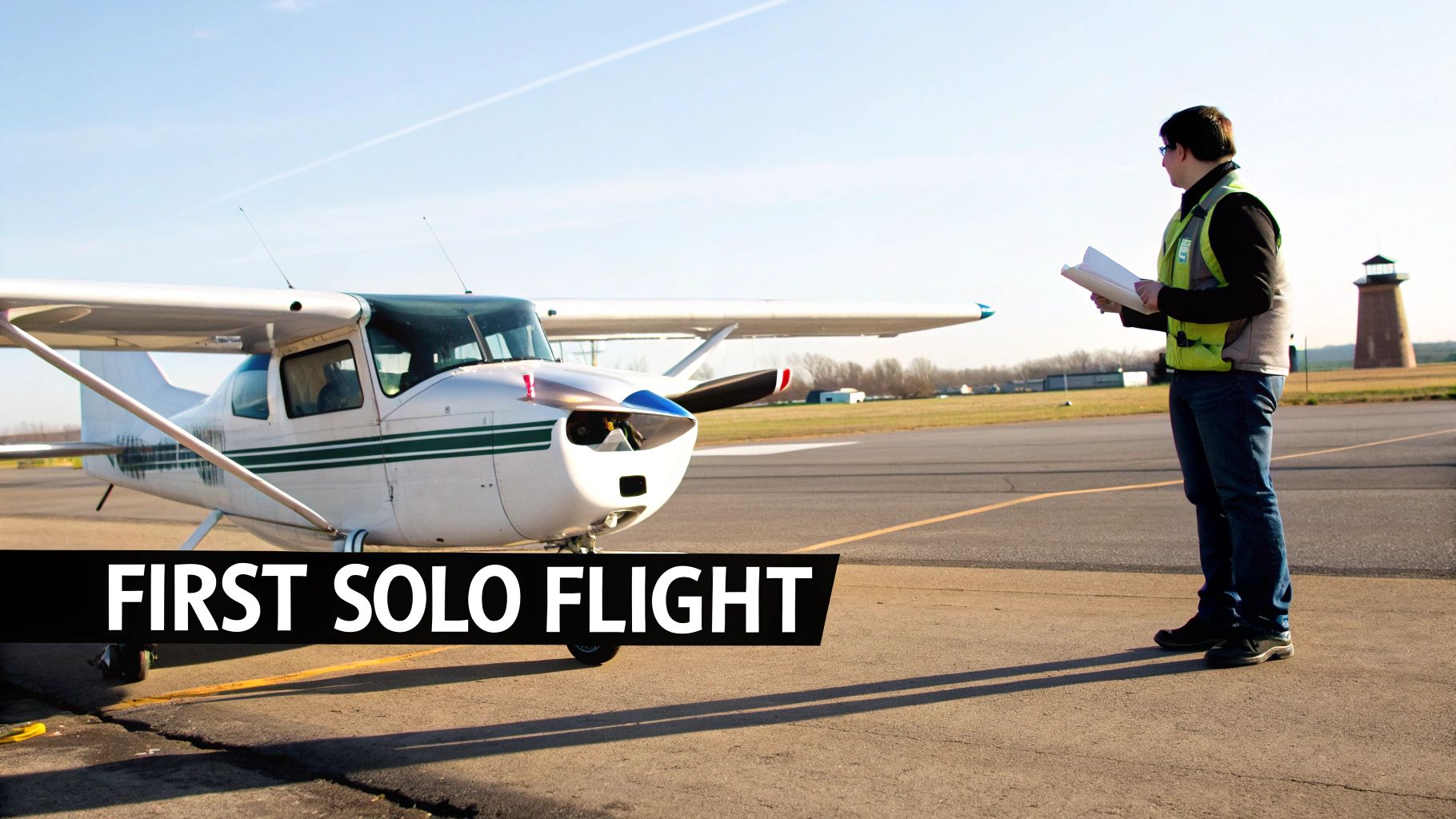
Nothing quite compares to your first solo flight. It's that moment your instructor hops out, shakes your hand, and sends you up alone for the first time. It's an unforgettable milestone and the ultimate proof that you have what it takes to command an aircraft.
Mastering the Fundamentals of Flight
The flight training portion of your PPL is all about precision and consistency. You’ll practice the core maneuvers—takeoffs, landings, climbs, turns, and stalls—until they become muscle memory. The goal is to handle the aircraft with a calm, methodical approach, especially when practicing emergency procedures.
Under FAA Part 61 rules, you need a minimum of 40 flight hours. Honestly, though, most students find their sweet spot for proficiency is closer to 50 or 60 hours. This time is carefully structured to make you a well-rounded pilot.
| Flight Training Component | Primary Objective |
|---|---|
| Dual Instruction | Flying with your instructor to learn and refine maneuvers. |
| Solo Flight Time | Building your confidence and decision-making skills as pilot-in-command. |
| Cross-Country Navigation | Planning and flying routes to other airports, a critical skill. |
All of this hard work culminates in the FAA checkride. It’s a two-part test with a Designated Pilot Examiner (DPE) that includes a rigorous oral exam on the ground followed by a practical flight test. Passing it is your final hurdle. For a deeper dive into this process, check out our comprehensive guide on how to get your Private Pilot License.
Earning this certificate isn't just an achievement; it's your ticket to the next stage of your professional pilot career.
Mastering the Skies with an Instrument Rating
If getting your Private Pilot License proves you can fly, earning an Instrument Rating (IR) proves you can navigate and think like a professional. This is a huge leap. You’ll go from a fair-weather, visual pilot to an aviator who can confidently fly through clouds and low visibility, relying entirely on your instruments.
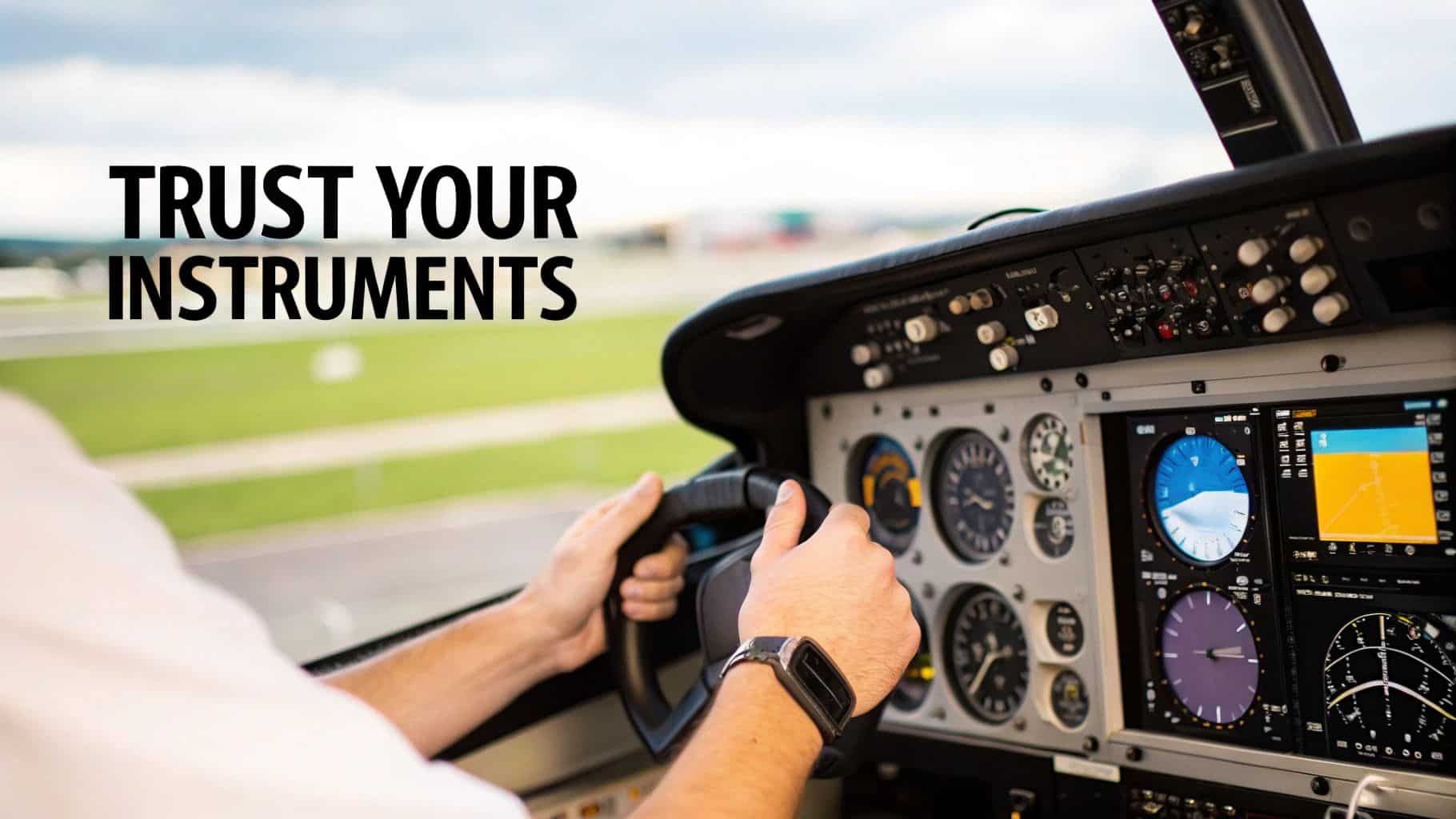
This isn’t just another piece of paper for your wallet; it’s a fundamental change in how you fly. You learn to trust your instruments over your own senses—a skill that’s both challenging and absolutely critical. For any pilot dreaming of a career, whether in a corporate jet or an airliner, the instrument rating is non-negotiable.
Flying by the Numbers
Instrument training immerses you in the world of Instrument Flight Rules (IFR). It's a whole new way of operating in the sky, complete with its own language, strict procedures, and demand for precision. The skills you build here are the foundation for safe, all-weather flying for the rest of your career.
You’ll get hands-on experience mastering several key areas:
- Instrument Approaches: Flying published procedures that guide your aircraft down to a runway you might not see until you're just a few hundred feet from the ground.
- Holding Patterns: Executing precise, timed patterns in the sky—an essential skill for sequencing with other air traffic or waiting for weather to clear.
- IFR Cross-Country Flying: Planning and executing long flights entirely in the clouds, staying in constant communication with Air Traffic Control.
- Emergency Procedures: Learning to handle instrument failures and other urgent situations without any outside visual references.
This level of precision is demanding. It forces you to develop a calm, methodical cockpit workflow where you’re always thinking three steps ahead of the airplane.
Many pilots will tell you the Instrument Rating is the most challenging—and most rewarding—certificate they ever earned. The confidence and situational awareness it builds will elevate every other aspect of your flying, making you a much safer and more capable pilot.
The Power of Simulation and Real-World Practice
Modern flight simulators have completely changed the game for instrument training. They provide a safe, controlled, and cost-effective way to drill complex procedures and emergencies again and again. You can practice multiple instrument approaches in a single session or deal with a simulated vacuum system failure in zero visibility—all without burning a drop of fuel.
That kind of repetition builds deep muscle memory. The confidence you gain in the sim translates directly to the real airplane, making every hour in the air more efficient and productive.
But nothing can fully replace real-world experience. Training at an airport like Chino (KCNO) gives you a massive advantage because it has a variety of published instrument approaches. This isn't just theory; you'll get to fly different approach types like the ILS, RNAV, and VOR in a busy, real-world environment. That hands-on practice of managing the aircraft while talking to ATC is something you just can't get from a book.
Our in-depth instrument rating course explains exactly how we blend simulation with this invaluable practical application. Mastering instrument flight is the true mark of a professional, and it's a core step on your path to become a commercial pilot.
Earning Your Wings as a Commercial Pilot
After nailing your instrument rating, you’re on the final approach to your professional certificate: the Commercial Pilot License (CPL). This is the big one. It’s where you transition from a capable pilot into a true professional, honing your skills to a level where you can legally fly for compensation or hire.
The journey to your CPL really breaks down into two main efforts: building the required flight time and absolutely perfecting a new set of advanced maneuvers.
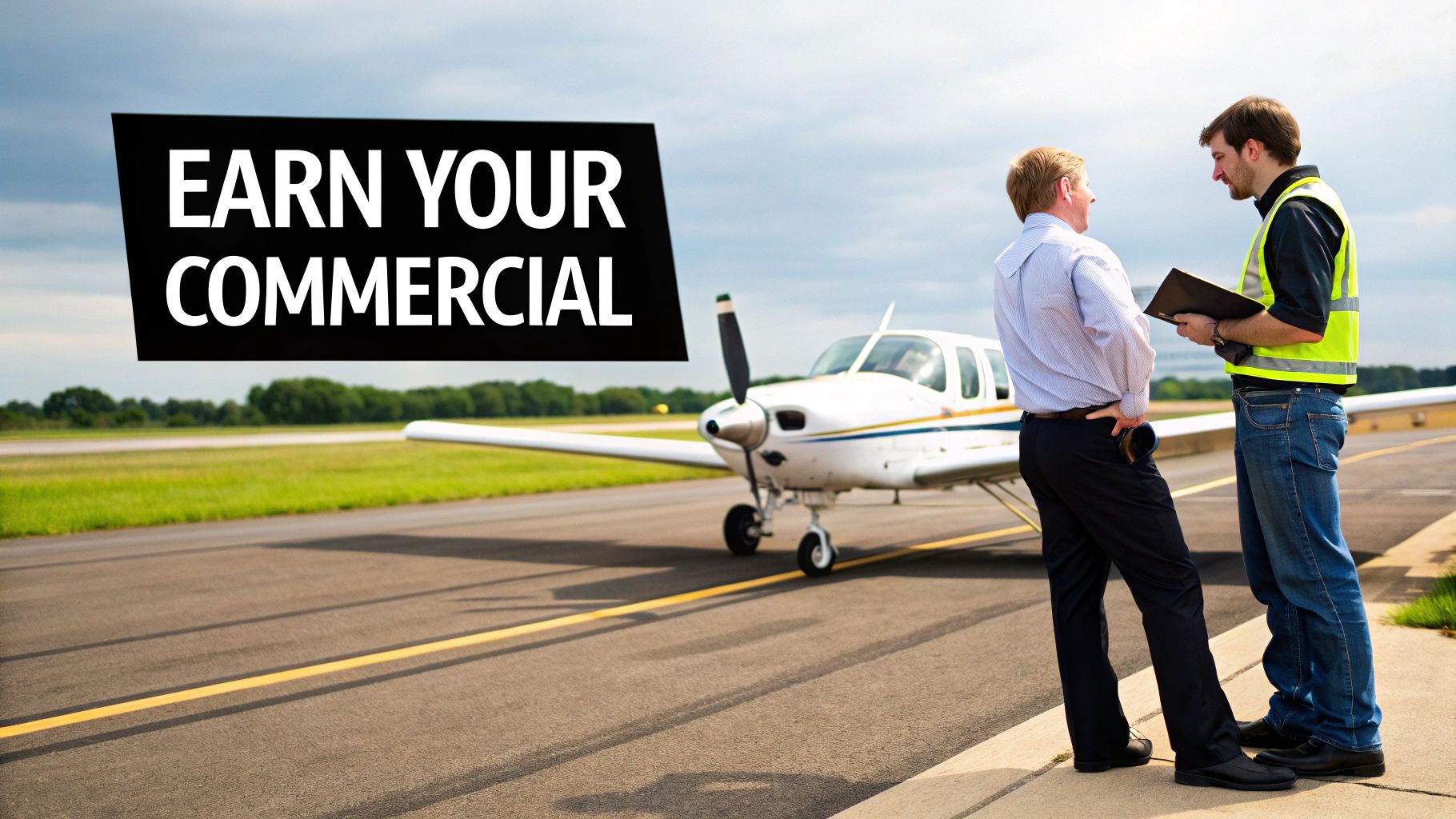
The first major milestone is hitting that magic number of 250 total flight hours required by the FAA under Part 61. This phase is all about “hour building,” and it’s a serious investment in both time and money. Having a smart plan is crucial.
Smart Strategies for Building Flight Hours
Here’s the thing about hour building: it's not just about watching the Hobbs meter click over. It’s about building experience. Flying the same $100 hamburger route over and over isn’t going to cut it. This is your chance to really push your boundaries, fly into new and challenging airspace, and become a more seasoned, confident pilot.
Savvy pilots get creative to make this phase more affordable and valuable. Here’s a breakdown of the most common ways to get to that 250-hour mark.
Comparing Hour-Building Strategies
Choosing how to build your time depends on your budget, schedule, and what kind of experience you want to gain.
| Strategy | Typical Cost per Hour | Experience Gained | Best For |
|---|---|---|---|
| Aircraft Rental | Moderate to High | Total control over your schedule and destinations for diverse cross-country trips. | Pilots needing maximum flexibility or wanting to fly a specific type of aircraft. |
| Flying Clubs | Low to Moderate | Access to shared aircraft at lower rates in exchange for monthly dues. | Cost-conscious pilots who can plan flights in advance within a community setting. |
| Safety Pilot | Very Low (split costs) | Builds valuable instrument time and proficiency by acting as a safety pilot for others. | Pilots focused on building IFR skills and logging hours as affordably as possible. |
There's another route: aircraft ownership. While it’s a big upfront investment, owning a simple, reliable plane like a Piper Cherokee can dramatically reduce your per-hour cost in the long run. For pilots on a fast track to an airline career, this can be a fantastic financial decision, giving you total freedom to fly whenever you want.
No matter which path you take, focus on quality over quantity. Use this time to fly to new airports, encounter different weather systems, and navigate complex airspace. Every single flight should teach you something new.
Mastering Commercial Flight Maneuvers
As you build your hours, your formal training will zero in on the advanced maneuvers that are the hallmark of a commercial pilot. The FAA’s standards get a lot tighter here. It’s no longer about just doing the maneuver; it’s about executing it with precision, smoothness, and total command.
You'll spend a good amount of time with an instructor perfecting maneuvers that test your energy management and fine motor skills. These include:
- Chandelles: A maximum performance climbing 180-degree turn that feels like a ballet of managing airspeed, bank, and pitch all at once.
- Lazy Eights: A graceful, flowing maneuver that builds a true "feel" for the aircraft as you coordinate control inputs across a wide range of speeds and attitudes.
- Power-Off 180° Accuracy Landing: This is the ultimate test of your judgment and energy management. You’ll pull the power to idle opposite your landing spot and glide the plane to a precise touchdown point on the runway.
These maneuvers are tough, but they forge the high-level stick-and-rudder skills that separate the pros from the amateurs.
The Multi-Engine Rating: Your Gateway to the Airlines
For most aspiring pilots who want to become a commercial pilot and fly for an airline, the single-engine CPL is just one step. The next critical piece of the puzzle is the Multi-Engine Rating (MER). This add-on is your ticket to the bigger, faster, and more complex aircraft that airlines and corporate flight departments operate.
Training for your MER in our Piper Apache will introduce you to the unique world of multi-engine flying. You’ll learn how to handle engine-out scenarios, manage asymmetric thrust, and understand the systems that keep two engines running in harmony. For anyone dreaming of the flight deck, mastering these skills isn't just an option—it's an absolute necessity.
What Comes After the Commercial Certificate? Your Career and Maybe… an Airplane
You did it. You have your Commercial Pilot License. This isn't the finish line; it's the starting gate for your professional career, and you’re entering an industry that is desperate for well-trained pilots like you. The doors are wide open, whether you're dreaming of flying for a regional airline, a cargo carrier, a corporate flight department, or even teaching others to fly.
Each path has its own rhythm. An airline career is structured, with a clear ladder to climb. Corporate flying can be less predictable but might take you to more interesting, off-the-beaten-path destinations. And becoming a flight instructor? It's a fantastic way to solidify your own skills, build hours, and share your passion with the next wave of aviators.
The timing couldn't be better. The pilot shortage has completely flipped the script. Just a few years ago, new pilots had to fight for entry-level jobs. Today, airlines are actively recruiting right out of flight schools, offering signing bonuses and fast-tracked career paths. You’re in the driver's seat, both literally and figuratively.
Thinking About Aircraft Ownership
For many pilots, flying for a living is just one part of the dream. The ultimate goal? Owning your own aircraft. It could be for personal trips, business travel, or even as a smart way to build flight time on your own terms and accelerate your career. Whether you are looking for an airplane or helicopter, the buying process is a major investment that demands a careful, methodical approach if you want to avoid a financial mess.
The single most important step in buying an aircraft is the pre-buy inspection. Skipping this or cutting corners is the fastest way to turn a great deal into a costly, long-term problem. An independent, trusted mechanic is your best ally in this process.
How to Buy an Airplane or Helicopter the Safe Way
Buying an aircraft is a whole different ballgame than buying a car. To make sure your purchase is a success, there are a few non-negotiable steps you have to take.
- Define Your Mission: Get real about what you'll use the aircraft for. Are you building cross-country time for an airline application in a fixed-wing plane? That calls for a different bird than a helicopter pilot would use for local training or utility work. The mission always dictates the machine.
- Get a Serious Pre-Buy Inspection: This is not optional. You need to hire your own A&P mechanic—preferably one who specializes in that make and model—to go over the airframe, engine, and every single logbook with a fine-tooth comb.
- Run a Title Search: Just like buying a house, you have to make sure the title is clean. A proper search uncovers any liens or hidden claims, guaranteeing the seller actually has the legal right to sell it to you.
- Always Use an Escrow Service: This protects everyone. A neutral third party holds the money until the title and bill of sale are signed and sealed. It’s the simplest way to prevent fraud and ensure a smooth transaction.
As you step into the professional world, remember that your flying skills are only part of the equation. Knowing how to create a personal brand can make a huge difference, helping you stand out in airline interviews or network effectively in the tight-knit owner community.
The True Cost of Owning an Aircraft
The sticker price is just the entry fee. The real cost of owning an airplane or helicopter comes from all the recurring expenses you'll have month after month, year after year. You absolutely must have a realistic budget for these before you even think about buying.
| Expense Category | Description |
|---|---|
| Maintenance | This covers the required annual inspection, plus a healthy fund set aside for things that inevitably break. |
| Insurance | Your rate will depend heavily on your flight time, the type of aircraft, and how you plan to use it. |
| Hangar or Tie-Down | Your plane needs a home. A hangar provides the best protection from the elements but costs more. |
| Fuel and Oil | This is your biggest variable operating cost. The more you fly, the more you'll spend. |
Making the jump from pilot to owner is a huge step. But if you do your homework and approach it with a solid plan, it can be an incredibly rewarding new chapter in your life as an aviator.
Got Questions About Becoming a Commercial Pilot?
It's only natural to have a ton of questions when you're thinking about a career in the cockpit. How much will it cost? How long will it take? What about buying a plane? Getting straight answers is key to building a realistic plan. Let’s tackle the big ones.
So, What's the Real Cost to Become a Commercial Pilot?
Let's get right to the number one question everyone asks. To go from zero flight time to a commercial pilot with both instrument and multi-engine ratings, you should plan on investing somewhere between $70,000 and $100,000. That's a realistic all-in figure that covers your flight time, instructor fees, ground school, books, and exam fees.
Yes, it’s a big number. But think of it as an investment in a career that offers incredible earning potential and a level of job security most industries can't match. Most pilots pay as they go, and we can also point you toward some solid aviation-specific loan options to make it happen.
How Long Does It Take to Get All the Ratings?
This one is all about you and your schedule. If you can treat it like a full-time job and fly a few times every week, you could have all your certificates and ratings knocked out in about 9 to 12 months. That's an aggressive but totally achievable timeline.
If you’re like most people and need to fit training around a job or family, a more relaxed pace might take 18 to 24 months. The key isn't speed, it's consistency. Flying regularly keeps the lessons fresh in your mind and your skills sharp, which actually saves you money in the long run.
Is a College Degree Required to Fly for an Airline?
This is one of the biggest myths in aviation today. A few years ago, the answer was almost always "yes," but the game has changed. With the massive demand for pilots, airlines have shifted their priorities. For most regional airlines, and even some majors, a four-year degree is no longer a hard requirement.
Today, what really matters are your FAA pilot certificates, your total flight time, and a professional, well-documented training record. A degree might help at some legacy carriers, but it's absolutely not the roadblock it used to be.
Should I Just Buy a Plane for My Training?
For the right person, this can be a fantastic move. Owning your own aircraft, especially when you're building hours for your commercial certificate, can sometimes pencil out to be cheaper than renting. The best part? You have total freedom to fly whenever and wherever you want, which can seriously speed up your journey to 250 hours.
But let's be clear: ownership is a major commitment. You have to go into it with your eyes wide open.
Buying an Airplane the Smart Way
If you're serious about owning, you have to protect yourself. Don't even think about buying a plane without following these steps:
- Know Your Mission: First, what's the goal? Are you planning long cross-country flights to build time? A Piper Cherokee might be perfect. Just need something for local maneuvers? A different plane might fit the bill. The mission always determines the aircraft.
- Get a Pre-Buy Inspection: This is the most important step. Period. Hire a reputable A&P mechanic—someone who is not connected to the seller—to go over the plane, engine, and all its logbooks with a fine-tooth comb. This is the single best way to avoid buying someone else's expensive problems.
- Run a Title Search: Just like buying a house, you need to make sure the aircraft has a clean title. You don't want to find out later that there’s a lien or some other claim against it.
- Always Use an Escrow Service: A neutral third-party escrow service is your best friend. They hold your money safely until the title is officially transferred and all the paperwork is signed, protecting both you and the seller.
Thinking about owning an aircraft is a great sign you're serious about your career. Taking these steps ensures that dream doesn't turn into a nightmare.
Ready to take the next step and become a commercial pilot? At DuBois Aviation, our experienced instructors, diverse fleet, and supportive environment at Chino Airport (KCNO) provide the ideal launchpad for your career. Explore our professional pilot programs and start your journey today at https://duboisaviation.com.