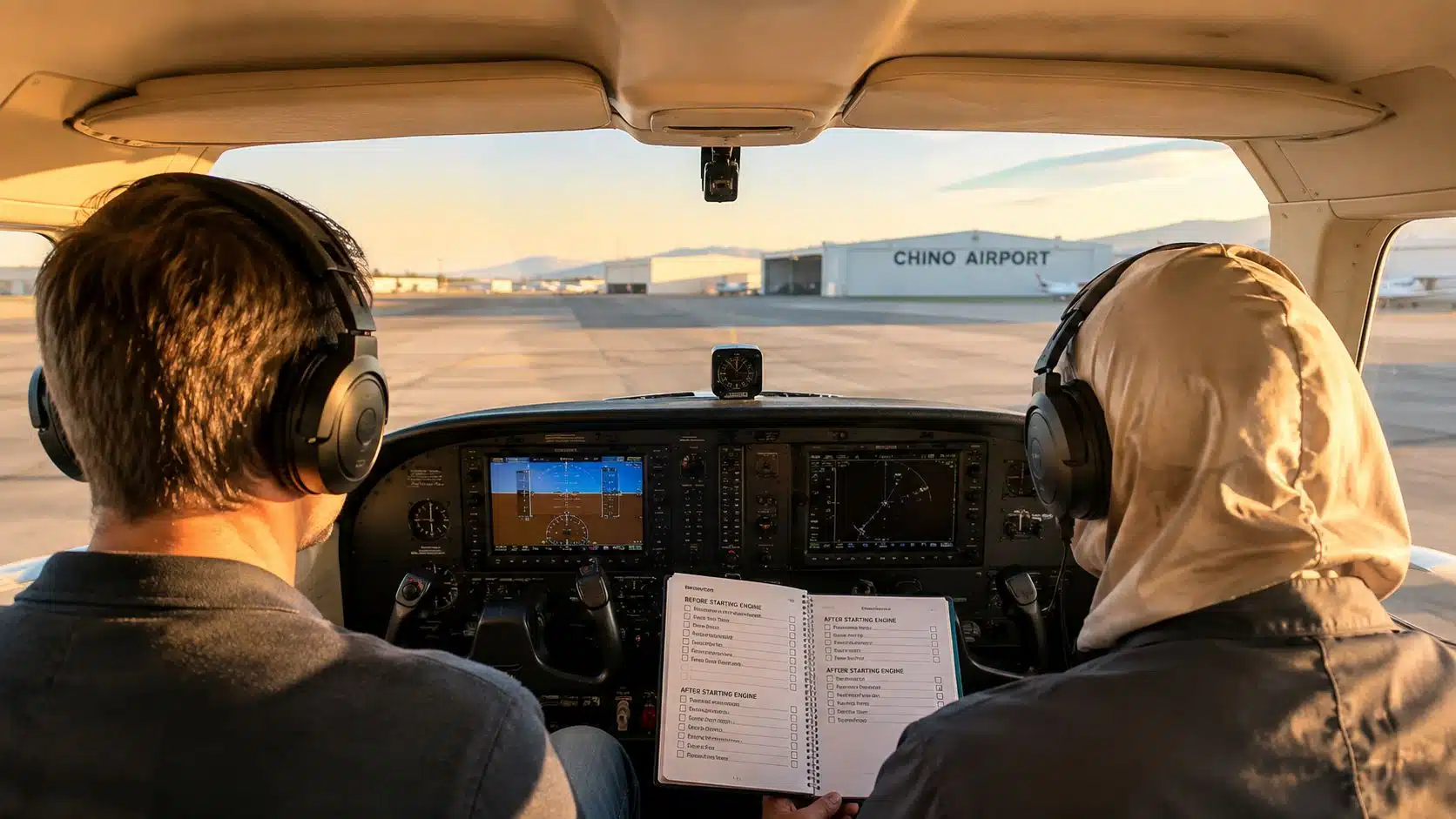
What does a safety pilot need to do, and can a qualified renter sit beside the pilot under the hood? Under 14 CFR 91.109(c), a safety pilot is a required crewmember during simulated instrument flight. The pilot must hold at least a private pilot certificate with the appropriate aircraft category and class ratings, occupy the other control seat, and maintain the required outside view. The airplane must have functioning dual controls, subject to a narrow exception for certain single-engine airplanes with a throwover control wheel. 14 CFR 91.109
That answer matters at any airport, but it becomes especially practical at a busy Class D field such as Chino Airport, KCNO. A safety pilot isn't a passenger watching someone practice approaches. The role involves traffic scanning, radio support, aircraft control awareness, and accurate logbook entries. The distinction also affects renters who are deciding whether to fly with another private pilot, book an instructor, or schedule a training block through DuBois Aviation's pilot-in-command guidance.
Table of Contents
- What Does Safety Pilot Actually Mean Under the Rules
- The Three FAA Requirements Everyone Quotes
- Real-World Preflight and Inflight Duties
- Logging Safety Pilot Time the Right Way
- Currency and Medical Questions Renters Ask
- Handling Busy Class D Work at Chino KCNO
- Preflight Checklist and Final Wrap-Up
What Does Safety Pilot Actually Mean Under the Rules
What does a safety pilot legally have to do? The answer is more specific than “look outside while another pilot flies.” Under 14 CFR 91.109(c), the safety pilot occupies the other control seat while the manipulating pilot uses a view-limiting device, such as a hood or suitable glasses. The safety pilot must be able to see outside well enough to help maintain separation from other aircraft and obstacles.
The regulation treats the safety pilot as part of the required flight crew for that operation. The role exists because a pilot whose outside view is blocked can't perform an adequate visual lookout. The safety pilot restores that safety function while the other pilot concentrates on instrument references.
A role, not a special certificate
“Safety pilot” isn't a certificate, rating, or logbook endorsement. It's a crewmember role created by the conditions of the flight. A pilot may hold several certificates and ratings, but the relevant question at the airplane is whether that pilot meets the requirements for the aircraft and operation.
The role also differs from a flight instructor. An instructor can serve as safety pilot while providing instruction, but a private pilot serving only as safety pilot isn't automatically teaching. Likewise, the pilot under the hood remains responsible for the flying duties assigned to that pilot and may log time only when the applicable logging rules support the entry.
The most useful distinction is between legal eligibility and good operating practice:
- Eligibility: The safety pilot satisfies the certificate, rating, medical or BasicMed, seating, visibility, and control requirements.
- Operating responsibility: The safety pilot actively performs the outside scan, supports radio work, identifies traffic, and speaks up when safety or compliance is deteriorating.
- Training role: An instructor provides instruction only when acting under the applicable instructor privileges and logging rules.
At the FBO, the rental invoice won't determine whether the person is a safety pilot. The seat position, view-limiting device, aircraft configuration, qualifications, and actual duties do.
Practical rule: If the pilot under the hood can't clearly explain who is responsible for the outside scan, radio coordination, and immediate traffic calls, the crew briefing isn't finished.
The Three FAA Requirements Everyone Quotes
The familiar checklist comes from 14 CFR 91.109(c). The rule requires a safety pilot to hold “at least a private pilot certificate with category and class ratings appropriate to the aircraft being flown,” occupy the other control seat, and have an adequate outside view. The aircraft must also have “fully functioning dual controls,” subject to the limited throwover-control exception in the regulation. Review the complete regulatory text before a rental flight, especially when the airplane has an unusual cockpit layout.
Certificate and aircraft ratings
The safety pilot must hold at least a private pilot certificate, with category and class ratings appropriate to the aircraft. A pilot qualified for a single-engine airplane is not automatically qualified to serve in a helicopter, multiengine airplane, or another aircraft category.
The rating follows the aircraft, not the lesson objective. Saying that the other pilot will do all the flying does not remove the requirement. The safety pilot occupies a required crewmember position, so the certificate and ratings must match the aircraft being operated.
At a busy towered airport such as Chino, this distinction matters during rental planning. A pilot may be comfortable helping with radio work while still lacking the ratings required to serve legally in that airplane. Confirm the aircraft category and class before scheduling the flight, not after arriving at the FBO.
Medical qualification or BasicMed
The medical rule changed on December 22, 2022, when U.S. regulations were updated to permit a pilot using BasicMed to serve as safety pilot while not acting as pilot in command. Earlier guidance treated a current medical certificate as part of the minimum requirements. Under the updated rule, the baseline is a private pilot certificate or higher, appropriate category and class ratings, and either a current third-class medical or BasicMed. The post-2022 BasicMed explanation discusses this distinction in practical terms.
BasicMed does not replace every medical requirement. The aircraft, operating circumstances, and the pilot-in-command arrangement still matter. A renter should verify the proposed setup before accepting the keys, rather than assume that any BasicMed pilot qualifies for every safety-pilot assignment.
Seat, visibility, and controls
The safety pilot must occupy the other control seat. That seat must provide adequate outside visibility, and the aircraft must have functioning dual controls unless the narrow regulatory exception applies. A rear seat or obstructed position may be unsuitable even if the pilot can communicate with the person flying under the hood.
| Requirement | Regulation | What It Means Practically |
|---|---|---|
| Certificate and ratings | 14 CFR 91.109(c) | The safety pilot holds at least a private pilot certificate and the proper category and class ratings for the aircraft. |
| Medical qualification | Current medical or permitted BasicMed status | A safety pilot who is not acting as PIC may qualify under BasicMed after the 2022 amendment, but the operation must still fit the applicable rules. |
| Seat, view, and controls | 14 CFR 91.109(c) | The pilot occupies the other control seat, can see outside adequately, and has access to functioning dual controls. |
If the safety pilot is also acting as PIC, that pilot remains responsible for the applicable PIC duties, including see-and-avoid, ATC coordination, and terrain clearance. An instrument rating is not required merely to serve as safety pilot. It becomes relevant when that pilot is also acting as PIC in IFR or instrument conditions.
Real-World Preflight and Inflight Duties
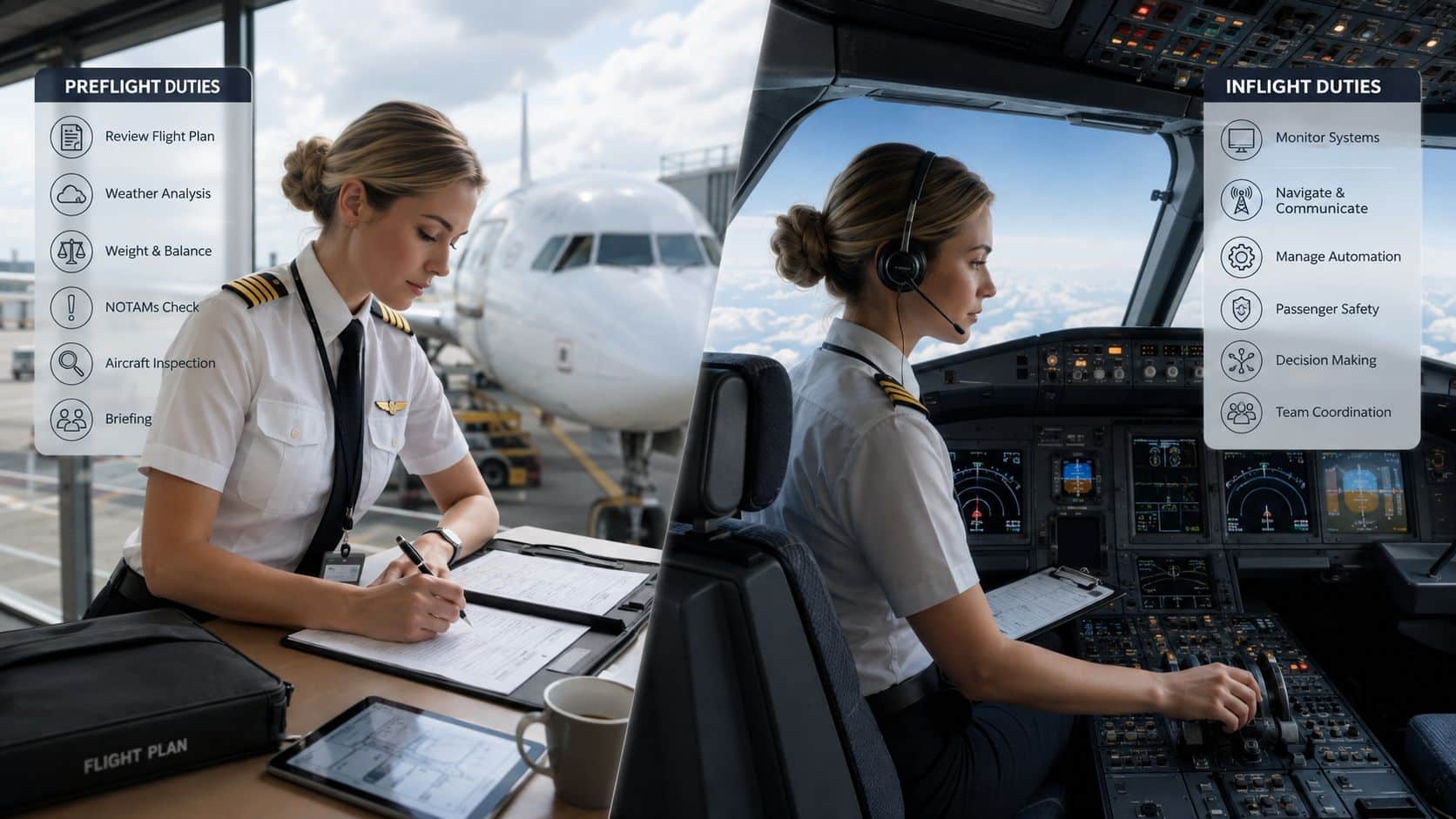
A productive safety-pilot flight starts with a crew briefing, not with the hood going on during taxi. The two pilots should agree on who will handle which radio calls, what traffic callouts will sound like, when the hood comes off, and how either pilot will announce an unsafe situation.
Before engine start
The preflight conversation can be short, but it needs to cover the items that become difficult once workload rises:
- Review the plan. Identify the practice area, expected route, approaches, altitude assignments, and return plan.
- Inspect the view-limiting device. It should block the manipulating pilot's outside view while allowing the safety pilot to maintain an effective lookout.
- Confirm aircraft controls. Both pilots should know which controls are available from each seat and verify that the required dual controls function.
- Set callout standards. Use traffic position, direction, altitude when known, and distance when useful. Agree on plain language for “my controls” and “your controls.”
- Brief abnormal situations. Discuss lost communications, an unusual attitude, an unexpected runway change, and the immediate response if the safety pilot sees a hazard.
A sterile cockpit concept helps keep the flight focused. Nonessential conversation can wait until the aircraft is clear of the departure workload and the manipulating pilot has stable instrument references.
During the flight
The safety pilot's primary job is an active outside scan. That means looking for traffic continuously, not checking the sky only after a radio call. At a towered airport, the safety pilot can also reduce workload by monitoring the assigned frequency and making appropriate calls when the crew has agreed that the safety pilot will handle communications.
The pilot under the hood should still understand the clearance and aircraft position. The safety pilot shouldn't automatically take over the entire flight. A clear call such as “traffic, two o'clock, same altitude, close” gives the manipulating pilot useful information without forcing that pilot to search outside.
The flight ends with accurate records. After shutdown, both pilots should separate the portion flown under simulated instrument conditions from any time when the hood was removed or the safety-pilot role ended. The safety pilot is a working crewmember throughout the qualifying portion, not an occupant who happens to be available.
Logging Safety Pilot Time the Right Way
Which portion of the flight did each pilot perform? That question resolves most safety-pilot logging disputes. Two pilots may occupy the same aircraft while holding different responsibilities, so the record must identify the period when the safety pilot was a required flight crewmember and whether each pilot met the applicable PIC logging basis.
FAA guidance separates required-crewmember time from ordinary occupant time. A safety pilot may log PIC time for the portion flown under simulated instrument conditions while the other pilot is under the hood and the safety pilot is serving in the required role. That credit does not automatically cover the entire flight, and cross-country time does not apply to the whole trip because the safety pilot was aboard. The FAA logging guidance explains why the entry must match the qualifying portion.
Match the entry to the duty
A useful logbook entry identifies the date, aircraft, route or activity, total time, and role performed. A remark such as “safety pilot, simulated instrument conditions” helps show why the pilot logged that specific period. If an instructor provided training, the record should identify the instructional role and the training details required by the applicable rules.
The pilot under the hood may log PIC only when a provision of 14 CFR 61.51 supports that entry. Filing an instrument flight plan does not, by itself, create PIC authority or PIC logging credit. Determine the pilot's actual status and the rule supporting the entry before signing the logbook.
An instructor who also serves as an appropriately certificated flight instructor may record instructor time when the instructor duties meet the applicable requirements. Sitting in the right seat does not create that category. The entry must describe what the instructor provided.
| Role | Typical logbook entry | Important condition |
|---|---|---|
| Safety pilot | PIC time for the qualifying simulated-instrument portion | The pilot is a required crewmember, properly qualified, and occupies the required control seat. |
| Pilot under the hood | PIC, dual received, or other applicable time | The entry depends on the pilot's actual PIC status, training, and logging basis. |
| Flight instructor providing instruction | Instructor time, with applicable training details | The pilot must be acting under instructor privileges, not merely occupying the safety-pilot seat. |
| Passenger or nonqualifying occupant | No safety-pilot PIC time | Occupancy alone does not establish required-crewmember status. |
Before logging, separate the time flown under simulated instrument conditions from periods when the hood was removed or the safety-pilot role ended. This discipline matters at a busy towered airport such as Chino, where a rental flight can include pattern work, taxi delays, and radio workload that do not all qualify for the same entry.
Pilots focused on building pilot time effectively should also keep certificate goals in view, including the time requirements in 14 CFR 61.109. Clear, contemporaneous entries are easier for an instructor or evaluator to verify than vague records reconstructed months later.
Currency and Medical Questions Renters Ask
The most common mistake is treating every qualification as if it serves the same purpose. A pilot can be eligible to serve as a safety pilot without being current for every instrument operation, while a pilot who isn't current to act as PIC can't rely on the other pilot's hood work to bypass PIC requirements.
Flight review and PIC currency
A safety pilot serving only in that role doesn't need a new flight review each time the pilot flies under the hood. The flight review requirement concerns the exercise of PIC privileges under the applicable rule, not the mere fact that a pilot is occupying the other seat as a required crewmember. Independent training guidance on the post-2022 change emphasizes that the rule itself doesn't add a separate current-flight-review requirement for a pilot serving only as safety pilot and not acting as PIC.
That doesn't make an out-of-currency pilot a good choice. If the safety pilot is expected to act as PIC, coordinate with ATC, manage traffic, or take control during an abnormal event, the pilot should be current and qualified for those responsibilities. The conservative rental decision is to use a pilot whose certificate, medical status, flight review, and practical proficiency support the duties expected.
Instrument currency and IPCs
Instrument currency is a separate issue. To act as PIC under IFR or in weather below VFR minimums, FAA rules require six instrument approaches, holding procedures, and intercepting and tracking tasks in the preceding six calendar months. If those tasks aren't completed within that period, the pilot has an additional six calendar months to regain currency before an instrument proficiency check becomes necessary. FAA instrument proficiency guidance states that an IPC must cover a representative number of tasks from the instrument rating practical test.
A pilot doesn't routinely need an IPC merely to serve as safety pilot. An IPC becomes relevant when a pilot's instrument experience has lapsed and that pilot wants to regain instrument privileges. The safety pilot also doesn't need an instrument rating just to perform the required visual lookout. If the safety pilot will act as PIC in IFR or actual instrument conditions, the rating and currency analysis changes.
Medical status and BasicMed
After the December 22, 2022 amendment, a BasicMed-qualified pilot may serve as safety pilot when not acting as PIC, provided the operation fits the applicable requirements. A current medical certificate remains relevant in operations where BasicMed doesn't apply or where the pilot is acting as PIC under rules that require a medical certificate.
Rental staff, instructors, and pilots should verify the aircraft, operating rules, and any school agreement before departure. Medical documentation, driver-license requirements, aircraft eligibility, and PIC status shouldn't be assumed from a casual cockpit conversation.

Handling Busy Class D Work at Chino KCNO
Safety-pilot discipline becomes workload management at Chino Airport. KCNO is a towered Class D airport with multiple runways, intersecting taxi routes, helicopter activity, training traffic, rental operations, and transient aircraft. A hooded pilot may be able to manage the instruments, but that pilot has limited capacity for an outside scan and may miss a developing runway or taxiway conflict.
Brief the airport before the airplane moves
The crew should review the current airport diagram, chart supplement information, runway and taxiway status, frequencies, and local procedures before engine start. The instrument scenario should be clear before the run-up, including the intended departure, practice area, return route, and what happens if the tower issues a different clearance.
The assigned aircraft matters too. Rental availability can change, and not every airplane is configured or approved for the same simulated-instrument task. The crew should confirm the aircraft assignment, dual-control condition, view-limiting device, fuel plan, and any school or rental restrictions before leaving the ramp.
At DuBois Aviation, aircraft and rental availability can change, so the pilot should verify the assigned airplane and operating details directly rather than relying on a previous flight's assumptions.
Make the radio work predictable
A safety pilot can handle routine communication while the hood pilot concentrates on heading, altitude, navigation, and clearance compliance. That division only works when both pilots understand the clearance.
For a KCNO departure or pattern operation, the safety pilot should:
- Monitor the tower frequency: Listen for traffic instructions, runway changes, and restrictions that affect the crew.
- Call traffic early: State direction, relative position, and distance when those details are available and useful.
- Repeat critical instructions: Say back runway assignments, hold-short instructions, and crossing restrictions so both pilots hear them.
- Protect the sterile cockpit: Avoid unnecessary conversation during taxi, departure, pattern entry, and approach phases.
- Speak up immediately: Remove the hood or transfer control when the outside situation, aircraft control, or clearance requires it.
If the hood pilot is head-down during a pattern entry, the safety pilot must prioritize separation and aircraft control over completing another instrument task. At KCNO, one missed callout or misunderstood taxi instruction can create more workload than the planned approach is worth. A calm scan and disciplined radio cadence protect the training objective better than forcing the lesson to continue after the situation has become unstable.
Preflight Checklist and Final Wrap-Up
A renter can use the following checklist before a simulated-instrument flight:
- Confirm pilot eligibility: Verify the safety pilot holds at least a private pilot certificate with the appropriate category and class ratings.
- Confirm medical status: Check the applicable current medical certificate or BasicMed qualification, including the documentation required for the operation.
- Confirm PIC readiness: Determine who is acting as PIC and whether that pilot is current and qualified for the planned operation.
- Inspect the aircraft: Verify functioning dual controls, suitable seat positions, usable radios, and an appropriate view-limiting device.
- Brief the hood: Decide when the device goes on and off, who calls the tower, and what words signal an immediate transfer of control.
- Set the route: Agree on the run-up area, departure runway, practice area, return route, and missed-approach or go-around response.
- Plan fuel conservatively: Include the planned out-and-return flight and enough flexibility for traffic, delays, reroutes, and an early return.
- Review the local area: Check the current KCNO airport information, diagram, runway and taxiway status, frequencies, and surrounding airspace before departure.
At the Chino ramp, the crew should also confirm where the aircraft will be parked at DuBois Aviation, how the airplane will be marshaled at the self-service fuel island, and where the planned hood work can occur without creating an airspace or workload problem near the R-2508 complex edge. Local details can change, so the current briefing and airport information take priority over memory from an earlier flight.
A safety pilot should be selected for the actual job, not just because another pilot is available. When neither pilot feels current, a dual training block can provide a more controlled way to complete legal hood practice, improve radio coordination, and make the next KCNO flight less rushed.
Frequently asked questions
Does a safety pilot need an instrument rating?
Not merely to serve as safety pilot under simulated instrument conditions. The pilot needs the appropriate private pilot certificate and aircraft category and class ratings. An instrument rating becomes relevant if the safety pilot also acts as PIC in IFR or instrument conditions.
Can a BasicMed pilot serve as safety pilot?
A BasicMed pilot can serve as safety pilot when not acting as PIC under the post-2022 regulatory framework. The aircraft, operating rules, pilot status, and documentation still need to fit the applicable requirements.
Is a flight review required to serve as safety pilot?
The rule doesn't create a separate current-flight-review requirement for a pilot serving only as safety pilot and not acting as PIC. A pilot acting as PIC must still satisfy the requirements that apply to exercising PIC privileges.
Can both pilots log PIC time?
Both pilots may have a logging basis for the same portion of the flight, but each entry must stand on its own under the applicable logging rules. The safety pilot's entry must correspond to the time when that pilot was a required crewmember, while the hood pilot's entry depends on that pilot's actual PIC or training status.
Can the safety pilot log the entire flight?
No. Safety-pilot PIC time is limited to the portion during which the other pilot is under simulated instrument conditions and the safety pilot is serving as a required crewmember. Time outside that portion requires a separate valid logging basis.
Is a safety pilot a passenger?
No. A qualified safety pilot is a required crewmember for the simulated-instrument portion of the flight. The pilot must occupy the required seat and perform the outside lookout and related duties rather than just ride along.
DuBois Aviation offers airplane rental and one-on-one instruction at Chino Airport, including instrument training for pilots who need structured hood practice and stronger Class D radio habits. Visit DuBois Aviation to ask about aircraft availability, a safety-pilot arrangement, or a dual training block suited to the pilot's current qualifications.