

Choosing the right airport around Riverside usually starts the same way. You're close enough to several fields that none of them look terrible on paper, but each one flies very differently in real life. A student pilot needs runway options, manageable radio work, and a place where pattern time doesn't turn into a long wait. An owner or transient pilot cares more about ramp access, fuel flow, maintenance support, and how much friction the field adds to a simple trip.
That's why a pilot guide to airports close to Riverside CA matters more than another generic “nearest airport” roundup. Proximity helps, but it doesn't tell you whether the pattern gets backed up after midmorning, whether the local noise abatement procedures are strict, or whether a non-towered field stays calm enough for efficient solo work. It also doesn't tell you which airports are good for instrument repetition versus which ones are pleasant places to launch a local VFR flight.
Around Riverside, the spread is unusually useful. You've got busy towered training airports, relaxed community strips, a strong municipal field right in town, and a large airport that works well for higher-performance operations. The list below gets to the point and looks at each airport the way local pilots use it.
1. Chino Airport (KCNO)
If your goal is serious flight training, Chino is the one I'd put at the top of the list. KCNO gives you real-world towered airport experience without forcing you straight into the LA Basin deep end. It's busy enough to build habits that matter, but it's still a training airport at heart.
The field's biggest advantage is flexibility. KCNO has three runways, including 8L/26R, 8R/26L, and 3/21, so instructors can usually find a useful setup for traffic flow and crosswind work. That matters more than people think. On a training day, multiple runway options can mean more actual learning and less dead time.
Why KCNO works so well for training
Chino is home to Du Bois Aviation, one of the strongest training operations in the area for both airplanes and helicopters. If you're comparing schools, their Chino Airport flight school program is worth a close look because KCNO supports the kind of structured, one-on-one training that helps students progress without wasting flights.
As a Class D airport, KCNO forces you to get comfortable with ATC from the start. That's a good thing. Students who learn at towered fields usually get over radio hesitation earlier because every lesson includes clearances, sequencing, and traffic management.
Practical rule: If a towered airport feels slightly busy at first, that's often a feature, not a flaw. You're learning how the system actually works.
The published instrument approaches also make KCNO stronger than a basic VFR-only training field. Instrument students can stay based at one airport while building familiarity with procedures, local routing, and nearby complex airspace.
Trade-offs at Chino
KCNO isn't the place to hide from workload. During peak training windows, especially late mornings and weekends, you can expect extended pattern spacing, occasional holds, and a faster radio pace than a brand-new student may want on lesson one.
Still, that busier environment pays off quickly.
- Best fit for career-minded students: You'll build radio discipline and situational awareness early.
- Best fit for owners: Multiple FBOs, maintenance shops, and avionics support make the field practical after you earn the certificate.
- Less ideal for first-flight nerves: Some students do better with a quieter first few lessons before moving into a place like Chino.
For airports close to Riverside CA, KCNO is the best all-around answer for pilots who want training quality first and convenience second.
2. Riverside Municipal Airport (KRAL)
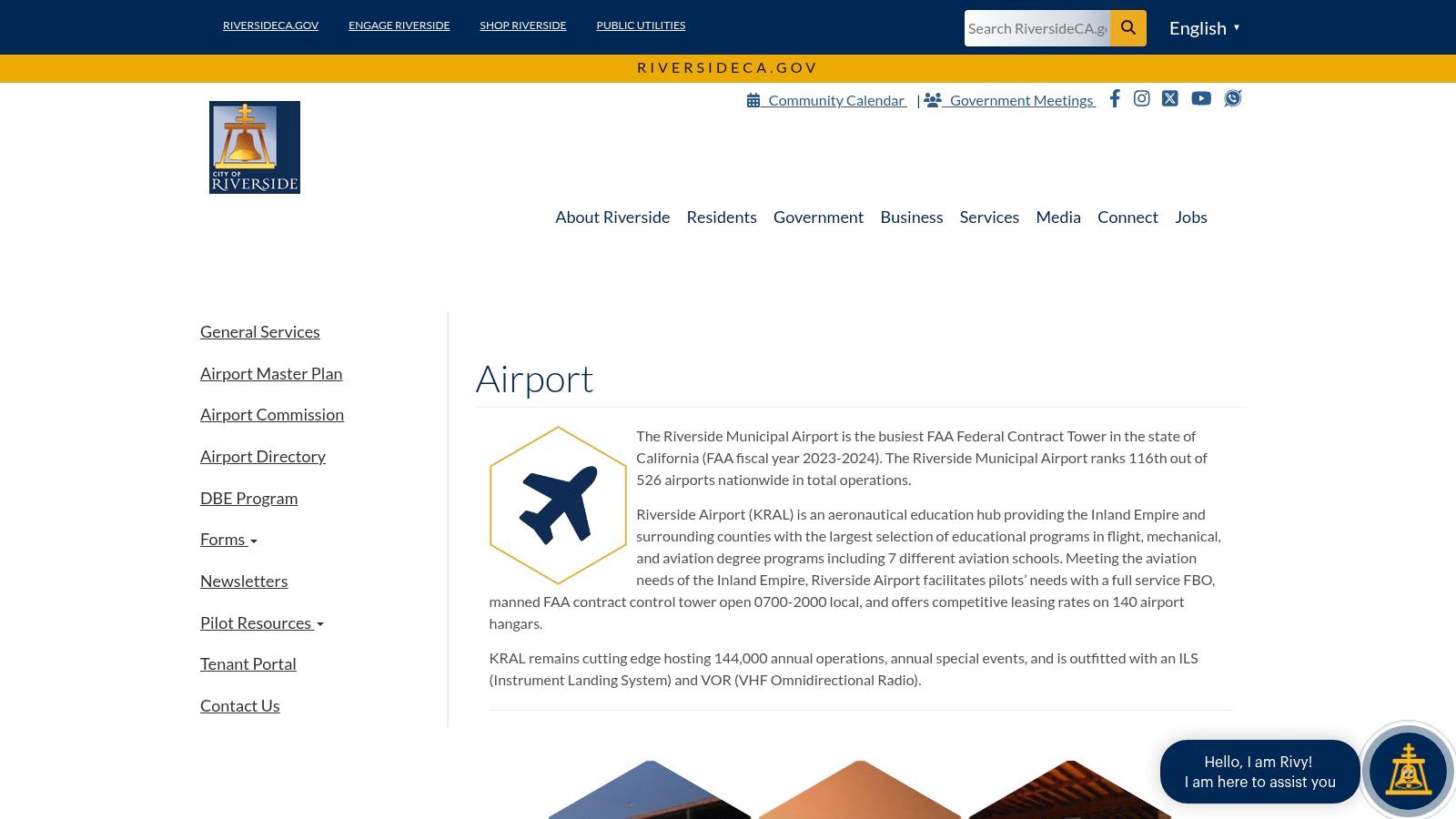
Riverside Municipal is the airport many locals should consider before they drive farther west. It sits only 4 miles from downtown Riverside according to Riverside Municipal Airport's Wikipedia entry, and for general aviation it's the most practical in-town option by a wide margin.
A lot of generic travel guides miss that point because they focus on airline passengers. For actual pilots, KRAL is the local field that matters. It has a towered environment, an active aviation community, instrument capability, and enough on-field support to function as a real home base.
What KRAL does better than people expect
KRAL is especially good for pilots who want frequent reps with radio work and instrument procedures. The runway length, published ILS and VOR approaches, and central location make it a very usable airport for maintaining proficiency. Stater Bros. FBO and the airport's hangar infrastructure also make transient and based operations more practical than they first appear.
If you're in Riverside and want a nearby training option, flight training near Riverside, CA is part of the broader local ecosystem many students compare when deciding whether to train at KRAL or commute to Chino.
KRAL is where convenience and workload meet. It saves drive time, but it doesn't save you from staying sharp.
Where KRAL can frustrate you
The same thing that makes KRAL useful also makes it busy. Pattern congestion can build quickly on weekends, and the field rewards pilots who stay ahead of the airplane. If you're rusty on towered operations, KRAL can feel more compressed than airports that spread traffic across more runways.
The tower also closes overnight, so late operations require solid non-towered discipline. That transition matters. A pilot who's only comfortable when the tower is open isn't really done learning the airport.
- Best for instrument repetition: The airport supports useful proficiency flying without a long reposition.
- Best for Riverside-based pilots: You're hard pressed to beat the convenience.
- Less ideal for low-stress pattern sessions: Busy periods can slow down repetitive training.
3. Flabob Airport (KRIR)
Flabob has a personality that most Southern California airports lost a long time ago. If you like grassroots aviation, classic airplanes, and a field where people still talk to each other instead of just cycling through the ramp, KRIR has that feel.
For training, though, you need to understand what kind of training it supports. Flabob is a non-towered field, and that makes it attractive for pilots who want to practice visual scanning, self-announcing, and flying a clean pattern without ATC in the loop.
Where Flabob shines
The airport works well for basic stick-and-rudder flying. Newer students can build confidence there if they're paired with an instructor who emphasizes traffic awareness and disciplined radio calls. Recreational pilots also tend to enjoy the field because departures and arrivals feel less procedural than at larger towered airports.
The on-field café and active community matter more than they sound. Airports like this make it easier to stay involved, and that often keeps pilots flying more regularly.
- Good for VFR fundamentals: Pattern work, local flights, and community flying fit well here.
- Good for pilots who dislike tower delays: You won't spend your whole lesson waiting for a sequence.
- Good for old-school airport culture: KRIR still feels like a neighborhood field.
Where you need to stay careful
Flabob is not a place to get casual just because there's no tower. Non-towered congestion can be messy when traffic mixes experience levels, visiting pilots, and event activity. The runway is also less forgiving than bigger municipal fields, so precision matters.
There are no published instrument approaches, so IFR training value is limited. If your main goal is instrument proficiency or exposure to busier airspace management, KRIR won't replace KCNO or KRAL.
A quiet non-towered field can teach discipline. A sloppy non-towered pattern can teach bad habits just as fast.
4. Corona Municipal Airport (KAJO)
Corona is the airport I'd call straightforward. It doesn't try to be everything. If you want a simple non-towered field for local flying, practice landings, or a quick launch toward nearby practice areas, KAJO does that well.
Its location near the Prado Basin and Chino Hills practice areas is a real operational advantage. You don't burn much time getting to useful training airspace, which makes shorter lessons more efficient.
Best use cases for KAJO
Solo students and private pilots often like Corona because the environment is less complex than Chino or Riverside Municipal. The runway length is workable for common trainers, and the city-operated setup keeps the airport accessible for local use.
Afternoons can get sporty, though. Winds and the surrounding operational environment demand better planning than the airport's low-key reputation suggests. This isn't a difficult airport, but it does punish lazy preflight thinking.
- Best for confidence building: Good for repetitive takeoffs and landings in a simpler environment.
- Best for short local lessons: Quick access to practice areas saves time.
- Best for recreational flyers: Easy in, easy out, no tower choreography.
What doesn't work as well
KAJO isn't a substitute for a more complete training field if you're pursuing instrument work. There are no published instrument approaches, and the airport's utility drops quickly if your training plan depends on procedure work or regular ATC interaction.
Parking and fuel are usually straightforward, but transient pilots should still think ahead during busier periods. Small municipals can feel wonderfully efficient until everyone shows up at once.
5. San Bernardino International Airport (KSBD)
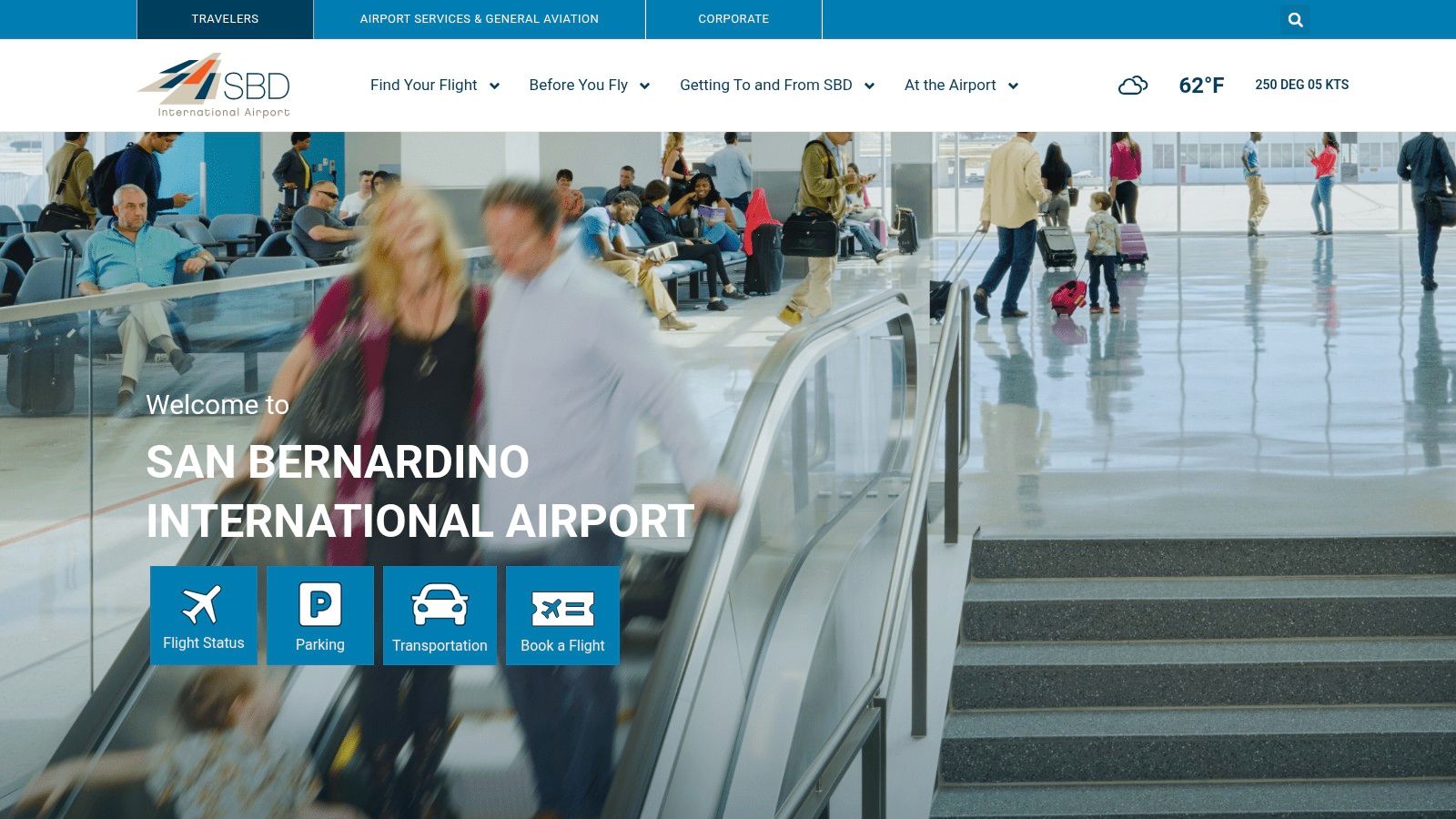
San Bernardino is the sleeper pick in this region for certain missions. If you fly a larger piston, a twin, a turbine aircraft, or you prefer wide margins and less cramped operating space, KSBD is excellent.
The commercial-travel side matters too. Rome2Rio's nearby airports page for Riverside identifies San Bernardino as the nearest airport at 12.1 miles. That's one reason it deserves more attention than it gets in generic airport roundups.
Why pilots like KSBD
The airport's long runway, Class D services, multiple instrument approaches, and Luxivair SBD FBO make it particularly strong for IFR work and transient operations. It feels expansive, and that can be a real benefit for pilots transitioning into higher-performance aircraft.
KSBD also tends to work well when you want a cleaner operational day. You still need to manage the airport professionally, but the field often feels less squeezed than the busier GA concentrations farther west.
Big runways don't make poor planning safe, but they do reduce workload when you're managing speed, energy, and cockpit task saturation.
The practical downside
The airport is physically large, and large airports come with large-airport annoyances. Taxi time can feel long if you're used to compact municipal fields. FBO-oriented services can also be more than some local training pilots want to pay for on a routine basis.
For pilots searching airports close to Riverside CA, KSBD works best when the mission justifies the field. Instrument practice, cross-country stops, bigger aircraft, and more formal transient support all fit. Basic private pilot pattern work usually fits better elsewhere.
6. French Valley Airport (F70)
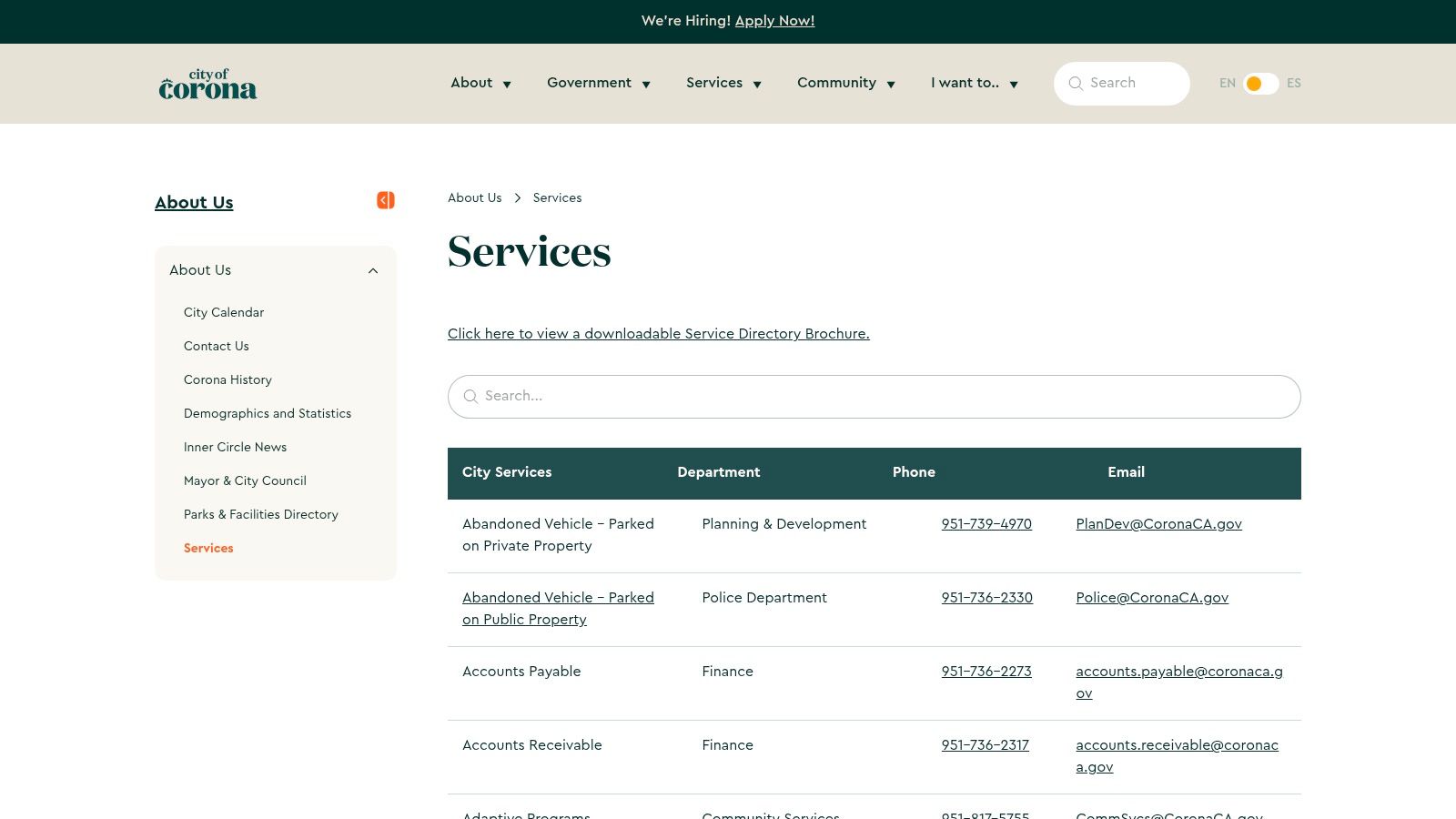
French Valley sits farther out, but pilots still bring it up for good reason. It's a useful cross-country destination, and the long runway gives the field more flexibility than many non-towered airports.
That combination makes F70 attractive to several different groups at once. Students can use it as a confidence-building destination, owners like the services and local access, and instrument pilots appreciate having RNAV approach options without always dealing with a tower.
How to use French Valley well
This is a good airport for learning non-towered discipline at a higher-activity field. You have to make clear calls, build a reliable visual scan, and avoid assuming everyone in the pattern is where they should be. In that sense, French Valley can be a very honest airport.
The runway length also makes arrivals and departures less compressed than they are at smaller strips. That's especially helpful for heavier singles, complex aircraft, and pilots flying in warmer conditions.
- Strong cross-country stop: Services are good and the airport is easy to justify as a destination.
- Useful for IFR practice: RNAV approaches add value without requiring tower interaction.
- Good for growing pilots: It bridges the gap between tiny non-towered fields and busier Class D airports.
The catch at F70
Weekend traffic can stack up quickly, and non-towered busy is its own skill set. It's not enough to make radio calls. You need to build a picture, predict where conflicts will develop, and stay flexible.
Summer performance also deserves respect. Density altitude and heat management matter there more than they do on cooler coastal days, and pilots who ignore that tend to learn the lesson the hard way.
7. Bonus Buying an Airplane or Helicopter Safely
A common Riverside-area progression goes like this. A pilot trains at Chino or Riverside, rents for a while, then starts doing the math on schedule flexibility, overnight trips, and hourly cost. Buying can make sense at that point, but only if the airplane fits the mission and survives a real inspection.
Start with the flying you plan to do, not the listing that caught your eye. A trainer that works well for pattern work at KCNO is not automatically a good choice for regular IFR trips or mountain crossings, and a helicopter with deferred maintenance can turn "affordable" into very expensive fast. If you're still sorting out what makes a good first aircraft, this breakdown of the best beginner aircraft is a useful starting point.
Required pre-buy inspections
A proper pre-buy is a maintenance investigation, not a courtesy look from a friend on the ramp. The mechanic should review logs carefully, verify airworthiness directive compliance, check major repairs and alterations, confirm serial numbers, and inspect the engine and airframe with the kind of skepticism you'd want if the aircraft were about to enter your school or club fleet.
In practice, the biggest misses are usually paperwork and condition history.
Missing logbooks, vague damage history, old modifications with weak documentation, and sloppy component tracking should slow the deal down immediately. Around busy training airports like Chino and Riverside, that matters even more because airplanes tend to fly often, cycle hard, and pick up wear that a clean paint job can hide.
Helicopter buyers need to be stricter. Component times, life-limited parts, and maintenance record accuracy are part of the aircraft's value, not side details to clean up later.
Use an inspector who works for you. Not the seller, not the seller's regular shop, and not the mechanic who already has an opinion about getting the deal closed.
A good purchase usually feels a little slower than an impulsive one. That is normal.
Pay for the inspection first. Buy the aircraft only after the records, condition, and mission all line up.
7-Point Comparison: Airports Near Riverside, CA
A typical Inland Empire choice looks like this. You want one airport that will make a better pilot out of you, and another that will not waste half the day on parking, taxi time, or pattern delays. These seven options around Riverside separate pretty cleanly once you judge them by two things that matter in the cockpit. How well they work for training, and how well they work for arrivals, departures, and quick turns.
| Airport / Item | Airspace and traffic | Training fit | Transient fit | Practical notes |
|---|---|---|---|---|
| Chino Airport (KCNO) | Busy towered Class D with multiple runways and frequent training traffic | Excellent for primary through advanced training | Good, though ramp activity can slow quick in-and-out visits | Best all-around training field on this list. You get real radio work, runway options, and enough traffic to build judgment without jumping straight into Class C pressure. Du Bois Aviation stands out here because the field supports structured training well. Arrive early if you want a calmer first lesson or cleaner pattern work. Midday and weekend traffic can stack up. |
| Riverside Municipal Airport (KRAL) | Towered, often busy, with contract tower hour considerations | Very good for instrument work, proficiency flying, and local training | Very good for local pilots and routine transient stops | KRAL is convenient, but convenience comes with congestion. Expect more pattern compression than pilots new to the area sometimes anticipate. The ILS is a real advantage if your goal is instrument currency close to town. Parking and access are straightforward compared with larger fields. |
| Flabob Airport (KRIR) | Non-towered, tighter community feel, lighter flow most days | Good for basic stick-and-rudder work and visual discipline | Fair for simple day VFR visits | Flabob works best for pilots who value a lower-pressure environment and can manage non-towered operations well. It is less suited to pilots who need instrument infrastructure or a long list of services on the ramp. Good place to sharpen pattern awareness without tower coaching. Noise sensitivity matters here, so fly the published local expectations carefully. |
| Corona Municipal Airport (KAJO) | Non-towered and usually straightforward, but the pattern can get busy fast | Good for solo practice and short local flights | Good for quick turns in light aircraft | Corona is practical, not fancy. It is useful for nearby practice areas and short sorties, but it can feel tight when several training aircraft arrive at once. Best use case is focused VFR flying when you do not need instrument approaches or extra runway margin. Early morning usually offers the least friction. |
| San Bernardino International Airport (KSBD) | Towered Class D with more room and less GA pattern crowding than Chino or Riverside | Excellent for IFR, multi, turbine transition, and higher-performance work | Excellent for transient operations | KSBD gives you space, long pavement, and a more professional operating rhythm. That makes it a strong field for instrument training that does not involve constant pattern compression. It is usually easier on transient crews too, especially if you care about ramp access, services, and straightforward arrivals. Less ideal for a brand-new student who needs a simpler first environment. |
| French Valley Airport (F70) | Non-towered, can get busy, especially with regional training and weekend traffic | Good for cross-country training and RNAV approach practice | Good for destination stops and light business flying | French Valley sits in a useful middle ground. You get published approaches and a longer runway without towered-field pace. It works well for pilots building cross-country judgment and for crews who want fuel and a reasonable stop without the busier feel of Chino. Wind and traffic timing matter here more than pilots sometimes expect. |
| Bonus: Buying an Airplane or Helicopter Safely | Coordination-heavy process with inspection, title, insurance, and mission planning | Good fit for pilots moving from renting to ownership | Not a flying stop, but relevant to long-term basing decisions | Ownership changes which airport makes sense. Hangar access, maintenance support, insurance requirements, and where you plan to do recurrent training all matter more once you own the aircraft. Keep the purchase guidance in the bonus section separate from airport choice, then match the airplane to the field that supports its actual mission. |
A few local patterns show up quickly once you fly these airports more than once.
For pure training value, Chino leads because it asks more of the pilot in a useful way. Riverside is a close practical second if location and instrument access matter most. Flabob and Corona are better fits for VFR repetition, confidence building, and shorter sessions. San Bernardino is the strongest transient and IFR-capable option in the group. French Valley is the flexible middle choice for pilots who want approach practice and a destination field without towered-field workload.
Best time to fly matters at every one of these airports. Early mornings usually give you smoother air, less pattern congestion, and less waiting on the ground. If you are evaluating a school, a rental checkout, or a field for future basing, do not visit only at the easiest hour. Show up once in the morning and once during a busier block. That tells you more about the airport than the brochure ever will.
Making Your Final Approach For You
A pilot based in Riverside can make the wrong airport choice without realizing it for months. The field that feels easy on a quiet morning may become a poor fit once the pattern fills up, the radio gets busy, or regular IFR work becomes part of the mission.
The right airport is the one that matches how you fly now, and still supports the next step. If training quality is the priority, Chino remains the strongest choice in this group. It exposes students to real tower rhythm, intersecting demands, and the kind of traffic mix that builds good habits early. That matters. Pilots who learn there usually arrive at other local airports more comfortable on the radio and less surprised by workload.
Riverside Municipal makes sense for pilots who want a practical home field close to town and who expect to use it often. It is less about novelty and more about repeat utility. For instrument practice, short local flights, and staying current without a long drive, KRAL is hard to beat. Flabob and Corona serve a different purpose. They are better for pattern repetition, visual flying, and sharpening stick-and-rudder discipline, especially if you prefer shorter sessions and less tower structure.
San Bernardino is the transient winner. If you fly for business, need easier IFR arrivals and departures, or want a field where parking and runway capability matter more than neighborhood feel, KSBD is the professional option in this set. French Valley sits in the middle. It gives you enough activity to stay sharp, but without the same pace and compression you get at Chino or San Bernardino.
Parking, noise abatement, and timing also change the experience more than many newer pilots expect. Early morning usually gives the best combination of cooler temperatures, smoother air, and shorter waits. Midday and weekend peaks tell you how the airport really works. If you are choosing a school, a rental base, or a future home field, visit at both times and compare the flow on frequency, the ramp access, and how easy it is to get in and out without wasting half the lesson on the ground.
As noted earlier, Du Bois Aviation stands out at Chino for pilots who want structured airplane or helicopter training in a busier towered environment. That combination is not ideal for everyone. It is a very good fit for students and rated pilots who want their training to carry over cleanly into more demanding flying later.
Go fly two or three of these airports before you commit. Taxi in, shut down, watch the pattern for a while, and talk to the people based there. The best choice usually becomes clear once you see how the airport handles a normal busy day.