
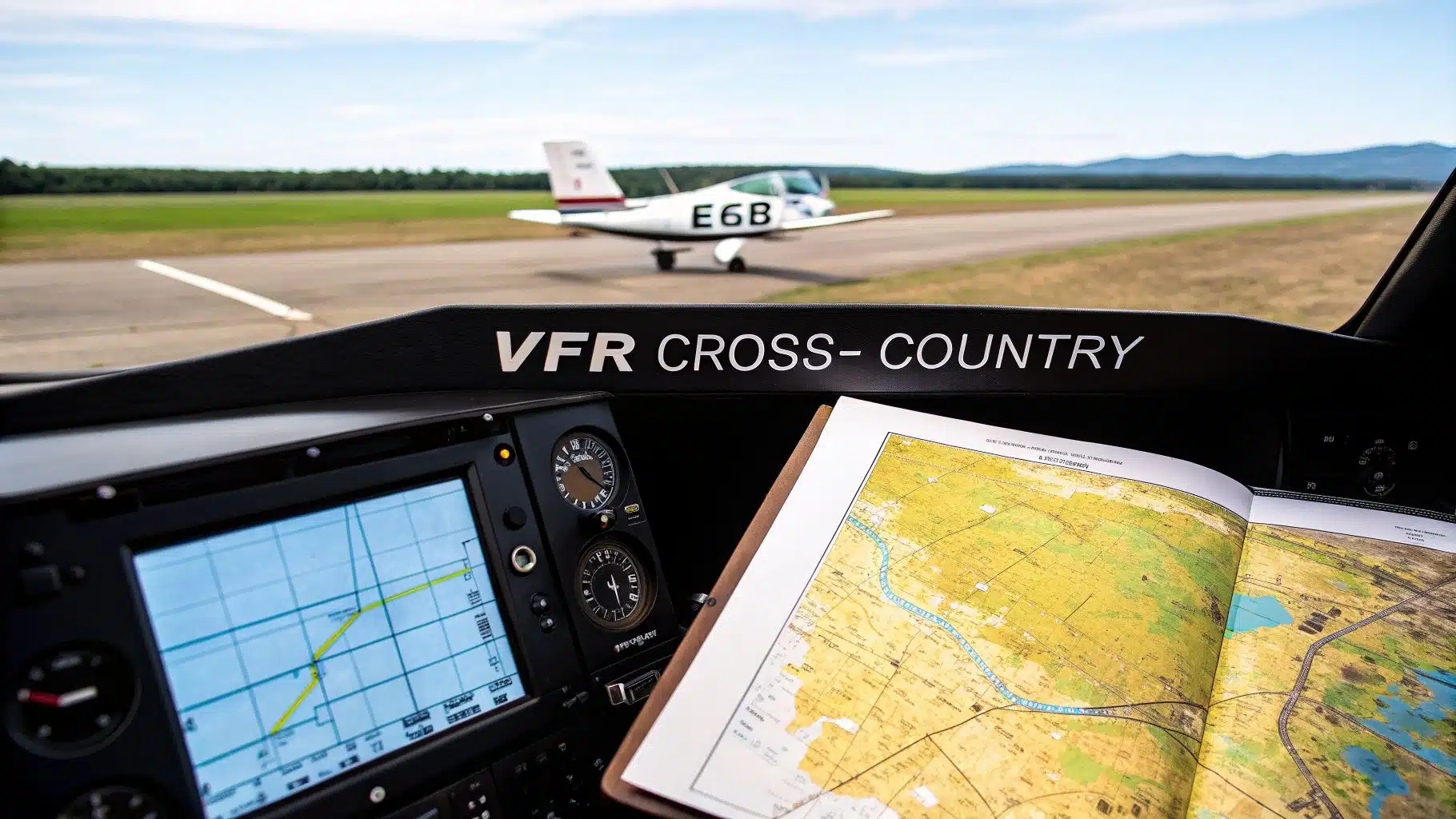
Proper VFR cross-country flight planning is so much more than just drawing a line on a map. It’s the disciplined process of turning a complex trip into a series of simple, manageable steps. Done right, it prepares you for everything that could happen, building the confidence you need to venture beyond your home airport.
Your First Solo Cross-Country Adventure
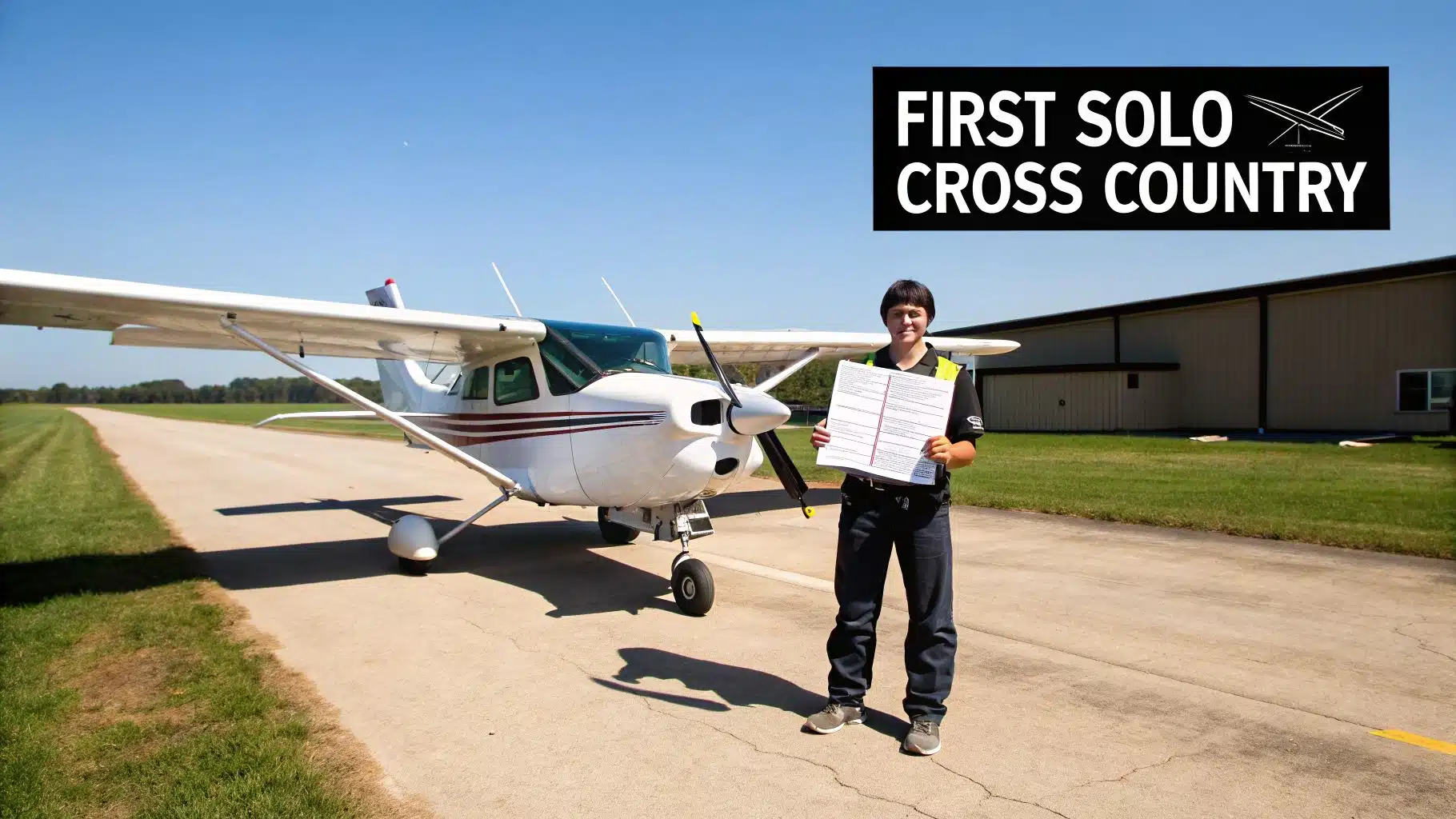
That first solo cross-country flight is a huge moment in any pilot’s training. It's where you stop feeling like a student and start acting like a true pilot-in-command. This isn't just about logging hours; it's about putting all your training into practice in the real world, and the skills you sharpen here will stick with you for your entire flying career.
I get it—at first, the whole process can feel overwhelming. Suddenly, you're in charge of picking a route, reading the charts, calculating performance, and making that final go/no-go call. But with a solid, structured approach, it becomes one of the most rewarding challenges you'll face. There's a good reason the FAA has specific rules for this.
Two practical options worth comparing
These are specific products pilots commonly compare for this type of flying. Confirm compatibility with your aircraft and instructor before ordering.
 Flight planningASA CX-3 Flight ComputerCheck current availability on Amazon (paid link)
 Electronic flight bagApple iPad mini A17 Pro, Wi-Fi and Cellular, 128GBCheck current availability on Amazon (paid link)
The "Why" Behind the Requirements
Those FAA regulations aren't just there to make you do more work; they're designed to build self-reliance. Under 14 CFR 61.109, your solo cross-country for a private pilot certificate has to be at least 150 nautical miles in total distance, with full-stop landings at three different airports. On top of that, one of those legs has to be a straight-line distance of more than 50 NM from your starting point.
This isn't some arbitrary number. The rule is specifically designed to push you out of your comfort zone, forcing you to navigate beyond familiar landmarks and truly rely on your planning and skills. It’s a critical part of your development.
The safety data backs this up. The FAA’s General Aviation Joint Safety Analysis Team (GAJSAT) found that between 2021 and 2025, about 12% of VFR accidents were tied to navigation errors. Even more telling, a staggering 65% of those happened on flights longer than 50 NM. Meticulous planning is your best defense against becoming a statistic.
From Local Flights to Cross-Country Confidence
Think of all those local flights you’ve been doing around Chino Airport (KCNO) as your practice runs. The cross-country is the big game. Every single task—from picking out visual checkpoints on your sectional chart to getting a thorough weather brief—sharpens your situational awareness and hones your decision-making.
The entire planning process can be broken down into three core phases: mapping your route, calculating your numbers, and making the final decision.
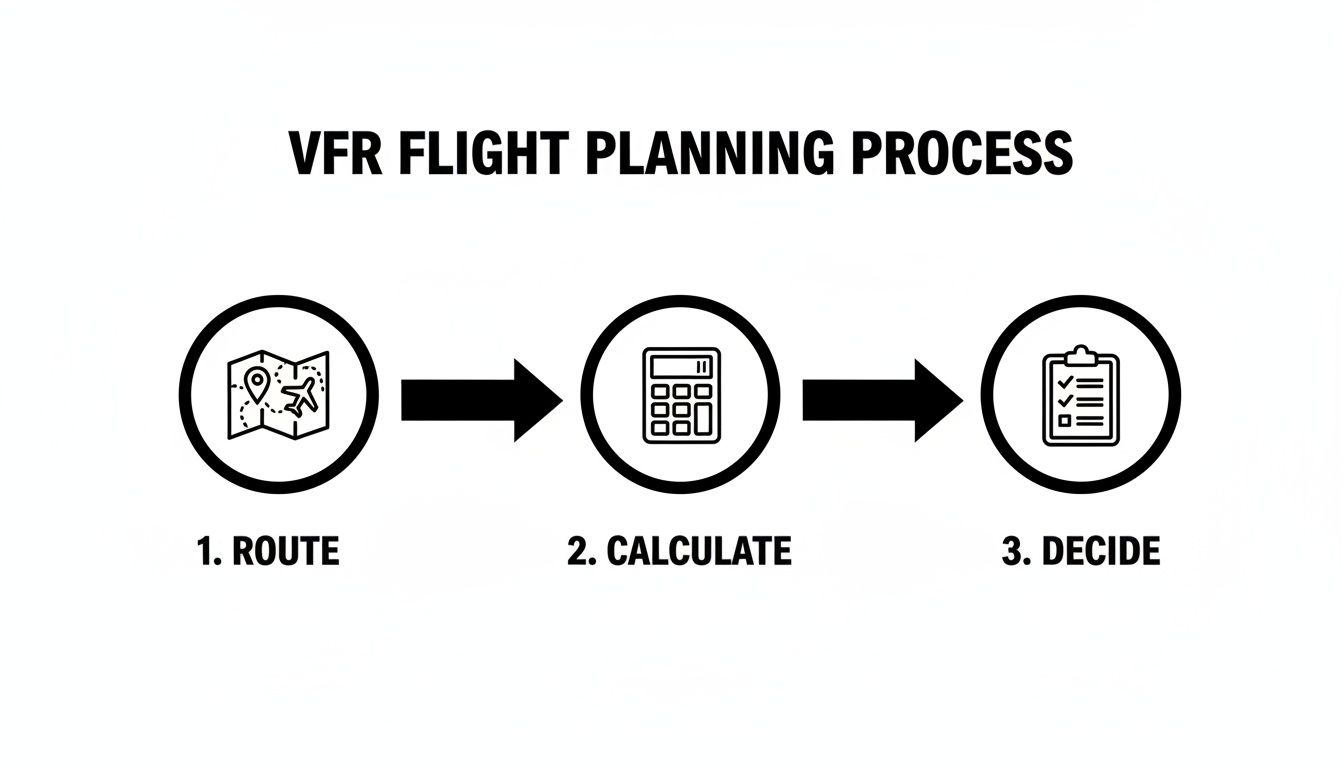
To make this even clearer, let's look at what each phase involves. This table gives you a quick overview of the key objectives and tools you'll be using.
VFR Cross-Country Planning Phases at a Glance
| Planning Phase | Key Objective | Primary Tools |
|---|---|---|
| Route & Checkpoints | Plot the safest and most efficient path from departure to destination. | VFR Sectional/TAC Charts, ForeFlight, Pilotage & Dead Reckoning |
| Calculations & Briefings | Verify the flight is legal and safe based on weather, fuel, and aircraft performance. | POH/AFM, 1-800-WX-BRIEF, E6B or Electronic Equivalent |
| Risk & Decision | Make the final go/no-go call and prepare for contingencies. | Personal Minimums Checklist, Risk Assessment Matrix (PAVE) |
Think of these phases as building blocks. Once you master this systematic approach, you'll feel confident handling any flight, anywhere. It’s the same fundamental process that airline captains use every day, just scaled to your aircraft and mission.
If you’re just starting to think about flying, our introductory flying lessons are a great way to experience the cockpit firsthand and see what it’s all about.
Plotting Your Course for Safety and Efficiency
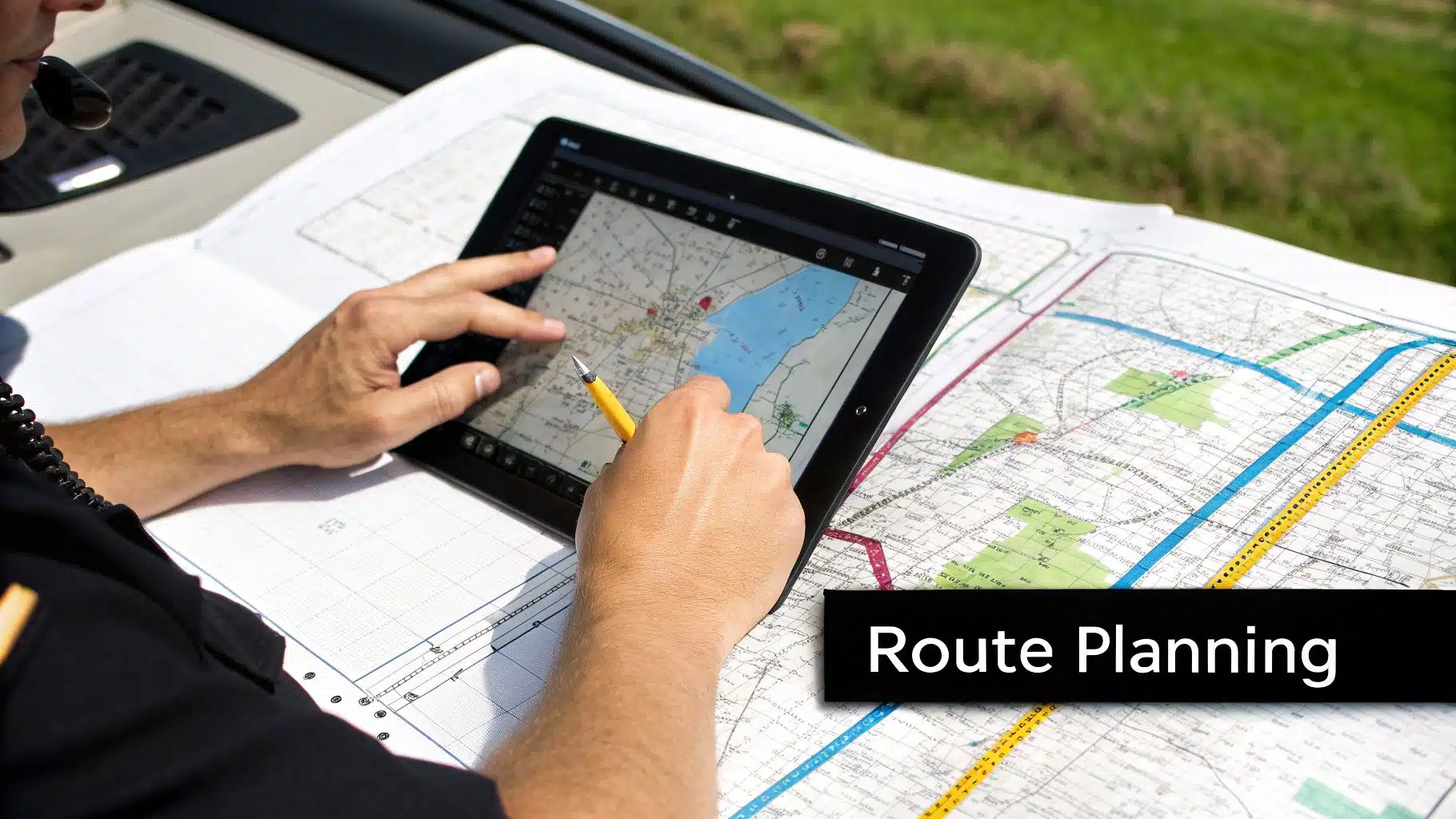
Okay, so you know why you have to fly a cross-country. Now for the fun part: figuring out how. This is where the real art of VFR cross country flight planning comes into play. It’s so much more than just drawing a straight line on a chart; you're creating a personalized roadmap in the sky, blending safety, efficiency, and common sense.
The backbone of any good VFR flight plan is a series of solid visual checkpoints. These are landmarks you can easily spot from the air, confirming you’re on the right track. A good rule of thumb is to pick checkpoints that are roughly 10 to 15 nautical miles apart. This gives you a steady rhythm of confirmation without overwhelming you.
Interpreting Your Sectional Chart
Your VFR sectional chart is dense with information, but when you're choosing a route, you can zero in on the most important features. You're essentially looking for things on the ground that will scream, "Here I am!"
- Distinctive Natural Features: Lakes, sharp river bends, and unique hills or mountain peaks are your best friends.
- Man-Made Structures: Major highway intersections, prominent towers (always check their height!), towns, and, of course, other airports are great options.
- Avoid Ambiguity: An isolated radio tower is an excellent checkpoint. A whole field of windmills? Not so much—they all tend to look the same from a few thousand feet up.
As you draw your line, you have to be vigilant about airspace. Your route will inevitably cross different airspace types, each with its own set of rules. Plan to skirt around restricted areas and decide ahead of time how you’ll handle Class B or C airspace—will you fly under, around, or plan to request flight following for a transition? Thinking this through on the ground saves you from making a rushed, high-stakes decision in the air.
Remember, your route is three-dimensional. You need to pick a cruise altitude that complies with VFR regulations and keeps you safely above terrain. The rule is simple: for an eastbound magnetic course (0-179 degrees), fly at an odd thousand-foot altitude plus 500 feet (like 3,500 or 5,500). For a westbound course (180-359 degrees), choose an even thousand-foot altitude plus 500 feet (like 4,500 or 6,500). Always double-check that your chosen altitude clears all obstacles along your path by a wide margin.
Choosing Your Stops and Diversion Airports
Picking an airport for your required full-stop landing isn't just about finding the closest strip of pavement. This is a critical decision that demands a bit of detective work.
- Runway Length: Is it long enough for your plane's performance, especially considering the day's temperature and density altitude?
- Available Services: Do they have fuel? What are their hours? Nothing’s worse than landing somewhere only to find the FBO closed an hour ago.
- Crosswind Component: Check the TAF. A gusty crosswind at an airport with only one runway can turn a routine landing into a serious challenge.
That last point is more important than you might think. As of 2026, of America's 4,933 public airports, a staggering 65% have just a single runway, according to AOPA's Flight Training Magazine. It's no coincidence that a 2025 NTSB study found 18% of VFR accidents were linked to runway excursions on these fields, often because pilots didn't fully account for the wind. Evaluating your destination and having alternates isn't just "good airmanship"—it's a core safety practice.
The Private Pilot cross-country requirement kicks in when you fly to a point more than 50 NM straight-line distance from your departure airport, as laid out in 14 CFR 61.1(b)(3). For a flight of this length, winging it is simply not an option.
Let’s apply this to a real-world scenario from our home base at Chino (KCNO). A student plans a flight to Blythe (KBLH). If the weather starts to turn sour over the desert, a smart pilot would have already identified alternates like Banning (KBNG) or Palm Springs (KPSP). They'd have the runway lengths, frequencies, and services noted right on their navlog. This kind of preparation turns a potential emergency into a straightforward diversion.
Our comprehensive cross-country book dives much deeper into these real-world scenarios, helping you build the judgment you need to handle whatever a flight throws at you.
Dialing in Your Numbers: Performance and Weather
Alright, you've got your route penciled out on the chart. Now comes the part where we turn lines on a map into a real, flyable plan. This is where we dig into the nitty-gritty of aircraft performance, fuel requirements, and—most critically—the weather. Honing this skill isn't just about acing a checkride; it's about building the fundamental habits that will keep you safe for your entire flying career.
Before any cross-country flight, getting a comprehensive weather briefing is non-negotiable. And I don't mean just glancing at the METAR for your destination. A standard briefing from 1-800-WX-BRIEF or a good Electronic Flight Bag (EFB) is essential for seeing the full picture along your entire route of flight.
Reading Between the Lines of a Weather Briefing
When you pull up that briefing, your job is to be an interpreter, not just a reader. You're hunting for specific details that could make or break your flight. Pay close attention to these:
- Winds and Temperatures Aloft: This is a big one. It directly impacts your groundspeed and, by extension, your fuel burn. A strong headwind you didn’t plan for can turn a comfortable flight into a nail-biter. A tailwind? That's free speed.
- AIRMETs and SIGMETs: These are your official heads-up for trouble. SIGMETs warn of weather hazardous to all aircraft, while AIRMETs point out conditions like turbulence, icing, or widespread IFR conditions that are particularly nasty for light aircraft.
- Temporary Flight Restrictions (TFRs): These are pop-up "no-fly" zones for things like VIP movements, stadium events, or wildfires. Busting a TFR is a huge deal, so you have to know where they are.
An AIRMET Tango for moderate turbulence might be a coffee-spiller in a jet, but for a Piper Cherokee, it can be a significant safety issue and an exhausting ride. It's all part of the same thorough mindset we discuss in our pre-flight checks for the Cessna 172.
Running the Numbers from the POH
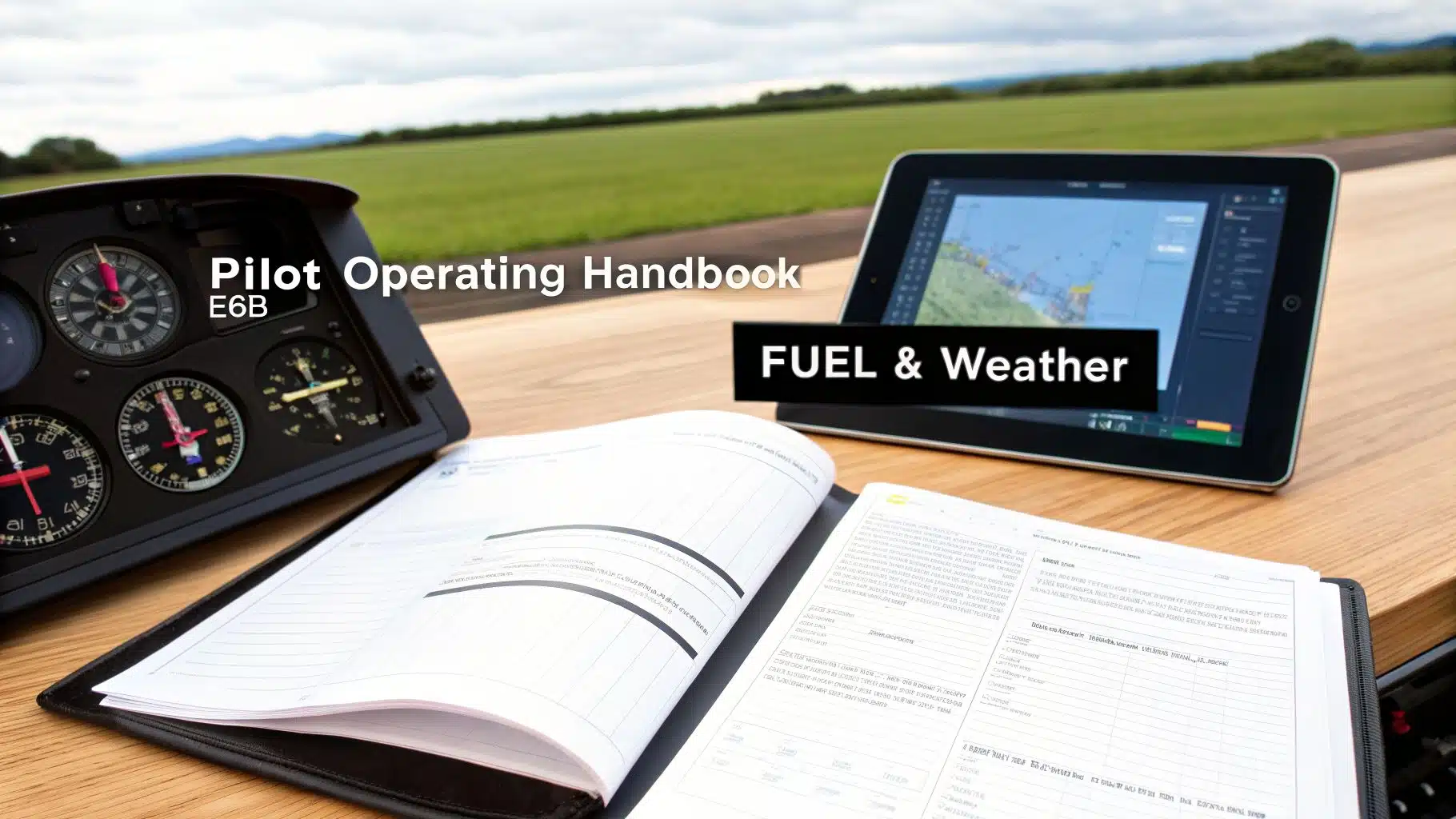
With the weather in hand, it's time to grab the Pilot’s Operating Handbook (POH). This is the bible for your specific aircraft, filled with the performance charts you need to answer some critical questions. Using the day's temperature and pressure altitude, you'll calculate the real-world performance you can expect.
For instance, in a Piper Cherokee, you'll be hitting the charts to figure out:
- Takeoff Distance: How much runway will you actually need to get off the ground and clear that 50-foot obstacle? Remember, a hot day at a high-elevation airport like Big Bear can dramatically increase this number.
- Climb Performance: How long will it take to get to your cruising altitude? How much gas will you burn just getting up there?
- Cruise Performance: Once you're level at your chosen altitude and power setting, what’s your true airspeed and fuel burn going to be?
This isn't just busy work. These calculations tell you if you can safely operate out of your chosen airports and are the foundation for your fuel plan.
A core part of good airmanship is knowing how to run these numbers manually with an E6B flight computer. As great as modern EFBs are, they can fail. Being able to verify the math yourself provides a crucial backup and a deeper understanding of what’s happening.
Planning Your Fuel the Right Way
Fuel exhaustion is, without a doubt, one of the most preventable emergencies in aviation. That's why your fuel calculations have to be meticulous, accounting for every single phase of flight: taxi, run-up, takeoff, climb, cruise, and descent. A modern dedicated flight planning app can be a fantastic tool for this, pulling in real-time weather to make your numbers more accurate.
The federal regulations are the absolute floor, not the ceiling. 14 CFR 91.151 requires you to land with at least 30 minutes of reserve fuel for a daytime VFR flight and 45 minutes at night.
Here’s some real-world advice: Never plan to land with minimums. A smart pilot always adds a personal buffer. An extra hour, or at least 30-45 minutes on top of the legal requirement, gives you a comfortable margin for stronger-than-forecast headwinds, unexpected delays, or the need to divert to your alternate.
The numbers don't lie. According to 2025 FAA data, miscalculations in performance and fuel are contributing factors in roughly 22% of general aviation accidents each year. GAJSAT analysis also found that fuel exhaustion was a factor in 15% of cross-country incidents between 2015 and 2025. While that number is thankfully dropping with the widespread use of EFBs, it’s a stark reminder of how critical this planning phase is.
Finalizing Your Plan and Making the Go/No-Go Decision
You've plotted the route, run the numbers, and your nav log is starting to look like a real plan. This is where the paperwork and planning on the ground transition into the actual act of flying. Now it's time to pull everything together, file your plan, and make the single most important call of the day: the go/no-go decision.
Before you even grab your keys to head to the airport, do a quick pocket check. Make sure you have your pilot certificate, a current medical, and a government-issued photo ID. You'll also need the aircraft's documents, which we remember with the ARROW acronym:
- Airworthiness certificate
- Registration
- Radio station license (only needed for international flights)
- Operating limitations (found in the POH)
- Weight and balance data (the one you just calculated!)
With all that sorted, you’ll put the finishing touches on your navigation log. Think of this as your in-flight playbook. It’s the single source of truth for every leg, heading, checkpoint, and fuel burn estimate once you're in the air.
Filing, Opening, and Closing Your Flight Plan
Next up is filing your VFR flight plan. This isn't just busywork; it's a crucial safety net. If you don't show up at your destination, this is what tells Search and Rescue where to start looking. You can file easily through an app like ForeFlight or by calling a flight briefer at 1-800-WX-BRIEF.
Just remember, filing the plan is only the first step. It doesn't become active on its own. Once you're airborne and clear of the airport traffic pattern, you have to contact Flight Service to open your flight plan. A quick radio call is all it takes.
Equally important is what happens when you land. You must close your flight plan. I can't stress this enough. Forgetting to close it will trigger a full-blown search-and-rescue operation. Tie a string around your finger, set a phone alarm—whatever it takes. Make closing your flight plan a non-negotiable part of your shutdown checklist.
Real-World Risk Management: The PAVE Checklist
Now for the moment of truth. The final go/no-go decision isn't just about whether the weather legally meets VFR minimums. True airmanship demands a much deeper, more honest look at the entire situation using a risk management framework like the PAVE checklist.
PAVE forces you to systematically consider all risk factors, not just the ones that are easy to measure. It stands for Pilot, Aircraft, enVironment, and External Pressures.
Think of it as a structured conversation with yourself to uncover any hidden risks.
Breaking Down the PAVE Model
Pilot: How are you feeling, really? It’s more than just the IMSAFE checklist. Are you well-rested, hydrated, and not stressed? More importantly, are you proficient enough for this specific flight? Flying to a familiar airport in clear skies is one thing; navigating a complex route with marginal weather is another. Be honest about your skill and comfort level.
Aircraft: Is the airplane truly ready? You did your preflight, but what about the paperwork? Are the annual and 100-hour inspections current? Does the plane have all the equipment you need? And do you have enough fuel—not just the legal minimum, but a comfortable personal buffer for delays or a diversion?
enVironment: What’s the weather really doing, and what's it forecast to do? Don't just look at ceilings and visibility. Consider the winds aloft, potential turbulence, and the impact of density altitude on your plane's performance. Are there any last-minute TFRs or active special-use airspace along your route?
External Pressures: This is the subtle one that gets a lot of pilots in trouble. Do you feel rushed to make a meeting? Are you trying to impress a passenger by promising you’ll get them there no matter what? Is "get-there-itis" clouding your judgment?
Recognizing these pressures is the first step toward neutralizing them. A good pilot knows when to go, but a great pilot knows when not to. Sometimes, the most professional decision you can make is to grab a coffee and wait it out on the ground. That disciplined, safety-first mindset is the ultimate goal of all your VFR cross country flight planning.
How to Safely Buy Your First Aircraft
Once you start logging serious cross-country hours, that little voice in your head gets louder. The one that says, "What if I owned my own plane?" It’s an exciting thought, but jumping into ownership without a solid plan can be a costly mistake. Let’s walk through how to approach your first aircraft purchase smartly and safely.
The process starts way before you ever browse an aircraft listing. The very first thing you have to do is get brutally honest about your mission. What are you actually going to do with this airplane?
- Are you mostly just looking for a fun machine to grab that $100 hamburger on the weekends?
- Do you have serious travel in mind, requiring a capable platform for VFR cross country flight planning?
- Is an instrument rating in your future, meaning you'll need an IFR-certified aircraft?
- Who are you bringing along? Is it just you and a friend, or do you need to haul the whole family?
Thinking this through is crucial. It’s what helps you decide between, say, an economical two-seat Cessna 150 and a four-seat Piper Archer. The C150 is a brilliant little plane, but it's the wrong tool if your mission is flying a family of four from California to Arizona.
Budgeting for the Whole Picture, Not Just the Price Tag
With a mission in hand, it’s time to talk money. The sticker price of the plane is only the beginning, and this is where many first-time buyers get a nasty surprise. Your real budget needs to account for the total cost of ownership.
Your ongoing expenses will include:
- Insurance: This cost fluctuates wildly depending on your flight hours, the aircraft model, and whether it’s hangared or tied down.
- Hangar or Tie-Down: A hangar gives your plane the best protection from the elements, but it comes at a premium. An outdoor tie-down is cheaper but exposes your investment to sun, rain, and hail.
- Annual Inspection: Every aircraft needs a thorough inspection once a year. This can easily run into thousands of dollars—and that’s before fixing whatever the mechanic finds.
- Routine Maintenance: Think of this like car ownership, but more expensive. Oil changes, tires, spark plugs, and other scheduled items are a constant.
- Fuel and Oil: Look up the hourly fuel burn for your target aircraft and multiply it by how many hours you realistically expect to fly each year.
Here’s a pro tip: create a separate savings account specifically for maintenance. I call it the "uh-oh fund." Something will always break when you least expect it, and having cash set aside means a small mechanical issue won't keep you grounded for months.
The Non-Negotiable Pre-Purchase Inspection
If you only listen to one piece of advice in this guide, make it this one: never, ever buy an aircraft without a thorough pre-purchase inspection.
This isn't just a quick look-over. You need to hire a qualified and independent Airframe & Powerplant (A&P) mechanic—someone who works for you, not the seller.
The pre-purchase inspection is your best line of defense against buying a lemon. A good mechanic, especially one who specializes in the aircraft type you’re considering, knows all the common weak spots, corrosion-prone areas, and signs of hidden damage.
During this inspection, you and your mechanic must go through the aircraft's logbooks with a fine-toothed comb. You're looking for a clean, complete, and continuous maintenance history. Gaps in the logs or entries detailing major damage are serious red flags that demand a much deeper dive.
Tap Into the Power of the Pilot Community
Before you get serious about a specific model, find its "type club." These owner groups are an absolute goldmine of information. Whether it’s the Cessna Pilots Association, the American Bonanza Society, or an online forum for Robinson helicopter owners, you need to join.
Members in these groups are usually more than willing to share their real-world experiences—the good, the bad, and the expensive. They’ll tell you about common maintenance gripes, performance quirks the POH doesn't mention, and what to look for when inspecting a plane. This insider knowledge gives you a massive advantage and helps you ask smarter questions.
Buying your first airplane is a huge step, but it doesn't have to be intimidating. With careful planning and the right advice, you can make a purchase you’ll be proud of, opening up a whole new level of freedom in the sky.
From Renter to Owner: Selling Your First Aircraft
Eventually, your mission may change. The two-seater that was perfect for weekend getaways might not be enough for a growing family, or you might be ready to step up to a more capable, IFR-equipped aircraft. Selling your airplane requires just as much care and planning as buying one. A well-prepared seller not only gets a better price but also ensures a smooth, transparent transaction.
Getting Your Plane "Market Ready"
First impressions matter. Before you even think about listing your aircraft, get it ready for its close-up.
- Deep Clean: A professional detail is worth every penny. A sparkling clean airplane inside and out shows pride of ownership and suggests the aircraft has been well-cared for.
- Organize the Paperwork: This is non-negotiable. Gather all logbooks (airframe, engine, propeller), maintenance records, and STC paperwork. Scan them into a digital format. A complete, organized set of digital logbooks is a massive selling point and makes the buyer’s pre-purchase review much easier.
- Fix the Squawks: Take care of those minor, nagging issues. That slightly dim instrument light or a cracked piece of plastic trim might seem small, but to a potential buyer, they can signal a lack of care. A "clean" airplane with no obvious squawks inspires confidence.
Pricing It Right
Setting the right price is more art than science. Start by researching the market. Look at online marketplaces like Trade-A-Plane or Controller to see what similar aircraft with comparable hours and equipment are listed for. Be honest about your plane’s condition.
Remember to consider factors like:
- Total time on the airframe and engine (TTAF/TTE)
- Time since major overhaul (SMOH)
- Avionics package
- Paint and interior condition
- Damage history
Pricing it too high will scare away buyers, while pricing it too low will leave money on the table. A price that is fair and reflects the current market will attract serious inquiries.
The Selling Process
Once you've listed the plane, be prepared to answer questions and show the aircraft. Honesty is the best policy. Be upfront about the plane’s history, including any damage. A documented, properly repaired incident is far better than a hidden one discovered during the pre-purchase inspection.
The buyer will (and should) arrange for a pre-purchase inspection with their own mechanic. Facilitate this process by making the aircraft and its logbooks readily available. A smooth and cooperative pre-buy process builds trust and helps close the deal.
Navigating the sale of an aircraft can be complex, but by preparing thoroughly, you ensure a positive experience for both yourself and the buyer, paving the way for your next aviation adventure.
Making the dream of aircraft ownership a reality starts with a rock-solid foundation. At DuBois Aviation, we focus on building safe, competent, and confident pilots, from that very first flight all the way to your advanced ratings. Learn more about our comprehensive flight training programs at https://duboisaviation.com.