Ever wondered what it really takes to become a pilot? The journey from your first time in the cockpit to commanding a commercial airliner is a structured, step-by-step process. Think of it as a ladder of pilot license levels, where each new certificate you earn unlocks greater skills, more privileges, and exciting new opportunities.
This guide will walk you through the entire path, showing you exactly how it all fits together.
Your Flight Path To The Cockpit
Earning your pilot certificates is a lot like getting your driver's license. You start with a learner's permit, move up to a full license, and might eventually get a commercial license to drive trucks or buses. Each stage builds on the last, adding new skills and responsibilities. The FAA designed this system to ensure pilots gain the experience they need to safely handle increasingly complex aircraft and flying conditions.
Two practical options worth comparing
These are specific products pilots commonly compare for this type of flying. Confirm compatibility with your aircraft and instructor before ordering.
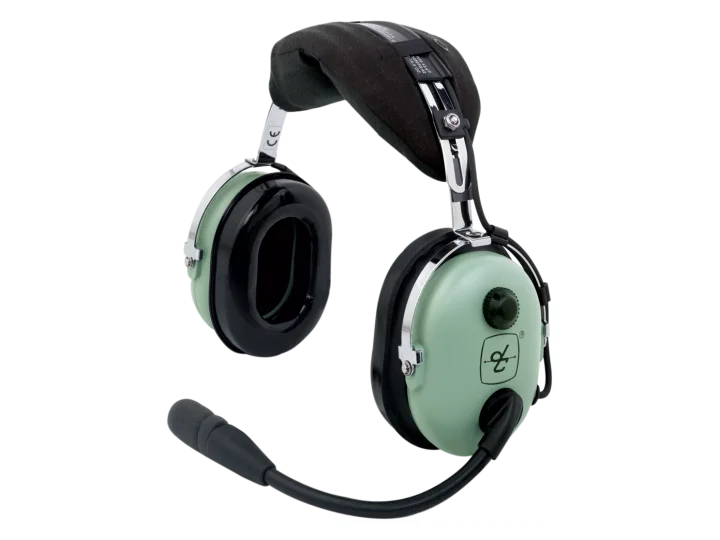 Student headsetDavid Clark H10-13.4 Aviation HeadsetCheck current availability on Amazon (paid link)
 OrganizationASA Flight BagCheck current availability on Amazon (paid link)
Whether you dream of flying for fun on the weekends, launching a new career, or even buying your own airplane or helicopter one day, understanding this progression is your first crucial step. The certificate you hold directly impacts what you can fly, where you can fly, and how you can fly.
The journey typically follows these core milestones:
- Private Pilot License (PPL): This is the foundation for every pilot.
- Instrument Rating (IR): An essential add-on for flying in less-than-perfect weather.
- Commercial Pilot License (CPL): The license that allows you to get paid for flying.
- Airline Transport Pilot (ATP): The highest certification, required for a career with the airlines.
The path to the airline cockpit is a well-traveled one, demanding a serious commitment to rack up flight hours and master complex systems. This deliberate, structured system is designed to make sure pilots are more than ready for the new responsibilities that come with each certificate.
The image below gives you a quick visual of how these licenses stack up, from the foundational Private Pilot License all the way to the Airline Transport Pilot certificate.
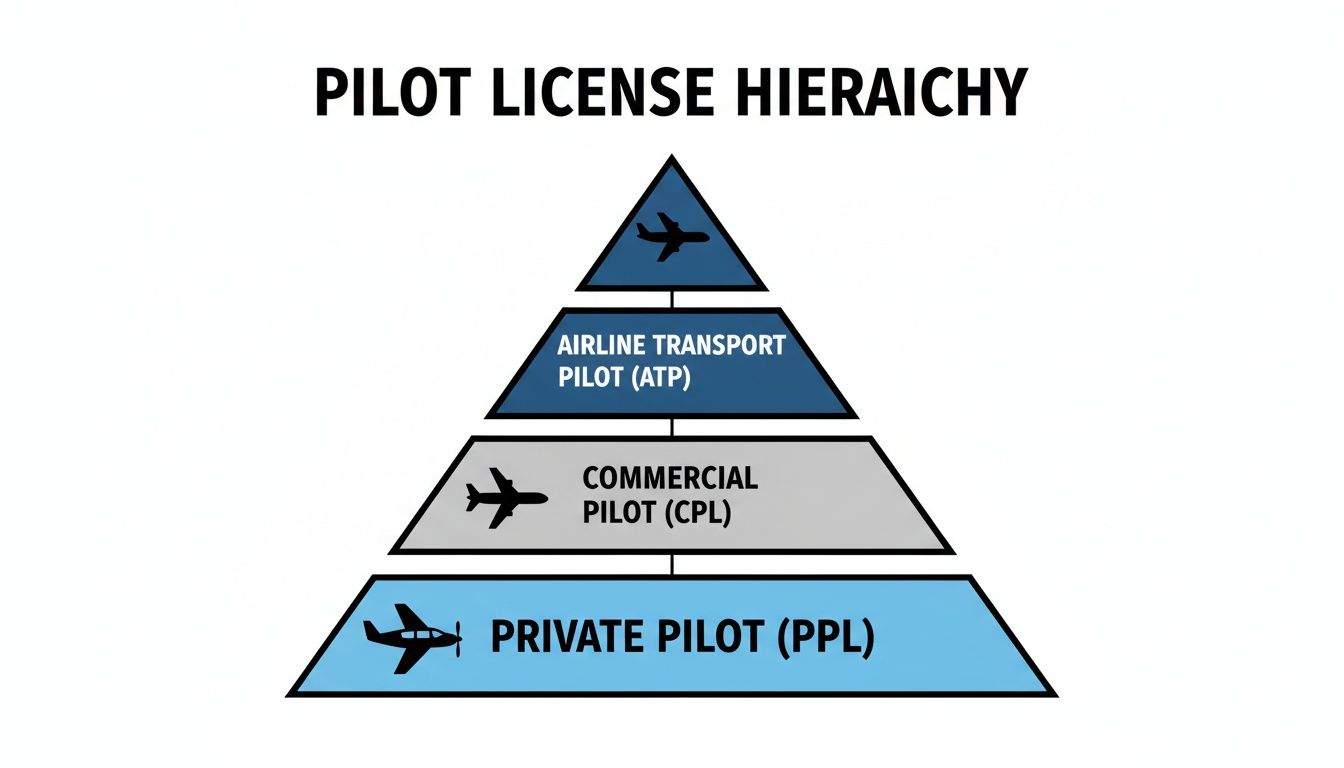
As you can see, each level serves as a building block for the next. This pyramid structure perfectly illustrates how your experience and skills grow as you climb higher.
Pilot License Levels at a Glance
To give you a clearer picture, here’s a simple breakdown of the main pilot certificates and what they’re all about.
| License Level | Primary Purpose | Who It's For |
|---|---|---|
| Private Pilot (PPL) | Fly for personal reasons, not for compensation. | Hobbyists, aspiring career pilots starting their journey. |
| Commercial Pilot (CPL) | Fly for hire; get paid for flying services. | Career pilots (e.g., charter, survey, instruction). |
| Airline Transport Pilot (ATP) | Act as pilot-in-command for an airline. | Pilots aiming for a career with major or regional airlines. |
This table shows the main "rungs" on the ladder, but as you'll see, there are other important ratings—like the Instrument Rating—that fit in between these major milestones. Now, let's dive into the details of each one.
The Private Pilot License: Your Ticket to the Sky
The Private Pilot License (PPL) is where your real flying journey begins. Think of it as your driver's license for the sky—it's the certificate that unlocks the freedom to fly an aircraft for fun, take friends and family on incredible sightseeing trips, and see the country from a breathtaking new perspective.
Earning your PPL is a major milestone. It proves you have the knowledge and skill to act as Pilot in Command (PIC) of an aircraft. This comes from a blend of ground school, where you'll get a handle on aerodynamics and regulations, and plenty of hands-on flight training. In the cockpit, you'll master everything from smooth takeoffs and landings to confidently managing in-flight challenges.
What It Takes to Earn Your PPL
The Federal Aviation Administration (FAA) lays out some clear starting requirements. You need to be at least 17 years old to get the license and hold a third-class medical certificate, which is a basic health screening.
The FAA's minimum flight time is 40 hours, but it's important to see that number for what it is: a minimum. Most pilots find they need a bit more time to feel truly comfortable and proficient. In reality, the national average is closer to 60-70 hours to build the skill and confidence needed to ace the final exam, known as the checkride. That extra time in the air is what makes you a safe, capable pilot.
The solo cross-country flight is a rite of passage for every pilot. It's the first time you plan a route, navigate to a distant airport, and return completely on your own. It's a huge confidence booster and an experience you'll never forget.
Privileges and Where to Go from Here
With your PPL in hand, you can fly a single-engine airplane in good weather and bring passengers along for the ride. The one major limitation? You can't be paid for flying. This license is purely for personal and recreational use.
So, what's next? For many, the PPL is just the first step. At DuBois Aviation, we're here to help you figure that out. Maybe you want to add an Instrument Rating to fly in more challenging weather, or perhaps you're just getting started on your path.
To get a complete picture of the process, check out our in-depth guide on how to become a private pilot.
Flying Confidently in Any Weather
Earning your Private Pilot License is an incredible achievement, but it comes with one major string attached: you must fly by Visual Flight Rules (VFR). In simple terms, you have to be able to see where you're going. The Instrument Rating (IR) is what cuts that string, giving you the skills and legal authority to fly when the weather isn't cooperating.
This is the rating that lets you navigate through clouds and low visibility, relying solely on your aircraft's instruments.
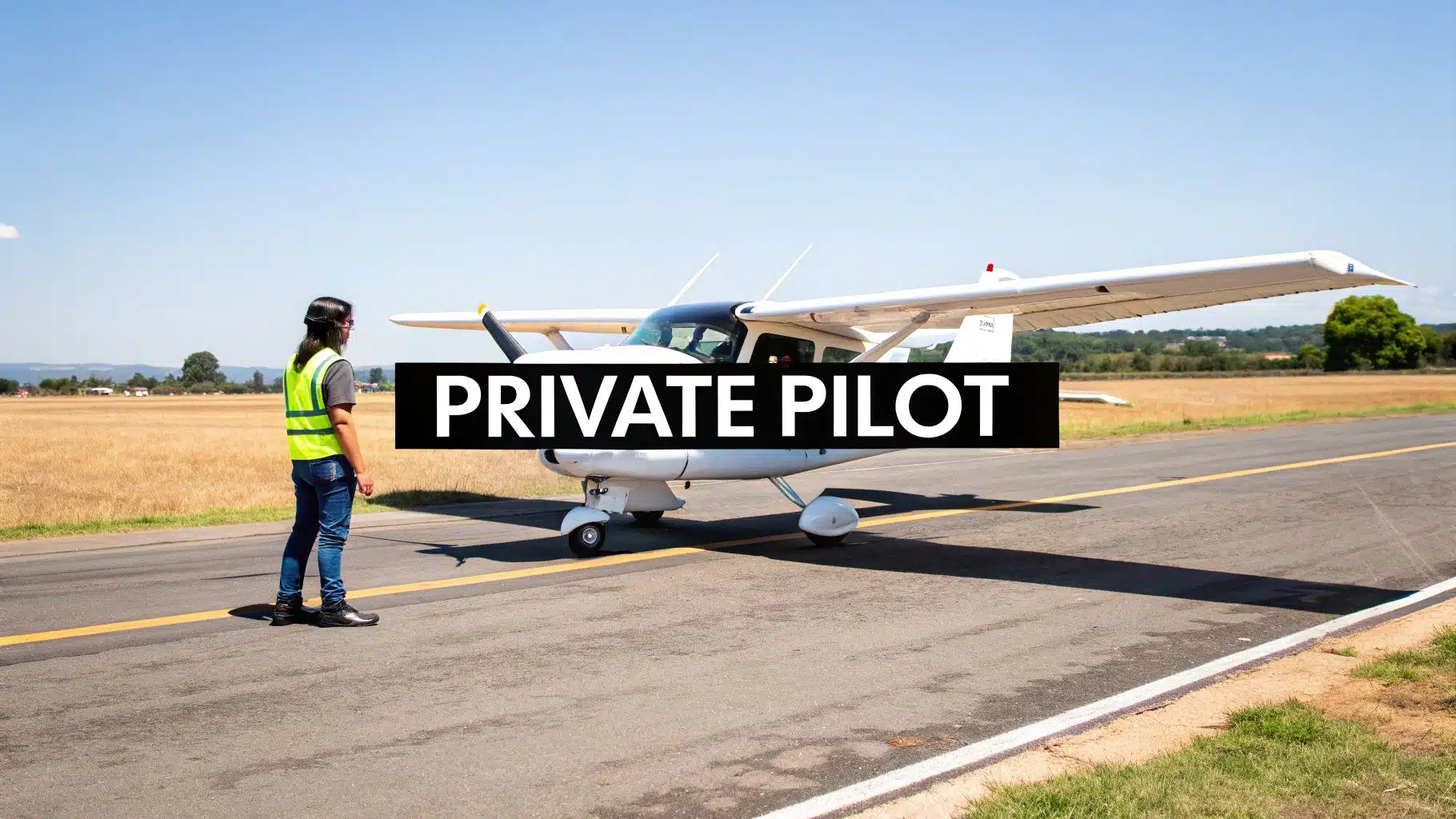
Think of it like this: your PPL makes you a fair-weather driver. An Instrument Rating turns you into an all-weather professional, equipped to handle dense fog in the middle of the night. It completely changes your capabilities, shifting you from a pilot who must always avoid clouds to one who can confidently fly through them.
Mastering the Art of Instrument Flight
Instrument training is all about precision and discipline. It's an intense process that teaches you to tune out what your body is telling you—a dangerous sensation called spatial disorientation—and place your complete trust in the aircraft's gauges.
This training builds an entirely new level of confidence. It fundamentally makes you a safer, more capable pilot, even when you're flying on a perfectly clear day.
To add this rating to your certificate, the FAA requires you to log some specific experience:
- 50 hours of cross-country flight time as Pilot in Command
- 40 hours of actual or simulated instrument time
- 15 hours of dual instruction with a certified flight instructor (CFII)
A huge part of this is mastering instrument approaches, which are the highly structured procedures for landing at an airport when you can't see the runway until you're just moments from touchdown. It's a challenging skill set, but incredibly rewarding to learn.
The Instrument Rating is arguably the single most important qualification a pilot can earn after their PPL. It is non-negotiable for an airline career and the biggest safety enhancement a recreational pilot can invest in.
Smart Training with Modern Tools
Building all those required hours can be a big investment of time and money. The good news is that modern flight simulators are a massive help in making instrument training more affordable and effective.
At DuBois Aviation, our advanced simulators let you practice complex procedures and emergency scenarios over and over in a safe, controlled setting. Best of all, that time counts toward your required hours. This blend of real-world flying and focused simulator sessions is the perfect way to prepare you for the realities of flying in instrument meteorological conditions (IMC).
If you're ready to take this critical step, you can learn more about how to get an instrument rating and see why it’s such a vital part of your journey.
Transitioning from Hobby to Career
This is the moment your passion for flying can officially become your profession. Earning a Commercial Pilot License (CPL) is the key that unlocks your ability to get paid for being in the cockpit. It’s the essential qualification that turns flying from an expensive hobby into a viable career.
With a CPL, you can finally start earning an income from flying. This certificate opens the door to a wide range of entry-level jobs that are the backbone of the entire aviation industry. While it's not the final step for an airline career, it is the most critical stepping stone to get you there.
Upping the Stakes and the Skill
Earning a CPL means a serious jump in both your flight time and your precision. The FAA sets the bar at a minimum of 250 total flight hours to be eligible—a huge increase from the private pilot requirements. This isn't just about logging time; it's about proving you have a much higher level of mastery over the aircraft.
The practical exam, or checkride, for the CPL is far more demanding. You'll have to perform advanced maneuvers with much tighter tolerances, showing an examiner you have the skill and judgment to be responsible for the aircraft, the mission, and any passengers you might carry.
This higher standard reflects the growing global demand for skilled pilots. In fact, the Commercial Pilot License segment of the pilot training market is the clear leader, commanding a dominant 48.17% market share as it fuels the needs of commercial aviation worldwide.
Think of the CPL as more than just another certificate; it's a professional credential. It tells the world you’ve met a high standard of proficiency and are ready to be compensated for your skills, paving the way for a career in the sky.
Your First Professional Flying Jobs
A CPL qualifies you for a variety of fascinating jobs that also happen to be perfect for building the flight hours you'll need for an airline career. These roles give you invaluable, real-world experience that you just can't get anywhere else.
Common first jobs include:
- Flight Instruction: After earning a Certified Flight Instructor (CFI) rating, you can teach new pilots.
- Aerial Photography and Surveying: This involves flying precise patterns for mapping or agricultural purposes.
- Banner Towing: A classic first pilot job that teaches excellent aircraft control.
- Sightseeing Tours: A popular route for both airplane and helicopter pilots to share the joy of flight.
As you start thinking about moving into a professional pilot role, getting advice from a career coach can provide a ton of strategic guidance for your growth.
Each of these jobs sharpens your decision-making and prepares you for the next level. At DuBois Aviation, our experienced instructors can guide you through the demanding CPL requirements, setting you up for a successful checkride and a rewarding career.
Reaching the Airline Career Pinnacle
Welcome to the top of the mountain. The Airline Transport Pilot (ATP) certificate is the highest level of pilot certification you can achieve, and it's the mandatory credential required by the FAA to fly for a scheduled commercial airline. Think of it as the PhD of the aviation world.
Earning an ATP is a testament to an immense amount of time, dedication, and skill. It signifies that a pilot has the judgment, technical mastery, and professionalism to be responsible for hundreds of passengers and a multi-million-dollar aircraft. This isn't just another rating; it's the culmination of a pilot's entire training journey.
The Famous 1,500 Hour Rule
At the heart of the ATP certificate is one massive requirement: flight time. To even be eligible, a pilot must have logged a minimum of 1,500 total flight hours. This rule ensures that every airline pilot has deep, well-rounded experience before they ever step into a modern airliner cockpit.
This significant flight time requirement is exactly why the entry-level jobs available after earning a Commercial Pilot License are so important. Most pilots spend years working as flight instructors, banner towers, or survey pilots specifically to build the hours needed to qualify for an airline interview. For anyone on a dedicated career path, this time-building phase is a crucial part of the process.
The ATP certificate is the final key that unlocks the door to a major or regional airline. With this certificate, you can finally apply for that coveted first officer position and officially begin your career in the right seat of an airliner.
The Essential Multi-Engine Rating
Before you can even think about the airlines, you need to master aircraft with more than one engine. The Multi-Engine Rating is an add-on to your pilot license and a non-negotiable prerequisite for nearly any airline job.
This specialized training dives deep into the unique aerodynamic challenges of multi-engine flight. A huge focus is on how to maintain control if one engine fails—a concept known as asymmetrical throughst. You’ll spend a significant amount of your training identifying and flawlessly executing engine-out emergency procedures until they become second nature.
The ATP license sits at the very top of the pilot certification pyramid, requiring a staggering 1,500 hours and multi-engine proficiency. This demand is happening as the training market is exploding from USD 7.4 billion in 2024 to USD 14.3 billion by 2030, driven by massive airline expansions and a global need for 660,000 pilots, according to Boeing.
These advanced qualifications are the final, essential steps in a structured journey, preparing you to take command in the demanding environment of a modern airliner cockpit. To see how all these pieces fit together, explore our guide on the airline pilot career path and learn how DuBois Aviation can support you at every stage.
How to Buy an Airplane or Helicopter the Safe Way
For many pilots, each license level is just another step toward the ultimate dream: owning your own aircraft. Whether you're in the market for an airplane or a helicopter, the buying process is a major undertaking that requires careful planning to avoid costly mistakes.
1. Define Your Mission
Before you even look at a single listing, you need to answer one critical question: What are you going to do with it? Your "mission" dictates everything else. Are you looking for a simple, two-seat plane for weekend breakfast flights? A six-seat, high-performance machine for cross-country family trips? Or a helicopter for private land access? Be realistic about your typical flights, as buying too much aircraft for your mission is a classic and expensive mistake.
2. Create a Realistic Ownership Budget
The purchase price is just the tip of the iceberg. A smart budget accounts for all the fixed and variable costs that come with ownership. Don’t get caught off guard.
- Acquisition: The upfront cost of the aircraft itself.
- Insurance: Varies widely based on your experience, the aircraft's value, and how it will be used.
- Hangar or Tie-Down: Essential for protecting your investment from the elements.
- Annual Inspection: A thorough yearly inspection that can cost thousands.
- Maintenance Reserves: A fund for scheduled engine overhauls and unexpected repairs.
- Operating Costs: Fuel, oil, and other consumables.
3. The Pre-Purchase Inspection is Non-Negotiable
This is the single most important step in buying a used aircraft. You must hire a qualified, independent mechanic—one you trust, not one recommended by the seller—to conduct a thorough pre-purchase inspection. They will meticulously review the aircraft's logbooks for a complete maintenance history, look for any signs of damage or corrosion, and give you a clear picture of the aircraft's true condition. Skipping this step is the fastest way to turn your dream into a financial nightmare.
Selling Your Aircraft: A Strategic Approach
If you're on the other side of the transaction, selling your airplane or helicopter also requires a plan. A well-presented aircraft with complete records will always attract better offers and a faster sale.
- Get Your Paperwork in Order: Ensure all logbooks are complete, organized, and up-to-date. Missing logs are a massive red flag for potential buyers and will significantly devalue your aircraft.
- Presentation Matters: A clean, well-maintained aircraft makes a powerful first impression. Invest in a professional detail inside and out.
- Set a Fair Price: Research the market for comparable aircraft. Pricing your plane or helicopter realistically from the start will attract serious buyers.
- Be Ready for the Pre-Purchase Inspection: A transparent and cooperative attitude during the buyer's inspection builds trust and helps the sale go smoothly.
Frequently Asked Questions About Becoming a Pilot
Thinking about learning to fly always sparks a lot of questions. Whether you're just curious about getting started or even looking into buying your own airplane or helicopter, getting good answers is the first step. Let's tackle some of the most common things we hear from people who are new to aviation.
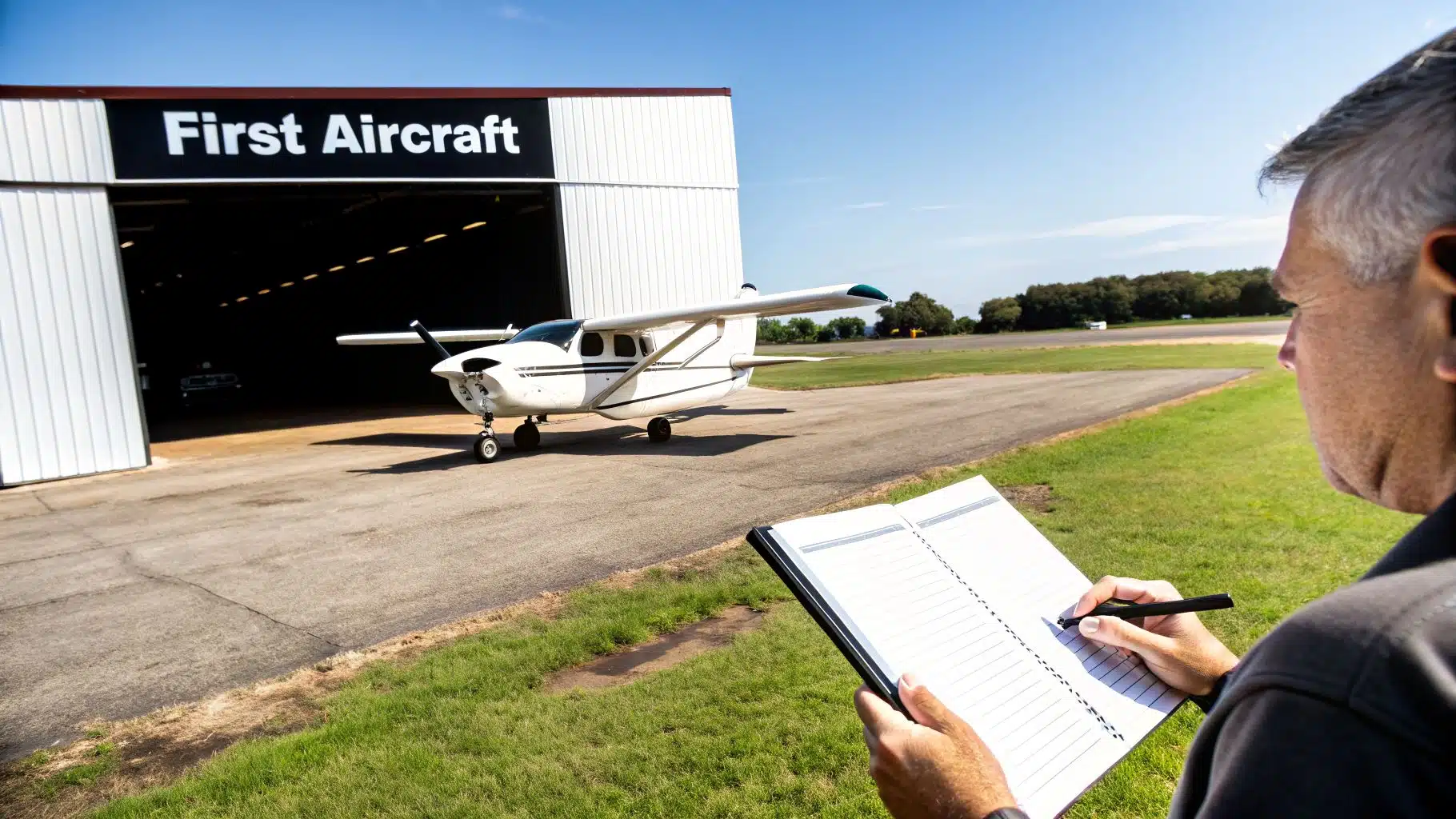
One of the biggest questions we get is about eyesight. Many people worry that needing glasses or contacts is an automatic disqualification, but that’s not the case at all. As long as your vision can be corrected to the FAA's standard during your medical exam, you’re cleared for takeoff.
People also want to know how long it all takes. If you can dedicate yourself to training full-time, it's possible to earn a Private Pilot License in as little as 2-3 months. For most people balancing flying with work or family, a part-time schedule is more realistic, usually taking about 4-6 months.
Buying an Aircraft and Training Differences
Once the idea of flying really takes hold, the next thought is often about ownership. If you're looking to buy an aircraft, a Private Pilot License is generally the minimum you'll need to get insured and legally fly a basic single-engine plane. The license you hold literally defines what kind of aircraft you're qualified to own and operate.
This works the other way if you're selling, too. The type of aircraft you have determines who your potential buyers are.
- Simple Trainers: A classic like a Cessna 172 or Piper Cherokee has a huge market because so many pilots hold a Private Pilot License.
- Complex or Multi-Engine: A more advanced aircraft naturally narrows your audience to pilots with higher-level certificates and ratings, which is something to consider in your sales strategy.
A big decision right at the start is choosing between airplanes and helicopters. While they both fly, the training is quite different. Helicopters are inherently unstable, so just learning to hover requires constant, subtle control inputs—making the initial learning curve a bit steeper.
Ultimately, your choice depends on your goals. Airplanes are the direct path to the airlines, while helicopters unlock unique careers in emergency medical services, tourism, and utility work. No matter which you choose, financing is readily available through lenders who specialize in aviation training.
Ready to take the first step, no matter which cockpit you dream of sitting in? DuBois Aviation offers personalized airplane and helicopter training programs to match your goals. Start flying with us today!