
Look up on a clear day and you might see the thin white contrails of a jet streaking across the sky, miles above the earth. That aircraft is flying in a world apart from where most general aviation pilots operate. It's flying in Class A airspace.
This isn't just another layer of the sky; it’s the high-altitude expressway system, reserved for the fastest and most capable aircraft. Think of it as the interstate for airliners and corporate jets, a highly structured environment where safety and efficiency are paramount.
Understanding The High-Altitude Highway

If you imagine the U.S. airspace as a giant layer cake, most of us in general aviation spend our time in the lower layers, like Class E or the airspace around towered airports (Class D). But once you climb past a certain point, you enter an exclusive realm.
Class A airspace exists for one primary reason: to safely manage a huge volume of high-speed, high-altitude traffic. This is achieved through a system of "positive control," which is just a formal way of saying every single aircraft is on an active flight plan and in constant communication with Air Traffic Control (ATC). No exceptions.
Defining The Boundaries of Class A
One of the best things about Class A is its consistency. Unlike other types of airspace that can change from city to city, the rules for Class A are the same everywhere across the United States.
- Vertical Limits: It starts at 18,000 feet Mean Sea Level (MSL) and goes all the way up to and includes Flight Level 600 (FL600)—that's roughly 60,000 feet.
- Flight Rules: You can only operate under Instrument Flight Rules (IFR). VFR flight is strictly prohibited.
- Purpose: Its main job is to provide safe, positive separation for aircraft, primarily the airliners and business jets crossing the country at high speeds.
This rigid structure is what allows thousands of flights to crisscross the nation safely every single day. To give you an idea of the scale, let's look at the numbers.
En route centers responsible for this airspace manage an incredible amount of traffic. For instance, ZLA (Los Angeles ARTCC), which handles a huge slice of Southern California's Class A airspace, tracked over 2.3 million operations in a recent fiscal year.
That sheer volume is precisely why mastering IFR procedures is non-negotiable for any pilot with professional ambitions. Understanding these high-altitude operations is a cornerstone of advanced pilot training, something we dive into deeply in our ground school programs. This is the knowledge that bridges the gap between local flying and navigating the complex world where airline careers are made.
For now, just seeing those contrails high above is a great reminder of what this elite airspace represents. It’s the pinnacle of instrument flying, where precision, skill, and advanced systems come together to make modern air travel a daily reality. Learning about it is the first step toward one day flying within it.
Getting Your Ticket to the Flight Levels: Pilot and Aircraft Requirements
Flying in Class A airspace isn't like your typical weekend flight. You can't just hop in, point the nose up, and go. Think of it as the express lane of the sky—it’s fast, efficient, and strictly controlled. Gaining access means both you and your aircraft have to meet some serious, non-negotiable standards set by the FAA.
First and foremost, let's talk about the person in the left seat. Before you can even dream of punching through 18,000 feet, you absolutely must hold an instrument rating. This isn't a recommendation; it's a hard-and-fast rule.
An instrument rating is proof that you’ve mastered the art of flying without looking outside, relying solely on your instruments to navigate and keep the aircraft upright. Since VFR flight is prohibited and the weather up there can be unforgiving, this skill is the absolute cornerstone of operating safely in the Class A environment.
It's an IFR-Only World
In Class A, every single flight operates under Instrument Flight Rules (IFR). There are no exceptions. This means your entire operation, from start to finish, is choreographed with Air Traffic Control based on a flight plan you file beforehand. You are under "positive control" the entire time.
This IFR-only system is what allows ATC to safely manage the incredible volume of high-speed traffic crisscrossing the country. Every aircraft is known, tracked, and kept safely apart from all the others. It's a demanding system to fly in, but our expert CFIs can get you ready for it with our comprehensive instrument rating course.
Gearing Up the Aircraft
Just like the pilot, the airplane has to be properly equipped for the mission. The avionics needed for Class A flight go well beyond the basics for VFR flying, focusing on precise navigation and constant communication.
Your aircraft’s equipment list must include:
- Two-Way Radio: You need to be in constant contact with ATC. This is your link for clearances, instructions, and traffic alerts. No radio, no entry.
- Mode C Transponder with ADS-B Out: Since the FAA mandate on January 1, 2020, ADS-B Out is required in all Class A airspace. This system broadcasts your aircraft’s exact position, altitude, and speed, forming the foundation of modern air traffic surveillance.
These technologies aren't just for show; they have a massive impact on safety. The introduction of ADS-B Out, for instance, has been credited with cutting separation errors by over 50%, according to FAA data. That's a huge deal in an environment where major airliners like the Boeing 737 are projected to log 10 million flights globally. You can explore detailed airspace explanations on PilotInstitute.com to learn more about how this airspace has evolved over time.
But that's not all. For any flight at or above Flight Level 240 (24,000 feet), you'll need more advanced navigation gear. The regulations require either Distance Measuring Equipment (DME) or a suitable Area Navigation (RNAV) system, like GPS. This ensures you can pinpoint your position and fly direct routes without having to rely solely on ground-based VORs, which can be hundreds of miles apart at those altitudes. Bottom line: meet the requirements, and you're cleared to the flight levels.
Navigating Class A Airspace Step by Step
Having the right ratings and a properly equipped aircraft is just the start. So, what’s it actually like to fly in Class A airspace? Think of it less like flying and more like a carefully coordinated ballet in the sky, where every move is planned and executed with precision. Let's walk through the entire sequence, from the ground up.
Your trip into the flight levels doesn't start when the engine does—it begins on the ground with filing an Instrument Flight Rules (IFR) flight plan. This is non-negotiable. The flight plan is your declaration to Air Traffic Control (ATC), telling them who you are, your destination, and your intended route. It’s your official request to join the high-altitude highway system.
Obtaining Your Clearance and Entering Class A
After filing your IFR plan and getting airborne, you'll soon be handed off to an Air Route Traffic Control Center (ARTCC). These are the controllers who manage enormous sections of the sky and all the IFR traffic passing through. Before you can even think about climbing past 17,999 feet, you absolutely must be in two-way radio contact with the right center and get a specific clearance.
You're waiting to hear those magic words from the controller:
"N12345, cleared into the Class A airspace. Climb and maintain Flight Level two four zero."
That clearance is your ticket in. Without it, you are legally stuck below 18,000 feet. Your readback confirms you've understood the instruction and is just as critical: "Cleared into Class A, climb and maintain Flight Level two four zero, N12345."
The whole procedure is a system of checks and balances involving you, the rules you're flying under, and your aircraft's equipment.
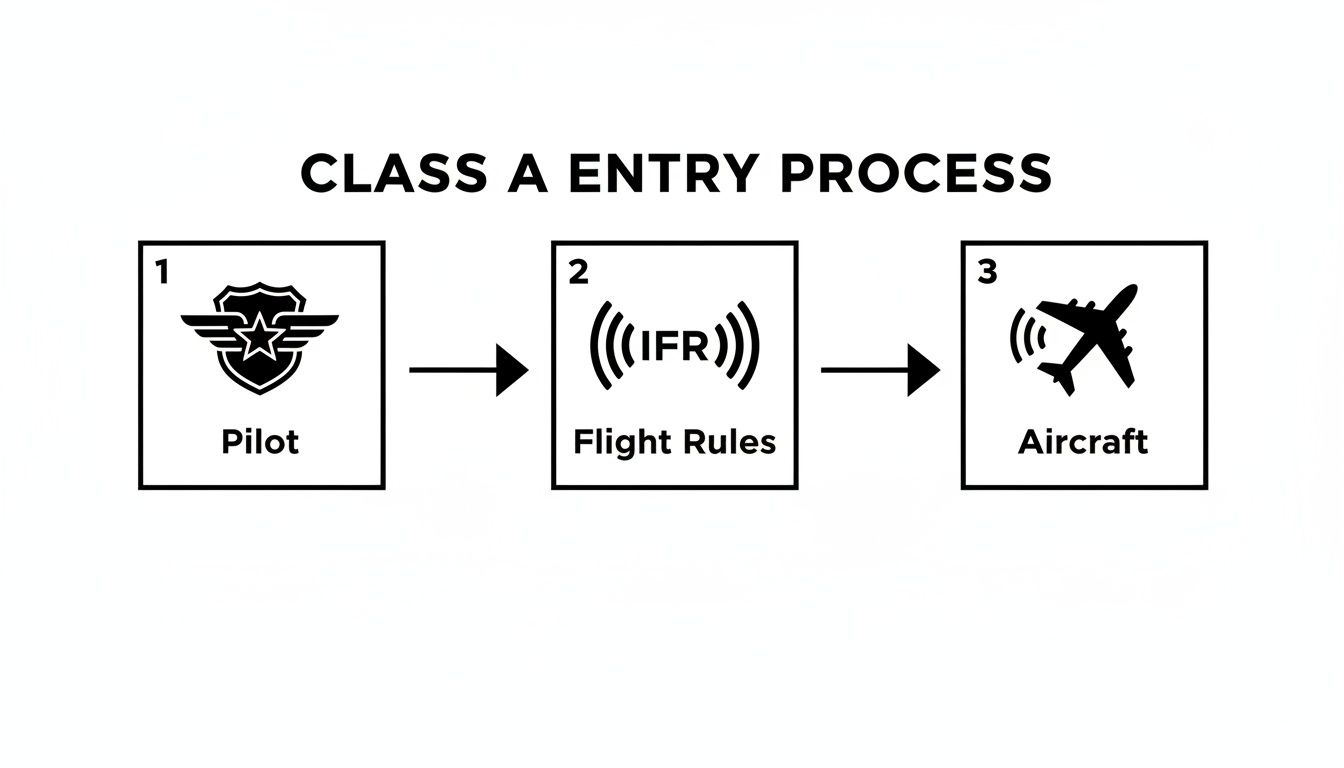
As you can see, it’s a three-part harmony—the pilot, the flight rules, and the aircraft must all be in sync to operate here.
Understanding Flight Levels and Altimeter Settings
As you punch through 18,000 feet on your climb, you'll perform a crucial, standardized action: setting your altimeter to 29.92 inches of mercury. We call it "standard" or just "two-niner-niner-two."
Why does everyone do this? Below 18,000 feet, we constantly adjust our altimeters to the local pressure to get an accurate altitude above the ground. But imagine the chaos if dozens of jets in the same area were using slightly different settings. By switching to a single, standard pressure setting, ATC ensures every aircraft is using the same vertical yardstick. This guarantees that when you're at "Flight Level 350," you are truly separated from the jet at FL330.
Once you’re above 18,000 feet, you also change how you talk about altitude. We drop the term "feet" and start using Flight Levels (FL). The conversion couldn't be simpler: just take the altitude in feet and lop off the last two zeros. So, 24,000 feet becomes FL240, 35,000 feet becomes FL350, and so on.
The scale of this operation is hard to overstate. To get a sense of the operational tempo, just look at the traffic numbers. Major ARTCCs that manage Class A traffic, like ZLA (Los Angeles Center), handle over 2.3 million operations a year. The vast majority of the country's IFR traffic flows through this airspace, which is why advanced equipment like DME or GPS is required above FL240.
To really nail down the skills needed for the Class A environment, nothing beats hands-on practice. Spending time in a motion flight simulator lets you rehearse these complex procedures and communications in a safe, realistic setting. It builds the muscle memory you need to manage the aircraft and talk to ATC with confidence, making the real thing feel second nature.
Buying or Selling a High-Altitude Capable Aircraft

For pilots with ambitions that reach the flight levels, owning an aircraft capable of flying in Class A airspace is the ultimate goal. Whether you are looking to buy your first turbine airplane or helicopter, or sell a cherished machine to upgrade, navigating this market requires a careful, professional approach. It's a major transaction that demands more than just a handshake.
How to Buy an Airplane the Safe Way
Buying a complex aircraft isn't like buying a car; it's a significant investment where a single missed detail can cost a fortune. The most important rule is to protect yourself with a thorough, well-executed pre-buy inspection. This isn't just an annual inspection; it's a deep-dive investigation performed by a trusted mechanic who specializes in that make and model and works exclusively for you.
A proper pre-buy should include:
- Logbook Forensics: Scrutinizing the aircraft's entire history for red flags like damage history, recurring issues, or missing entries.
- AD & SB Compliance: Verifying all mandatory Airworthiness Directives (ADs) are complied with and checking the status of recommended Service Bulletins (SBs).
- Engine & Systems Check: Performing compression checks, borescope inspections, and operational tests of crucial systems like pressurization, de-icing, and the advanced avionics required for Class A flight.
- Title Search: Using a reputable escrow company to ensure the aircraft has a clean title with no hidden liens. The last thing you want is to buy someone else's debt.
This process is your best defense against post-purchase surprises. While it may cost a few thousand dollars, a diligent pre-buy can save you tens or even hundreds of thousands in unexpected repairs.
Navigating the Market When Selling
If you're on the other side of the transaction, preparation is key to a smooth sale and getting the best value. A potential buyer will put your aircraft under a microscope, so get ahead of it.
- Organize Your Records: Have all logbooks, maintenance records, and AD compliance data neatly organized and ready for inspection.
- Presentation Matters: A clean, well-maintained aircraft makes a powerful first impression. It signals that the plane has been cared for.
- Be Transparent: Disclose the aircraft's full history, including any damage repairs. Honesty builds trust with potential buyers.
Whether buying or selling a high-performance aircraft or helicopter, the process is complex. Working with experts can make all the difference. To learn more about navigating the market, you can explore our comprehensive aircraft sales services. Taking these steps helps ensure your aviation dreams become a safe and successful reality.
Common Misconceptions and Global Perspectives
Given how regimented Class A airspace is, it's no surprise some myths and misunderstandings have popped up over the years, especially for pilots used to the freedom of flying closer to the ground. Let's bust a few of these, because getting the facts straight is a huge part of developing a professional pilot's mindset. We'll also take a quick trip around the world to see how high-altitude flight is handled outside of U.S. borders.
One of the most common points of confusion is the idea of "VFR-on-top." While it sounds like VFR, it's actually an IFR clearance that lets you pick your own altitude based on VFR rules. However, it's strictly prohibited in Class A airspace. The entire system above 18,000 feet is built on positive ATC control and assigned flight levels, which leaves zero room for the self-separation and variable altitudes that come with any kind of VFR flight.
Another myth is that you can get a last-minute "pop-up" IFR clearance to climb right into the flight levels. You might get away with a pop-up clearance at lower altitudes if ATC isn't too busy, but entering Class A is a different ballgame. It requires a filed IFR flight plan and serious coordination with an Air Route Traffic Control Center (ARTCC). Think of it as a planned event, not a spontaneous decision.
Debunking Common Class A Myths
Let's clear the air on a few more frequent hangar talk topics. Getting these straight is essential for safe and compliant flight planning.
- Myth 1: You can freely deviate for weather. Not so fast. While controllers will absolutely work with you to get around a thunderstorm, you can't just hang a left to dodge a build-up. You must request and receive an official deviation clearance. This ensures you maintain separation from all the other IFR traffic up there that you can't see.
- Myth 2: All jets fly in Class A. While most airliners live in the flight levels, plenty of private jets and turboprops spend their days on shorter routes well below 18,000 feet. An aircraft's capability doesn't automatically mean it will be flying in Class A on every single trip.
- Myth 3: Helicopters don't fly that high. This is definitely false. Your average training helicopter might top out far below the flight levels, but many modern turbine helicopters—the kind used for VIP transport, search and rescue, or offshore work—are IFR-certified and perfectly capable of cruising in Class A.
A Look at Global High-Altitude Airspace
While the U.S. calls it Class A, the core principles of controlling high-altitude traffic are global. The International Civil Aviation Organization (ICAO) provides the playbook, and most countries adapt it to their needs. When you fly internationally, you'll find systems that feel familiar but have different names and slightly different rules.
For instance, in Europe, you'll often hear about Upper Information Regions (UIRs). They serve the exact same purpose as the airspace controlled by our ARTCCs: providing positive, controlled separation for IFR traffic way up high.
The worldwide trend is toward standardized equipment to boost safety and efficiency. Most countries now require ADS-B Out for aircraft flying at high altitudes, but the specific flight levels and equipment rules can change when you cross a border.
- Canada: Requires ADS-B in its Class A and B airspace (at or above FL125) and has a unique "dual diversity" antenna requirement for both satellite and ground-based reception.
- Europe: Mandates ADS-B for IFR aircraft above a certain weight or speed, creating a unified surveillance environment across the continent.
- Australia: Is all-in on the technology, requiring ADS-B for all IFR flights at all altitudes, not just in the flight levels.
For any pilot with ambitions beyond domestic flying, understanding these international variations is a must. The good news is that the foundational principles you learn for flying in U.S. Class A airspace—discipline, precision, and communication—will serve you well anywhere in the world. The terminology might change, but the unwavering focus on positive control and IFR discipline is universal.
Frequently Asked Questions About Class A Airspace
Now that we’ve covered the fundamentals, let's tackle some of the practical, real-world questions that come up when pilots talk about flying way up high in Class A airspace. Think of this as the hangar talk session where we clear up any lingering confusion.
Do I Need A Special Clearance To Fly Through Class A Airspace?
Yes, and it's non-negotiable. You can't just wander into Class A airspace like you might in other parts of the sky. Entry requires a specific, positive clearance from Air Traffic Control.
The whole process starts on the ground when you file an Instrument Flight Rules (IFR) flight plan. As you climb toward the floor of Class A, you’ll be in constant contact with an Air Route Traffic Control Center (ARTCC). You can only pass through 17,999 feet once you hear that magic phrase from the controller: "Cleared into the Class A airspace." This is the essence of "positive control"—ATC is actively tracking and separating every single aircraft.
What Happens If My Radio Or Transponder Fails In Class A?
An equipment failure in the flight levels is a serious business, and you need to know the playbook cold. If your radio goes silent, you must follow the lost communication procedures detailed in FAR 91.185.
First, squawk 7600 on your transponder. This immediately tells ATC you can't talk. From there, your job is to fly the route and altitude you were last assigned or what was expected based on your flight plan.
What about a transponder or ADS-B failure? You have to tell ATC immediately. They can often still see your plane on older primary radar—the kind that just shows a basic blip—but they lose all the rich data that modern systems provide. A controller will start issuing verbal instructions to keep you separated, but they'll almost certainly route you out of Class A as soon as safely possible. It’s a stark reminder of why those pre-flight equipment checks are so critical.
Can Helicopters Fly In Class A Airspace?
They sure can, but only if they're up to the task. A helicopter has to play by the exact same rules as an airplane to enter the flight levels. This means the helicopter itself must be certified for IFR flight, the pilot needs to be instrument-rated and on an IFR flight plan, and it has to have the muscle to climb to 18,000 feet and beyond.
Your typical training helicopter isn't built for this, but many powerful turbine helicopters are right at home up there. You'll often find them used for:
- Corporate and VIP transport on long-haul flights.
- Search and Rescue (SAR) missions that might require operating over high terrain.
- Specialized industrial or medical operations.
Why Is The Altimeter Always Set To 29.92 In Class A?
This is one of the most brilliant and simple safety features of the entire airspace system. Setting every altimeter to the standard pressure of 29.92 inches of mercury ensures that everyone in the flight levels is using the same yardstick for vertical measurement.
Down low, local barometric pressure changes with the weather. Two planes near each other with different local altimeter settings might show the same altitude on their instruments but be at dangerously different actual heights.
By making 29.92 the universal setting above 18,000 feet, ATC knows that "Flight Level 350" means the exact same thing for every aircraft. When one plane is at FL350 and another is at FL330, there's a guaranteed 2,000 feet of metal between them. It’s why we switch from saying "feet" to "Flight Levels" (FL)—it signals that we've all agreed to play by the same set of rules.
At DuBois Aviation, we believe that truly understanding why the rules exist is what turns a student into a confident, professional aviator. Whether you're grinding for your instrument rating or have your sights set on an airline career, our instructors are here to provide that deeper level of knowledge. To see how we can help you on your journey, check out the programs we offer at https://duboisaviation.com.


