You've got your private pilot certificate, you're comfortable in a Cessna 152 or Piper Cherokee, and a familiar thought keeps showing up after shutdown: I'm ready for more airplane.
That usually starts innocently. You want a little more climb on a hot day. A little more cross-country capability. Maybe a cabin that feels less like a trainer and more like a traveling machine. Then you start hearing names on the ramp like Mooney, Bonanza, Saratoga, and Cirrus. That's when many pilots first run into the phrase high performance aircraft.
The jump is exciting, but it can also get muddy fast. Pilots mix up high performance with complex. Buyers focus on paint and panel upgrades while missing maintenance records. Sellers talk about speed while the true value sits in logbooks, engine history, and honest presentation. The smart move is to understand the whole path, from endorsement to ownership.
Your Next Horizon in Aviation
A newly minted private pilot usually reaches a point where the training airplane starts to feel small in every sense. It still teaches discipline, but it no longer feels like the airplane that matches your goals. You look farther ahead on the map. You want to carry more, go farther, and arrive sooner.
That urge is healthy. It means your flying is maturing.
A high performance airplane isn't just a faster version of what you already know. It asks you to think ahead of the aircraft, manage energy earlier, and treat engine controls with more respect. In return, it opens doors. Cross-country trips become more practical. Busy airspace feels less overwhelming because the airplane can climb and accelerate with authority. Systems knowledge deepens because the machine expects more from you.
You're not just moving up in horsepower. You're moving up in judgment.
For many pilots, this stage also sparks another question: should you rent, train, buy, or eventually sell into something else? That's a real part of the high performance world. Some pilots want the endorsement for proficiency and travel. Others are already scanning listings for airplanes and helicopters and wondering how to buy an airplane the safe way.
Both paths benefit from the same mindset. Learn the airplane thoroughly. Respect the systems. Verify everything. Fly with discipline.
What Defines a High Performance Aircraft
The FAA meaning of high performance aircraft is narrower than many pilots expect. It doesn't mean sleek, fast, or expensive. It means one specific thing.
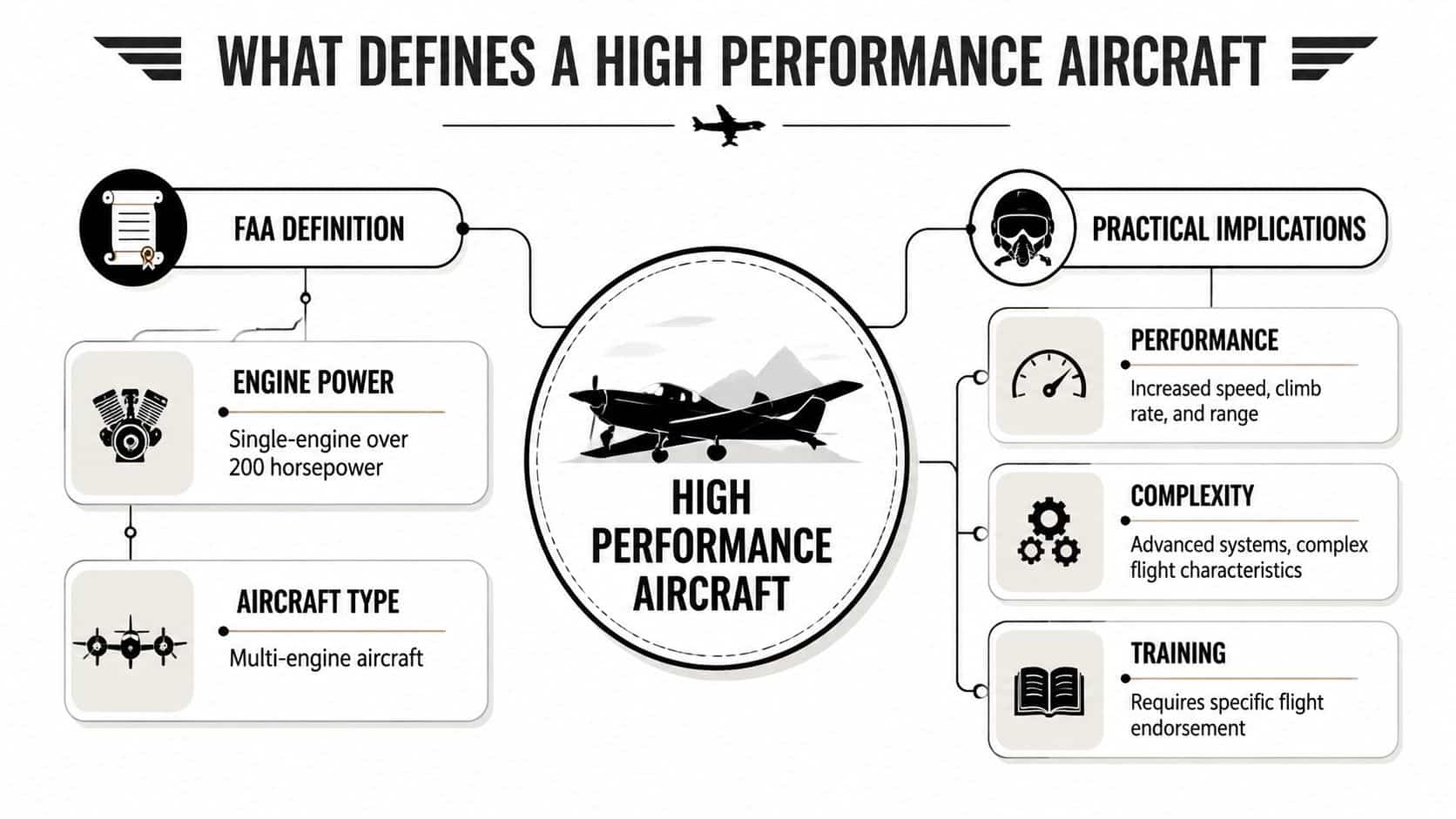
Under 14 CFR §61.31(f)(1), a high-performance aircraft is an airplane with an engine capable of developing more than 200 horsepower, and the rule also includes a grandfather clause for pilots who logged PIC time in such aircraft before August 4, 1997.
That line matters because it decides whether you need the endorsement. If the engine produces more than 200 horsepower, you need the signoff to act as PIC unless you fall under that older PIC-time exemption.
The legal definition
Pilots often get tripped up assuming retractable gear makes an airplane high performance. It doesn't. Retractable gear belongs to the complex category, not high performance.
The horsepower line is strict. An airplane with 201 horsepower falls on one side of the rule. An airplane with 200 horsepower falls on the other. That's one reason instructors and schools pay close attention to engine specs and to old logbooks when a pilot claims the pre-1997 exemption.
Here's the practical takeaway:
- More than 200 hp: the high performance endorsement applies.
- Exactly 200 hp or less: it doesn't.
- Old PIC time matters: pilots who logged PIC in high-performance airplanes before August 4, 1997 may be exempt under the grandfather clause.
The cockpit meaning
The FAA definition is legal. The flying definition is felt in your hands and feet.
More power usually means a stronger left-turning tendency on takeoff and climb. You'll need firmer, earlier right rudder input. Acceleration builds faster. Mistakes arrive sooner. If you're used to adding power and waiting for the airplane to catch up, this class of airplane can surprise you.
Many high performance aircraft also introduce system-management habits that basic trainers don't force you to master. Fuel flow, mixture control, manifold pressure, and propeller RPM become part of your routine. Some airplanes are also fast enough that poor planning in the pattern or on descent shows up immediately.
What pilots confuse most often
A pilot may say, “It's retractable, so it's high performance.” Another may say, “It's fast, so it must need the endorsement.” Neither statement is reliable on its own.
A better habit is to ask three questions:
- What is the horsepower?
- Is it over the FAA threshold?
- Does this airplane also add other endorsement or insurance considerations?
That habit keeps the legal question simple and leaves room for the main issue, which is whether you can manage the airplane safely.
Earning the High Performance Endorsement
The endorsement process is more approachable than many pilots expect. It's training-focused, not test-centered.
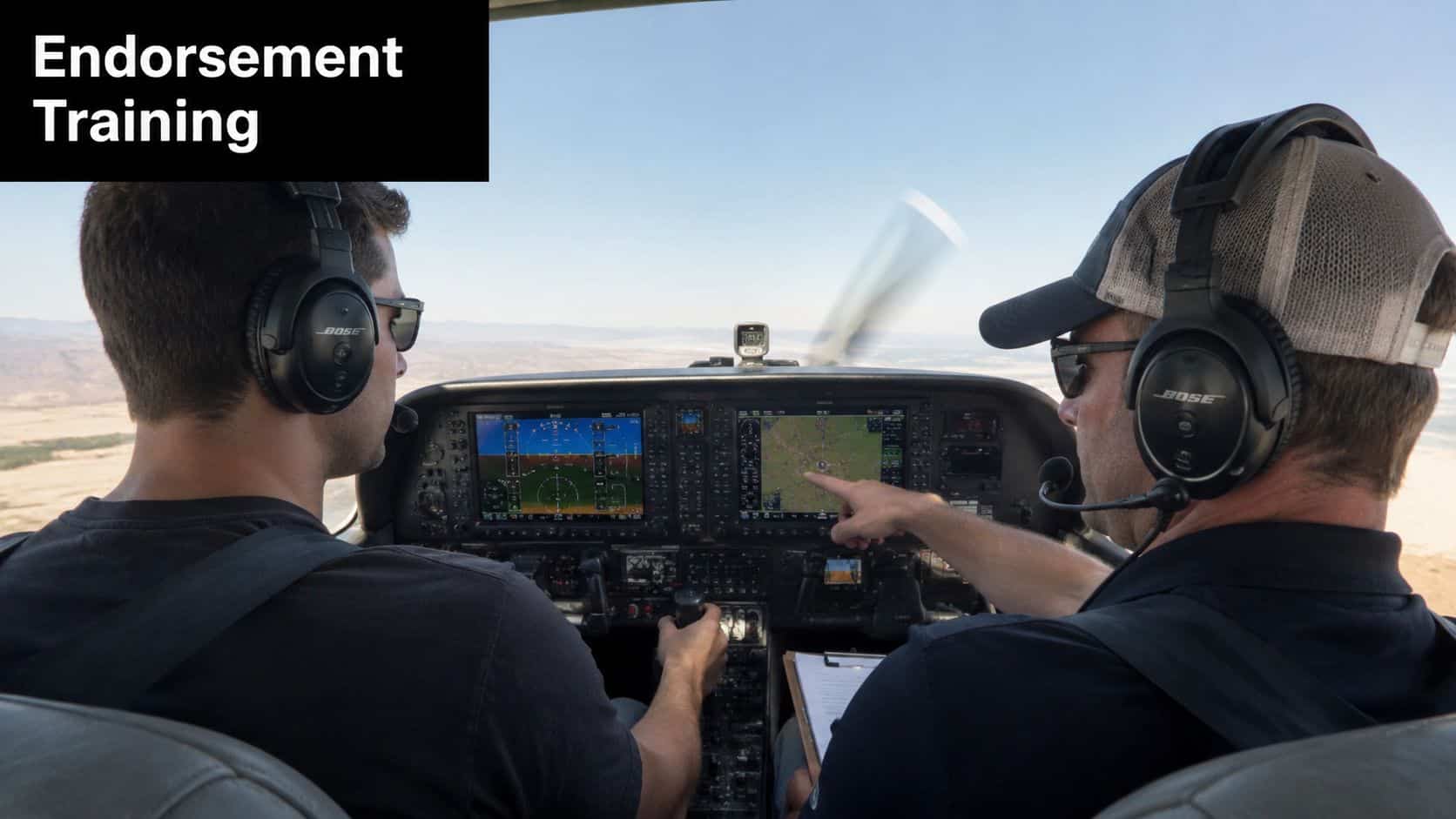
Typical training runs 2 to 4 hours of ground instruction and 4 to 8 hours of flight instruction, with a total cost of $1,000 to $1,800. There's no FAA checkride or knowledge test for the endorsement. A flight instructor signs you off once you show proficiency. Those figures come from the verified training benchmarks provided in this brief.
What happens on the ground
Ground training should make the airplane feel less mysterious before you ever taxi. A good instructor won't just point at extra knobs and say, “You'll get used to it.”
You should expect to cover:
- Engine management: how power changes affect temperatures, performance, and workload.
- Constant-speed propeller basics: what the prop control does, what manifold pressure means, and why the throttle-prop relationship matters.
- Takeoff and climb planning: heavier airplanes and stronger engines punish lazy performance calculations.
- Weight and balance: these airplanes often invite more bags, more passengers, and more temptation.
Practical rule: If you can't explain what the throttle and propeller control are each doing, you're not ready to “just go fly it.”
What happens in the airplane
In flight, the lesson usually starts with your feet. A high-horsepower takeoff often teaches humility in a hurry. The airplane wants to yaw and roll left more aggressively than the trainers most private pilots know well. You learn to lead the airplane instead of chasing it.
Then comes pattern work, climbs, descents, cruise setup, power changes, and emergency scenarios. The point isn't to survive a lesson. The point is to become predictable and smooth.
Later in training, your instructor will usually focus on the places pilots tend to get behind:
- During takeoff roll: staying ahead of directional control.
- In climb: balancing cooling, power, and airspeed.
- On descent: avoiding rushed configuration changes.
- In landing: managing excess energy instead of carrying it all the way to flare.
This walkthrough gives a useful visual overview of the systems-and-technique side of transition training:
What earns the signoff
The endorsement isn't about logging a magic number and going home. It's about whether your instructor sees consistent judgment.
That means you can set power deliberately, operate the systems correctly, maintain directional control, and avoid common handling errors before they become safety problems. The pilots who do well aren't always the quickest learners. They're the ones who stop trying to “muscle through” and start managing the airplane with intention.
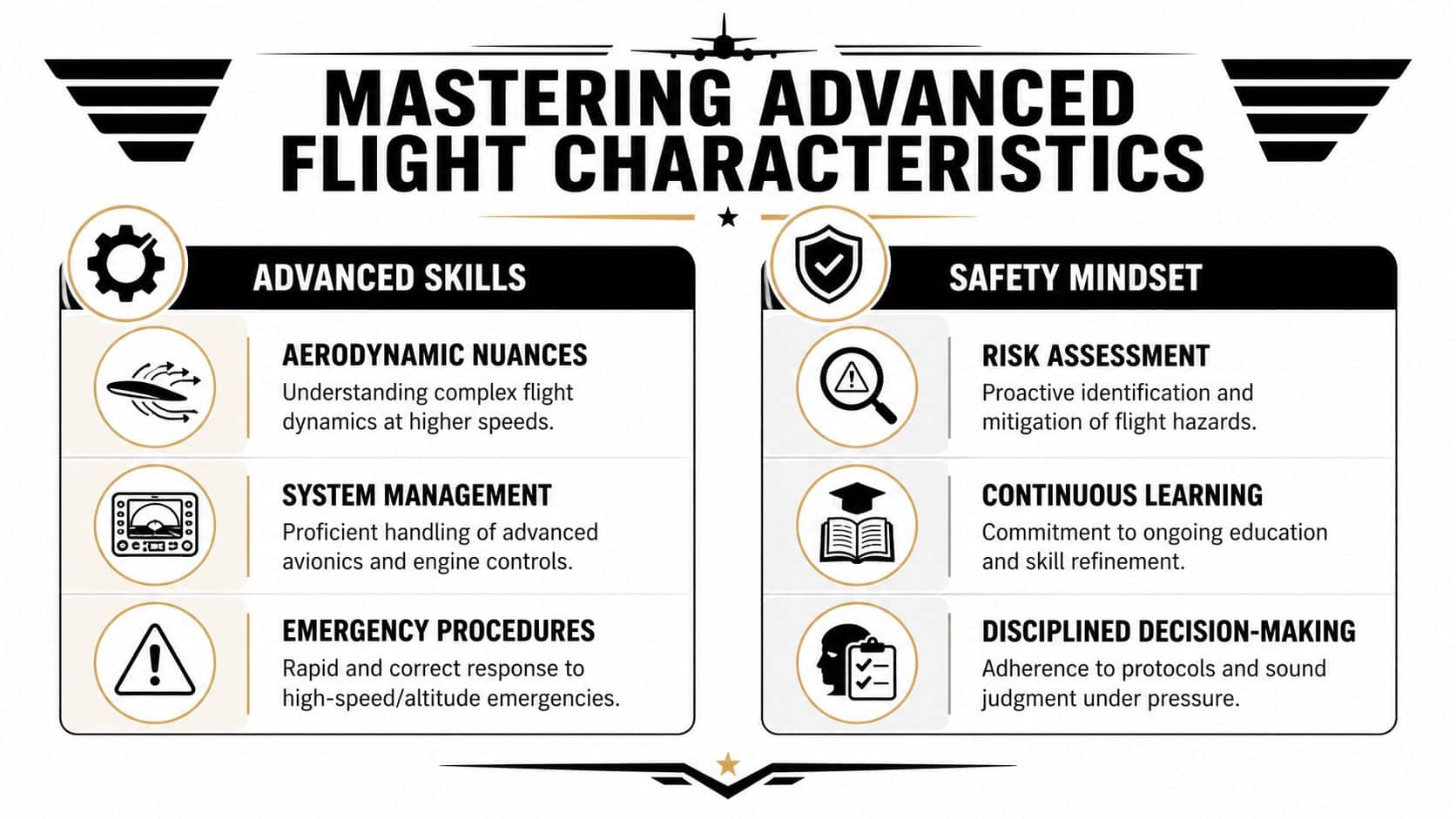
Mastering Advanced Flight Characteristics
Flying high performance aircraft feels a lot like moving from an automatic car to a manual transmission, except the consequences are bigger and the checklist is longer. In a trainer, you can sometimes get away with being late. In a more powerful airplane, late often becomes unstable.
The core of the transition is learning the three Ps: power, propeller, and precision.
Power changes happen faster
When a powerful airplane accelerates, your window for correction shrinks. On takeoff, left-turning tendencies become more noticeable because P-factor, torque, slipstream, and gyroscopic effects show up with more authority. That's why instructors harp on right rudder. They're not being dramatic. They're trying to keep you ahead of the airplane.
A second change is energy retention. These airplanes are often “slipperier” in cruise and descent. If you come downhill too fast without a plan, the airplane won't help you slow down.
The propeller adds a second layer of thinking
A critical skill in this category is learning to manage a controllable-pitch propeller. You're no longer just moving the throttle and waiting for the engine to respond in a simple way. You're coordinating RPM and manifold pressure together. Flight school curricula commonly treat 1 to 10 hours of dedicated flight time as a practical range for effective mastery of this skill, because pilots must learn to manage performance without stressing the engine.
That's where many private pilots feel overloaded at first. The airplane asks for two related decisions at the same time:
| Control | What you're managing | Why it matters |
|---|---|---|
| Throttle | Manifold pressure | Sets engine load and power production |
| Prop control | RPM | Influences propeller efficiency and engine operating behavior |
Think of it this way. The throttle tells the engine how hard to work. The prop control tells the system how that work is converted. If you move one without understanding the other, the airplane may still fly, but you won't be operating it well.
A smooth high-performance pilot doesn't react to the airplane's speed. They predict it.
Precision is the real upgrade
Most pilots assume the leap is mainly about speed. It isn't. The deeper change is precision.
Checklist discipline gets sharper. Pattern planning starts earlier. Descent management matters more. Your understanding of structural limits should also improve, especially when you're thinking about maneuvering in turbulence. If you want a practical refresher on that piece, this guide to calculating maneuvering speed is worth reviewing.
The safest mindset is simple:
- Be early: configure before you feel rushed.
- Stay coordinated: rudder work matters more in powerful airplanes.
- Respect systems: engine management isn't optional.
- Go around willingly: pride has no place in a fast airplane.
A Look at Popular High Performance Aircraft
The phrase gets easier to understand when you attach it to real airplanes. Some sit right near the regulatory line. Others are classic examples of the category. The differences in handling, systems, and mission are often more important than the label itself.
Here's a simple side-by-side view using examples named in the verified material and editorial context for comparison.
| Aircraft | Horsepower note | High performance status | What pilots should know |
|---|---|---|---|
| Cessna 152 | 110 hp | No | Classic trainer. Great for fundamentals, not a high-performance endorsement platform. |
| Piper Cherokee | 140 to 150 hp | No | Stable trainer and traveler. Builds habits that transfer well, but without the added engine-management workload. |
| Cessna 172RG | 200 hp | No under the horsepower rule | Important edge case. Retractable gear may trigger complex-aircraft issues, but 200 hp itself does not cross the high-performance threshold. |
| Piper Seminole | 180 hp per engine | Not high performance by the single-engine rule discussed here | A reminder that multi-engine complexity is its own training world. |
| Mooney M20 series | Often 200 to 230 hp | Often yes, depending on model | Efficient, slick, and honest. It rewards planning and punishes lazy descents. |
| Piper Saratoga | Included in common high-performance examples | Yes when equipped above the threshold | Strong cross-country platform with more load-carrying utility than basic trainers. |
| Cirrus SR22 | 310 BHP example appears in the verified data | Yes | Modern, capable, and systems-heavy. Ownership requires disciplined record review and maintenance tracking. |
Why these airplanes matter
The Cessna 152 and Piper Cherokee matter because they show where most pilots start. They're forgiving enough to let you build a scan, trim habits, and basic energy awareness before adding complexity.
The 172RG matters because it exposes a common misunderstanding. A pilot may see retractable gear and assume “high performance.” The regulation says otherwise if the engine is exactly 200 hp. This is why labels on the ramp can't replace a careful check of the actual rule and aircraft specs.
The Mooney M20 series is often where many pilots first feel the personality of high performance flying. Mooneys don't just go faster. They ask for better planning. If you're thinking beyond piston singles and want broader transition perspective, this overview of turbine transition training helps show how system management keeps expanding as aircraft capability rises.
A useful way to compare airplanes
When you're evaluating one of these models, don't start with speed bragging rights. Start with mission and workload.
Ask:
- Will this airplane make my trips easier, or just faster?
- Do I want more capability, or more cockpit management?
- Can I operate it consistently, not just impressively on a good day?
That last question usually leads to the right airplane.
The Smart Way to Buy or Sell Your Aircraft
Buying or selling airplanes and helicopters is where enthusiasm can outrun judgment. A sharp paint scheme, upgraded avionics, or a polished listing can distract you from the boring details that protect you. If you want to know how to buy an airplane the safe way, start with records, condition, and compliance. Everything else comes later.
For buyers, the first rule is simple. Don't shop with your heart first. Shop with a checklist first.
How to buy an airplane the safe way
When purchasing a high performance aircraft, buyers need to verify the aircraft's maintenance logs against FAA Part 43 records and confirm that required inspections, including the 100-hour or annual, have been completed. The verified data also notes that a Cirrus SR22 with a 310 BHP engine has specific documented service intervals that should appear in the records. That kind of review isn't paperwork theater. It's how you learn whether the airplane has been cared for or merely marketed well.
A safe purchase usually includes these steps:
- Start with the logs: Make sure airframe, engine, propeller, and inspection records are present, legible, and continuous enough to support the airplane's history.
- Match records to reality: Don't assume the listing is accurate. Compare installed equipment, modifications, and maintenance status to the actual aircraft.
- Use a qualified mechanic for a pre-purchase inspection: Your friend who “knows airplanes” isn't enough.
- Check recurring inspection compliance: Missing required inspections can turn a bargain into a project.
- Think beyond purchase price: Fuel, insurance, storage, maintenance, and transition training all shape whether the airplane is affordable.
Buyers get in trouble when they treat a pre-purchase inspection like a formality. It should feel more like an audit.
This matters for helicopter buyers too. The principles are the same. Verify records. Confirm inspection status. Understand what you're buying, not what the ad suggests.
How sellers make the process smoother
Sellers who present an aircraft transparently usually attract better buyers and cleaner transactions. You don't need sales language. You need organized records, realistic expectations, and transparency about discrepancies.
Good sellers tend to do three things well:
- They organize maintenance and ownership documents before listing.
- They disclose known issues early.
- They price based on condition, equipment, and record quality, not emotion.
If you're moving an aircraft to a new owner, remember that trust is part of the product. A clean, complete package reduces wasted calls and protects both sides. Pilots exploring current listings and transaction support can review aircraft sales resources to see how a structured process helps.
The same discipline that keeps you safe in flight keeps you safe in a deal
A rushed pilot busts altitudes. A rushed buyer misses corrosion, engine history, or record gaps. A rushed seller creates suspicion.
Slow is smooth here too. Verify the logs. Verify the inspections. Verify the story.
Start Your High Performance Journey with DuBois Aviation
The best next step in high performance flying is one that combines proper instruction, a well-maintained aircraft, and an environment that keeps sharpening your decision-making. That combination matters because the transition isn't just about checking off an endorsement. It's about building habits that hold up when the airplane is faster, heavier, and less forgiving of delay.
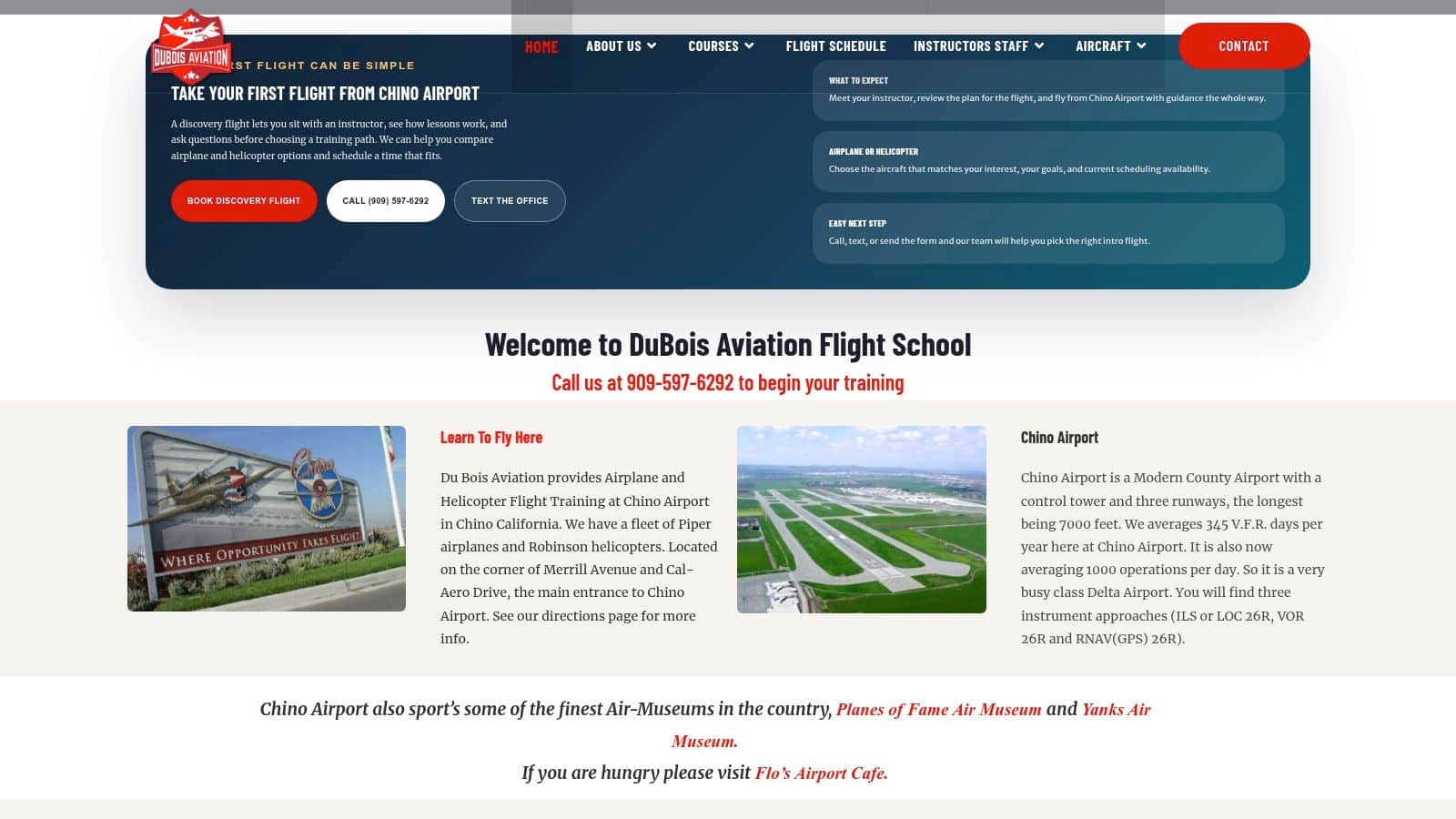
At Chino Airport, a busy towered Class D field, pilots get the kind of repetition that builds real-world competence. Radio work stays active. Traffic awareness has to stay sharp. Planning ahead becomes normal instead of optional. That's exactly the environment where a pilot can grow into more capable aircraft without developing lazy habits.
What a strong training environment looks like
For a pilot pursuing this step, the right school should offer more than access to horsepower. It should offer instructors who can explain why the airplane behaves the way it does, not just correct you after the fact.
That means:
- One-on-one instruction: training matched to your pace and experience.
- Aircraft variety: enough fleet depth to build judgment across platforms.
- A safety-first culture: procedures that support proficiency, not shortcuts.
- A practical path forward: training, rental standards, and advice that fit your goals.
A school with experience in both airplanes and helicopters also tends to understand ownership and mission planning from a wider angle. That helps if your interest eventually expands from earning an endorsement to renting regularly, buying, or selling into another aircraft later.
Your next move
If you're ready to step beyond the trainer stage, keep the goal simple. Fly with a CFI who knows transition training well. Learn the systems thoroughly. Build respect for power management before you build speed. Then decide whether your next chapter is advanced rental, endorsement training, or ownership.
The pilots who enjoy high performance aircraft the most are rarely the flashiest. They're the ones who stay teachable.
DuBois Aviation helps pilots take that next step with personalized instruction, aircraft rental, and practical guidance at Chino Airport. If you want to pursue a high-performance endorsement, train in more capable aircraft, or talk through the safest path to renting, buying, or selling, connect with DuBois Aviation.