
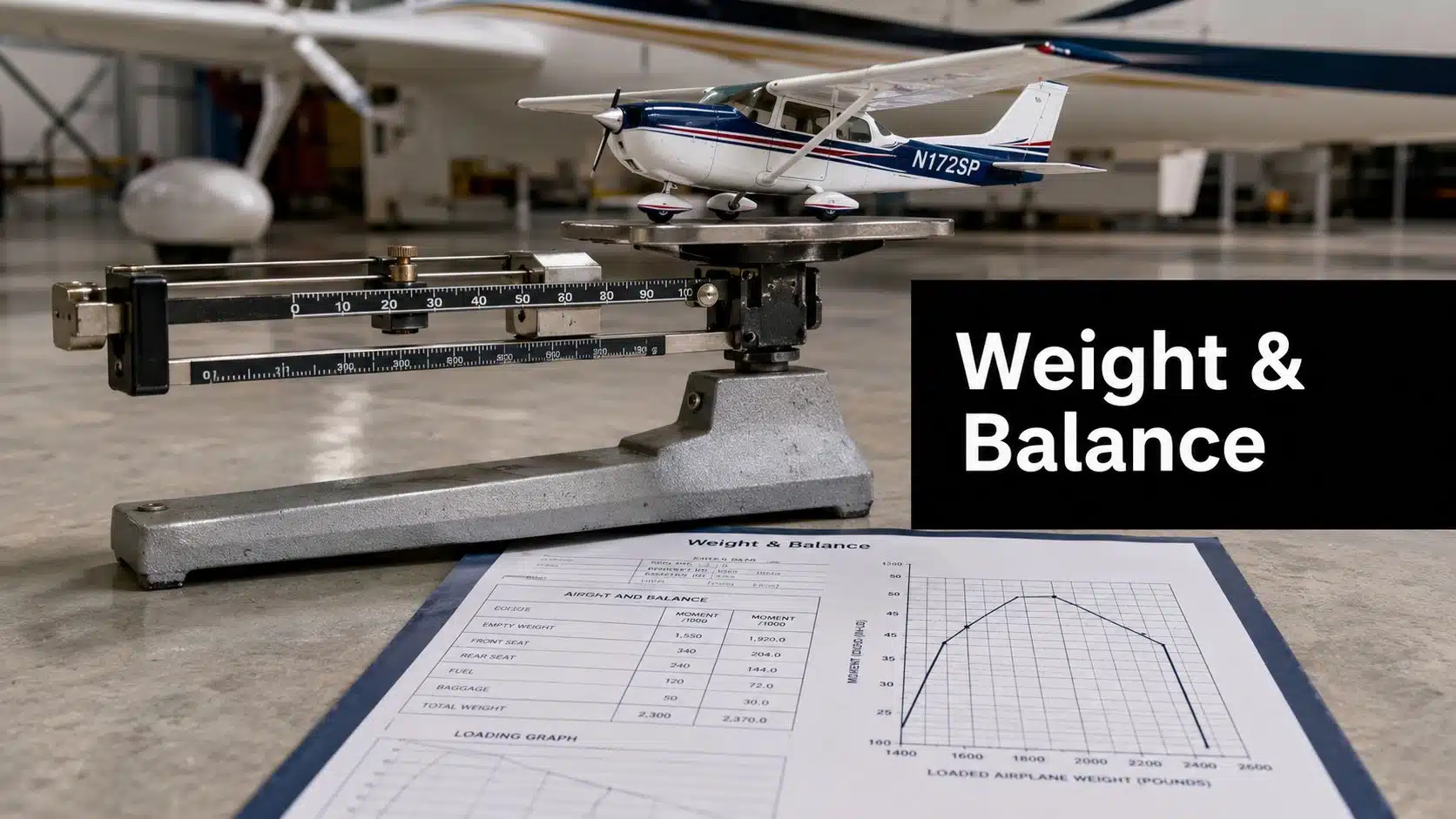
You've got the route picked out, your passengers are excited, and the airplane is sitting on the ramp looking ready to go. For a lot of new pilots, that feels like the hard part is over.
It isn't.
Before any cross-country in a training airplane, there's one passenger you can't see and can't negotiate with. Physics comes along whether you planned for it or not. In a Piper Cherokee, a Cessna 150, a Mooney, or a Robinson helicopter, every person, bag, headset, and fuel load changes how the aircraft sits in the air and how it responds to control inputs.
Two practical options worth comparing
These are specific products pilots commonly compare for this type of flying. Confirm compatibility with your aircraft and instructor before ordering.
 Flight planningASA CX-3 Flight ComputerCheck current availability on Amazon (paid link)
 Electronic flight bagApple iPad mini A17 Pro, Wi-Fi and Cellular, 128GBCheck current availability on Amazon (paid link)
That's why aircraft weight and balance matters so much. It isn't just a checkride topic or a box to click in an app. It's one of the basic disciplines that makes an aircraft predictable, controllable, and safe.
As a CFI, I've seen students relax too early once they see the airplane is fueled and the weather looks good. But a safe flight starts earlier than engine start. It starts when you ask a simple question: is this aircraft loaded correctly for this exact flight, today, with these exact people and this exact fuel load?
Your First Cross-Country Flight and the Invisible Passenger
You've just earned your certificate. You want to take two friends on your first real trip in a Piper Cherokee. One friend brings a backpack. The other brings a camera bag and a jacket. You top off fuel because that feels safer. Everyone climbs in smiling.
Then you stop and do the math.
That moment matters. A lot of pilots first meet aircraft weight and balance as a worksheet in ground school, but out on the ramp it becomes real. The airplane doesn't care that the weather is smooth or that the runway is long. It only responds to loading, lift, drag, throughst, and control inputs.

A first cross-country is usually where this topic clicks. You're no longer solving a classroom problem with made-up passengers. You're making decisions for real people. That makes your VFR cross-country flight planning more than route selection and weather review. It also means checking whether your loading gives you a safe airplane from takeoff through landing.
Practical rule: A flight can be legal in one sense and still be a bad idea if you haven't looked closely at loading, CG, and how the aircraft will actually handle.
Students often think weight and balance only means “don't exceed max gross.” That's only half the story. You can have an airplane that seems fine on total weight, yet still handles poorly because the center of gravity is in the wrong place.
That's the invisible passenger. Physics rides along on every flight, and it always gets the final vote.
The Physics of Flight Why Balance Is Everything
A Du Bois Aviation aircraft does not feel “people” and “bags.” It feels forces acting at specific locations. That is why two Piper Cherokees loaded to the same total weight can fly differently, and why a Robinson R22 can become a very different machine when the passenger, fuel load, or baggage setup changes.
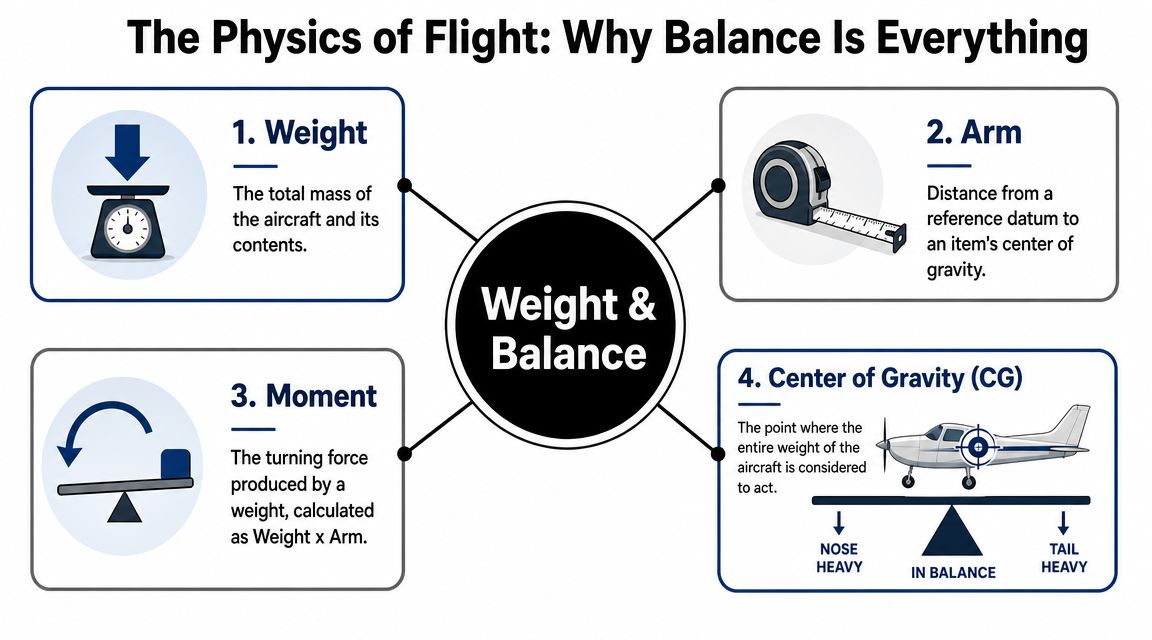
A simple way to understand it is a seesaw. The board does not only care how heavy each child is. It also cares how far each one sits from the middle. Aircraft loading works the same way. Put weight farther from the balance point, and its effect grows.
The four terms that matter
Students usually get comfortable with weight and balance once these four terms stop sounding abstract:
- Weight is every load the aircraft carries. In a Cherokee, that means the pilot, passenger, fuel, bags, and anything else on board.
- Arm is how far that load sits from the aircraft's reference point, called the datum.
- Moment is the turning effect created by that weight at that distance.
- Center of gravity is the aircraft's actual balance point after all those moments are added together.
If you want the short version, moment tells you how much “pull” a load has on the aircraft's balance. A light bag far aft can matter more than a heavier item placed closer to the datum.
The FAA describes weight and balance control as a system of weighing the aircraft, keeping records current, and loading it correctly. The math behind the final CG is straightforward: total moment divided by total weight.
That formula matters because airplanes do not respond to total pounds alone.
If you have already worked through what angle of attack means in real flight, you have seen this kind of cause and effect before. Small changes in one part of the system can change how the whole aircraft flies.
Why the datum matters
The datum is the manufacturer's reference point. It works like the zero mark on a ruler. Every seat, fuel tank, and baggage area is measured from that point.
A common error for new pilots involves the datum. The datum is not guessed, and it is not “close enough” from memory. You use the approved numbers for that exact aircraft. A Piper Cherokee in the Du Bois Aviation fleet may look nearly identical to another Cherokee on the ramp, but their equipment, empty weight, and recorded balance data can differ enough to change the result.
Clean math with bad starting numbers still gives you a bad answer.
What happens when CG is wrong
An aircraft can be under maximum gross weight and still be unsafe because the CG is out of range. That is the part many students miss at first.
According to the FAA's Pilot's Handbook of Aeronautical Knowledge chapter on weight and balance, too much weight reduces performance and can affect structural margins. A center of gravity outside approved limits creates control problems and, in severe cases, can make safe flight difficult or impossible.
Those are two separate checks:
- Total weight affects takeoff, climb, landing, and structural limits.
- CG location affects stability, control feel, and recovery characteristics.
A forward CG usually makes the aircraft feel nose-heavy. You may need more back pressure on takeoff or in the flare, and the airplane can feel more stable but less responsive in pitch. An aft CG often feels lighter in pitch, but it gives you less natural stability and less margin for error.
That second case deserves respect. In a training airplane like a Cherokee, an aft CG can make rotation, flare, and stall behavior feel less forgiving than a student expects. In a helicopter like the R22, balance is just as real. The aircraft may be within a weight limit but still have loading that changes handling in ways the pilot will notice immediately.
One bag moved to a different compartment can change none of the total weight and still change the way the aircraft flies.
That is why balance matters so much. The aircraft is always answering two questions at once: how much is on board, and where is it?
A quick visual helps before we go further.
Decoding the POH Your Aircrafts Rulebook
A lot of confusion disappears once you stop treating the POH like a book you only open for checkrides.
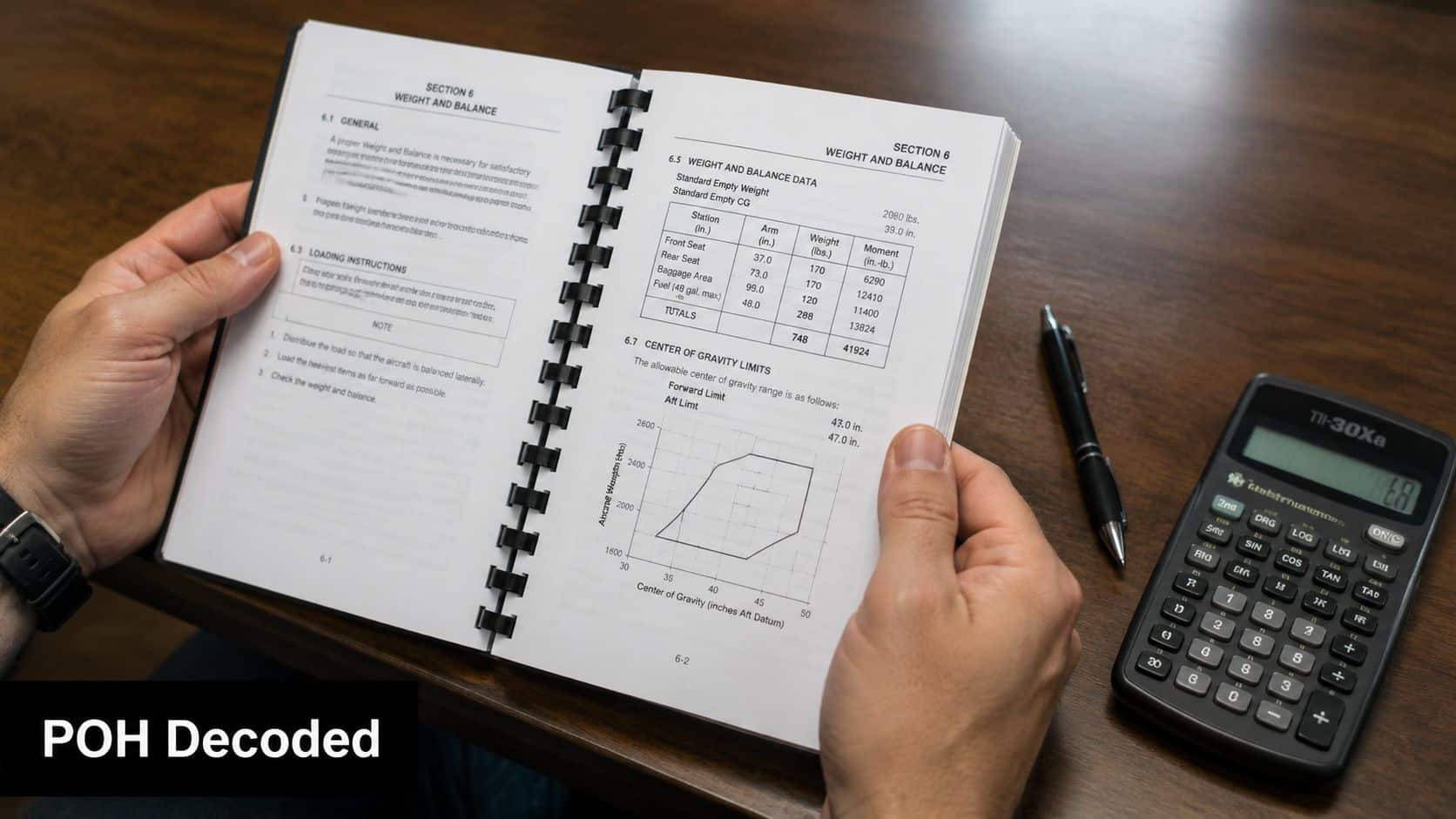
For aircraft weight and balance, the Pilot's Operating Handbook or Aircraft Flight Manual is where you find the official answers for that exact aircraft. Not the same model in a forum post. Not your buddy's notes from another airplane. That specific aircraft.
What you're looking for
When I teach students to open the POH for a Cherokee or another trainer, I have them find four things first:
Basic empty weight information
This is the aircraft as configured and recorded. It matters because your whole calculation starts there.The aircraft's empty CG or empty moment information
That gives you the airplane's starting balance point before people and fuel are added.Station or arm data for seats, baggage, and fuel
These tell you where each load acts relative to the datum.The CG envelope chart
This is the final check. Your calculated loading point must fall inside the approved area.
Students often expect one neat page with everything on it. Sometimes it is neat. Sometimes it takes a little digging through the weight-and-balance section and the equipment list.
Why current records matter
The FAA's Weight and Balance Handbook says the certificated mechanic or repairman is responsible for updating the weight-and-balance data after any repair or alteration that changes weight or location of weight. That's part of why aircraft records have to stay current over the life of the airplane, as explained in the earlier FAA handbook reference.
That has a practical meaning for pilots. If an aircraft has had avionics work, an interior change, or any other alteration that affects weight or placement, an old worksheet or old app profile may no longer match the airplane sitting in front of you.
Check the paperwork, not your memory. Weight and balance is aircraft-specific, and records matter just as much as the arithmetic.
This is also where buyers need to pay attention. If you're looking to buy an airplane or helicopter, one of the smartest safety questions you can ask is whether the records show a clear, current weight-and-balance history. If the paperwork is vague, incomplete, or obviously stale, that's not just an admin issue. It can affect every loading calculation you do after purchase.
Step by Step Calculation for a Piper Cherokee
You are standing on the ramp at Du Bois Aviation, planning a Cherokee cross-country. You have one friend in the right seat, a bag in back, full attention on the weather and route, and one quiet question that can decide whether the flight starts legally and flies the way you expect. Where is the airplane's weight sitting?
A Piper Cherokee is a great trainer for learning this because the math is manageable, but the lesson is real. Small loading changes can move the center of gravity more than many new pilots expect. A backpack in the baggage area does not just add pounds. It adds pounds at a location, and that location matters.
Start with the specific airplane, not a generic Cherokee example from memory. Use the current weight and balance records for the tail number you are flying, along with the loading information in that aircraft's POH or AFM. As noted earlier, the FAA handbook explains the underlying method. Your job on preflight is to apply that method to the aircraft in front of you.
Build the worksheet
Set up a simple table before you touch the calculator:
| Item | Weight (lbs) | Arm (in) | Moment (lb-in) |
|---|---|---|---|
| Basic empty aircraft | use aircraft records | use aircraft records | weight × arm or approved listed moment |
| Pilot | actual | POH station | weight × arm |
| Front passenger | actual | POH station | weight × arm |
| Rear passenger or passengers | actual | POH station | weight × arm |
| Baggage | actual | POH baggage station | weight × arm |
| Fuel | planned fuel load | POH fuel arm | weight × arm |
| Total | sum | sum |
Label it clearly in your notes. Something simple like Piper Cherokee Weight and Balance for N12345 helps prevent mix-ups later.
Work one row at a time
For each row, multiply the weight by the arm to get the moment.
Students often try to do the whole page in one mental blur. That is how bags get skipped, fuel gets entered in the wrong row, and good math turns into bad dispatch decisions. Treat it like a checklist. Complete one line, confirm it, then move on.
Here is the order I teach in the Cherokee:
- Enter the basic empty weight and its arm or listed moment from the aircraft records.
- Add the pilot and front-seat passenger using actual weights.
- Add any rear-seat passenger.
- Add baggage at the correct station.
- Add fuel based on the amount you plan to launch with, using the approved fuel arm for that airplane.
Then add the total weight and total moment.
Calculate the loaded CG
Now use the standard formula:
CG = total moment ÷ total weight
That result gives you the loaded center of gravity location.
Here is the part that trips up many new pilots. Getting a CG number does not answer the whole question. It only tells you where the balance point is. You still have to decide whether that point is acceptable for that weight.
A wheelbarrow works the same way. If the load sits in the wrong spot, it feels awkward and harder to control even if the total weight seems manageable. The Cherokee gives the same warning in flight, just with higher stakes.
Check the envelope
Take your total weight and your calculated CG, then plot that point on the Cherokee's approved envelope chart.
If the point falls inside the approved area, the loading works. If it falls outside, change something before engine start. In a Cherokee, that often means reducing baggage, adjusting fuel, changing who sits where, or deciding that one passenger or item stays behind for this trip.
This practical difference is part of why students compare training aircraft carefully. A discussion of Piper Cherokee versus Cessna 172 handling and loading tradeoffs is not just about visibility or landing feel. Useful load and cabin layout affect what you can do on a real flight with real people and bags.
A simple Cherokee example in plain language
Let's keep this qualitative rather than plugging in made-up numbers. Suppose your Du Bois Aviation Cherokee has a current empty weight from the records. You add yourself, a front-seat passenger, one light bag in the baggage area, and enough fuel for the trip plus reserves. The airplane may still be under max gross weight, but the baggage and fuel can shift the balance enough that you need to check the chart carefully.
That is the lesson. Total weight alone is not enough.
A Cherokee can be legal on weight and still be out of limits on CG. It can also be in CG with one fuel load and out of CG with another, especially if passengers or bags change.
Common student mistakes in the Cherokee
The mistakes are usually predictable:
- Using an old app profile that does not match the current aircraft records.
- Rounding passenger weights because the actual number feels awkward.
- Forgetting small items in the baggage area or cabin.
- Entering fuel in gallons on one line and pounds on another without converting correctly.
- Stopping after the arithmetic and never plotting the final point on the envelope.
Do your first few by hand, even if you later use software. An app can speed up the process. It cannot tell you that you entered the wrong passenger in the wrong seat unless you already understand what the worksheet is supposed to show.
Helicopter W&B The Robinson and Enstrom Difference
Airplanes and helicopters follow the same core idea. Weight has to stay within limits, and the center of gravity has to stay inside the approved envelope.
But helicopters usually make the lesson feel less forgiving.
Why helicopters feel tighter
In a small helicopter like a Robinson R22, seating and load placement can have a more immediate effect on balance than many students expect. The cabin is compact, and the useful loading choices are more limited than in a typical training airplane. You don't have the same “I'll just put that bag farther forward” flexibility you might have in a Piper Cherokee.
That means pilot and passenger loading becomes a primary consideration before startup, not an afterthought.
An Enstrom helicopter has its own approved loading data and limitations, and you always use the records and handbook for that aircraft. The key habit stays the same. Don't carry over assumptions from one helicopter to another, and definitely don't borrow airplane thinking for rotary-wing operations.
The extra idea airplane students may not expect
Helicopter students also run into a concept that most light-airplane students don't spend much time on at first: lateral balance.
In a light airplane, most beginners think mostly about front-to-back balance. In helicopters, side-to-side loading can matter too. That changes how you think about occupant placement and gear.
Here's the simplest comparison:
| Aircraft type | Main loading concern students notice first |
|---|---|
| Piper Cherokee | Front-to-back CG and total weight |
| Robinson helicopter | Front-to-back CG, total weight, and more immediate sensitivity to occupant loading |
| Enstrom helicopter | Aircraft-specific limits and careful attention to approved loading data |
Helicopter weight and balance usually demands more precision from the start. Small changes in who sits where can matter quickly.
That's why helicopter students should resist the temptation to generalize. The principle is shared. The practical margins often aren't.
Common Mistakes and the Dangers of Digital Shortcuts
You finish the numbers for a Piper Cherokee rental, the app gives you a green check mark, and everything looks fine. Then your instructor asks one question: “Which empty-weight record did you use?”
If you cannot answer that right away, the green check mark does not mean much.
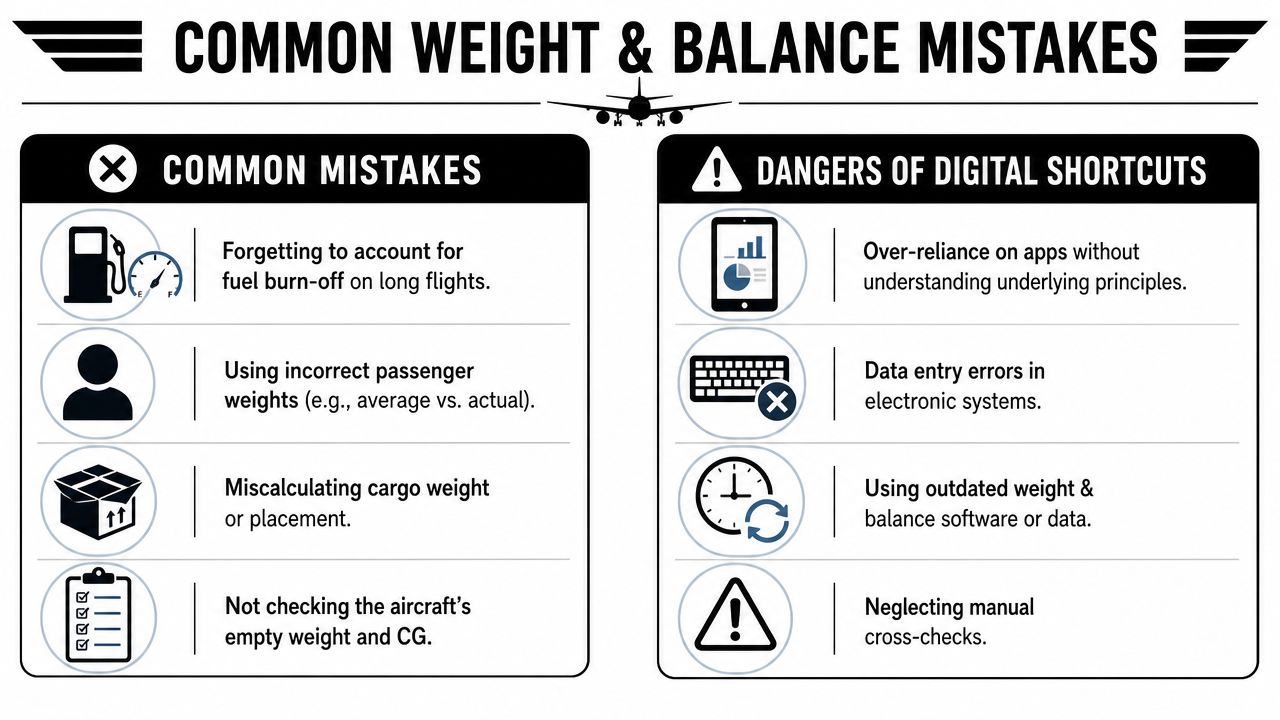
Most weight-and-balance errors are not math errors. They are setup errors. A pilot uses an old aircraft profile, guesses at passenger weight, skips a bag in the back, or forgets that the fuel load used in planning is no longer the fuel load in the airplane.
The modern trap
Digital tools help. I use them, and many instructors do too.
The problem starts when the app becomes a substitute for understanding. As noted by California Aeronautical University's discussion of aircraft weight and balance tools, a digital tool is only as good as the aircraft-specific inputs, and automation can reduce arithmetic errors while increasing input-confidence errors.
That last part catches a lot of students. The app looks polished, so the answer feels trustworthy. But a wrong number entered neatly is still a wrong number.
In the Du Bois Aviation fleet, this can show up in simple ways. A renter copies a saved Cherokee profile from a previous flight, but today's airplane has different records. A helicopter student loads an R22 with the wrong seat or fuel assumptions because the template was built for a different aircraft. The software calculates perfectly. It just calculates the wrong airplane.
Common examples include:
- Old empty-weight data after maintenance or equipment changes
- Missing or incorrect arm stations in a saved profile
- Baggage or seat entries copied from another aircraft
- Blind trust in the final “in limits” message without checking the source numbers
A better habit
Use the app the way you use a calculator in ground school. It speeds up the work, but you still need to know whether the answer makes sense.
A solid workflow looks like this:
- Confirm the aircraft profile first. Match the empty weight and stations to the current records for that specific aircraft.
- Check at least one or two entries by hand. If the moment or arm looks off, stop there.
- Look at the CG location, not just the pass/fail message. You are checking where the load sits, not only whether the app says yes.
- Ask whether the result fits the actual airplane. If a heavily loaded Cherokee shows a surprisingly favorable CG, pause and recheck the inputs.
That last step matters more than many new pilots expect.
Good instructors develop a kind of smell test for weight and balance. Yours will too. If two adults, bags, and substantial fuel are going into a small trainer, the final result should feel believable. If the app says the airplane is comfortably within limits and your instincts say, “That seems too easy,” trust the instinct long enough to review the numbers.
Some operators provide aircraft-specific references to help pilots verify what they are entering. DuBois Aviation's aircraft weight and balance resources can help renters match their planning to the airplane or helicopter they are flying, but the pilot still has to confirm the final inputs.
Records matter outside the flight lesson too
Weight and balance mistakes do not only affect students planning a Saturday cross-country. They matter when an aircraft changes hands.
If you are buying a used airplane or helicopter, review the weight-and-balance paperwork with the same care you would give the engine logs. Equipment changes, interior changes, radios, and other modifications can all affect the numbers. If those updates are missing, every future calculation starts on shaky ground.
If you are selling, clean and current records make it easier for the next owner to verify the aircraft safely.
Ask a sharper question than “Does it have weight-and-balance paperwork?” Ask, “Do these records match the aircraft as it sits today?”
Conclusion Your Preflight W&B Checklist
By the time a pilot feels comfortable with aircraft weight and balance, the process usually feels less like math homework and more like preflight judgment.
That's the right mindset.
Before each flight, run a simple mental checklist:
- Use the correct aircraft documents for the specific airplane or helicopter you're flying.
- Start with current records for empty weight and related balance data.
- Get real weights for people, bags, and planned fuel whenever possible.
- Use the approved arm stations from the POH or AFM.
- Calculate total weight and total moment, then compute CG.
- Check the result against the approved envelope, not just against a total-weight limit.
- Rework the loading if needed before anyone starts the engine.
The pilot in command owns this decision. Not the app. Not the passenger who says, “It'll probably be fine.” Not the line guy. Not the previous pilot.
A careful pilot treats weight and balance as part of professionalism. It's one of those quiet habits that passengers never notice when it's done right, but it protects every takeoff, every climb, every approach, and every landing.
If you want hands-on practice with aircraft weight and balance in the aircraft you'll fly, DuBois Aviation offers airplane and helicopter training at Chino Airport with one-on-one instruction, aircraft rental, and a fleet that lets students apply these loading concepts in real preflight planning.