

You're probably in one of two places right now. Either you're looking at Texas because the flying looks bigger, busier, and more varied than your local market, or you already live there and want a straight answer on whether pilot jobs in Texas can be reached without wasting years on the wrong path.
The short answer is yes, but only if you match your training plan to the kind of cockpit you want. Texas offers airline, cargo, charter, instruction, helicopter, survey, patrol, and technical flying. That breadth is the advantage. It's also the trap. Too many pilots train in a generic way, then discover that the jobs they want require a different mix of ratings, recency, logbook discipline, and operational experience than they built.
A practical career plan for Texas has three parts. First, train with the end job in mind. Second, build time in a way that keeps you employable, not just current. Third, think strategically about mobility, including whether renting, partnering, buying, or later selling an aircraft makes sense for your time-building and finances. That ownership piece gets ignored in most career guides, but it matters more than people think.
Why Your Aviation Career Should Take Off in Texas
Aviation in Texas works at scale. The state has major airline hubs, strong business aviation activity, energy-related flying, agricultural operations, helicopter demand, and a long list of smaller airports where pilots build real experience instead of sitting on a waitlist for aircraft availability.
The labor picture supports that opportunity. The U.S. Bureau of Labor Statistics shows a profession projected to grow 4% from 2024 to 2034, with about 18,200 openings each year for airline and commercial pilots over that decade, and it lists Texas-specific pilot demand as part of that broader market. The same BLS page reports a median annual wage of $226,600 for airline pilots, copilots, and flight engineers, and $122,670 for commercial pilots in May 2024. A Texas salary guide published in 2026 estimates the average airline pilot salary in Texas at $186,500 (BLS pilot occupation outlook).
That matters for two reasons. First, Texas is large enough that pilots can move between niches without leaving the state. Second, the compensation ceiling is high enough that a disciplined training plan can pay off, especially for people changing careers or younger pilots trying to avoid dead-end time-building.
Texas gives you room to specialize
Not every pilot wants the same life. Some want a major airline schedule and a long seniority climb. Others want turbine charter, medevac, utility helicopter work, or survey flying that gets them into the field faster. Texas supports all of those tracks because it has the airport infrastructure, the business activity, and the geographic spread to keep different kinds of operators busy.
One practical factor people overlook is daily life on the ground. If you're aiming at Houston, Dallas, Austin, or San Antonio, compensation only matters if it fits your housing costs, commute, and reserve lifestyle. Before you accept a job or choose a base, compare the broader picture with this guide to housing and salaries in Houston. New pilots especially need that reality check.
Practical rule: Don't choose Texas just because it's big. Choose it because you can build a sequence there. Train, instruct, move into a specialized role, and keep climbing without resetting your life every time you change jobs.
What works and what doesn't
What works is targeting a lane early. If you know you want airline hiring competitiveness, your decisions on ratings, multi-engine time, and instructing should reflect that. If you want specialized field operations, you'll need a different mix of experience and a higher tolerance for irregular schedules and weather-dependent work.
What doesn't work is assuming “pilot shortage” means every fresh certificate turns into a job offer. In Texas, opportunity is broad, but employers still screen for fit. The pilots who move fastest usually aren't the most gifted stick-and-rudder people. They're the ones who build a clean training record, keep their paperwork in order, and understand the hiring ladder they're trying to climb.
Choosing Your Cockpit Common Pilot Jobs in Texas
Texas aviation isn't one market. It's several overlapping markets, and each one rewards a different kind of pilot. If you only search “pilot jobs” on a job board, you'll get a messy mix of airline pipeline roles, survey flying, patrol, rotorcraft work, corporate jobs, and positions that are nowhere near entry level.
Current postings show that variety clearly. In February 2026, Indeed listed 160 Survey Pilot jobs in Texas, while Glassdoor showed 279 open pilot jobs in Texas, which is a good reminder that opportunities extend beyond traditional airlines (Texas survey and pilot job listings).
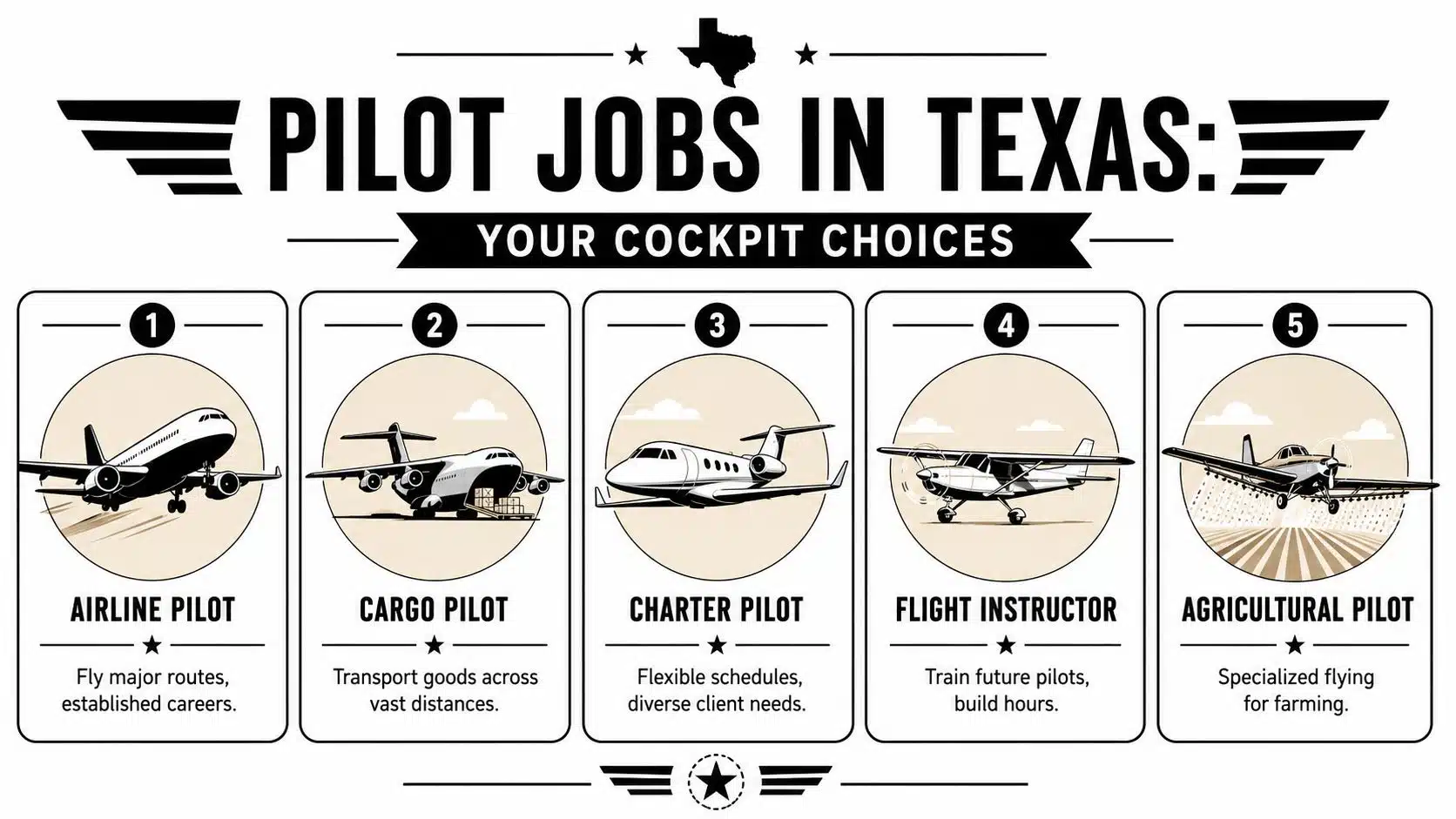
The main Texas career lanes
Airline flying gets most of the attention, but many pilots in Texas first build momentum elsewhere.
Airline pilot
Best for pilots who want a structured seniority system, recurrent training, and long-term earnings potential. The trade-off is that your early years can involve reserve, commuting, and a very deliberate climb through regional or pathway systems.Cargo pilot
Cargo can be a strong fit for pilots who like operational discipline and odd-hour flying. You'll often deal with night schedules, tighter weather decisions, and less glamorous routings, but the experience is respected.Charter and corporate pilot
This lane attracts pilots who want varied passengers, changing routes, and a more personalized service environment. The trade-off is unpredictability. Some crews love that. Others burn out on it.Flight instructor
Instructing remains one of the clearest ways to build time while sharpening your own flying. It's not passive hour-building. Good instructors improve because they explain, demo, catch errors early, and fly in a wide range of student-driven scenarios.Survey, patrol, and technical operations
These jobs often involve low-level flying, repetitive route work, cameras, sensors, or mission-specific procedures. They can be a solid bridge for pilots who want real commercial experience before moving into larger aircraft.
If you want to widen your search beyond the usual boards, it can help to browse career opportunities by role type and location, then compare the required qualifications carefully against your logbook rather than your intentions.
Texas Pilot Career Path Comparison
| Career Path | Typical Minimum Hours | Average Starting Salary | Lifestyle |
|---|---|---|---|
| Airline Pilot | Varies by employer and pathway | Varies | Structured training, seniority-driven, reserve likely early |
| Cargo Pilot | Varies by operator | Varies | Often night flying, procedural, schedule can be demanding |
| Charter Pilot | Varies by aircraft and insurer | Varies | Flexible but less predictable, customer-facing |
| Flight Instructor | Often accessible earlier than other paths | Varies | High flight repetition, teaching-intensive, strong for time-building |
| Agricultural Pilot | Specialized experience matters | Varies | Seasonal, low-level operations, highly skill-dependent |
That table is intentionally qualitative on pay and hours. In Texas, those two variables swing hard based on aircraft category, insurance requirements, and whether the operator is hiring for an entry-level seat or for someone they expect to turn loose quickly.
For more role-specific reading, DuBois Aviation has a practical overview of aviation jobs for pilots that helps sort through common employment paths.
A good career choice isn't the job that sounds most impressive. It's the one whose hiring requirements match the next two years of your actual training and time-building.
Your Flight Plan to Certification and Required Hours
The pilots who progress efficiently usually do one thing right from day one. They stop treating certificates like isolated achievements and start treating them like a sequence.
For the airline track, that sequence is straightforward: FAA medical, student pilot certificate, Private Pilot, Instrument Rating, Commercial Pilot, Multi-Engine, Flight Instructor, then ATP. Major pathway programs pay attention to progression and milestones. Delta's Propel program, for example, prefers 100 total flight hours for initial applicants, which tells you something important. Airlines and pathway partners don't just want licensed pilots. They want pilots who move through training in an organized way (airline pilot training sequence and milestones).
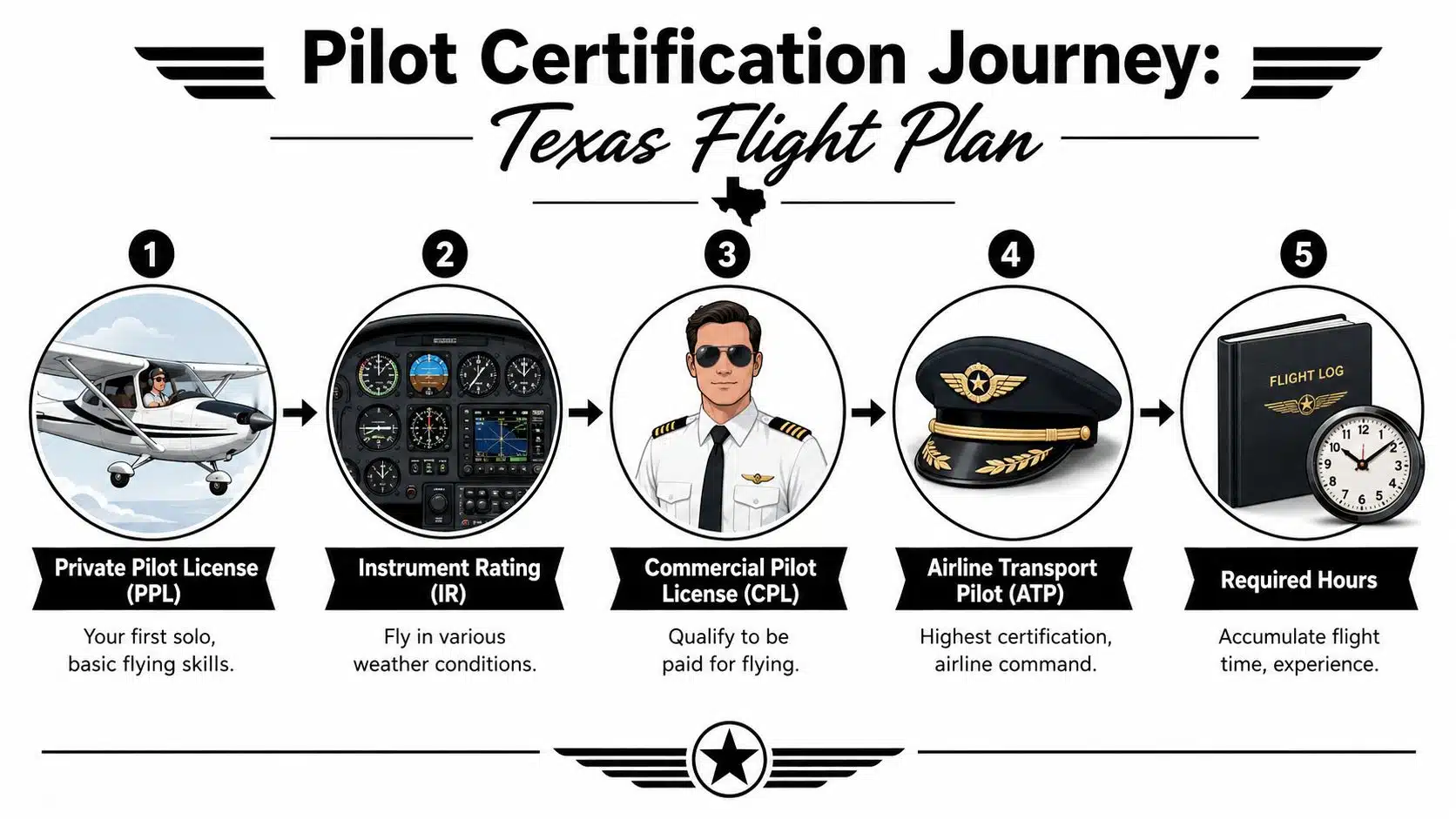
Start with the medical before anything else
If you remember one warning from this article, make it this one. Don't commit serious money to training before you've confirmed medical eligibility. A lot of wasted time starts when a student assumes the medical will sort itself out later.
That matters even more if your long-term goal includes airline, cargo, or air ambulance operations. If you want a useful primer on standards and why they matter operationally, this article on ensuring pilot medical safety for air ambulance is worth reading.
Part 141 versus Part 61
This choice affects pace, structure, and how much self-management you can handle.
- Part 141 works well for students who want a tighter syllabus, stage checks, and more externally structured progress.
- Part 61 fits pilots who need schedule flexibility or who learn well in a less formal training environment.
- Either path can work if your training frequency stays high and your lessons build on each other.
One benchmark often discussed in professional progression is 190 hours for Part 141 commercial eligibility versus 250 hours for Part 61, with a written exam and checkride still required once the time requirement is met. Reported commercial timelines can range from about 6 to 18 months depending on schedule density, instructor availability, simulator use, and overall training continuity, as described in this expert walkthrough (commercial training benchmarks and timelines).
Required hours are only half the story
A lot of pilots become hour-focused too early. Hours matter, but so do endorsements, instrument discipline, cross-country quality, and whether your logbook tells a coherent story.
Here's what tends to work:
Fly consistently
Long gaps force relearning. That costs money and delays checkrides.Use instructing strategically
CFI work remains one of the most efficient ways to build time while gaining decision-making experience.Build relevant time
If your target jobs ask for multi-engine, actual or instrument-focused experience, or operational maturity, shape your flying around that.Prepare for each practical test early
Applicants often reach the hour requirement but still stumble because endorsements, written completion, and scenario proficiency aren't lined up.
The checkride doesn't care how badly you want the job. It cares whether your preparation is complete.
If you're comparing certificate stages and how they fit into a long-term plan, DuBois Aviation's guide to pilot license levels is a useful reference.
A Pilot's Guide to Buying an Airplane in Texas
Aircraft ownership isn't for everyone, but for some pilots it can be a strategic tool. If rental availability is tight, if you need schedule control, or if you want to build time without competing for weekend blocks on a school aircraft, buying an airplane or joining a well-structured partnership can make sense.
That said, people get into trouble when they buy for emotion first and mission second. A time-building airplane should be simple, supportable, insurable, and appropriate for the kind of hours you need.

Buy for mission, not ego
A pilot trying to build reliable cross-country and instrument time usually does better in a proven trainer-tourer than in a complicated airplane with expensive surprises. Fixed costs can outrun your logbook plan quickly if you buy something that spends more time in maintenance than in the air.
A few practical filters help:
Training role first
Ask whether the airplane matches your next certificate or next hundred hours. If it doesn't, keep looking.Maintenance support nearby
Texas is large. An airplane that needs a specialist several hours away can become a scheduling problem, not just a maintenance problem.Parts and insurance reality
Before you commit, talk to insurers and mechanics. Don't assume availability or affordability.
For pilots comparing common ownership candidates, this look at the Piper Cherokee vs Cessna 172 is a practical place to start.
How to buy the safe way
The safe purchase process is boring on purpose. That's a good sign.
Define the mission clearly
Time-building, instrument training, local flying, family trips, or partnership use all point to different airplanes.Review logs before you travel
Missing logbooks, vague maintenance history, or inconsistent entries should slow you down immediately.Order a true pre-buy inspection
Use an A&P or IA who works for you, not the seller. A real pre-buy is not a quick glance at cosmetics and oil level.Run title and lien checks
Verify ownership and paperwork before money changes hands.Talk to insurance early
Coverage terms can affect whether the airplane is realistic for your experience level.
A clean paint job can hide a bad buying decision. Logbooks, maintenance history, and an independent inspection tell the real story.
In Texas, ownership can be especially useful if you're based away from major metro schools or if your work schedule makes rental booking difficult. But don't buy just to “save money.” Buy because ownership gives you operational control that supports your training plan.
Navigating the Sale of Your Aircraft
Selling an aircraft well takes almost as much discipline as buying one well. The best sales aren't built on flashy listings. They're built on credibility. Buyers pay attention to records, maintenance quality, and whether the seller clearly understands the airplane.
A rushed sale usually costs you twice. First in the final price, then again in the time lost answering preventable questions. If you're upgrading after time-building or leaving ownership behind because your airline or charter career no longer requires it, preparation matters.
Prepare the airplane before you list it
Start with the documents, not the photos. Organize airframe, engine, prop, and avionics records in a way a serious buyer can review without detective work. If there are recurring squawks, deferred cosmetic issues, or equipment questions, write them down clearly.
Then address the easy friction points.
Clean up logbook presentation
Neat, complete records lower buyer anxiety and speed up decision-making.Handle obvious maintenance items
Buyers notice neglected basics quickly. Small unresolved problems can make them assume larger hidden ones.Be honest about mission history
Training use, personal travel, leaseback, and partnership flying each raise different buyer questions.
Market to the right buyer
The wrong listing language wastes everyone's time. If the airplane is a dependable trainer, say that. If it's set up for IFR cross-country work, say that. If it needs cosmetic love but has strong maintenance history, say that too.
A few channels usually work better than broad, generic advertising:
- Local airport networks where buyers can inspect quickly
- Instructor and mechanic referrals because they often know motivated pilots
- Type-specific communities where people understand the model
- Well-written online listings with complete equipment and maintenance notes
Manage showings and closing carefully
Don't let excitement outrun process. Pre-qualify the buyer enough to know they're serious. For demo flights, clarify insurance and PIC responsibility in advance. During negotiation, stay factual and avoid trying to “win” every point. A smooth, documented transaction is better than dragging a deal out over minor items.
Use a purchase agreement, confirm how funds will move, and make sure FAA paperwork is completed correctly. If the airplane had been your time-building platform, the best outcome is often a straightforward handoff to the next pilot who needs the same kind of tool you did.
The Final Approach Application and Interview Best Practices
Texas hiring rewards pilots who present themselves like professionals before they have the title, not after. That means your application package, your technical preparation, your interview conduct, and your networking all need to show the same thing. You understand the operation you're applying to.

The biggest mistake I see is pilots applying too broadly with the same resume and the same talking points. A charter operator, a survey company, and a cargo carrier do not hire for the same reasons. If your materials don't reflect the mission, you look unprepared even when your time is competitive.
The Texas market also demands realism about what counts as entry level. Some Dallas-area jobs with Ameriflight require a commercial multi-engine land certificate plus an instrument rating or ATP, a current IPC, and a first- or second-class medical, while other Texas jobs such as pipeline patrol can require 500 total time and comfort with low-level or marginal-VFR conditions. That's why a fresh commercial certificate isn't always enough for immediate hire in this market (Texas pilot listing requirements).
Build an application that answers employer concerns
Your resume should make a chief pilot's job easier. Organize it so they can quickly find certificates, medical class, total time, multi-engine time, instrument experience, instructional experience, and recent operational flying. If there are gaps, be ready to explain them plainly.
A strong application package usually includes:
A clean logbook summary
Make it easy to verify totals and recent experience.A role-specific resume
Highlight instruction for CFI jobs, multi and instrument discipline for cargo, customer-service polish for charter, and mission reliability for survey or patrol.A short, useful cover message
Don't tell them flying is your dream. Tell them why your background fits their operation.
Employers hire the pilot they can trust on a Tuesday in bad weather with a schedule change, not the pilot with the most romantic story.
Prepare for the interview and simulator evaluation
Technical interviews often reveal whether your knowledge is operational or memorized. Expect questions on weather, alternates, systems, regs, decision-making, CRM, and scenario-based judgment. If the employer uses a sim evaluation, they're usually watching how you brief, how you manage workload, and how you respond after a mistake.
Useful prep habits include chair-flying flows, reviewing IFR scenarios out loud, and practicing concise explanations of your own judgment calls. If you instructed, use that to your advantage. Instructors who can teach clearly often interview well because they think in structured steps.
This video is a good prompt for sharpening interview mindset before you sit down with a chief pilot or recruiter.
Network like a working pilot, not a collector of business cards
Texas has large hubs and a lot of repeat interaction across the industry. People remember the pilot who follows up professionally, shows up prepared, and asks informed questions. They also remember the pilot who only reaches out when they need a favor.
Focus on airport communities, instructor referrals, local aviation events, and operator-specific connections. Ask what experience the company values most in new hires. That answer often tells you more than the public job posting.
Frequently Asked Questions About Texas Pilot Jobs
Can a newly certified pilot get hired in Texas
Sometimes, but not in as many roles as people assume. A fresh certificate may open doors to instruction or certain niche operations, but many Texas postings lean toward pilots who already have multi-engine, instrument, turbine, or specialized operational experience. If you're new, your best move is to choose a first job that builds employable time instead of chasing every posting with “pilot” in the title.
Are there good opportunities for helicopter pilots in Texas
Yes, especially because Texas supports utility, patrol, air medical, agricultural, and private rotary-wing activity. The challenge is that helicopter hiring is often mission-specific. Operators care about the exact kind of flying you've done, not just whether you hold a helicopter certificate. Low-level work, external-load environments, and emergency-response style operations all reward focused experience.
Should I move to Texas before I apply
Not always. Some operators will consider out-of-state applicants, especially if your qualifications are strong and relocation is simple. But proximity helps. It makes networking easier, gets you to interviews faster, and reduces concern that you're casually applying everywhere. If you can't move yet, at least show clear knowledge of the airport, operation, and local expectations.
Is buying an airplane a smart time-building strategy
It can be, if the mission is clear and the airplane is chosen carefully. Ownership works best for pilots who will use the aircraft regularly, manage the fixed costs responsibly, and buy a model that supports their next training stage. It works poorly when someone buys too much airplane, underestimates downtime, or assumes ownership automatically lowers cost.
What's the safest way to buy an airplane
Start with mission clarity, then records, then inspection. Review logs before travel. Use an independent A&P or IA for the pre-buy. Verify title and paperwork. Talk to insurance before closing. If a seller resists those steps, walk away. The safest aircraft purchase process is the one that gives you enough verified information to say no without regret.
When should I sell my time-building airplane
Usually when the airplane no longer matches your next phase. That might happen when your schedule changes, when employer-provided flying replaces your personal time-building needs, or when maintenance starts consuming the benefit of ownership. If you sell, prepare records carefully and market the aircraft accurately. That preserves both value and reputation.
How should I choose between airline, charter, and cargo flying in Texas
Start with lifestyle, not aircraft size. Airline flying offers structure and a long seniority game. Charter offers variety and client interaction but can be unpredictable. Cargo often means tough schedules and strong procedural discipline. None is automatically better. The right choice is the one whose lifestyle, advancement path, and hiring standards fit your actual priorities.
What hurts applicants most in the Texas market
Three things come up repeatedly. Incomplete medical planning. Generic resumes that don't match the operation. Logbooks that are technically accurate but poorly organized. Pilots often think they're being judged only on flying skill. In reality, operators are also evaluating judgment, reliability, and whether onboarding you will be straightforward or messy.
If you want a structured path into professional flying, DuBois Aviation offers fixed-wing and helicopter training, aircraft rental, simulator access, and career-focused instruction that can help pilots build ratings and time with a clear plan instead of guessing their way through the next step.


