
To correctly calculate maneuvering speed (Va), you need to start with the published Va from the Pilot's Operating Handbook (POH) for maximum gross weight. From there, you'll adjust it for your aircraft's actual, lighter weight using a simple formula: Va_new = Va_max * √(Current Weight / Max Gross Weight). Mastering this calculation isn't just about passing a checkride; it's a fundamental safety skill every pilot needs in their toolkit.
Why Maneuvering Speed Is Your Most Important V-Speed
Picture this: you're climbing out over rolling hills on a bumpy afternoon. The air is active, and you're contemplating a session of steep turns. This is precisely the moment when a solid understanding of your maneuvering speed, or Va, becomes absolutely critical. It’s far more than just another number on your airspeed indicator—it's your airframe's primary structural safeguard.
The Structural Fuse Concept
I like to think of Va as the aircraft’s “structural fuse.” It’s the maximum speed where applying a single, abrupt, full control input will cause the wings to stall before the airframe hits its design load factor, or G-limit.
Fly faster than Va and yank back on the yoke, and you risk bending metal or even causing a structural failure before the wing ever gets a chance to stall. Staying at or below Va ensures the wing reaches its critical angle of attack first, effectively acting as a circuit breaker that protects the airframe from overstress. The aerodynamic principles behind this are fascinating, and you can dive deeper into what angle of attack is and why it matters in our detailed guide.
Real-World Safety and Why It Matters
This isn't just theory; it has life-or-death consequences. For normal category aircraft, like the Piper Cherokees we fly at DuBois Aviation, the positive load limit is +3.8G. Maneuvering speed (Va) is the airspeed at which the wing will stall before you can exceed that limit.
The NTSB has found that over 15% of general aviation accidents between 2000 and 2020 involved in-flight structural failures or stall-spins during maneuvering—many of which were initiated above Va. These numbers underscore just how crucial this V-speed is.
Key Takeaway: Flying below your current maneuvering speed doesn't make you invincible. It only protects against a single, full, abrupt control input on one axis. Multiple rapid inputs or severe turbulence can still overstress the airframe.
While we focus on maneuvering speed for structural integrity, other areas of aviation demand equally critical calculations, such as when optimizing flight parameters for performance. Ultimately, knowing your numbers—especially Va—is what separates a pilot who just operates the controls from one who truly understands the machine.
Quick Guide to Critical V-Speeds
To put Va in context, it helps to see how it compares to other important V-speeds you use every day. Each one tells a different, critical part of the aircraft's performance story.
| V-Speed | Definition | When It Matters Most |
|---|---|---|
| Va (Maneuvering) | Max speed for full, abrupt control inputs without overstressing the airframe. | In turbulence, performing aerobatics, or practicing maneuvers. |
| Vne (Never Exceed) | The absolute speed limit. Exceeding it may cause structural failure. | High-speed descents or any situation near the red line. |
| Vno (Normal Ops) | Max structural cruising speed. Only fly above it in smooth air. | When cruising at high power settings in potentially bumpy air. |
| Vs (Stall Speed) | The minimum speed to maintain level flight. | During takeoff, landing, and slow flight. |
This table isn't exhaustive, but it clearly shows that Va is your go-to speed for protection during aggressive flight inputs or rough air, filling a unique safety role that no other V-speed covers.
Finding Your Published Maneuvering Speed in the POH
Alright, before we can crunch any numbers for our flight today, we need a baseline. That baseline is the published maneuvering speed (Va) for your aircraft at its maximum gross weight. This is the foundational number for every calculation we'll do, and knowing exactly where to dig it up is a skill every pilot needs to master.
Your first and most trusted resource is always going to be the Pilot’s Operating Handbook (POH). Think of it less like a manual and more like the aircraft's biography—it has all the critical details specific to your exact model. In my experience, the number you’re looking for is almost always in one of two spots.
Check the Limitations Section First
The first place I always look is Section 2: Limitations. This isn't just a suggestion; it’s where the manufacturer is required to put the aircraft's non-negotiable operating limits, including its V-speeds.
Flick to that section, and you should find Va clearly listed as the maneuvering speed at maximum gross weight. For instance, if you're flying a Piper Cherokee PA-28-181 Archer, the POH's "Airspeed Limitations" chart will give you the value in knots or MPH of indicated airspeed (KIAS or MPH IAS). That's the number you'll plug into the formula we're about to cover.
Other Places to Look: Performance and Placards
If for some reason it’s not in the Limitations section, your next best bet is Section 5: Performance. This is more common in older POHs, where the manufacturer might have grouped Va with other performance data like takeoff and landing distances.
And of course, don't forget the most obvious spot: right in front of your face. Most aircraft have a placard on the instrument panel with key V-speeds for quick reference. While incredibly handy, never trust a placard without question. I've seen placards that were for a slightly different model or were just plain wrong. Always, always verify it against the POH. The book is the final authority.
Pilot Tip: When you get into older planes, like a classic Cessna 150, the POH can be pretty sparse. It often lists just one Va—the one for max gross weight—and that’s it. This is exactly why learning to calculate your actual maneuvering speed is so critical. It’s not just an academic exercise; it's a real-world safety habit.
Knowing your numbers is just one part of being prepared. A deep understanding of your aircraft comes from both the paperwork and a hands-on inspection. To brush up on the latter, take a look at our guide covering the essential pre-flight checks for the Cessna 172. The more you know your plane, inside and out, the safer and more confident you'll be at the controls.
The Simple Math for Adjusting Maneuvering Speed
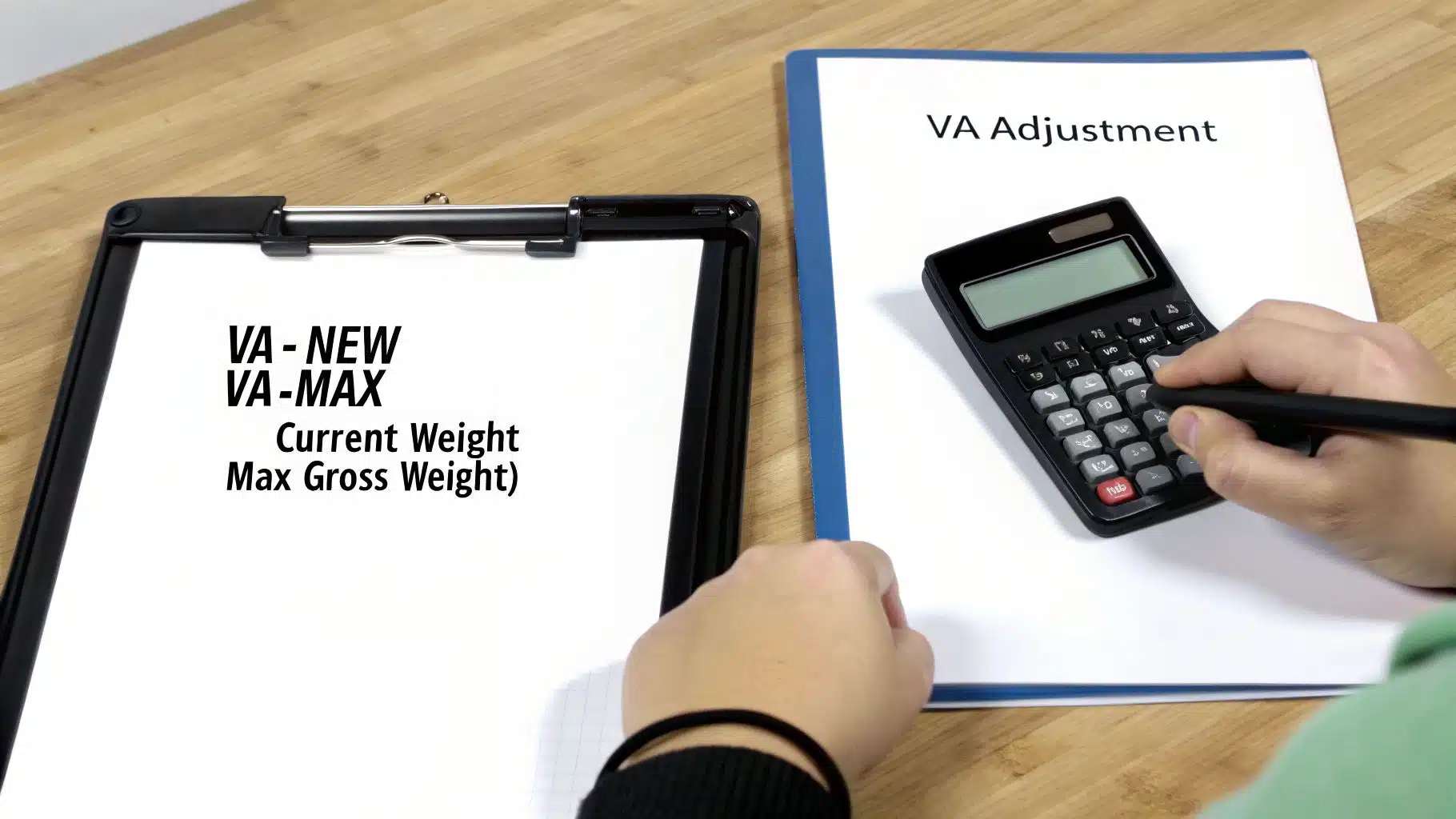
So, you've found the maneuvering speed (Va) in your POH. That's your starting point, but it's important to remember that number is only accurate at one specific weight: maximum gross. In the real world, you're almost never flying at max gross weight.
As you burn fuel, your aircraft gets lighter. And a lighter aircraft is a more skittish one. It can generate high G-forces much more easily at a given speed. By slowing down, you're ensuring the wing will stall before you can apply enough force to bend the airframe. This is why you absolutely must adjust your Va for your actual weight.
The Formula Behind the Adjustment
The standard formula for adjusting Va looks a bit complex at first glance, but it's really quite simple once you know the pieces. This is the key to figuring out your maneuvering speed on any given day.
Va_new = Va_max * √(Current Weight / Max Gross Weight)
Let's break that down:
- Va_new: This is the adjusted speed you’re solving for.
- Va_max: The published maneuvering speed from the POH at maximum gross weight.
- Current Weight: Your aircraft's actual weight right now.
- Max Gross Weight: The maximum certified takeoff weight for your plane.
You're just finding the ratio of your current weight to the max weight, taking the square root, and multiplying that by the published Va. Any modern flight planning app or even the calculator on your phone can handle the square root part in seconds.
A Pilot's Rule of Thumb for In-Flight Math
Let's be honest, nobody wants to be doing square roots in their head while getting bounced around in turbulence. Thankfully, there's a fantastic mental shortcut that gets you remarkably close to the exact number.
For every 2% reduction in weight from max gross, you should reduce your Va by 1%.
This simple relationship makes in-flight calculations incredibly easy. Say you've burned off 20% of your aircraft's weight in fuel. Just reduce your starting Va by 10%, and you're in the right ballpark.
Why This Calculation Is Not Just "Nice to Know"
This isn't an academic exercise; it has real-world consequences. A 2024 analysis from Transport Canada showed that after burning 390 lbs of fuel, a typical 1,950-lb aircraft (a 20% weight loss) needs its Va to drop from 89 KIAS to around 80 KIAS. That's a huge difference.
While POHs for aircraft certified after 1993 often give you a few different Va speeds for various weights, pilots in older aircraft like a classic Cessna 150 have to do this calculation themselves. Studies have consistently shown that understanding and applying this adjustment significantly reduces the risk of stall-spin accidents in turbulent air. Getting this right is fundamental to protecting your aircraft and flying safely.
If you want to dig deeper into the physics, you can explore the relationship between weight and Va in this excellent breakdown from AOPA.
Putting It All Together: Calculating Va in the Real World
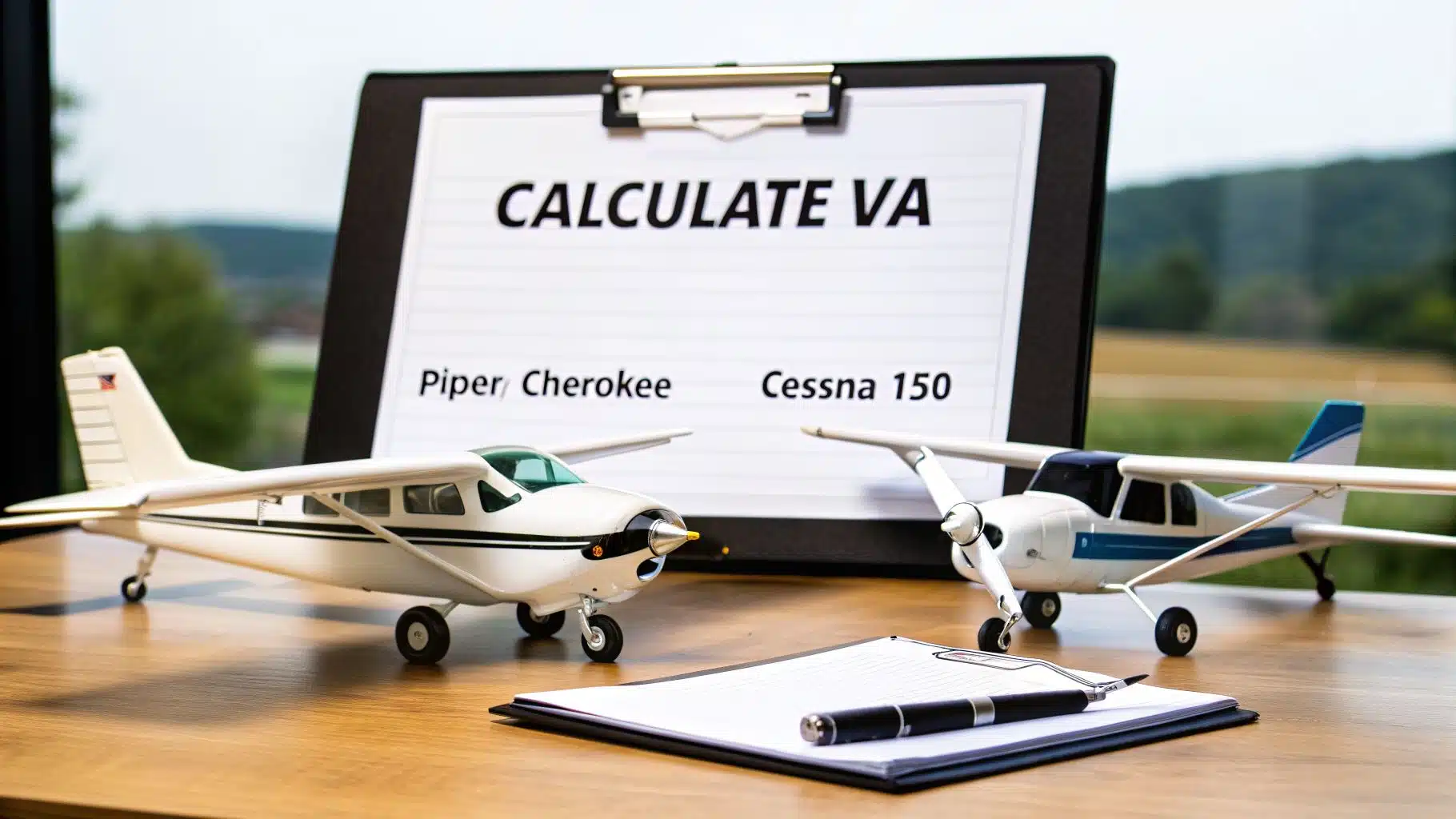
Alright, let's move from theory to the flight line. Knowing the why is one thing, but true airmanship comes from applying it. Seeing the numbers work for the kinds of planes you actually fly is the best way to burn this into your pre-flight routine.
We’ll walk through a couple of common scenarios you'll almost certainly encounter in your training and beyond.
Your Piper Cherokee Lesson
Picture this: you and your instructor are about to hop into a Piper Archer for some pattern work and maneuvers. You've just finished up the weight and balance calculations—a crucial skill for every flight. If you need a refresher on that process, you can find a great example of a Cessna 172 weight and balance sheet here.
For this flight, here's what your W&B sheet tells you:
- Max Gross Weight (W_max): 2,550 lbs
- Published Va @ Max Gross (Va_max): 113 KIAS
- Current Takeoff Weight (W_current): 2,300 lbs (two pilots, half fuel, and gear)
Now, let's apply our formula: Va_new = 113 * √(2,300 / 2,550)
First, find the ratio of your current weight to max gross, which is 2,300 / 2,550 = 0.90. Then, take the square root of that ratio, which is about 0.95.
Multiply that by your published Va: 113 KIAS * 0.95 = 107.35 KIAS.
Let's call it 107 KIAS. Right away, you can see your real-world maneuvering speed is 6 knots slower than the number printed on the placard. That’s a significant difference you need to respect.
A Solo Flight in the Cessna 150
Now, let’s switch gears. You’re flying solo in a trusty Cessna 150. You took off light, and you've already been flying for an hour, burning off fuel. Your weight is constantly changing, and so is your Va.
Here’s your current situation mid-flight:
- Max Gross Weight (W_max): 1,600 lbs
- Published Va @ Max Gross (Va_max): 104 MPH IAS
- Current In-Flight Weight (W_current): 1,350 lbs (solo pilot and reduced fuel)
Let's run the numbers again: Va_new = 104 * √(1,350 / 1,600)
Your weight ratio is 1,350 / 1,600 = 0.84, and the square root of that is roughly 0.92.
So, your adjusted Va is: 104 MPH * 0.92 = 95.68 MPH.
Round that to 96 MPH. If you hit an unexpected patch of turbulence, you now know that your personal "yellow arc" begins at 96 MPH, not the 104 MPH listed in the POH. This is exactly the kind of in-flight thinking that separates a good pilot from a great one.
Sample Va Calculations for Common Training Aircraft
To make this even more practical, here’s a quick-reference table showing how Va changes for a few common trainers. Notice the consistent pattern: as weight decreases, so does your safe maneuvering speed.
| Aircraft | Max Gross Weight | Published Va | Sample Current Weight | Calculated Va |
|---|---|---|---|---|
| Piper Archer (PA-28-181) | 2,550 lbs | 113 KIAS | 2,300 lbs | 107 KIAS |
| Cessna 150 | 1,600 lbs | 104 MPH | 1,350 lbs | 96 MPH |
| Cessna 172S | 2,550 lbs | 105 KIAS | 2,200 lbs | 98 KIAS |
| Diamond DA40 | 2,646 lbs | 108 KIAS | 2,400 lbs | 103 KIAS |
These examples highlight why a "one-size-fits-all" approach to Va doesn't work. The number on the placard is just the starting point.
The Big Takeaway: The relationship is simple and direct: the lighter you fly, the slower your Va becomes. Whether you're in a classic trainer or a zippy Mooney M20, the physics don't change. Making this quick calculation a part of your pre-flight is a non-negotiable habit for safe flying.
Common Misunderstandings About Maneuvering Speed
Knowing how to calculate your maneuvering speed is a critical first step, but it's only half the battle. There are some dangerous myths floating around about Va, and believing them can get you into serious trouble even when you think you're being cautious.
The single most dangerous misconception is that flying below Va gives you a get-out-of-jail-free card for any control input you want to make. It absolutely does not.
This isn't just theoretical. The tragic 2001 crash of American Airlines Flight 587 is a sobering, real-world lesson. The investigation revealed that the first officer's aggressive and repeated rudder inputs—made while the aircraft was flying below its design maneuvering speed—led to the catastrophic failure of the vertical stabilizer.
It's a Single-Input Speed Limit
Here’s the hard lesson learned from the AA587 accident: Va only protects the airframe from a single, full, abrupt control input on a single axis. That’s it.
It offers no protection against multiple, rapid-fire inputs (like wrestling with the rudder), or applying full deflection on multiple axes at once (like a full rudder stomp combined with a sharp aileron roll).
In the wake of the AA587 tragedy, the FAA updated regulations to clarify this very point. New aircraft certification rules now explicitly define Va based on these single-axis control limits, reinforcing just how vital it is to respect the laws of aerodynamics. The data backs this up: 18% of turbulence-related accidents below 10,000 feet involve speeds higher than the corrected maneuvering speed. Furthermore, over 500 general aviation incidents in the U.S. between 2000 and 2020 were linked to maneuvering overloads.
If you're curious about the specifics of these rule changes, you can discover more insights about maneuvering speed on Wikipedia.
Is It Va or Vo? Understanding the Difference
To add another layer to this, you might spot a different V-speed in more modern aircraft: Vo, the Operating Maneuvering Speed. This is now often used in place of the traditional Va on new designs.
So, what's the difference? It's actually pretty straightforward.
Va (Design Maneuvering Speed): This is the classic term. In most older POHs, it's the only maneuvering speed you'll find, and it's almost always a single value calculated for the aircraft's maximum gross weight.
Vo (Operating Maneuvering Speed): This is the maneuvering speed for your current weight. If a POH gives you a chart with different maneuvering speeds for different weights, it's essentially giving you a list of Vo values.
For all practical purposes, when you do the math to adjust Va for your lighter flight weight, you are calculating your Vo. Think of Vo as the real maneuvering speed for right here, right now.
This isn't just a matter of semantics. It’s about building the kind of deep airmanship that truly separates a safe pilot from a great one. Understanding that your airplane is more vulnerable at lighter weights—and having the discipline to slow down accordingly—is a hallmark of a pilot who truly respects their machine.
A Smart Pilot's Guide to Buying an Airplane
While mastering maneuvering speed is a core part of being a safe pilot, there's another set of calculations that often occupies a pilot's daydreams: the cost of owning your own plane. Making the leap from renter to owner is incredibly exciting, but it requires a different kind of checklist—one focused on finances, due diligence, and a healthy dose of skepticism.
Before you even start browsing listings for airplanes or helicopters, you have to answer one simple question: What’s the mission? Are you just looking for a fun local flyer to grab that legendary $100 hamburger? Or do you need a stable IFR platform for family trips and business? The answer changes everything, guiding you toward a classic trainer or a more complex, capable machine.
Getting Real About the Budget
With a clear mission in mind, we have to talk about the money. The sticker price you see on an ad is just the beginning; it’s the down payment on a much larger financial commitment. I’ve seen too many pilots get in over their heads by underestimating the true cost of ownership.
Your budget needs to account for the predictable (and unpredictable) expenses that come after the sale:
- Insurance: This is a huge variable. A low-time pilot stepping into a complex single or a turbine helicopter will pay a hefty premium compared to an experienced aviator buying a Cherokee.
- A Place to Call Home: Whether it's a shared hangar or a simple tie-down, you have to protect your bird from the elements. This is a fixed monthly cost you can't ignore.
- The Dreaded Annual: Annual inspections can easily run a few thousand dollars on a good day. If the inspection uncovers corrosion or a major component nearing its end, that figure can skyrocket.
- Feeding the Beast: Factor in fuel, oil changes, new tires, and, most importantly, an engine reserve. Every hour you fly is one hour closer to an overhaul.
Here’s a solid piece of advice: have at least 15-20% of the aircraft's purchase price sitting in a dedicated maintenance fund from day one. That cash buffer is what separates a minor, fixable squawk from an issue that grounds your plane for months while you scramble for funds.
The Pre-Buy Inspection Is Non-Negotiable
This is it. This is the single most important part of the entire buying process. No matter how pristine the paint looks or how organized the logbooks seem, you absolutely must get a thorough pre-buy inspection from an independent A&P mechanic you trust.
And let me be clear: this mechanic needs to work for you, not the seller. Find someone who specializes in the make and model you’re looking at. Their job isn’t to be friendly; it’s to be your advocate, to actively hunt for corrosion, hidden damage, and pencil-whipped logbook entries. They are there to find the reasons you shouldn't buy the aircraft.
Important Takeaway: Think of the pre-buy as the cheapest, most effective insurance policy you'll ever purchase. Spending a couple of thousand dollars on a detailed inspection can, and often does, save you tens of thousands in unexpected repairs later on.
Finally, one of the best moves you can make is to join the owner’s group or type club for your target aircraft before you even make an offer. These communities are an incredible resource. Members will have insights on common issues, performance quirks, and the best mechanics for the job. They might even know the specific history of the tail number you're considering. Tapping into that collective wisdom is a powerful advantage for any prospective buyer looking to buy or sell an aircraft.
Common Questions About Maneuvering Speed
Even after you’ve mastered the math, some real-world questions about maneuvering speed tend to pop up. Let's tackle a few of the most common ones I hear from pilots. Getting these straight is what separates a by-the-book pilot from one with true airmanship.
What if I Make a Full Control Input Above Va?
So what really happens if you make a single, full, abrupt control input above your maneuvering speed? The short answer: you risk breaking the airplane.
Va is designed as a structural fuse. It's the speed at which the wing will stall before you can exceed the aircraft's G-load limit. Go faster than that, and the wing is capable of generating enough lift to bend or snap something important.
Simply put, above Va, the airplane can be overstressed before it has a chance to stall. This is why flying at or below your current, weight-adjusted maneuvering speed in rough air or during abrupt maneuvers isn't just a suggestion—it's a critical safety habit.
Does Maneuvering Speed Change with Altitude?
This is a great question that often trips people up. The answer is no, your indicated maneuvering speed (Va) does not change with altitude.
The stresses on your airframe are a product of dynamic pressure, and your indicated airspeed (IAS) is a direct measure of that pressure. The wing "feels" the same IAS at 10,000 feet as it does at 3,000 feet.
What does change is your true airspeed (TAS). As you climb into less dense air, your TAS will be significantly higher than your IAS. But for G-loading and structural limits, you always, always fly by the numbers on your airspeed indicator.
A Word of Caution: Remember, Va only protects you from a single full control input along one axis. It's not a magical force field. Severe turbulence can slam the aircraft from multiple directions at once, and yanking the controls back and forth—even below Va—can still overstress the airframe. The best defense is always to slow down and fly with a light touch in chop.
Is Va the Same for Pushing and Pulling Maneuvers?
No, and this is a crucial distinction. The published Va you find in your POH is based on the positive G-limit (e.g., +3.8G for a Normal category aircraft). The negative G-limit is almost always much lower (e.g., -1.52G).
This means the maneuvering speed for an abrupt, nose-down push on the controls is actually lower than the published Va. While most handbooks don't list a separate "negative Va," a sharp pilot always keeps this in mind. An aggressive forward push on the yoke at or near the published Va could easily exceed the negative G-limit.
The takeaway is simple: always be smooth and deliberate with your control inputs, especially in the pitch-down direction.
At DuBois Aviation, we're passionate about teaching the "why" behind the numbers, turning good pilots into great ones. Our CFIs bring years of real-world experience to every lesson, ensuring you get practical knowledge, not just rote memorization. Whether you're buying a plane, adding a rating, or just want to sharpen your skills, we're here to help you fly safer and with more confidence. Stop by and see us or learn more at https://duboisaviation.com.