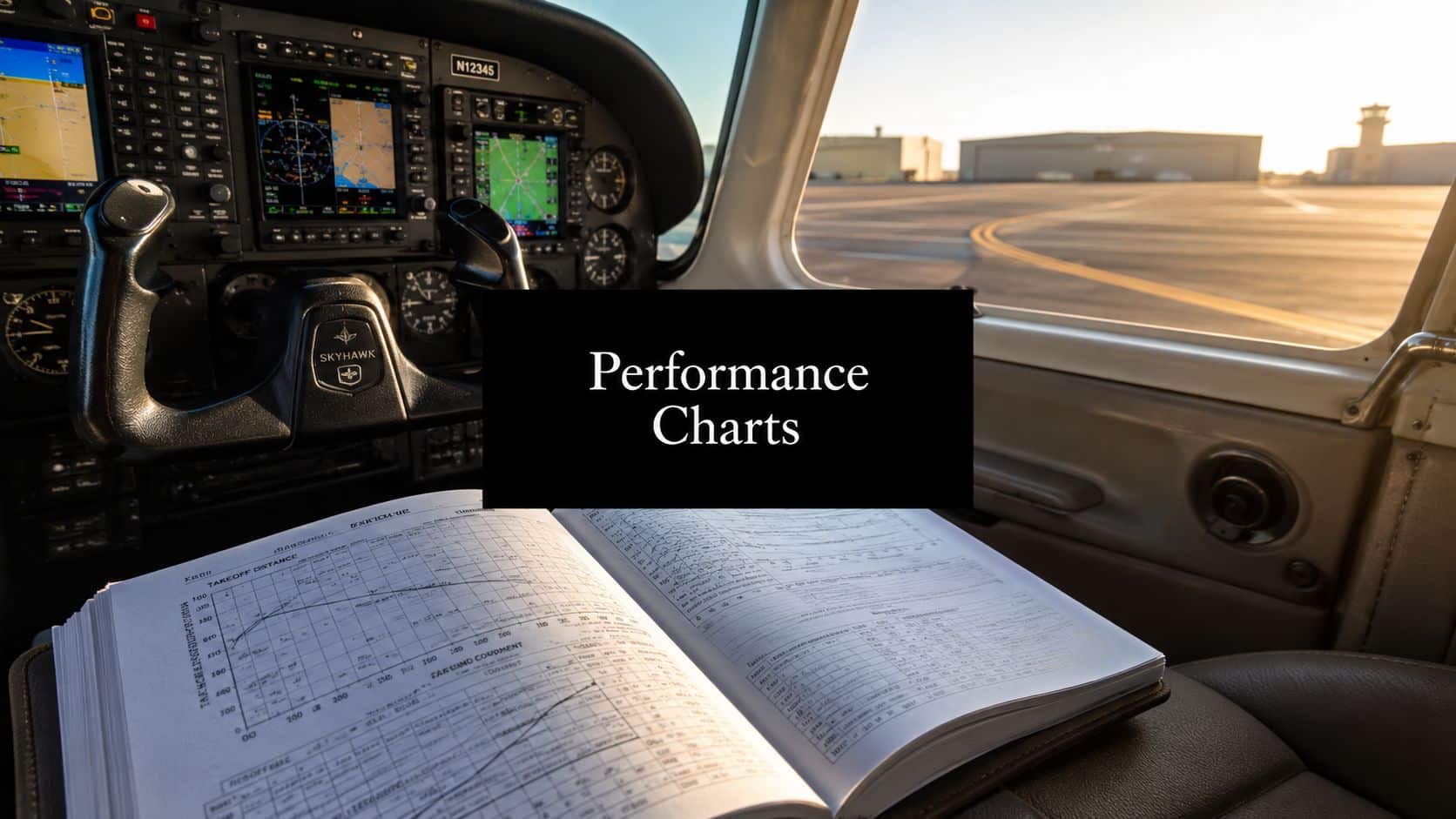
You're probably looking at a POH right now, tracing lines across a chart and wondering why something so important feels so awkward at first. That's normal. Nearly every student pilot reaches a point where aircraft performance charts stop feeling like simple homework and start feeling like a foreign language.
Then the day comes when the weather is warmer, the airplane is loaded heavier, or the runway feels shorter than it did last week. That's when the chart stops being academic. It becomes a safety decision.
At a busy training environment like Chino, where you're juggling taxi instructions, checklists, and timing, it's easy to want a shortcut. There isn't one. You need to know what the airplane can do before you ask it to do the job. That applies whether you're planning your first solo cross-country, working toward an instrument rating, training in a Piper Cherokee, or thinking long-term about buying or selling airplanes and helicopters.
Why Performance Charts Are Your Most Important Copilot
A student walks out to the airplane on a hot afternoon, does a careful preflight, and feels ready to go. The airplane looks fine. The engine starts. The runway is the same one they've used before. But the conditions aren't the same.
Hotter air changes performance. A heavier load changes performance. Wind changes performance. If you guess, you're no longer flying with facts. You're flying on optimism.
That's why aircraft performance charts matter so much. They tell you, in the airplane's own approved language, what the airplane is likely to do under a specific set of conditions. They aren't a rough suggestion. They're one of the most practical risk-management tools a pilot has.
According to EAA's discussion of FAR 91.103 and aircraft performance planning, pilots are legally required to determine runway lengths at the airport or airports of intended use and calculate takeoff and landing distances before flight. That same source explains that these charts are built from flight test data recorded by engineers and recognized by the FAA, and that they provide critical values such as ground roll and takeoff distance over a 50-foot obstacle.
What the chart is really telling you
Think of the chart as a conversation between the airplane and the pilot.
The airplane says, “If you give me this temperature, this altitude, this weight, and this wind, here's what I can reasonably deliver.” Your job is to listen carefully.
Practical rule: If you haven't run the numbers, you haven't finished planning the flight.
Why students get tripped up
Most students don't struggle because they can't read. They struggle because charts combine several variables at once. The eye jumps to the wrong line. A note at the bottom gets missed. A headwind correction gets applied casually instead of exactly the way the chart intends.
That's why instructors keep coming back to this skill. A pilot who can read a performance chart correctly is usually a pilot who plans ahead, notices details, and respects margins. Those habits carry into every phase of flying.
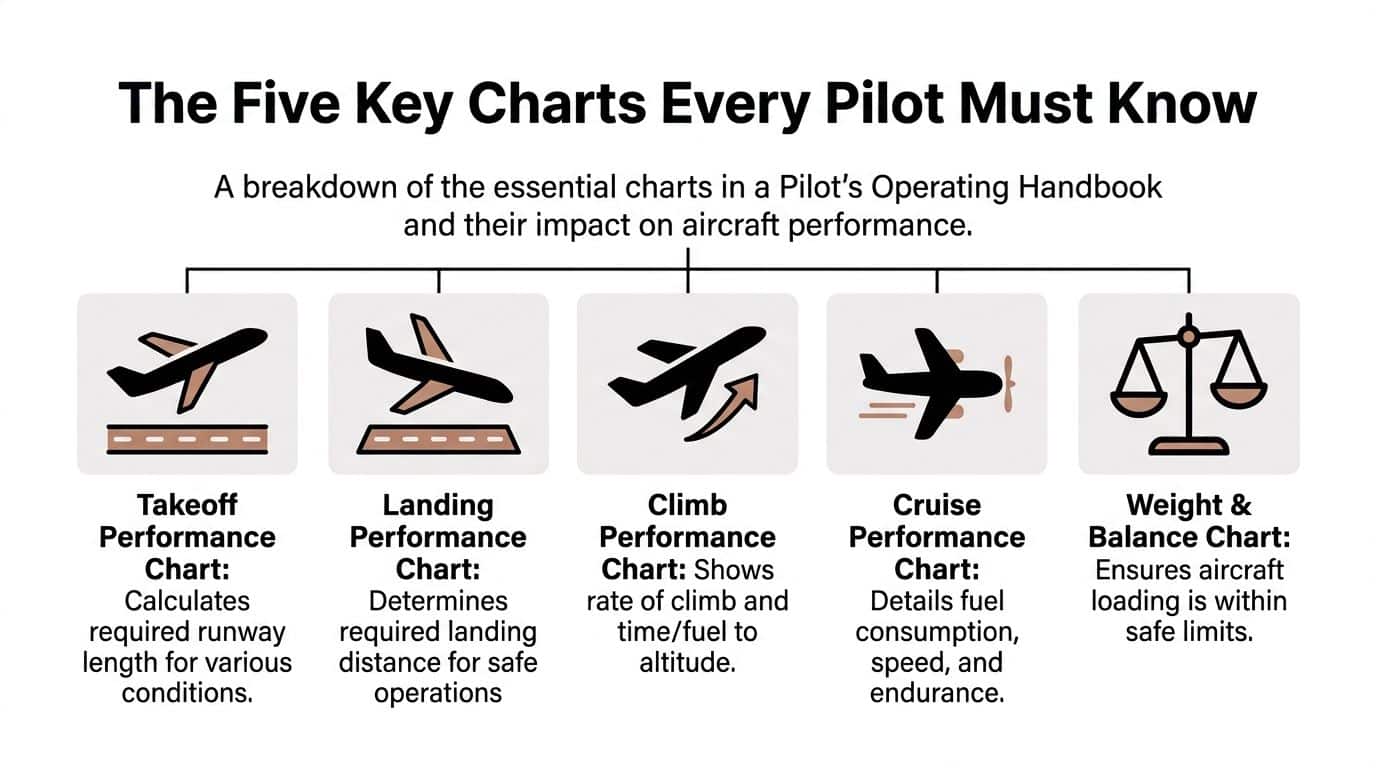
The Five Key Charts Every Pilot Must Know
A POH doesn't give you one all-purpose answer sheet. It gives you several tools, each tied to a different phase of flight. Once you stop seeing them as random graphs and start seeing them as flight-planning tools, they become much easier to use.
Takeoff and landing charts
These are the runway charts. They answer the first practical question most pilots ask.
- Takeoff performance chart tells you how much runway you need under the conditions you expect.
- Landing performance chart helps you determine how much runway you'll need to stop safely after touchdown.
Students often focus only on the takeoff side because departure feels urgent. Don't do that. Plenty of flights launch comfortably and create trouble later because the pilot never seriously checked the landing side.
Climb and cruise charts
Once you're airborne, performance planning doesn't end.
The climb chart tells you how the airplane will get from one altitude to another. In many POHs, that includes rate of climb and planning values tied to time or fuel. That matters when terrain, obstacles, temperature, or airspace make climb performance a real concern.
The cruise chart answers a different question: how efficiently the airplane will move through the air at a chosen power setting and altitude. According to the FAA Pilot's Handbook of Aeronautical Knowledge Chapter 11, engineers create these charts from recorded test-flight data, and they're used to determine fuel consumption, true airspeed, endurance, and range. The FAA example notes that a Piper Cherokee at 5,000 feet pressure altitude and 20°C might show 10.5 gallons per hour and 112 knots true airspeed, which gives the pilot a basis for range and endurance planning.
If the takeoff chart helps you leave the runway safely, the cruise chart helps you avoid discovering too late that your fuel plan was just a hope.
Fuel and range versus weight and balance
Many pilots think of fuel planning and loading as separate subjects. In real flying, they're closely connected.
Here's a simple way to sort the five key chart types:
| Chart | Main question it answers |
|---|---|
| Takeoff | Can I get off this runway safely? |
| Landing | Can I get stopped safely? |
| Climb | How well will the airplane gain altitude? |
| Cruise | How fast and efficiently will it travel? |
| Weight & Balance | Is the airplane loaded within safe limits? |
Weight and balance deserves a place in this group because every other performance chart assumes you know the airplane's loading condition. A chart can't save you from a bad starting assumption. If the airplane is outside its loading envelope, the rest of your numbers may be built on sand.
How to Read a Takeoff Performance Chart
The first time you open a takeoff chart, it can look like a plate of spaghetti. Slanted lines, vertical scales, tiny notes, multiple conditions. Students often think they're bad at charts when the underlying problem is that nobody showed them the path.
Use your finger. Move slowly. Treat the chart like a route you're tracing, not a puzzle you're trying to solve in one glance.
Start with the conditions you actually have
Before you touch the chart, gather the inputs. You need the right chart for the exact airplane and configuration, then the actual conditions for the flight.
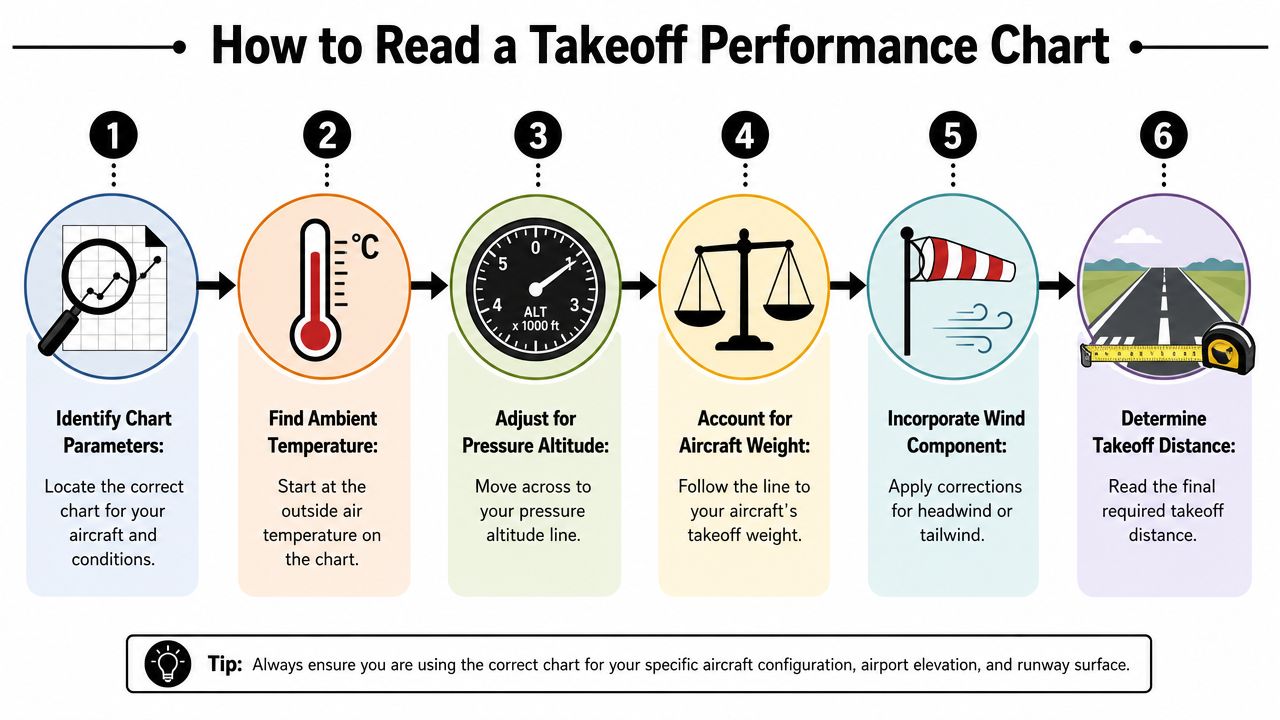
Your basic workflow usually looks like this:
- Identify the correct chart for the aircraft model, flap setting, runway surface, and obstacle condition.
- Find outside air temperature on the chart.
- Move to pressure altitude using the chart's guided path. If that term still feels slippery, this plain-language pressure altitude guide helps connect the number on the chart to the environment you're flying in.
- Apply aircraft weight at takeoff.
- Apply wind correction exactly as the chart instructs.
- Read the result for ground roll or distance to clear an obstacle, depending on which number you need.
A common student mistake is treating those factors like separate mini-problems. They aren't. The chart expects you to apply them in sequence.
Why sequence matters
A takeoff chart compounds the effects of multiple variables. If you skip ahead or mentally “add a little for heat” and “subtract a little for wind,” you can drift away from what the chart is designed to show.
The performance-chart walkthrough discussed in this pilot forum explanation of chart interpretation describes how nonstandard conditions are applied through sequential reference lines. It also notes that a 10-knot headwind reduces takeoff distance by about 15%, while increasing weight from 2,200 lb to 2,400 lb may increase takeoff distance by 12% to 18%.
That tells you something important. A favorable wind can help, but extra weight can erase that advantage quickly.
Here's a useful cockpit mindset:
- Temperature asks more of the wing and engine.
- Pressure altitude makes the airplane behave as though the air is thinner.
- Weight asks the airplane to accelerate and lift more mass.
- Wind either helps or hurts, but only after you've correctly handled the earlier variables.
A short visual walkthrough can help before you practice on your own:
Read the notes, not just the graph
Students love the center of the chart and ignore the small print. That's a costly habit.
Look for notes about flap settings, paved versus grass surfaces, leaning procedures, obstacle assumptions, or whether the chart is valid only under a certain configuration. If the chart assumes one thing and you fly another, your answer may be neat, precise, and wrong.
The chart only works if you use the same assumptions the chart used.
Worked Example A Flight in a Piper Cherokee
A practical example is where the numbers start to stick. Let's put a student in a Piper Cherokee at Chino and work through the planning mindset the way it happens on the flight line.
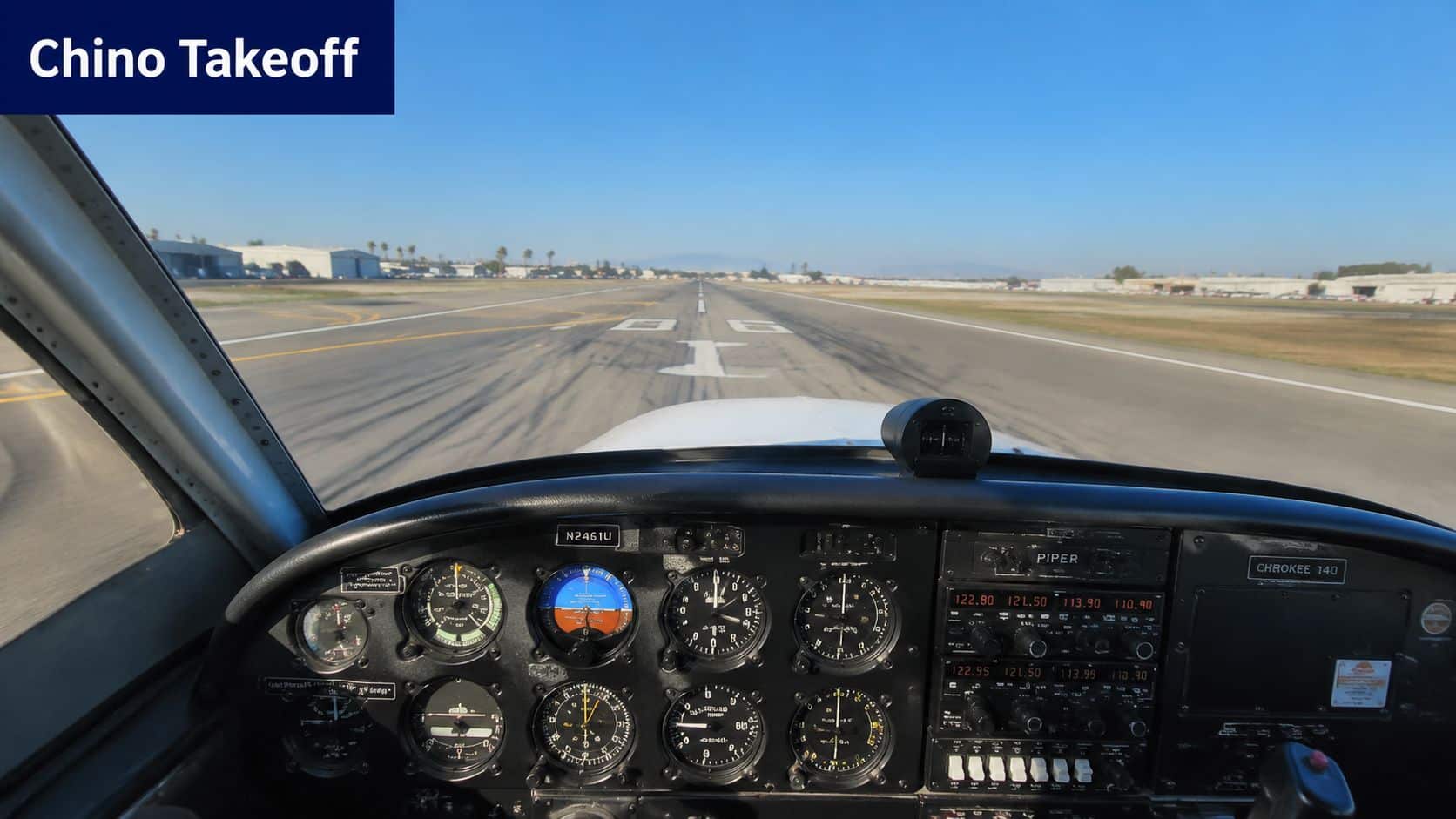
You've finished the walkaround. The airplane is fueled. Your instructor asks a simple question before engine start: “What do you expect this airplane to do today?”
That question matters because it shifts your thinking from procedure to prediction.
Walking the chart like you would on the ramp
Let's say you're flying a Cherokee for local training and short cross-country work. You pull out the takeoff chart and begin the same finger-trace method described earlier. Temperature first. Pressure altitude next. Then weight. Then wind. Then obstacle clearance distance.
The specific numbers will depend on the exact chart in that airplane's POH, so the point here isn't to fake precision. The point is to build a reliable habit. You don't say, “Cherokees usually do fine from here.” You say, “Under these conditions, this specific Cherokee is expected to need this much runway.”
That's one reason many students compare training aircraft before they even start. If you're deciding between common trainers, this look at Piper Cherokee vs Cessna 172 training differences helps frame how aircraft choice affects the feel of training and planning.
What you're really deciding
The chart result gives you more than a distance. It gives you a go or no-go discussion.
Ask yourself:
- Runway margin: Does the available runway leave comfortable room beyond the calculated need?
- Obstacle margin: If departure requires clearing nearby obstacles, does the total distance support that safely?
- Pilot margin: Are you current and sharp enough to deliver the technique the chart assumes?
A student's real-world answer should sound something like this:
“The airplane can do it on paper, but I also want enough margin for technique variation, runway condition, and the fact that this isn't a factory-new engine with a test pilot at the controls.”
That's professional thinking.
Why this matters beyond one lesson
The habit you build here shows up everywhere else in aviation. A commercial student uses the same discipline with tighter tolerances. A renter uses it before a weekend trip. An owner uses it before loading family, bags, and fuel for a summer flight.
If you ever buy or sell airplanes and helicopters, this kind of disciplined planning still matters. Ownership doesn't remove the need for judgment. It raises the stakes because the aircraft decisions are now operational and financial.
Common Pitfalls and Building In Safety Margins
Student pilots rarely get in trouble because they don't care. They get in trouble because they rush, simplify, or assume the chart result is more generous than it is.
One of the biggest traps is mixing chart assumptions with outside information and not noticing the mismatch. A January 2026 Flight Training Central quiz on aircraft performance errors reported that 72% of students incorrectly calculate crosswind limits when wind data conflicts with chart assumptions. That matters because it shows how often pilots struggle when the neat textbook setup collides with real conditions.
The mistakes that show up again and again
Here are the errors I see most often in training:
- Wrong chart selection: A pilot grabs the right airplane but the wrong configuration, such as the wrong flap setting or runway surface assumption.
- Skipped notes: Fine print gets ignored, especially remarks about technique, leaning, or obstacle criteria.
- Bad interpolation: The pilot guesses between lines instead of reading carefully.
- Tailwind minimization: A small tailwind gets mentally dismissed even when the chart treats it as significant.
- No reality check: The chart answer is accepted blindly, with no comparison to runway available or actual aircraft condition.
If landing calculations are giving you trouble too, this landing distance calculation primer is a useful companion because the same disciplined chart-reading habits apply on arrival.
Why margins matter
Charts are based on test data and controlled assumptions. Your airplane may have wear. Your technique may vary. The runway may not be ideal. The day may be hotter than forecast by the time you depart.
That's why experienced pilots build margin into their decisions instead of treating the chart number like a dare.
Don't ask whether the airplane can do it. Ask whether it can do it with room for ordinary human imperfection.
A safety margin isn't a sign of weak confidence. It's evidence of mature judgment. Students who learn that early usually become the pilots others trust later.
Beyond the POH How to Buy an Airplane the Safe Way
A student pilot runs the numbers for a summer departure in a Cherokee and learns an important lesson. The airplane on paper is not always the airplane you have. Weight, density altitude, runway condition, and aircraft condition all shape performance. That same habit of looking past the headline number matters when the question changes from, “Can I depart safely today?” to “Should I own this airplane at all?”
Buying an airplane belongs in this article for one reason. Performance charts only help if the aircraft you are flying matches the assumptions behind them. A clean, well-maintained airplane with complete records gives you a much firmer starting point than one with missing logbooks, uncertain modifications, or a long history of deferred maintenance. For a pilot thinking beyond rental flying, ownership starts with performance honesty.

Buy for the mission you actually fly
The first question is not brand, paint, or panel. It is mission.
A trainer used for short local flights asks different things of a pilot than an airplane meant for family trips over high terrain in summer. If your flying will be day VFR time-building from longer runways, your performance needs are different from a pilot operating from shorter strips with passengers and bags. The wrong match shows up quickly in the charts. Useful load disappears, climb rates shrink, and runway margins get tight.
That is why experienced instructors tell buyers to work backward from the flights they expect to make most often. Start with the runways, temperatures, field elevations, and payloads you will encounter. Then ask which airplanes still leave margin.
Budget for airworthiness, not just the sale price
Purchase price is only the opening number.
An airplane that uses your entire budget can become a poor choice fast if it needs tires, cylinders, avionics work, or corrosion repair soon after closing. J.A. Air's guidance on buying a plane safely advises buyers to leave room below their maximum budget so maintenance does not become an immediate financial strain. That advice connects directly to performance planning. Deferred maintenance has a way of turning book numbers into optimistic numbers.
A practical way to frame it is simple. If you cannot afford to maintain the airplane to the standard assumed by the POH, you may not be able to trust the margins you calculate from its charts.
The buying process should verify performance assumptions
A careful purchase process protects more than your wallet. It protects your planning.
A pilot discussion on how to buy an airplane highlights a few habits that keep emotion from taking over, such as having funds lined up early and treating the pre-buy inspection as a real mechanical evaluation rather than a quick look. That matters because a pre-buy is not only about finding defects. It is also about learning whether the airplane is likely to perform consistently with its paperwork, equipment list, and intended use.
A sound process usually includes these steps:
- Define the mission clearly. Base it on real payloads, real airports, and real weather conditions.
- Review the records before getting attached. Missing logbooks or vague maintenance history should slow the decision down.
- Use a purchase agreement and independent evaluation. Clear expectations reduce pressure and rushed choices.
- Order a true pre-buy inspection. Have a mechanic familiar with the type examine the airplane in detail.
- Compare the airplane's condition to your planned operation. A “good deal” can still be the wrong airplane if it leaves little performance margin.
A real pre-buy inspection protects flight safety later
Students sometimes hear “pre-buy” and picture paperwork. In practice, it is closer to a reality check.
AOPA guidance on buying used aircraft explains that a pre-purchase inspection should include items such as differential compression checks, FAA Form 337 review, Airworthiness Directive compliance, service bulletin status, and serial number verification. Those details matter because they answer a larger question. Is this airplane configured and maintained the way its records suggest?
For performance-minded pilots, each of those checks has a practical meaning:
- Engine condition affects climb, cruise, and confidence on hot days.
- Accurate logs help confirm that inspections and repairs were done properly.
- Form 337 entries reveal major repairs or alterations that may affect weight, drag, or operating limitations.
- AD compliance protects both legal airworthiness and operational safety.
- Correct serial numbers and component records help verify that the airplane is what the seller says it is.
The pattern is the same one you use with charts. Verify the inputs before trusting the output.
Ownership raises the standard for chart discipline
Rental flying gives many students a structured environment. The dispatch sheet, the instructor, and the school's policies often catch weak planning habits early. Ownership removes some of those guardrails.
That is not a reason to avoid buying. It is a reason to buy carefully and keep the same discipline you used in training. A good ownership decision supports chart-based planning because the airplane's condition, equipment, and records are known. A careless purchase does the opposite. It adds uncertainty right where a safe pilot wants clarity most.
From Charts to Cockpit Proficiency
A student at Chino can work a takeoff chart correctly at a desk, then freeze a little on the ramp when the airplane is loaded, the temperature is rising, and departure traffic is stacking up. That moment is where proficiency starts to become real. You are no longer answering a training question. You are deciding whether today's flight makes sense in the airplane you have.
Chart skill becomes cockpit skill when the numbers turn into habits. You check runway length the same way you check fuel. You compare book performance to the conditions in front of you. You ask one more question before takeoff: “What changed since I planned this?”
That habit protects you.
A pilot who uses performance charts well tends to fly with steadier judgment because the chart is teaching more than arithmetic. It teaches respect for small penalties that add up. A little extra weight, a little extra heat, a runway with a slight upslope, a surface that is less than ideal. Each one may look manageable by itself. Together, they can erase the margin you thought you had.
This is why instructors keep coming back to repetition. Run the numbers before the lesson. Say them out loud on the flight line. Compare your estimate to what the airplane does after liftoff. Over time, the chart stops feeling like a page in the POH and starts working like a preflight weather check for airplane capability. It gives you a realistic picture of what the aircraft can deliver today, not what you hope it will do.
The same discipline carries into bigger aviation goals. A renter uses it to make safer go or no-go decisions. An owner uses it to understand how a specific airplane, with its real condition and loading, will perform over months and years of flying. A pilot thinking about aircraft ownership needs that same habit because ownership removes some of the training wheels. The airplane is still governed by the same physics.
At Du Bois Aviation, that idea shows up in practical training. Students and certificated pilots work through planning in the setting where flights begin, on the ground, with the airplane in front of them, not only in a workbook. That is how chart reading grows into judgment you can carry into renting, transitioning, and eventually buying an airplane with clearer eyes and safer standards.