A lot of readers asking how much do international airline pilots make are standing in the same place, mentally if not physically. You might be a student pilot watching an airliner climb out over the field. You might be a parent helping a son or daughter decide whether flight training is worth the cost. Or you may already be logging hours and trying to figure out whether the long road to an airline cockpit leads to a solid paycheck or just a glamorous-looking job with a complicated tax return.
The short answer is that international airline pilots can earn very well.
The full answer is more complicated, and that is the answer you deserve.
Two practical options worth comparing
These are specific products pilots commonly compare for this type of flying. Confirm compatibility with your aircraft and instructor before ordering.
 Premium ANR headsetLightspeed Zulu 4 ANR Aviation Headset - Dual GA PlugCheck current availability on Amazon (paid link)
 Premium headsetBose A30 Bluetooth Aviation Headset - Dual PlugCheck current availability on Amazon (paid link)
Pilot pay is not one clean salary number. It is a package shaped by where you fly, what you fly, who you fly for, and how long you have been there. A captain at a Middle Eastern carrier may have a tax-free package with housing built in. A European pilot may have a respectable gross salary that shrinks after taxes and cost of living. A pilot in the United States may earn some of the strongest headline pay in the world, especially after moving from the right seat to the left seat.
If you are trying to build a career, you need to understand the mechanics behind the paycheck, not just the biggest number on a recruiting ad. That means learning the difference between base salary and total compensation, between a narrowbody first officer and a widebody captain, and between gross pay and true wealth.
The Dream of the Cockpit and the Reality of the Paycheck
A young pilot taxis back after a lesson, shuts down, and looks up as a long-haul jet passes overhead. That moment is common in aviation. So is the next question.
How much does that crew make?

Many people expect a single answer. There is no single answer.
An international airline pilot’s income changes with region, airline, aircraft, seat, and seniority. Two pilots can both fly internationally and still bring home very different amounts. One may be a first officer on an Airbus A320 in Asia-Pacific. Another may be a senior captain on a Boeing 777 in the Gulf. Both are airline pilots. Their pay packages can look nothing alike.
Why the simple answer fails
The confusion usually starts with the word salary.
Pilots often talk about pay in ways that sound strange to people outside aviation. You will hear terms like block time, guarantee, override, per diem, housing allowance, tax-free package, and fleet bid. None of that is fluff. Those details are what turn an ordinary-looking contract into a strong one or a disappointing one.
A pilot might have a moderate base pay but excellent housing support. Another might have a stronger hourly rate but live in a high-tax country. One airline may promote quickly to captain. Another may keep you in the right seat much longer.
A pilot’s paycheck is less like a teacher’s salary and more like a cockpit checklist. Multiple items combine to produce the final result.
The question behind the question
When most aspiring pilots ask how much do international airline pilots make, they are really asking three things:
- Can I make a good living doing this
- How long does it take to reach top earnings
- Which career path gives me the best long-term outcome
Those are the right questions.
By the time you finish reading, you should be able to look at any airline pay offer and think like a captain, not just a dreamer. You will know what parts of the package matter, where the strongest earning regions are, which career choices move the needle most, and how pilots often use high earnings later in life when buying or selling aircraft of their own.
Decoding the Pilot Payslip The Core Components of Your Salary
A pilot’s pay package works like a toolkit. The total amount comes from several pieces working together, not from one flat number.
If you only look at the base figure, you can misunderstand an offer badly.
Base pay and guaranteed pay
The first piece is base salary or the monthly guarantee. This is the floor under your earnings. It gives stability when flying schedules shift, weather interferes, or you spend time on reserve.
At some airlines, the base is the headline figure candidates focus on first. That makes sense, but it is only the starting point.
For example, compensation structures at international carriers can become much larger once allowances are included. Emirates captains are described as earning $145,000 to $225,000 tax-free base pay, with total packages rising to $180,000 to $320,000 when housing allowances and per diems are added, according to this airline pilot salary update covering U.S. and international pay.
Flight pay and block hours
The next piece is flight pay, sometimes tied to block hours. In plain language, block time usually means the period from pushing back at the departure gate to arriving at the destination gate.
This is important because many airline contracts reward the actual flying schedule. A pilot who flies more valuable trips, larger aircraft, or premium routes can see higher total pay than someone with the same title and company seniority but less favorable assignments.
A first officer should learn this early. If you want a simple breakdown of how entry-level airline compensation is often discussed, this guide to first officer salary is a useful reference point.
Per diem and allowances
Then there is per diem. This is money paid for time away from base. It helps cover meals and incidental expenses on trips.
For international pilots, this can be more meaningful than outsiders expect. The same goes for housing allowances, transportation support, and other expatriate benefits. In some regions, especially where airlines recruit globally, these items can reshape the value of a contract.
A tax-free package with housing support often feels very different from a taxed salary where the pilot pays for everything out of pocket.
Bonuses and special premiums
Some packages also include extras that show up only in certain situations:
- Aircraft premiums for larger or more complex fleets
- International overrides for long-haul or special route structures
- Retention or signing bonuses where airlines compete hard for crews
- Instructor or check pilot pay for pilots who take on training duties
Not every airline uses the same labels. That is where young pilots get tripped up. They compare one company’s base salary against another company’s total package and think they are comparing equals. They are not.
The payslip mindset
A smart pilot reads a compensation package in layers:
- What is guaranteed
- What depends on flying activity
- What support lowers living costs
- What part of the package is taxed differently
Never judge an airline offer by the first number you see. Its true value often sits in the details below it.
That habit will serve you well whether you stay in passenger airlines, move into cargo, or build a mixed career that includes charter, instruction, or aircraft ownership later on.
Global Salary Snapshot Where Pilots Earn the Most
Two pilots can both say, “I fly international jets,” and still bring home very different amounts at the end of the month. One earns a higher gross salary in a high-tax country. The other accepts a lower headline number, but keeps more after tax, receives housing support, and spends fewer years waiting for an upgrade. That is why a global salary table is only the starting point.
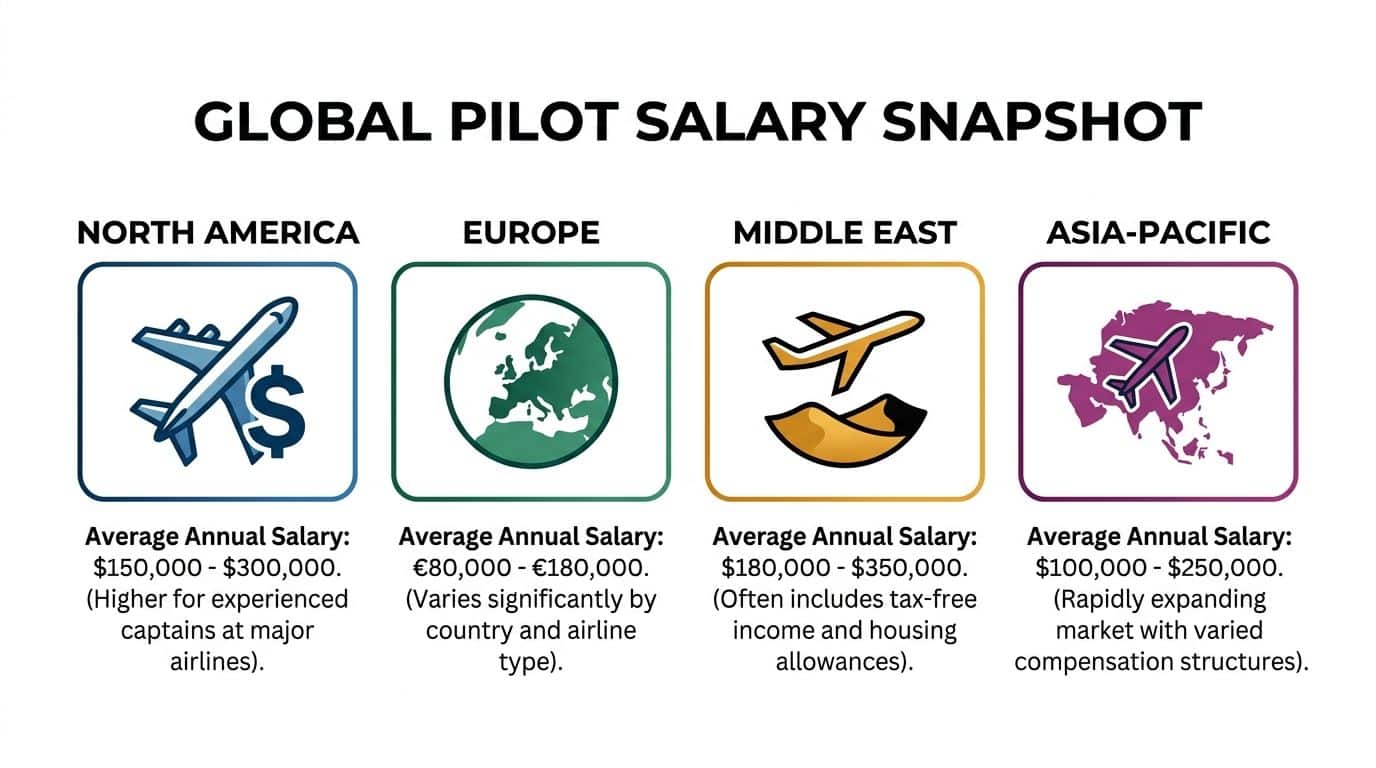
A good way to read the market is to separate headline pay from usable pay. Headline pay is the big number recruiters put in front of you. Usable pay is what remains after taxes, housing, commuting, and the slow or fast pace of promotion. Pilots who understand that difference make better career moves.
A quick regional comparison
Here is the broad picture:
| Region | First Officer Years 1-5 | Captain Years 5-15 |
|---|---|---|
| North America | Strong earning potential, especially at major airlines | Among the strongest headline earnings globally |
| Europe | Moderate to strong, but country differences matter | Can be solid, though taxes and regulations affect take-home pay |
| Middle East | Attractive expat packages, often tax-advantaged | Strong total compensation, especially with housing allowances |
| Asia-Pacific | Competitive in major markets, varies widely by airline | Strong opportunities at growing carriers and larger fleets |
For readers who want a U.S. benchmark before comparing contracts abroad, this guide to the average salary of a pilot gives helpful context.
Middle East
The Gulf carriers attract attention for a clear reason. The pay package often works harder than the base salary alone suggests.
As reported in AeroProfessional’s 2025 Global Pilot Salary Market Insights, Middle East captains on A320s average $10,500 to $11,999 per month, while Boeing 777 and 787 pilots average $13,500 to $14,999 per month. First officers range from $6,000 to $10,499, often under tax-free structures.
That tax treatment can change the whole equation. A pilot earning less on paper in the Gulf may keep more cash than a pilot earning more in a heavily taxed market. Add company housing or housing allowances, and the gap can widen further.
Europe
Europe rewards careful contract reading.
AeroProfessional’s 2025 Global Pilot Salary Market Insights reports an average of €113,800 annually across major European countries. That sounds attractive, but Europe is not one pay system. Country tax rates, social charges, base location, and commuting costs can push two similar-looking contracts in very different directions.
For some pilots, Europe offers strong long-term quality of life and respected airline names. For pilots focused on net income, the smarter question is not “What is the annual salary?” It is “What do I keep after the system takes its share?”
Asia-Pacific
Asia-Pacific is a wide field. You cannot treat it as one market.
In AeroProfessional’s 2025 Global Pilot Salary Market Insights, A320 captains in Asia-Pacific average $9,000 to $10,499 monthly. Some airlines offer strong progression and modern fleets. Others may offer decent pay but slower upgrades, harder commuting, or less predictable contract terms.
Before signing in this region, examine the mechanics:
- Is the contract local or expatriate
- Is housing included or left to you
- How realistic is the upgrade timeline
- Can you commute without burning money and rest days
- Does the airline have a stable fleet growth plan
Those questions often matter as much as the salary figure itself.
United States and North America
North America remains one of the strongest markets for headline pilot pay, especially at major passenger and cargo airlines.
The U.S. Bureau of Labor Statistics occupational data for airline and commercial pilots lists a mean annual wage for this group and helps explain why the U.S. is often used as the reference point in pay discussions. At the top end, union contracts at large U.S. carriers can produce very high earnings for senior wide-body captains, especially when hourly rates, override pay, and premium flying stack together.
That does not mean a new airline pilot walks straight into top-tier earnings. It means the ceiling is high, and strong union agreements can make the path to that ceiling more predictable.
How to read the map correctly
A pilot comparing countries should ask four practical questions:
- Where do I keep the most after taxes
- Where can I upgrade in a reasonable time
- Where do allowances reduce my real living costs
- Where can I build stable seniority instead of restarting every few years
That is how experienced pilots compare global opportunities. They do not chase the loudest salary number. They study how the pay system works, because the mechanics often matter more than the headline.
The Four Levers That Control Your Earnings Potential
The pilot who earns the most over a career is not always the one who chose the flashiest airline first. Usually, it is the pilot who understood the four levers that move pay over time and made calm, strategic choices.
Seniority rules almost everything
In aviation, seniority is king.
It affects your pay rate, your schedule, your vacation, your route quality, your reserve life, and often your upgrade timing. Two pilots with similar flying skill can live very different professional lives because one joined an airline earlier and accumulated more seniority.
This is why experienced pilots often tell younger ones not to chase every shiny opportunity. A stable seat with a good long-term contract can beat a short-term pay bump somewhere else.
Aircraft type changes the paycheck
Bigger and more complex aircraft usually command better pay.
That does not mean every large jet job is automatically superior, but aircraft type matters. The premium attached to long-haul fleets is significant. According to the BizJetJobs salary survey, Global 7500 and 8000 captains average $306,100 to $510,500 annually, and the increase is tied in part to 20 to 30 percent aircraft bonuses and hourly rates that can scale from $250 to over $450 with experience and aircraft assignment, as described in the pilot salary survey at BizJetJobs.
The lesson for airline pilots is straightforward. A widebody long-haul fleet often pays differently from a narrowbody short-haul fleet because the mission, schedule, and contract structure differ.
Airline type shapes your ceiling
Not all airlines build compensation the same way.
A legacy passenger carrier, a low-cost carrier, and a cargo giant can all offer good careers, but the path and the top end may not match. Cargo, for example, can be especially attractive for pilots who value predictable systems, international flying, and strong captain pay.
Likewise, some international carriers emphasize housing and expat support. Others lean more heavily on hourly rates and internal progression.
Here is how to think about airline type:
- Legacy majors often bring strong long-term pay and better seniority value.
- Cargo carriers can deliver excellent captain earnings and a different lifestyle rhythm.
- Low-cost and regional operators may offer faster entry or upgrades, but the long-term picture depends on the contract.
- International expat airlines may package compensation in ways that look modest at first glance but become compelling after tax and allowance review.
Union contracts set the framework
A pilot contract is not just HR paperwork. It is the operating manual for your financial life.
A good union contract shapes rates, guarantees, trip rigs, reserve rules, vacation, retirement structure, and upgrade protections. Even if two airlines advertise similar salaries, one contract may protect your quality of life and long-term earning power much better.
Consequently, many newer pilots focus on the wrong thing. They compare only top-line pay. Experienced pilots compare rules.
A practical way to use the four levers
A young pilot cannot control everything. You cannot force a quick upgrade or bid a widebody on day one. But you can make smarter career decisions by asking four questions before each move:
- Will this move improve my seniority position long term
- Does this fleet create better earnings later
- Is this airline’s business model stable
- What does the contract protect besides base pay
If you want a high-income flying career, do not chase one paycheck. Build a sequence of decisions that compounds.
That is how a right-seat pilot becomes a left-seat pilot with options.
From Flight School to the Right Seat Your Career and Salary Trajectory
You finish a long day at the airport, log another lesson, and look at your bank account. That moment surprises many new pilots. The path to an international cockpit is exciting, but the money does not arrive all at once. It builds in stages, much like flight training itself. First you learn to hold altitude. Later you learn to manage the whole system.

Training comes first, earnings come later
Early in a pilot career, your job is to become employable, not to chase the highest headline salary.
That starts with the standard ladder of certificates and ratings, then continues with something less visible but just as important. Airlines want pilots who show consistency, sound judgment, and calm cockpit habits. A clean instrument scan, accurate radio work, and disciplined checklist use do not feel glamorous during training. They are the habits that later make an airline chief pilot comfortable putting you in the right seat.
If you want a plain-language roadmap, this guide to the airline pilot career path shows how students move from training into airline hiring.
Hour-building is your apprenticeship
Many students fixate on the number in the logbook. Airlines look at the story behind that number.
A pilot who built time while instructing usually learns faster than a pilot who only chased hours in fair weather. Teaching forces you to explain procedures clearly, catch errors early, and stay ahead of the airplane. That matters in airline flying, where crew coordination and standard calls are part of every leg.
Aircraft type matters too. A school that gives you time in both basic trainers and multi-engine aircraft helps you progress in a more useful sequence. Flying a Cherokee teaches repetition and fundamentals. Flying an Apache starts introducing asymmetric throughst, higher workload, and the kind of systems thinking that shows up later in transport-category aircraft.
The first airline seat starts the pay clock
Your first airline job is usually the right seat, and that seat changes more than your title.
It starts your seniority date. It puts you inside a pay system built around hourly rates, monthly guarantees, trip credit, and allowances. That is the point where many aspiring pilots begin to understand a hard truth. Two first officers can appear to earn the same salary on paper and still take home very different amounts after per diem, housing support, tax treatment, and duty schedules are applied.
In other words, your early airline years are not only about building flight time. They are also about learning how pilot compensation functions.
A new first officer may see income rise steadily over the first several years because airline pay scales reward longevity. Then another jump often comes with a fleet change, a better contract, or an upgrade opportunity. The salary progression is real, but the headline number only tells part of the story. A pilot based in a high-tax city on reserve may feel much less financial momentum than a pilot on a similar pay rate who holds a productive line and collects steady per diem.
The right seat is where you learn to read the system
New pilots often ask how long it takes to "make good money." The better question is what position you are putting yourself in.
The right seat works like a paid apprenticeship. You are learning airline procedures, dispatch coordination, crew resource management, irregular operations, and the rhythms of a seniority-based career. You are also learning which choices compound. A base with cheaper housing, a contract with better rigs, or an airline with faster movement can change your earnings path more than a slightly higher starting rate.
That is why experienced pilots study more than the pay table. They study how the job credits time, how reserve is assigned, how overtime is paid, and whether the airline operates in a tax environment that helps or hurts net income.
Keep your eyes on the upgrade, not just the entry point
The first officer seat is a phase, not a finish line.
Captain upgrade usually changes four things at once. Your pay rate rises. Your authority increases. Your schedule options often improve with seniority. Your long-term earnings ceiling becomes much higher. For international flying, that upgrade can be the difference between a solid professional income and a top-tier airline career.
Pilots who reach that point efficiently usually do a few things well. They avoid training setbacks. They build a reputation for consistency. They choose jobs that add useful experience instead of just adding calendar time.
A good cockpit mindset starts early. This short video gives a useful look at airline career thinking from the training stage forward.
A practical timeline to keep in mind
For many pilots, the progression looks like this:
- Training phase with private, instrument, commercial, and advanced ratings
- Hour-building phase through instruction, multi-engine flying, or other professional work
- First airline role in the right seat, where seniority and airline pay progression begin
- Upgrade to captain when experience, company growth, and seniority line up
- Long-term specialization in international passenger, cargo, or premium fleets with stronger earning potential
Aviation rewards patience with purpose. The pilots who do well over time usually treat each stage as preparation for the next paycheck tier, the next aircraft, and eventually the left seat.
The High-Earner's Next Move Buying and Selling Aircraft
Once pilots begin earning well, a new question often appears. Not “Can I afford to fly?” but “Should I own?”
That is where airline experience becomes an advantage.
A professional pilot understands maintenance language, dispatch reliability, avionics usefulness, performance tradeoffs, and logbook clues better than most buyers. That does not make pilots immune to bad deals. It does mean they can approach ownership more intelligently than the average consumer.
How to buy an airplane the safe way
Buying an airplane safely starts with restraint. Excitement ruins judgment.
A smart purchase process usually includes these steps:
- Define the mission first. Cross-country family travel, time-building, leaseback, and business use are different missions. A cheap airplane that cannot do your mission is not a bargain.
- Order a real pre-buy inspection. Use a mechanic or shop that knows the aircraft type and is independent of the seller.
- Audit the logbooks. Missing records, unclear damage history, inconsistent maintenance entries, and gaps in recurring inspections deserve hard questions.
- Review avionics thoroughly. A panel that looks modern in photos may still require expensive upgrades for your actual needs.
- Calculate total ownership cost. Insurance, hangar or tie-down, inspections, engine reserves, and downtime matter as much as purchase price.
Pilots often make better aircraft buyers
Airline pilots bring habits from professional flying into private transactions.
They tend to think in checklists, operational limits, and risk management. That helps when evaluating an airplane, but the same principle applies when selling. A clean aircraft presentation, organized records, current maintenance status, and transparent history all improve buyer confidence.
The same logic carries into helicopter transactions too. Rotorcraft ownership adds its own complexity, especially around maintenance planning, component life, and mission suitability. A pilot with rotorcraft training or commercial exposure is usually better positioned to ask the right questions before writing a check.
Ownership can be personal or strategic
Some pilots buy purely for lifestyle. Others buy with a mixed purpose.
That might mean personal travel plus occasional rental, or purchasing an aircraft suitable for structured time-building. In some cases, owners explore leaseback arrangements with flight schools or rental operations. The key is not to treat the airplane as effortless passive income. It is still an operating asset with wear, scheduling friction, insurance realities, and maintenance surprises.
Safe aircraft buying is not about finding the cheapest airframe. It is about finding the right airframe with the fewest hidden problems.
For high-earning pilots, ownership can be rewarding. It can also become expensive fast when buyers skip due diligence because they assume flying skill automatically makes them a good dealmaker.
Beyond the Paycheck Hidden Factors Affecting Your Net Worth
The biggest mistake in pilot career planning is assuming the highest gross salary creates the highest net worth.
It does not.
A pilot in a high-paying country may still lose a large share of that income to taxes and living costs. Another pilot may earn less on paper but keep more because the tax regime and benefits package are better.
Gross pay is not take-home pay
Global differences make this obvious.
According to Simple Flying’s pay comparison, Switzerland offers average pilot salaries of $172,610, while pilots in Pakistan may earn $12,000 to $45,000. The same source notes that taxes and cost of living can erode net income by 30 to 50 percent in high-pay nations, as explained in this analysis of the countries with the highest-paid commercial pilots.
That is the part many salary roundups skip.
Four hidden wealth factors
When you compare two pilot jobs, look at these four issues before celebrating the bigger number:
- Tax treatment. A tax-free or tax-advantaged package can outperform a higher taxed salary.
- Base city cost. Housing, transportation, and schooling can change the practical value of a contract.
- Currency exposure. Expat pilots paid in one currency while living or supporting family in another take on exchange-rate risk.
- Retirement structure. Pension strength, company contributions, and long-term savings options can outweigh a short-term pay difference.
Think like a chief financial officer
Pilots are trained to manage fuel, weather, alternates, and margins. Apply the same discipline to your career.
The right question is not just how much do international airline pilots make. The better question is, how much of that pay turns into durable wealth after taxes, living costs, and career timing.
A wise pilot studies the full package, guards seniority, avoids unnecessary debt, and makes major purchases carefully, including aircraft purchases. That is how a flying career becomes a strong financial life, not just a good story at the airport café.
If you are ready to start the path from first lesson to airline cockpit, DuBois Aviation offers airplane and helicopter training, multi-engine instruction, aircraft rental, and an Airline Career Program at Chino Airport. It is a practical place to begin building the ratings, discipline, and flight time that make long-term airline earnings possible.