
So, you want to know what a pilot really makes? It’s one of the first questions aspiring aviators ask, and the internet is full of confusing answers. Let’s get straight to it. You’ll see numbers like the median airline pilot salary hitting $226,600, but that figure is just one waypoint on a much longer flight plan.
A pilot's salary isn't a single, flat number. It’s a dynamic income that changes dramatically based on your experience, the type of aircraft you fly, who you work for, and even where you’re based.
A Financial Flight Plan for Your Pilot Career
Think of your career earnings like planning a cross-country flight. Your first job as a First Officer is your initial climb out—you’re building hours and gaining altitude. As you gain seniority, upgrade to Captain, and add more advanced aircraft "type ratings" to your license, your income climbs to its cruising altitude.
The final destination? A Captain’s seat at a major airline, which represents the peak of the profession and comes with top-tier compensation.
The Best Job Market in a Generation
There has never been a better time to become a professional pilot. The industry is facing a massive, well-documented pilot shortage, which is pushing salaries, signing bonuses, and benefits to record levels. Airlines are in a fierce competition to attract and retain talent, putting qualified pilots firmly in the driver's seat of their careers.
This isn’t just a passing trend. As of May 2024, the median annual salary for airline pilots, copilots, and flight engineers reached $226,600. That's a solid 3.4% bump from 2023 and a huge 4.5% jump from 2022, all driven by this intense demand. With projections showing a potential shortfall of 80,000 pilots by 2032, the need for new aviators is urgent. For a deeper analysis, you can see the full picture in the 2026 pilot salary update.
For aspiring pilots, this shortage translates directly into opportunity. It means stronger negotiating power, better starting salaries, faster career progression, and greater job security right from the start of your professional journey.
This is why investing in high-quality, structured flight training like the programs at DuBois Aviation isn’t just about learning to fly—it’s a direct and calculated investment in a secure and highly profitable future.
A Glimpse into Your Earning Potential
To help you visualize your financial trajectory, we've put together a snapshot of what you can expect to earn at key stages of your career. This table outlines the journey from your first professional role to the highest levels of the industry.
Pilot Salary Potential at a Glance (2026 Estimates)
| Career Stage | Typical Role | Estimated Annual Base Salary Range |
|---|---|---|
| Entry-Level | Flight Instructor or First Officer (Regional) | $50,000 – $90,000+ |
| Mid-Career | Captain (Regional) or First Officer (Major) | $100,000 – $250,000+ |
| Peak Career | Senior Captain (Major Airline or Cargo) | $350,000 – $500,000+ |
As you can see, the earning potential grows substantially with experience and seniority. This guide will break down each of these stages in more detail, giving you a clear and realistic picture of the financial rewards that await a dedicated and proficient pilot.
How Your Salary Changes Depending on Where You Fly
When people ask "how much do pilots make," their minds usually jump straight to the major airlines. But that's only one piece of a much bigger puzzle. A pilot's salary isn't a single number; it's tied directly to the type of flying they do. The mission, the aircraft, and the schedule all shape your earning potential.
Think of it this way: an airline pilot is like the captain of a massive cruise ship, responsible for hundreds of passengers on a fixed, international route. A corporate pilot, on the other hand, is like the skipper of a private yacht, offering bespoke, on-demand travel for a very exclusive group. Both are expert mariners, but their jobs, lifestyles, and paychecks are worlds apart.
Because of this, you can't really compare the salary of a FedEx pilot flying a Boeing 777 freighter overnight to a helicopter pilot performing life-saving rescues. Each path comes with its own set of rewards and demands.
Airline Pilots: Commercial and Regional
This is the career path most people picture. Pilots flying for major carriers like Delta or American Airlines are typically the industry's top earners. This is especially true for senior captains on wide-body jets flying international routes, whose pay is clearly defined by strong union contracts based on seniority and aircraft type.
Regional airline pilots are the essential connectors in this system, flying smaller jets for companies like Endeavor Air or SkyWest that feed into the major airline hubs. Not long ago, starting pay at the regionals was notoriously low. But the current pilot shortage has completely changed the game. It’s now common to see starting salaries for first officers jump above $90,000 a year, often sweetened with huge sign-on bonuses. You can see a full breakdown of the best-paying airlines for pilots to understand how competitive the market has become.
Cargo and Freight Pilots
Flying for the cargo world is a fantastic—and often incredibly well-paid—alternative to passenger airlines. Pilots at companies like FedEx, UPS, and Atlas Air are the engines of global commerce, moving everything from packages to heavy machinery around the clock.
Salaries here are right on par with the major passenger airlines, and in some cases, can even be higher. The lifestyle is the main difference. You'll likely do a lot more flying on the "back side of the clock" to keep logistics moving smoothly overnight.
- Fly the Heaviest Metal: Cargo pilots often command some of the largest aircraft in the sky, including the iconic Boeing 747 and 777.
- See the World: This career involves extensive international travel, linking the world's major economic centers.
- Excellent Pay: It's not uncommon for senior captains at the top cargo carriers to earn well over $350,000 annually.
Corporate and Private Jet Pilots
If you value flexibility and a more personal flying experience over a rigid airline schedule, corporate aviation might be your calling. These pilots fly private jets for corporations, high-net-worth individuals, and charter management companies. The role demands a unique blend of technical skill, adaptability, and five-star customer service.
In corporate aviation, your value is tied to being a trusted travel partner. It's less about a fixed schedule and more about providing safe, efficient, and flexible transportation whenever the client needs it.
Pay in the corporate world varies more than in any other sector. A pilot flying a small jet for a local business might earn around $80,000. In contrast, a chief pilot managing a fleet of large-cabin, long-range jets for a Fortune 500 company could easily command a salary north of $250,000. Your paycheck is directly influenced by the size of the jet you fly, the complexity of the flight operations, and your employer's resources.
From The Right Seat To The Left: Your Earning Potential As A Pilot
Think of your pilot career as a well-defined flight plan. You start with training, and from there, each new rating, aircraft, and role is a waypoint on your journey. The path from a newly-minted First Officer to a seasoned airline Captain is a clear progression, and each step you take brings a significant bump in responsibility and, of course, your paycheck.
Most pilots get their professional start in the right seat as a First Officer (FO), or copilot. This is where you cut your teeth, building flight time and getting a feel for real-world airline operations. Not too long ago, this meant scraping by on a meager salary. Thankfully, those days are over. The industry is hungry for pilots, and as a result, First Officers at regional airlines are now seeing starting salaries that often top $90,000 a year, frequently sweetened with hefty signing bonuses.
As you log more hours and build seniority, your eyes will be set on the ultimate prize: the upgrade to the left seat.
Taking Command: The Path To The Captain’s Seat
Moving into the Captain's seat is a career-defining moment, and it comes with a paycheck to match. As the Pilot in Command (PIC), the ultimate responsibility for the aircraft, passengers, and crew rests on your shoulders. That added responsibility is rewarded handsomely. A Captain at a regional airline can expect to earn anywhere from $100,000 to $250,000 annually, based on their years with the company and the type of aircraft they command.
What's truly changed is how quickly you can get there. A decade-long wait for a Captain upgrade used to be the norm. Now? It’s not unheard of for pilots to make that jump in just two to three years at some regional carriers. This incredible acceleration is happening because the major airlines are hiring aggressively, creating a constant pull of experienced pilots from the regionals and opening up the left seat for the next FO in line.
Reaching The Majors
For many pilots, the end goal is a spot at a major U.S. airline like United, American, or Delta, or a global cargo giant like FedEx or UPS. This is the pinnacle of the profession, and the pay scales reflect that. A first-year First Officer at a major can start around $150,000. A senior Captain flying a wide-body aircraft on international routes? They can command a salary of $400,000 to $500,000 per year, and sometimes even more.
A pilot's career is one of the most predictable and financially rewarding out there. Your income isn't a mystery—it's driven by seniority, the aircraft you fly, and your total flight hours. It's a clear, achievable path to a very high-income profession.
The chart below shows how different sectors of the aviation industry have grown over time, each presenting its own unique timeline and opportunities.
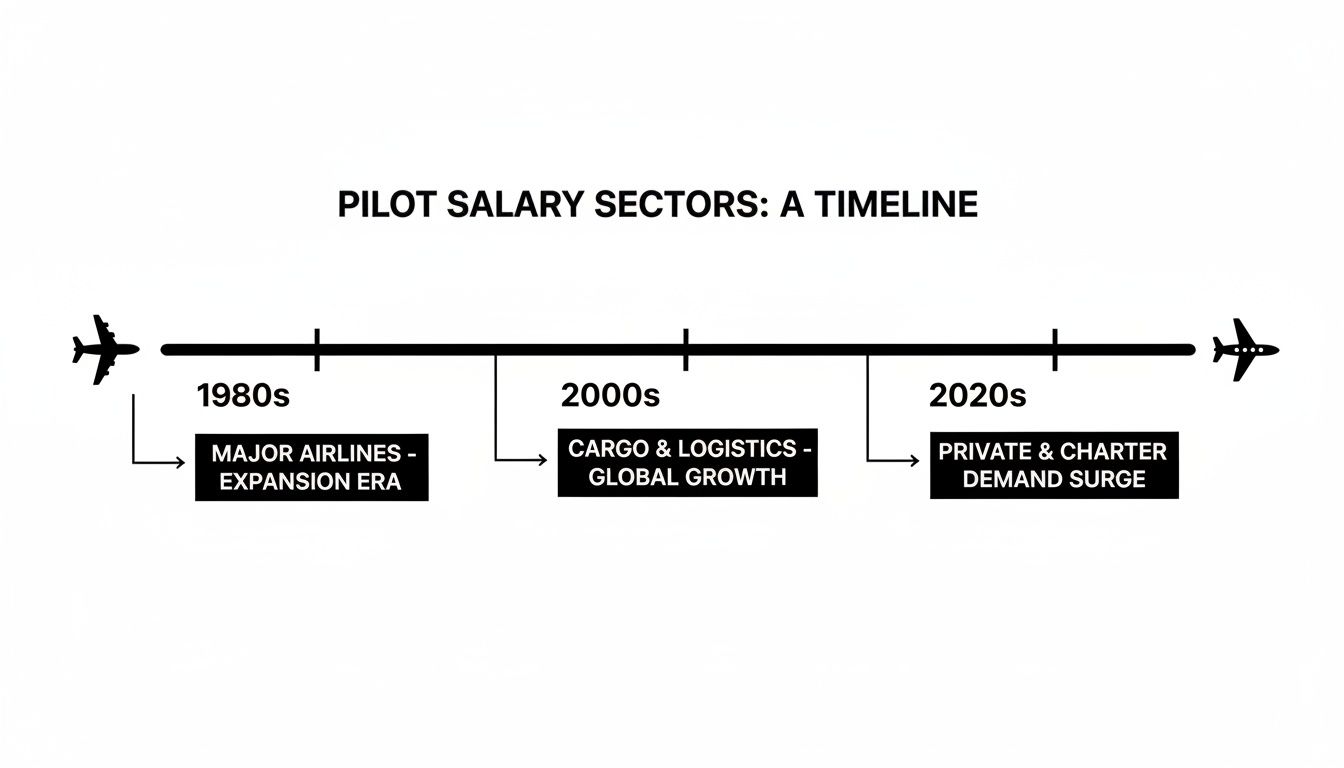
As you can see, while airline, cargo, and private aviation are distinct career tracks, they all tend to rise with the tide of pilot demand. You can dive deeper into how these paths unfold in our detailed guide on the airline pilot career path.
Key Factors That Boost a Pilot's Salary
When you see a pilot's salary figure, it’s important to know that the number is just a starting point. A pilot's real-world earnings are built from several key components that can dramatically increase their total compensation.
Think of the base salary as the foundation. The real money comes from the extra layers built on top—things like the specific aircraft you fly, union contracts, and company bonuses. These variables are what separate an average income from a truly lucrative career.
Let's break down exactly what those factors are and how they stack up.
How Union Contracts and Per Diem Add Up
For nearly all airline pilots in the U.S., your pay isn't something you negotiate one-on-one. Instead, it’s laid out in detail by union contracts, also known as collective bargaining agreements. These documents are the rulebook for pilot compensation.
They create a clear and predictable pay scale based on two things: your seniority (how long you’ve been with the airline) and the aircraft you fly. This system rewards loyalty and experience with a structured path for advancement.
On top of your hourly pay, you'll also receive per diem. This is a daily, tax-free allowance meant to cover your meals and other small expenses when you're on the road. It might not sound like much, but this can easily add up to thousands of extra dollars in your pocket each year.
The Power of Type Ratings and Certifications
One of the single most effective ways to boost your income is by earning a type rating. This is an FAA certification that proves you’re qualified to be the pilot in command of a specific, larger aircraft, like a Boeing 737 or an Airbus A320.
Airlines value pilots who can fly their biggest, most profitable planes. A pilot rated for a widebody jet like a Boeing 777 will always earn more than a pilot flying smaller, regional aircraft. Getting these ratings is a direct investment in your future, unlocking higher pay scales, international routes, and more senior roles.
You can get a clearer picture of how these credentials stack up by reviewing our guide to pilot certification levels.
Acquiring an in-demand type rating is like earning a master's degree in a specialized field. It immediately signals a higher level of expertise and qualifies you for roles with greater responsibility and compensation.
Bonuses and Profit Sharing
The competition for qualified pilots is fierce, and airlines are using big financial incentives to attract the best talent. It’s not uncommon to see regional and even major airlines offering huge sign-on bonuses, sometimes worth over $100,000. These upfront payments give your income a massive head start.
Many airlines also have profit-sharing programs. When the airline has a good year financially, it shares a slice of those profits with its employees. This can add a significant bump to your annual pay, directly connecting your wallet to the company's success. For those considering a career beyond the majors, remember that cargo and corporate flying also offer highly competitive pay, both in the U.S. and abroad.
How to Safely Buy Your First Aircraft
As your pilot salary starts to climb, that long-held dream of owning your own plane can finally feel within reach. Making the jump from renting to owning is a huge milestone, whether you’re dreaming of a Piper Cherokee for weekend getaways or a Robinson R22 to keep your helicopter skills sharp. But it's a major investment, and a little careful planning goes a long way in making sure it’s a source of joy, not a financial headache.
There's more to buying a plane than just finding one that looks good online. The process is a lot like buying a house—you have to look past the fresh paint and see what's really going on underneath. This careful, methodical homework is what separates a smart buy from a story you’ll be telling with regret for years to come.
Define Your Mission and Budget
Before you even start browsing aircraft listings, your first step is to get crystal clear on your mission. What, exactly, do you plan to do with this plane?
- Family Travel: Planning to load up the family for cross-country adventures? You’ll need a capable, four-seat aircraft with decent baggage capacity.
- Time Building: Just need an affordable way to build hours toward your career goals? A simple, reliable workhorse like a Cessna 150 is probably your best bet.
- Business Use: Will the aircraft be a tool for your business? Speed and efficiency will be your top priorities.
Once you know your mission, you can put together a realistic budget. And remember, the purchase price is just the down payment on your total cost of ownership. You have to factor in the fixed costs—things like hangar rent, insurance, and the annual inspection—plus variable costs like fuel and, most importantly, a healthy maintenance fund.
As you explore how you'll acquire the plane itself, it's worth looking into the pros and cons of leasing versus buying equipment. This can help you figure out the smartest financial path forward for your unique situation.
The Non-Negotiable Pre-Buy Inspection
If you only remember one thing from this guide, make it this: never, ever buy an aircraft without a thorough pre-buy inspection. This isn't optional. It's your single most important line of defense.
This inspection must be done by a trusted and completely independent Airframe & Powerplant (A&P) mechanic—someone with zero ties to the seller. Even better, find a mechanic who specializes in the exact make and model you’re looking at.
A pre-buy isn't a quick walk-around. It’s a forensic deep dive into the aircraft's true condition. The mechanic will check everything from engine compression to the airframe's deep, dark corners, hunting for hidden corrosion or signs of old, repaired damage. The cost of a proper inspection is pocket change compared to the bill for fixing a major problem you didn't see coming.
Finally, you need to go through the aircraft’s logbooks with a fine-toothed comb. These books are the plane's official biography, detailing every inspection, every repair, and every new part it's ever had. You're looking for a complete, unbroken history. Gaps in the records or vague entries are a massive red flag. Pairing a meticulous logbook review with a professional pre-buy is the absolute best way to protect yourself from expensive surprises down the road.
How Location Impacts Pilot Pay in the US and Abroad
When it comes to a pilot’s paycheck, geography is a huge deal. Asking for the "average salary of a pilot" is a bit like asking for the average price of a house in the U.S.—the answer completely changes depending on whether you’re in Omaha or Los Angeles. Where you’re based as a pilot has a direct and significant impact on your total earnings.
Pilots flying out of a major hub in a high-cost-of-living area like New York or Southern California will almost always earn more than their counterparts based in smaller, regional markets. There's a clear reason for this pay gap: airlines use higher pay to offset the cost of living. More importantly, these major hubs are the gateways for the most profitable long-haul international routes, which use the biggest planes and, in turn, pay the highest pilot salaries.
Pay Differences in Key US States
Inside the United States, a few states have become major centers of gravity for the aviation world, creating a competitive landscape for pilot salaries. These aren't just places with big airports; they're home to airline headquarters, massive cargo operations, and a bustling corporate flight scene.
- California: With powerhouse international hubs like LAX and SFO and one of the world's busiest private aviation markets, California is a top-tier state for pilot pay. Being based at Chino Airport (KCNO), for example, puts DuBois Aviation students right in the middle of this incredible Southern California aviation ecosystem.
- Texas: As the home base for American Airlines (Dallas-Fort Worth) and Southwest Airlines (Dallas), Texas is a true aviation juggernaut. Its central U.S. location also makes it a critical crossroads for both passenger and cargo carriers.
- Florida: Serving as the primary gateway to Latin America and the Caribbean, Florida is packed with major international airports. The warm weather and large population also fuel a very strong market for corporate and private flying.
While your base pay is set by your airline, remember that where you’re based often dictates your long-term opportunities. Living in a state with multiple airline hubs, cargo giants, and corporate headquarters simply gives you more paths to a high-paying career.
A Look at the Global Stage
The career of a pilot knows no borders, and neither do the opportunities. For many pilots, the dream involves flying for a major international airline, and the financial packages offered abroad can be incredibly compelling. Airlines in the Middle East and Asia, in particular, are famous for offering lucrative contracts to attract experienced pilots from around the world.
Carriers like Emirates, Qatar Airways, and Singapore Airlines often structure their compensation to be much more than just a base salary. It's common for their contracts to include substantial, game-changing benefits:
- Tax-free income (in certain countries, like the UAE)
- Free, high-quality housing for pilots and their families
- Education allowances for their children’s schooling
- Comprehensive health insurance and exceptional travel perks
When you add up these benefits, the total value of the compensation package can easily surpass what's typical in the United States. This creates a very attractive financial picture for pilots willing to look beyond their home country.
To put this in perspective, here is a quick comparison of potential earnings for senior captains at the top of their game.
US vs International Senior Captain Annual Pay (Estimated)
A comparative look at potential earnings for senior captains at major airlines in different regions, considering base pay and common benefits.
| Region / Airline | Estimated Total Compensation Range (USD Equivalent) |
|---|---|
| Major US Airline | $350,000 – $500,000+ |
| Major Middle Eastern Airline | $300,000 – $450,000+ (often including housing & benefits) |
| Major European Airline | $250,000 – $400,000+ |
This table shows that while U.S. airlines offer some of the highest base salaries in the world, the comprehensive benefits packages from international carriers can make for a very competitive alternative. The bottom line is that the skills you build as a pilot are in high demand across the globe.
Frequently Asked Questions About Pilot Salaries
It’s natural to have a lot of questions when you’re thinking about a career as a pilot, especially when it comes to the practical, day-to-day realities of the job. Let’s tackle some of the most common things aspiring aviators ask about their potential earnings and what the career is really like.
Once you're established and your pilot salary grows, you might start thinking about the ultimate goal for many aviators: aircraft ownership. It's a huge step, but for successful pilots, it's a very real possibility. Whether you're looking to buy or sell airplanes and helicopters, doing it right means careful planning to make sure it's a smart, safe investment.
How Do I Safely Buy My First Airplane or Helicopter?
Moving from renter to owner is a massive milestone in any pilot's journey. To pull it off without a hitch, you have to treat it as a major business transaction. First, get crystal clear on your "mission"—what you actually plan to do with the aircraft. This will guide you to the right make and model.
Next, build a realistic budget. This isn't just the purchase price; you need to account for recurring costs like insurance, hangar space, fuel, and—this is a big one—a healthy reserve for maintenance. The single most important step is hiring a trusted, independent A&P mechanic to conduct a thorough pre-buy inspection. This deep dive is your best defense against discovering expensive, hidden issues down the road. Finally, go through the aircraft’s logbooks with a fine-toothed comb to ensure a complete and unbroken maintenance history.
What Is the Easiest Pilot Job to Get?
For most new pilots, the most accessible on-ramp to a professional career is becoming a Certified Flight Instructor (CFI). While the pay isn't glamorous at the start, the demand for good instructors is sky-high.
This is the job where you'll build the critical flight hours and real-world experience that airlines and charter companies require. Think of it as your paid apprenticeship—it's the most reliable first step on the ladder.
Is Being a Pilot a High-Stress Job?
There's no sugarcoating it: being a pilot is a high-responsibility job. You’re trained relentlessly to manage stress and make crucial decisions when the pressure is on. The most intense moments are usually during takeoff, landing, and when you're managing non-standard situations, like navigating rough weather or troubleshooting a mechanical quirk.
That said, the entire system is built to manage that pressure. The highly structured environment, rigorous training, and standardized procedures are all there to minimize stress and maximize safety. Many pilots don't just cope with the responsibility—they thrive on it, finding the focused, professional challenge more rewarding than stressful.
How Many Hours Do Pilots Work Per Week?
A pilot’s schedule looks nothing like a typical 9-to-5. To combat fatigue, FAA regulations strictly limit airline pilots to 100 flight hours in a month and 1,000 hours in a year.
But flight time is only part of the story. Your "duty time"—which includes pre-flight inspections, ground delays, and post-flight paperwork—is much longer. Most airline pilots work around 12 to 15 days a month, but those days are often grouped into multi-day trips where you’re on the road, followed by a solid block of days off back home.
Ready to turn your dream of flying into a high-earning reality? DuBois Aviation offers expert one-on-one flight training to guide you from your first flight to a professional pilot career. Learn more about our airplane and helicopter programs by visiting https://duboisaviation.com.